Welcome to this latest edition of our Workbench blog and all the news, updates, and modelling exclusives from the fascinating world of Airfix.
There’s only one way with which to start this first blog of 2025, and that’s by wishing each and every one of our readers a happy and prosperous new year, in the hope that everyone managed to survive the recent festivities intact and without adding too much extra to our waistlines.
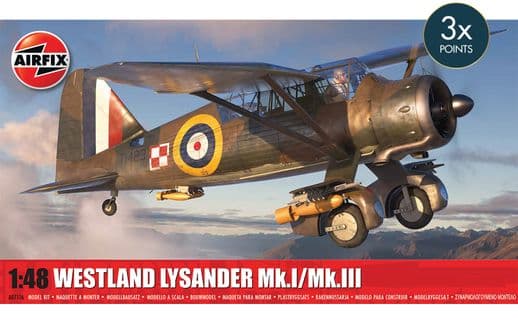
As for our first subject of the year, we thought the best way to ease us all back into work and our normal routines was to go BIG, so we intend to bring you details of our first new tooling release of 2025 and a truly spectacular addition to our 1/48th scale kit range, the Westland Lysander. During the course of this latest update, we will be looking at some of the reasons why the Lysander makes for such an interesting scale model kit subject, along with bringing you some project exclusives from our latest attempt at immortalising this unusual aircraft in scale model kit form. We will be bringing you the new box artwork in all its original glory, before moving on to look a little more closely at the two scheme options included with the initial release of this kit, which is scheduled for release this month. Hopefully, this will help us all decide which of the two schemes get’s our vote prior to the Lysander appearing on our own workstations in the very near future.
Right then, a new year definitely deserves a new model tooling, and we head into 2025 with our scale homage to Westland’s incredible Lysander.
Our scale homage to a most interesting aeroplane. The Westland Lysander was designed to work in cooperation with the British Army, but would prove versatile enough to be used in several other roles.
When Britain’s Air Ministry initially communicated their requirements for a new Army cooperation aircraft to replace the Hawker Hector and Hawker Audax in this role, they invited proposals from the Hawker, Avro and Bristol companies, whilst ruling out Westlands, by virtue of the relative inexperience of their design team. After some internal wrangling and after officials had seen the impressive automatic slat and flap system the company had been developing, they relented and allowed the Westland Aircraft Company of Yeovil to also submit proposals.
Under the direction of Westland’s relatively inexperienced design manager William ‘Teddy’ Petter, the company embarked on an exercise which saw officials spending a great deal of time interviewing pilots who were currently engaged in Army cooperation flying, in an attempt to find out what they liked about their aircraft and more importantly, what they thought could be improved. These discussions helped to build a picture of what capabilities the new aircraft must possess and what Westland’s design team had to deliver, if their new aircraft was going to prove successful.
The Army wanted an aircraft which could take on a variety of roles, including reconnaissance, artillery observation, general duties and light bombing, whilst the pilots who were already serving in these roles wanted a capable new aeroplane which offered excellent ground visibility at all times, was rugged in operation and possessed excellent short field capabilities. Petter and his team at Westland set about designing an aircraft which could satisfy both.
What they produced was an unusual looking, if rather advanced aeroplane, but one which wasn’t without its vices. The high-set cockpit and extensive glazing afforded both the pilot and his observer an exceptional field of view, with the high mounted, unusually shaped wings not only helping to support this, but also incorporating a few little design tricks of its own. The wing design included the introduction of an automatic slat and flap arrangement which gave the aircraft exceptional low speed and short field performance, but due to its design, did have to be managed carefully.
The Lysander afforded both pilot and observer an excellent view of the ground in all phases of flight and included some technical innovation which made its slow speed performance exceptional.
During the landing phase, if a pilot attempted to make a three-point landing at slow speed, the angle of attack at such a speed would immediately deploy the automatic slats and flaps, causing the aircraft to rear up and potentially stall, something which could have a catastrophic outcome for both the crew and their aircraft. With the power of the Bristol Mercury radial engine though and with careful handling, the Lysander could be an impressive performer, with a stalling speed of just 65 mph allowing this aircraft to be operated in incredibly short distances.
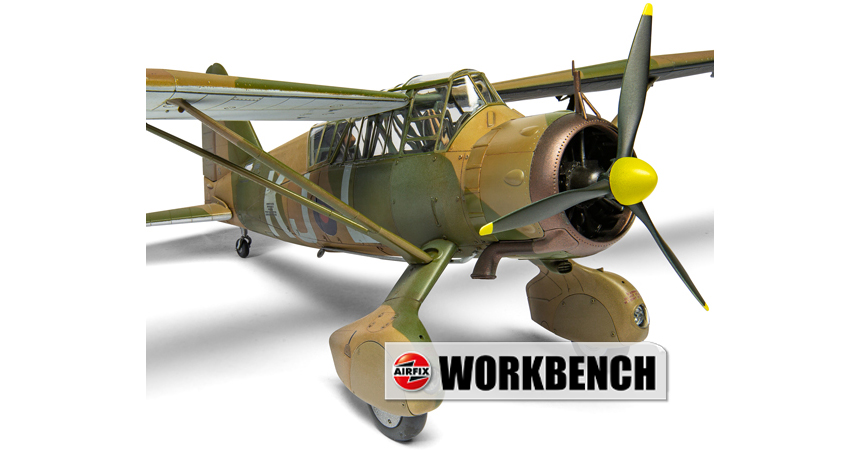
Another significant design feature of the Westland aircraft was its rugged, fixed undercarriage, something which made it easy to operate whilst on the ground, with the rigidity to allow it to be operated from all but the most uneven of landing grounds. The wheel spats themselves were streamlined, but also housed a pair of fixed, forward firing Browning machine guns, which were away from the arc of the propeller and therefore didn’t require the use of interrupter gear.
These wheel spats were strong enough to allow small stub wings to be fitted to each outer section, so that if the aircraft was to be used in an offensive or supply capacity, their hard points could be used to deliver small bombs, supplies or as would later prove to be the case, rescue equipment. An additional Light Series bomb carrier could be fitted under the rear of the aircraft’s fuselage to allow a further four 20lb bombs to be carried and defensive armament consisted of a plinth mounted single or twin Browning/Lewis machine gun arrangement in the observer’s section of the aircraft, behind the wings.
Westland submitted their design proposal during the summer of 1935 and a contract to produced two prototype aircraft (which would carry the internal designation P.8) was duly awarded. Almost exactly twelve months later, the new aircraft made its maiden flight from the Westland airfield at Yeovil and before that month was out, the aircraft had also been exhibited at that year’s Society of British Aircraft Manufacturers Display at Hatfield. The following month, the aircraft flew to Martlesham Heath, where it was put through its paces by the Aeroplane and Armament Experimental Establishment, to discover if the new aircraft possessed the qualities needed for the intended role.
In competition with the Bristol Type 148 monoplane for the contract, the Westland aircraft quickly emerged as the most suitable aircraft and a subsequent order for 144 production aircraft would be placed even before the second prototype aircraft had flown. Trials at Martlesham Heath and Farnborough continued, but with a view to testing the proposed armament arrangement for the new aircraft, which would subsequently be named Lysander, after the historical Spartan military leader.
The Lysander was equipped with an offensive capability which included two fixed forward firing Browning machine guns in the wheel spats and the ability to carry a selection of bombs.
The new aircraft was introduced to the public at the Hendon Air Pageant in June 1937, where it was celebrated as a ground-breaking new type, one which proved that Britain’s aviation industry led the world at that time, and that the RAF would be equipped with the most capable aircraft in the skies in the event of war, or so they would have the public believe. When movetone images of the Lysander were shown, they described the aircraft as having world-leading short field performance, with a top speed which whilst still being secret at that time, could rival the world’s most capable single engined fighters. Unfortunately for Lysander crews, that boast proved to be something of an exaggeration and even though the Lysander was an excellent aeroplane, it was no match for the Luftwaffe’s latest fighters.
Lysanders would enter Royal Air Force service with No.16 Squadron during the summer of 1938 and by the start of the Second World War, seven squadrons of Lysanders were in service, having worked up to perfect this excellent aircraft’s capabilities in a cooperation/general duties role. As part of the air component of the British Expeditionary Force sent to France in October 1939, four squadrons of Lysanders operated in support of this force, flying reconnaissance, spotting and light bombing duties in advance of the German onslaught. Despite the many admirable qualities the Lysander possessed, the aircraft was not one that could be used effectively in contested airspace and France would prove to be a baptism of fire for Lysander crews.
Often operating in areas close to the fighting, if Lysanders were caught by marauding Luftwaffe fighters, they were incapable of defending themselves, not manoeuvrable enough to evade the attentions of the agile Messerschmitt Bf 109, whilst at the same time making for a rather large and tempting target for them. Even when protected by RAF Hurricanes, the Lysanders were too slow to evade their attackers, once they had dealt with the Hurricanes sent to protect them. Ultimately, of the 175 Lysanders sent to operate in France and Belgium, 118 would be destroyed either in the air or on the ground and by the time the RAF flew back to Britain to prepare to face their own onslaught, plans were put in place to replace the Lysander in the Army cooperation role with aircraft which were significantly faster.
Another view of our new dynamic Lysander duo.
Lysander crews would have to soldier on as Britain prepared to face invasion and despite their mauling at the hands of the Luftwaffe during their time in France, would remain in an offensive role for the time being. Mounting coastal patrols looking for signs of enemy commando landings, U-boat incursions, or any German shipping activity, Lysanders were in the air around the clock and in the event of invasion, would have been hurled against the invasion beaches to unleash everything they had! Rugged and dependable, Lysanders would have operated from bases as close to the landing beaches as possible, and would more than likely have given a good account of themselves in such a situation.
The Westland Lysander would be produced in three major variants during its production life, each one using a different engine, with the Bristol Perseus XII equipped Mk.II being the fastest of them all at 230 mph. In addition to performing the duties for which it was intended, the Lysander helped to establish a cohesive Air Sea Rescue service for airmen downed in the seas around Britain, with earlier variants also going on to see extensive service overseas. It would also find an operational niche as a special operations aircraft later in the war, serving as an agent taxi and clandestine supply aircraft, as the Allies prepared for D-Day, but that’s a fascinating subject for a future blog.
A total of 1,786 Westland Lysanders were built before production halted in 1942, a figure which included 104 sent to Canada and a further 225 which were built under licence in the country. Several other nations would operate the Lysander both during WWII and after, however, of this number, only two remain in airworthy condition in Europe today, with both being incredibly popular performers on the UK Airshow circuit.
An impressive looking aircraft from any angle, the Westland Lysander can be a surprisingly agile performer in the air, and it doesn’t take much to see why this aircraft was pressed into service as a clandestine, cross-Channel agent shuttle aircraft, relying on a compass, map, moonlight and piloting skill to arrive at a designated field in France in the dead of night. All this had to be attempted in the knowledge that German troops would likely be in the vicinity of the landing zone, and they would be desperate to stop such incursions taking place.
Flying above the Firth of Clyde, the stunning new box artwork took inspiration from the second of the two scheme options available with the first release from this newly tooled model.
As one of the most interesting and certainly most distinctive aircraft of the Second World War, it will come as no surprise to learn that the Westland Lysander was inducted into the Airfix scale model kit ‘Hall of Fame’ relatively early in the hobby, with its 1956 introduction marking it as one of the first 1/72nd scale aircraft kits introduced. Back then, the kit was released in the original bagged kit and paper header/instructions which have become so sought after by collectors these days.
Continued sales success, and ever improving design and manufacturing techniques resulted in the introduction of a newly tooled Lysander kit in 1972, again in 1/72nd scale, but this time in boxed series 2 configuration, with the box artwork making the clear association between the aircraft and its use in transporting agents to and from secret locations in France. Always a popular addition to the range whenever it was included, this second Lysander kit continued to be a top performer well into the 21st century, underlining the popularity of the Lysander as a modelling subject, as well as its suitability for further development.
That further development was announced to the modelling world just prior to our attendance at Scale ModelWorld last year, as we shared news of our latest new tooling addition to the range here on Workbench and through our usual social media channels. The new kit was to be the latest addition to our ever expanding range of 1/48th scale kits, and visitors to the Airfix stand at SMW 2024 were treated to the sight of two expertly completed kits on our stand, each finished in one of the two scheme options included with the initial release of the new kit. As that release is now fast approaching, let’s take a closer look at both of those new schemes now.
A rather impressive aeroplane all round, the Lysander negotiated its service trials in short order, which enabled the first production aircraft to be delivered to the Royal Air Force and No.16 Squadron just two years after the first flight of the prototype aircraft. Based at Old Sarum airfield in Wiltshire, the RAF’s School of Army Cooperation was set up to allow both instructors and students to learn to fly the Lysander at the same time, ensuring that both were fully operational by late September 1938.
The squadron’s aircraft would regularly take part in large scale exercises with the British Army on nearby Salisbury Plain, with No.16 Squadron operating fourteen Lysanders and the School of Army Cooperation a further nine aircraft all at Old Sarum. These first Lysanders were extremely hard working aircraft and effectively introduced the Lysander into Royal Air Force service, perfecting its Army cooperation tactics and unlocking some of the secrets of this incredible new aeroplane.
With seven full time Army cooperation Lysander squadrons in place by the time of the outbreak of the Second World War, it seems obvious that the majority of these would be sent to France as part of the Air Component of the British Expeditionary Force. Only No.16 Squadron and the School of Army cooperation were to stay behind at Old Sarum, so the work of training new pilots and instructors could continue unabated during this period, as the thinking was that as many new crews as possible were going to be needed in the struggles to come.
This stunning scheme marks the squadron introduction of this impressive and distinctive aircraft.
In the late spring of 1940, No.16 Squadron was eventually sent over to France for additional training and acclimatisation, and were still there when the Germans launched their invasion in May. Although the Germans had perfected the use of air power in support of their ground units, the British and their French Allies showed they were well behind them in perfecting such coordination and the Luftwaffe made short work of the Allied air forces in France. After only nine days of fighting, what remained of No.16 Squadron was withdrawn back to England, so grievous were their losses.
The unit would continue flying armed reconnaissance patrols along the British coastline following their return, as a German seaborne invasion attempt was a very real possibility following the fall of France, however, success for Fighter Command during the Battle of Britain allowed the Lysanders to be used to undertake wider ranging anti-shipping patrols, in addition to being utilised in an air sea rescue role, as Britain struggled to perfect a cohesive service for aircrews forced to ditch in the seas around the country.
No.16 Squadron’s original Lysander Mk.I aircraft were relatively quickly exchanged for the sleeve valve Perseus XII powered Mk.II variant during 1940 and on to the Mk.IIIA Lysander, but with a number of Gloster Gladiator fighters being allocated to them in between. The unit would ultimately trade their Lysanders for Tomahawks, Mustangs and Spitfires later in the war, as the role of Army cooperation flying was quickly found to require aircraft possessing greater speed and fighting capabilities than the Westland Lysander did.
Formed as one of the 15 Squadrons of the Polish Air Force in exile in an agreement between Britain and the Polish Government in 1939, No.309(Polish) Squadron was initially formed as an Army cooperation unit in early October 1940, with the intention of using them in conjunction with those elements of the Polish Army which managed to escape the fighting following Germany’s invasion of France. The British knew that if it came to a ground war in Britain, deployed Polish troops would need the close support of aircraft if they were to be effective, and how Polish speaking aircrews would be important in providing the support they were going to need.
The fighting in France proved to be disastrous for the RAF’s Westland Lysander Squadrons, with only around 50 of the deployed 174 aircraft managing to limp back to Britain. These aircraft were gathered at a temporary airfield home in Kent, where their condition could be assessed prior to dispersing them to several different locations around the British Isles, to be joined by further newly constructed Lysanders as and when they became available.
No.309 (Polish) Squadron flew the Lysander in the Army cooperation role, utilising all the offensive capabilities of this impressive STOL aircraft.
One of these units was the newly formed Polish manned No.309 Squadron at Renfrew near Glasgow, a site which has been in use since before the start of the Great War, but one which was remote enough to allow this unit to train without too much interference from the Luftwaffe. They would operate the Lysander for 30 months from October 1940, initially in an Army cooperation role, with some target towing activities thrown in for good measure, but would later take on a much more offensive role flying the Mustang I in an armed tactical reconnaissance role. Although these aircraft were required to fly armed reconnaissance sweeps into northern France, they worked alongside their fellow pilots flying Lysanders, with their activities carrying on unaffected.
By March 1943, No.309 squadron had relinquished their association with the Lysander, trading their aircraft entirely for the Allison powered Mustang I by then, but later also trading these for Packard Merlin powered Mustang IIIs and IVs.
Interestingly, operational units which occupied the airfield at Renfrew during the Second World War shared the site with civilian aviation contractors, who were responsible for assembling and repairing hundreds of P-38 Lightnings and P-51 Mustangs which had arrived in Glasgow by ship from America. Despite its position in the far north west of the country, this must have made the area around this airfield quite an interesting place to be during the war years.
In this larger 1/48th scale form, the new Westland Lysander makes for an irresistible modelling proposition. Not only will this make for an enjoyable build project, as all the latest Airfix model kits are, but it also serves as our scale tribute to an aircraft which must qualify as one of the more interesting types to have served during the Second World War. In this scale, it looks truly magnificent amongst any collection of built models, and whilst it could hardly look more different to something like a Spitfire or Hurricane, it has an undoubted aesthetic appeal all of its own.
One to look out for. Can you think of a better modelling way to start 2025 than with our new 1/48th scale Westland Lysander?
We feel sure that our new Westland Lysander is going to be a popular addition to the 2025 Airfix range, which is about to benefit from the addition of a further influx of new blood (or should that really be plastic), as the new 2025 range is scheduled to be announced on Tuesday 14th January at 4pm. We’ll be bringing you more news about that in next week’s edition of Workbench, but until then, please keep an eye out for the impending arrival of the Lysander.
We are afraid that's all we have for you in this latest edition, but we will be back next Friday with more project development updates and the very latest Airfix kit exclusives. In the meantime, we are always keen to hear your views on all things Airfix and in particular, any thoughts and opinions you may have regarding our Workbench blog. If you would like to drop us a quick line, could we please ask that you use our workbench@airfix.com email for all correspondence.
To re-visit any of the Airfix blogs we have produced over the past seven years or so, please head to our main Workbench hub, where you will find our entire blog back catalogue and all the Airfix design projects we have already covered.
All our dedicated official social media sites can be accessed by clicking the respective link icons at the foot of this page, or by heading to the Airfix homepage. Other useful Airfix links are:
Facebook, YouTube, Twitter and Instagram official sites
Please join us for more Airfix updates next week and thank you for your continued support.