

Welcome to this latest edition of our Workbench blog and all the news, updates and modelling exclusives from the fascinating world of Airfix.
After last week's edition where we unashamedly devoted the entire blog proceedings to our latest scale tribute to Reginald Joseph Mitchell's legendary fighting aeroplane, this week's Workbench update takes more of a 'classic' turn, as we prepare to welcome the latest modelling inductees into the Vintage Classics hall of fame. With the astonishing popularity of this ever growing range of models, the announcement of any new Airfix range is now as much about which classic kits will be charming a new generation of modellers, as it is about which high-tech new tooling projects will be joining the range over the coming twelve months. As we now find ourselves at the beginning of November, thoughts will inevitably start turning to the subject of which classic Airfix kits might be making a reappearance once more in 2023, however, before we get on to discussing that, let's take a closer look at the latest two additions to the Vintage Classics range.
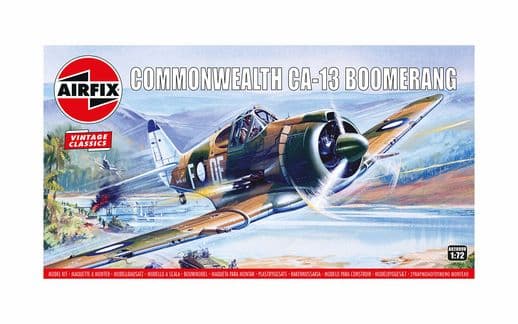
Adopting our usual format of giving each kit its own blog for reasons of future ease of online searchability, we begin by looking at a classic helicopter kit which marks the early years of rotary air power and arguably the first British built machine to truly underline the incredible potential of the helicopter. We will be following this with a look at a fascinating little fighter aircraft which was the product of Australia's fledgling aviation industry and one which was introduced to equip home based RAAF squadrons with an indigenous type with which to potentially take on the might of the combined Japanese Air Forces during WWII, the Commonwealth Aircraft Corporation Boomerang. To access this and all previous Workbench blogs, please visit the main Workbench hub in the community section of the Airfix website, or use the Boomerang link above.
Right then, who's up for some classic Airfix action?
As one of the most capable of the world's early helicopter designs, the Sikorsky S-55/H-19 Chickasaw was coveted by many nations, including Britain. It would later be produced under licence by the Westland Aircraft Company of Yeovil, but not before Britain had received a number of US built machines. This handsome beast is a UH-19B of the US Air Force, complete with nose artwork.
The period in world history just prior to, and during the Second World War would see incredible advancement in aviation technology, a time which encompassed the introduction of the ultimate biplane fighters, right through to the first of the world's first operational jet fighters, all in just over a seven year period. As fixed wing aircraft continued to advance and attain ever greater speeds, work was also quietly advancing in a much more sedate form of flying, that of rotary air power and the realisation of the dream of vertical flight which had captivated man for centuries. The flexibility and operational potential offered by the helicopter ensured that development of this technology continued apace during the mid 1930s and in Germany, aircraft such as the Focke Achgelis Fa61 and Flettner Fl 282 Kolibri finally proved that a practical and workable helicopter design was surely not that far away.
Ultimately, it would be the Americans who would take the honour of designing the world's first large scale, mass produced helicopter type, in the shape of the Sikorski R-4, an aircraft which was the brainchild of celebrated helicopter pioneer Igor Sikorski and one which would go on to see service with the US military during WWII. Still a relatively primitive design, the R4 was blighted by the challenges facing early helicopter development, as it was difficult to control, wasn't overly blessed with power and from a pilot's perspective, was a hands-on aircraft at all times. Requiring the most competent of pilots to fly them, it was reported that an in-service joke at the time described how you could always tell a helicopter pilot apart from a fixed wing airman, as the helicopter pilot would have a permanent case of the shakes, due to the constant vibration he was forced to endure.
Despite these remaining challenges, the concept had been proven and the flexibility offered by the helicopter ensured that development efforts were given renewed impetus following the introduction of the R-4 and as pilots continued to gain experience, better machines were already in the wings.
It has to be acknowledged that the early days of helicopter development were mainly dominated by two significant challenges, those of aircraft control and engine power to weight ratio. If both of these problems could be overcome, the helicopter would truly come of age and provide operators with an aircraft type so flexible that it would be unique in the world of aviation, with numerous military and civilian applications open to it. The next Sikorski design, the S-51 (H-5), addressed many of these outstanding issues and would become one of the most important types in the establishment of the helicopter as a practical aircraft type. With increased speed, endurance, range and levels of control, the S-51 underlined the flexibility of the helicopter concept, whilst still being far from perfect. Its distinctive, somewhat ungainly profile was dominated by an incredibly long tail boom and large, greenhouse cabin, with the overall size of the aircraft making it a difficult aircraft to operate in confined spaces, however, it did underline the fact that the helicopter was here to stay.
The distinctive Westland Sikorski WS-51 Dragonfly was the immediate predecessor of the Whirlwind, with this example being an HR.5 variant and part of the collection at the Yorkshire Air Museum.
A truly practical helicopter design was clearly going to be of huge interest to the world's military and in Britain, the Westland Aircraft Company were keen to establish a formal working relationship with Sikorsky, signing an agreement which granted them the ability to produce Sikorski helicopters under licence for UK operators. The first helicopter produced under this agreement was the Sikorski S-51, which in British service was known as the Westland Dragonfly, with a total of 133 Dragonfly's eventually produced for the Royal Navy, Royal Air Force and a number of civilian operators. This is quite an interesting development, as the Dragonfly/S-51 was the first helicopter to be used for commercial applications - a sign of things to come.
Despite the undoubted success of the Dragonfly, Westlands were already eying their next helicopter collaboration project, a machine which would arguably be the world's first truly practicable multi-role helicopter and the one which finally confirmed the potential of rotary air power.
For the helicopter to finally start to realise its undeniable development potential, what the Sikorski company were striving to produce was a larger, more rugged design, one which possessed the control stability, power and range to transport both troops and supplies over relatively large distances in a safe and reliable manner. The initial development of their new helicopter would get underway as a private company venture, a move which clearly highlighted the confidence Sikorsky had in the work they were doing. The philosophy behind their design was to produce a machine with greater load carrying capabilities, whilst at the same time ensuring it was easy to both maintain and operate. This work would eventually result in the first flight of the distinctive S-55 (H-19 Chickasaw), a classic helicopter design which would be produced in greater numbers than any of comparable size that had gone before it and one of the world's truly great helicopters.
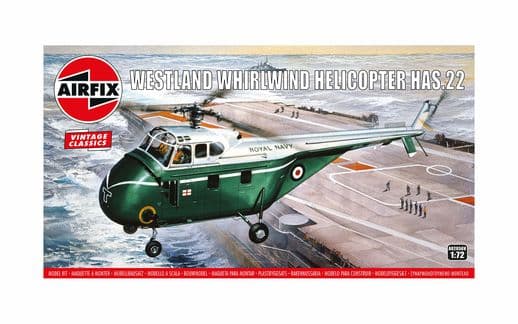
The incredible artwork of Roy Cross is familiar to many millions of modellers the world over and even though we will all have our own particular favourites, this piece must surely be one of his most famous works. It certainly helped to make the Westland Whirlwind one of our most popular kits.
Featuring design innovations such as the use of hydraulic servos for rotor head control and clever placement of the aircraft's centre of gravity, which allowed the pilot to easily compensate for different load configurations, the aircraft adopted an unusual positioning for the engine, right at the front of the aircraft. With two opening clamshell-type doors allowing unrestricted access to the powerplant, engine maintenance was a relatively straightforward operation and indeed, a full engine change was possible in under two hours, if carried out by a relatively experienced team. This engine positioning also gave the S55 its distinctive appearance and the high mounted cockpit for the flight crew, a feature which afforded then an excellent field of view.
The first true transport helicopter of the US Army, the S-55/H-19 Chickasaw would play a significant role in the establishment of military air mobility and the modern strategic battlefield deployment of troops, weapons and ammunition. They would be used in a similar manner to establish effective Medevac and Search & Rescue capabilities.
Whilst still engaged in the production of the Dragonfly, Westlands negotiated a deal to manufacture and sell the new Sikorski S-55 helicopter in 1950 and would take delivery of a complete machine to serve as a manufacturing pattern the following year. The original US design required modification to meet British requirements, a process which was not without its challenges and as a consequence, the prototype helicopter would not take to Yeovil skies until August of 1953. The first machines subsequently produced for British military service would undertake the non-combat roles of communications and Search & Rescue, whilst Westlands continued their further development of the type. These Westlands produced machines would be known as the Whirlwind.
As with all of the early pioneering helicopter designs, the need to equip these aircraft with ever more powerful, efficient, yet lighter engines proved to be a constant struggle, however, the potential possessed by the helicopter meant that all this development work was well worth the effort. Early variants of the Whirlwind were powered by several US or British rotary engine types, however, the introduction of the 1,000 hp Bristol Siddeley Gnome turboshaft would provide a welcome performance boost for the aircraft and allowed it to really show what it could do. Westlands would eventually produce over 400 Whirlwind helicopters, with around on quarter of these being sold to overseas operators.
Occupying a rather significant position within the history of Airfix scale model aircraft kits and therefore serving up a healthy slice of modelling nostalgia, our 1/72nd scale Westland Whirlwind S-55 was originally tooled back in 1956, making this one of the very earliest model aircraft kits in our modelling heritage. Indeed, highlighting just how progressive the brand was even in those days, design development of the kit must have been taking place whilst the first British Whirlwinds were just entering service with the Royal Navy. The Whirlwind also holds the distinction of being one of the most popular kits we have ever produced and over the years, appearing successfully in several ranges over that period.
As iconic as the original bagged kits undoubtedly were form an Airfix and wider hobby perspective, perhaps the most significant development in the post tooling heritage of this kit occurred in 1974 and at the hand of a true Airfix icon, Mr Roy Cross. We suspect that few Workbench regulars would disagree with the opinion that Roy Cross possibly did more for the modelling hobby than anyone else, with his magnificent artwork encouraging hundreds of thousands of us to pick up that very first model kit and become captivated by the simple pleasures of modelling. How many of us will own up to cutting out the box artwork at the end of our latest modelling project and storing them as part of a separate collection? As far as the Whirlwind is concerned, if Mr Cross was going to paint one of these important early British helicopter types, he may as well go with a particularly distinctive one as his subject. I know we will all have our own personal favourite pieces of Airfix artwork from over the years, however, I bet few are as widely familiar to so many modellers as this magnificent piece of work.
The first Westland built Whirlwind HAR.1 helicopters entered service with the Royal Navy in July 1954, although Fleet Air Arm pilots were already experienced in operating the type, as the Navy had previously purchased American built versions of the aircraft. Joining No.848 Naval Air Squadron in Search & Rescue and general utility/communications roles, these capable helicopters operated both from land based stations and on amphibious operations at sea, providing the Navy with a highly capable and extremely reliable new rotary aircraft. Royal Navy Whirlwind HAR.1 helicopters also served aboard the Ice Patrol Ship HMS Protector (A146) during her long ranging Antarctic patrols from 1955 onwards, a posting which required them to operate above some of the most inhospitable environments in the world.
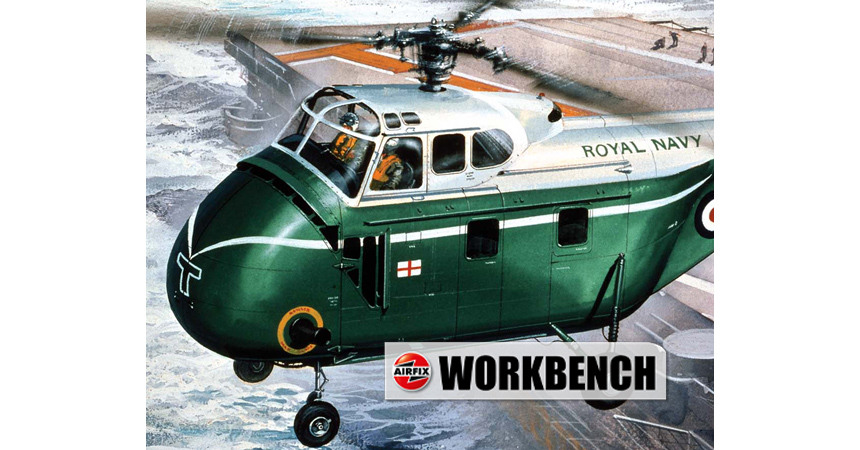
The distinctive scheme details for No.781 Naval Air Squadron's 'Green Parrot'.
Now available on the Airfix website, this is the first time this iconic Roy Cross artwork has been inducted into the Vintage Classics hall of kit fame.
Westland Whirlwind HAS.22 WV223 was originally one of fifteen former Sikorski built HO4S-3 variant helicopters manufactured for the US Navy (c/n 55-498) and later supplied to the Royal Navy, apparently under the Military Assistance Programme. Making its first flight from East Hartford, Connecticut in July 1953, it was delivered to the Royal Navy towards the end of September the same year, only days after the prototype Westland Whirlwind had made its first flight and as its variant designation suggests, it was intended to perform the vital role of anti-submarine warfare.
As more Westlands produced aircraft started to be delivered to the Royal Navy, some of these earliest examples were past around between squadrons, many of which went on to become exclusively shore based aircraft and rarely (if at all) spending time at sea aboard naval vessels. As one of the most distinctive Whirlwind helicopters to ever see Royal Navy service, WV223 was assigned to the role of VIP transport during its time with No.781 Naval Air Squadron and flamboyantly presented in this smart emerald green and white livery, a really beautiful looking machine. In this non-operational role, she would be used to transport senior officials between engagements, in addition to representing the Royal Navy in Airshow static parks up and down the country. The aircraft attracted a couple of nicknames during this period and was colloquially referred to as either 'The Admiral's Barge' or 'The Green Parrot', but in either case, you knew exactly which machine they were talking about.
As one of the former US built Whirlwind helicopters in Royal Navy service, WV223 was sold to the South African Air Force in November 1970, where she was given the serial ZS-HDN. She suffered significant damage when involved in an accident in May 1995, with the fuselage later undergoing restoration - it is still thought to be stored in this partially restored state as part of the South African Air Force Museum.
A rather historic kit which is certainly deserving of the title 'Classic', our 1/72nd scale Westland Whirlwind HAS.22 kit is available once more and in this stunning scheme, is ready to add an interesting splash of colour to any built model collection.
That’s it for another week, but please don't forget to check out the separate CAC Boomerang edition also posted today. We will be back as usual next Friday with more Airfix project updates for your information and enjoyment.
As ever, we are always keen to hear your views on all things Airfix and in particular, our Workbench blog, so if you would like to drop us a line, please use workbench@airfix.com for all correspondence. To re-visit any of the Airfix blogs produced over the past seven years, please head to our main Workbench hub and scroll through the available pages.
All our dedicated official social media sites can be accessed by clicking the respective link icons at the foot of this page, or by heading to the Airfix homepage. Other useful Airfix links are:
Facebook, YouTube, Twitter and Instagram official sites
Please join us for more Airfix updates next week and thank you for your continued support.