
Welcome to this latest edition of Aerodrome and our regular look at the fascinating world of aeroplanes and the historic aviation scene in the UK.
As the final couple of months of the UK Airshow season finally started to resemble something approaching normality, the latest edition of Aerodrome reports from a very special event which is always one of my personal highlights in any year. We will be joining people who were fortunate enough to secure a ticket for the latest combined Lincolnshire’s Lancaster Association and RAF Memorial Flight Club Members Day, held in the grounds of the BBMF Visitors Centre on Saturday 25th September and will be including pictures of all the Flight’s aircraft present on the day. As some of the best loved and most famous historic aircraft in the world, we are about to spend some quality time with the aircraft of the BBMF and the service men and women who maintain, fly and administer our continued enjoyment of these aviation classics.
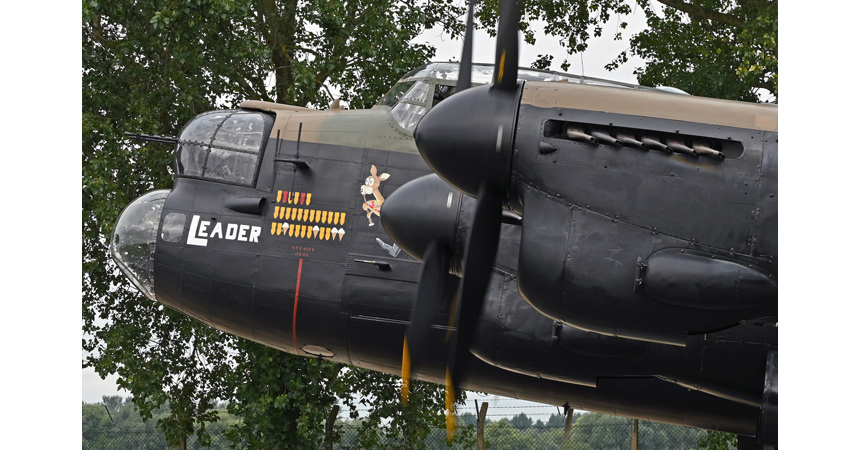
Avro Lancaster PA474 sets off to fulfil an early morning flypast commitment during this year’s Members Day event, having only just returned from a 10 month maintenance stay at Duxford.
There can be few aircraft across the world Airshow scene which enjoy such a devoted public following as Avro Lancaster PA474, an aircraft which has served the Battle of Britain Memorial Flight faithfully since 1973. An incredibly historic aeroplane which serves as a flying tribute to the men and women of Bomber Command and those who have fallen in the service of Britain and the Commonwealth nations, the appearance of the Lancaster at any Airshow is a definite crowd highlight and as the only airworthy example in Europe, is always guaranteed to command everyone’s undivided attention.
Not only is the aircraft a huge Airshow favourite, Lancaster PA474 can also count on the loyal, unstinting support of many thousands of people across the world, who all gladly pay their annual subscription fees to keep informed on all Lancaster developments and through their respective associations, assist with the ongoing maintenance and restoration of an aircraft which means so much to them. The two organisations whose members have a greater Lancaster devotion than most people are Lincolnshire’s Lancaster Association and the RAF Memorial Flight Club and for one memorable day each year (Covid restrictions permitting), members are given the opportunity to attend a ‘Members Day’, an occasion which is basically an ‘At Home Day’ for the aircraft and personnel of the Battle of Britain Memorial Flight.
Lincolnshire’s Lancaster Association is an impressive organisation dedicated to the preservation of this magnificent aircraft and ensuring she remains in the county which played host to so many Lancasters during WWII. A registered charity, the association is unique as the official support group for the Battle of Britain Memorial Flight and over the years, the Association’s continually growing membership has managed to raise many thousands of pounds and sourced rare aircraft artefacts and components that have benefited all the aircraft of the Memorial Flight. Originally established to ensure that an example of the Avro Lancaster remained in the Lincolnshire area to mark the close association between the county and Bomber Command during WWII, the association worked tirelessly towards this goal and can be extremely proud of their efforts over the years.
Not only do they now have an Avro Lancaster permanently based in their fair county, but they also have Europe’s only airworthy example of this famous bomber operating from Lincolnshire, just as they did back in WWII. Originally, the association’s request was that PA474 be brought back to the county for preservation when she was due to be retired back in the early 1980s and in those days, they could hardly have imagined what members of the association enjoy today. Due to the care and attention bestowed on this famous aircraft by the engineers and technicians of the BBMF, Lincolnshire may well have a flying example of the mighty Avro Lancaster for many years to come, with the continuing work of the Lincolnshire Lancaster Association and their worldwide membership supporting their steadfast efforts.
The subject of our devotion. Avro Lancaster PA474 runs up in advance of a flypast commitment, under the gaze of her adoring fans.
Membership of the RAF Memorial Flight Club has been growing steadily since it was first launched and is a way fans of this famous collection of historic aircraft can feel they are much closer to the aircraft which mean so much to them. Club members receive a host of appealing benefits, which includes magazines, newsletters and regular competitions to enter, with all proceeds going towards the ongoing operation of the Battle of Britain Memorial Flight.
Both organisations offer their members the opportunity to attend their annual Members Day event at RAF Coningsby, but with one rather major caveat attached. The combined membership of the groups massively exceeds the number of tickets available for this exclusive event, with the space available around the BBMF Hangar only able to accommodate around 2,500 people on the day. For this reason, attendance at any Members Day cannot be guaranteed and in most years, being in possession of a ticket can prove to be quite an achievement. Members who are interested in attending the day are invited to register their interest by post, sending a stamped, addressed envelope just on the off-chance that you might be successful, with ticket allocation being fairly attributed via a random draw of interested parties. If you come in from work in the weeks leading up to the event and your handwriting is on an envelope behind the door, your day has just been made and you are amongst the lucky few to have been successful.
What made attending this year’s event so important was the fact that due to a combination of poor weather and the pandemic restrictions, if everything went as planned, this would be the first time for three years that members would have the opportunity of seeing the Memorial Flight’s aircraft in the air at a Members Day event for three years. Last year’s event could not take place due to the fight against covid and in 2019, hideous weather kept all aircraft on the ground and members seeking the shelter of the BBMF hangar - it was a total washout! And that was not all, there was also a rather large four-engined attraction we were all hoping to see, our beloved Lancaster.
So good to have her back. Following a lengthy period of maintenance, PA474 only arrived back at Coningsby on 11th September, just days before this year’s Members Day event.
With few Airshow events likely to be taking place this year, the Flight’s engineering team took the decision late last year to embark on the Lancaster’s planned period of deep maintenance, work which would be completed by the Aircraft Restoration Company in their facilities at Duxford airfield. Unbeknown to everyone at that time, these works would see the Lancaster spending an extended period away in Cambridgeshire, leaving a rather large Lancaster shaped space in the usually quite crowded BBMF hangar. This was not only down to the size of the task facing the ARCo engineers, but also some rather high profile operational commitments for the Lancaster crew (Afghanistan situation) and the safety parameters by which the aircraft operates requiring optimum conditions for the aircraft to take off from Duxford’s relatively short runway.
In the end, Lancaster PA474 would spend ten months away from her home, only returning to Coningsby on 11th September and even then, pictures taken during her arrival show that she landed with her port inner engine closed down and propeller feathered, a worrying sight for enthusiasts everywhere. Her arrival back also attracted a huge crowd of well-wishers clinging to the perimeter fence around the BBMF Visitor Centre and when the Lancaster taxied in and shut down the other three engines, the crowd erupted in a spontaneous round of applause - she was back where she belongs.
Having been away for so long and significantly, out of the public gaze for all that time, both BBMF personnel and enthusiasts alike would be hoping that this incredibly historic aircraft would be able to resume her Airshow and ceremonial flypast commitments as soon as possible, with the last major Airshow event of the year looming large on the horizon …. would she be able to make it? For members of both Lincolnshire’s Lancaster Association and the RAF Memorial Flight Club, the thing on their minds was definitely the hope that she could be the centre of attention during the impending Members Day and would she be able to take to the air?
The only airworthy Lancaster in Europe, PA474 is a fitting tribute to the men and women of Bomber Command, many of whom would have flown from bases in Lincolnshire.
The usual format for a Members Day is that when we are allowed access to the usual small section of land inside RAF Coningsby, people have the opportunity to get much closer to the aircraft of the Memorial Flight that they would usually be able to, with any engine runs or pre-flight activity taking place right in front of us. We also have our chance to speak with and express our appreciation to the people who maintain, fly and administer these magnificent aircraft all year round, allowing millions of people to experience the thrill of seeing (and hearing) this unequalled collection of Warbirds. Members will be hoping to see all serviceable aircraft out on the airfield and whilst we are all safely gathered behind barriers, are still able to document the occasion with some memorable photographs. Aircraft which are currently undergoing maintenance can also be viewed if they are in the BBMF hangar, however, as was the case with Hawker Hurricane LF363 this year, if they are receiving attention away from Coningsby, they will obviously not be taking part. With the flight having a reputation for regularly changing the schemes applied to their aircraft over the years, each Members Day is an opportunity to capture a photographic moment in time in the ongoing history of the Flight, something we will be able to look back on with interest in the years to come.
The highlight of the day for many is the chance to see the magnificent aircraft of the Battle of Britain Memorial Flight up where they belong, in the sky, and if the weather, aircraft serviceability and crew availability all allow, the prospect of seeing several of these magnificent aircraft flying both in formation and individually is definitely something worth looking forward to. Aircraft can take to the air during the morning, if they have a flypast commitment to perform, however, it is usually around 13.00 before aircraft begin starting their engines in advance of the flying display.
For the purposes of this review and to allow Aerodrome readers to sample the atmosphere of the day in blog form, we will begin by looking at all the Flight’s aircraft spotted during Members Day, ending with a selection of photographs taken during the flying display. You will be able to see a real change in the weather conditions when looking at the pictures, as it was really quite grey and uninspiring for most of the day, however, the minute the aircraft landed back following the end of the flying display, the clouds parted and the sun came out - isn’t that always the way! We begin by looking at the second largest aircraft operated by the flight and one which has become a much loved display item in its own right over the years.
Douglas Dakota ZA947
An aircraft type which was a real aviation workhorse during the Second World War and one which has been described as one of the most important machines in helping the Allies win the war, this particular Dakota was only allocated to the BBMF in 1993. At that time, she was intended to be used as a support aircraft for the Flight’s other aircraft and to provide vital multi-engine tail wheel training and currency support for Lancaster crews.
Originally constructed in 1942, the aircraft was allocated to the US Army Air Force, but transferred to the Royal Canadian Air Force just a week later. Flown to the UK in 1944, the aircraft served with No.109 Communications Flight RCAF, operating around Europe for the next 20 years or so. Having been deemed surplus by the Canadians, ZA947 was rescued from storage by the Royal Aircraft Establishment, who were looking for a replacement for the Dakota they were about to retire and over the next few years, she would be seen wearing the classic livery of RAF Transport Command and the distinctive red, white and blue of the RAE.
Presented to the Battle of Britain memorial Flight in March 1993, this beautiful aircraft, which has now gone on to be an important display aircraft in her own right, has worn the liveries of several famous wartime RAF Dakotas and is currently resplendent in the colours of an RAF No.223 Sqn aircraft, wearing full D-Day recognition markings. The aircraft carries the name “KWICHERBICHEN’ on her nose and as she has been wearing these markings for several years now, this name is usually how she is referred to by enthusiasts.
Hawker Hurricane IIc PZ865
This magnificent aircraft has to be considered one of the most important historic artifacts still flying today and a real jewel in the aviation crown of the Battle of Britain Memorial Flight. Hawker Hurricane Mk.IIC PZ865 has the distinction of being the last Hurricane produced at Hawker’s famous Langley factory, from a total production run of 14,533 aircraft. As the fighter occupied such a significant position in the company’s history, workers at the factory painted the slogan ‘The Last of the Many’ on the aircraft’s fuselage, an artwork addition this aircraft would proudly wear for many years to come, and a clear identifier of her status for all who were fortunate enough to set eyes on her. Marking her importance within the history of the Hawker company, she was immediately purchased back from the Air Ministry and would be used as a general communication, media asset and test aircraft in coming years, with this development definitely saving her from the scrapman’s torch, with the end of the war being so near.
On 29th March 1972, Hawker Hurricane Mk.IIC PZ865 was flown to RAF Coltishall, which was the then home of the BBMF, and delivered into their care, the start of another exciting chapter in the story of this incredibly historic aircraft. Some 28 years after the aircraft had made its first flight, PZ865 became the last Hurricane to be delivered to the Royal Air Force and at the same time, the oldest aircraft ever delivered for RAF service.
Another aircraft which has regularly undergone scheme and livery changes to mark the history of the Hawker Hurricane and the pilots who flew them, the aircraft only returned to the Flight following a period of maintenance earlier this year and to the delight of enthusiasts up and down the country, was resplendent in a smart new scheme. Bringing the continuing story of this fascinating aircraft right up to date, she is currently presented in the markings of Hawker Hurricane Mk.IIC BE634/ZY-V of RAF No.247 Squadron, an aircraft which flew out of Predannack and Exeter during 1942, engaged in the night defence of the area around Plymouth and Exeter. She would later fly night intruder operations deep into enemy occupied Europe.
Supermarine Spitfire Mk.IIa P7350
Another hugely famous aircraft, P7350 was one of almost 12,000 Spitfires to come out of the famous Castle Bromwich Aircraft Factory and would go on to see service during the Battle of Britain. This Spitfire possesses genuine wartime combat provenance, with records showing that she was forced to make a wheels-up landing following combat with Messerschmitt Bf 109 fighters on 25th October 1940. Repaired and returned to operational flying, the aircraft went on the offensive with Fighter Command during 1941 and was used on many fighter sweeps over occupied Europe, before again suffering damage and spending time in the repair shop. Continuing to serve throughout the war, mainly in a training role, P7350 was deemed surplus to RAF requirements in 1948 and sold for scrap. Thankfully, the scrap man must have been something of an aviation enthusiast, because once he learned of the aircraft’s illustrious history, he presented the Spitfire to RAF Colerne as a museum piece, preserving an important piece of Britain’s aviation heritage.
As suitable aircraft were in demand by a team looking to produce the famous Battle of Britain movie, Spitfire P7350 was airworthy once again by the summer of 1968 and flown to Duxford, where she would play an active role in the many flying sequences which make this film so memorable. Once filming was finally completed, this now priceless aircraft was presented to the Battle of Britain Memorial Flight, where she was referred to as their ‘Baby Spitfire’. For many years, P7350 was the only airworthy Spitfire which had actually taken part in the Battle of Britain, a truly a unique piece of Britain’s flying heritage. The oldest aircraft operated by the BBMF, P7350 is currently wearing the markings of New Zealand fighter ace Alan Deere, complete with his famous KIWI III artwork.
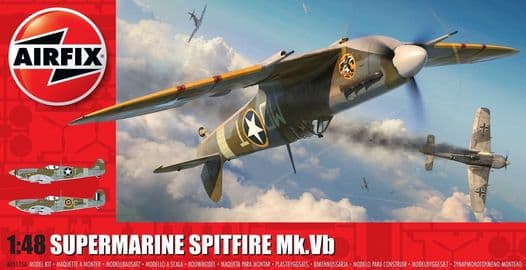
Supermarine Spitfire Mk.Vb AB910
It would be a real challenge to select one BBMF aircraft as being more famous than any of its hangar mates, however, it has to be noted that Spitfire Vb AB910 must be in with a shout for this particular aviation accolade. With an active combat career to its name, this Spitfire flew 143 operational missions during almost three years continual use, initially allocated to No.222 (Natal) Squadron at North Weald in August 1941. She would go on to see action during air operations covering the disastrous Dieppe Raid of August 1942 (Operation Jubilee), before flying numerous sorties in support of the D-Day landings in the summer of 1944.
Even when relegated to support duties after July 1944, this famous Spitfire just couldn’t keep itself out of the headlines. Whilst operating from RAF Hibaldstow in early 1945, the aircraft was being taxied to the runway with a WAAF ground crew fitter sitting on the tail, helping to prevent the aircraft from lifting in the windy conditions. The usual procedure in such cases would be for the pilot to hold at the runway threshold, allowing his temporary passenger time to climb down, before applying power and beginning his take off run. Unfortunately, on this occasion, this did not happen and the pilot simply carried straight on to the runway. Immediately applying take off power, all his terrified passenger could do was to cling on to the tail for dear life and pray. As soon as the Spitfire became airborne, the pilot realized something was seriously wrong, as he was having great difficulty controlling the fighter, but thankfully, he was able to avert disaster, flying a wide circuit of the airfield and landing safely back at Hibaldstow. Both the pilot and his unsuspecting passenger were shaken by the experience, but had a truly unique story to tell their respective families from that day forward.
Following the end of her service career, AB910 would take part in several high profile air races around the country, before returning to Vickers Armstrong for refurbishment in 1953. In the capable hands of celebrated test pilot Geoffrey Quill, she performed at Airshows all over the UK until she was presented to the Battle of Britain Memorial Flight in September 1965. Her current scheme also sports full D-Day identification markings, with the codes SH-F representing the aircraft flown by Flight Lieutenant Tony Cooper, who was the Commanding Officer of No.64 Squadron on D-Day.
Supermarine Spitfire Mk.LF.IXe MK356
Representing a late mark Merlin powered Spitfire, LF.IXe MK356 is the Flight’s most recent addition, only joining this historic collection of aircraft in November 1997. They had been looking into the possibility of returning an example of this famous mark of Spitfire to airworthy condition for some time and this airframe, which was being stored at RAF St Athan as part of the RAF Museum’s reserve collection, was seen as a potential option. Following a lengthy period of restoration, the aircraft arrived at Coningsby on 14th November 1997, to take its place as a future Airshow favourite.
Her wartime history consisted of 60 sorties in around nine weeks of operational flying, most of which were spent flying Rodeo fighter sweeps into occupied France, in the weeks leading up to the D-Day landings. During this time, the fighter would make no fewer than three wheels up landings after sustaining damage, with the last one being on her final wartime operational sortie. On this day, one of the fighter’s wheels detached on take-off, but as this didn’t hamper the performance of the aircraft, the pilot bravely decided to continue with the mission anyway, making a perfect belly landing on return to his home station.
This beautiful aircraft is currently resplendent in the markings of a ‘Desert Spitfire’, quite an unusual sight on a restored Spitfire and one which looks absolutely spectacular on a blue sky day. The markings themselves represent a Spitfire flown by famous RAF pilot Neville Duke, during his time with No.92 Squadron in Tunisia - this scheme also proves that the Spitfire looks good no matter what colours it is painted in.
Supermarine Spitfire Mk.XVIe TE311
This aircraft is the most recent acquisition for the Flight and for the first six years of being its custodians, there were actually no real intentions to return it to airworthy condition. It was only when engineers started working on the aircraft in their spare time that they thought it such a waste if all this effort would not result in a ‘flyer’, if at all possible.
Originally delivered on 8th June 1945, TE311 would end up having a rather uneventful service career, but was another aircraft which found itself being used during the filming of the Battle of Britain movie. She was made to look like a much earlier variant of the Spitfire and restored to taxiing condition, but following the end of filming, received a further period of renovation to return her to her original configuration. She would spend the next twenty years or so as something of a mobile exhibition aircraft, positioned in several locations around the country and wearing a number of different schemes.
The initial intention for this aircraft was that it would be offered for sale, but before this could happen, it was donated to the Battle of Britain Memorial Flight for use as a spares airframe, an aircraft they could use to keep their other Spitfires flying. As engineers began working on the aircraft to hone their skills, the question was later raised about the possibility of actually returning the aircraft to airworthy condition and a feasibility study was completed. After receiving official approval, the aircraft underwent an exhaustive period of restoration, making her first post restoration flight on 19th October 2012. Benefitting from a scheme change for the 2018 display season, the fighter currently wears the markings of a Spitfire which was the personal mount of Group Captain Aleksander Gabszewicz, the Officer Commanding RAF No.131 (Polish) Wing.
Supermarine Spitfire PR.XIX PM631
With both of the Flight’s Rolls Royce Griffon powered Spitfires being in maintenance at the moment, we are not going to be looking too deeply into the histories of these aircraft at this time, preferring to keep this aviation treat for a future edition of the blog.
This late mark version of the Spitfire illustrates how successful the basic Spitfire design was at accepting upgrades and modification to keep it at the forefront of air fighting capabilities. Spitfire Mk.XIX PM631 is actually the youngest aircraft operated by the BBMF and her claim to fame is that she was the aircraft used in dissimilar combat trials against RAF Lightning jets during the 1960s. She was also one of the four founding aircraft of the Historic Flight at Biggin Hill in 1957, the forerunner of the Battle of Britain Memorial Flight.
Supermarine Spitfire PR.XIX PS915
The second of the Flight’s Griffon powered Spitfires, PS915 is a photo reconnaissance version of the Spitfire and one which entered RAF service just too late to see operational service during WWII. After military service at bases in the UK and Germany, the aircraft joined the Temperature and Humidity Flight at RAF Woodvale near Southport in June 1954, a unit which was manned by civilian pilots, but ones which had a military flying past. When these aircraft were replaced by Mosquitoes just two years later, this aircraft would also become one of the founding airframes of the Historic Flight at Biggin Hill in 1957.
As the aircraft was in relatively poor condition when she arrived at Biggin Hill, she would go on to spend many years as a gate guardian at several RAF stations. In 1984, apprentices at BAe Samlesbury began a restoration project on the Supermarine classic, which would eventually lead to her making a post restoration flight on 20th December 1989. She officially returned to the BBMF on 7th April 1987, almost 30 years after she had first been presented to the flight.
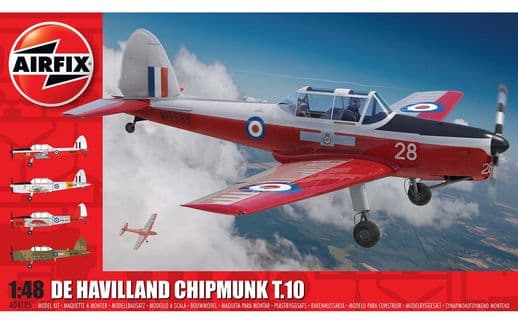
De Havilland Chipmunk T.10 WG486
The Chipmunk is sometimes viewed as an unusual aircraft type to come under the banner of the BBMF, but this is a classic aircraft in its own right and provides the Flight with essential support. It is also fitting that they should be custodians of the last two of 735 Chipmunks which saw service with the Royal Air Force. Providing a similar service to the one provided by the Dakota, the Chipmunks are used for training and continuation flying for the Flight’s fighter pilots, providing them with invaluable experience flying this single engined, tail dragger type. They can also be used to deliver or collect the Flight’s pilots and even to fly reconnaissance sorties in advance of display commitments.
Chipmunk WG486 joined the flight as their second Chipmunk in 1995, following an RAF career which saw her serving as something of a spy plane, during her time in Germany during the Cold War. She is currently presented in the markings she wore during her time with the Bristol University Air Squadron during the early 1970s.
De Havilland Chipmunk T.10 WK518
The Chipmunk was a prolific post war aircraft for training pilots and giving many thousands of people the opportunity of experiencing the thrill of flight, something which makes this a much loved aircraft in its own right. The two aircraft operated by the Flight have been in even more demand than usual this year, as the venerable Chipmunk celebrated the 75th anniversary of the type’s first flight, something which has been commemorated throughout the year in some style.
WK518 is actually the longer serving of the Flight’s two Chipmunks, having been allocated to the BBMF way back in 1983. Although both Chipmunks have mirrored the other aircraft in the Flight by sporting several different liveries over the years, she is currently wearing the markings she wore between 1970 and 1973, when she was serving with the University of London Air Squadron. This hard working aircraft actually spent time with University Air Squadrons at Manchester, Liverpool, Hull, Cambridge and London, in addition to serving on the RAF Cottesmore Station Flight.
The highlight of any Members Day event is undoubtedly the flying display, where all serviceable aircraft available on the day take to the air to perform a series of formation flypasts, before the fighters usually break off to perform their own, more dynamic displays. As you would expect, Avro Lancaster PA474 is the centre of attention, with the rest of her hangar mates acting as priceless aviation chaperones during her display, particularly during this latest event, as she had only just returned to Coningsby. Understandably, the Memorial Flight have some strict operating parameters they have to adhere to when considering flying their aircraft and even when aircraft are serviceable, wind speed and wind direction can dictate that all aircraft are forced to stay firmly on the ground, even though the skies may be clear and bright. Indeed, anyone who has been fortunate enough to attend several of these events will attest to the fact that we can often be holding our breath right up to the allotted take off minute of a proposed display, as the good old British weather always seems determined to play its part in the day’s proceedings.
This year, we were fortunate enough to enjoy the spectacle of a Members Day flying display, but a little unlucky with the actual conditions in which it took place - the skies were very grey. Indeed, you will probably notice quite a change in the conditions through some of the photographs included here, because as soon as all the aircraft had landed and the final engine had been shut down, the sun came out, as if to remind us all who was the real outdoor event boss is. Ironically, as we were being invited to leave our positions and start heading home, the conditions were the best they had been all day and were ideal for photography - how predictably ironic!
This final selection of pictures all feature the flying display performed at the 2021 BBMF/LLA Members Day, but please don’t alter the brightness on your monitors, the sky actually was that grey. In addition to this, several of the pictures were taken immediately following the completion of the flying display, after the sun came out and just prior to us being asked to start making our way home.
As for the event itself, it was a resounding success and despite the event team only having a short time to make all the necessary arrangements, everyone in attendance had a thoroughly memorable day. After such a challenging couple of years, it was so good to spend some quality time with these magnificent aeroplanes and in particular, to welcome the Lancaster back home after such a long time away. Hopefully, as we begin looking forward to the 2022 Airshow season, the aircraft of the Battle of Britain Memorial Flight will once again be in high demand and the annual Members Day will be the final celebratory event at the end of another hectic display season. You never know, we might even be blessed with good weather for the display next year.
On behalf of all in attendance on the day, we would like to thank everyone from the Memorial Flight and Lincolnshire’s Lancaster Association for arranging such a memorable and enjoyable day and for allowing us all the opportunity to join them.
We begin with a series of images featuring the formation flypast performed by the seven aircraft taking part, before ending with a few photographic ‘extras’ from the day.
I’m afraid that is all we have for you in this latest edition of Aerodrome, but we will be back with more aviation related content for your enjoyment in four weeks’ time. If you would like to send us a selection of your own pictures, or suggest an aviation related subject you would like to see covered in a future edition of the blog, please use our aerodrome@airfix.com address to drop us a line - we will be delighted to hear from you.
Between editions of our blog, the aviation related conversation is always continuing over on the Airfix Aerodrome Forum and if social media is your thing, there is always interesting content and discussion taking place on our Official Airfix Facebook, Twitter and Instagram accounts, not forgetting our Official Corgi Facebook, Twitter and Instagram sites too. We would be delighted if you took part in all the aviation related discussions going on there and please don’t forget to let us know what you think about Aerodrome and any suggestions you may have.
The next edition of Aerodrome is scheduled to be published on Friday 19th November, where we will have more interesting aviation content to bring you.
Thank you, as always, for continuing to support our Aerodrome blog.
Michael
Return to the Aerodrome home page
Model link section
Airfix
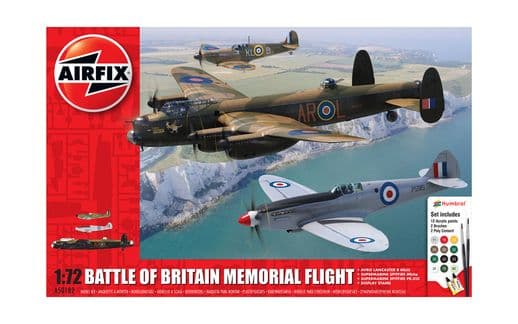
BBMF Gift Set three model kit, Avro Lancaster, de Havilland Chipmunk, Spitfire Mk.la, Spitfire Mk Va, Spitfire Mk.I, Hawker Hurricane Mk.l, Spitfire Vc, 1/24th scale Hawker Hurricane.