Welcome to the latest fortnightly edition of Airfix Workbench, where we bring you all the latest news and views from the wonderful world of Airfix modelling. In this latest edition, we have our usual mix of project updates, exclusive product images and an interesting model build take on a classic RAF training aircraft, which has been finished in an unusual Naval theme. Later, we will also be asking Workbench readers to send us their stories about a particular kit from the historic Airfix range that has special significance for them – it may be the first model they ever built, the one where all your skills finally came together, or simply one that you enjoyed building. Our Airfix ‘First Flight’ reader stories will be featured throughout the rest of 2016 and it is your chance to tell us about the kits you hold dear and be part of our Workbench blog. There is a lot to squeeze into this latest edition of Workbench, so it’s about time we got things started.

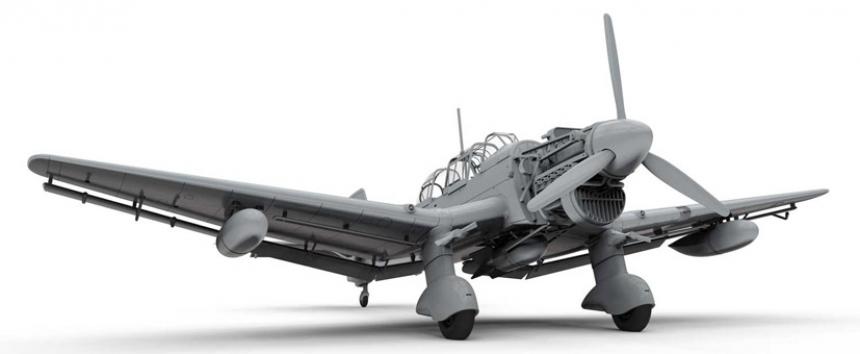
Computer rendered 3D CAD image of the 1/48th scale Ju-87B-1 Stuka
The incredibly popular 1/48th scale range of aircraft kits in the current Airfix line-up are proving to be a real hit with the modelling community and the extra size associated with these models allows the Airfix designers to incorporate a truly impressive level of detail. As one of the most anticipated model releases of 2016, the 1/48th scale Junkers Ju-87B-1 dive bomber (A07114) will further increase the number of 1/48th scale Battle of Britain era aircraft kits available to the modeller, and could quite possibly prove to be the most popular model so far when it is eventually released later in the year. With a great many people looking forward to the release of this model, we are extremely pleased to be able to bring you the latest update on the new 1/48th scale Stuka.

Test build of the ‘first shots’ Stuka components underway at Airfix
First announced in Workbench Edition 9, this new Stuka has attracted plenty of positive comments across modelling forums and when it is eventually released later in 2016, it will allow the Airfix modeller to choose from newly tooled examples of this extremely famous aircraft in both 1/72nd scale and this larger 1/48th scale. Describing the Stuka as one of the most famous aircraft of WWII is certainly accurate, but perhaps this description would be even more accurate had we used infamous – the Stuka was without doubt one of the most terrifying weapons from the early years of WWII. Taking a huge toll of Allied shipping and armoured vehicles, the Stuka was a close air support and strike attack aircraft, which was capable of providing precision bombing support to advancing Wehrmacht ground units, or destroying strategically important targets, before they could become a problem. Arguably feared more than any other weapon during the opening months of the Second World War, the sight of Stukas in the air would usually signify that war was coming and you lay in its path.
Perhaps the most visible exponent of Blitzkrieg, the Stuka was designed not only to inflict devastating strategic damage on opposing military forces, but to do so by spreading fear and confusion amongst their ranks, thus further reducing their effectiveness as a fighting force. As the Stuka began its bombing dive, a siren which was intentionally bolted to one of the undercarriage spats would produce a loud, wailing sound, which would continue until the aircraft pulled out of its dive and the precursor to the sound of exploding bombs. Disorientating enemy forces on the receiving end of their attack and causing panic amongst the local civilian population, the intention was that this terror from the skies would result in a mass exodus of civilians, which would further hinder the effectiveness of any opposing military forces. During the German onslaught against Poland, France and the Low Countries, the Stuka proved to be a devastatingly effective dive bomber, as well as a flying propaganda tool for the all-conquering Wehrmacht, but following significant early successes during the Kanalkampf, the Battle of Britain proved to be something of a watershed for Luftwaffe Stuka crews.

 'First Shots’ test frame sprue components from the new 1/48th scale Ju-87B-1 tooling
Workbench readers are always keen to see how new model projects are progressing and we are pleased to be able to bring you a Stuka update in this latest edition. As was the case with the Victor images we showed you in the previous edition, the magnificent new Stuka has progressed to the test sprue stage, where the newly designed model tooling has been used to produce the plastic kit components for the first time. Clearly, this is a significant stage in the production of any new tooling project and as Workbench has covered this with a number of projects over the past few months, you will be familiar with the processes the Airfix designers are currently engaged in. Before the model can advance any further, the designer responsible for the project will have to inspect every aspect of these test frame components, assessing them for accuracy, detail and eventual construction fit. He will then undertake a test build of the components, painstakingly compiling a review of his findings, with any issues needing to be incorporated into the tooling design before the project can advance further.

The test build of ‘first shot’ model components is a challenging time for the Airfix team, but significantly advances the project
It is important to stress that the exclusive 1/48th scale Stuka images you are seeing here are of the first test shots from the tooling and any number of alterations and modifications may be required, before the model is released for production. With its relatively large size, fixed undercarriage spats and distinctive inverted gull wings, this magnificent new kit is already looking like being something special for the WWII modeller and these latest images will only serve to increase the excitement levels. For the designers, it is on to the next stage in the process, but we are one important step closer to having a 1/48th scale Stuka on our own workbenches.
The Junkers Ju87 B-1 Stuka (A07114) is currently scheduled to be available from Airfix stockists nationwide from late September, and can be pre-ordered on the Airfix website.


The magnificent box artwork for the 1/48th scale Tropical Hurricane has been released
Perhaps the most exciting stage of any new model project is when we are in a position to bring you the stunning and highly appealing box artwork that has been commissioned for the kit and usually signifying its imminent release. Not only do these superb images do justice to the the magnificent models produced by Airfix, they also serve as inspiration to any modeller lavishing copious amounts of time and attention on their latest build project, in the hope of making it look something like the picture on the box. As you can see from the evocative image above, we are pleased to inform you that the 1/48th scale Hurricane Mk.I (Tropical) A05129 is now at this stage and well on track for a scheduled early May release date. The rugged and reliable Hawker Hurricane was used extensively in many overseas theatres of operation during WWII and this latest Airfix release includes additional parts to allow the construction of a 'tropicalised' version of the Hawker Hurricane Mk.I, with modifications designed to coax every last ounce of performance from these extremely important aircraft. The unforgiving desert environment also resulted in some spectacular liveries being applied to RAF Hurricanes, none more so than this beautiful aircraft.

The highly distinctive appearance of Hawker Hurricane Mk.I P2638 will inspire many modellers to attempt this kit
Hawker Hurricane Mk.I (Tropical), P2638, Sgt. Plt. F. H. Dean, RAF No.274 Squadron, Sidi Barrani, Egypt 1941
This impressive scheme is an absolute beauty and will surely form the basis of many construction projects throughout 2016. Featuring the already attractive desert camouflage of the RAF, this aircraft sports a rather striking lightning flash on the fuselage in place of the Squadron codes. It also has the unusual ‘spaghetti scheme’ applied to the nose, chin and wing leading edges of the fighter. After serving with No.274 Squadron in Egypt, P2638 went on to serve with No.208 Squadron at Heliopolis in early July 1942, where it was converted to a 'tropicalised' photographic reconnaissance aircraft. It was shot down by a gaggle of Messerschmitt Bf 109Fs on 27th July 1942.
1/48th scale tropical Hawker Hurricane Mk.I A05129 is scheduled for release at the beginning of May and will be available at all good model stockists and on the Airfix website.

The late mark Beaufighters were some of the most aggressive looking aircraft in RAF service
As one of the most aggressive looking RAF aircraft of the Second World War, many enthusiasts are surprised to learn that the Bristol Beaufighter actually entered RAF service as the Battle of Britain was just beginning. Originally intended as a heavy fighter, in a similar role to that of the Luftwaffe’s Messerschmitt Bf 110 Destroyer, the Beaufighter was to excel as a long range maritime strike fighter for Coastal Command, where its many attributes could be fully utilised. The late war Mk. X version of the aircraft was the last major development of the Beaufighter, and armed with rockets and torpedoes it took a heavy toll of Axis shipping, operating in large formations and developing aggressive tactics which proved so effective that shipping movements were restricted to night sailings only.
Although still a Mk. X version of the Bristol Beaufighter, the later production aircraft of this series included a number of improvements and alterations which gave the aircraft a very different appearance. The most distinctive of these was the addition of a large dorsal fin fillet, which greatly increased the directional stability of the aircraft. There was also a ‘thimble’ nose A.1 Mk.VIII radar, which gave the aircraft much enhanced target acquisition capabilities.
Other improvements associated with this version of the aircraft included new rocket rails, which carried the projectiles in two banks of two, one rocket above the other and increased the accuracy of rocket attacks. There was also an additional 200-gallon drop tank, a new tail wheel suspension system and large spinners on the propeller hubs. A re-positioning of the gun camera to a new position high on the fuselage, just behind the cockpit canopy was the final improvement which visually altered the appearance of the late mark Beaufighter Mk.X aircraft.
Announced back in October of last year, A05043 includes additional parts to allow the modeller to construct an example of this later version of the Beaufighter, which is generally regarded as the most capable and operationally effective version of this mighty strike fighter. We can also now bring you the decal scheme options that will be supplied with this impressive kit, which is currently scheduled for an early June release.

Scheme Option A
Bristol Beaufighter TF.10, RD805 / OB-J, RAF No.45 Squadron, ‘Operation Firedog’, RAF Kuala Lumpur, Malaya, May – December 1949
The Malayan Emergency between 1948 and 1960 saw combined Commonwealth forces facing a guerrilla war with the Malayan National Liberation Army. With the unforgiving terrain of the country being a significant factor, air power was to play an important role in bringing about a successful conclusion to the conflict – Operation ‘Firedog’ saw the use of no fewer than 31 aircraft types, in 36 versions during the twelve years of fighting. This extremely capable looking Beaufighter TF.10 wears the attractive livery applied during its service in Malaya.

Scheme Option B
Bristol Beaufighter Mk.X, RD432 / P6-L1, RAF No.489 (RNZAF) Squadron, RAF Dallachy, Scotland 1945
This magnificent looking machine was one of the maritime strike Beaufighters that proved to be the nemesis of Axis shipping in the final weeks of WWII. Interestingly, the small 1 after the L on the coding identifies this aircraft as having been fitted with the improved A1 Mk.VIII radar unit, which further enhanced the aircrafts operational effectiveness. This scheme is typical of a late war Beaufighter engaged in night ‘Rover’ torpedo armed patrols, which were aimed at strangling the ability for Axis forces to move shipping under the cover of darkness – an extremely attractive scheme.
The 1/72nd scale Bristol Beaufighter Mk.X (Late) A05043 is due to be released in early June.

The magnificent box artwork used on the Airfix Tiger Moth release
With so many magnificent model kits in the current Airfix range, it is sometimes difficult to choose your next build project from the extensive subject choice available. Many modellers and enthusiasts would usually go for a classic WWII fighter aircraft, such as a Spitfire or Messerschmitt, or if speed was your thing, then possibly an English Electric Lightning might fit the bill and although this is obviously a very personal choice, it would usually be a muscle plane that would win the day. Having said this, there are a number of superb, if slightly less enigmatic kit options available and the modeller overlooks them at their peril - one such model would definitely be the diminutive, yet highly significant De Havilland D.H 82A Tiger Moth – a biplane giant in historic aviation terms, with many examples still flying to this day.
Designed by Geoffrey de Havilland, the Tiger Moth was intended as a modern, cheap and effective way to train pilots for the RAF and provide them with their basic introduction to flying. Entering service with the Central Flying School in February 1932, there were 500 machines in service by the time World War II started, with many more Tiger Moths working with civilian operators around the country.
Described by pilots and instructors alike as being quite a forgiving aircraft to fly, the Tiger Moth possessed relatively stable handling characteristics, with very few control vices. Despite this, it is often said that the Tiger Moth was an easy aircraft for the student pilot to fly, but a challenging one for him to fly well. This dictated that the aircraft proved to be the ideal aircraft in introducing student pilots to flight and allowed large numbers of prospective RAF pilots to be trained quickly, cost-effectively and with a high degree of serviceability. This would prove to be critical in the latter years of the 1930s, as the RAF were in desperate need for as many trained pilots as they could get their hands on, as the clouds of war began to gather.

De Havilland DH.82A Tiger Moth L-6923 Hatfield Reserve Flying School
With a great many pilots spending time on the Tiger Moth, this classic biplane training aircraft has probably come into contact with more aviators than any other British aircraft and as such, the aircraft enjoys incredible popularity. With a total worldwide production of well over 8,000 machines, no less than 4,000 of these Tiger Moth IIs were built for the RAF during the War and proved essential in maintaining the critical supply of new and replacement pilots, as the RAF moved on to the offensive. As a tail-dragger aircraft, the Tiger Moth proved to be particularly effective in the training of potential fighter pilots and indeed, even though it is now 84 years since the aircraft entered RAF service, this attribute is still very much in demand to this day. With many aircraft still in service with a multitude of private operators, the Tiger Moth is still used to train future Warbird pilots for the UK Airshow circuit, as it allows them to gain valuable experience in flying a tail-dragger aircraft, before moving on to something like a Harvard and then ultimately a Spitfire, or Mustang.
Proving the effectiveness of the original design, Tiger Moths all over the world continue to be restored and operated with some enthusiasm, as the aircraft remains an effective way to train pilots and allow people to experience the delights of flight. Earning their keep by training future Warbird pilots, the Tiger Moth is also extremely popular with aviation enthusiasts desperate to get some time in the air and even take control of an aircraft for the first time. These air experience flights continue to maintain the popularity of the classic Tiger Moth, as these opportunities are open to anyone and ensure that the aircraft continues to come into contact with large numbers of people, even if not all of them go on to become pilots themselves. With this in mind, it is no wonder that the Tiger Moth remains one of the most famous historic aircraft in the world and extremely popular with both enthusiasts and the general public alike, as it is one of the few classic aeroplanes that people can get close to.

An unusual scheme selection for this Airfix Tiger Moth build
With an aircraft that enjoys such historic significance, it is quite surprising that the Tiger Moth has not proved to be more popular with the aviation modeller. Although clearly not as enigmatic as a Spitfire or Defiant, you would think that the fact that more people have come into contact with the Tiger Moth than any other British aircraft would dictate its overwhelming popularity. This situation does seem to be changing of late and one of the main contributing factors in this change has to be the recent arrival of the newly tooled D.H 82a Tiger Moth from Airfix, in their 1/72nd scale range. As many older modellers will testify, the Airfix range has included a 1/72nd scale example of the Tiger Moth since 1957 and although this kit was very much showing its age, it will hold some extremely happy memories for modellers of a certain vintage – despite the affection in which this classic Airfix kit was held, it was very much time for an upgrade.
Many Airfix enthusiasts will remember the 2013 IPMS Telford show for the announcement of the hugely impressive 1/24th scale Hawker Typhoon, which very much took centre stage on the Airfix stand over this weekend. Although the Typhoon was undoubtedly the star of the show that year, there was another classic model on display for the eagle-eyed modeller – a newly tooled example of the De Havilland Tiger Moth in 1/72nd scale. Produced using the very latest technologies available to the Airfix designers, this magnificent model included incredible levels of detail for a kit of this size, with many modellers describing it as the definitive example of the Tiger Moth in this scale. Following a number of incredibly positive reviews, this beautiful model has stimulated a surge in popularity for the Tiger Moth, as this new kit has allowed modellers to re-visit this classic aircraft in some style and mark one of the most important British aircraft of WWII. With this in mind, the opportunity to inspect a recent Tiger Moth model build by North West modeller Colin Duckworth was too good to refuse, particularly as he had finished his model in a rather unusual scheme.


Tiger Moth XL714 in the colours of HMS Heron Flight
You may recall that we featured Colin’s modelling prowess in the sixteenth edition of Workbench, with his magnificent Royal Air Force SEAC Dakota Mk.III review – with an Airfix kit almost constantly on his own workbench, there is always something interesting to see at Colin’s house. For this particular project, Colin managed to acquire an example of the Airfix Tiger Moth Starter Set (A55115) – but rather than finish the model on the Hatfield Reserve Flying School livery provided, decided on a slightly more unusual scheme. Using decals taken from his spares box and some adapted dayglow strips he had available, he decided to finish his model as a Royal Navy Tiger Moth he had seen in one of his reference books.
De Havilland DH 82A Tiger Moth XL714 was one of four former civilian owned aircraft acquired by the Royal Navy during the 1950s. Originally T6099, the aircraft was subsequently registered as G-AOGR on 20th January 1956 and then XL714 on 2nd August 1956 and given this smart silver and dayglow orange scheme. Stationed at Roborough airfield, this and a number of other Royal Navy owned Tiger Moths would provide Naval students from the nearby Britannia Royal Naval College with air experience and pilot aptitude assessment flights. If selected for aircrew, the students would gain experience flying the Tiger Moth, before moving on to Linton-On-Ouse for more advanced fixed wing training. These aircraft were flown regularly and could often be spotted at Royal Naval bases all over the country.
It is more than likely that XL714 had the distinction of being the last biplane aircraft to land on the deck of an aircraft carrier (HMS Eagle) in the English Channel, during the summer of 1967. With surviving pictures showing the aircraft on one of HMS Eagle’s deck lifts, it is reported that once the aircraft managed to get airborne from the deck, the wind was so strong and the Tiger Moth travelling so slowly, that the Captain of HMS Eagle had to make a sharp turn to starboard in order to avoid a collision. XL714 was restored to life as a civilian aircraft on 10th February 1976 and is still flying to this day wearing an RAF training scheme of camouflage and yellow.


Tiger Moth XL714 provided Britannia Royal Naval College students with air experience flights
The images attached above show Colin’s Tiger Moth wearing the distinctive colours XL714 during her Royal Naval service and as the aircraft was photographed at Plymouth on 19th March 1967. As one of the most important aircraft produced by Britain and the Commonwealth, the De Havilland Tiger Moth deserves just as much recognition as the famous fighter aircraft many of its student pilots went on to fly and this recent 2014 Airfix tooling in 1/72nd scale certainly does justice the classic lines of this biplane trainer. Once again, we would like to thank Colin Duckworth for producing this magnificent model and allowing us to use these images for our latest edition of Workbench.
There is no doubting that Airfix kits will have played an important part in the lives of a great many people, and throughout the rest of 2016 we are going to feature some of our Workbench reader stories and the models that were so important to them. As with everything else in life, we expect to receive some diverse and interesting stories about the particular Airfix kit that sticks in your mind, but it would be really interesting for like-minded enthusiasts to share their stories. Your memorable kit might simply be the first model that you remember making, or the one you enjoyed making most. It could also be a kit that you made and presented to someone else, but whatever the kit and whatever the reason it would be really interesting to share your story with other Workbench readers.
It would be great if you would take the time to let us have your Airfix ‘First Flight’ story – supporting pictures would be a bonus, but not essential. Please send your stories to workbench@airfix.com, we intend to feature a selection of these stories in Workbench throughout the rest of 2016 and this will be a fantastic opportunity to feature some classic Airfix plastic.

The new Gloster Meteor F.8 is proving to be an incredibly popular kit
Our regular review of the imminent new model releases and popular kit re-stocks opens this week with something of a modelling call to action. The recently released 1/48th scale Gloster Meteor F.8 kit (A09182) has proved to be an incredibly popular model and anyone wishing to add this fantastic kit to their project pile would be well advised to secure their example sooner rather than later. As previously mentioned, the 1/48th scale Tropical Hurricane (A05129) is also due to be released early next month and as this will again be a popular release, it would be advisable to ensure that your example is reserved at your usual model supplier, or on the Airfix website. In addition, the new 1/72nd scale Red Arrows Hawk T.1a (A02005C) is another new arrival that is selling fast.
With additional supplies of low stock and previously sold out kits arriving at our warehouse all the time, a quick visit to the Back in Stock section of the Airfix website will always be time well spent, as it lists all the models that are either available once more, or due to arrive soon.
Some particularly noteworthy re-stocks include:
A02069 Boulton Paul Defiant Mk.I 1/72nd Scale
A55208 Hawker Typhoon Starter Set 1/72nd Scale
A55207 VW Beetle Starter Set 1/32nd Scale
A50097 Vulcan to the sky Gift Set 1/72nd Scale
For the latest information on the release of re-stocked model kits, please keep checking the Back in Stock area of the Airfix website, which will have all the latest availability details for you. We will have more release information in the next edition of Workbench.
I am afraid that is all we have for you in this latest edition, but we look forward to bringing you more news from the fascinating world of Airfix in the next edition of Workbench. Please do support our Airfix ‘First Flight’ feature, as it would be really interesting to see which Airfix kits were important to you
As usual, you can get involved in all the latest Airfix modelling chat via our dedicated Workbench thread on the Airfix Forum, or if you prefer, by logging onto our Facebook or Twitter social media channels and using #airfixworkbench.
Until next time, enjoy your modelling.
The Airfix Workbench Team
© Hornby Hobbies Ltd. All rights reserved.