

Welcome to this latest edition of our Workbench blog and all the news, updates, and modelling exclusives from the fascinating world of Airfix.
Anyone out there excited to find out about a new collection of Airfix model kits? In time honoured fashion, the start of any new year also goes hand in glove (or should that be poly cement on kit parts) with the announcement of the latest Airfix model range and catalogue publication, and we are delighted to announce that this will be the final edition of Workbench without our new collection being available for all to inspect. From 4pm next Tuesday afternoon (14th January), the next Airfix model kit range will be available to view in all its glory, and we can’t wait to show you what we’ve got planned over the coming twelve months.
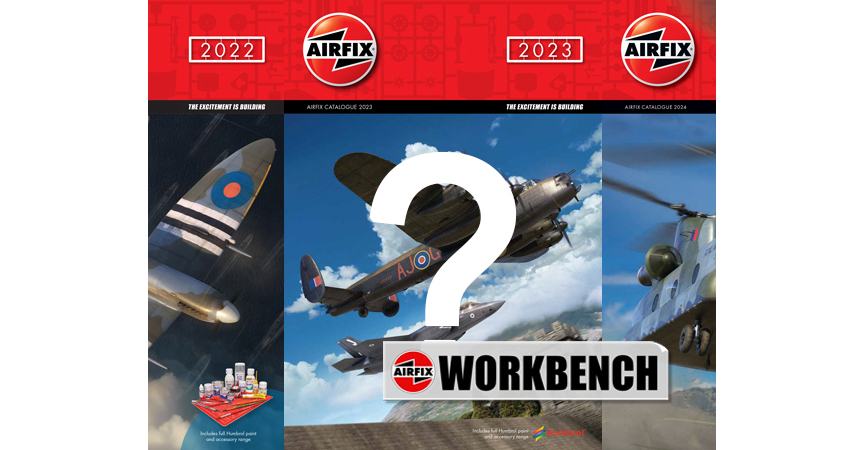
That being the case, with this being the final edition of Workbench prior to range launch, we will be taking the opportunity to look back at some of the headline new tooling announcements from previous recent range launches, whilst also posing the important question, ‘What new tooling subject would you like to see joining the range in 2025’? We will also be proudly showcasing a subtle, albeit important new appearance for our beloved logo, whilst also including a rather cryptic clue, which if evaluated successfully, will identify one of the exciting new tooling projects which will be announced next Tuesday. Thinking caps on, but if you get it, you should really sign up for ‘Mastermind’, because it’s a tough one!
We will end by looking at an existing kit in the current range which has proved popular since release, probably because it’s our scale model tribute to North American’s ‘Magnificent Medium’. As we are now in possession of a selection of built model images which weren’t available at the time of posting the original review blog, we’re going to be re-visiting this kit, but by only focusing on the details behind the two scheme options which feature within this kit offering.
One of the highlights of our entire year, we’re excited to be bringing you our latest range launch in just a couple of days’ time.
Range launch day is all about new Airfix models, and we’re about to unleash a new collection on an expectant modelling world.
It can often be quite a challenge getting back to work and normality after the excesses of the Christmas and New Year holidays, not just because it marks the end of some much-needed rest and recouperation time for us all, but how we still have to cope with fewer daylight hours and depressing winter conditions. Thankfully, there is one thing which always serves as an annual pick-me-up at this time of year, something which is guaranteed to warm the cockles of every modelling enthusiast’s heart, the latest Airfix range launch announcement.
At the time of publishing this latest blog, the final touches are being made to our range launch presentation, with all individual product pages of the Airfix website, our annual YouTube range video and the all-important 2025 Airfix catalogue all about to be unleashed on an expectant modelling world. For those in a position to do so, the only place to be at 4pm next Tuesday afternoon is the Airfix website, when a new collection of model kit offerings will be available for your perusal and enjoyment – please don’t melt our website again!
As has become the norm in recent times, we do also reserve the right to hold one, or two projects back for unexpected announcement at strategic points during the coming year, but we will have a fine selection of new tooling project information to share with you next week. For those who will have to wait until they get home before sampling our new delights, our Head of Brand Dale will be hosting his usual range overview video over on our official YouTube channel, where he will talk you through some of the highlights of the new range in his own inimitable style.
Although we’re only too aware that no new tooling announcement will ever meet with the approval of every modeller in our community, we do try to bring the models we know enthusiasts would like to see joining the range to launch day, and we sincerely hope that the latest selection will be of interest to the modelling majority. You never know, we might just have a couple of pleasant surprises for you over the coming year.
Over recent years, range launch has included some real subject heavyweights, and in all cases, it does have to be remembered that each and every one of the new tooling announcements made represents significant investment from the company, and many months of hard graft for one of our designers. That being the case, I’m sure you’ll understand that no new tooling project decision is ever taken lightly, even though some might intentionally be made to bring some appealing subject variety to the range, however, these decisions are the travails of an Airfix Development Manager.
Clearly, we’re not in a position to give too much away at this point, however, let’s take a quick look at some of the highlight new tooling announcements which have graced range launch day over the previous five years or so.
Avro Vulcan B.2
Back in 2020, a great many modellers would have been delighted to see a newly tooled 1/72nd scale Avro Vulcan B.2 kit joining the range, a model which had been long requested within the hobby and one which served as a high-quality replacement for a slightly outdated, if much loved existing Vulcan kit which had been in the range since 1983. Although the kit was actually announced at Scale Modelworld the previous November, range launch 2020 brought with it the very real prospect of us all getting our hands on this instant kit classic, enabling us all to create our latest tribute to one of Britain’s most distinctive and popular post war jets.
When looking at the rather futuristic delta profile of Avro’s mighty Vulcan bomber, it can be difficult to appreciate that development work on this magnificent aircraft actually began back in 1947, just a few short years after its famous predecessor, the Lancaster, had proved decisive for Bomber Command during WWII. At their Chadderton facility near Manchester, the A.V Roe design team began work on this significant project, in response to Ministry of Defence requirement B35/46, which called for an aircraft which must possess an operating range in excess of 3,350 nautical miles, be capable of speeds approaching 500 knots and have an operating ceiling of 50,000 feet.
Importantly, the aircraft was also required to carry a ‘special’ payload of 10,000 imperial pounds in weight (a nuclear device), as it was intended to serve as a flying deterrent to any future threat against the UK. An extremely tough design brief, these specifications represented a 100% increase in the capabilities of any previous bomber aircraft in RAF service.
Despite this demanding specification brief, what the Avro team produced was an aviation classic, and one which just had to be part of an Airfix kit range. There was definitely a large delta shaped shadow over range launch day in 2020.
By their nature, aircraft designed specifically to train future pilots are some of the highest profile aeroplanes in our skies, and as a consequence, often come into contact with more people than most other types. For this reason, training aircraft are usually held in high regard by millions of people all over the world, particularly if they were designed by the famous de Havilland company and therefore, are also of great interest to modellers and enthusiasts. As a consequence, our announcement of a newly tooled 1/48th scale kit of the Chipmunk to start 2021 proved to be just the tonic for those back to work blues that year.
Having the distinction of being the first aircraft type designed and built by the de Havilland Company of Canada, the first Chipmunk took to the skies in May 1946 and almost immediately gained interest from the military. By April 1948, the Royal Canadian Air Force had taken delivery of their first Chipmunk, but they were not the only ones admiring the qualities of this extremely capable aeroplane. The vast majority of the 1,283 de Havilland Chipmunks built would be manufactured under licence in the UK, in factories at Hatfield and Chester, with around 735 of these going on to see service with the Royal Air Force, again as the direct replacement for the venerable old Tiger Moth.
In RAF service, the British built machines were known as the de Havilland Chipmunk Mk.10 and they would go on to provide basic flight training support many thousands of future military aviators, in addition to providing air experience opportunities for many more as part of the University Air Squadron organisation. Despite being a Canadian design, the Chipmunk has become one of the most recognisable Royal Air Force aircraft of the post war era and has enjoyed a military career which began in the early 1950s and continues to this day. The Battle of Britain Memorial Flight still operate two Chipmunks regularly, providing currency training for aircrew assigned to fly the unit’s historic ‘taildraggers’ and also to allow crews to reconnoitre new display venues in advance of their show appearance.
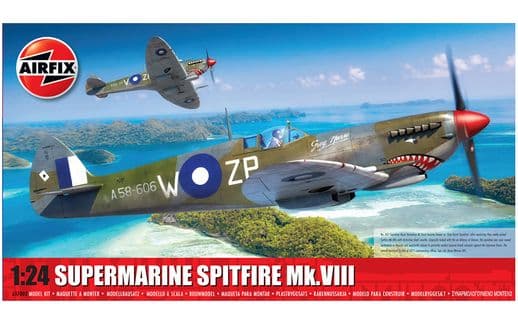
2022 proved to be an exceptional year for new tooling additions to the Airfix range, which included both the Avro Anson and the Blackburn Buccaneer in 1/48th scale, however, when a new Spitfire joins the Airfix range, that will always take top billing, particularly if that kit is in our largest 1/24th scale. A modelling phenomenon which began back in the early 1970s, our 1/24th scale aircraft kit range have always offered modellers the opportunity to build a collection of the world’s most famous fighting aeroplanes in extremely high detail, producing arguably the most accurate, and certainly the most pleasing representations of these aircraft in model kit form.
Continuing this series in fine style, our latest 1/24th scale tooling presented arguably the most famous variant of Spitfire to have ever graced the skies, a stop-gap incarnation of the fighter introduced to meet the challenge posed by the Luftwaffe’s Focke Wulf Fw190A, but one which would go on to become a thoroughbred fighting aeroplane. We have decided to go with this kit above other noteworthy additions to the range in 2022 for a very specific reason. We were all proud when it was decided that this spectacular kit was going to be produced in Britain, however, that pride only swelled further when it was confirmed that this kit proved so popular that we have since produced more examples of it here than Supermarine did the real aeroplane! How could you not love an Airfix statistic like that.
The Supermarine Spitfire Mk.IX variant was arguably the most important mark of Spitfire in the entire production run and for this reason, it is somewhat surprising to learn that it was actually something of a stop-gap development of the fighter. The arrival of the Luftwaffe’s new Focke Wulf 190 fighter over the Western Front in August 1941 and continuing development of the Messerschmitt Bf 109 saw RAF Spitfire Mk.Vs operating over the Channel falling victim to the ‘Butcher Bird’ in ever increasing numbers and something had to be done.
A major Spitfire upgrade was in development at that time, however, that Mk.VIII variant was still some way off, as manufacturing facilities prepared their tooling jigs for the new aircraft, but there was a temporary solution. One of the major features of the new Spitfire was its use of a powerful new version of the Rolls Royce Merlin engine and it was proposed that fitting this new engine to a Spitfire Mk.V airframe would give the fighter a welcome performance boost.
The first 100 Spitfire Mk.IX fighters constructed were actually Mk.Vc airframes adapted to take the new Merlin 61 two stage, two speed supercharged engine, with this combination producing a thoroughbred fighting aeroplane, one which was more than capable of challenging the FW190 and the latest ‘F’ variant of the Messerschmitt Bf 109. In fact, this new variant of the Spitfire was eventually considered so successful that this would become the second most heavily produced variant in the entire production run and if including the aircraft powered by the licence built Packard Merlin 266 (Spitfire Mk.XVI) even eclipsed the Mk.V in production numbers.
With further powerplant refinement taking place throughout the production life of this variant, the first Mk.IX Spitfires started to join RAF Squadrons from July 1942, with this famous mark of Spitfire going on to see service past D-Day and into the post war era. The last major Merlin engine powered variant of the Spitfire, this ‘emergency stop-gap fighter’ actually became something of an aviation classic.
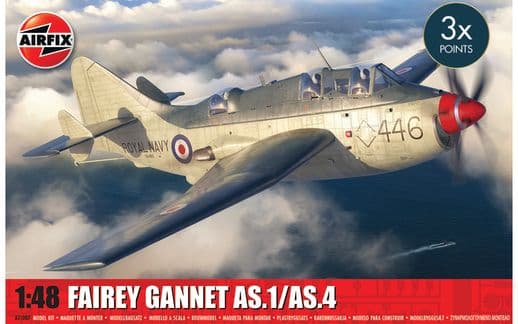
Over the years, modellers have always been able to rely on Airfix to provide a rich variety of subjects to support their continued modelling enjoyment, a list which includes some truly iconic machines. Having said that, if you were looking for a kit which offered a ‘different’ modelling challenge, surely few would have had the impact that the new Fairey Gannet did when it was announced in 2023. Although a subject which will be familiar to many enthusiasts, few would have been expecting a Gannet to be part of the 2023 Airfix range, and less still to see it produced in 1/48th scale.
When contemplating the subject of distinctive British aircraft types of the post war era, it's difficult to think of a type more distinctive or unusual than the Fairey Gannet, particularly if you narrow the criteria to aircraft which operated from the decks of the Royal Navy's relatively small aircraft carriers. The first British designed aircraft in Fleet Air Arm history to combine both search and strike roles when it came to protecting ships from enemy submarine activities, the Gannet was developed in response to a 1945 Royal Navy requirement for an advanced carrier-based turbo prop powered anti-submarine hunter killer, one which was rugged enough to withstand the rigors of operation at sea.
Intended to counter the recent expansion of the Soviet submarine fleet at the start of the Cold War era, the Gannet was equipped with all manner of the latest electronic detection equipment and if an enemy submarine was detected, it could be marked, tracked and if necessary, attacked, using bombs, depth charges, rockets and air-launched acoustic torpedoes.
Despite its rather portly appearance, the Gannet was a highly manoeuvrable aircraft and when this attribute was combined with the excellent visibility its pilot was afforded and the considerable power available from its unusual and innovative Armstrong Siddeley Double Mamba powerplant arrangement, proved to be ideally suited to the harsh aviation environment of operating from the deck of an aircraft carrier.
Offensively, the Gannet was definitely not to be messed with, as its large weapons bay was able to carry around 30 different combinations of detection and attack stores, so if you attracted the attention of a Gannet, you were unlikely to escape the encounter unscathed. In strike configuration, the Gannet could be equipped with up to 36 rockets mounted on stations below each wing, which could be used against any number of potential targets, from ships to coastal defences. Just as the Short Sunderland was regarded during the Second World War, the Fairey Gannet proved to be one prickly aviation customer.
As with most range launches, last year proved to be rather spectacular for new tooling additions, and whilst it was difficult to choose just a single project to focus on for the purposes of this article, there was one which simply demanded to be picked, our new 1/72nd scale Boeing Chinook. As one of the most important aircraft of the post WWII era, the Chinook is a massive helicopter which can do things which seem to defy the laws of physics, and since a single RAF example served so valiantly during the Falklands War, the Chinook has gone on to become an aviation icon in British service.
When it comes to describing an aircraft type which possesses incredible role versatility as standard and is able to turn its abilities to a seemingly endless list of operational taskings, surely there’s no other aircraft currently in service that comes close to matching the capabilities of the mighty Boeing Chinook. A heavy lift helicopter which has proved just as proficient when providing medivac support for British troops in the deserts of Afghanistan, as it is serving as a ‘Damfixer’, when the retaining wall of a UK dam is about to fail and needs the urgent placing of shoring ballast, the Chinook is an invaluable aviation asset and one which has worked its way into the affections of both military personnel and the general public alike over the past four decades.
An extremely impressive machine, the Chinook made its first flight back in 1961 and since that date, has gone on to become one of the most effective aircraft designs of the post war era, one which can operate in almost any environment, no matter how inhospitable the terrain. Clearly, this has made the Chinook invaluable when performing a great many roles and certainly when it comes to British military operations where troops are on the ground, they won’t go unless Chinooks are there to support them.
An indication of just how successful the RAF’s Chinook force had proved to be over the years, the fleet has benefitted from almost constant upgrade and additional procurement, with the aircraft unquestionably becoming an essential component of Britain’s military capabilities. This upgrading of capabilities has kept the Chinook at the forefront of world helicopter technology, and currently, it appears the only aircraft capable of replacing a Chinook is another Chinook, a situation which doesn’t seem likely to change for many years to come.
Hopefully you will agree that just like the modelling Oscars, the above selection represent a glittering array of new tooling stars which were all announced over the past few years which are worthy of note, with all representing our desire to keep the Airfix kit range both vibrant and current within the hobby. Hopefully, at least one of the above will be amongst your own personal favourites and may even be residing amongst your own collection, in built model form.
As for the new model range, we don’t have to wait long now to see if that new tooling project you’ve been hoping to see has taken its place in the latest Airfix range, and which classics from previous ranges has been allowed to captivate a new modelling audience.
One thing you find when you start getting older is how we struggle with, and even sometimes rebel against change, as if somehow changing something you’ve been used to for quite a while is something of a personal affront. This flies in the face of the old saying that ‘a change is as good as a rest’, but for something as iconic and personal as the Airfix logo, which camp would you place yourself in?
The image displayed above show how the Airfix logo has changed over the past 80 years or so, and how some of those changes were really quite subtle. After all, you don’t change a winning formula, or at least that’s what marketing gurus will have us all think. The interesting thing about this collection of logos is how it dates us all as modelling enthusiasts, and how our own particular modelling history will probably revolve around one of the logos displayed, and the corresponding decade throughout which they were prevalent.
For me, the 1970s and 80s were most definitely my era, even though I have kits featuring all those displayed somewhere within my collection. From a hobby perspective, these famous logos and the branding presentation which went hand in glove with them were a feature of model shop displays and Airfix sales outlets everywhere, not to mention our formative years, and wherever we saw them, we knew we were in our happy place.
Having said all that, as we prepared to enter the second half of the 2020s, the Airfix team started to look at how our logo has evolved over the previous 85 years and how it appears today, not only on our kit presentation, but across a new digital world. If we were being honest with ourselves, whilst we’re all passionate about the brand we’re fortunate to represent and the logo we rally behind, the current incarnation had started to fight us a little when it came to the modern marketplace, with some elements simply not being practical for continued use.
That being the case, and most definitely not wanting to make a change just for changings sake, we looked at how we could change our logo without losing any of its identity and charm, but whilst at the same time, making it more appropriate for today’s modern, multi-channel, digital world. We knew the changes would have to be sympathetic, almost subtle ones, whilst at the same time, making the logo and the representation of it more user friendly across many channels.
So here it is and we’re rather proud of it. Clean, clear, yet still 100% Airfix, but can you tell the difference? In the words of our Head of Brand Dale Luckhurst, ‘If not, I’ll take that as a win!’ A subtle evolution of a famous brand logo, we’re pleased that the changes we needed to make didn’t take us too far away from what we all know, and love and we look forward to taking the revised logo forward into 2025 and beyond.
As you would expect, with range launch just around the corner, the Airfix team are usually extremely tight-lipped at this time of the year, just so we don’t give too much away regarding the new delights the Airfix website will be showcasing in just a few days’ time. Having said that and most definitely breaking with usual tradition, our Researcher Clint must be a fan of knowledge based quiz shows, particularly those which require plenty of lateral thinking, because he’s supplied us with an extremely cryptic clue connected to one of the new toolings about to be announced.
Clint sent us the image displayed above and told us that it was linked to one of the new tooling announcements about to be made in our latest range launch, but when he asked us to guess which one, we were all left scratching our heads. When he subsequently went on to reveal the link, we were still scratching our heads and have to say that if you get it, you deserve the scoop. If you manage to fathom this one out, you should be contacting the BBC and securing a place on that unbelievably difficult quiz show 'Only Connect', hosted by Victoria Coren Mitchell, you would be that good.
The only clue that we’re allowed to give you is that this is a picture of a famous monument in France, but that’s it, the rest is up to you. If you manage to get it from that, you are very special, and we’d like you to come back and help us with our lottery numbers next week please. Amidst the excitement of range launch in the next edition of Workbench, we’ll be sure to explain how the picture is linked to one of the new tooling projects for 2025, but if you think you’ve worked it out, please do drop us a line at workbench@airfix.com and we’ll be sure to mention you too.
Despite the fact our latest selection of new model tooling projects will always take star billing in any range launch review, Airfix regulars will be only too ware that the majority of any Airfix range consists of existing toolings which are either being carried over from the previous range, or are being re-issued with new box artwork, new scheme options, and possibly additional components to allow a different variant of the kit subject to be built. For that reason, we didn’t want to end this latest blog without bringing you an image update from a kit which is already a range favourite.
As one of the most successful bomber aircraft of the Second World War, the North American B-25 Mitchell saw service in most theatres of operation during the conflict and were used by several of the Allied air forces. Of almost 10,000 aircraft produced, the gunships which operated throughout the Pacific Theatre were some of the most heavily armed aircraft of the entire war and underlined the flexibility of an aircraft which was also used to mount the famous ‘Strike back’ Doolittle bombing raid against Tokyo in April 1942.
A kit which was welcomed into the Airfix range around this same time last year, let’s use the recently available built model images to showcase the two scheme options on offer with this most appealing kit release.
The hard-working Mitchells of the MTO were tasked with operating strike missions against a wide variety of enemy targets across North Africa and the Mediterranean, including artillery and anti-aircraft emplacements, command and control infrastructure, shipping, military vehicles and enemy airfields, usually at relatively low altitudes and always under heavy enemy fire. With American air units arriving in North Africa from the summer of 1942, it wouldn't be too long before the B-25 Mitchells of the 321st Bombardment Group joined them, with their aircraft having negotiated the long South Atlantic Ferry Route to get there. With staging points in the West Indies, South America, Ascension Island and Africa, this was a much longer route to fly that the Northern Route which arrived in Scotland and consequently, was significantly more expensive from a fuel perspective. They did, however, avoid facing the full might of the Luftwaffe by not transiting across Europe, as they headed for their new bases in the deserts of North Africa.
These aircraft were prepared for operations under desert skies by having their olive drab upper surfaces overpainted in a sand coloured paint finish, with their undersides benefitting from a lighter grey scheme than usual, however, once Allied advances had taken the B-25s onwards across the wider Mediterranean, additional camouflage mottling was often added to sand coloured aircraft, even though the increasing strength of Allied air power in the region rarely saw them operating without strong fighter protection.
Making their combat introduction on 15th March 1943, the bombers of the 321st BG attacked the airfield at Mezzouna escorted by a large force of P-38 Lightning fighters from the 57th FW. Although all aircraft returned safely to Aïn M'lila, they did encounter ferocious anti-aircraft fire around the target area, something crews knew they would have to get used to and fast!
The unit had its first encounter with enemy fighters whilst engaged in an anti-shipping strike just five days later, which was something else crews would have to get accustomed to. The bomber force was attacked by around 30 Axis fighters operating from their bases in Tunisia, however, the enemy appeared unaware that the Mitchell's defensive armament had recently been improved with the addition of higher calibre weapons. At least seven enemy aircraft were dispatched for the loss of just two bombers, with both of these being as a result of anti-aircraft fire, as opposed to enemy fighter actions. Not a bad start for the desert Mitchells.
This beautiful North American B-25C Mitchell which would fly more than 80 combat missions in a frenetic ten month period.
Within a few short weeks, the battle of Tunisia had been won, and the Allies now had their base from where offensive operations throughout the wider region could be mounted. The B-25 was quickly earning a reputation for both combat effectiveness and general survivability, something which would earn it the respect of air and ground crews alike. Indeed, the Mitchell proved so effective that Axis fighter units took to adopting drastic, if ultimately futile tactics, those of flying above bomber formations and attempting to drop bombs on them. As you might well imagine, results proved disappointing to say the least.
The 445th BS and wider 321st BG would go on to play significant roles in the invasion of Sicily and onwards into the so-called ‘soft underbelly’ of Europe, as the Allies continued their sweep towards eventual victory.
A particularly attractive US 12th Air Force B25C Mitchell, this machine is representative of the first such bombers to arrive in North Africa and one which was destined to highlight the rugged, highly effective reputation this medium bomber would earn. She was one of the original 445th BS Mitchells to make the long journey to North Africa from the US in February 1943 and would eventually be credited with completing an impressive 80 plus missions over a ten month period. On 13th January 1944, this aircraft would suffer multiple flak strikes during its latest combat mission, rupturing hydraulic lines and making a forced landing back at base inevitable. Although the pilot performed a textbook wheels up landing, this aircraft, one of the oldest still flying with the unit, would not take to the skies again following the incident.
The flamboyant nose artwork applied to this B-25 was unusually carried on both sides of its fuselage and presumably references some form of gambling activity, or perhaps was just one of the crew's lucky number. If we’re a little wide of the mark in this assumption, perhaps one of our knowledgeable readers could shed some light on the subject for us.
The importance of America's decision to establish their Lend Lease bill cannot be overestimated, being particularly important during the months prior to, and immediately after America entered the Second World War. Allowing current and future allies access to a huge arsenal of military equipment and supplies, the bill enabled beleaguered nations to keep fighting against Axis forces, where if left to their own supply capabilities, would probably not been in a position to continue doing so. Aircraft were to play a significant role in this arrangement, with several nations benefitting from the supply of some of the latest US aircraft designs.
The Soviet Union would be significant beneficiaries of this arrangement, with their Air Force officials travelling to the US during August 1941 in the hope of securing American heavy bombers. They were looking to obtain B-17 Flying Fortresses, however, the Americans were reluctant to let these go, instead steering the Soviets in the direction of twin engined B-25 Mitchells and B-26 Marauders, aircraft which were still larger than the ones Soviet forces were used to flying operationally. This period was a time of some mistrust from the Soviets, despite the generosity of their American friends and their genuine best intentions, those initial dealings proved difficult to say the least.
The first two Soviet B-25s arrived in Russia aboard a cargo ship, but they were soon receiving hundreds of aircraft via the North-western Ferry Route between Alaska and Siberia. As you might imagine, not all of these aircraft were immediately pressed into operational service, some were sent to 'official' locations, where engineers and technicians dismantled and assessed every aspect of their design and construction, hoping to learn as many lessons as they could from America's impressive industrial capabilities in modern aircraft production.
Although classed as superior to the indigenous Soviet Pe-2 and Tu-2 twin engined bombers in many respects, the initial introduction of the B-25 in VVS service did not go terribly well. With the aircraft operating in daylight at lower altitudes and in support of ground units, they suffered at the hands of Luftwaffe fighter and anti-aircraft units. This resulted in a switch to night bombing operations, a role in which these American classics excelled. Using the aircraft's excellent navigation and sighting equipment, Soviet Mitchells were used extensively to target railway junctions, German airfields and areas of stubborn German troop resistance, all intended not only to break their supply lines, but also to demoralise their fighting spirit.
Such an interesting scheme, a Mitchel in Soviet Air Force markings will certainly create something of a talking point within any collection of built models.
On the night of 30th December 1942, Soviet Air Force B-25 Mitchells attacked the rail yards at Vitebsk, destroying at least 24 locomotives and hundreds of loaded goods wagons, starting an inferno which was said to have lasted for three days.
The Mitchells proved so successful in this night role that they would often be used to lead huge raids consisting mainly of Soviet bomber types, pinpointing targets for the following main force to attack. By the beginning of 1944, 10% of the Long-range Aviation Units which made up this branch of the Soviet Air Force were American built B-25 Mitchell bombers, with 877 (plus a further 9 lost in transit) aircraft eventually supplied to the Soviet Union.
Initially, aircraft were supplied to the Soviets finished in a camouflage scheme of Field Drab, Olive Drab and Slate Grey upper surfaces, with the undersides finished in black, however as the war progressed, later aircraft in the supply run were delivered wearing the standard USAAF colours of Olive Drab upper surfaces, with Neutral Grey undersides. Whichever scheme the aircraft wore, they were all at risk of receiving a liberal coating of hastily applied whitewash during winter months.
This particular Soviet Air Force B-25D Mitchell flew with the 1st Squadron, a unit under the command of Alexander Ignatyevich Molodchy, one of the most famous heroes of the Soviet Union and at that time, the only person alive to have been twice bestowed the title of 'Hero of the Soviet Union'. He would eventually fly well over 300 operational missions, mainly by night, but hitting strategically important targets across Europe with unerring success, a number of which were flown in the B-25 Mitchell.
Full box artwork presentation for this latest B-25 addition to the Airfix kit range which is just about still available.
Definitely an oldie but goodie, this latest North American B-25 Mitchell release is available now, and is even currently available with a handsome discount, whilst stocks last. It would make for a fine project with which to embark on another year of modelling.
We are afraid that's all we have for you in this latest edition, but we will be back next Friday with more project development updates and the very latest Airfix kit exclusives. In the meantime, we are always keen to hear your views on all things Airfix and in particular, any thoughts and opinions you may have regarding our Workbench blog. If you would like to drop us a quick line, could we please ask that you use our workbench@airfix.com email for all correspondence.
To re-visit any of the Airfix blogs we have produced over the past seven years or so, please head to our main Workbench hub, where you will find our entire blog back catalogue and all the Airfix design projects we have already covered.
All our dedicated official social media sites can be accessed by clicking the respective link icons at the foot of this page, or by heading to the Airfix homepage. Other useful Airfix links are:
Facebook, YouTube, Twitter and Instagram official sites
Please join us for more Airfix updates next week and thank you for your continued support.