
Welcome to the latest edition of our weekly Workbench blog, and all the news, updates, and modelling exclusives from the fascinating world of Airfix.
We seem to have started this year with a succession of different kinds of blog updates, with the vast majority not conforming to our usual format, but all celebrating the Airfix brand and the simple pleasures of the modelling hobby. We’re pleased to confirm that we remain on that slightly more unusual blog trajectory with this latest edition, but with our ultimate destination being earth’s stratosphere, or to be more precise, an Airfix model kit being sent stratospheric. This is also the reason why we have an extremely rare Saturday evening publication for Workbench this time around, as we play our small part in this fascinating, record breaking project.
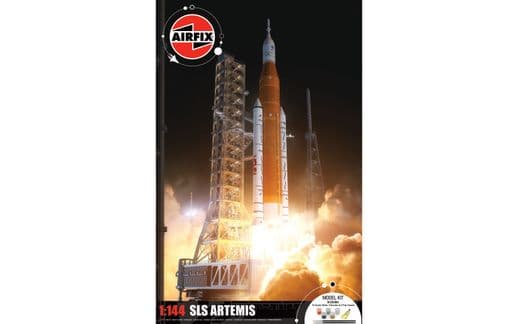
With our recently launched SLS Artemis kit being the focal point for this project, we will be bringing you all the details you will need to have you up to speed with a project that’s out of this world, and a new video presentation that we see us quite literally shooting for the stars. As we create this latest edition, we’re currently T-Minus 2 days and counting until publication launch, but by the time you will be reading this, Lift-Off will have already taken place.
The other big news for the week is that we’re celebrating the 400th edition of Workbench, an Airfix blog phenomenon which began back in the summer of 2015. We know that many of our readers will have been with us since the very beginning and we’re truly humbled by your loyal support, so we wanted to mark this occasion with a little competition, with a spectacular kit bundle being up for grabs. You’ll find details about the competition in the blog section after the main event, so please do stick with us right till the end.
At 400 not out, we have an edition of Workbench aiming to go where no Airfix blog has gone before.
For an entire generation of the world’s population, the amazing sight of seeing a man standing on the surface of the moon was something they never had the opportunity to see taking place live on their TV screens, with the result being that this incredible achievement for mankind was somehow not part of our lives. Indeed, as many of us weren’t completely immersed in this historic series of achievements, other incredible machines and pressive human beings attracted our attention, even resulting in the fact that this generation is arguably the most active group of Apollo moon landing conspiracy theorists.
Looking back on my own youth, even though I was aged 5 at the time astronaut Neil Armstrong set foot on the surface of the moon, I can’t say that I recall this monumental occasion having much of an impact on me at the time, or indeed even have memories of my family crowding around the TV watching the spectacle unfolding, even though it would have been headline news everywhere at the time.
A few years later when I was at school, my class used to have to walk the couple of miles to and from our local swimming baths prior to those lessons, and I remember that we must have been quite philosophical for our age back then, as my group of friends often used to discuss having the ability to time travel and where/when we would go, given the opportunity, during the walk to and from the baths. This probably says much about the influences on our young lives back then, and how Dr Who was clearly of more interest to us than the director of the Apollo programme.
As I had already become fascinated by aeroplanes by then, my suggestions would always be the wartime years, so I could witness the Battle of Britain, or see large numbers of Sunderland flying boats operating from their coastal bases, but always being conflicted by the desire to actually see a real, living dinosaur for myself, another fascination of mine at the time. Now that I’m older, with a little more life experience under my belt, I would definitely want to go back to a time when I was old enough to be able to experience the entire Apollo programme, both the years leading up to man’s attempt to land on the moon, and those historic first steps in the Sea of Tranquillity. Given the chance though, I still wouldn’t mind seeing a dinosaur of two as well, if you don’t mind.
For those lucky people who remember witnessing the moon landings during the summer of 1969, the events of that particular year will no doubt be remembered as perhaps the most significant in their lives. They, and the rest of the world, watched in absolute amazement and probably some disbelief, as the crew of the Apollo 11 moon lander set foot on the surface of the moon, with astronaut Neil Armstrong delivering his iconic , “One small step for man, one giant leap for mankind” quote. Those words also proclaimed America as the lead player in this incredible space race, which was surely the main purpose of this incredibly costly exercise.
Although the cultural and historical significance of that first lunar roam can’t be overestimated, 53 years (and counting) without a human being walking on the surface of the moon has resulted in space exploration bypassing huge numbers of people during that time, and even though the Space Shuttle always managed to thrill during every launch and recovery, and the technologies utilised always finding their way into our everyday lives in a positive way, did it really captivate as overwhelmingly as the Apollo programme did?
As for Apollo, six mighty Saturn V rockets powered astronauts to the moon, with Apollo 11 being the first, and Apollo 17 being the last. Only twelve American men have ever set foot on the surface of the moon, with everybody knowing that Neil Armstrong was the first, but who was the last? Surely occupying just as significant position in human history, that man was Eugene Cernan, the last man on the moon.
As he was about to climb the ladder into the Lunar Lander for the final time, he delivered a speech equally as memorable as the words uttered by his predecessor in the summer of 1969. ‘As I take man’s last step on the surface and head back home, I’d like to say what I believe history will record. America’s challenge of today has forged man’s destiny of tomorrow, and as we leave the Moon at Taurus, we leave as we came and, God willing, as we shall return, with peace and hope for all mankind. Godspeed the crew of Apollo 17’.
Astronaut Eugene Cernan is also one of only three men to have travelled to the Moon twice, and one of only two men to flown in two different Apollo Lunar Modules in space while not docked to the Apollo Command and Service Module, both times near the Moon. Although he’s no longer with us, those words spoken in December 1972 ultimately proved to carry even greater gravitas than he possibly intended back then, as we are currently at 53 years and counting since a man has stood on the surface of the Moon. That being said, there is currently light at the end of the telescope, as NASA’s Artemis Programme intends to continue man’s Lunar exploration heritage.
To this point, only the mighty Saturn V rocket has powered man to the moon – will SLS Artemis join it in the history of man’s exploration of space?
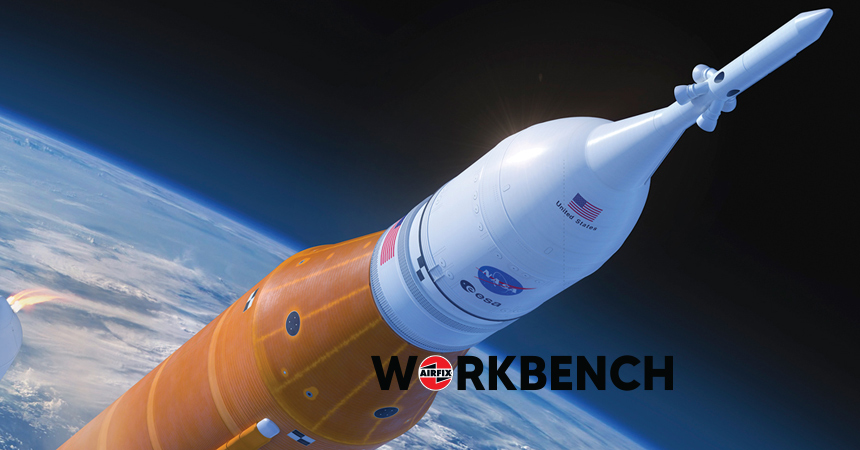
Allowing the current population of the world to re-engage with the thrill and drama of space exploration, NASA’s Artemis Program plans to support further Moon landings in the years to come, with the Space Launch System surely holding the potential to become one of the most famous machines ever created by man. That being the case, SLS Artemis was clearly of interest to the Airfix team, with a desire to see a beautifully crafted scale model representation of the rocket in the range being something of a subject priority. The successful test launch of Artemis 1 in November 2022 only increased the need for this to become a priority project, with the resultant kit being announced as a new tooling addition to the 2025 range in January last year.
As we were going to be needing a new model tooling that was going to boldly go where no Airfix kit had gone before (well, at least for a few years anyway), we needed a designer with astronaut credentials, a man whose stellar talents position him as one of humanities most impressive beings, and we knew just such a person.
Although Airfix Senior Product Designer Paramjit Sembhi is better known for bringing us such new tooling masterpieces as the 1/48th scale Blackburn Buccaneer and recently announced Phantom FG.I in the same large scale, he told us during our Artemis designer interview edition of Workbench that he was really excited when asked to work on this stellar project. Even though he knew this design project would be very different to anything he had tackled previously, he was really interested in space exploration, and couldn’t wait to get started on this significant new model tooling for the range, particularly as he knew the real craft would be the subject of so much attention in the years to come.
Bringing NASA’s space exploration endeavours and Moon landing intentions right up to date, SLS Artemis represents a new generation of super heavy lift launch vehicles, and has been designed to be ‘evolvable’, changing over time, being adaptable enough to be used to carry numerous different payloads into space as different mission profiles dictate.
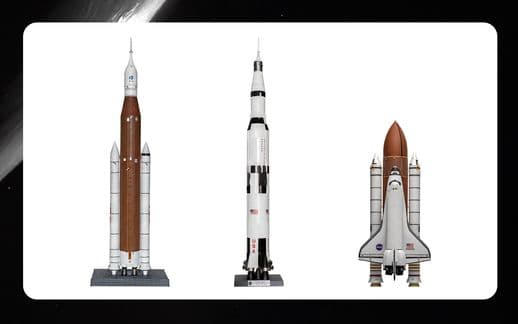
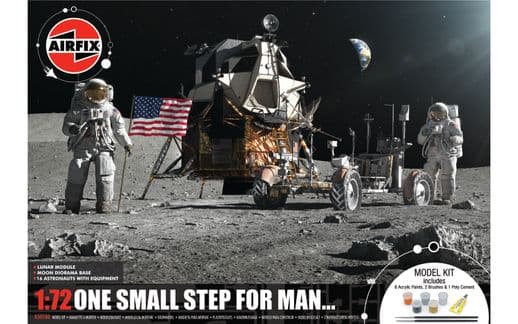
Gravity escaping trio. The Airfix space range provides us with the opportunity to create a scale modelling tribute to man’s lunar endeavours.
This incredible amalgamation of the latest cutting edge technologies will allow a new generation of the earth’s population to witness the development and ongoing achievements of a contemporary NASA space program, as the Space Launch System is their latest and most powerful rocket launch system to date, one intended to take mankind back to the surface of the Moon and beyond.
The latest generation of super heavy lift launch vehicles, to the uninitiated, SLS and the Orion spacecraft capsule almost appear to be something of a combination of both Apollo and Space Shuttle technologies, however, this incredible program does represent the absolute pinnacle of engineering technology as we know it today, and the means by which man will venture deeper into space than ever before. Blasting off from launch pad 39B at Kennedy Space Centre in Florida for an unmanned maiden launch on 16th November 2022, the Artemis generation began in successful manner, with the new spacecraft harnessing 8.8 million pounds of thrust from its outer solid rocket boosters and main Aerojet Rocketdyne RS-25 engines.
Only last week, the latest important date in the Artemis Programme calendar saw a practice launch sequence having to be shut down following the discovery of a liquid hydrogen leak, a development which whilst creating a frustrating delay, highlights the safety parameters the NASA team operate within when perfecting this incredible launch system. As they are currently preparing to send a manned Artemis mission to orbit the moon, NASA are being rightly cautious about every aspect of the SLS’s preparations, something which dictates that delays and mission cancellations are both possible and probably likely, but with the ultimate aim of returning humans to the surface of the moon being their ultimate goal.
Artemis II will see four astronauts undertaking a lunar fly-by mission, a 10 day sortie to the dark side of the Moon (the side of the Moon we never get to see from Earth) 230,000 miles away from Earth, where they will test and evaluate every aspect of the craft’s performance and technology, prior to the launch of an actual lunar landing mission. The rocket, or Space Launch System, used to get them there will be the most powerful manned rocket to ever launch, but significantly, also serving as the precursor to man’s long awaited return to the surface of the Moon, with the promise of deeper space exploration to follow.
SLS Artemis also presents the current population of Earth with the tantalising prospect of seeing multiple launch events live and in higher definition that ever before, with these events surely being amongst the most spectacular events we’re ever likely to witness. Everything about the Artemis Program is spectacular, from the technology used, to the visual spectacle of the launch itself.
Even before the Space Launch System can stand majestically on its launch platform, it takes this stellar behemoth an incredible 11.5 hours to travel the 4 miles from its Vehicle Assembly Building to the launch pad, on the only Crawler Transporter Vehicle capable of supporting its massive weight. This equally impressive machine travels at a maximum speed of just 1 mph, significantly slower when negotiating a bend, just another indication of how everything connected with this program is impressive and totally captivating.
An Airfix new tooling project which is truly reaching for the stars. As the world watched the Artemis project with fascination, surely this new kit is destined to become one of our most popular model kits of the current era.
Ultimately, it’s intended that SLS Artemis technology will drive NASA’s space program for decades to come, with this impressive space delivery system evolving to adapt to different mission demands, and the size of payloads needing to be delivered into space. Indeed, as the weight of those payloads increase, so will the capability of the rockets needed to power them, as the Artemis Generation will create rockets which become ever more capable and ever more powerful, claiming ever more records and achievements in the process.
This latest practice sequence abort has pushed launch date for Artemis II back a little, but it’s hoped that SLS will power humans back into Moon orbit at some point during 2026, which is highly appropriate for the project. 2026 will see America celebrating their 250th anniversary, and the two solid rocket boosters carry the 250th logo which is going to be seen everywhere with US connections this year, hopefully including in space, or to be precise, in the Stratopause.
It’s interesting to note that in this year of ‘America 250’, engineers and technicians from every state in America have brought their talents to bear on the Artemis program and SLS rocket, so it will be more than fitting if this first manned mission takes place during 2026. Thankfully, we’ll be in pole position to watch as this historic event unfolds on our high definition TV screens.
From a space exploration perspective, we currently find ourselves at the beginning of an exciting new chapter for humankind, many of whom will have never seen a live manned space launch before in their lives. Destined to captivate audiences old and new, SLS Artemis will take mankind’s desire to explore space and new frontiers to new heights, with the drawdown in associated technologies going on to benefit everyone over the coming years.
As we prepare to witness mans ‘Next Beginning’ in space, what achievements will Artemis missions be claiming in the years to come, and how many of us will be able to hear the iconic speeches of men such as Neil Armstrong’s and Eugene Cernan in real time, as they are transmitted in real time?
Already a model achievement, could our new SLS Artemis kit be sent stratospheric?
With the successful launch of our own scale representation of SLS Artemis, and with this year being such a significant one for the actual Artemis program, the Airfix team started to ponder if there wasn’t something more we could do with the kit, perhaps something which potentially brought both programs together. When marketing new kit releases, we often raise awareness by creating bespoke content where the kit meets the real subject which inspired its range inclusion in the first place. That’s fine if it’s a restored Helicopter in southern England, or a military vehicle in Shropshire, but the latest cutting edge rocket technology in NASA’s back yard? Now, that was going to be some challenge.
What started as a light-hearted discussion amongst members of the Airfix team started to gain some traction when we considered what it would take to get one of our SLS Artemis kits into space. Obviously, our initial thoughts leaned towards a NASA tie up and the possibility of a model being part of a future launch event, but we quickly discounted this as being something of a pipe dream, and even if it were possible, would likely be prohibitively expensive.
That’s when one of the team came across a specialist company who have perfected the unusual art of sending products into space for marketing or social media purposes, and a plan started to take shape, but how on earth could we make this happen? Contact was made and discussions had, and for a business who usually send such items as beer and food, or toys and electrical goods into near space, the chance to work with a scale model of an SLS Artemis rocket must have been more closely aligned to what they’re actually interested in.
Shooting for the stars. The following series of pictures were all taken during the recent stratospheric attempt to send our SLS Artemis model kit where no Airfix model kit had ever gone before.
The company we contacted are based here in the UK, but have undertaken launches all around the world, using advanced high altitude balloon and photographic technologies to create some truly unique and inspirational advertising and product awareness opportunities. The mode of transport for these projects are the same kind of high altitude balloons which are used to obtain weather and atmospheric data, tried and trusted technology which has been adapted to provide this unique product awareness opportunity, with the resultant content not only being a fascinating watch, but also having a positive commercial impact on the items transported to such lofty altitudes.
The race was now on to see if we could adapt this successful launch system to take an Airfix model where no other Airfix model kit had gone before, and even if such a thing would be possible, accepting that the process must be subject to vibration and high winds – would our scale SLS Artemis prove as robust as the real thing? Both teams worked to make a launch event a reality, with a beautifully finished model sent over to the team for testing. Of course, it wasn’t just about getting the model to near space altitude, but filming the process in real time, and the closer we got to launch day, the more excited we were getting.
That launch date event was scheduled to take place on Saturday 31st January just passed, with the launch location being Upstate New York, just a few hours prior to the latest planned NASA Artemis test. With altitude information being available in real time to the team, we could see that the launch had taken place, and could clearly see the incredible altitudes our SLS Artemis model had hopefully attained, but we were going to have to wait a few days for video evidence of this incredible journey and the media footage we were hoping to receive, and share with our followers.
That is the reason why this latest edition of workbench is the first in 400 editions to be posted this late on a Saturday evening, as it had to be after we made the final project video available on our social media channels, allowing us to embed that video within the body of this latest blog.
Not only was this project a spectacular success, but it also brought record recognition for our stellar model kit.
Airfix SLS Artemis model kit, a certified record breaker.
As we now look back at an incredibly successful project, we’re pleased to be in a position to tell you that both launch and recovery were an Airfix modelling success, although we did initially lose the Orion section on re-entry. Fortunately, this was recovered by the team in the US, and we are incredibly grateful to them for their superhuman efforts.
Incredibly, the model itself is a record breaker, and has been verified as now holding the record for being the ‘highest altitude attained by a scale model rocket aboard a high altitude balloon’. Once we get our record breaker back, we hope it will take pride of place in our Wonderworks display at Margate, on its way to potentially becoming one of the most famous individual kits in the long and impressive history of Airfix.
This project obviously resulted in the creation of some truly spectacular images, with our SLS Artemis model kit truly reaching new heights, pictured with a backdrop we could have only dreamt of when first contemplating our post launch marketing strategy.
Congratulations to everyone involved, especially the launch team in the US, who truly had us shooting for the stars.
We hope you enjoy our own scale SLS Artemis model launch video presentation.
Can you believe that it will be eleven years this summer since we published our very first edition of Workbench? Back then, we were conscious of the fact that in the main, the only time modelling hobbyists heard details regarding the latest developments here at Airfix was on range launch day itself, and we wanted to do something about that. With the full support of the design, development and marketing teams, we decided to unlock some of these Airfix secrets in a much more timely manner than our audience was used to, and thankfully, thousands of you decided to join us right from the start.
With a desire to provide our readers with regular insights behind the scenes at Airfix, Workbench has been honoured to be in a position to bring our readers the very latest information, updates and exclusive images from the most eagerly anticipated new tooling projects currently underway. Over the years, each new edition has been packed with exclusive content, reader supplied articles and interesting modelling related features, and importantly, if you want to be the first to find out about new model tooling announcements, or see the latest box artwork reveals in all their glory before anyone else, then Airfix Workbench is definitely the blog for you.
As far as we’re concerned, there’s an interesting story behind every one of the kits featured in the Airfix model range and our Workbench blog is the place where you can discover everything you need to know.
Now with over ten years under our blog belt, this latest edition marks 400 and counting for Workbench, and whilst this is a proud achievement for us, we definitely couldn’t have done it without you, and the entire Airfix team would like to thank you for your exceptional support. Whether you’ve read a handful of blogs, or the whole 400, we will always be grateful for your support.
Just an image for illustrative purposes, one lucky winner of our 400th edition competition will bag a spectacular bundle of Airfix kits worth £400, enough to keep you busy as we heat towards 500!
On such an auspicious occasion as this, even though our stellar record breaking Artemis model is unquestionably the story of this latest edition, we couldn’t let the 400th edition pass without marking it with a suitable competition for our readers to enter.
Up for grabs is an anniversarytastic bundle of kits to the value of £400.00, as we thought this to be a most appropriate amount for this landmark edition, and what’s more, you don’t even have to answer a question to be in with a chance of winning.
All you have to do is to access our competition page HERE and:
• Fill in your name and email address where indicated
• On the next page, select up to 6 social media platforms to follow Airfix on – each follow qualifies as an entry, and even if you already follow us, clicking the platform will still count as an entry.
Then, simply sit back and keep your fingers crossed.
The competition closes at 23.59 on 28th February, and we’ll be notifying our winner on or around the 6th March.
Full terms and conditions are available on the competition page, should you wish to view them.
Right then, onwards to 500!
We're afraid that's all we have for you in this latest edition of the Airfix blog, but we will be back next Friday with more project development updates and the very latest Airfix kit exclusives. In the meantime, we're always keen to hear your views on all things Airfix and in particular, any thoughts and opinions you may have regarding our Workbench blog. If you would like to drop us a quick line, could we please ask that you use our workbench@airfix.com email for all correspondence.
To re-visit any of the Airfix blogs we have produced over the past TEN years or so, please head to our main Workbench hub, where you'll find our entire blog back catalogue and all the Airfix design projects we have already covered.
All our dedicated official social media sites can be accessed by clicking the respective link icons at the foot of this page, or by heading to the Airfix homepage. Other useful Airfix links are:
Facebook, YouTube, Twitter and Instagram official sites
Please join us for more Airfix updates next week and thank you for your continued support.