
Welcome to this latest edition of our Workbench blog and all the news, updates, and modelling exclusives from the fascinating world of Airfix.
You will have noticed that we have a slightly later publication timing for this latest edition of our Workbench blog this week, but for very good reason. By now, the Airfix events team will be hard at work setting up our display stand at the latest Scale ModelWorld show, and amongst our layout of impressive modelling riches, we have exciting news to share. As of 10am this morning, we were proud to announce our latest new tooling addition to the Airfix range, and it’s BIG news!
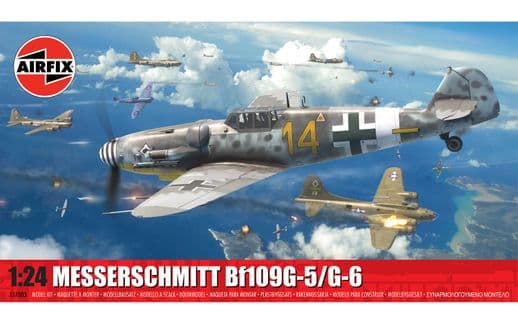
It what has now become something of an Airfix tradition at Telford, the SMW show has regularly seen the team announcing new tooling projects as part of our attendance, with visitors to the International Centre over the weekend being the first to view the new kit in the plastic, whilst also having the opportunity to discuss this and all matters Airfix with the team in attendance. This latest release is something very special indeed, and if some like to challenge us about our fascination for producing kit tributes to the incredible Supermarine Spitfire, we have something very different for you this time around, in the shape of the Spitfire’s aviation arch nemesis, the Messerschmitt Bf 109. A spectacular new design in 1/24th scale, our new kit is a stunning representation of the G-5/G-6 variant of the Bf 109, the most heavily produced of more than 34,000 aircraft manufactured, and one which struggled to stem the tide of Allied air forces until the end of the Second World War.
By way of an introduction to the new kit, we will be bringing you the details behind why the Messerschmitt Bf 109 ‘Gustav’ makes for such an appealing modelling subject, and will have a selection of exclusive imagery to help us do that, from new box artwork and built model images, to details behind each of the FIVE scheme options included with the first release of this new kit.
The exclusive reveal of our new large scale tribute to one of the most significant fighting aeroplanes in the history of warfare is our headline subject for this week’s edition of Workbench.
As we find ourselves in Scale ModelWorld week, we have BIG news to share with you in this latest edition of Workbench.
When it comes to fighting aeroplanes of the Second World War, arguably no other aircraft type represents the inter-war hostile intentions of the German nation than the diminutive Messerschmitt Bf 109 series of fighters, an aircraft designed to dominate the skies, and one which pointed the way towards the very future of fighter aircraft performance. From a development perspective, it would also mirror the Spitfire for development potential and airframe adaptability, with the two types locked in a duel for aerial supremacy for the duration of the war.
The origins of the Messerschmitt Bf 109 fighter go back to 1934, and specifications issued for the production of a new generation of aircraft, a fast and manoeuvrable monoplane fighter at a time when the aviation world was still dominated by biplane designs. As Germany was still bound by the restrictions imposed by the Treaty of Versailles, it’s interesting to note that when the prototype Messerschmitt Bf 109 made its first flight at the end of May 1935, it was actually powered by a British Rolls Royce Kestrel engine, as the aircraft’s intended Daimler Benz powerplant was still in development at that time. Just five years later, the latest incarnations of Daimler Benz and Rolls Royce engines would be powering opposing fighter aircraft during the savage aerial duels taking place in the skies above southern England.
Taking many of its design influences from its predecessor, the extremely successful Bf 108 Taifun four seat sports aircraft, the Messerschmitt Bf 109 was developed for one thing and one thing only, domination the skies. A relatively diminutive aircraft, everything about the new aircraft was cutting edge, from the inclusion of automatic wing leading edge slats to the fuselage mounted fully retractable undercarriage, this aircraft was intended to give the Luftwaffe an advantage when war eventually came, whilst at the same time being relatively easy to mass produce.
When the prototype aircraft made its first flight in May 1935, it looked very different to the front line fighter types which were in service with most of the world’s major air forces at that time. With fast and manoeuvrable biplane fighters very much still the order of the day, Messerschmitt’s sleek, yet powerful monoplane was a completely new direction for aviation, possessing exceptional speed and manoeuvrability, and designed to outfly anything in the skies.
Interestingly, some of the first pilots assigned to fly the new fighter weren’t altogether complimentary about the handling of the Messerschmitt, with its advanced features and very different handling characteristics presumably coming as quite a shock to airmen who were more used to flying open cockpit, wide fuselage aircraft with the perceived security of a second wing. They had to make decisions much sooner in this very different aeroplane, and think much further ahead when flying this cutting edge fighter, but they had better get used to the situation fast, because the page had already turned on the age of the biplane.
Just to keep the new kit suspense going that little bit longer.
Entering service in February 1937, the Messerschmitt Bf 109 would make its combat debut during the Spanish Civil War and whilst it certainly showed itself to be an exceptional fighting aeroplane, those early combat experiences presented an invaluable opportunity for designers to fine-tune the Luftwaffe’s new fighter. They conducted a series of interviews with combat pilots to understand their experiences using the fighter, then went away and incorporated modifications and improvements into subsequent aircraft working their way down the production lines.
By the time Europe descended into its second war in 21 years, many of the Bf 109 fighters committed to combat had benefited from a series of improvements, either during manufacture, or via a field modification programme. Just to go back on this Messerschmitt timeline a little, a fact which places the impact the Bf 109 had on the world of aviation is that in the same month that the Messerschmitt Bf 109 entered service with the Luftwaffe, the Royal Air Force were also introducing their latest fighter into service, the biplane Gloster Gladiator.
The Messerschmitt Bf 109 would go on to form an unbreakable aerial combat bond with the Supermarine Spitfire of the Royal Air Force, with both aircraft types locked in a perceived duel for aerial supremacy for the duration of the Second World War, or at least that’s how it seemed to many observers over the years. Both aircraft proved to be exceptional in the roles for which they were intended, and capable of accepting upgrades, some of which were quite significant. Both would also chart their development upgrades with successive improvements made in their respective powerplants, and how the availability of more powerful engines would usually be the catalyst for incorporating new features and capabilities to each aircraft.
Just as proved to be the case with the Spitfire, later Messerschmitt Bf 109 fighters engaged in the Defence of the Reich were very different aeroplanes to the machines which started the Second World War, even though they were based on the same basic airframe. Adding ever more offensive capability also added ever more weight to the aircraft, so more powerful, fuel hungry variants of the Daimler Benz engine were always needed, arguably turning this fighting thoroughbred into something of a punch drunk prize fighter.
When it comes to fighter aircraft of the Second World War, it has to be said that when it came to the Messerschmitt Bf 109G series, they did exactly what it said on that aviation tin – these were ruthless dominators of the sky, no ifs or buts.
With the basic Messerschmitt Bf 109 airframe proving adaptable enough to accept modification and upgrade throughout the aircraft’s service life, the availability of more powerful engines was always an opportunity taken by Messerschmitt designers to provide their famous fighter with another performance boost. Unfortunately, this would usually come at the same time as redesign and the addition of further offensive capability, all of which would add additional weight to the aircraft.
By far and away the most heavily produced variant of the entire Messerschmitt Bf 109 series was the ‘G’, or ‘Gustav’, the aircraft variant which immediately superseded the thoroughbred ‘Friedrich’, and one which introduced some much needed firepower to the 109. A later variant of the fighter introduced to allow the aircraft to be adapted to take on a variety of different operational tasks with a minimum of fuss, the Gustav was the variant of Bf 109 tasked with defending the Reich against the incessant USAAF daylight bombing raids heading deeper into German controlled airspace, where heavier calibre weapons were needed to bring down these mighty four-engined leviathans.
The first Gustavs to enter service may have incorporated a host of modifications and improvements but visually at least, they still closely resembled the F-4 variant they were superseding. The work of up gunning the Bf 109 soon resulted in the fighter taking on a much less visually appealing appearance, with several lumps and bumps starting to degrade the appearance of this sleek and purposeful fighter, if presenting it with a more aggressive profile. The use of more powerful nose mounted MG 131 machine guns required the need to add bulges to the top forward section of the fuselage just in front of the canopy windscreen, to accommodate the breech blocks of the guns, a development which underlined the fact that this variant of the Bf 109 was intended to be incredibly adaptable.
This model also made use of the latest variant of Daimler Benz engine, the DB605, which whilst providing the fighter with a welcome boost in horsepower, was required to haul the weight of an ever heavier aeroplane around the skies. Field modification packs would also allow the aircraft to be equipped with additional weapons under their wings, which were specifically intended to bring down bombers. These included heavy calibre cannon housed in under-wing gondolas, and 210mm Werfer-Granate 21 unguided air-to-air rockets being carried by aircraft in the same position. These weapons were all intended to wreak havoc amongst the mighty USAAF bomber streams, without requiring Messerschmitt pilots to have to stray too close to the withering firepower the tight box formations of American bombers were able to hurl in their direction.
A Messerschmitt pilot’s office. Having had the good fortune to sit in a Bf 109G cockpit, I can confirm that there’s not much room in there, and it’s certainly not for the claustrophobic.
Despite all the ingenious weaponry these Messerschmitt ‘gunboats’ could bring to bear, the Luftwaffe’s situation was becoming increasingly desperate by this stage of the war, and despite the brave efforts of pilots now fighting to protect their homeland, the tide of the air war had already turned against them, with the outcome now inevitable.
In service throughout the Second World War, the Messerschmitt Bf 109 fighter would undergo almost constant development and upgrade modification, as designers attempted to keep pace with the constant requirement for ever increasing performance, greater range and heavier firepower, a feature which serves to underline the effectiveness of the aircraft’s basic initial design. The final ‘Kurfürst’ K-4 variant of the fighter was the fastest of the Daimler Benz powered 109s, and was capable of speeds in excess of 440mph, some 110mph faster than the ‘Emils’ which fought the Battle of Britain during the summer of 1940.
Constantly developed and upgraded, these sleek and cultured late war machines bore little resemblance to the angular fighters which swept across Western Europe in the early months of the Second World War, despite the basic airframe remaining largely the same. Contrary to common misconception, the Messerschmitt remained an extremely dangerous fighting aeroplane throughout the Second World War, and in the hands of an experienced pilot, was more than capable of challenging all the very latest Allied fighters in an aerial combat situation, right through to the final days of the war.
Historically, the Messerschmitt Bf 109 has to be regarded as one of the most important aircraft in the history of military aviation, one which was first committed to the design drawing boards at Bayerische Flugzeugwerke in 1934, but one which would go on to see service and remain in production throughout the Second World War. Although essentially mirroring Britain’s Spitfire from an ongoing development perspective, with the two aircraft locked together in a constant duel for aerial supremacy, whilst the Spitfire continues to be held in great public affection, the Messerschmitt Bf 109 is often regarded as having something of an infamous reputation. This may have something to do with its sinister appearance, but is probably more likely because of the loathed regime it represented, a regime which was intent on imposing its will on the rest of the free world.
With more than 34,000 aircraft eventually produced, the Messerschmitt Bf 109 is the most heavily produced fighter and single seat aircraft in history, one which was responsible for creating more fighter ‘ace’ pilots than any other - a true war eagle of the skies. Although perhaps not as aesthetically pleasing as something like a Spitfire or Mustang, the Bf 109 was bred for combat, and looks exactly like you would expect an aggressive dominator of the skies to look. No matter from which angle you look at it, the Messerschmitt Bf 109 makes the hairs stand up on the back of your neck, because deep down, you know this particular fighting aeroplane would love to make you its latest victim.
Not a Spitfire, but its arch aviation nemesis, our latest new 1/24th scale tooling is a Messerschmitt Bf 109G-5/G-6 tooling, complete with no fewer than five fascinating scheme options.
As the great and the good from within our beloved hobby head for this weekend’s scale modelling extravaganza at Telford’s International Centre, its only right that we help mark the occasion by announcing our latest new tooling project and for 2025, and we’re going BIG! Our previous Messerschmitt Bf 109 kit in 1/24th scale was unleashed on the modelling world back in the early 1970s, a Battle of Britain era ‘Emil’ variant that many modellers will regard as playing a significant role in their hobby lives. Now though, our talented design team have recreated the later ‘Gustav’ variant in scale kit form, and it’s a thing of beauty, something to allow modellers to produce another stunning large scale example of this most famous of fighting aeroplanes.
Visitors to the Airfix stand at Scale ModelWorld this weekend will be able to see the new kit in all its glory, with built examples, part frames and part builds all laid out for their inspection, and of course, our expert designers and researcher will be on hand to field any questions you may have on the subject. The kit is supplied with paint masks for finishing the cockpit, but we will have all these details, plus pictures from the show in a forthcoming edition of Workbench.
For now though, can we just confirm that by the time you’re reading this latest edition, the BIG news will be out and the product page for the new 1/24th scale Messerschmitt Bf 109G-5/G-6 kit will already be live on the Airfix website. That being the case, let’s now take a closer look at the FIVE scheme options which come with this initial release from the tooling, the first three of which relate to the same aircraft, but operated by German, American and British air forces.
When looking at the presentation of this particular Messerschmitt, it really isn’t hard to see why the Bf 109 continues to be such a source of fascination for modellers and historians everywhere. Whether it’s the threatening, purposeful lines of the aircraft itself, or the sinister looking camouflage markings applied to the aircraft, it possesses something of a morbid fascination for many, an enemy aircraft you know you shouldn’t really like, but just can’t help yourself.
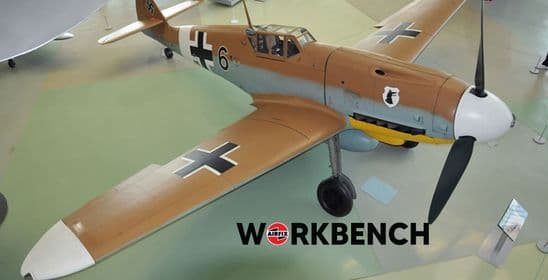
For many UK based aviation enthusiasts, having the opportunity to see Bf 109G ‘Black 6’ displaying on the circuit only served to make this the most interesting historic aircraft we were ever likely to see, a genuine war veteran Messerschmitt Bf 109 powered by an extremely rare Daimler Benz DB605A engine. When this magnificent aircraft blasted into the circuit at IWM Duxford for its first display, it sounded so different to the Rolls Royce Merlin, Allison and Pratt & Whitney engines we were used to hearing, that we were instantly hooked, and if the aircraft were still flying today, I suspect it would have secured even greater legions of followers by now.
Just like a spider, scorpion or shark, the Messerschmitt Bf 109 was something you really shouldn’t mess with, but you can’t help being fascinated by it at the same time.
This aircraft is presented in the colours of Jagdgeschwader 53 ‘Pik As’ (Ace of Spades), one of the oldest and most prestigious Luftwaffe units of the entire Second World War, and tracing its origins back to 1937. Fighting in France, during the Battle of Britain, in the Soviet Union and in Italy/Sicily, elements of JG53 were committed across three different theatres at one stage of the war, such was the increased pressure they were coming under by Allied Air Forces at that time.
This first scheme option hits us hard, but don’t press the trigger just yet, we have more schemes to tempt you with, including two more featuring this very aircraft.
The entire unit was sent to operate from Sicily against the RAF on Malta from the end of 1942 and whilst they would initially have given an extremely good account of themselves in their latest Messerschmitt fighters, the Allies were on the move by that stage of the war and there would be no let-up in the relentless pressure being exerted on Luftwaffe fighter units in the Mediterranean. With the situation getting worse by the day, JG 53 were finally withdrawn from Italy in October 1943, and would become the first unit specifically assigned to Defence of the Reich duties.
Upon hearing the news that Allied forces had landed on Sicily, the official staff of JG53 at Comiso immediately ordered all serviceable aircraft and supporting staff to leave their home airfield at Ramacca, and make for the less vulnerable operating airfield at Catania on the east coast of the island. All non-essential equipment was either destroyed or abandoned prior to the move, which included the lame duck aircraft. For some reason, this particular Bf 109G-6 was left relatively intact, unserviceable at the time, but not destroyed by the German sappers, where she was later discovered by Allied troops liberating the airfield.
The fighter was manufactured by Erla Machinenwerk at Leipzig in March 1943, and was finished in the standard factory finish of the day, with yellow cowling recognition markings and white fuselage theatre band. She is a fine representation of a late 1943 Messerschmitt Bf 109G-6 from this period of the war, complete with her underwing 20mm MG 151 cannon gondolas, a weapons upgrade which was issued to allow pilots to better deal with the increasing number of Allied heavy bombers they were facing.
Although she was a fine representation of a Luftwaffe fighter at that time of the war, she would spend the next few months operating in very different markings and in very different circumstances.
It has to be remembered that when Allied troops were liberating airfields which until recently had been under the control of Luftwaffe units, even though they may come across aircraft and artifacts they found fascinating, they were still at war and as such, there were definitely more pressing matters at hand. That being said, with Axis forces now on the back foot, there were some opportunities where abandoned aircraft afforded the opportunity for a little recreational time, including crawling all over the abandoned aircraft of your adversaries.
Its thought that Messerschmitt Bf 109G-6/Trop W.Nr. 15270 ‘Yellow 14 and bar, which was left abandoned by a retreating and re-grouping Jagdgeschwader 53 was first discovered by British and Canadian troops who had landed on the southern tip of Sicily, with wartime photographs showing the aircraft being inspected by British troops with its underwing cannon gondolas still in place.
It appears that soon after the invasion had been successful, the aircraft and support personnel of the USAAF 57th Fighter Group (US 9th Air Force) arrived on Sicily, and at some point during that period, this captured Messerschmitt must have been transported to Pachino airfield. Once there, senior flight commanders started to appropriate other abandoned Messerschmitts and equipment from across the island, with a view to returning at least one to airworthy condition.
Once returned to airworthy condition, the Messerschmitt was used as a squadron hack by the pilots of the USAAF 57th Fighter Group.
They were successful, and just a handful of US pilots had the opportunity to fly ‘Yellow 14’, the aircraft which had been abandoned during the Allied invasion, although it isn’t known exactly how many pilots were afforded this opportunity – presumably, this was restricted to higher ranking airmen. As the 57th were still flying the Curtiss P-40 at that time, its highly likely that they would have been suitably impressed with the power and manoeuvrability of the German fighter, even though no official records exist to suggest it was used to fly mock combat trials against USAAF fighters based in theatre.
The aircraft retained the basic camouflage in which it was captured, however, to prevent the possibility of friendly fire incidents and to alert Allied personnel to the aircraft’s change of ownership, its Luftwaffe insignia was overpainted with US markings and large red stripes were painted around the wings and rear fuselage, with the tail markings and spinner also painted in red. The aircraft did appear reluctant to wear these markings of its former enemy, as the underwing crosses could still be seen ‘peeping out’, despite the liberal application of red paint.
It appears that the aircraft was used by the 57th FG as a recreational aircraft, something of a unit hack, but whether it had become difficult to keep airworthy, or they had more pressing matters at hand, they appeared to lose interest in their captive eagle towards the end of the year, and subsequently passed it on to their British allies, who intended to use the fighter in a slightly more formal manner.
Although only in service for a relatively short period of time, some aircraft just seem determined to fly themselves into the aviation history books, with this captured Messerschmitt being amongst them. Having turned its back on its previous owners in Sicily and allowed American pilots to see what it was capable of, the aircraft was soon on the move again, this time to a new home in England and another gathering of enemy pilots and technicians who would no doubt be desperate to learn all her secrets.
The aircraft arrived from the Mediterranean by crate at Southampton’s packing depot in early February 1944, but was immediately discovered to have suffered quite an amount of damage, including several bullet holes in its wings and fuselage. Initially, this poor condition led officials to overlook the aircraft for flight trials and instead removed her Daimler Benz engine for use on another of the RAF No.1426 Flight aircraft.
One of the most interesting units operated by the Royal Air Force during the Second World War, No.1426 (Enemy Aircraft) Flight was formed at Duxford, but later spent some time based at RAF Collyweston, charged with caring for, and operating a collection of captured former Luftwaffe aircraft. For obvious reasons, this unit became colloquially known as the ‘Rafwaffe’, by virtue of the interesting, enemy aircraft types they operated. During this time, the aircraft usually wore schemes consisting of RAF dark green/dark earth upper surfaces, with yellow undersides and a large yellow ‘P’ for prototype on its fuselage sides, in addition to the usual roundels and fin flashes.
In addition to time spent flying comparative trials against many Allied aircraft types, the aircraft and airmen of No.1426 Flight proved to be extremely popular when touring RAF and USAAF airfields across the country, where they were charged with allowing base personnel the opportunity to inspect the appearance and performance of these hostile aircraft types, and even just to allow them to hear what enemy engines sounded like. They would also be on hand to discuss any aspects of the aircraft’s performance with the airmen they came into contact with, helping them to understand how best to overcome those particular aircraft types in combat.
After the Americans had finished with it, this well-travelled Messerschmitt spent time with the RAF’s No.1426 (Enemy Aircraft) Flight here in the UK.
These demonstration flights were not without their challenges, and despite the fact that No.1426 Flight test pilots were highly experienced and knew their aircraft were of great interest to fellow pilots, very few flights passed without incident, and safety was always their paramount concern. It has to be acknowledged that they were flying dissimilar aircraft types, and all instrumentation would carry guidance in German. In addition to this, aircraft can be fickle beasts at the best of times, let alone when you don’t have a ready supply of dedicated spares for them, so many flights would often be to raid the stores down at Farnborough, just to keep the aircraft in the air.
Whilst we all might like to imagine this squadron of former Luftwaffe aircraft touring the length and breadth of the nation, to the delight of millions of fascinated people across the country, that was probably quite some distance from the actual situation, but why let the truth spoil such an interesting wartime aviation story.
This former Luftwaffe, former USAAF and now RAFwaffe Messerschmitt unfortunately suffered damage beyond economical repair following the collapse of its undercarriage during a landing at RAF Thorney Island on 19th May 1944. On a bad day for the Flight, this was the same day that they also lost their Junkers Ju88 to another accident, underlining just how difficult it was to operate these enemy aircraft on a longer term basis. VX101 (the former Messerschmitt Bf 109G-6/Trop W.Nr. 15270), was subsequently reduced for spares in an effort to keep other aircraft in the Flight serviceable, after only 11 hours and 10 minutes flight time.
Marking one of the aircraft which operated with the utterly fascinating RAF No.1426 (Enemy Aircraft) Flight during the latter stages of the Second World War, our captured Messerschmitt is presented here wearing a smart upper surface camouflage scheme of dark green and ocean grey, with yellow undersides, white spinner and RAF roundels – doesn’t she look magnificent!
Another famous Luftwaffe unit, elements of which operated different versions of the Messerschmitt Bf 109 for the entirety of the Second World War, pilots of JG.3 ‘Udet’ would fight on every front contested by Germany during the conflict, and would claim numerous ‘Ace’ pilots within their number. With the Bf 109 forming the backbone of the Luftwaffe fighter force, the aircraft would be used at one time or another by many of the top scoring ace pilots the world would ever know, with Luftwaffe records suggesting that something like 2,500 of their pilots managed to achieve at least five aerial victories during the Second World War.
Perhaps of even greater significance than that incredible figure, a large number of these would go on to set an even more impressive figure than this, with somewhere between 100 and 107 individual Luftwaffe pilots managing to attain a figure of 100 or more aerial victories during combat in WWII, figures which really are quite astonishing.
Although having excellent aeroplanes and plenty of enemy aircraft to engage, as the war progressed, exhaustion and combat fatigue would become significant factors within the ranks of the Luftwaffe, and with time away from combat flying being a rare occurrence, more and more experienced flight leaders began to fall during the final eighteen months of conflict, to be replaced by less experienced, novice pilots. Unfortunately for them, the Allies were in no mood to release the pressure by that stage, and things were only going to get worse for the Luftwaffe.
It's not known if this beautifully presented Bf 109G-6 was ever flown by one of JG.3’s famous ‘Ace’ pilots, but by this stage in the war, was probably flown by anyone who needed to use it, in the face of ever increasing Allied pressure. This aircraft was produced at Messerschmitt AG Regensburg and was assigned to JG.3 operating at Nogent-le-Roi airfield near Dreux in the days and weeks which followed the Allied landings at Normandy. As the Allies established their beachheads and started to flood Normandy with men and equipment, not only would there have been plenty of targets for the Messerschmitts of JG.3, but they would themselves have been heavily targeted by Allied fighters, both in the air and whilst on the ground at their home airfield.
Back in more familiar Messerschmitt territory, this option looks exactly how we would expect a Bf 109G to look like.
The unit would be heavily involved in supporting German ground forces attempting to prevent the Allies from breaking out into wider Normandy, but would also have to fly sorties against high and medium altitude Allied bombers, and also engage in combat with the swarms of Allied fighters in the skies above Normandy. When allowed to engage in a jagdfrei sortie, pilots were free to search for targets of opportunity, but these would often involve destroying Allied supply convoys, as they needed to hamper their advance progress as effectively as possible.
Unfortunately, the sheer number of Allied troops and their equipment in France at that time meant that every mission was one fraught with danger, and no matter what number of aircraft they could muster for a mission, they would usually be at a significant numerical disadvantage.
This aircraft was discovered having made a wheels up landing in a field in Northern France, with the pilot presumably having long since made good his escape. This aircraft is unusual in having its Werknummer rather crudely displayed on its rudder, along with a very strange large yellow 97. Although details behind the application of this number is a little confusing, it appears that these were numbers applied to aircraft on the production lines at Messerschmitt, and nothing to do with an Allied system of logging downed enemy aircraft. It still remains to be seen if they should have been removed prior to aircraft being sent to individual units, and how common this practice actually was.
The airfield at Ludwigslust Mecklenburg was initially established to undertake the sizeable task of helping to train the large numbers of pilots the Luftwaffe were going to require over the coming years of conflict. With its positioning near Hagenow, not far from the northern German coast, it would also become an important airfield for the training and deployment of nightfighter pilots, and for the testing of night interception equipment, technology the Germans were initially lagging well behind the Allies in.
As was the case with many wartime airfields, a great many units and different operational roles had to be performed at Ludwigslust, but as the war progressed, this also included Defence of the Reich responsibilities. With its position on the run in towards Berlin, aircraft based at the airfield would be required to challenge Allied bombers by day and by night, as the war moved inexorably towards its increasingly inevitable end. This particular Messerschmitt is arguably the most attractively presented of the five included with this spectacular first release from this newly tooled model kit, with its unusual camouflage markings suggesting it would have been equally well equipped to mount both day and night sorties.
Underlining the increasing pressure Luftwaffe pilots found themselves under by the early months of 1944, this particular aircraft is known to have been flown by several different pilots on the unit, including 3 victory pilot Emil Hecker, Gerhard Kroll and Fritz Unger, all men who didn’t have the luxury of learning their trade whilst their fellow, more senior pilots were in the ascendancy – they were forever hunted by Allied fighter squadrons. Other than Hecker, it isn’t known if any of the other two pilots managed to score any victories during their service careers.
Such an unusual scheme, this option with prove difficult to resist for many.
This aircraft was constructed at the Erla works in Leipzig during October 1943 and was the subject of some detailed photographs during its time with JG54 at Ludwigslust, sometime between December 1943 and late February 1944. Flown by several different squadron pilot, it was reported as being shot down on 8th April 1944 with Uffz. Gerhard Kroll at the controls and whilst he did manage to survive the incident, he did require treatment for the wounds he sustained.
So, there you have it, one spectacular new model kit and five thoroughly appealing scheme options to consider finishing it in. Our researcher has moved heaven and earth to provide something different for Messerschmitt and Luftwaffe fans to get their teeth into with these options, and even though the three linked abandoned, captured and Allied operated schemes are irresistible, the fourth and fifth options are both 100 percent Messerschmitt, and could therefore easily turn our heads.
For now though, its time to start getting ready for Scale ModelWorld and to commit this blog to the Airfix website. We hope news of our newly tooled 1/24th scale Messerschmitt Bf 109G-5/G-6 kit came as a pleasant surprise, and that you’ve enjoyed finding out a little more about the five scheme options the initial release of this kit will include, although how you’re going to decide on just the one, we have no idea.
Bandits at 12 o’ clock high – our new Messerschmitt Bf 109G-5/G-6 kit has broken cover and is ready for action!
We look forward to bringing you more Messerschmitt details over the coming few weeks, but for now, please head to the new kit’s dedicated webpage, where you will be able to check our new Gustav in all its 1/24th scale glory.
We're afraid that's all we have for you in this latest edition of the Airfix blog, but we will be back next Friday with more project development updates and the very latest Airfix kit exclusives. In the meantime, we're always keen to hear your views on all things Airfix and in particular, any thoughts and opinions you may have regarding our Workbench blog. If you would like to drop us a quick line, could we please ask that you use our workbench@airfix.com email for all correspondence.
To re-visit any of the Airfix blogs we have produced over the past TEN years or so, please head to our main Workbench hub, where you'll find our entire blog back catalogue and all the Airfix design projects we have already covered.
All our dedicated official social media sites can be accessed by clicking the respective link icons at the foot of this page, or by heading to the Airfix homepage. Other useful Airfix links are:
Facebook, YouTube, Twitter and Instagram official sites
Please join us for more Airfix updates next week and thank you for your continued support.