
Welcome to the latest edition of our weekly Workbench blog, and all the news, updates, and modelling exclusives from the fascinating world of Airfix.
We find ourselves returning to the subject of significant aviation related anniversaries in this week’s edition of Workbench, as we bring you not one, but two blog posts connected to two of the most significant aircraft to have ever performed on the UK Airshow circuit. In this first post, we look at an aircraft which was flown operationally by the Luftwaffe at the end of 1942, was captured by Allied troops just a few days later, and was subsequently flown by the RAF’s enemy aircraft flight back in the UK. It would eventually take its place on the UK Airshow circuit as the only original German combat aircraft flying anywhere in the world, following the completion of a 20 year restoration project which became the life’s work of a very special man a handful of volunteer professionals.
In a second, separately published post, we will be marking another significant British aviation anniversary, one which is not only related to the last flight of a famous aircraft type in Royal Air Force service, but one which would also go on to take its place on the UK Airshow circuit, and for a seven year period, become the world’s most complex aircraft restoration project to flying condition. Known to millions by her military serial number XH558, this icon of the Cold War would captivate the UK Airshow scene for seven unforgettable years, where she not only commanded record crowds wherever she performed, but was also proclaimed ‘The Spirit of Great Britain’.
Two of the most famous aircraft to have ever flown on the UK Airshow circuit are our Workbench subjects for this weekend, as both celebrate significant anniversaries this month, and both will help to get us all a little excited for the coming Airshow season.
An uneasy peace. Former air combat foes view each other with respect in the War in the Air hangar at the RAF Museum’s Cosford site.
Having just seen the world’s only genuine WWII combat veteran German fighter aircraft blast into the air at a UK Airshow event for the very first time, the crowd gathered at IWM Duxford for their September show in 1991 scanned the sky in anticipation of seeing the aircraft’s first pass. The culmination of a long and arduous restoration project, this was a huge moment in the world of historic aviation, and thousands of people had turned up to witness the event.
We were all used to the sight and sound of restored Allied aircraft filling the skies of this hallowed area of Cambridgeshire, but this was going to be something very different, something many people probably thought they would never see. As the Messerschmitt appeared over the northern M11 end of the airfield and dived in for its first pass, the stage was set for one of the most significant moments in the historic aviation world, and a moment those in attendance would never forget. The excited silence only served to increase the drama of the moment, as this aircraft wasn’t powered by the Rolls Royce Merlin, or Wright Cyclone engines we were so used to hearing, it was pulled along by a genuine German Daimler Benz DB605A – this was going to be great!
Resplendent in its desert camouflage, and with its engine growling and whistling at the same time, this aeroplane was very different to what we were used to, a unique link to the stories of aerial combat which had captivated us so completely during our formative years, literally bringing aviation history to life. This was an enemy aircraft in British skies, and as such, really did make the hairs stand up on the back of our necks, but what an experience. ‘Black 6’ had just introduced itself to a UK Airshow audience, and for a young(ish) enthusiast from the northwest of England, I was already hooked – this was my aeroplane and I couldn’t wait to see it chasing Spitfires!
The fascinating story of this very special aeroplane really begins at the recently abandoned Luftwaffe airfield at Gambut Main in Libya during November 1942. Having only arrived in North Africa at the end of October, the aircraft was thought to have been flown on combat operations by the 21 year old Heinz Lüdemann of 8/JG77, a veteran of the Eastern Front, but one who ran into trouble with SAAF P-40 fighters when attacking an Allied bomber formation.
Although slightly injured, he was able to land the aircraft on its undercarriage and relatively unscathed, which is where the story takes a turn for the slightly confusing. Reports state that the aircraft was later ferried to the airfield at Gambut Main to undergo repairs, although diary entries by the pilot seem to suggest that he might have landed the aircraft on a desert clearing. Pictures of the aircraft taken by advancing Allied troops certainly look as if the aircraft was left abandoned in the desert, but conditions on these airfields were rather spartan during WWII, and it could have been pushed to an outlying area of the airfield, perhaps to act as a decoy.
Such a stunning aeroplane, who would have thought that a former Luftwaffe fighter would become such an enthusiast favourite here in the UK.
Whatever the case may have been, the close proximity of advancing Allied ground forces meant that all serviceable aircraft were immediately flown to a safer location, whilst ground crews collected whatever movable equipment they could, destroying as much of what was left as they could, before heading off to meet up with the rest of the unit.
When Commonwealth troops arrived not long after, all they found was a deserted enemy airfield and a collection of damaged aircraft and aircraft components scattered across a wide area. Damaged in combat just days earlier, Messerschmitt Bf 109G-2 (Trop) W.Nr 10369 was inexplicably found to be in excellent condition, and clearly aroused the interest of Gambut airfield’s new tenants, particularly as it was the latest version of the Luftwaffe’s main fighter in North Africa. It was described at the time as having been shot up, but this was probably from the earlier combat with Curtiss P-40 fighters, and not as a result of being strafed by the Desert Air Force.
The Messerschmitt was found to have a missing canopy, a bullet hole through one of the propeller blades and had a number missing instruments in the cockpit, probably commandeered to keep other aircraft serviceable. When the fighter was later inspected by famous Australian ace pilot Squadron Leader Bobby Gibbes, unit commander of No.3 Squadron RAAF, he estimated that the fighter was almost brand new, having probably spent no more than around ten hours in the air.
Profile artwork of Messerschmitt Bf 109G-2(Trop) representing how she would probably have looked during her combat operations in theatre.
As one of the latest ‘G’ series Messerschmitt Bf 109 fighters to fall into Allied hands, ‘Black 6’ was quite the prize and initially at least, Squadron Leader Gibbes used his fame and influence to claim the aircraft for himself. Using parts from other abandoned Messerschmitts at Gambut, he managed to repair the aircraft to a point that it was in airworthy condition, and had the codes CV-V painted on the side of the aircraft’s fuselage, which were his personal markings.
His intentions at that point were to claim the aircraft as a war prize and eventually have it shipped back to Australia, where it could go on display and could be flown after the war had ended. Indeed, it was even reputed that Gibbes became so infatuated with the aircraft that he slept underneath it on several occasions, in order to prevent other units from removing parts of the aircraft as war trophies.
He did manage to fly his 109 on several occasions, but usually whilst flanked by a pair of RAAF Curtiss P-40 fighters, to prevent him from falling victim to friendly fire. He was said to have been thoroughly impressed by the handling of the diminutive German fighter, describing it as having ‘terrific’ performance and far superior to the Curtiss fighters being used by the Desert Air Force.
Unfortunately for Gibbes, news of the airworthy captured Messerschmitt soon came to the attention of military officials in Mediterranean Command, and his plan to claim ‘Black 6’ for himself was scuppered. He was ordered to fly the aircraft to RAF Heliopolis in Cairo, where test pilots could officially evaluate the performance and capabilities of the fighter, assessing both its strengths and possible weaknesses. Once again flanked by several P-40 Tomahawks, ‘Black 6’ arrived at Cairo in early December 1942 and whilst this must have been a painful flight for Gibbes, he did allow himself a little fun in the German fighter during the ferry flight.
Spotting a flight of RAF Douglas Dakotas over the desert, Gibbes flew the captured Messerschmitt in close formation with the unsuspecting transport aircraft, a move which resulted in some ‘interesting results’. One can only imagine.
By the end of December, ‘Black 6’ was ready to begin flight test operations, assessing all aspects of its performance, and flying it against British and Commonwealth aircraft currently in service in theatre. As the latest version of Germany’s most widely used fighter, this information would prove crucial, highlighting the superiority of the aircraft over its Allied contemporaries at that time. Further testing back in the UK was required, so Messerschmitt ‘Black 6’ was later dismantled and crated for shipping to Britain at some point during the spring of 1943. A product of the famous Messerschmitt factory, this particular example would be used to develop tactics to destroy as many of them as possible, a hard working aircraft in the hands of their enemy.
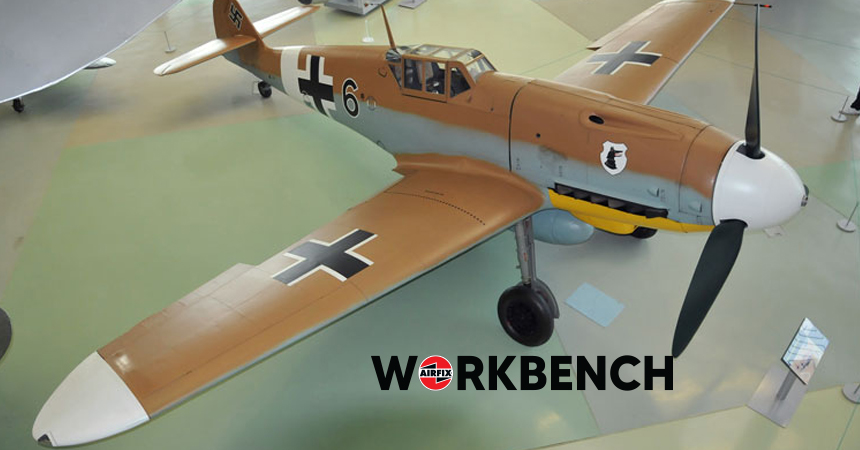
The markings and distinctive tropical sand filter identify ‘Black 6’ as an aircraft which was operated above the deserts of North Africa, against the Allied Desert Air Force.
The next stage in the fascinating history of this aircraft would come in the late December of 1943, when she arrived at RAF Collyweston, home to No.1426 (Enemy Aircraft) Flight, a unit which was colloquially referred to within the Royal Air Force as the ‘Rafwaffe’. On opening the aircraft’s protective crate, it was discovered that the Messerschmitt had suffered some transit damage, having been poorly secured during packing in Cairo. She was reassembled using components from other captured Messerschmitt fighters and after receiving a new propeller from Farnborough, and was ready to begin her flight evaluation trials.
Messerschmitt ‘Black 6’ went on to have an extremely busy 1944, engaging in flight comparison trials against many new and existing Allied fighter types, in addition to giving demonstration flights to RAF stations around the nation, where she was understandably in high demand. Following the end of the Second World War, this fighter which was previously in great demand was no longer of use to the RAF and was subsequently allocated to No.47 Maintenance Unit at RAF Sealand for storage. As a rare example of German air power, she would still make display appearances where she would be the centre of attention, most notably at the annual Battle of Britain display on Horse Guards Parade Grounds.
This next series of images show ‘Black 6’ in some of the various display positions she has occupied at both Hendon and Cosford over the years, starting with this original display positioning at Hendon.
Over the course of next twenty years or so, it would probably be fair to say that Messerschmitt Bf 109G-2 ‘Black 6’ wasn’t particularly viewed with any great affection. Still owned by the Royal Air Force and earmarked for future museum display, the aircraft would spend much of that time in a storage crate, slowly deteriorating through lack of maintenance and attention. She would be re-assembled and displayed from time to time, often wearing a succession of rather poorly researched pseudo Luftwaffe colour schemes, all of which were applied without too much attention to detail.
In the early 1960s, the aircraft was transported to RAF Wattisham, where a team of volunteers intended to restore her back to flying condition, however, the task proved too great for the facilities at hand and the plan was quickly abandoned. Not having the full service history of the aircraft to hand, and its importance to the nation, the cost and man hour requirement for such a project meant that it was abandoned before it even got started. Once again, this saw the aircraft languishing in the corner of a hangar, pushed out for the odd appearance at Airshows and service charity events.
Unquestionably, the most significant development in the history of this famous Messerschmitt occurred when the aircraft came to the attention of a man who would become inextricably linked with the fighter, Flt. Lt. Russ Snadden. He was searching for a suitable restoration project to take on in his free time, and was informed of the former German aircraft which was languishing in a hangar at RAF Wattisham. Unfortunately, despite his determined efforts to secure authorisation to start working on the aircraft, he was consistently met with frustrating RAF red tape and resistance.
Taken from the balcony at Hendon.
Not a man to give up easily, Russ Snadden re-doubled his efforts and continued to lobby anyone in a position to assist him in his cause, having already formed a bond with this unusual aircraft. Finally, on 30th September 1972, two Hercules transport aircraft landed at his home station of RAF Lynham, bringing the crated wings and fuselage of Messerschmitt Bf 109G-2 (Trop) ‘Black 6’ into his care. An exciting new chapter in the history of this unique aeroplane was about to begin.
What followed next as an extensive and meticulous 19 year restoration project led by Russ Snadden and a small volunteer team of engineers and technicians, each one determined to bring this magnificent Axis fighter back to flying condition, despite a great many challenges and almost constant setbacks. The trials and tribulations of the project are described by Russ Snadden himself in his book ‘Black 6 – The extraordinary restoration of a Messerschmitt Bf 109’ and the only way to do justice to the incredible achievement of Russ and his team, is to grab a copy of this book.
Positioned ominously under a B-17G Flying Fortress in Hendon’s Bomber Command Hall.
On 26th October 1990, ‘Black 6’ was placed on the British civil register as G-USTV and the historic aviation world held its breath for news of further developments with no little excitement. Following a 19 year restoration which stands testament to the dedication and professionalism of a small group of committed volunteers, and is one of the most significant undertaken here in the UK, Messerschmitt Bf 109G-2 (Trop) ‘Black 6’ took to the air for her first 32 minute post restoration test flight from RAF Benson on 17th March 1991. She was flown on that occasion by Group Captain Reg Hallam who on that date, became the only pilot in the world to fly a genuine WWII German combat aircraft. When landing back at Benson, a beaming Hallam was reputed to have said to the waiting Russ Snadden, ‘Russ, it goes like a train!’
That first flight was made whilst the aircraft was still wearing a basic primer paint finish, but was soon to benefit from the application of a meticulously researched desert livery which was intended to be as close to the one she was wearing when she fell into Allied hands at Gambut Main airfield. The aircraft left RAF Benson for the last time on 12th July 1991, flying to her new home at the Imperial War Museum airfield at Duxford, where this magnificent aeroplane would be introduced to the legions of UK Airshow enthusiasts.
The next few months saw the team having to overcome a series of frustrating technical issues, and whilst thousands of people headed to Duxford to see this aircraft make its display debut, it would remain firmly on the ground, despite looking absolutely resplendent at this airfield which was so inextricably linked with the 109’s traditional aviation adversary, the Spitfire.
We all had to wait for our flying introduction to ‘Black 6’.
‘Black 6’ as one of the star attractions of Cosford’s Axis aircraft display in her previous position in the War in the Air hangar at the RAF Museum Midlands.
That glorious occasion took place on 15th September 1991, as the crowds at Duxford gathered to witness the first public display of this only genuine airworthy former Luftwaffe fighter. In the capable hands of Warbird specialist pilot Squadron Leader Dave Southwood, ‘Black 6’ announced her arrival on the UK Airshow scene in spectacular fashion, as the pilot felt it important that this capable fighting aeroplane should be flown in a manner befitting an aircraft of this pedigree and how we loved it – talk about making an entrance.
Over the next six years or so, ‘Black 6’ would become one of the best loved display aircraft on the UK Airshow circuit, a unique, living example of an Axis fighter aircraft from the Second World War, and one resplendent in desert air war markings. Her rarity dictated that keeping her in airworthy condition was always going to be a challenge for the team behind her, and whilst she would serve on the UK Airshow scene for the next six years, much of this time was spent with the aircraft requiring maintenance attention. Only rarely flying away from her home airfield at Duxford, whenever she did, show organisers knew that her appearance was guaranteed to add thousands to visitor numbers, so popular was Britain’s Messerschmitt.
Ultimately, with the aircraft due to be transferred to the care of the RAF Museum, she was involved in an unfortunate landing accident at Duxford on 12th October 1997, where the aircraft flipped over onto her back after landing in a field on the other side of the M11, sustaining significant damage in the process. Thankfully, the pilot involved didn’t suffer injury during the incident.
Although the aircraft was recovered and restored to her former glory, the decision had been taken that she would not be restored to airworthy condition, and instead would go on static display at the RAF Museum Hendon. For those who marvelled at her performances during her short but memorable stay on the UK Airshow circuit, you couldn’t help feeling that she was something of a caged eagle when forced to welcome visitors to the RAF Museum, because we’d seen her in her natural habitat, blasting around the skies of Cambridgeshire, chasing Spitfires.
At least we could still see her.
Such a magnificent aircraft, anyone who was ever fortunate enough to see ‘Black 6’ fly will enjoy spending time with her on a visit to Cosford.
As part of the RAF Museum’s preparations to mark the centenary of the Royal Air Force, several of their more significant aircraft exhibits were moved out of Hendon and sent to their Midlands site at RAF Cosford, with Messerschmitt ‘Black 6’ being one of them. This was a hugely positive development for the Cosford site, with the new arrivals making a visit to this magnificent museum even more essential, and arguably making the newly arrived historic aircraft even more accessible to large sections of the population.
Initially placed on display in their War in the Air hangar, this magnificent display space housed a world class collection of Axis aircraft which saw visitors heading for Cosford from all over the world, with ‘Black 6’ being the only one to have appeared on the post war UK Airshow circuit. When standing before her, it really is like greeting an old friend, and no matter how many times you might have seen her previously, every meeting is something to be cherished, time spent with a very special aeroplane.
She is currently on display in the adjoining Test Flight hangar, watching over the oldest Spitfire still thought to be in existence, with the mighty TSR-2 on the opposite side of the hall. If you were ever lucky enough to see her fly, she’s still the undoubted star exhibit of the RAF Museum collection, and for those unaware of her unique history, her attractive presentation ensures that she always receives plenty of attention.
Messerschmitt Bf 109G-2 (Trop) ‘Black 6’ has always had a special place in my heart, and through my infatuation with her, I was fortunate enough to make the acquaintance of Russ Snadden, although I have to say that I didn’t initially cover myself in glory. I was writing an article at the time about ‘Black 6’ and her impending availability in scale model form, and had asked Russ if he would be good enough to cast his eye over the feature.
The aircraft in her current location at Cosford, or should we say the Royal Air Force Museum Midlands. She can be found in the top corner of the Test Flight hangar.
I had entitled the article ‘England’s Messerschmitt’, which I thought was quite a clever play on words, but had Russ ringing me back almost immediately. I was forgetting that Russ was a proud Scotsman and after everything he had gone through to get his Messerschmitt back into the air, that title simply would not do – he told me in no uncertain terms that I had to change it to ‘Britain’s Messerschmitt’. That was definitely a schoolboy error on my part.
As one of the most significant aircraft to have ever displayed on the UK Airshow circuit, and at the time, the only airworthy genuine German combat aircraft anywhere in the world, we simply couldn’t let last Tuesday’s 35th anniversary of ‘Black 6’ first post restoration flight at RAF Benson pass without making some form of blog tribute, and we hope this will suffice. It will hopefully remind us that she’s still a very special aeroplane and is still very much available to be admired at Cosford, a former Axis fighter aircraft with a fascinating story to tell.
That reminds me, I haven’t been to see her for a few months now – time to put that right!