
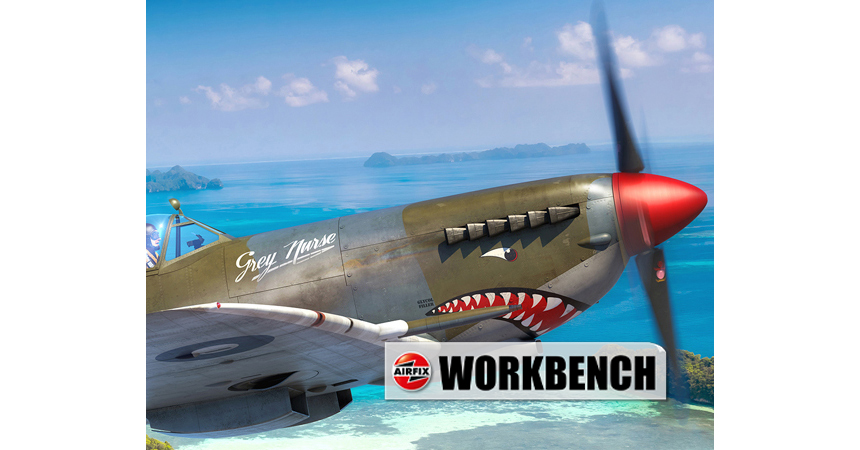
Welcome to this latest edition of our Workbench blog and all the news, updates, and modelling exclusives from the fascinating world of Airfix.
As far as the modelling community is concerned, there’s nothing quite like hearing of an unexpected new model announcement to the current range and that being the case, it’s been quite the week for us here at Airfix. As far as we’re concerned, if you’re going to make a new announcement, you may as well go BIG, which is exactly what we did last Monday, as we announce the latest addition to our 1/24th scale kit range, a modified version of our relatively new Spitfire Mk.IX kit tooling and one which will allow modellers to build a fascinatingly different variant of this famous fighting aeroplane, the Supermarine Spitfire Mk.VIII. We don’t use the term ‘Superkits’ when talking about our 1/24th scale range anymore, but with regard to this new Spitfire Mk.VIII offering, this particular kit is super in every respect.
Although this variant of Spitfire was similar to the Mk.IX in many ways, there are some significant differences between the two and even though both were closely matched in performance terms, experienced Spitfire pilots who flew both describe the Mk.VIII as probably the most pleasant of all the Spitfire variants to fly.
In this update, in addition to looking at the design challenges which needed to be overcome in allowing this lesser-known variant of the Spitfire to take its place in the Airfix range, we will discover how but for the intervention of the Luftwaffe, this may well have been the most famous and the most heavily produced variant of all the Spitfire marks. We will also see how the Mk.VIII proved to be something of an ‘international’ Spitfire and how the majority of its achievements were earned far from British skies. With beautiful new box artwork to share and a selection of built sample images showcasing models finished in all three of the appealing scheme options included with this new kit, if you have even the slightest interest in Spitfires, then this is sure to be the Workbench edition for you.
It's a big one this weekend, as we allow our new 1/24th scale Supermarine Spitfire Mk.VIII kit to introduce itself to the modelling world.
One of the most impressive attributes the Supermarine Spitfire possessed was how the basic airframe of the aircraft proved to be adaptable enough to allow almost constant upgrade and improvement throughout the entire Second World War.
Although the history of aviation is the fascinating study of many hundreds of different aircraft types and designs which all managed to slip the surly bonds of earth, just a handful of aircraft have gone on to become instantly recognisable to countless millions of people over the past 120 years, with some even becoming familiar to people who never actually had the opportunity to see one fly. One aircraft which continues to be an enduring source of fascination, even though the final aircraft emerged from the production lines back in 1948, the Supermarine Spitfire is probably the most famous aircraft to have ever taken to the skies and certainly the most famous warplane, but with a great many airworthy examples still flying regularly to this day, continues to captivate new generations of admirers and enthusiasts.
Fast, agile and incorporating the latest advances in aviation innovation, from the first time the Spitfire was unveiled, it was undoubtedly a beautiful thing to look at, however, its eye-catching styling was more a result of aerodynamic functionality than simple design aesthetics. This new aircraft was not created to captivate the nation with the visual appeal of an aviation company breaking new technological ground, but to dominate the sky and rule over other aircraft, a true metal bird of prey. As such, when the new Spitfire entered Royal Air Force service, every boy, teenager and young man in the country was desperate to get behind the controls of one and at that time, it really did seem as if the word on everyone's lips was Spitfire!
When Supermarine's chief test pilot Joseph 'Mutt' Summers took off from Eastleigh Aerodrome at 4.35 in the afternoon on Thursday 5th March 1936 in the company's new Type 300 fighter (the fledgling Spitfire), he would have been impressed with the performance of this powerful new monoplane fighter. What he couldn't have imagined was how this aircraft would go on to change not only British aviation, but would write its name in the annals of aviation history, becoming probably the single most famous aircraft to ever take to the skies.
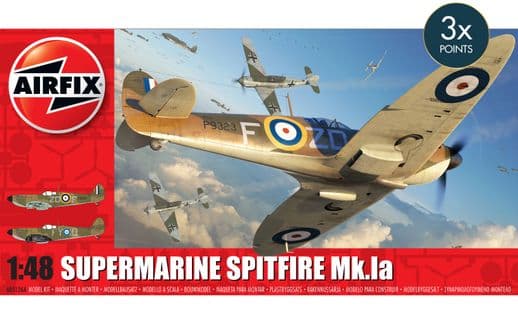
As Airfix have a proud association in creating scale representations of this most famous of aeroplanes, it’s probably fitting if we include some of the previous box artwork we have commissioned in support of Spitfire releases over recent times.
The aircraft he took to the air that day was the first of over 20,000 examples of the type which would go on to be manufactured over a ten-year production run, with the same basic airframe proving adaptable enough to see the aircraft remaining in active frontline service fourteen years later. Almost constant design evolution would see the last Spitfires boasting double the power from their Rolls Royce engines and capable of speeds in excess of 100mph faster than the first examples entering Royal Air Force service.
What ‘Mutt’ Summers definitely wouldn’t have known was that no matter how impressive his company’s new aircraft was, how the new fighter would go on to captivate the general public so completely and how restored examples of this fledgling fighter would still be gracing world skies almost 90 years later.
Created for war, but an aircraft which is now championed as a bringer of peace, the Spitfire is revered as much today as it was during the dark days of the Battle of Britain, and if you are fortunate enough to see one displaying at an Airshow, it has to be described as an experience rather than just another flying display. The unmistakable music of the Merlin engine, combined with the beautifully clean lines of this graceful aeroplane manages to captivate our senses in a way no other aircraft could possibly hope to match.
Perhaps the most impressive attribute the Spitfire possessed was how the basic design of the aircraft could accept modification and upgrade so readily, a feature which allowed the aircraft to remain at the forefront of world fighter design technology throughout the Second World War and subsequently, how the Spitfire came to be built in such vast quantities. It also has to be accepted that the Spitfire’s development went hand in glove with the constant development of the famous Rolls Royce Merlin engine which powered it, that is until the even more powerful Griffon engine became available and was ‘shoehorned’ into the front of a Spitfire.
More Airfix Spitfire box artwork delights, this time featuring the Mk.V, the aircraft the new Mk.VIII was being developed to replace.
Significantly, when capable new Luftwaffe aircraft were introduced to challenge the aerial prowess of the Spitfire, a new and more powerful derivative of the Rolls Royce Merlin engine was developed to power the Spitfire to even greater levels of performance. The skill displayed by the Supermarine design team was to modify their Spitfire in a way to allow these more powerful engines to be used by the fighter, whilst maintaining the combat integrity of the Spitfire, essentially making it better with the introduction of each subsequent variant.
It's interesting to note that not all improved variants of the Spitfire were introduced sequentially and how even though Supermarine designers were always working on producing the next major variant of the Spitfire, how some of the most successful marks of Spitfire were actually ‘stopgap’ arrangements borne out of operational necessity. The introduction of the Luftwaffe’s Messerschmitt Bf 109F and later, their Focke Wulf Fw190, saw the Germans taking a technological advantage in the skies over Western Europe, but how improvisation and ingenuity allowed designers to keep the Spitfire competitive.
The introduction of both the Spitfire Mk.V and the later Spitfire Mk.IX may have been the result of Supermarine’s designers having to quickly respond to the introduction of new enemy fighters, but both proved to be thoroughbred aeroplanes in their own right and more than a match for the latest breed of Luftwaffe fighters.
An important, but probably lesser-known variant of the Spitfire, the Mk.VIII was a fully engineered upgrade from earlier fighters and the intended full replacement of the stopgap Spitfire Mk.V.
The constant wartime development of the Spitfire would result in the production of several variants which were produced in much lower quantities than others, intended to fulfil specialist roles against specific threats, whilst still being modifications on the basic Spitfire design. The Mk.VI and VII were pressurised Spitfires optimised for operation at extreme altitude, as Britain’s War Office were concerned about the RAF’s ability to challenge high altitude Luftwaffe reconnaissance aircraft and the perceived threat of a high altitude Luftwaffe bombing campaign at that time.
As for a Spitfire for widespread service, the Mk.V (which would be the most heavily produced Spitfire variant) was actually one of the stop-gap Spitfires we mentioned earlier, an insurance policy of a development which saw the Merlin 45 engine married with the Spitfire Mk.I airframe. The Mk.III was to be the major Spitfire upgrade to the aircraft which had fought the Battle of Britain, however, problems with the latest variant of Merlin engine and the protracted development of this variant saw the Mk.V essentially extending the life of the original Spitfire design.
Clearly, there was more to the Spitfire Mk.V than just an uprated Merlin engine, such as the ability to accept different engines for better performance and different altitudes and the adoption of the ingenious universal wing and its various armament options, but the Mk.V was essentially an improved Spitfire Mk.I.
The subject of the new model announcement made earlier this week, the Spitfire Mk.VIII was the planned, fully engineered design successor to the Mk.V and featured a host of improvements and modifications which were intended to make this the second major variant of the fighter, after the original Mk.Is which had fought the Battle of Britain. Taking some of the features of the Mks VI and VII which preceded it, but without the pressurisation they incorporated, the Mk.VIII benefitted from significant strengthening across the airframe, utilising the universal wing and having the ability to carry both an increased fuel load and bombs if required.
An upgraded variant of Spitfire, the Mk.VIII’s instrument panel was different to earlier variants, particularly as this variant has additional fuel tanks to manage.
The Mk.VIII Spitfire was intentionally designed to utilise three different variants of Merlin engine which were optimised for operations at different altitudes. The standard fighter variant was the F (Fighter) which could be fitted with either the Merlin 61 or 63 engine and was intended to be the major fighting variant of this mark. The LF (for operations at low and medium altitudes), was powered by the Merlin 66 engine and this would actually prove to be the most heavily produced variant of the fighter. Optimised for high altitude performance, the HF version was powered by the Merlin 70 and all versions featured a four bladed propeller and retractable tailwheel, which made this a particularly sleek variant of Spitfire.
This is where the introduction of the German Focke Wulf Fw190 impacted on the fighting legacy of the Spitfire Mk.VIII. With the fearsome ‘Butcher Bird’ having a definite combat advantage over the Spitfire Mk.V fighters in service at that time, the RAF needed to find an immediate response to the new enemy fighter. The introduction of the planned Mk.VIII would definitely have provided the improvement the Spitfire needed to take on the Focke Wulf, but the introduction of the new fighter was still some way off and the establishment of working production jigs would have taken far too long in these dire circumstances.
The answer was to adopt a similar stance as the one taken with the Mk.V and to improvise yet again, fitting a Mk.V airframe with the new Merlin 61 two stage, two speed supercharged engine, the second of the stop-gap Spitfires introduced. Out of necessity, the Mk.IX would overtake production of the newly developed Mk.VIII and actually become one of the most important aircraft in the history of the Royal Air Force. Proving to be quite the performer, the Spitfire Mk.IX was given priority over the new Mk.VIII and would be produced in large numbers, proving to be such an effective combat aeroplane, that it would remain in service throughout the rest of the war.
A beautifully sleek and strengthened variant of the Spitfire, the Mk.VIII was an excellent fighting aeroplane, but one which was more difficult to produce than the ubiquitous Mk.IX.
Back to the poor old Mk.VIII which was equally as good a fighting aeroplane as the Mk.IX, but was produced in nothing like the same quantities due to that damned Focke Wulf. With the Mk.IX proving to be a revelation, development and subsequent production of the Mk.VIII continued to be somewhat pedestrian and this variant would not arrive with combat units until much later than the Mk.IX. All aircraft were produced by Vickers Supermarine at factories other than the impressive Castle Bromwich facility and 1,654 aircraft would eventually be produced.
The Spitfire Mk.VIII should have been the next major, fully developed variant of the Spitfire, however necessity and ease of production would see a stop-gap option overtake it as the most important Rolls Royce Merlin powered variant of the fighter to see service through to the end of the war. From a performance perspective, the two aircraft were very closely matched, but with the additional fuel weight of the Mk.VIII providing this variant with greater range than the Mk.IX. From a pilot’s perspective, the Mk.VIII was described by British test pilot Jeffrey Quill and the nicest of all the Spitfires to fly and as he probably flew more Spitfires than anyone else, who better to make such a judgement.
The first Spitfire Mk.VIII fighters were delivered to squadrons fighting in the Mediterranean and indeed this variant of Spitfire would go on to serve with distinction in foreign skies, notably in the Far East and with the Royal Australian Air Force in the Southwest Pacific. Its overseas service and the fact that it was overshadowed by the Mk.IX has resulted in the Mk.VIII being one of the lesser known variants of Spitfire, but as one of the most capable fighting aeroplanes of the Second World War, and one which wore some particularly attractive schemes, we’re hoping that our new kit brings the aircraft some long overdue recognition, certainly in modelling terms.
A modification to the existing Spitfire Mk.IX tooling, the new 1/24th scale Mk.VIII required designer Chris Joy to make some quite significant alterations to his design files.
With the incredible success of our newly tooled 1/24th scale Spitfire Mk.IX released in 2022, it was clear that as a modelling subject, the Spitfire has lost none of its appeal and continues to be as popular with the modelling community as it’s ever been. With this kit benefitting from the latest advancements the injection moulding industry had to offer and having passed through the computer of one of our most accomplished designers, this new kit is a stunningly accurate scale representation of this most famous fighting aeroplane, but when we quizzed designer Chris Joy about the project following the announcement of the new kit back in 2022, it appears he withheld rather important information from us.
As we learned earlier this week following the surprise announcement of our new 1/24th scale Supermarine Spitfire Mk.VIII kit, not only had he been spending many weeks designing a stunning scale tribute to the Mk.IX in months past, but his brief also included a requirement to include the Spitfire design variant which was in development prior to the introduction of the Mk.IX and the one which would ultimately follow it into service.
As we have seen with the Spitfire variant overview posted above, the Mk.VIII may be generally regarded as one of the lesser-known marks of the fighter, but certainly not to people interested in RAF operations in the Far East during WWII and certainly not to aficionados of the Royal Australian Air Force. Importantly, the release of this impressive new kit has presented modellers with an opportunity to produce a beautifully accurate representation of this particularly sleek variant of Rolls Royce Merlin powered Spitfire, one which has a particularly fascinating back story to tell. If the three scheme options included are anything to go by, we’re not going to need that much persuading to do so.
A previously circulated design images Chris made available when describing his project to introduce the Spitfire Mk.IX into the Airfix range as a 1/24th scale kit.
Obviously, we took this new Spitfire kit announcement opportunity to discuss some of the finer points of its development with designer Chris Joy once again, and were particularly interested to learn how he approached a tooling modification project such as this, from a design perspective. Before we get into this though, if you would like to revisit the original BIG Spitfire review we did with Chris at the start of 2022, you can do so by using this link.
Chris told us that from a designer’s perspective, ensuring the Mk.VIII Spitfire could be added to the design files wasn’t actually too much of a challenge, but only because of the way in which the project was structured. He informed us that from the outset, he could set his design stall out as the project would be utilising the production of separate tooling components for the new parts, something which significantly increased associated costs, but similarly, something which also brought design clarity and subject authenticity. In effect, this was the most effective way to proceed from a modelling perspective, resulting in a more accurate model and clearer assembly instructions for the modeller.
Already having the differences highlighted between the two variants of Spitfire in the design brief, Chris got on with the job of finishing the Mk.IX, then copied the components he needed to re-work as the basis for starting work on the separate Mk.VIII parts. From a design perspective, this then involved taking his wing design and changing it to match the wings of a Mk.VIII Spitfire, altering the ailerons and removing quite an amount of surface detailing, before completely redesigning these sections. Importantly, as the two projects were to be treated as separate releases, Chris was able to finish the design of the Mk.IX project and allow this to move on to the tooling phase, with the additional work needed to create the Mk.VIII being less of a priority at this stage.
As Chris explained the way the Spitfire Mk.VIII’s design was briefed, we wanted to ask how many new frames this appealing alternate variant required to be designed?
Obviously, the new kit shares much commonality with the existing 1/24th scale Spitfire Mk.IX kit, so from a project perspective, it was a case of making design alterations as opposed to wholesale changes. The main area which needed Chris’ attention were the completely redesigned wing components top and bottom, which incorporated additional leading edge fuel tanks, the shorter span ailerons and repositioned gun camera mounting. The Mk.VIII also featured a retractable tailwheel which proved to be quite a significant change, a repositioning of the under fuselage positioning lamp and a newly designed instrument panel, which featured a different layout primarily for the management of the additional fuel tanks.
This next series of images show part of the instruction booklet which illustrate the changes Chris had to consider when modifying his Spitfire Mk.IX design files to allow the Mk.VIII to be modelled. The next two images show the new wing frames designed to allow this important variant of the Spitfire to be produced.
With accuracy and detail being of critical importance to Chris, clearly some of these modifications would have been more time consuming and challenging than others, although modellers will undoubtedly have their own order of importance when they come to work on the new kit. Perhaps the most visually impactful change is the redesigned rear fuselage featuring the retractable tailwheel, but from a design time spent perspective, Chris informed us that incorporating the modified surface detailing proved to be the most time consuming aspect of the design work on this project.
Another interesting aspect of the Mk.VIII design work concerned the repositioning of the aircraft’s belly mounted identification lamp. On the Spitfire Mk.IX, this lamp was positioned between the 9th and 10th fuselage frames, but as the strengthened Mk.VIII could carry under-fuselage ordnance if required, carrying such ordnance would obscure the lamp, so therefore necessitated a position change. The new location was a little further back on the fuselage, between frames 15 and 16, but just as this would have been a concern for Supermarine designers at the time, so it now had to be tackled by Chris in scale. With the specifics known, Chris had to come up with the most effective way in which to apply this modification without introducing significant additional tooling costs, but also by not making the process too onerous for the modeller.
Using his own extensive design experience and having discussed the issue with other colleagues within the Airfix team, Chris finally decided on a design development which required him to design a new tooling jig, something which the modeller could use to accurately mark where the repositioned light should be placed, but requiring the modeller to actually create the opening.
The new 1/24th scale Spitfire Mk.VIII kit includes 3 new component frames, two which provide new wing components top and bottom, and a third which includes a host of smaller parts, such as the retractable tailwheel modifications both open and closed, the new instrument panel and the new identification lamp jig tool.
This next series of images show the additional frame of parts which feature the Mk.VIII’s shorter ailerons, retractable tailwheel and updated instrument panel. These are followed by a Mk.VIII rendered design image and the positioning tool Chris designed to allow the under fuselage identification lamp to be re-positioned.
When discussing the work our designers do in allowing us all access to these beautiful models, we always like to give them the opportunity to tell us what aspects of design projects caused them the most problems and if there were any aspects of the work they would like to point out to modellers?
With regard to his new Spitfire Mk.VIII tooling, Chris told us that designing the retractable tailwheel has probably turned out to be the most distinctive feature of the new kit, the modifications which created what is actually an appealingly sleek version of the famous Spitfire. In this larger scale, the aircraft looks absolutely spectacular, but that additional size does bring with it a few design pressures. Clearly, as everything is just that bit larger, the designer does have the ability to include tremendous amounts of detail, but places an even greater requirement to incorporate all that associated detail, including design shapes and surface detail, accurately.
As this will ultimately prove to be the most visible difference between this new kit variant of the Spitfire and its 1/24th scale predecessor, Chris described how the retractable tailwheel is probably the aspect of the design phase which he enjoyed most, but how it was the surface detail representation which actually proved to be the most time consuming.
As for the most problematic aspect of the work, Chris told us that he would definitely describe the issue of re-positioning the identification lamp as being the most challenging, mainly because he knew what he wanted to achieve, but had to approach this design task with some different thinking. Having fully discussed all options at the briefing stage, Chris knew that the cost of a newly tooled fuselage would have been prohibitively expensive, so a clever compromise had to be found, one which achieved the aim, but being the least challenging to the overall assembly of the new kit. Thankfully, he managed to do that with a bit of clever design, avoiding adding significant additional cost to the kit, but still keeping it 100% Spitfire Mk.VIII.
It’s not often modellers are presented with a new and interesting Spitfire kit to build, but that all changes with the late summer release of this beautiful new Spitfire Mk.VIII.
In summary, Chris described his design work on the new 1/24th scale Supermarine Spitfire Mk.VIII as being a collection of subtle but significant changes to the existing Mk.IX tooling, with some more extensive design work being required, but with small changes and surface detailing being the most time-consuming aspects. Whilst the design work was completed at the same time as the wider design of the 1/24th scale Spitfire Mk.IX tooling, the actual testing and tooling phase took place some time later, as this project was planned to have no impact on the introduction of the original Mk.IX variant.
Chris went on to tell us that overall, the most rewarding aspect of this project is that it allows this important, yet underrepresented variant of the famous Spitfire to take its place in the Airfix range, and in our largest aviation scale. It’s a truly beautiful looking aeroplane and with the selection of scheme options included with this kit, make this a rather cosmopolitan variant of the Spitfire and one he hopes modellers will enjoy spending time with. As the kit is now available for pre-order and scheduled for release later this summer, the team will be hoping to see at least a couple of examples on display when attending this year’s Scale ModelWorld show.
Speaking of the three new scheme options which accompany the release of this latest 1/24th scale kit, let’s take a closer look at all three of those now.
The Spitfire Mk.VIII would become inextricably linked with Royal Australian Air Force operations during the latter stages of the Second World War, serving with two wings, No.1 Fighter Wing and No.80 Fighter Wing, with the latter comprising three squadrons which were entirely made up of Australian personnel. No.80 Wing would become operational with the Mk.VIII during the summer of 1944 and had been established to support a planned Allied operation into the Dutch East Indies. Unfortunately, after an intense period of training for the Wing’s pilots, the operation was cancelled, leaving them to continue flying long, laborious standing patrols and training sorties over Northern Australia.
Finally, after the successful joint US and Australian operation to re-take the island of Morotai from defending Japanese forces, the Wing was moved forward to the island in order to provide effective air support for a planned advance through New Guinea and onwards to retake the Philippines. Whilst their Spitfires would have a busy mission load in support of these operations, the almost total lack of Japanese aerial opposition meant that most of these sorties would be in a ground attack role, supporting troops on the ground and becoming particularly proficient in dislodging stubborn pockets of Japanese resistance, often in remote areas of jungle.
Australian Spitfire crews were also free to search for targets of opportunity, although they had to be careful when doing this, as concealed anti-aircraft guns were a constant hazard and coming down in jungle areas was something to be avoided at all costs. Attacking Japanese shipping proved to be a particularly highly prized activity amongst RAAF pilots, particularly if the barge being shot up was running ammunition for the beleaguered Japanese garrisons – when these vessels exploded, everybody in the squadron knew about it.
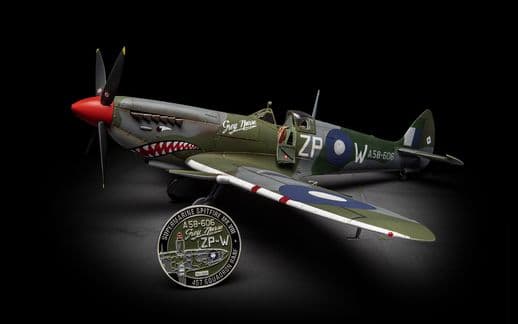
A selection of images featuring this most stunning of Spitfire scheme options, including a built sample model, the full scheme details and the exclusive collectors coin which was still available at the time of producing this blog update.
The fighters of No.457 Squadron have to be regarded as some of the most impressively presented Spitfires of the entire war and if a Japanese aircraft did come across one of these aircraft, it must have made for a terrifying sight. Adopting the name ‘Grey Nurse’ Squadron from the end of December 1944, pilots began adorning their aircraft with spectacular sharkmouth artwork at around the same time, with this presentation looking particularly effective on the sleek Spitfire Mk.VIII.
It's thought that the squadron chose this name due to the colours in which their new Spitfire Mk.VIIIs arriving from Britain were painted in, and how the sleek appearance of the fighter really did make it look like a Grey nurse shark, an ocean predator which was native to Australian waters. Taking inspiration from similar artwork applied to the aircraft of the Desert Air Force and the American Flying Tigers, the shark’s teeth looked particularly effective on their Spitfires, as these aircraft did look every inch the airborne predator they were. Even though the unit didn’t claim too many aerial victories during their operational service, they certainly looked like they would have done extremely effectively, had they been given half the chance.
Before the end of WWII, No.457 Squadron would become experts in low level strafing and dive bombing with their Spitfires, in addition to taking part in the Borneo Campaign during the final months of the war.
An extremely sleek variant of the Spitfire, the uniquely presented Spitfires of the RAAF ‘Grey Nurse’ squadron have to be considered some of the most attractive of all the service Spitfires.
The particular Spitfire presented with this scheme option was built at Supermarine’s Chattis Hill factory in Hampshire during the spring of 1944 and was delivered to the Royal Australian Air Force in September the same year. Constructed as MT819, she was allocated the serial A58-606 in RAAF service and on joining No.457 Squadron, she would become the personal aircraft of the unit’s charismatic leader Squadron Leader Bruce Watson. Watson used this aircraft extensively until having to make a forced landing at Morotai on 14th July 1945, having sustained anti-aircraft damage during a strafing attack against the Japanese airfield at Keningau strip. Whilst the pilot managed to walk away from the incident, the aircraft was damaged beyond economical repair and immediately discarded.
As far as Spitfire schemes go, this is an absolute crackerjack, particularly as the now famous operation down at the Biggin Hill Heritage Hangar have presented one of their T9 Spitfires in this exact scheme and allow people to pay for experience flights in their own Grey Nurse Spitfire.
It would probably be accurate to concede that at the start of the Second World War, Britain’s military significantly underestimated both the strength and capability of Japan’s military in the Far East, which led to some painful early losses and the subsequent loss of vital territory. From an air power perspective, RAF units in the region were equipped with the portly Brewster Buffalo at that time, an aircraft which was no match for the agile Mitsubishi Zero, but was flown valiantly by pilots who had very little in the way of support infrastructure at their home airfields. The situation was turning increasingly desperate.
Although they would be forced to fight a long war of defensive actions, newer aircraft did start to arrive in theatre, in the shape of Hawker Hurricanes transferred from the Middle East and Curtiss Mowhawks, but it would be towards the end of 1943 before significantly better aircraft started to arrive with SEAC units.
RAF No. 162 (Hyderabad) Squadron can trace its origins back to the Great War and the aerial defence of Britain, but was proudly a fighter unit for much of its history. Operating such aircraft as the Sopwith Camel and Gloster Gladiator, the squadron would begin a long association with the Spitfire just after the start of the Second World War and would subsequently see plenty of action operating from UK stations in defence of the country.
As the RAF moved on to the offensive, the squadron would take part in both the invasion of North Africa and Sicily, before moving on to India during 1943 to assist with the defence of Calcutta. Operating the Spitfire Mk.VII from December 1943 until the end of the war, No.152 Squadron would be heavily involved in fighting with the Japanese, occasionally intercepting incoming raids, but more usually providing fighter escort for bomber and transport aircraft, but more commonly, flying fighter bomber/ground attack missions in support of SEAC ground operations.
Built sample and full scheme details for this beautiful ‘Black Panthers of Burma’ Spitfire Mk.VIII.
During their time in the Far East, the unit christened itself the ‘Black Panther’ Squadron and adopted a rather unique and distinctive artwork addition to many of their aircraft, a black panther leaping over, or through the port-side fuselage SEAC roundel. This proved to be another stunning scheme which really suited the good looks of the sleek Supermarine Spitfire Mk.VIII and one this new kit will allow the modeller to replicate.
The squadron is regarded as the first Spitfire unit to be used in a bombing role and after flying many missions in support of the Fourteenth Army, they became the first Squadron to re-enter Burma at Tamu, where they soon became known as the ‘Black Panthers of Burma’. In November 1944, the squadron intercepted a formation of Japanese Zero fighters, shooting down several of them, and with one of the pilots subsequently claiming the distinction of having shoot down aircraft of all three of Britain’s Axis enemies, German, Italian and Japanese – only two pilots claimed this distinction during the Second World War.
No.152 Squadron had the distinction of flying against all Axis air forces during the Second World War, including the Luftwaffe during the Battle of Britain, the Regia Aeronautica in the Mediterranean and the Japanese in the Far East, and were in service until the very final days of the war. Later aircraft flown by the squadron would be the Spitfire Mk.XIV, the Hawker Tempest, Gloster Meteor Mk.12 and Mk.14s, the twin engined Pembroke C.1 and finally the Scottish Aviation Twin Pioneer.
More recently, the Squadron and its operations in Burma received national attention as a large scale search was initiated to find a collection of Spitfires and their engines which were reputed to have been buried at several of the airfields in Burma which played home to RAF Spitfires. It was claimed that up to 60 new and still crated Spitfires were unceremoniously buried in outlying areas of several airfields, as they were deemed surplus to requirements, with the Japanese being close to defeat by the time they were delivered. Despite captivating the nation over several months, the investigations proved fruitless and if these airfields do hold a Spitfire secret, they certainly appear determined to keep hold of it.
The many admirable qualities of the Spitfire were well known to the Americans, as a production example of the fighter was sent to the US for evaluation prior to the start of the Second World War and provided them with valuable data on how a modern, lightweight fighter should perform. What is perhaps not quite so well known is the fact that over 1000 Spitfires were supplied to American units as part of a ‘reverse lease-lend’ arrangement in place between the two nations.
Prior to America entering the war, many US volunteer pilots travelled to Britain to offer their services in trying to stem the tide of German aggression, often at great personal sacrifice and without the backing of their home nation. Actually restricted from fighting in the name of America, many of these pilots first travelled to Canada and became pilots in the RCAF prior to heading for Britain, with many subsequently serving in the Royal Air Force. Banned from displaying their heritage in a way other Commonwealth pilots in the RAF were allowed to do, these hero pilots became known as ‘Eagle Squadron’ pilots and carried a stylised American eagle on the shoulder of their tunics in recognition of their homeland.
Following America’s entry into the war, the three squadrons which constituted the 31st Fighter Group were sent to operate from bases in Britain, with the initial intention of equipping them with the Bell P-39 Airacobra fighter. Fortunately for their pilots, the RAF had previously evaluated these aircraft and classified them as being unsuitable for combat operations in the European Theatre, so the 31st would actually receive British Spitfire Mk.Vb fighters. The 307th Fighter Squadron would be based at RAF Atcham and would be allocated the fuselage codes MX.
A beautiful Spitfire thoroughbred, this particular aircraft was retained by the USAAF 307th Fighter Squadron when they converted to new North American P-51B fighters in April 1944.
Once acclimatised and released for combat operations, the 31st would be involved in heavy action for the rest of the war, initially flying into enemy occupied France from bases in Britain, but moving on to operate from bases in North Africa and Italy, where they would continue to see plenty of action. Following heavy fighting in North Africa where the 31st Fighter Group had been involved in constant combat with the Luftwaffe, the unit would be given a period of rest and replenishment during May 1943, during which time their Spitfire Mk.Vs were replaced by Spitfire Mk.IX and Mk.VIII fighters. Initially, there was some resistance from Group pilots to the Mk.VIII, as the lower mark number led them to assume that these were earlier, inferior variants of the aircraft, however, once they had flown the fighter, they considered the retractable tailwheel, additional fuel capacity and stronger airframe of the Mk.VIII to make this the purer fighting aeroplane.
The next few months would see the 31st Fighter Group supporting Allied operations throughout the Mediterranean Theatre, including the invasion of Sicily and operations at Salerno and Anzio, with their Spitfires seeing heavy action as the Allies slowly pushed Axis forces back towards Germany and allowing strikes to take place from opposite ends of Europe. After months of fighting, April 1944 would see the 31st Fighter Group undergoing another period of change. After months of exceptional service, their Spitfires were finally relinquished in favour of new North American P-51B fighters and they moved to a new base at San Servero, on the eastern side of the Italian mainland to carry on their fight.
A truly fascinating machine, this particular Spitfire Mk.VIII was retained by the 307th Fighter Squadron to be used as a squadron ‘hack’ aircraft, the only Spitfire on an airfield which was now full of Mustangs. Presented in this rather unique scheme, the Spitfire’s tail was finished with the diagonal red stripes which were also applied to the unit’s Mustangs, but helps to tell the interesting story of the 1,000 plus Spitfires operated by USAAF units during the Second World War.
Full box artwork presentation for what has to be considered one of the most appealing new model additions to any Airfix model range in the current era.
From a modelling perspective, the release of this new 1/24th scale Spitfire Mk.VIII kit now allows us all to produce a beautifully accurate scale representation of this important, yet largely forgotten variant of Britain’s most famous fighting aeroplane, one which we have seen has strong links with both the Royal Australian Air Force and the USAAF. All three of the scheme options included are both interesting and eye catching in equal measure, and if you find yourself looking for an appealing Spitfire build project to get your teeth into, could there be a better option than this?
A beautifully sleek variant of the Spitfire, the Mk.VIII may have plied its trade in skies well away from the factories where they were produced, but they were presented very differently from those which operated from British bases and as such, have a fascinating aviation story to tell. We think this new kit makes for a stunning addition to the legacy Airfix 1/24th scale model kit range and can’t wait for you to get your hands on one.
Our new 1/24th scale Supermarine Spitfire Mk.VIII kit is available for pre-order now and even though ordering activity has been brisk throughout the week, there might still be a handful of the collector coin kit bundles available, but only if you’re quick.
We are delighted to announce this latest surprise addition to the current Airfix range and look forward to seeing the kit’s striking new box artwork as part of model store displays across the world following its release later this summer.
We won’t need much encouragement over being captivated by this box artwork in deciding to add the new Spitfire Mk.VIII to our late Summer/Autumn build schedules.
We are afraid that's all we have for you in this latest edition, but we will be back next Friday with more project development updates and the very latest Airfix kit exclusives. In the meantime, we are always keen to hear your views on all things Airfix and in particular, any thoughts and opinions you may have regarding our Workbench blog. If you would like to drop us a quick line, could we please ask that you use our workbench@airfix.com email for all correspondence.
To re-visit any of the Airfix blogs we have produced over the past seven years or so, please head to our main Workbench hub, where you will find our entire blog back catalogue and all the Airfix design projects we have already covered.
All our dedicated official social media sites can be accessed by clicking the respective link icons at the foot of this page, or by heading to the Airfix homepage. Other useful Airfix links are:
Facebook, YouTube, Twitter and Instagram official sites
Please join us for more Airfix updates next week and thank you for your continued support.