
Welcome to this latest edition of our Workbench blog and all the news, updates, and modelling exclusives from the fascinating world of Airfix.
When it comes to modelling subjects produced as scale kits over the past seventy years or so, the word ‘Classic’ has sometimes been used a little too liberally when discussing such matters, even though this will always be the subject of healthy debate. From an Airfix perspective however, when it comes to the subject of this week’s Workbench update, we’re unquestionably in classic territory, as we look at the latest impending release of a kit which was first unleashed on the hobby world back in 1962, but was so important to the range that it was the subject of a new tooling update 63 years later.
The Boeing B-17 Flying Fortress has to be regarded as one of the most famous fighting aeroplanes of the 20th century, an aircraft which showed the world what a modern heavy bomber should be like, and one which came to represent the industrial might of the American nation. Arguably, it was the aircraft’s use from bases in Britain which really cemented its immortality in the affections of enthusiasts, modellers and the general population over the years, as the youth of America took the fight to the Axis powers from 25,000 ft.
In this update, we prepare to welcome our latest scale tribute to this incredible aircraft to the current Airfix range, one which includes two scheme options which whilst being the same aircraft type, could hardly look more different, from a presentation perspective.
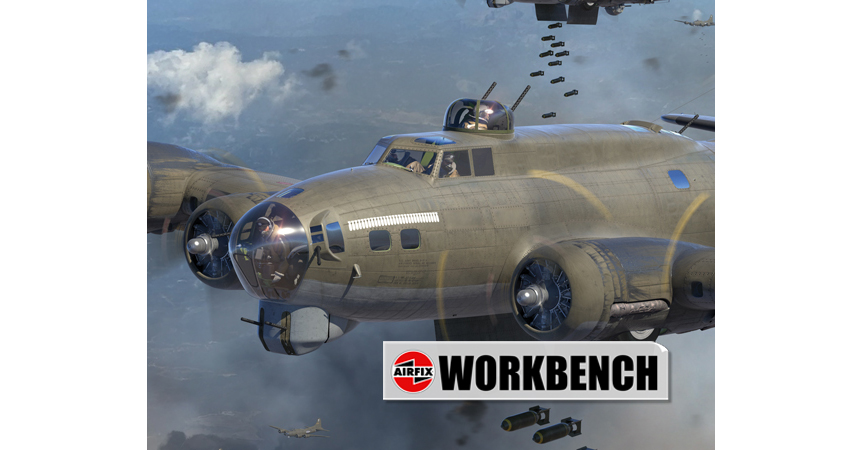
The unmistakable profile of the Boeing B-17 Flying Fortress is entering the virtual modelling world landing pattern in this latest edition of Workbench.
A bomber which possessed such an array of defensive armament, that it was thought it could defend itself against enemy fighter attack.
The aircraft which arguably came to represent American industrial prowess during the Second World War more effectively than any other, the Boeing B-17 Flying Fortress was designed from the outset to dominate the sky, not only to pound its enemies into submission under a carpet of bombs, but by also destroying any aircraft reckless enough to challenge its operation, bringing the withering firepower of its impressive defensive armament to bear against them. Unquestionably an impressive looking aircraft in its own right, the B-17 entered WWII with something of a reputation to live up to, one of the most advanced heavy bombers currently in service, and one which the Americans claimed was more than capable of looking after itself in a combat situation.
The B-17 project began in the mid 1930s, as the Boeing company decided to tender a design for a new multi-engined bomber for the United States Army Air Corps, one which needed to have a significant bomb load, and possess both impressive range and endurance. Initially developed without any financial assistance from the government of the day, the new Boeing bomber would eventually take part in a fly-off event against rival designs from Douglas and Martin, a contest it was clearly well placed to win. Interestingly, not only did the Boeing aircraft not win the contest, but it also actually failed to even take part, as the prototype aircraft crashed prior to the fly-off. Nevertheless, the potential shown by the aircraft during its flight test program resulted in a decision to further develop the bomber and subsequent production of this classic fighting aeroplane.
The name ‘Flying Fortress’ which has become so synonymous with this magnificent aircraft was thought to have originated during a press day the recently opened Boeing factory airfield site, with this mighty aircraft displaying for those in attendance. Staring in awe at this mighty bomber bristling with defensive armament, a locally based journalist published an article in The Seattle Times, where he described the new bomber as a ‘Fifteen ton Flying Fortress’.
Airfix artwork has always had a major role to play in our scale representations of the world’s most famous aircraft.
On reading the article following its publication, Boeing officials must have been impressed by this colloquialism, as they immediately trademarked the words ‘Flying Fortress’ for future use, although at that time, they could have had no idea just how successful their aircraft would go on to become. Following the crash of the prototype Model 299 during the trials program, military officials did place an order for 133 of the rival Douglas B-18 Bolo twin engined bomber, however, the Boeing aircraft did make a lasting impression on those who saw it fly and further development was authorised, as the clouds of war gathered ominously across the Atlantic.
By the end of 1942, the Boeing B-17 Flying Fortress had matured into one of the world’s most effective heavy bombers, with further development taking place following evaluation of its combat performance only serving to increase its operational effectiveness. Like several US produced aircraft types of this period, the British would give the Boeing B-17 its operational debut in 1941, as their need for modern aircraft was so desperate at this stage of the war. From a design perspective, it’s generally accepted that the early variants of the Flying Fortress were built predominantly with defensive operations in mind, but from the E variant onwards, the B-17 was very much on the offensive.
The first USAAF B-17 bombing missions mounted from bases in Britain took place in August 1942, and the lessons learned during these early operations would shape US bombing doctrines for the rest of the war, using their heavy bombers to strike strategic enemy targets in daylight, often with just sheer numbers and meticulously planned combat box formations for mutual defence. These early missions were flown by heroic crews who faced the full force of the Luftwaffe’s defensive might.
CAD imagery produced from the design files created in support of the 2016 re-tool of the Airfix Boening B-17G Flying Fortress model kit.
Without doubt, the definitive version of the Flying Fortress was the ‘G’ model, with this final mass-produced variant of the bomber being manufactured greater numbers than all previous versions combined. In a concerted attempt to address all the operational shortcomings of previous combat variants, the B-17G incorporated numerous significant improvements, all of which were intended to improve general serviceability, bombing accuracy and aircraft survivability. With the experiences of combat crews leading directly to many of these improvements, the G model would see the introduction of the distinctive Bendix chin turret forward armament and staggered nose and waist gunner’s positions, with the waist gunners also now benefitting from enclosed windows.
During the melee of aerial combat with Luftwaffe fighter units in earlier versions of the B-17 bomber, waist gunners in the middle of the aircraft’s fuselage could often obstruct each other during the fighting, as the gun positions were directly opposite each other. Whilst fighting back-to-back with your crewmate must have provided some much needed mutual support during the heat of battle, it did result in the possibility of actually getting in each other’s way during the fighting and even the risk of missing shots at vital moments. Crews reported a number of occasions when this design feature almost led to disaster, so the majority of G models would feature staggered waist gun positions, in addition to the inclusion of windows in these positions for the first time.
Although their missions would certainly be no less perilous in future, these two design improvements must have made the gunners working environment just a little more bearable, until the fighting started at least. The final ‘visible’ improvement came with the adoption of the ‘Cheyenne tail’, a much more capable defensive firing position at the rear of the aircraft and one which gave the Fortress a rather different profile from the ‘Stinger’ unit which featured on earlier versions of the bomber.
Ultimately, 12,731 of this magnificent aircraft would be manufactured in three major production variants, making the B-17 the second most heavily produced four engined heavy bomber of the Second World War, only beaten into this position by its fighting stablemate, the Consolidated B-24 Liberator. Of the two aircraft types though, it was definitely the Flying Fortress which managed to capture the imagination of the public, becoming one of the most famous fighting aeroplanes of all time.
The artwork produced to support the first launch from this new B-17G tooling drew inspiration from the original Roy Cross artwork produced in 1964.
We used the word ‘Classic’ when talking about the Boeing B-17 Flying Fortress a little earlier, but when talking about the aircraft’s legacy as an Airfix scale model kit, that’s exactly how this subject has to be regarded. As one of the most impressive kits available at the time, the B-17G Flying Fortress joined the Airfix range for the first time in 1962, an innovative model kit which offered much for the modelling enthusiast, like rotating turrets, spinning propellers and lots of impressive detail. First and foremost, it was an excellent representation of this famous aircraft and would become a perennial best seller from that point onwards.
That first kit was presented in a standard Airfix box for larger kits at that time, with a stylised artwork representation of the aircraft on the box front, not particularly inspiring, but at the time, more than enough to get any modeller excited at the prospect of building a kit representation of this famous bomber. Things would take an impressive artwork turn for the more iconic just two years later, when a highly respected Airfix artwork maestro produced a picture which would elevate this popular kit into one of the most famous in the entire hobby.
Now fully committed in his Airfix artwork tenure, Mr Roy Cross created his iconic Boeing B-17G ‘A BIT O’ LACE’ masterpiece, artwork which essentially demanded that this model be built by anyone with even the slightest interest in modelling, both young and old, experienced and novice. Since that date, the Airfix B-17 has always proved to be be one of our most popular kits, and in view of its longevity, was therefore one which needed to be considered for updating to modern standards.
That new tooling work started for one of our talented designers back in 2015 and from a Workbench blog heritage perspective, allowed us to follow the development of this new kit from just the fourth edition of our blog onwards. The first new kit to be produced from this latest and much more modern Airfix tooling was released the following year and as expected, has gone on to become just as popular as its predecessor, a relatively new tooling which is already securing its own legacy within the annals of Airfix kit heritage.
This next impending release from our Flying Fortress tooling looks set to continue the success of this magnificent kit, and presents scheme options of Boeing B-17G bombers flying in the colours of both the USAAF during the Second World War, and the Royal Air Force. With both looking very different from each other from a presentation perspective, let’s take a look at the details behind each scheme option now.
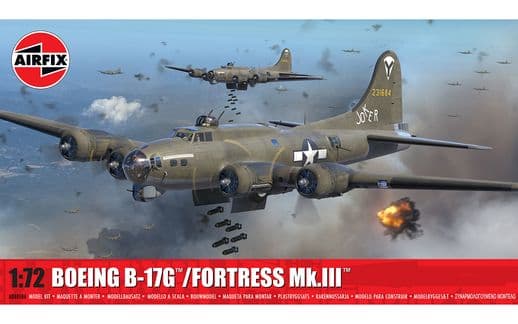
Stunning new artwork featuring the aircraft covered by the lead scheme option available with this latest release from our Boeing B-17G tooling.
Although only committed to combat towards the end of the Second World War, the B-17G variant would be heavily employed in preparations for D-Day, and the subsequent Allied advances into enemy occupied Europe. With the US daylight bombing campaign now increasingly benefitting from the support of fighter protection for the majority of each mission, they still had to face the increasingly desperate, but no less deadly Luftwaffe opposition during many sorties, in addition to the deadly accurate flak defences, which would claim more bombers than enemy fighters would.
The 774th Bomb Squadron was established as a Heavy Bombardment Unit operating the B-17 Flying Fortress in mid 1943, embarking on an intense period of training in the US, prior to being sent overseas to join the fighting in Europe. Deployed to the Mediterranean Theatre of Operations in early 1944, the unit’s bombers flew the long South Atlantic Ferry Route to reach their new bases in Italy, taking a route through Florida, across the Caribbean, into Brazil, routing via Ascension Island and onward to West Africa. It was then a transit flight across Africa and onward to Celone Airfield on the eastern coast of Italy.
Profile and full scheme artwork featuring B-17G 42-31684/Y ‘JOKER’
Once they had acclimatised in their new surroundings, it was straight into the action for the Flying Fortresses of the wider 463rd Bombardment Group, as they engaged in the long range destruction of strategic targets right across Axis controlled Europe, both in support of operations in the Mediterranean Theatre, and as part of wider D-Day preparations. Targets would usually include military industrial targets, transport infrastructure, aircraft production plants and oil refineries and oilfields, as the Allies attempted to tighten their stranglehold on Germany’s ability to keep fighting.
This aircraft is interesting by virtue of the fact the nose artwork/nickname these aircraft were so famous for sporting was actually carried on the port side of its tail. ‘Joker’ flew missions from Celone Airfield east of Rome, an airfield which was also referred to as Foggia Satellite Airfield No.1, and did so from March 1944. She would be lost less than four months later, as she fell victim to a German fighter whilst attacking chemical works near Blechhammer, deep in southern Germany, on 7th July 1944 – the aircraft was posted as missing.
Although the majority of the aircraft sports standard USAAF camouflage, the aircraft has benefitted from the addition of the later Cheyenne rear turret, units which were usually fitted at field modification centres, instead of disrupting the main aircraft production lines, particularly in the months immediately following their introduction. Introduced to improve the defensive firepower available to B-17 crews, when combined with the effectiveness of friendly fighter protection, must have provided crews with a much needed boost to morale at this vital stage of the war. Unfortunately, it wasn’t enough to protect the crew of ‘Joker’ during the mission to Blechhammer.
A very different representation of a WWII Flying Fortress, this aircraft was one of around 85 B-17G variants (Fortress Mk.III in RAF service) supplied to the Royal Air Force, with this being one of many operated in something of a clandestine role. These RAF Fortresses are significant in marking the birth of electronic warfare as an effective method of waging war, and were aircraft intended to spread confusion and uncertainty amongst Luftwaffe home defence units during the latter stages of the Second World War.
At a time when Germany was facing ever increasing Allied supremacy in the skies above Europe, the actions of RAF No.100 Group aircraft could have only further frustrated their position, whilst at the same time possibly saving the lives of hundreds, if not thousands of Allied airmen in the process. These RAF Fortress Mk.IIIs of this specialist unit were at the forefront of the world of electronic countermeasures technology and were dedicated to supporting Bomber Command’s night bombing offensive by jamming, interfering with and generally disrupting Luftwaffe nightfighter operations.
No.100 Group operated from eight airfields and had approximately 260 aircraft at their disposal, the majority of which were radar equipped nightfighters, but also included heavier aircraft crammed with the latest electronic countermeasures equipment. Their remit included jamming and interfering with the Luftwaffe night interception network, shooting down German nightfighters and protecting bomber streams by taking part in missions, emitting their electronic countermeasures to throw off the German night interception radar. Failing that, they would disrupt communications between ground controllers and patrolling nightfighters to ensure the British bombers had the best chance of making it home safely.
Such an interesting scheme, these RAF RCM Fortresses conducted an electronic countermeasures war during the latter stages of WWII, and will make for a fascinating modelling project.
A stunning new addition to the current Airfix range.
The disruption they caused resulted in many a Luftwaffe nightfighter sortie failing to come into contact with British aircraft, and German losses mounting simply by virtue of all these wasted hours in the air, which were challenging enough at the best of times. During their time, No.100 Group aircraft evaluated an operated over thirty different types of new electronic equipment, most of which were powerful enough to interfere with German detection equipment which was trying to pick up details of the latest Bomber Command raids. Taking their place within the wider attack formations, these aircraft didn’t carry bombs, but their payload was no less deadly – an electronic war which pointed to the future of aerial warfare.
This particular aircraft was the subject of an incredibly clear wartime photograph taken at RAF Oulton during 1945, with the aircraft looking particularly weary, as if it had been used on many a Radio Countermeasures mission. This scheme option allows us to place the spotlight on the often unsung, yet vital role these secretive aircraft played during the latter stages of the Second World War, aircraft which plied their trade in the shadows of night, using technology to protect fellow Allied airmen.
Although it really isn’t possible to quantify the impact these clandestine Fortresses of the RAF actually had in operational terms, there can be no doubt that their clever use of technology certainly saved the lives of a great many Allied airmen, which is reason enough for us to produce a scale tribute to their often overlooked wartime contribution.
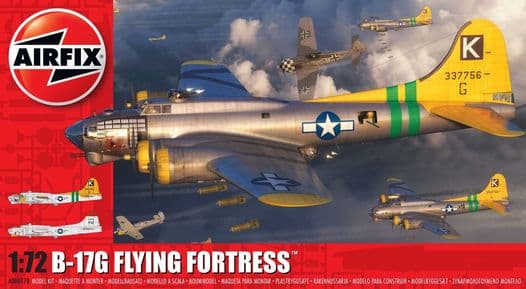
As we’re having ourselves a Boeing B-17 Flying Fortress sort of a week, it would be remiss of us if we didn’t also include the other B-17G kit which is currently still available on the Airfix website, if only now in limited numbers. A much more colourful example of a European based B-17G, A08017B includes markings for a Flying Fortress named ‘Milk Wagon’, a term which actually represented a mission where little or no enemy aircraft opposition was encountered, something which was a rare treat for USAAF crews.
Boeing B-17G-70-BO serial number 43-37756 was built at Boeing’s Seattle factory in the early spring of 1944 and delivered to the USAAF at Dow Field, Maine on 18th May the same year. She was assigned to the 708th Bomb Squadron, 447th Bomb Group and later flown to Rattlesden in England, where she would join the rest of her unit already engaged in combat. Flying her first combat mission on 20th June 1944, she would be in the air again the following day, this time on a raid to the Big One - Berlin, in the hands of a different crew.
This crew had recently transferred to Rattlesden from the 15th Air Force, flying bombing missions from bases in Italy. As this was quite unusual for base personnel, on landing back following the Berlin raid, they were asked by members of the ground crew how it compared to flying missions from the opposite side of Europe and they replied that it was like a ‘Milk Run’, obviously a little tongue in cheek, as this was a colloquialism for a mission which was without incident and one which incurred no casualties.
This off the cuff remark would stay with this particular Flying Fortress from that point onwards and 43-37756 would later benefit from the addition of some impressive and rather unique artwork. She would be adorned with a friendly looking cartoon cow and the words ‘Milk and Wagon’ painted either side of it. For every successful mission flown, a new milk bottle would be added to the scoreboard on the port side nose of the bomber, with the white bottles being painted over a black background, so they could be more easily seen.
If the addition of this nose artwork was intended to bring the crew luck, then this was a shrewd move, as ‘Milk Wagon’ was definitely seen as being a lucky ship. She would eventually set a record for a Fortress in the 447th Bomb Group, as she racked up no fewer than 129 missions without suffering a single abort due to mechanical issues, testament not only to the strength of the B-17 as a fighting aeroplane, but also the talented ground crews who kept her serviceable and in the air.
Following the end of hostilities, Milk Wagon was flown back to the US and despite her impressive war record and nose artwork, was sent to Kingman Storage Depot 41 in the Arizona desert for scrapping, a fate which awaited so many former wartime military aircraft. Such an ignominious end for an aircraft which fought so valiantly to help bring about an end to the Second World War and one which appeared determined to protect its crews through the flames of battle.
Another example of a stunning Airfix tribute to the mighty Boeing B-17G Flying Fortress in 1/72nd scale, this fantastic kit is also currently still available, although now in ever diminishing quantities.
We are afraid that's all we have for you in this latest edition, but we will be back next Friday with more project development updates and the very latest Airfix kit exclusives. In the meantime, we are always keen to hear your views on all things Airfix and in particular, any thoughts and opinions you may have regarding our Workbench blog. If you would like to drop us a quick line, could we please ask that you use our workbench@airfix.com email for all correspondence.
To re-visit any of the Airfix blogs we have produced over the past seven years or so, please head to our main Workbench hub, where you will find our entire blog back catalogue and all the Airfix design projects we have already covered.
All our dedicated official social media sites can be accessed by clicking the respective link icons at the foot of this page, or by heading to the Airfix homepage. Other useful Airfix links are:
Facebook, YouTube, Twitter and Instagram official sites
Please join us for more Airfix updates next week and thank you for your continued support.