
Welcome to this latest edition of our Workbench blog and all the news, updates, and modelling exclusives from the fascinating world of Airfix.
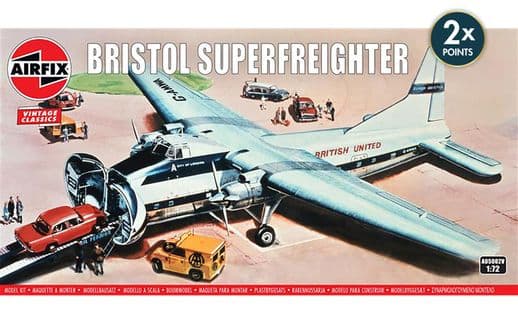
We begin this latest edition of Workbench by asking readers a question – is anyone up for an unexpected and thoroughly engaging winter build project? If the answer is yes, then we might have just released the model kit for you, the latest in our successful series of surprise releases for 2024 and the latest addition to the Vintage Classics model range, the magnificent Bristol Superfreighter in 1/72nd scale.
As we find ourselves in Scale ModelWorld week and the nation’s modellers prepare to enjoy the latest instalment of this magnificent event, many Airfix fans would have been expecting us to be making a surprise kit announcement or two this week, but we bet you wouldn’t have been expecting the return of the Bristol Superfreighter. That being said, we’ve gained quite a reputation for new kit surprises over the past couple of years, but the question is, do you think that’s us all done for Scale ModelWorld week? Unfortunately, we’re not in a position to either confirm or deny anything at this point, but advise you to keep an eye of the Airfix website and socials over the coming few days, as we bring you all the latest news from Telford. We’ll have more on our planning for Scale ModelWorld a little later in this edition.
As you would expect for this edition, we will be concentrating on the latest of our 2024 range surprise announcements, and the arrival of a model which surely must be considered as one of the more unusual kits in the Airfix tooling inventory. The Bristol Mk.32 Superfreighter may be a slightly ungainly looking aircraft, but represents a period in aviation when everything seemed possible, the time immediately following the end of the Second World War. An aircraft which was described as a flying car ferry, we will be looking at the history of this unusual aircraft, before looking more specifically at this kit and how we prepared it for inclusion in the Vintage Classics range.
For those who were ever fortunate enough to fly on of these aircraft, or even saw one fly, they certainly wouldn’t forget the experience and will no doubt have great affection for the Superfreighter. As such, this latest Vintage Classics addition should be of interest to many.
A built model of a Bristol Type 170 Mark 32 Superfreighter, a larger, modified variant of the original Freighter.
As one of the most interesting and innovative aviation designs of the early post war era, it doesn’t take too much imagination to appreciate that the Bristol Type 170 Freighter and its derivatives had their origins in conflict, and the search for a rugged and reliable airborne load lugger. Having designed and introduced the distinctive high-wing, twin engined Bristol Type 130 Bombay bomber/transport aircraft in 1939, the Bristol Aeroplane Company had previous experience in producing aircraft of this type, one which was very much in the background of military operations during WWII, but one which was nonetheless essential to those operations.
The development of the Bristol Type 170 Freighter began after the British military were approached by the famous military commander General Orde Wingate, whose Chindit forces were engaged in savage jungle fighting against the Japanese during the Second World War. These operations proved incredibly demanding for Wingate’s troops, and he felt that the introduction of a rugged and extremely capable transport aircraft, one which was able to operate from roughly prepared jungle clearing landing strips, would have a significant impact on the effectiveness of such operations.
Any subsequent aircraft would have to be powerful enough to carry significant loads of men, supplies and equipment, but also to operate into and from short, often roughly prepared landing strips and often in close proximity to the enemy. As the Bristol Aeroplane Company started work on the new aircraft, they based their initial blueprints on the Type 130 Bombay which they had introduced some years earlier, but ‘toughened it up’ in many respects, whilst at the same time opening the appeal of the new aircraft to as wide a potential market as possible, with both military and civilian applications.
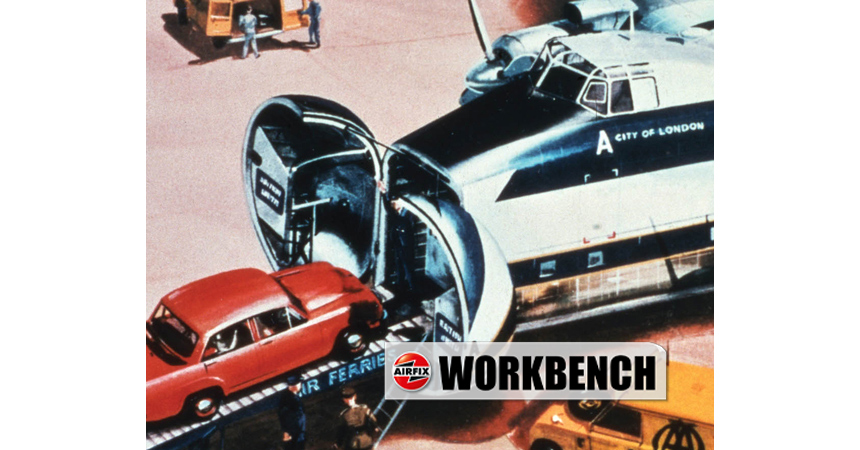
Retaining a similar structural layout to the Bombay which preceded it, the new aircraft retained a fixed main undercarriage, which was robust yet streamlined, but deviated with the inclusion of large, side hinged clamshell doors at the front of the aircraft. These doors opened to reveal a cavernous cargo area and were manually operated via a crank handle and an ingenious arrangement of geared cogs and chain, and once closed, were held securely in place by several robust locks down the central joint. Opening out wide, this arrangement allowed for a large amount of cargo to be carried, military vehicles and cars, but we’ll come to that a little later.
The majority of the images we’re using to illustrate this review feature built sample models of our new Vintage Classics Bristol Superfreighter, a later derivative of the Type 170 Freighter.
This original design would have had to undergo significant modification if it was to satisfy an updated specification for the Royal Air Force, however, with the war now clearly in its latter stages and the new aircraft being less of a priority for them, Bristol started to look towards other air forces and how to appeal to civilian operators. They were fortunate in securing Government financial support for the project, allowing the production of manufacturing jigs and two prototype aircraft, with two variants progressing without delay. The standard load-lugging aircraft was called the Freighter, whilst a modified variant with increased passenger carrying capacity was to be known as the Wayfarer.
At a time when the world was witnessing the introduction of early jet powered aircraft and their sleek designs which were intended to squeeze every last drop of performance these aircraft were capable of, the new Bristol Type 170 Freighter, whilst also being a new design, appeared to be something of a backward step in design terms. Less sleek and more slab, the Type 170 was unquestionably an aircraft which scoffed at the technology of aerodynamics, and laughed in the face of physics to plough its own aviation furrow. In fact, the aircraft attracted the colloquial title of being ‘20,000 rivets flying in close formation’, but usually delivered with great affection.
Despite its appearance, the Bristol Freighter offered something different for both military and civilian operators, air mobility. It has to be remembered that the aircraft was being marketed at a time when reliable and effective heavy lift helicopters were still some way off widespread service, and therefore possessed great appeal in many situations. Rugged, reliable and extremely capable, it seemed as if no air transportation task was too much for this practical aeroplane – if you could fit the load in its fuselage, you really were good to go.
Aircraft G-AMWA served as the prototype aircraft for the modified Superfreighter variant.
The reliability and performance of the Freighter did make the new aircraft of interest to the military and they would eventually go on to see extensive service with the air forces of Argentina, Australia, Burma, Canada, Iraq, Pakistan and New Zealand, however, they would perhaps be more famously remembered for finding a niche in civilian service, as these aircraft offered choice, flexibility and reliable service at a time when Britain was desperately trying to put the hardships of the Second World War behind them.
For those who could afford to do so, if you fancied a little touring holiday in Europe, you could take your car to an airport served by one of these aircraft and within an hour or two, could be driving through the idyllic streets of France, whilst ferry passengers hoping to do the same were still sat at their departure port. At a time when aviation appeared to offer all sorts of liberating possibilities for the population, several companies started to operate Bristol Freighters in this way, offering both businesses and individuals the opportunity to take their cars to the continent with a minimum of fuss, and importantly, with scheduled services that were as regular as clockwork.
The freedom these services offered made the Bristol Freighter one of the most popular aircraft of this early post war era, one which was always in the public eye. Whether it was performing at a Farnborough Airshow, or the main feature of a Pathé news update film, the media loved these aeroplanes because they offered something very different, an opportunity to look forward to a new consumer world and away from the horrors of war. The Bristol Freighter offered a fast, professional and reliable service to the continent, and with hundreds of flights taking place every day during the summer months, also offered an ideal opportunity for people to brush up on their French face to face, whilst at the same time appearing to all that knew them as being upwardly mobile.
The prototype Bristol Type 170 Freighter made its first flight on 2nd December 1945 and around 214 of these impressive aircraft would eventually be produced.
Airfix heritage in artwork form. The Superfreighter box artwork was created by the great Roy Cross in 1967.
The Bristol Freighter variant immortalised by the re-introduction of this 1/72nd scale kit was a slightly modified aircraft to those first machines which made such an impact on the aviation world back in the 1950s. During early operations, two aircraft were lost in crashes, with investigations indicating that both were lost due to extreme yaw which caused the structural failure of the tail during a failed engine climb (on a single engine). All future aircraft therefore benefited from structural modifications, which included a larger more robust tail and general strengthening to the rear of the aircraft. These aircraft were categorised as Bristol Type 170 Mark 31 Freighters, with this version of the aircraft going on to become the most successful of all the variants.
The production of Bristol Freighters was subsequently further modified following a request submitted to the manufacturers from Silver City Airways, a company who were operating the Freighter to provide cross Channel air ferry services. Their service was becoming increasingly popular with the British public, however, crews often found that there was something of an imbalance with regard to outward loads and those coming back. They wanted to standardise the service they offered by operating a fleet of slightly larger aircraft which could carry more cargo and ultimately prove more economical.
They were looking for an aircraft that could carry three cars in its cargo hold, which would require an aircraft with a longer fuselage and need the extra power offered by the latest variant of the Hercules engines. The new aircraft was referred to as the Mark 32 Superfreighter and these aircraft were powered by 2000hp 14 cylinder sleeve valve Bristol Hercules 734 engines, and had a fuselage length increased by 5 feet at the nose.
Although the Superfreighter could be described as a little ungainly, it was absolutely liberating for the British public looking to put the horrors of the Second World War behind them.
The Superfreighter allowed Silver City Airways to fly their cross Channel services offering either 3 car and 12 passenger services, or 2 car and 23 passenger flights, at a time when the British public appeared to have well and truly caught the bug for continental touring holidays. These extremely capable and hard-working aircraft could carry an 8,000lb load over a distance of around 1,300 miles at 165mph and with this level of operation, would put quite a strain on the fatigue life of their aircraft.
The prototype Mark 32 Superfreighter was converted during its production, with the donor aircraft starting the process as a Mark 31, but ended up as G-AMWA, the aircraft which is featured in this Vintage Classics release. The aircraft made its maiden flight on 16th January 1953 and was subsequently delivered to Silver City Airways at the end of March that same year.
Silver City Airways would eventually take 14 Bristol Superfreighters, with a further six aircraft later procured by a rival air charter company. Although production of these aircraft ceased in 1957, two Mark 31 variants would also subsequently be upgraded to Superfreighter standard in 1958.
Taking all Bristol Freighter/Superfreighter production in its entirety, 214 Type 170s were built, or which 94 were produced for civilian operators, with the remaining 116 all produced for various military operators around the world. Of the remaining 4 aircraft, one was a test and evaluation machine, and three others were lost to accidents and were written off prior to delivery.
These really were incredibly interesting aeroplanes. They were most definitely unusual, but we suspect they were actually in much wider service than many people might have thought prior to reading this kit feature.
Bristol Superfreighter Mk.32 G-AMWA, British United Air Ferries, Lydd Airport, Kent, England, 1967.
As we have already seen, this particular aircraft was the prototype Mark 32 Superfreighter, but started its life as an aircraft working its way down the production lines as a Mk.31 Freighter. It was selected as the donor airframe for modification to the larger Superfreighter project and made its first flight in this configuration as G-AMWA on the 16th January 1953. Later that same year, the aircraft was leased from the Bristol Aeroplane Company to Silver City Airways as the first of their Superfreighters, but would be purchased outright by them the following year.
The aircraft was named ‘City of London’ and after operating for many years with the famous Silver City Air Ferries, transferred to British United Air Ferries following their acquisition of Silver City in January 1963. This change initiated the livery change which inspired the scheme option included with this new kit, one which was engineered in 1959 and benefitted from the production of classic box artwork from the hands of Mr Roy Cross a few years later in 1967.
After a long career taking passengers and their vehicles across the English Channel and to and from the Channel Islands, this historic aircraft was written off following an accident at Guernsey Airport on 24th September 1963. As the aircraft prepared to return to Bournemouth Airport and after the crew had completed their pre-flight checks, the aircraft started its take-off run. As they were heading into quite a strong crosswind, the captain quickly brought the throttles up to full power, however, as the aircraft accelerated down the runway, the crew noticed the power from the port engine was surging.
Full scheme details for this prototype Superfreighter which went on to have a busy career with Silver City and British United Air Ferries.
Despite initiating immediate corrective actions, the engine continued to appear to be struggling, resulting in the captain aborting the take-off. Unfortunately, the brakes failed at this critical moment and the crew knew they were going to run off the end of the runway. They steered the aircraft off at an angle to avoid the runway lights, but the aircraft became airborne for a short while, hoping over the boundary fence and the public road which ran along it and coming down again heavily in an adjoining field. With its undercarriage collapsing and the lower fuselage suffering significant damage, the aircraft was clearly beyond economical repair and was written off and subsequently scrapped. Fortunately, the crew of four avoided serious injury and lived to tell the tail.
The British United Air Ferries Company can trace its heritage back to Silver City Airways and their use of the distinctive Bristol Freighter/Superfreighter. With the air ferry business being incredibly popular during the 1950s, officials behind the Silver City company felt their effectiveness was being held back by the carrying capacity of the aircraft they had in service. What they wanted was a slightly larger variant of their existing Freighters, directly leading to the production of the Mk.32 Superfreighter.
Once this new variant of the aircraft entered service, they discovered a problem when operating them from their home airfield at Lympne – now able to carry additional weight, the aircraft were regularly becoming stuck in the ground at this grass airfield, a situation which simply couldn’t continue. A move to the airfield at West Malling did alleviate this problem, however, the airfield was still under MoD ownership, and they were charging them higher than usual rent and landing fees. As they were scheduling multiple flights every day, these costs were beginning to spiral and something had to be done – they really needed their own airfield.
After securing significant investment and having surveyed several suitable sites, they finally selected a site at Lydd on the Kent coast and construction got underway. Silver City’s impressive new purpose built airfield home was referred to as ‘Ferryfield’, with the inaugural service from the new airfield taking place on 13th July 1954. A total of 70 flights were made on that first day.
Following the end of the Berlin Airlift and their commitment in support of it, Silver City had a fleet of five Bristol Freighters and six Mk.32 Superfreighters available exclusively for its air ferries services. Once Ferryfield was working at maximum capacity, it really did start to post some impressive service and passenger statistics. During a single day in July 1953, 222 Channel crossings were made in a single day, figures which often required crews to fly around six round trips each day, figures which serve as an impressive indication of the overall serviceability of these aircraft.
The Silver City company would become a household name across Britain because of the high-profile cross Channel air ferry service they offered, but would eventually be swallowed up in a later round of industry acquisitions and mergers. British Aviation Services started to acquire airline businesses during the 1950s as the number of individual businesses continued to diminish due to competition and costs, and they would eventually swallow up Silver City in a subsequent take over. On 1st January 1963, a new company called British United Air Ferries was established and as one of the aircraft formerly operated by Silver City, Superfreighter G-AMWA was subsequently repainted in the livery of the new company, the livery which is on offer with this latest kit addition to the Vintage Classics range.
The Bristol Superfreighter kit in full Vintage Classics presentation. We’re so pleased to have this classic model back in the current Airfix range.
As we have already seen, she would be lost in an accident at Guernsey Airport in September 1963, inside the first year of wearing her new livery. After representing Silver City for nine years, she would only fly in the colours of British United Air Ferries for around six months before being written off.
Within the wider heritage of the Airfix brand, this kit has to qualify as one of the more interesting aircraft models ever released, and one which has captivated many thousands of modellers over the years. Although not a Spitfire or Lancaster, the Superfreighter was such an unusual project, that it really did catch people off guard and subsequently proved incredibly popular. A model which serves to commemorate the incredible service record of this unusual aircraft and how the aeroplane directly transformed the lives of the British public during the immediate post war years, an Airfix Bristol Superfreighter would certainly draw plenty of admiring attention, if one was included amongst your built model collection.
Although we’re delighted to be welcoming the Bristol Superfreighter into the 2024 Airfix range, we are in Scale ModelWorld week and as such, you didn’t really think we would be leaving the new model announcements there did you?
For those people who follow the various Airfix social media sites, you will probably have seen several posts this week which appeared to suggest that we’ve been keeping secrets again, but how all will be revealed at 10am on Friday 8th November. This information embargo also explains the slightly later posting of this week’s edition of Workbench, because we were also in on this covert operation and have news of new models to bring you. By waiting until after the unveiling announcement, we can direct readers to the individual web pages of the new models, but what news do we have to share with you?
We can announce that visitors to the Airfix stand at this years Scale ModelWorld show will be the first people to see built sample models of two new additions to our growing 1/48th scale kit range in all their glory, one a new tooling project, with the other being a much requested second release from a hugely popular tooling.
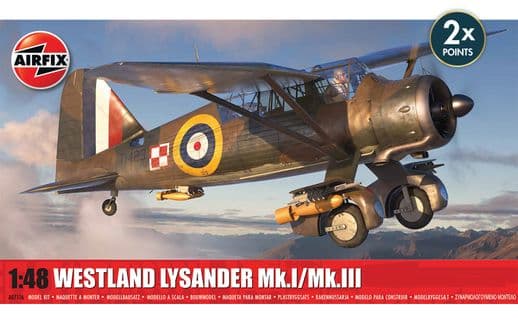
New tooling – 1/48th scale Westland Lysander Mk.I/Mk.III
An addition to the Airfix range which has been long requested and will therefore be welcomed by many modelling enthusiasts, a Westland Lysander in this larger scale will be simply magnificent, and one many of us will be looking forward to getting our hands on. An impressive new tooling project, this new kit is a scale representation of one of the most distinctive British aircraft of the Second World War, one which was designed to provide the British Army with a modern aircraft for reconnaissance, observation and artillery spotting duties, replacing their ageing Hawker Hector biplanes in this role. The design team at Westlands were keen to gauge the opinions of serving Army cooperation pilots prior to starting work on the project, with the result of these studies leading them to design an aircraft with overall visibility and low speed handling as priority features. The aircraft they unveiled could hardly have looked more different from its predecessor.
Possessing exceptional rough field and short take-off and landing capabilities, the Lysander was just what the Army were looking for and following its service entry in June 1938, there were high hopes for the aircraft. Unfortunately, many of the design requirements incorporated into the aircraft were as a result of Great War thinking, but the war to come would be very different. Of the 175 Lysanders deployed to France with the British Expeditionary Force, 118 would be lost, with the aircraft unable to defend itself when faced with the Luftwaffe's Messerschmitt fighters. Despite this, the Lysander would prove itself to be an incredibly capable aircraft, one adaptable enough to be used successfully in several different roles.
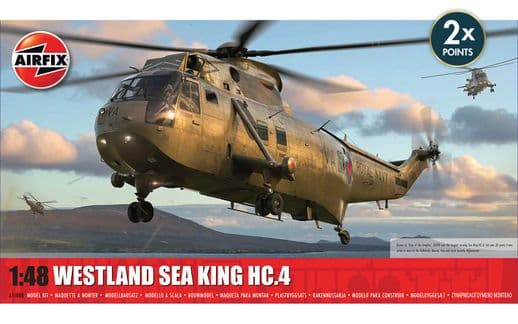
New parts and new schemes - 1/48th scale Westland Sea King HC.4
Just the second release from an impressive newly tooled model which received rave reviews following its release last year, this new kit includes an additional frame of parts to allow this specialist variant of the British Sea King to be built, along with no fewer than four different scheme options for us to choose from.
A specialist variant of the Westland Sea King, the HC.4 was the Royal Navy's Commando troop carrying and resupply helicopter replacement for their Wessex HU.5 helicopters and a development of similar aircraft produced for the Egyptian and Qatari Air Forces. 42 newly built helicopters were eventually produced in this configuration, which by their nature, were never too far from any action hotspots.
Deployed to combat zones right across the world during their 36 year service career, the Junglie as it was affectionately known, served with distinction from the Falklands War, through to the UK's campaign in Afghanistan.
A stunning dual addition to the range, we have two aviation products of the Westland Aircraft company from different eras to bring you, and both iconic in their own right. As you would expect, we will be bringing you full details relating to the initiation and ongoing development of both the new kits in subsequent editions of Workbench, including pictures of their triumphant debuts on the Airfix stand at this year’s Scale ModelWorld show.
As always, our attendance at Scale ModelWorld 2024 has been planned with military precision, and every member of the team is looking forward to greeting visitors to the Airfix stand whether they be first timers, or old hands. As ever, we will be in our traditional position against the dividing wall at the top of Hall 1 and with plenty of flags, banners and branded presentation, we will be easy to spot. We also have a spectacular display of models to show you, and our team will be available to discuss modelling issues of the day, so if you are heading down to this year’s show, please do make a point of dropping by to say hello.
Although we will be adopting our usual policy of not selling kits at the show itself, we will have a selection of appealing items for sale, including some limited edition collectables produced to mark this year’s 85th anniversary of the Airfix brand. With a beautifully finished pin badge and high quality collectable commemorative coin available to pick up at the show, make your 2024 visit all the more memorable by securing one of these appealing Airfix items. We will also have a selection of mugs, glasses and coasters/flight patches available over the weekend, so don’t go without marking your visit with a little Airfix treat.
For those who can’t make this year’s show, please keep an eye on our official social media channels, as posts should be available in real time over show weekend, and we will also be gathering content for future review articles in both Workbench and the Club magazine. Obviously, the website will also be open for business, so if you fancy a Bristol Superfreighter, or getting in early with one of the new models announced at the show, you know where to go. In any case, it would be rude not to treat yourself to a kit or two over Scale ModelWorld weekend.
Importantly, if you are heading down to this year’s show, please do come and see us at the Airfix stand, because we’re all really looking forward to meeting as many of you as possible. If you are a Workbench reader, please don’t forget to mention that too, because your support really does mean the world to us.
See you all there!
A final reminder of the main subject of this latest Workbench update.
We are afraid that's all we have for you in this latest edition, but we will be back next Friday with more project development updates and the very latest Airfix kit exclusives. In the meantime, we are always keen to hear your views on all things Airfix and in particular, any thoughts and opinions you may have regarding our Workbench blog. If you would like to drop us a quick line, could we please ask that you use our workbench@airfix.com email for all correspondence.
To re-visit any of the Airfix blogs we have produced over the past seven years or so, please head to our main Workbench hub, where you will find our entire blog back catalogue and all the Airfix design projects we have already covered.
All our dedicated official social media sites can be accessed by clicking the respective link icons at the foot of this page, or by heading to the Airfix homepage. Other useful Airfix links are:
Facebook, YouTube, Twitter and Instagram official sites
Please join us for more Airfix updates next week and thank you for your continued support.