

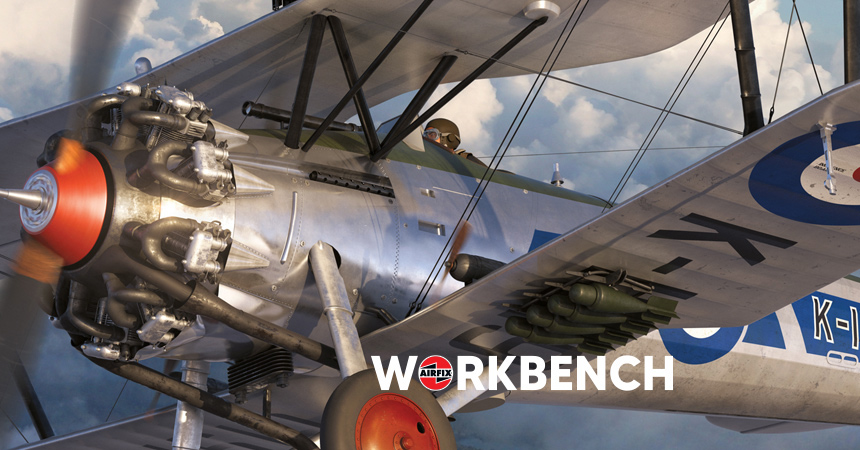
Welcome to this latest edition of our Workbench blog and all the news, updates, and modelling exclusives from the fascinating world of Airfix.
Well, we’ve managed it – we’ve safely negotiated another hectic year! With this being the final edition of Workbench for 2025, we wanted to go out with a serious cracker of a BANG, so that being the case, what could be better than to feature our final secret model release for the year, one which just happens to be a silver winged beauty.
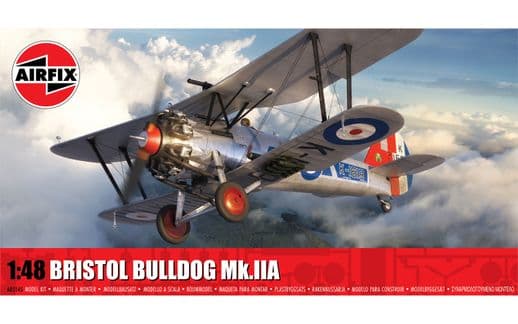
Earlier this week, the various Airfix information channels carried the news that as part of the festivities here at modelling HQ, we’d held back our final secret model release of the year for this most festive of periods, the second release from our new 1/48th scale Bristol Bulldog tooling. A beautiful inter-war British fighter which not only found favour with the Royal Air Force, but also with several overseas air arms during the early 1930s, this second release includes additional parts to allow the much modified Bristol Bulldog Mk.IIA variant of the fighter to be modelled. This was an aircraft which was unquestionably one of the most important British fighter aircraft of the late 1920s and early 1930s, and was an aircraft which stimulated a significant period of upgrade and expansion for the Royal Air Force.
In this final update of the year, we will be looking at why the Bulldog was such an important aircraft for the Royal Air Force, why this second release presents the fighter in arguably its most iconic form, and what made this such a highly regarded aircraft in RAF service. Of course, we will also have our usual selection of spectacular subject imagery, which will hopefully highlight why this makes for such an appealing modelling project.
We’re dancing the skies on laughter-silvered wings in this final edition of Workbench for 2025.
The release of our first 1/48th scale Bristol Bulldog kit last year brought this beautiful aircraft to the attention of the modelling community, earning it some long overdue enthusiast attention.
For a great many people, the world of aviation holds a fascination which stays with them throughout their lives, with the latest high performance aircraft which defend their nation’s airspace usually being the highest profile subjects of their infatuation. With the young men and women who fly these awesome machines still commanding the admiration of huge swathes of the population, today we have the benefit of almost daily live feeds being broadcast from either Coningsby or Marham, where our latest ‘top guns’ perfect their craft flying the most spectacular aircraft to have ever worn the iconic roundel of the Royal Air Force.
During the late 1920s and early 1930s, the British population’s infatuation with aviation and aviators was all encompassing, but they clearly didn’t have the benefit of live streams from Hendon and Kenley. They had to wait for updates in the national press or at the cinema, or join the throngs of people heading to Airshows and aerial pageants at the nation’s largest airfields, locations which were able to cope with the popular demand. Once on the airfield, gleaming silver aircraft performed precision aerobatics in front of crowds totalling many hundreds of thousands of people, with the pilots of these magnificent machines representing the very cream of the nation’s youth.
Aeroplanes held the British public completely captivated, and a life in the Royal Air Force was something many young people aspired to. This period is also remembered as unquestionably the most flamboyant in aviation terms, not only because precision aerobatic displays were regarded as highlighting the proficiency of a modern Royal Air Force, but how the presentation of aircraft was not shackled by the need for combat camouflage. That being the case, these gleaming silver aeroplanes proudly carried the colours of their respective squadrons into Britain’s skies, which must have been a sight to behold and was truly a golden era for the aeroplane.
So how did the Bristol Bulldog fighter manage to take its place amongst Britain’s aviation elite during this iconic period for the aeroplane? That takes us in a slightly different direction and to a talented aircraft designer who had previous combat experience above the trenches of the Western front.
A computer rendered Bristol Bulldog image produced from the CAD files produced during development of this beautiful model.
After benefitting from a first-class education in Scotland, Frank Sowter Barnwell went on to become a celebrated pioneer of early British aviation, designing and building a series of aircraft prior to enlisting in the Royal Flying Corps following the outbreak of the Great War. After successfully gaining his wings, Barnwell was assigned to No.12 Squadron RFC, however, in August 1915, was released from service to allow him to take up a prestigious position as Chief Designer at the Bristol Aeroplane Company.
This decision would not only benefit Barnwell, but later also the RFC/RAF, as this talented designer and his team would be responsible for producing one of the most capable British fighting aeroplanes of the Great War, the Bristol F2B Fighter, an aircraft which entered service in 1916 and was still in RAF service during the early 1930s. This impressive longevity for the F2B only ended after Barnwell’s latest fighter design had been accepted into Royal Air Force service, a rugged and powerful aircraft which represented the very pinnacle of biplane fighter technology at the time of its introduction, the capable and aesthetically pleasing Bristol Bulldog.
During the 1920s, Frank Barnwell and his design team at the Bristol Aeroplane Company were engaged in developing and perfecting a series of different fighter design projects, initially all as private ventures, but aiming to bid for military contracts issued by both the RAF and Fleet Air Arm. Their designs were built around cutting edge engine technology and incorporated all the latest aeronautical engineering advancements the industry had to offer at that time. One design in particular showed much promise, and when combined with their own Bristol Jupiter powerplant, seemed destined to satisfy the RAF’s requirement for a new fighter interceptor, one intended to replace the Armstrong-Whitworth Siskin and Gloster Gamecock fighters.
Looking at this original artwork for the Mk.II variant, can you spot the differences between this and the updated Mk.IIA version of this beautiful inter-war British fighter?
Featuring an advanced all-metal structure, with fabric covered wings and fuselage, the new aircraft was evaluated alongside aircraft produced by other manufacturers, and advanced to a further round of evaluation with the Hawker Hawfinch. In preparation for this, Bristol made some modifications to their aircraft, most notably by lengthening its rear fuselage, and with the aircraft now carrying the designation Bristol Type 105A (Bulldog Mk.II), it was to eventually win that contest, by virtue of its better overall serviceability record and following input from pilots who had spent time flying both types.
An initial order for 25 aircraft was placed and the first of the RAF’s new Bristol Bulldog Mk.II fighters were delivered to No.3 Squadron at Upavon during the early summer of 1929, something which was rather fitting considering the unit’s motto – Tertius primus erit - ‘The third shall be the first’.
The Bristol Bulldog was armed with a pair of forward firing Vickers 0.303 in machine guns mounted either side of the cockpit, however, it would ultimately never fire those weapons in anger during a relatively short seven-year period serving with Fighter Command, even though it would go on to equip ten out of the thirteen fighter squadrons defending Britain’s airspace during that time. Although it was the most capable fighter of the day, the Bulldog was more closely associated with challenging formation flying and spectacular aerobatics than it was with its prowess in aerial combat, with the Royal Air Force thrilling huge crowds at Airshows and pageants around the country, as they demonstrated the effectiveness of a modernising air force.
What the Bulldog certainly did do was to help advance Britain's aviation industry towards the production of the sleek, monoplane fighters which would subsequently contest the aerial duels of the Second World War, as it highlighted the fact that no matter how advanced, biplane designs were fast approaching their technological zenith.
The inter-war period of British aviation witnessed the introduction of some of the most attractive aircraft to ever see service with the Royal Air Force, and with their presentation celebrating squadron associations, they were also some of the most strikingly decorated.
Another important legacy of the design technology employed on the Bulldog was that it would influence aircraft which would go on to serve successfully throughout the Second World War, with machines such as the Fairey Swordfish and Hawker Hurricane all adopting similar construction techniques. In addition to this, from a company design perspective, it would also be an important steppingstone in ultimately leading to the introduction of later successful Bristol designed aircraft, such as the Blenheim, Beaufort and Beaufighter.
On the 23rd of May 1929, a newly manufactured Bristol Bulldog Mk.II landed at RAF Upavon, having just made the short flight from the Bristol manufacturing facility at Filton, the first delivery of the type to the first RAF Squadron to be equipped with the new fighter, No.3 Squadron. This first aircraft would be followed by others at regular intervals over the next few months, with the unit finally being at Squadron strength by the end of September.
The airfield at Upavon was at that time one of the oldest active stations in the country and whilst it was home to one of the RAF’s most prestigious squadrons, it was actually a less than ideal location for an airfield. Situated on the edge of Salisbury Plain, the airfield site was originally chosen because of its remote location, because in those days of early flight training, accidents were commonplace, and the military didn’t want prying members of the press reporting anything negative about a life flying military aeroplanes. Unfortunately, the location also featured some challenging topographical features and being situated on a hill, with a steep valley falling away at one end, it regularly suffered from strong and unpredictable winds and even the most capable pilots referred to it as the ‘Airfield on the Hill’. Flying from the airfield was never without its challenges.
Unusually, the box artwork produced in support of this modified tooling release of our Bristol Bulldog kit features the third scheme option of the three included with a secret release which was ‘outed’ this week.
Although the modelling world may have been a little surprised by our announcement that we were introducing a newly tooled 1/48th scale Bristol Bulldog Mk.II kit to the 2024 Airfix range, it probably wouldn’t have taken people too long to come round to the idea, as the aircraft is an absolute stunner, particularly in this larger scale! It could be argued that unless you describe yourself as an avid aviation enthusiast of some years standing, your knowledge of this diminutive inter war fighter might be somewhat limited, particularly as it only had a relatively modest period in Royal Air Force service.
This was more down to the astonishing pace of technological advancement at that time in the world of aviation, rather than being a reflection of the aircraft’s capabilities, and once you spend a little time brushing up on your Bulldog research, it isn’t difficult to become seriously captivated by the aircraft’s good looks and flamboyant presentation.
From an Airfix project perspective, many Workbench readers will have probably built the Bulldog in 1/72nd scale, a kit which was initially introduced back in 1969 and only recently inducted into the Vintage Classics kit hall of fame, however, in the larger 1/48th scale, that story is a very different one. Regarding biplane aircraft subject matter, we do have the Supermarine Walrus and de Havilland Tiger Moth kits available in this scale, kits which have both been released over recent years, and both occupying a similar period in aviation history. Other than those kits, we have to go back to 1980 and the release of the Hawker Fury I to find a classic RAF inter-war fighter type wearing the Airfix logo in this scale.
The introduction of the Bulldog brought the classic inter-war period of British aviation to the attention of the modelling world, a time when the most capable aircraft in the world were also some of the most attractively presented. Aeroplanes which truly graced the skies with their presence, the fact that the age of the monoplane fighter was just around the corner doesn’t diminish the relatively short period of time that these high performance biplanes captivated all who clapped eyes on them, aircraft which were not only built for performance, but were allowed to represent their squadrons in a manner that celebrated everything about modern aviation. This was truly a time to be serving in the Royal Air Force.
When it comes to decal options for a Bristol Bulldog kit, you’d better be prepared to bring the colour!
With the Bulldog already in RAF squadron service, the Bristol company received a new order for 92 fighters in May 1930, aircraft which were to be of a revised specification, incorporating a host of improvements aimed at making this already highly regarded aircraft even more capable, and even more reliable.
Amongst a long list of design modifications, this new variant of Bulldog featured improved overall strengthening, a wider track undercarriage with larger metal mainwheels, a new castoring tail wheel, a new braking system, a larger tail and rudder, the adoption of the more powerful Bristol Jupiter VIIF engine, improvements to the oil system and a host of cockpit modifications, all intended to make this excellent aircraft even more effective.
The undercarriage and tail modifications both improved the aircraft’s handling on the ground and during take-off and landing, but lengthening the undercarriage slightly was an attempt to future proof the fighter, making the future use of an even more powerful engine and larger propeller possible. In truth, the Bulldog was already a very highly regarded aeroplane, so these improvements only served to enhance its reputation, something which was further underlined by a further Air Ministry order for 100 fighters to be delivered between July 1931 and April 1932.
This second release from our 1/48th scale Bristol Bulldog tooling includes additional part frames to allow this upgraded variant of the fighter to be modelled, whilst also including the components to allow the existing Bulldog Mk.II to be modelled, should you wish to go for one of the first Bulldog fighters to see Royal Air Force service.
Let’s take a closer look at the three new scheme options available to modellers when building one of these attractive new kits.
The airfield at Kenley was originally constructed for use by the Royal Flying Corps during the Great war, and by the time No.23 Squadron took up residence with their Gloster Gamecock aircraft in February 1927, it had already established a reputation as being a fighter station. By July 1931, No.23(F) Squadron were in the process of exchanging their Gamecocks for new Bristol Bulldog Mk.IIA fighters, although the squadron would effectively be used as a test unit, never fully relinquishing their Gloster fighters, and only finally doing so when exchanging them for Hawker Harts, with the unit operating both types.
When No.23 Squadron arrived at Kenley, they joined the already resident No.32 Squadron and their Bristol Bulldogs, a move which proved rather significant for both units, as it was the first time they had operated from the same airfield since they had done so in France during the Spring of 1917.
No.23 Squadron had earned a growing reputation for aerobatic excellence, and in their responsive Gloster Gamecock fighters, represented the Squadron at several high profile events, including the Hendon Air Display of June 1931. For that event, ‘C Flight’ commander F/L Harry day had been instructed to recruit and train another pilot to thrill the near 200,000 crowds at Hendon with a display of precision aerobatics, which he set about doing by recruiting a talented, yet headstrong 21 year old pilot officer named Douglas Bader.
After weeks of intensive training, their display proved to be a spectacular success, with the pair giving a good account of their Squadron, and highlighting the skill and professionalism of the modern Royal Air Force.
Full scheme details for this rather famous Bulldog, or in view of the incident which made it famous, should that be infamous?
Back home at Kenley, there was a growing problem with pilots engaging in unauthorised low flying and aerobatic exuberance, something the young Douglas Bader was guilty of partaking in. On a number of occasions, he and his fellow pilots had been admonished by their Flight Commander on the perils of such activities, but the headstrong Bader simply couldn’t stop himself once in the cockpit of his fighter.
On converting to the new Bristol Bulldog Mk.IIA, Bader was allocated this particular aircraft, K1676, an aircraft with which he would become inextricably linked. Although more powerful that the Gamecock he was used to flying during his aerobatic demonstrations, it was at least 600lb heavier, a factor which would have dire consequences just a few weeks later.
On the morning of 14th December 1931, Bader took his recently allocated Bulldog up for its latest flight, and after putting it through its paces over the surrounding countryside, which included some enthusiastically executed aerobatic manoeuvres, he headed back towards Kenley. As he approached the airfield, he noticed two other Bulldogs climbing away in the distance, which reminded him that one of his squadron mates was flying over to Woodley Aerodrome for a lunch appointment with his brother, who was a flying instructor at the Reading Aero Club based there. Bader decided to join them, and increased speed to join the pair.
With his reputation for thrilling the crowds at Hendon clearly preceding him, Bader proved to be quite the celebrity, and during some boisterous after dinner banter, it was likely that he was challenged to perform some low altitude aerobatics over the airfield clubhouse prior to leaving. Challenge accepted, as the three aircraft took off from Woodley to head back to Kenley, Bader’s machine was seen to leave the formation and head back towards the aerodrome.
The group gathered outside the clubhouse saw Bader’s Bulldog pass low over the airfield threshold and start to roll at an incredibly low altitude, but before the manoeuvre could be completed and the aircraft right itself, one of its wings struck the ground, sending the speeding aircraft cartwheeling across the grass in a catastrophic crash. The engine was ripped off, and the fuselage became a twisted ball of metal, with the reckless pilot still trapped inside. Thankfully, there was no fire, and onlookers rushed to free the injured pilot, who on that day, had just 33 hours of Bulldog flying experience in his logbook.
The rest of this story is the stuff of aviation legend, one of determination and devotion to duty, a man who overcame incredible adversity to return to operational flying and lead the RAF during some of its darkest times. He would become an inspirational figure who helped to keep Britain fighting when the nation needed a hero.
With No.3 Squadron taking the distinction of becoming the first Bristol Bulldog equipped unit in the Royal Air Force, it also follows that their home airfield at Upavon also became inextricably linked with this important inter-war British fighter type. As the squadron started to use their smart new fighters, the members of No.17(F) Squadron with whom they shared the Wiltshire airfield must have been a little envious of their neighbours. Whilst their colleagues at No.3 Squadron started taking delivery of their Bulldogs during the summer of 1929, they were still operating their ageing Armstrong Whitworth Siskin IIIA fighters, and would be made to wait for their Bulldogs to be allocated.
The motto of No.3 Squadron ‘Tertius primus erit’ proved to be rather apt when considering the unit’s historic position as the first to be equipped with the new Bulldog, as it translates as ‘The third shall be first’. Their home airfield at Upavon also had several ‘firsts’ to its name, as it was the aerodrome at which an aircraft made the first night landing anywhere in England, as well as being the airfield used to develop an effective bomb sight for British aircraft, technology which was deployed during the Great War. The first unmanned aerial target aircraft was also developed and successfully tested at Upavon, however, despite its position in Royal Air Force heritage, the fact that it remained as a grass airfield meant that it wouldn’t be suitable for the operation of heavy or jet powered aircraft in the post WWII years.
The airfield at Upavon was at that time one of the oldest active stations in the country and whilst it was home to one of the RAF’s most prestigious squadrons, it was actually a less than ideal location for an airfield. Situated on the edge of Salisbury Plain, the airfield site was originally chosen because of its remote location, because in those days of early flight training, accidents were commonplace, and the military didn’t want prying members of the press reporting anything negative about a life flying military aeroplanes. Unfortunately, the location also featured some challenging topographical features and being situated on a hill, with a steep valley falling away at one end, it regularly suffered from strong and unpredictable winds and even the most capable pilots referred to it as the ‘Airfield on the Hill’. Flying from the airfield was never without its challenges.
An aircraft which spent months flying in much sunnier skies that it did for most of its service life, this is yet another beautifully presented Bulldog.
Following Italy’s attack against Abyssinia in October 1935, Britain faced a threat to its interests in the region, and wider Mediterranean from their military forces and resolved to do something about it. Intended to send an immediate message to Italian leaders, RAF No.3 Squadron were ordered to immediately fly their compliment of eighteen Bristol Bulldog fighters to RAF Sealand near Chester, so the aircraft could be dismantled, crated, and prepared for onward shipping to Africa.
With personnel travelling aboard one ship and their aircraft loaded on another, the crated Bulldogs arrived at Port Sudan on 20th October and were immediately unloaded. Once having been re-assembled and test flown, the fighters were flown to Khartoum, which would become their temporary home base until January the following year.
With further RAF aircraft subsequently arriving in the region, a full on aerial confrontation with the Regia Aeronautica was looking increasingly unlikely, however, the pilots of No.3 Squadron kept themselves sharp by flying training missions and demonstration flights for local people, in conditions which must have been very different from those at home. This type of flying may have been logged as training or display flying, but would have also served as a significant show of strength to the Italians, something which ultimately helped to prevent military escalation.
Without the aircraft being committed to combat action, the RAF Bulldogs finally started their journey home at the beginning of August 1936, and by the time they arrived back at RAF Kenley, they had been away for just about eleven months. Despite losing a couple of aircraft due to training accidents, their time in Africa had highlighted impressive levels of general serviceability for the Bulldog, even though they were being operated in very different conditions to those usually experienced back home.
Whilst the RAF’s Bulldogs had yet to fire their guns in anger, aircraft operated by the Spanish Republican Air Force would soon have plenty of opportunity to do so, and fighting against the same enemy aircraft the RAF had been sent to deter during their time in Sudan – another unusual aviation twist of fate.
For current Bristol Bulldog pilots, some of the modifications applied to the latest Mk.IIA variant of the fighter must have taken some getting used to, not least of which would have been the aircraft’s new braking system. The new larger diameter main wheels now featured cable operated Bendix brake technology, which was activated using toe pedals on the rudder bar. The effect of applying pressure to these pedals was cleverly controlled in design, to prevent the over-enthusiastic application of brakes by the pilot, with the system also featuring a handbrake to be used once the aircraft had taken position in its parking spot.
There were definitely several reported ‘hairy’ moments as pilots attempted to master the new brakes, particularly after the aircraft had just landed back at an airfield and were in the process of slowing down. If a gust of wind, or some ground hazard momentarily startled the pilot and had him taking to the brake pedals whilst the aircraft was still at speed, the braking system was more than happy to oblige them by flipping the aircraft onto its back. If the pilot was fortunate enough to avoid the ignominy of such a mishap, it was even easier to fall foul of a ground loop, with the brakes once again helping to create such a situation.
Once the system started to ‘bed in’ and pilots became more experienced in dealing with its idiosyncrasies, such incidences soon began to diminish in number and the Bulldog regained its reputation as being an excellent, and a rather forgiving aeroplane to fly.
The new castoring tailwheel proved to be a very welcome improvement as far as Bulldog pilots were concerned, as the tail skid of the previous variant did nothing for the quality of ride the aircraft allowed, particularly when landing. One pilot noted that when the tail skid came into contact with the ground, it made a sound like a ‘bag of old tin cans’, not at all befitting an aircraft of this pedigree. The actual reason for making the change to a tailwheel wasn’t to improve pilot experience, but more to cope with the increased weight the adoption of all this new technology was having on the aircraft, but did prove to be a welcome by-product in any case. Anyway, a modern fighting aeroplane really shouldn’t be relying on a tail skid in the mid 1930s.
Full scheme details for the aircraft decoration option which inspired the production of this model’s box artwork.
Although earlier aircraft had reported some difficulties when attempting to recover from spins, the actual reason for increasing the size and shape of the tail and rudder was squarely aimed at improving the general handling of the Bulldog, and to better control the increased power output from the Bristol Jupiter VIIF engine.
In actual fact, although you have to look quite hard to spot the differences between the Bulldog Mk.II and the updated Mk.IIA variant, if you know where to look, those differences are quite significant, and certainly helped to make this a more effective fighting aeroplane.
Replacing their obsolete Armstrong Whitworth Siskin IIIA fighters, RAF No.32(F) Squadron started taking delivery of their new Bulldog Mk.IIIA aircraft from October 1930, and by the January of the following year, they were fully equipped. Almost as soon as the squadron were used to operating their new aircraft, reconstruction works planned for RAF Kenley required the aircraft to be temporarily relocated to Biggin Hill, a time when the RAF was in a concerted period of modernisation.
This modernisation would also result in No.23(F) Squadron relinquishing their Bulldogs in April 1933, making them the unit out of ten RAF Bulldog squadrons to use the fighter for the shortest time. No.32 Squadron would continue to operate the Bulldog until the summer of 1936, when they would exchange their aircraft for Gloster Gauntlet fighters, aircraft they would themselves only use for a very short time.
The final public appearance for No.32 Squadron and their Bulldogs would come at the end of June 1936, when nine of their fighters performed an exciting and particularly spirited airfield attack routine at that year’s Hendon Air Display, a rather fitting way in which to mark the passing of the excellent, if relatively short-lived Bristol Bulldog fighter.
As far as the built model images we’ve featured throughout 2025, has there been a more attractive subject that the Bristol Bulldog?
The eagle-eyed amongst our number will have noticed that the full scheme detail image and profile for this third option show this aircraft sporting two different serial numbers, with K-1619 being displayed on its lower wings and fuselage sides, whilst its rudder carries the serial K-1690. This aircraft was the subject of an air-to-air photoshoot during 1935, when she was pictured flying with several other Bulldogs from her squadron. Those pictures clearly show the aircraft sporting a rudder taken from a different aircraft, and as the serial number hadn’t been changed to match its new owner at that point, we can only assume that the incident which required the change had only recently happened.
In support of research accuracy and modeller choice, we elected to replicate the aircraft as she can be seen in those photographs, but include this explanation of the situation, just in case the accuracy of your latest build is challenged by an observant admirer of your work. There’s nothing like a good story to inspire a modelling project, and marking the RAF service of the Bristol Bulldog certainly seems like a worthy build project to us.
Thankfully, the final secret model release for 2025 is secret no more, and we’re delighted to be able to introduce you to our scale tribute to this most beautiful of British aeroplane designs, from a time when fighters and their pilots were just about the most admired combination in the nation. An aircraft which is quite different to its predecessor, the Airfix team hope that this stunning kit will help the Bulldog receive much more enthusiast recognition than it historically has. In any case, the Bulldog has to be considered one of the most attractive aircraft to have ever sported the iconic roundel of the Royal Air Force.
Only making it into the 2025 Airfix range by the skin or its teeth, or should that be by the thickness of a section of bracing wire, our new 1/48th scale Bristol Bulldog Mk.IIA is in stock and available now.
Just the second release from our 1/48th scale Bristol Bulldog tooling, we’re delighted to have this new kit in the range, one which includes new parts to allow this modified variant of the aircraft to be modelled.
That brings another year of Workbench updates to a close, and a well earned rest for both your editor and you all as readers. Thank you so much for your incredibly loyal support over the past twelve months, which really does mean the world to us. On behalf of the entire Airfix team, would you please allow me to wish you all a very Happy Christmas and prosperous New Year to come – have a fabulous time.
We won’t be posting a blog next Friday, but will be back to start a new year of updates on Friday 2nd January, when we look forward to seeing you all again with those modelling resolutions in hand.
See you all in 2026.
We're afraid that's all we have for you in this latest edition of the Airfix blog, but we will be back next Friday with more project development updates and the very latest Airfix kit exclusives. In the meantime, we're always keen to hear your views on all things Airfix and in particular, any thoughts and opinions you may have regarding our Workbench blog. If you would like to drop us a quick line, could we please ask that you use our workbench@airfix.com email for all correspondence.
To re-visit any of the Airfix blogs we have produced over the past TEN years or so, please head to our main Workbench hub, where you'll find our entire blog back catalogue and all the Airfix design projects we have already covered.
All our dedicated official social media sites can be accessed by clicking the respective link icons at the foot of this page, or by heading to the Airfix homepage. Other useful Airfix links are:
Facebook, YouTube, Twitter and Instagram official sites
Please join us for more Airfix updates next week and thank you for your continued support.