
Welcome to this latest edition of our Workbench blog and all the news, updates, and modelling exclusives from the fascinating world of Airfix.
With another dual blog posting to bring you this weekend, this second edition for the week sees us making a swift return to a subject which has always proved incredibly popular with the modelling community over the years, scale kit tributes to one of the most capable fighting aeroplanes of the Second World War, the Focke Wulf Fw190 ‘Bucher Bird’. As we have recently come into possession of a series of excellent built model images finished in both scheme options included with this now imminent release, we thought this the ideal opportunity to put everyone on a final Würger arrival notice.
In addition to showcasing the scheme options included with this extremely welcome addition to the current Airfix range, we will also be looking at the dramatic impact the Focke Wulf had on the European air war, and how the RAF were so desperate to get their hands on one, that they could hardly believe their luck when the Luftwaffe kindly delivered one in June 1942.
Our second, separately posted blog for the week can be accessed by visiting the main Workbench hub in the Community section of the Airfix website, and features the welcome return of our 1/48th scale Albion three point fueller kit. Something of an RAF airfield diorama classic, we also have built model images of this release, which is about to make just its second appearance in an Airfix range.
If you could spare a little Airfix time over the coming weekend, our latest dual blog posting includes all the latest details regarding two fantastic impending additions to the current Airfix range.
This latest Airfix kit release marks the later, and most heavily produced variant of the capable and extremely adaptable Focke Wulf Fw 190.
It’s interesting to note that when looking into the history behind the development of the Focke-Wulf Fw190, this fighter, an aircraft which made such a dramatic impact on the air war in 1941, could actually trace its lineage back to a fighting thoroughbred of the Great War, the Albatros series of fighters. The Focke-Wulf company merged with Albatros Flugzeugwerke in September 1931, and just as their distinctive Albatros had been in WWI, the new Focke-Wulf Fw190 possessed a slightly more rugged, almost rotund appearance than its contemporaries. It was certainly very different in appearance to both the Messerschmitt Bf109 and Spitfire which preceded it.
The aircraft’s designer, Kurt Tank, had previously served in both the German cavalry and infantry, and drew on those experiences when he started work on this new aircraft, one the German Air Ministry needed to fight alongside the Messerschmitt Bf 109 which was already proving to be so effective. Many of the designs submitted were very similar to the Bf 109, featuring the most powerful engine available at that time, married with a light and diminutive airframe. The proposal submitted by Kurt Tank and Focke-Wulf however was very different, and whilst still relatively small, was powered by a BMW 14-cylinder radial engine and featured a rugged, wide track undercarriage. The choice of powerplant was of immediate interest to the Air Ministry, because if this design proved capable, it could be produced without placing a strain on existing manufacturing commitments, specifically the Bf 109. Fortunately for them, the new aircraft proved to be more than they could have hoped for, a truly formidable fighting aeroplane.
When explaining the design philosophy behind the Focke Wulf Fw190 following its introduction, Tank described how he likened both the Spitfire and Bf109 fighters to thoroughbred racehorses, extremely capable performers on good ground and if they had been carefully prepared. For his new fighter, he wanted it to be like a cavalry horse, one which was muscular and rugged, ready to charge into action at a moments notice and able to give a good account of itself no matter what the conditions.
He went on to describe that how in his opinion, the Spitfire and Bf 109 had been designed as the perfect flying machines, with the addition of armament being something of an afterthought, but how his new fighter would be very different. Not exactly a workhorse, but more of an airborne gladiator, one built for combat, and one intended to be something of a multi-role aircraft from the start, able to accept a variety of armament options.
Although the Spitfire and Bf 109 would be superior to the Focke Wulf at high altitude, the new fighter possessed incredible performance at low and medium altitudes, which is where most aerial combat engagements took place. In addition to this, its wide-track undercarriage and relatively intuitive cockpit layout meant that conversion to the new fighter was relatively trouble free, allowing pilots of all experience and abilities to operate this devastating new aircraft effectively. Significantly, on entering Luftwaffe service, the Focke Wulf Fw190 outclassed all its single engined contemporaries, immediately presenting the Luftwaffe with an operational advantage.
At the lower altitudes where aerial combat usually took place, the Focke-Wulf Fw190 remained a feared adversary until the last days of the Second World War. It must have been a terrifying sight for allied fighter and bomber crews alike.
When the High Command of the Royal Air Force started to receive reports of a devastatingly effective new radial engined German fighter aircraft operating in the skies over the Western Front towards the end of 1941, the intelligence services had absolutely no knowledge of such an aircraft. Initially, they simply dismissed these reports as pilots being mistaken in the heat of combat, thinking they had probably seen former French Air Force Curtiss Hawk 75 fighters operating with Luftwaffe markings. However, as these reports continued to be filed, and were now also accompanied by alarming loss figures now being sustained over Northern France, they knew something was seriously wrong.
With reports coming in from some of the most respected fighter leaders in the Royal Air Force, reports which all included descriptions of an angular new fighter possessing incredible performance and fearsome firepower, plans were put in motion to attempt a daring and extremely dangerous clandestine commando raid against a Luftwaffe airfield in Northern France. Incredibly, the sole aim of this mission was to steal one of these new fighters and fly it back to Britain for evaluation, but as security around the target airfield would be extremely tight, and a pilot charged with flying it back to the UK would have no experience of the type, surely such a plan was doomed to fail in spectacular fashion.
If nothing else, this episode highlights the absolute desperation the Royal Air Force were feeling at that time, due to the devastating impact the introduction of the Focke-Wulf was having on the air war during the summer of 1941. Thankfully, nobody was ever asked to undertake such a dangerous mission, but only due to a stroke of good fortune. Incredibly, by the following summer, a pristine example of a Focke-Wulf Fw190 was delivered to the Royal Air Force courtesy of the Luftwaffe themselves.
A truly historic image showing Armin Faber’s Focke-Wulf fighter after he had inadvertently landed at RAF Pembrey in June 1942. Image in the public domain.
As the Gruppen adjutant of the Luftwaffe’s III./JG2, Armin Faber needed to balance his administrative duties with any combat flying opportunities, with the former usually taking precedence over the latter, however, that wasn’t the case on the evening of 23rd June 1942. That evening, he was cleared to fly the still relatively new Focke Wulf Fw190 ‘Butcher Bird’ from his home airfield at Maupertus-sur-Mer on the tip of the Cherbourg Peninsula, on what would only be his eighteenth combat mission.
Vectored to intercept an incoming offensive RAF Ramrod raid, the Luftwaffe fighters from Nos III and 7./JG2 fell upon Spitfires of the Perranporth and Exeter Wings off the Devon coast, as they were returning from supporting a medium bomber raid over Northern France. Following contact, a frantic dogfight broke out between the converging fighters, with several Spitfires subsequently being shot down or suffering damage, with an Fw190 also crashing into the sea, after losing its tail following a mid-air collision. With all aircraft now low on fuel and the situation becoming increasingly perilous for all involved, the majority of the aircraft broke off the engagement and made for the safety of their respective home stations.
For reasons that still remain unclear, Oberleutnant Faber in his Focke Wulf FW 190A-3 (Werke Nummer 313) was observed heading north, away from the other Luftwaffe fighters and heading deeper into British territory. It has since been suggested that the ferocity of the aerial combat, and having just witnessed the collision between the two opposing fighters, Faber had simply become disorientated and headed in the wrong direction. There was also the small matter of a pair of RAF Spitfires sticking to his tail to further confuse the situation.
He was involved in further combat that evening, with the Luftwaffe pilot claiming to have already shot down one of the Spitfires, before performing a risky and extremely bold Immelmann turn, and making a head on attack against the second. With both aircraft closing at high speed and firing with everything they had, Faber claimed the Spitfire came off worse, with its pilot being forced to take to his parachute. Reports collated later claimed that eyewitnesses on the ground saw the German fighter circling around the parachuting RAF pilot, and how they initially fearing it may be about to fire on his hapless victim. They went on to describe how to their complete surprise, it actually appeared as if the Luftwaffe pilot was checking on the condition of his stricken adversary, before making good his own escape.
What happened next was so incredible that it has been the subject of much speculation over the years, and has definitely become a significant entry in the annals of RAF folklore. Now with his aircraft critically low on fuel and possibly suffering from combat disorientation, Faber appeared to be convinced that he had just crossed the coast of Normandy, and that being the case, it was safe to head for what he thought to be the nearest German controlled airfield he could see. Before attempting a landing, some reports claimed that he performed a series of rather enthusiastic victory rolls above the airfield to signify his combat success, even lowering the undercarriage of his fighter whilst it was still inverted, however, if his fuel situation was as critical as suggested, and if his navigational error was the result of combat stress, this seems fanciful in the extreme. It certainly makes an already incredible story even more unbelievable.
Landing his fighter at the airfield and taxiing in towards tower and administrative buildings, had Armin Faber intentionally landed at an enemy airfield in a pristine example of the most feared fighter on the Western Front, or had he just made the most incredible error of judgement?
Faber had just landed his Focke Wulf at RAF Pembrey airfield on the South Wales coast, which was at that time in service as an air gunnery school for the Royal Air Force. The duty officer on the day could hardly believe what he was seeing, but immediately grabbed a signalling pistol from the control tower locker, and sprinted out to the German fighter and its hapless pilot. Climbing onto the wing of the aircraft, he pointed the pistol at Faber and took him prisoner, ensuring the had German had no opportunity to rectify his mistake by attempting to sabotage his aircraft, one which had just become the most fortuitous gift the Royal Air Force had ever received.
Faber had presented the RAF with something they could have never imagined in their wildest dreams, an absolutely pristine, fully serviceable and almost factory fresh Focke Wulf FW190A-3 fighter. On falling into their hands, it was unquestionably the most valuable intelligence asset in the country at that time and its arrival certainly prevented many people from losing their lives in an attempt to steal one from an active German airfield. Crucially, later evaluation of the fighter also allowed Supermarine and Rolls Royce to further develop the Spitfire, enabling the RAF to meet the challenge posed by the fearsome Focke Wulf.
There were many variations of this story recounted in the years which followed the incident, including some which described how Faber, being so dismayed at his error, would only speak (and swear) French for many hours following his arrest, simply refusing to accept that he wasn’t in France. It is a little easier to accept other reports which describe how he was reluctant to cooperate with officials attempting to interrogate him at the time, however, this was of little concern to them, as he had already presented them with what they coveted so much.
It was also claimed that Faber cheekily made an offer to his interrogators, informing them that he’d be willing to take the aircraft up and show them what the Focke Wulf could really do, going so far as to offer to engage in simulated dogfights with RAF fighters, if that would be of benefit to them. Having only just acquired their Fw190, it will come as no surprise to learn that officials elected to respectfully decline Faber’s offer, entrusting such duties to more trustworthy sources, so we’ll never know what he might have attempted to do in such circumstances.
Following the Focke Wulf’s arrival, the remote airfield at Pembrey became the centre of RAF attention, and in the days which followed this incident, the aircraft was photographed from every conceivable angle and thoroughly inspected, prior to being dismantled and transported by road to the Royal Aircraft Establishment facility at Farnborough. Once there, it was re-assembled and serviced, before being allocated the RAF serial MP499 and given new RAF identification markings and day fighter camouflage – it did, however, retain the distinctive ‘Cockerel’s Head’ emblem of III./JG2.
An extremely valuable wartime asset, the aircraft was subjected to a concerted period of testing and evaluation, which included conducting many flight trials against current Allied fighter aircraft types, and particularly the latest variant of Spitfire. The aircraft proved to be incredibly popular with those RAF fighter pilots fortunate enough to fly her, with many more travelling to Farnborough on their rest days to see this impressive new adversary in the metal, and speak to test pilots in an attempt to glean any information from them that may help them the next time they met the Butcher Bird in combat.
Another historical delight, showing the captured Focke-Wulf, now in full RAF markings, at RAE Farnborough. RAE Chief Test Pilot ‘Willie’ Wilson is at the controls and there appears to be a Hawker Typhoon in the background. This aircraft was flown in evaluation trials against all the latest RAF fighter types. Image in the public domain.
These evaluation trials would ultimately prove significant in the development and rather hasty introduction of the Spitfire Mk.IX, a variant which was rushed into service specifically to combat the Focke-Wulf threat, but one which ultimately proved superior to the Messerschmitt Bf 109F variant and more than a match for the Focke Wulf. Thanks to Oberleutnant Armin Faber, the Royal Air Force were able to introduce a new variant of the famous Spitfire which had the Luftwaffe on the run once more.
The RAF’s first Focke Wulf Fw190 MP499 was flown extensively throughout the rest of 1942, clocking up more than twelve hours of test flying, and providing a huge amount of valuable data in support of the war effort. The fighter was used for destructive ground testing from the end of January 1943, and was finally scrapped later that same year, such an ignominious end for an aircraft which was coveted so much only a few months earlier.
As for Oberleutnant Faber, his kind offer to fly Britain’s new and only airworthy Focke-Wulf in trials was never taken up, and following interrogation, he was subsequently sent to a prisoner of war facility in Canada. It was said that he was so distraught about his mistake that he attempted to take his own life, and was put on trial by his fellow German prisoners in Canada, once they learned the circumstances of his famous Focke-Wulf mistake, clearly suspecting it to be a defection attempt. He was subsequently found not guilty, another twist which only serves to make this incident all the more fascinating, at the same time as highlighting just how fortunate the RAF were on that fateful day.
In keeping with the incredible nature of this story, it was probably inevitable that it would have an unusual end too. Having managed to convince his captors that he wasn’t a well man and was suffering with epilepsy, Faber was repatriated back to Germany in a prisoner exchange in 1944. Once back in Germany, he was almost immediately accepted back into Luftwaffe service, resuming operational flying before the end of the Second World War – this is all such an incredible story!
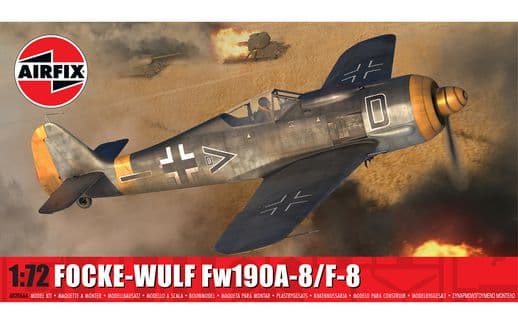
This stunning new box artwork has been created in support of this forthcoming Focke-Wulf Fw190A-8/F-8 release.
Breaking with the traditional design ethos of sleek, streamlined, V12 in-line aero engine powered fighters which prevailed in the late 1930s, the Focke-Wulf Fw190 was rather squat and muscular, in comparison to the more cultured Messerschmitt Bf 109, however, this was unquestionably a thoroughbred fighting aeroplane at heart, and one which could both take combat punishment and give plenty of it out. Its radial engine was a masterpiece in propulsion technology and when the prototype aircraft took to the air in 1939, it was without doubt the most advanced fighter aircraft in the world at that time.
Still an effective fighter at low and medium altitudes until the very final days of the Second World War, the FW190 would be adapted to perform many combat roles during its wartime service, with over 20,000 aircraft eventually being produced. It would be flown by some of the world’s most successful air aces. The A-8 variant entered production in February 1944 and featured many improvements over previous variants. Its standardised production included the ability for the aircraft to be configured to carry a wide variety of offensive armament, meaning this most heavily produced variant was incredibly adaptable, almost something of a multi-role platform.
This variant of Fw190 would excel as a ground attack aircraft, and even though it could only carry a modest bomb load, the variety of weapons it could carry saw it taking over many such duties from the Junkers Ju-87 Stuka, and once its bombs had been delivered, this was still one of the most capable fighters in the world.
Heavily armed and extremely rugged, the A-8 was the most numerous of all the A variants, with approaching 6,700 aircraft produced between March 1944 and May 1945, with at least eight different factories producing this most important aircraft. Ultimately accounting for 40% of all German fighter production during the Second World War, unlike the Bf 109, the Focke Wulf remained a feared and competitive adversary right through to the end of the conflict.
Schlachtgeschwader 2 (SG2) Immelmann was a close air support unit formed in October 1943, bringing together former Stukageschwader units on the Eastern Front. The constituent units had initially transferred to the Eastern Front in June 1941, so members of the unit had already been heavily involved in many of the major actions in the Soviet Union, either supporting ground actions, or acting strategically as an autonomous air unit.
In addition to flying the feared Junkers Ju-87 Stuka, this unit was one of only two ground attack units on the Eastern Front to operate the Focke-Wulf Fw190, making them of interest to researchers and modellers alike. When they were not flying top cover protection for ground attacking Stukas, or Kanonenvogel anti-tank Bordkanone equipped Stukas, they were either assigned to fly standalone air combat sorties, or fighter bomber missions themselves, and as the situation in the East began to deteriorate, they would see their mission count start to rise significantly.
The unit was heavily committed to the Crimean campaign during 1944, during which time they flew numerous interception sorties against a resurgent Red Air Force, in addition to their ground attack duties. The unit’s Focke-Wulf pilots claimed at least 250 Soviet aircraft destroyed during this time, albeit whilst fighting an increasingly defensive battle by then.
By the end of the first week in May 1945 and with the end of the war now in sight, the unit’s home airfield at Kummer was in danger of becoming overrun by Soviet forces and fearing what might happen to them in Soviet captivity, senior commanders decided to fly all serviceable aircraft west and surrender to either US or British forces. To this end, they made radio contact with American US XIX Tactical Air Command officials on the 8th May, and were instructed to fly their aircraft to Kitzingen Airfield in Bavaria.
II./SG2 had been supporting German ground operations right up until the impending cessation of hostilities and as such, only a few aircraft remained serviceable on the day of the surrender flight. As these took off and headed west, the majority of remaining staff left their home airfield in whatever vehicles they could muster, but were attacked by the Soviets soon after leaving, with many being killed or injured. Those who survived the incident faced many years in captivity in the Soviet Union, the very thing they were hoping to avoid.
The base at Kitzingen was home to the P-47 Thunderbolts of the 405th Fighter Group, and all local anti-aircraft units were informed of the incoming surrender flight that day, and how they should refrain from shooting at the Luftwaffe aircraft, unless they themselves started firing. During the two-hour flight from Kummer, the German formation of seven aircraft, which included Ju-87 Stukas and Focke-Wulf Fw190s, did attract the attentions of the Soviet Air Force, however, for some reason, they were not attacked.
Built model images finished in the markings of this unusually presented Focke-Wulf, an aircraft which was the regular mount of an Ace pilot, and one which has a fascinating story to tell.
After circling the American held airfield, the German aircraft proceeded to land one after the other, with US troops excitedly running out to meet the enemy aircraft. Many of the aircraft were carrying passengers, including one which was carrying the pilot’s girlfriend, however, three pilots deliberately damaged their aircraft in a final show of defiance. Amongst those pilots landing at Kitzingen that day were famous Stuka ace Hans-Ulrich Rudel and Major Karl Kennel, a celebrated Fw190 ace pilot.
Major Karl Kennel was born in the town of Pirmasens, Germany (close to the French border) in January 1914 and by the start of the Second World War, was already a pilot in the Luftwaffe. Initially serving in a Messerschmitt Bf 110 heavy fighter unit, then transferring to fly nightfighters, he was later promoted to the position of Staffelkapitan of a Schlachtgeschwader unit on the Eastern Front in September 1943, after having displayed exceptional bravery and commendable flying skill in supporting ground operations in theatre.
One of the most highly decorated Luftwaffe airmen of the Luftwaffe during the Second World War, Kennel would eventually fly at least 957 combat sorties, the majority of which were over the Eastern Front, and mainly in support of, or actually engaged in ground attack missions. Despite this, he was an ‘Ace’ pilot, with 34 aerial victories to his name, with at least three of these being claimed over the Western Front.
His final mission of the war came on 8th May 1945, when he piloted the aircraft featured above on a surrender flight to the American operated airfield at Kitzingen, and on landing, deliberately damaged his FW190. It was claimed that he heavily crash landed his aircraft, shearing off both the main undercarriage legs and warping the starboard wing in the process.
He would avoid captivity with the Soviets and pass away at the age of 85 in his birth town of Pirmasens.
Scheme B – Focke-Wulf Fw190F-8 Black <D+-, Stab II./Schlachtgeschwader 4, Eastern Front, 1944.
Although visually similar to the Fw190A-8 variant, the F-8 was the dedicated ground attack variant of the famous Focke-Wulf Fw190 fighter, one which was optimised for these types of operation. Featuring additional armour protection to the underside of the aircraft, the fuel injector system was also modified to allow the pilot to select increased performance at lower altitude for several minutes during the attack phase, and a much improved radio set allowed for better communication with the ground units these missions would often be called upon to support.
Armament for this variant consisted of heavier 13mm MG 131 machine guns in the nose of the aircraft, above the engine, and a pair of 20mm MG 151/20 cannon in the wing roots. This variant was also one of the most heavily adapted variants of the Fw190, and was configured to carry a bewildering array of offensive weaponry, some of which would definitely qualify for the description of German ‘Wonder Weapons’. Many of these aircraft also served as testbeds for numerous armament configurations, including the delivery of anti-tank missiles and heavy ground bombardment rockets, not to mention various standard bomb rack options under the wings and fuselage.
The centrally mounted weapons pylon could carry a variety of ordnance, with some aircraft even carrying bombs of greater than 1,000lb in weight, however, performance of the aircraft was significantly affected when doing so, and the take-off run the aircraft required meant that this could only be attempted from the longest and most evenly prepared runways.
The aircraft featured here is equipped with the Abwurfbehälter AB 250-2 munitions container, a unit which allowed smaller anti-airfield or anti-personnel bombs to be delivered. Made from mild steel, the container was hinged at the tail and was divided into three internal compartments, where various sub-munitions options could be stored. Essentially a cluster bomb, or fragmentation munition, these weapons would typically be used against enemy troop concentrations, or particularly stubborn areas of resistance, with the confusion and damage caused allowing Wehrmacht ground units to take advantage of the aftermath of an attack.
SG.4 was one of the specialist ground attack Fw190 units of the Luftwaffe, with its aircraft and pilots seeing heavy action across Europe and the Eastern Front from late 1943 onwards. Initially operating in Italy, the services of the unit were always in high demand, and as missions were usually directed towards enemy troop concentrations, they were never too far away from the action.
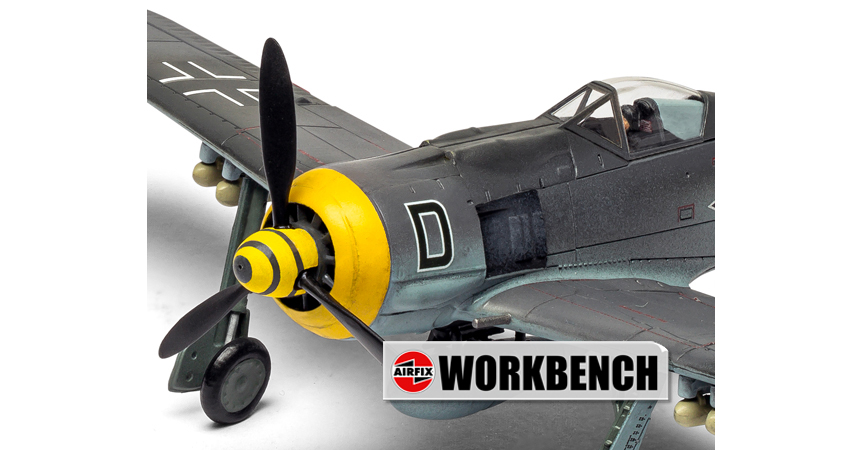
Two different views of a beautifully finished example of this kit finished in the scheme option which inspired the production of the impactful box artwork which accompanies the release of this latest Fw190 kit.
Understandably, attrition rates within the unit were high, but as the most proficient pilots became incredibly skilled in this dangerous flying, their services were required right across Europe. Always committed where the fighting was heaviest, elements of SG.4 would fly operationally in Italy, on the Western Front and in two spells on the Eastern Front, which is where the unit would eventually disband following Germany’s surrender in May 1945.
The presentation of Luftwaffe fighters throughout the Second World War is a fascinating subject in its own right, and even though many people are of the opinion that the Germans had a regulated system for everything, nothing could actually be further from the truth. Although the actual colour shades themselves were controlled and prescribed and indeed, most new aircraft would leave their respective manufacturing facilities painted in the prescribed colours and scheme application configuration of the day, once they arrived in theatre, things were often much more flexible.
Although they were often engaged in heavy fighting and time to make unnecessary modifications could never be allowed to impact operational flying, if there was a specific strategic or geographical reason for doing so, additional camouflage markings could be applied to aircraft. These would be made using the standard RLM colours in the majority of cases, however, if these stocks weren’t available, other colours to hand could be used. This sometimes led to Luftwaffe aircraft wearing Italian, French and even British paint stocks, but these cases were definitely the exception rather than the rule.
In addition to this, particularly successful, or influential pilots were given some autonomy when it came to the decoration of their aircraft, something which can make the modeller’s life challenging, or more flexible, depending which way you look at it. Knowing these practices did exist, modellers can mount a case for the presentation of any Luftwaffe aircraft, unless clear photographic evidence exists to the contrary.
The scheme option on offer here was the one which inspired the creation of the stunning new box artwork which will adorn this kit once it’s released. It shows a Focke-Wulf Fw190 F-8 ground attack fighter in action against Soviet armour on the Eastern Front, the arena for which this variant of the aircraft was developed.
No collection of model fighter aircraft from the Second World War can be considered complete without at least a couple of Fw190s being present, and this new ground attack variant is an absolute cracker and something just that little bit different.
Two cracking Focke Wulf schemes await modellers picking up this latest ‘Butcher Bird’ release.
Marking a welcome return for the Focke-Wulf Fw190 in 1/72nd scale, this beautiful little kit marks not only the most heavily produced variant of the aircraft, but Focke-Wulf’s which were optimised for ground attack operations during the Second World War. With both schemes having interesting stories behind them, it could be difficult choosing which option to go for, but as this will be our latest scale homage to the mighty Butcher Bird, we could definitely be excused for taking on a dual model build with this one.
We are afraid that's all we have for you in this latest edition, but we will be back next Friday with more project development updates and the very latest Airfix kit exclusives. In the meantime, we are always keen to hear your views on all things Airfix and in particular, any thoughts and opinions you may have regarding our Workbench blog. If you would like to drop us a quick line, could we please ask that you use our workbench@airfix.com email for all correspondence.
To re-visit any of the Airfix blogs we have produced over the past seven years or so, please head to our main Workbench hub, where you will find our entire blog back catalogue and all the Airfix design projects we have already covered.
All our dedicated official social media sites can be accessed by clicking the respective link icons at the foot of this page, or by heading to the Airfix homepage. Other useful Airfix links are:
Facebook, YouTube, Twitter and Instagram official sites
Please join us for more Airfix updates next week and thank you for your continued support.