Welcome to this latest edition of Workbench and all the news, updates and exclusive announcements from the fascinating world of Airfix modelling. How on earth can we already be in August and just seven editions of Workbench away from the modelling phenomenon which is Telford’s Scale ModelWorld show? With so much 2019 Airfix development news still to bring you, we certainly have a busy few weeks ahead of us, as we attempt to chart the progress of several eagerly anticipated modelling projects which are all nearing their eventual release dates. In this latest edition, the focus is very much on classic Soviet air power and one of the most distinctive jet fighters ever to take to the skies. Much more than just a MiG 15 upgrade, the MiG 17 ‘Fresco’ was a highly capable and extremely rugged jet fighter which caused more than a few problems for the latest US jets during the Vietnam War, where it was dismissed as an obsolete type, operated by inexperienced pilots. Already showing itself to be an extremely popular addition to the Airfix kit range, we bring you details of the two scheme options which will accompany the first release from this newly tooled model, one of which marks the aircraft operated by a successful North Vietnamese ace pilot. We also bring you details of the Airfix team’s attendance at the recent Royal International Air Tattoo and how the RAF Cadets, who are such an important part of the organisation behind this massive show, rewarded their ‘Red Sparrows’ with a little Airfix treat. There is a lot to get through, so let’s begin by revisiting a project which will see a 1/72nd scale example of one of the world’s most distinctive jet fighters joining the ranks of classic Airfix kits.
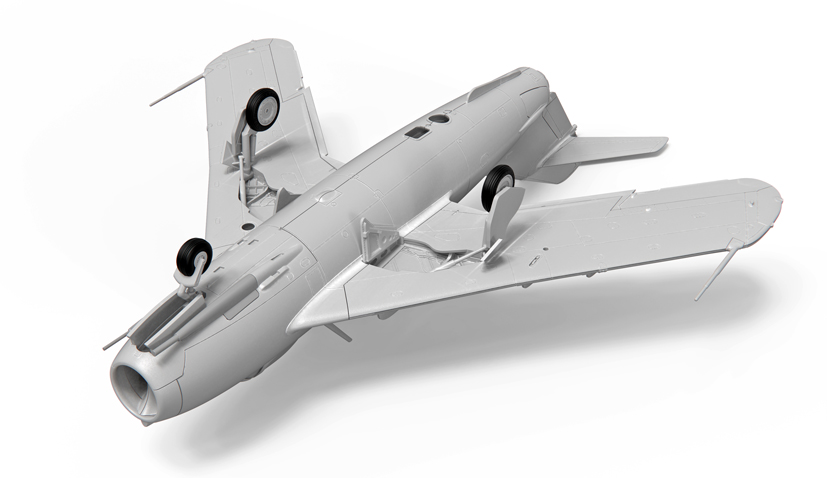
Not equipped with air to air rockets, the nose of the MiG-17 is dominated by the placement of two powerful cannons, making this one of the last jet powered ‘gunslingers’
The launch of any new Airfix model range is always a time of great excitement within the modelling hobby, as enthusiasts look to see which new tooling projects will be joining the ranks of famous Airfix kits past, as well as discovering if some much-loved classics will be making a welcome reappearance. The latest range announcement included confirmation of a new model tooling which appeared to come as something of a pleasant surprize for many people and marked one of the most distinctive early jet fighters in the history of post war aviation. The Mikoyan Gurevich MiG 17 ‘Fresco’ is often wrongly described as an upgraded version of the earlier MiG 15, an aircraft which made such a dramatic impact on the world of aviation, but was in actual fact a completely new design, incorporating all the lessons learned during the development of its predecessor and resulting in the production of a very different aeroplane. With both aircraft produced in significant numbers, these early MiG jet fighters represented the pinnacle of aviation design achievement at the time of their respective ‘first flights’ and would go on to see service with a large number of the world’s air forces, due to their operational reliability and rugged design, which offered these nations an extremely cost effective air power solution. Unfortunately, the pace of aviation development at that time dictated that the diminutive MiG jets would not remain dominant for long, however, despite being outclassed by the latest US and British designs, they would still operate effectively against aircraft which were considered much more capable. Adopting strategically designed engagement parameters to give their fighters the best chance of success, these MiG ‘gunslingers’ gave their aviation opponents much to think about.
With the opportunity to assess advanced ordering information with regard to the future model releases we feature within our Workbench blog, it became clear pretty early on that the diminutive new MiG 17 kit appealed to a great many people and we are sure that this latest project update will be an interesting addition to our blog series, as many of you will be planning to add this model to your build schedules later in the year. In the 92nd edition of Workbench, we published a full development review of the new Mikoyan Gurevich MiG 17 project, which included a host of exclusive images and introducing the talents of one of our young Airfix product designers, Tom. In a fascinating look at how the Airfix team continues to bring on talented new designers, ensuring they maintain the levels of knowledge and expertise needed to keep this historic brand at the forefront of the modelling hobby, Tom was only too pleased to describe his introduction to the team and how he was determined to make his mark in the annuls of Airfix history. As one of his first major projects, the MiG 17 would pose Tom some significant challenges, as he attempted to replicate the complex shapes of this famous aeroplane, whilst also incorporating all the latest design and production techniques available to the Airfix designers – we will not have to wait too long now to enjoy the fruits of his labours.
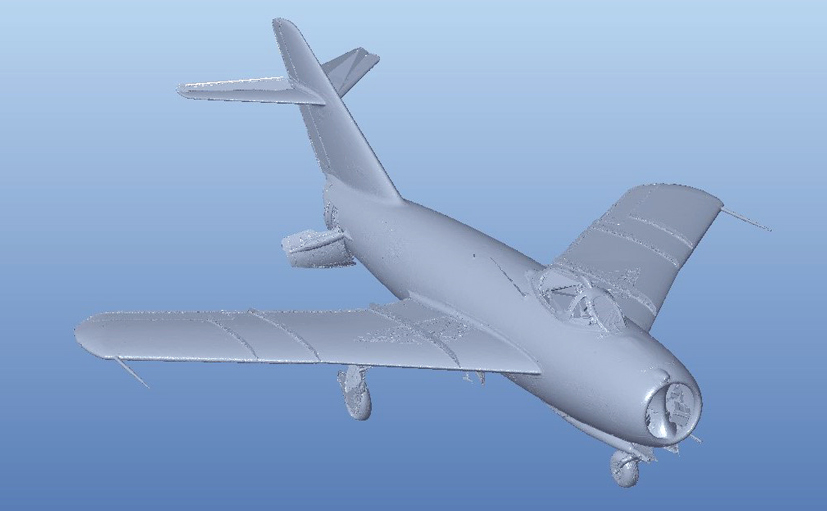
Data produced from the MiG-17 scan allowed the project designer to accurately represent the iconic shape of the aircraft, as he attempted to immortalise this aviation classic as a scale plastic model kit representation
The MiG 17 can trace its lineage back to the final months of the Second World War and the impact of German jet technology on the aviation world. Although the clear advances Germany had made in the fields of aviation propulsion and aerodynamics, overwhelming Allied superiority and continued political interference ensured that these advances could not alter the course of the conflict, but would shape the world of aviation for many years to come. As Europe settled into an uneasy period of relative peace, after six years of war, the victorious Allied air forces began to trade their huge aviation inventories for fewer numbers of more technologically advanced designs, based predominantly around jet propulsion and information captured with the fall of the Third Reich. As relations between former wartime allies quickly deteriorated, East and West both rushed to introduce new and more capable aircraft, each hoping that their awesome capabilities would prevent a swift return to conflict. Determined that their designers should at least match the capabilities of the latest Western aircraft being developed, the USSR used all the technical information they had seized from the Germans and set their scientists to work. Initially, they were hampered by the lack of a suitable jet engine, however an approach to Rolls Royce in the UK and the granting of a production licence for their Nene engine, quite literally gave them the boost that they needed. The design team at Mikoyan-Gurevich were immediately instructed to produce an advanced high altitude day fighter, capable of protecting Soviet territory against Western bombers, eventually producing a design which proved to be something of an aviation classic. Known to be sourcing support from British companies, the West became a little complacent in thinking Soviet jet technology was inferior to their own, however, this would prove to be an inaccurate assumption which was cruelly exposed during the air battles of the Korean war. The diminutive MiG-15 was one of the first successful transonic jet fighters to feature a swept wing configuration and its performance proved more than a match for all but the very latest North American F-86 Sabre. As the world descended into a Cold War of threats and mistrust, the acronym MiG would come to stand for the latest Soviet air power and aircraft the West must prepare to face in the event of conflict.
Even whilst the first frenetic jet versus jet fighter combat was taking place in the skies above Korea and the Soviets were demonstrating the prowess of their exceptional little MiG 15 fighter, engineers at the Mikoyan-Gurevich company were already at the advanced stages of developing and upgraded version of the aircraft. Whilst this new aircraft could not be accurately described as the replacement for the MiG 15, it did represent another technological leap forward in aviation design and incorporated many improvements over the earlier aircraft, some of which were made as a result of feedback from operational experience. Having said that, many people could easily be confused by the appearance of the MiG 17 (NATO reporting name Fresco), thinking that it was actually the same as its predecessor, or at best, a slightly larger derivative of the original MiG 15. Although the aircraft clearly retains a strong resemblance to the earlier fighter, it is a completely different aeroplane, taking everything that was good about the MiG which posted such an impressive combat record of 3:1 during the Korean War and improving it in almost every way. Indeed, it could be argued that the MiG 17 was a fascinating combination of the best fighter technology from the Second World War and the latest advancements in transonic flight research – with a devastating array of machine gun armament and in the days before effective air to air missiles were available, this aircraft could be described as the Soviet’s last ‘Gunslinger’.
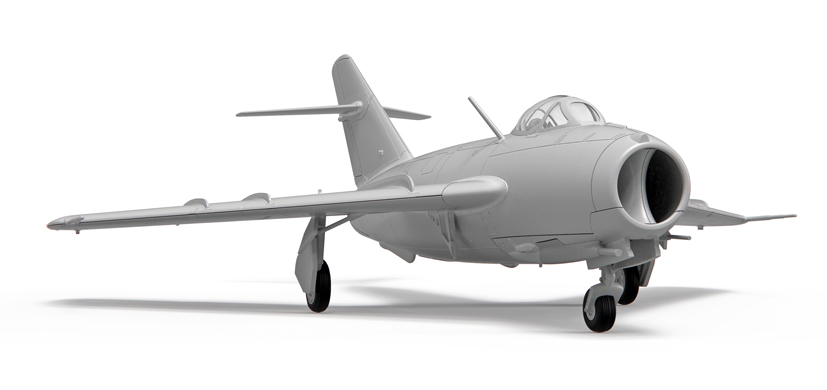
Although bearing a striking resemblance to its famous predecessor, the MiG-17 was a very different aircraft, improved in so many ways that it must be regarded as a completely different aeroplane and one which would see service in the colours of no fewer than 20 nations
The Mikoyan-Gurevich MiG 17 was a fast, high-subsonic fighter aircraft, designed to combat the potential threat of large scale Western bomber incursion into Soviet airspace. Although not intended as a dogfighter, the MiG 17 was an extremely manoeuvrable aircraft and would prove to be a feared adversary for much more modern designs during the Vietnam War. Indeed, these aircraft caused American airmen so many problems in combat, that in the aftermath of this conflict, the US initiated the lightweight fighter programme which would see such aviation heavyweights as the General Dynamics F-16 Fighting Falcon and the McDonnell Douglas F-18 Hornet eventually entering service. In the never ending quest to develop aircraft possessing even greater speed, the MiG 17 design attempted to overcome the effects of compressibility by adopting an even greater sweep to its wings and was the first Soviet designed aircraft to introduce the engine afterburner, allowing pilots to access greater thrust on demand, at the expense of greatly increased fuel consumption.
Although possessing more than just a passing resemblance to its famous aviation predecessor, a quick walk-around the MiG 17 reveals a number of differences which make identification between the two much simpler. Although perhaps least evident to the naked eye, the MiG 17 is around 3 ft longer than the MiG 15 and its engine incorporates a FOD screen positioned in the distinctive air intake, designed to allow the aircraft to be operated from rather rudimentary airfields and protecting against the possible ingestion of foreign objects. This operational requirement also extends to the extremely rugged undercarriage legs, which again were intended to allow the aircraft to operate from unprepared airfields and specifically following re-location as a result of US bombers strikes on their usual home airfields. The aircraft also employed the use of three highly visible undercarriage lock-down pins, which pop up as reassuring confirmation for the pilot when the gear is deployed and locked – the nose gear pin is in front of the cockpit canopy, whilst the main gear indicators are on top of each wing. For more definitive identification confirmation, the MiG 17’s wing and tail-plane have a greater sweep incidence than that employed on the earlier fighter, with the wing also being much thinner and having a slight outer wing kink on some models. It also employs a third stability strake on the top of the wings, all impressive design features which made this one of the world’s most manoeuvrable combat aircraft until the advent of the F-16 Fighting Falcon. The rear of the aircraft is dominated by two large speed breaks, which were almost twice the size of those employed on its predecessor and hydraulically operated, allowing their use at any speed. Offensively, this was one of the most heavily armed fighters in the history of aviation and employed two 23mm cannon under the port side nose of the aircraft and a mighty 37mm cannon under the starboard side – the entire lower nose section of the aircraft, back to just behind the cockpit, was devoted to guns and ammunition, which is why this fighter is often described as one of the last true jet powered gunships. With its combination of robust construction, extreme manoeuvrability and heavy armament, the MiG 17 proved that Soviet aviation design was a match for the Western powers in a combat situation. Although it was not produced in quite the same quantities as the earlier MiG 15, the faster and more powerful MiG 17 became the standard Warsaw Pact fighter from the late 1950s and served with the air forces of over 20 countries – it was also built under licence in both Poland and China, making this one of the most important jet fighters of the 20th century.
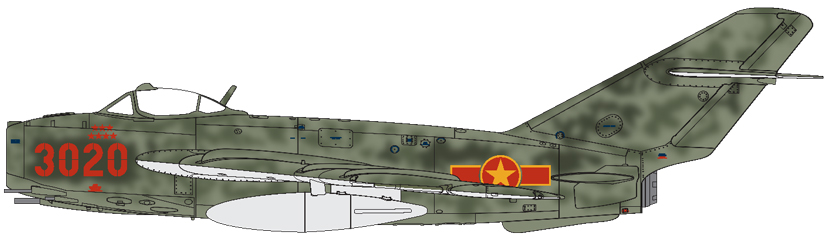

In this striking ‘Snake Scheme’, it is not difficult to see why the MiG-17 is already showing itself to be an extremely popular addition to the Airfix range and one many of us already have pencilled in as a 2019 build project
With the declaration of the Democratic Republic of Vietnam on 2nd September 1945, its new leader Ho Chi Minh quickly ordered the creation of an air force, to defend the country’s borders from potential air attack. Calling on the help of their international allies, personnel destined for service in the new North Vietnamese Air Force were sent to the Soviet Union and China for training, with these supportive nations also proving influential in equipping the new force with their first aircraft, the fast and rugged Mikoyan-Gurevich MiG 17 fighter. Indeed, this type would be the first aircraft operated by the NVAF, with 36 former Soviet Air Force machines arriving at their new home bases during 1963, with greater numbers of MiG 17F variants following over the next eighteen months, many of which were Chinese licence manufactured Shenyang J-5 examples. Operational by early 1964, the North Vietnamese MiG 17s would play a significant role in the escalating Vietnam War, where they would be forced to fly against the latest US air power, using what were effectively obsolete aeroplanes. Although the US military were aware of the existence of NVAF MiG 17 fighters in the region before they began their concerted bombing strike campaigns, intelligence reports told them that their pilots were still deep into conversion training and would be unlikely to be committed to combat for a further year or so. In addition to this, their relatively low numbers and the fact that they would be flying in combat against well trained and highly capable US airmen, who were equipped with the very latest aircraft and air-to-air rocket capability, further fuelled their complacency. Initially sending their strike bombers in without fighter protection, the ageing MiG 17s proved to be aggressive and tenacious in attempting to repel the American aerial onslaught and provided something of a rude awakening for US military planners.
Fully aware that they were operating technologically inferior aircraft, the North Vietnamese had to be both clever and extremely courageous in challenging the overwhelmingly superior American forces, using every advantage they could muster in launching their attacks. Initially, US radar coverage did not extend far enough to include the operating bases of the North Vietnamese fighters, in addition to the fact that their rules of engagement did not allow American attacks on fighter airfields. This enabled the NVAF to train, rest and launch attacks without being challenged and not allow the American pilots the luxury of knowing when and from which direction enemy attacks were going to come from. As engagements increased, so did the NVAF understanding of US tactics, which provided additional information which could be used against the attacking aircraft, whilst all the time using the strengths of their own aircraft and avoiding exposing its technological weaknesses. This knowledge helped to ensure the MiG 17 soon began to score air combat victories against aircraft which were considered technologically superior and help no fewer than 17 North Vietnamese fighter pilots to achieve the coveted status of air ‘Ace’ - in stark contrast to this figure, only 5 US airmen would achieve the same status during the Vietnam War.
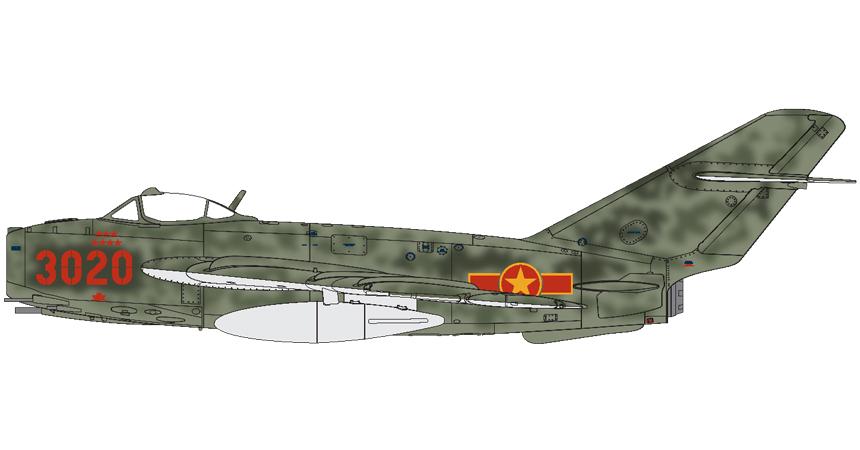
The first scheme option to be included with this new kit presents modellers with an aircraft flown by one of the 17 Vietnam War air aces of the Vietnam People’s Air Force, pilot Le Hai. Officially credited with six air to air victories, which included two US Phantoms, arguably the most capable aircraft to take part in the conflict, the aircraft actually sports seven victory stars on the fuselage side (underneath the cockpit canopy), clearly inferring that the pilot was confident that he had earned a seventh aerial victory. The operational advantages the North Vietnamese Air Force engineered at the beginning of the air war were soon nullified by American forces shocked at the capabilities of their opponents and whilst they still continued to score victories, these reduced significantly as the war progressed. Many modellers will probably associate the MiG 17 with the clean, natural metal finishes preferred by the Soviet Air Force, however, during the Vietnam War, several aircraft sported a number of attractive camouflage scheme variations, including Le Hai’s aircraft, which wore this rather sinister looking ‘snake scheme’. With the fuselage and upper-surfaces of the aircraft painted in a two tone green scheme, this has to be considered one the most visually striking MiG 17 presentations and would have made a fearsome sight if it ended up on your tail during combat. Wearing the distinctive red fuselage code 3020, you might think that this aircraft would be particularly easy to identify, however, it appears that NVAF aircraft numbering procedures were a little haphazard to say the least, with different fighter units adopting their own slightly different systems. This confusing situation becomes clearly evident when researching the fate of this particular aircraft, with some sources claiming it was destroyed in combat with a US Navy Phantom, whilst others have it displayed in a Vietnamese military museum.
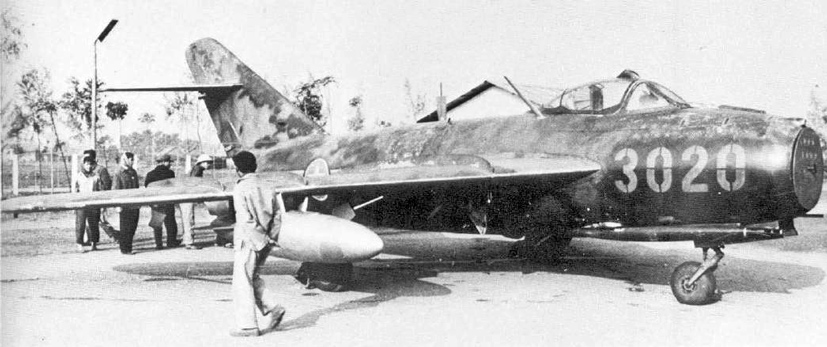
Original picture of MiG-17F (Shenyang J-5) ‘3020’, which was flown by North Vietnamese Air Force fighter ace Le Hai – was this the aircraft shot down by the US Navy pairing of Cunningham and Driscoll on 10th May 1972?
With the launch of Operation Linebacker in 1972, US forces in the Far East intended to inflict a crushing defeat on their North Vietnamese adversaries, bringing the full weight of their awesome air power and advanced technology to bear. Supporting a sizeable bombing mission against the Hai Dong railyards on 10th May 1972, successful US Navy pilot/navigator team Lt. Randy Cunningham and William Driscoll were flying their faithful F-4J Phantom, when the force came under attack by a large number of enemy MiG-17 fighters. As graduates of the US Navy’s Top Gun fighter school, the team had already scored victories during their Vietnam tour, but this would turn out to be by far their most eventful day and result in the pair achieving ‘Ace’ status. Turning into the strong attacking force of MiGs, Cunningham quickly destroyed one of the fighters with a Sidewinder missile, immediately looking for his next target – he saw that his wingman was being pursued by several enemy fighters, each one seemingly looking to claim an easy Phantom kill. He positioned his aircraft behind the battling formation, but could not fire a missile for fear it would lock on the huge engines of his squadron-mate. Calmly telling his wingman to break sharply, he was now clear to fire his missile, which took out a second MiG and prevented the others following his wingman.
With the US airmen at a significant numerical disadvantage, the Phantoms decided to disengage and hit the power for a high speed run for home, just as Cunningham noticed a MiG heading straight for him in a head on attack, firing its cannons as it came. The Phantom was not equipped with guns and if Cunningham was going to survive this dogfight, he would have to position his aircraft behind the MiG for a missile strike, but this was clearly not a novice aviator and every move the US pilot made was countered by the Vietnamese airman, who now took up a position on the Phantom’s tail. In an encounter which lasted several minutes, the aircraft passed close to each other on a number of occasions and Cunningham clearly recalls seeing the red number 3020 on the nose of the enemy fighter – as he was now engaged in combat with an extremely accomplished fighter pilot, could it be that they were facing the celebrated NVAF ace Le Hai? With neither airman giving any indication of breaking off the engagement, Cunningham attempted a risky manoeuvre, cutting the throttles with the MiG on his tail and moving in for the kill. The Vietnamese fighter sped past, but was initially too close to unleash a missile, however, this turning of the combat tables forced the MiG to dive for the ground at full speed, but before it could escape, a Sidewinder struck home and sent the aircraft plummeting to the ground. After claiming their third victory of the day, Cunningham and Driscoll set course for home, only to suffer a surface to air SAM strike moments later, disabling their Phantom and setting it alight – nursing the aircraft over the ocean, the pair safely ejected and were later picked up by a US Navy rescue helicopter.
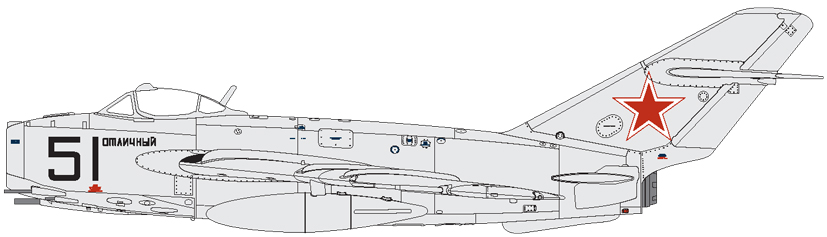
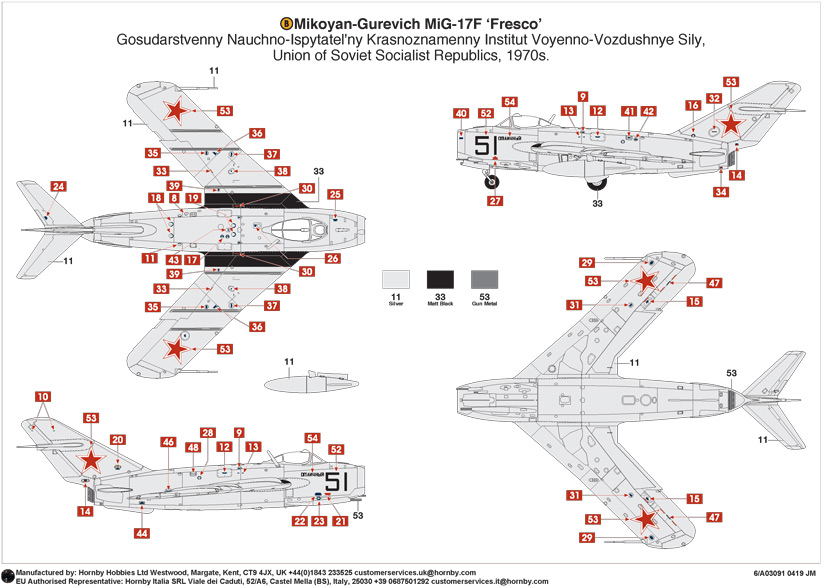
Full scheme details for this beautifully pristine ‘Excellent’ test and evaluation MiG-17F, which was operated by the test pilots of the GNIKI VVS, as they continually worked to improve the effectiveness of this distinctive jet fighter
With the Soviet Air Force already firmly in the jet age, the introduction of the new MiG-17 provided them with a capable new fighter and one of the most advanced aircraft in the world. With its predecessor in widespread service, the transition to the new aircraft was surprisingly trouble free and posed few problems for the average squadron pilot, despite its design differences and increased performance. What makes this even more impressive is the fact that conversion to the MiG-17 for current pilots was made without the benefit of a two seat trainer variant, with existing MiG-15UTI trainers still providing jet conversion training for new pilots. The fast and powerful MiG-17 entered squadron service late in 1952 and quickly proved itself to be a rugged and reliable performer, easy to fly and even easier for ground crews to maintain. These were vital attributes for any Soviet aircraft expected to be in widespread service, as the sheer size of the nation dictated that units were often required to be deployed to far flung areas of the country, operating from forward bases which had little in the way of facilities and only equipped with mobile ground support equipment. With its impressive performance, the MiG-17 would go on to become the standard Warsaw Pact fighter from the late 1950s and served with the air forces of over 20 countries. It was also built under licence in both Poland and China, making this one of the most important jet fighters of the 20th century.
This scheme marks an aircraft which was operated by the State Research and Test Institute of the Soviet Air Force, an important unit which was roughly equivalent to our own Royal Aircraft Establishment and Aeroplane & Armament Experimental Establishment. Here, some of the nations most gifted and experienced pilots and aircraft technicians operated and evaluated current service aircraft, finding solutions to issues reported by squadron pilots and working to successfully introduce upgrades, improvements and modifications to these aircraft. ‘Black 51’ was a standard production MiG-17F, which was obtained by the Institute as a test and evaluation machine and a number of interesting photographs exist of this aircraft being used by GNIKI VVS to test the installation of high capacity underwing fuel tanks, for use on squadron aircraft, presumably whilst being ferried to bases at the furthest reaches of the nation or on international delivery flights. It was unusual for Soviet Air Force fighters to adopt black for their identification numbers and this particular aircraft is made all the more interesting by the addition of extra wide black wing root panels, the area where aircraft tended to look a little shabby after some time in operation, as this is where pilots would access the cockpit and where ground crews provided their pre and post flight support. This MiG also has the word ‘Otlinchnyy’ displayed on both sides of its fuselage, behind the ‘Black 51’ code, a word which translates to ‘Excellent’ and is thought to be in reference to the aircraft’s maintenance team receiving a proficiency award – it appears that this particular MiG was something of a much loved and slightly pampered fighter.
A magnificent addition to the Airfix range, the agile and extremely distinctive MiG-17 ‘Fresco’ (A03091) is scheduled for an Autumn release and with its adoption by a large number of the world’s air forces, there will be a huge number of attractive scheme variations in which to consider finishing our models, starting with the two featured above. With just the box artwork reveal remaining, we can all start to look forward to the arrival of this Soviet Cold War classic kit.
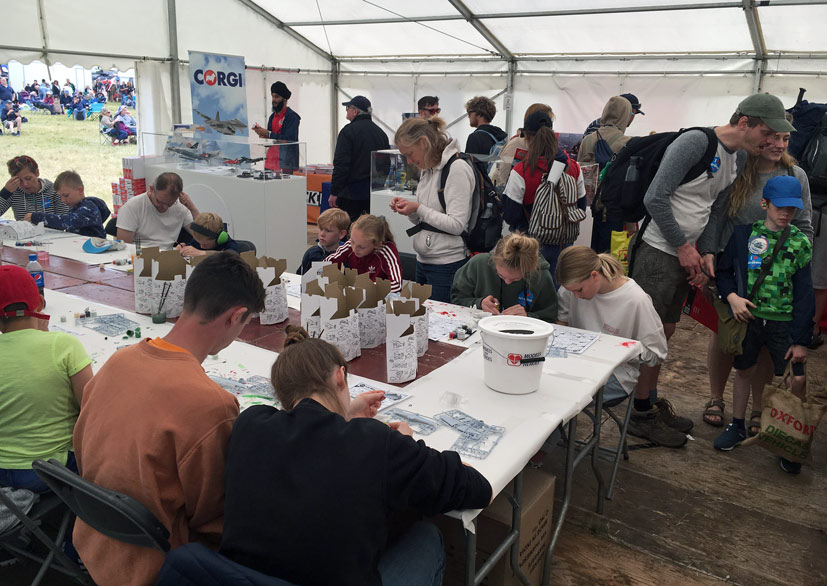
The Airfix marquee was a popular showground attraction for the duration of this year’s Royal International Air Tattoo, with our make and paint tables rarely having empty seats available - image courtecy of Airfix Assistant Brand Manager Sally Donald
The annual aviation extravaganza we all know as the Royal International Air Tattoo took place over the weekend of the 19th – 21st July and saw huge crowds heading to RAF Fairford in Gloucestershire to experience the latest instalment of the world’s greatest Airshow. With so many aviation minded people in the same place for one glorious weekend, we were delighted to be able to dispatch a sizeable Airfix team for the duration of the show, housed in a large marquee situated at the eastern end of the airfield, close to the popular Vintage Village. With an impressive display of built kits on show and our popular ‘Make and Paint’ tables in full effect, we were pleased to welcome thousands of visitors over the three public days of the show and it was fantastic to see so many families sitting down to enjoy a little modelling respite during the high octane aviation experience which is RIAT. The team were happy to discuss issues relating to the latest model releases, including our high profile 1/24th scale F6F-5 Hellcat, of which we had two examples on display and are now busy collating the many future model suggestions visitors offered during the course of the weekend. Significantly, with just under 2,000 Airfix catalogues distributed during the show, we hope that modellers both active and temporarily lapsed will have enjoyed seeing what we currently have on offer for the modelling hobby.
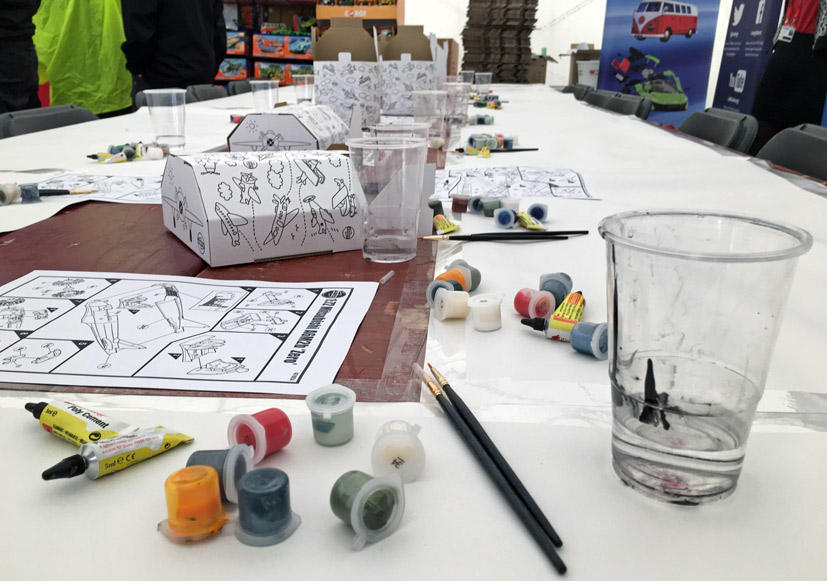
Calm before the storm – everything laid out in preparation for another busy day of model making
As can often be the case with outside events in Britain, the weather ensured that it had its say during the weekends proceedings, with the sunshine and high temperatures of Saturday being preceded by heavy rain and grey skies on Friday. As a consequence, our large marquee acted as a rain shelter on Friday and a sun shade on Saturday, but ensured that the Airfix team were kept busy for the duration of the show – we enjoyed meeting each and every one of you.
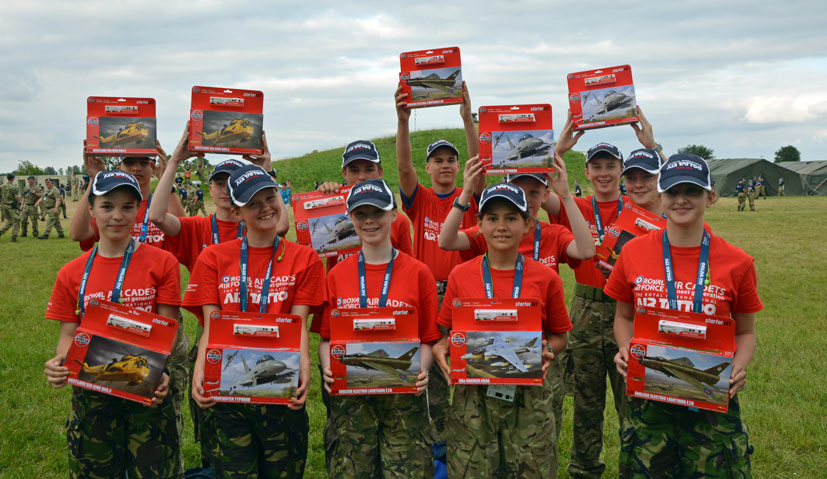
This year’s Royal Air Force Air Cadet ‘Red Sparrows’ looking rather pleased with the Airfix kits which formed part of their presentation packs – congratulations to one and all!
At the end of the show, we were delighted to once again help our friends at the Royal Air Force Air Cadet force, as they prepared to hold their annual RIAT camp award ceremony. The Air Force Cadets are an integral part of the shows success, with hundreds of young people coming from all corners of the country each year to offer their enthusiastic assistance in performing a multitude of duties. These can include greeting members of the public on entering the showground, patrolling the extensive crowdline for the duration of the show, or the backbreaking task of ensuring the airfield is free from debris and litter, which could potentially cause damage to display aircraft engines. In what is a significant occasion for these young people, they spend a week camped outside the eastern end of the airfield and combine hard work with the ability to get close to aeroplanes and aviation personalities, as well as forging relationships with fellow cadets from around the country. As the camp draws to a close, Flight Commanders from the various Squadrons nominate the best junior cadets attending their first RIAT camp, with senior staff selecting a final twelve, known colloquially as the ’Red Sparrows’. The Sparrows receive the recognition of their peers and superiors, as well as a selection of commemorative items, which once again this year included an Airfix kit. We are always happy to play our small part in helping to make this a memorable experience for these impressive young people, who work so hard in ensuring everyone else has an enjoyable time at the Airshow and it would be nice to think that some of the faces in the photograph featured above might be destined for a successful career in Britain’s armed forces. Congratulations to the 2019 ‘Red Sparrows’ and thank you to the Air Cadets Media and Communications Officer for kindly supplying the photograph – we will be featuring a full review of what it takes to stage an Air Cadets RIAT camp in a future edition of our Aerodrome blog, so please keep an eye out for that in the Community section of the Airfix website.
We are afraid that’s all we have for you in this latest edition of Workbench, however, we will be back as usual in two weeks’ time with a further selection of Airfix modelling delights for your enjoyment. In the meantime, if you have any suggestions for subjects you would like to see covered in a future edition of the blog, or ways in which we could enhance your enjoyment of Workbench, please do not hesitate in contacting us. We can be reached via our usual e-mail address workbench@airfix.com or by contributing to our Workbench thread over on the Airfix Forum. If social media is more your style, you could access either our Airfix Facebook page or Twitter channel, (using #airfixworkbench), where you will find plenty of modelling news, views and discussion taking place. Whichever medium is your preference, please do get in touch, as it is always interesting to hear from fellow modelling enthusiasts and the projects you have on the go at the moment.
As always, the Airfix website is the place to go for all the latest model release information, with our New Arrivals and Coming Soon sections both quickly accessed by clicking either of the links above. As updating the website is an ongoing process, a quick search through each section of the Airfix web pages will often reveal new information and updated images in many of the product sections and this is always an enjoyable way in which to spend a few spare minutes.
The next edition of Workbench is due to be published on Friday 16th August, when we will have more news and modelling features from the fascinating world of Airfix.
On behalf of the entire Workbench team, thank you for your continued support our Airfix blog.
The Airfix Workbench Team
© Hornby Hobbies Ltd. All rights reserved.