
Welcome to this latest edition of our Workbench blog and all the news, updates and modelling exclusives from the fascinating world of Airfix.
By way of a Bank Holiday blog treat, the latest edition of Workbench features two impending kit additions to the current range, both of which are in 1/48th scale and both featuring classic fighting aeroplanes of the Second World War. We begin by looking at the latest release from our North American P-51D/K tooling, a scale representation of an aircraft which may have only made its combat introduction during the final months of the war, but one which helped earn the fighter its stellar reputation. We follow this by looking at our larger scale tribute to the first of the RAF’s Rolls Royce Griffon powered Spitfires and how despite the fact that only 100 of this particular variant were produced, they paved the way for a more powerful breed of Spitfire and indeed, supported the ongoing search for the ‘Ultimate’ Spitfire.
In both cases, we will be showcasing the stunning digital artwork produced to support each release, in addition to looking a little deeper into the fascinating stories behind both of the decal scheme options supplied with each kit release. With both kits due for release over the next few weeks, we thought it was about time we spent a little quality time in the company of piston powered royalty from the Second World War, or at least our scale representations of them.
Few aircraft in the history of aviation can claim to have had the operational impact the North American P-51 Mustang could boast, a fighter which possessed all the qualities to make it one of the most effective fighting aeroplanes the world had ever seen. A single engined fighter which had range enough not only to protect USAAF bombers all the way to their targets deep into Germany, but also to engage in combat with any Luftwaffe opposition they came across along the way. It is rumoured that Hermann Göring proclaimed that he knew the war was lost when he saw Mustang fighters flying low over Berlin, particularly as they were on the hunt for Luftwaffe targets and mainly unopposed.
Although the Mustang is undoubtedly an American aviation classic, it will always be inextricably linked Britain and not just because hundreds of them flew from bases in England during the Second World War. When Britain stood alone against the might of Germany in 1940, the British Purchasing Commission approached US aircraft manufacturer North American Aviation and asked them to produce licence-built Curtiss P-40 fighters for the Royal Air Force. Feeling they could do better than simply building a rival’s aircraft, North American officials proposed to build a totally new fighter for the British, one which would be superior to the P-40 and one which would be more suitable for their needs. Their proposal must have been convincing, as the British agreed and signed a contract for the new aircraft there and then. Unfortunately, time was now very much against the North American design team, as Britain desperately needed these aircraft, so work on the new project had to start immediately.
What the North American design team achieved with their impressive new aircraft design was nothing short of astonishing. Incorporating highly advanced new features and using all the very latest manufacturing techniques, the prototype aircraft (NA-73X) rolled out of their hangar on 9th September 1940, just 120 days after the contract had been signed. The first flight of the aircraft took place a further 47 days later and other than the usual issues associated with a first flight, the aircraft showed great promise and was an immediate vindication of the confidence North American Aviation had in their in-house design capabilities.
The first Mustang fighters were powered by Allison V-1710 V-12 liquid cooled engines, the same basic powerplant used on such aircraft as the P-39 Airacobra, P-40 Warhawk and the highly successful P-38 Lightning. Although a perfectly good engine, the lack of a supercharger restricted performance at higher altitudes to little better than average, something which clearly impacted its overall operational effectiveness. In 1941, the North American (P-51A) Mustang I entered service with the RAF and whilst it was a welcome addition to their aircraft inventory, its lack of high altitude performance was immediately apparent. Operationally, this dictated that the first Mustangs would be used for tactical reconnaissance and ground attack missions and not as fighters, however, in this role, they proved to be a great success. The Mustang was required to operate at high speeds, often at treetop heights, where there was certainly no margin for error. Proving itself to be rugged and reliable, the Mustang could take quite some punishment and still bring its pilot home, quickly earning the respect of pilots and ground crews alike. Significantly, the Mustang had a strong, wide track undercarriage, a feature which gave it much better ground handling characteristics than a Spitfire.
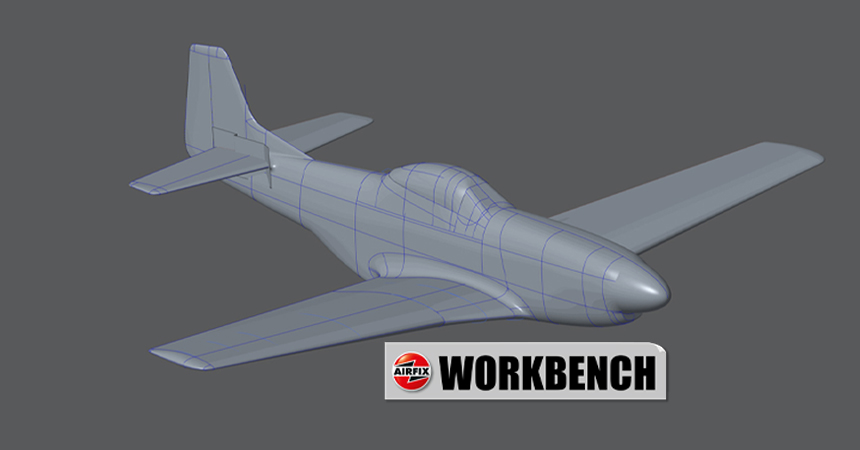
A CAD screenshot taken during the early development phase of this magnificent tooling, showing how our designer prepared to immortalise this aviation classic in plastic kit form.
Just as the British can claim to have been influential in the development of the Mustang, they were also instrumental in unlocking its full potential. In early 1942, a Rolls Royce test pilot flew the Mustang I and was particularly impressed with its low and medium altitude performance. He later informed his superiors that installing a Merlin 61 engine into its airframe would transform the performance of the aircraft and after some persistent lobbying, he eventually got his way. In August 1942, the Mustang X programme saw a number of Mustang I airframes fitted with Merlin engines and the results were nothing short of spectacular. Incredibly, this new combination propelled the Mustang to 441mph at 29,800ft, making it 100mph faster than the Allison powered P-51A at the same altitude - The Mustang had just come of age!
As the Merlin powered Mustang trials continued, performance data was supplied back to North American Aviation, who were keen to see the results for themselves. There was a problem though – the RAF could not proceed with the Mustang X programme, because ALL Rolls Royce Merlin engine production was required for existing designs. Not only were the engines needed for such aircraft as Spitfires, Hurricanes and Mosquitos, the recent decision to ‘up-engine’ the disappointing Avro Manchester bomber to the four Merlin engined Lancaster placed even more strain on production. The answer lay with American industrial might and the Packard Motor Car Company, who obtained a licence to produce the Merlin engine in America. Work on the US built Merlin engines started immediately, along with the mass production of the superb North American Mustang.
For an aircraft which would go on to earn such a legendary fighting reputation, it can be quite surprising to learn that Merlin powered Mustangs only made their European combat introduction in late 1943, although their impact would be significant and almost instantaneous.
A computer rendered image from our 1/48th scale P-51D/K Mustang design files, showing the classic lines of this magnificent aeroplane.
The P-51D was arguably the definitive variant of the Mustang and included a number of significant improvements to the aircraft’s already successful design. These included a new bubble canopy for greater pilot visibility, the introduction of a new K-14 gunsight, greater fire-power and an improved ammunition feed system to reduce jamming and the use of lightweight external fuel tanks, which endowed the fighter with even greater range. The Mustang would go on to make a significant contribution to eventual Allied victory in Europe, destroying more enemy aircraft in air-to air combat than any other USAAF fighter in the European Theatre.
First announced in the 31st edition of Workbench and released as part of our 2017 model range, our newly tooled 1/48th scale tribute to this most famous fighting aeroplane has been a modelling revelation since its arrival and we are delighted to be in a position to bring you details of the latest impending release in this week’s blog. Featuring two stunning schemes of Mustangs which flew from bases in England during the final few months of the war in Europe, let’s now take a closer look at the finish options which will be tempting us following the release of this fabulous new kit.
Born in Jacksonville Illinois on 8th July 1918, Edward Bonfoy Geller would go on to attend the University of Illinois, where he studied Chemical Engineering, in addition to joining the attached Military School. With his love of aviation, he used his own money to pay for a course of flying lessons and on the successful completion of these, paid even more to become proficient in aerobatics. Enlisting in the Army Air Corps prior to America’s entry into the Second World War, during the final stages of his training, he would be posted to Portland AFB, an airfield which shared operations with several civilian airline operators. One afternoon, one of his fellow pilots came into the crew room and asked if anyone wanted to go on a blind date with an airline stewardess at the base? Giller had spent the past few weeks telling his fellow trainees expressly not to get attached to a girl, as they would soon be posted overseas, but despite this, said he would very much like to go on the date.
When he met the attractive Mildred Schmidt, the couple had an instant connection and going against his own advice, married her just three months after this first meeting. Although he would soon have to leave his new wife for a posting to England and the savage aerial fighting over occupied Europe, her name would be carried on all five of the fighter aircraft Giller had assigned to him during his time in Europe - ‘The Millie G’ was sported on a P-38 Lightning and four different P-51 Mustangs.
Lt. Edward Giller and the rest of the 343rd Fighter Squadron left for England during the summer of 1943, destined for the new USAAF Station 131 at Nuthampstead in Hertfordshire. The three assigned squadrons at the base would make up the 55th Fighter Group of the Eighth Air Force and on 15th October 1943, became the first P-38 Lightning equipped group to become operational in the European Theatre. Their initial duties were to fly bomber protection missions deep into enemy territory and when the had the chance to engage the Luftwaffe, to destroy as many enemy aircraft as possible, be that by engaging in aerial combat, or by destroying them on the ground.
Giller is reported to have described the Lightning as an excellent fighting machine, but not one which was ideal for taking on the Luftwaffe over their own territory. German fighter crews knew that if they saw two contrails in the sky, that they were most likely to be American Lightnings, so they had no element of surprise in their operations. Lacking the range to escort the bombers all the way to their targets, if units were attacked by German fighters, they would adopt slash and run tactics, knowing that if the dived towards the ground, the American fighters simply could not catch them. Once they spotted the vapour trails, they just waited for the fighters to turn back before running in to target the bombers unopposed, but thankfully that all changed when the 343rd exchanged their P-38 Lightnings for a new fighter.
Full scheme details of ‘The Millie G’, one of the most attractively presented Mustangs of the European air war.
In April 1944, all three squadrons which made up the 55th Fighter Group moved to a new base, Station 159 Wormingford in Essex, in advance of their re-equipping with the latest variant of the North American P-51 Mustang. Giller and his squadron mates would prepare for their first flight in this new single engined fighter by fastidiously studying the pilots notes booklets they had all been supplied with and following a quick cockpit familiarisation session, it was a case of immediately taking that first flight plunge. Fully operational in the Mustang by July, Giller thought this new fighter gave them a definite combat edge - not only could they now spring attack surprises on the enemy, they had an aircraft which could follow Luftwaffe fighters down to the deck, pressing home their determined attacks. As the number of enemy aircraft to tangle with became noticeably fewer at that time, they often found themselves having to engage in dangerous, tree-top height missions to known Luftwaffe airfield sites, hoping to find targets of opportunity.
On a bomber escort mission over Munich on 9th April 1945, Giller and his flight were released to go and hunt Luftwaffe targets, when he noticed a Messerschmitt Me 262 jet being chased by, but outpacing a gaggle of Mustangs. It was a usual jet tactic to approach protected US bombers at speed, make an attack run and head for the deck, tempting the covering Mustangs to jettison their underwing fuel tanks and give chase. With little chance of catching the jets, the Mustangs would have to turn for home once their limited remaining fuel hit a certain level, leaving the German jets and other fighter units to return to the bombers and exact a heavy toll. On this particular occasion, the Me 262 pilot he spotted was not going to retain the combat upper hand for long.
Dropping tanks and rolling into a steep dive, ‘The Millie G’ had a significant height advantage over the Messerschmitt and helped by the effects of gravity, the Mustang’s airspeed indicator hit 500mph as he levelled out, immediately speeding past the other chasing Mustangs. With the German jet now preparing to land at Munich-Riem airfield, he lined it up in his gunsight and let him have all six fifty cal machine guns. The jet made a heavy belly landing, by which time every gun on the airfield was firing in the direction of Giller and his Mustang, but fortunately, his high speed and low altitude made it difficult for them to target him accurately and he managed to head home unscathed.
Later in the war, it was reported that Giller had the opportunity to speak with the famous German ace Adolf Galland, who was being held captive at their forward operating base. Recounting his Me 262 attack to Galland, the German said that he had been on the airfield that day and saw the incident. He told the American that the jet pilot managed to walk away from the incident without injury, but the very next day, took a fighter and made straight for Switzerland, clearly feeling that his close call was a sign of possible things to come.
‘Just one more pass’ - the famous last words of many a strafing fighter pilot
This digital artwork file was produced to present our Development Manager with a difficult choice and is a ‘flip’ of the image shown above. Which version would you have selected as the box artwork image?
With the new German Jets being so highly prized amongst USAAF fighter pilots and with less Luftwaffe aircraft now engaging in open combat, swarms of Allied fighters would either loiter around areas of known Luftwaffe activity, or fly at tree-top hights hoping to get lucky, stumbling across a lone German fighter, or better still, an airfield full of parked aircraft. These missions were incredibly dangerous and the USAAF would lose far more pilots engaged in strafing missions than they would those as a result of aerial combat, especially as the Germans proved to be particularly skilled in establishing flak-traps for unwary American pilots. Tempting Allied pilots into pre-determined fire zones, aircraft, often those which were damaged or unserviceable, were positioned around the boundary of the airfield, with concentrated anti-aircraft fire concealed within wooded areas. Any American fighter taking the bait would be met with a withering wall of fire and any thoughts of attack quickly switching to simply getting out of the situation in one piece.
Having discovered Luftwaffe aircraft concealed within trees at the side of the Autobahn on a previous mission just a few days earlier and finding nothing of note on their latest sortie, Maj. Giller flew his Mustang over a different stretch of the motorway and got lucky. At low level and high speed, he called his discovery to other members of his flight, before making multiple passes where he saw strikes on several parked aircraft. Not wanting to miss this opportunity, he wheeled around to make a third pass, this time seeing strikes on a parked Junkers Ju 88, before his aircraft was caught in a hail of ground fire coming from the trees. With multiple strikes hitting his fighter, a 20mm shell exploded through the canopy, causing fragments to bury themselves in his left shoulder.
Looking for all the world like a wind tunnel test model, this is another CAD screenshot produced during the design phase of the 1/48th scale Mustang tooling project.
Overcome by the searing pain and with blood oozing from the wound, all that Giller could think about now was getting out of there and seeing if his aircraft was still responsive and more importantly, if he was fit to fly it. Inspecting the wound and seeing the sheer amount of blood, he initially thought he would have to set the aircraft down in a suitable field and hope the Germans would allow him swift medical assistance, however, with his wingman at his side and a course for home now set, he decided to see how long he could keep flying with his one good arm, before the pain, or blood loss caused him to think otherwise. Thankfully, the two Mustangs managed to make it all the way back to their home base, but this would prove to be Major Giller’s final combat mission of the Second World War. Having flown 115 combat missions, including those in support of the D-Day landings and with at least one Me 262 jet to his name, Giller and his various ‘The Millie G’ fighters was officially accredited with three aerial and a further six ground victories during his time combat flying in Europe.
Remaining in the Air Force following the end of the war, he eventually retired having attained the rank of Major General and passed away in October 2017 at the age of 99 years. Although outliving his beloved wife to whom all his wartime aircraft were dedicated, they did enjoy a happy 69 years together, which wasn’t a bad result for a blind date at an Air Force training school in 1943.
The subject of the nose artwork which adorned many of the USAAF aircraft which flew from bases in the UK during the Second World War has captivated thousands of people over the years, with the world’s modellers having a particular interest in the subject. Some people have the opinion that this showed the confidence of a nation who were convinced of ultimate victory, whilst others claim it was a way of keeping a little piece of ‘home’ with them, as they were fighting from bases far away from their loved ones, a war which would have to be wone before they could return home. Whilst there is no doubting that during the final months of conflict, even the most pessimistic of airmen knew victory was only a matter of time, during the savage aerial battles of late 1943/early 1944, pilots and aircrews would have prayed for all the luck they could get and if the name on their aircraft made it a lucky ship, so much the better.
The 357th Fighter Group occupy a significant position within USAAF history and have a unique connection with the North American P-51 Mustang fighter and operations in the European Theatre. Arriving in the UK at the end of 1943 to take up residence at the newly constructed RAF Raydon airfield in Suffolk (which was designated USAAF Station 157), the unit soon began their operational work up flying the new North American Mustang single engined fighter. Originally assigned to the Nineth Air Force, the unit quickly transferred to the ‘Mighty Eighth’, as there was a pressing need to use their Mustangs for long-range bombing escort support missions, deep into occupied Europe. Significantly, the 357th Fighter Group (which was made up of the 362nd, 363rd and 364th Fighter Squadrons) would become the first North American P-51 Mustang equipped unit in the 8th Air Force. This structural transfer would also necessitate a change of home station and in early 1944, the Group moved to Leiston airfield (USAAF Station 373) on the Suffolk coast, a move which would immortalise the group in USAAF history and present it with a nickname they proudly took into combat.
Full scheme details of Lt. John Casey’s ‘Frisco Kid’, one of the Mustangs of ‘The Yoxford Boys’.
The move to their new base at Leiston was not only of great interest to the local population, but also appeared to capture the attention of the Germans. On the very night they arrived at their new home base, it was subjected to a night intruder raid by a Luftwaffe bomber, even though its bombs fell harmlessly into the North Sea. Their ‘official’ enemy welcome came the following day, when during one of his regular ‘Germany Calling’ propaganda broadcasts, infamous British traitor William Joyce, who was better known to the population at the time as Lord Haw-Haw, appeared to confirm the existence of German spies in the area, by welcoming the group to their new home. He proclaimed, ‘We gave those ‘Yoxford Boys’ a good welcome last night’, before going on to inform the American pilots of the hideous fate awaiting them at the hands of the Luftwaffe in the days and months to come. Although their base at Leiston was actually some distance from the village of Yoxford, they rather liked the nickname they had just inherited and they proudly took it in to battle with them – Lord Haw-Haw’s speech only served to bolster the resolve of American pilots and before long, it would be the Luftwaffe who were suffering at the hands of the ‘Yoxford Boys’ and their Mustangs, not the other way around.
Initially flying bomber escort missions to targets deep into enemy occupied Europe, the 357th would go on to fly missions in support of the D-Day landings and the Battle of the Bulge, before moving to operate from a forward operating base in Europe. The Unit would be awarded two Distinguished Unit Citations for combat prowess, the second of which came on 14th January 1945, when Mustangs of the 357th broke up a large formation of enemy fighters about to attack the bombers they were protecting. On that particular mission, the group claimed 56 aerial victories, the highest by a USAAF unit for a single mission.
By the end of the war, the 357th Fighter Group claimed 609.5 aerial victories, the third highest total amongst USAAF fighter groups in the European Theatre. Taking just air to air combat victories into consideration, the 357th could boast 42 pilots attaining the coveted status of ‘Ace’, the most amongst any of the ETO fighter groups.
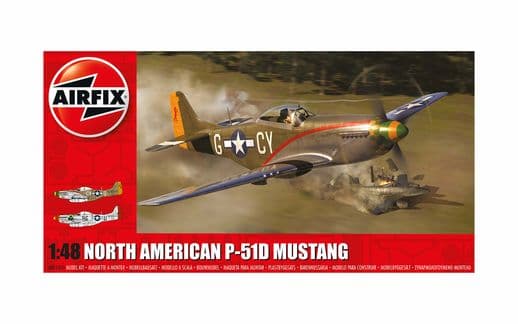
Keep an eye out for this distinctive box artwork, because as every modeller knows, you can never have too many Mustangs in the stash!
Sporting the red and yellow nose markings of the 363rd Fighter Squadron, this Mustang was the personal mount of Lt. John Carl Casey, who decorated his fighter with the name ‘Frisco Kid’ and a rather distinctive piece of artwork - a street fighter figure painted over a shamrock. Surviving the war, Casey remained in US Air Force service throughout the Korean and Vietnam wars, retiring having attained the rank of Colonel in 1970.
These two fantastic schemes will certainly prove difficult to resist and from a modelling perspective, this latest kit release will only enhance the reputation of a kit which is fast becoming something of a modern Airfix classic.
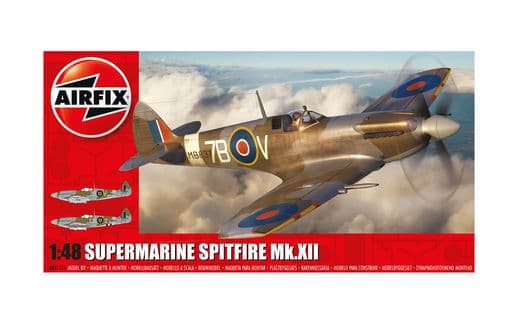
In a previous edition of our blog posted just three weeks ago, we included details of the latest impending release from our 1/48th scale Supermarine Spitfire Mk.XIV/F. Mk XVIII tooling, both of which represent model kits of later developments of the famous British fighter which saw constant service throughout the Second World War. We also touched on the fact that neither of these aircraft were the first production Spitfires to feature this new powerplant, but as the current 2022 kit range also includes a 1/48th scale representation of this very mark of Spitfire, we would be looking at the Mk.XII in a later edition. Although perhaps a little earlier that we had anticipated that edition is now upon us and its time to take a look at the first of the ‘Super Spitfires’.
Despite the fact that the Spitfire had already proved itself adaptable enough to undergo almost constant modification to keep it at the forefront of world fighter design, engineers at Supermarine knew that enabling their fighter to fly at ever greater speeds would require the development of a more powerful engine, but one which could still be bolted to the front of the Spitfire’s rather diminutive airframe. The engine which would eventually morph into the Griffon started life as the ‘R’ powerplant which allowed Britain’s Supermarine S.6B seaplane to capture the Schneider Trophy for Britain. This mighty 37 litre V-12 engine was actually developed in response to a Fleet Air Arm request for a more powerful version of the Merlin engine, one intended to power a new breed of naval aircraft designs, such as the Fairey Firefly. The new design would negotiate development without too many problems and would result in the availability of an experimental engine by late 1939.
A stunning wartime image featuring seven RAF No.41 Squadron Spitfire Mk.XII fighters in their domain, a much more aggressive looking version of Mitchell’s aviation masterpiece.
The new Griffon engine was first installed and flight tested in a Spitfire airframe in 1941 with the Mk.IV, using a variant of the powerplant which featured a single stage supercharger. It did provide the welcome performance increase Spitfire designers had been hoping for, but the fuel hungry engine consumed approximately 25% more fuel than a Merlin at similar power settings. This would have an impact on the intention to give the new Spitfire greater firepower, as space which would be required for more guns would now be needed for additional fuel carrying capacity. The prototype Spitfire IV was flown for the first time on 27th November 1941 and from that initial flight, it was clear that the additional power generated by this new engine also produced some flight handling challenges and more work would have to be done before Rolls Royce Griffon powered Spitfires could enter squadron service.
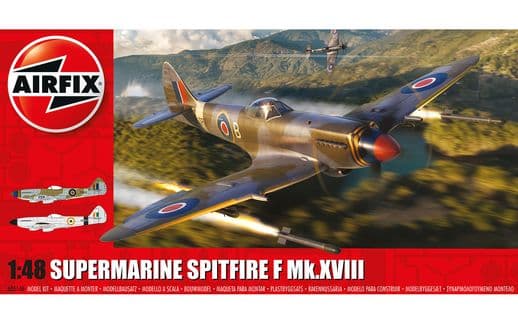
To mark the impending release of our latest 1/48th scale Spitfire Mk.XII kit, let’s take a look at the scheme options which will be available with the release of this muscle Spitfire.
The adoption of the Rolls-Royce Griffon engine would provide the Spitfire with a significant increase in performance, but not without presenting both Supermarine designers and pilots converting to Spitfires powered by the new engine with a few challenges. Installation of the new engine in the existing Spitfire airframe required a redesign of both the front and rear sections of the aircraft and was dominated by the use of a distinctive five bladed Rotol propeller. Pilots who had previous experience flying Merlin engined versions of the Spitfire would find the Griffon engine turned the propeller in the opposite direction, so just as earlier versions of the aircraft tended to veer to the left on take-off (and require corrective rudder input from the pilot), Griffon powered machines would pull even more noticeably in the opposite direction. If a converting pilot initially forgot this change in procedure and applied their usual corrective inputs during take-off, their first flight in a Griffon powered Spitfire might be a short and rather eventful one.
With the aircraft now cleared, Supermarine began production of an initial order for 100 fighters, using modified and strengthened Vc airframes. The increased length of the aircraft’s nose and the new long spinner reduced the pilot’s forward vision still further and when combined with the rather violent torque induced swing on take-off, Griffon powered Spitfire pilots had quite a challenge in taming this beast. Performance of the new Spitfire was considered superior to the Focke Wulf Fw 190 at altitudes below 20,000 ft, as it was found to be faster, possess an equivalent roll rate and was superior in the turn.
Full scheme details of a Spitfire which spent its service life being targeted by friendly anti-aircraft gunners, as they honed their interception skills.
RAF No.595 Squadron was an anti-aircraft co-operation unit which operated from bases in Wales from its establishment in late 1943 until early 1949. Operating a variety of aircraft types, they used the Griffon powered Spitfire Mk.XII from December 1944 until July 1945, although for several months, they had both Merlin and Griffon powered variants of the Spitfire on strength. The role of this unit was to provide aircraft to help anti-aircraft batteries calibrate their sighting equipment, flying aircraft at a range of speeds across pre-determined flightpaths, in addition to less predictable courses.
This particular Spitfire was delivered to No.6 Maintenance Unit at Brize Norton towards the end of May 1943 and on to RAF No.41 Squadron (coded EB-D) by early August. Less than a month later, the aircraft was damaged during the interception of a V-1 Doodlebug, with the flying bomb exploding in front of the fighter. Following repair, it was allocated to No.595 Squadron and the role of high speed anti-aircraft co-operation aircraft, much less dangerous than chasing Doodlebugs.
Taking the honour of becoming the first RAF squadron to be equipped with the new Rolls Royce Griffon powered Spitfire, No.41 Squadron received its first machine during February 1943 and by the end of the following month had received its full complement of aircraft. Undertaking a punishing period of familiarisation and conversion work, the unit was sent back on operational duty in April 1943 and would claim the first aerial victory by a Griffon powered Spitfire on the 17th of that same month. The Squadron would soon be fully engaged in providing Ramrod bomber escort support for strike formations hitting targets across enemy occupied Europe, where the low altitude performance of the aircraft was more than a match for anything the Luftwaffe sent to challenge them.
No.41 Squadron would be heavily committed during the lead up to the Allied invasion of Normandy and operations covering the beachheads on D-Day itself, losing three fighters to enemy flak on 6th June. Less than two weeks after the successful invasion, the squadron was reassigned to home defence duties, where the speed and low/medium altitude performance of their Spitfires could be brought to bear against a terrifying new threat, the indiscriminate V-1 Doodlebugs which were now raining down on southern England. Mounting anti-diver patrols, the squadron quickly developed tactics to bring down the flying bombs, although some aircraft and pilots were lost during this period of rapid learning.
As the first RAF Squadron to operate Griffon powered Spitfires, No.41 Squadron pilots also had the dubious honour of having to tame this beast, as the Spitfire’s quest for ever greater speed produced a real brute of an aeroplane.
By 28th August, No.41 Squadron had claimed the last of 53 Doodlebugs destroyed, a total which included several pilots who, despite having expended their ammunition, pressed home their attacks by flying alongside the V-1 and tipping them over, using the wing of their fighters to disrupt the airflow over the flying bomb’s wing, throwing its gyroscopic control system out and sending it spiralling earthwards. Sharing the V-1 victories amongst many pilots, the most successful anti-diver ace of the squadron was Flt. Lt Terry Spencer, who managed to account for seven of these hated weapons.
By September 1944, No.41 Squadron had re-equipped with the more capable Spitfire XIV, bringing to an end their historic association with the first of the RAF’s Griffon powered ‘Super Spitfires’. Spitfire MB854 made its first flight on 24th June 1943 and was allocated to No.41 Squadron at High Ercall, where it would wear the codes EB-T and EB-Z during its time there. This scheme shows the aircraft sporting D-Day identification markings and is a fine representation of an aircraft which was heavily involved in operations to support the Allied invasion of occupied Europe, both during the lead up to invasion and on D-day itself. Although the squadron would soon be recalled to fly anti-diver home defence operations, it is recorded that this Spitfire was hit by flak on 17th August 1944 and was forced to make an emergency wheels-up landing in a field near Brookland in Kent.
With its clipped wings and purposeful profile, this beautiful kit is a fine representation of the first mark of Griffon powered Spitfire to enter Royal Air Force service and in this slightly larger 1/48th scale, the finished kit more effectively portrays the stature and stunning clean lines of this magnificent machine. With this blog update putting us all on standby for the impending release of both this first Griffon powered Spitfire and the P-51D/K Mustangs of the Mighty Eighth featured earlier, we could all be welcoming in the summer with classic WWII fighter build projects on our workbenches this year.
Marking an important stage in the development of the Spitfire, this kit not only represents the first of the Rolls Royce Griffon powered machines, but in 1/48th scale, helps to give a better representation of its sheer power and majesty - a truly magnificent model.
That’s all we have for you in this latest edition of Workbench, but we will be back as usual next Friday with more modelling news, updates and exclusive imagery from the fascinating world of Airfix. If you have any comments in connection with the blog, or would like to suggest a subject to be covered in a future edition, please do drop us a quick line using our workbench@airfix.com e-mail address. The Airfix team would be only too pleased to hear from you. Enjoy your Bank Holiday break, which will hopefully include a few pleasant hours spent modelling.
If you would like to continue the Airfix modelling discussions between editions of the blog, the Airfix Workbench Forum is the place to be, however, if you simply wish to keep up to date with all the latest Airfix modelling news, you can access our official social media sites, or simply head for the Airfix website, where you will find all the details you need.
If you have yet to add our sites to your favourites, you can find links to our Facebook, YouTube, Twitter and Instagram sites at the bottom of our website homepage.
As always, thank you for continuing to support our Airfix Workbench blog.