Welcome to this latest edition of our Workbench blog and all the news, updates, and modelling exclusives from the fascinating world of Airfix.
As we prepared to welcome visitors to the Airfix display stand at this year’s Scale ModelWorld Show at Telford, we were also preparing two new surprise model releases for their public debuts, one a completely new tooling project, with the other being just the second release from an extremely popular tooling which took the modelling world by storm last year. In this latest edition of Workbench, we will be making our full blog introductions to the new 1/48th scale Westland Sea King HC.4 kit, a model which is scheduled for release this side of Christmas, and one which will allow us to build a scale example of the Royal Navy’s former amphibious assault variant of this famous helicopter.
With our usual impressive selection of both product and built sample model imagery to bring you, we will also be including details of the latest addition to our collector coin series, which is linked to this model release, one which commemorates one of the Royal Navy’s most famous individual helicopters, a machine which has been described as something of an aviation national treasure. The new kit comes complete with no fewer than FOUR appealing scheme options, and we will be taking this opportunity to look at each one in turn, in an attempt to help readers decide which one will be getting your vote when you get your hands on this fabulous new kit over the coming festive period.
We’re definitely in the company of British rotary aircraft royalty in this latest edition of Airfix Workbench.
The first release from this magnificent tooling presented the aircraft is its original anti-submarine configuration.
Over the past decade or so, the modelling world has witnessed a real surge in the popularity of new tooling projects produced in the slightly larger 1/48th scale, which is probably the result of several different reasons. One of those reasons could be that as the demographics of the wider modelling community simply finds working in a slightly larger scale more appropriate for them these days, but will also undoubtedly be the fact that people feel models finished in this larger scale always have that little bit more presence when viewed as part of a built model collection. Whatever the reason, 1/48th scale appears to be in the ascendancy and is most definitely here to stay.
From an Airfix perspective, our growing 1/48th scale range may include aviation classics such as the Junkers Ju-87 Stuka, Curtiss P-40 and Mustang, however, it has also been the grateful recipient of several larger types over the years, such as the Supermarine Walrus, Blenheim and Blackburn Buccaneer, and as of last year, welcomed the mighty Westland Sea King to the range. Adding one of Britain’s most famous post war helicopter types to the range not only came as a pleasant surprise to the nation’s modellers, but also served to underline the growing popularity of this scale, as this rather large aircraft offers something refreshingly different for many a collection of built model kits. Whether finished with rotor blades extended, or folded back for carrier stowage, this is one impressive model and a stunning representation of this magnificent aircraft.
The development of rotary technology gained real impetus in the years which followed the end of the Second World War, with the helicopter showing itself to possess the ability to do things other aircraft types were simply incapable of doing, making them invaluable assets in so many situations, both military and civilian. As helicopters became more reliable, with engine technology enabling them to carry ever heavier loads, their incredible versatility would see them positioned at the forefront of many a military intervention, and similarly spearheading relief and humanitarian responses in times of international crisis. Whether supporting military operations around the globe or coming to our rescue in times of need, the helicopter is viewed as an angel on our shoulders, and indispensable in so many situations.
A name which has always been at the very forefront of world helicopter design and development throughout the post war era, America’s Sikorsky Company were awarded a significant contract to produce an all-weather, amphibious helicopter for the US Navy in 1957. Its primary mission profile would be that of an anti-submarine warfare aircraft, protecting the US fleet from possible attack, however, the aircraft would prove adaptable enough to take on a multitude of secondary roles, going on to become one of the truly great aircraft of the 20th Century. The aircraft, which was given the designation SH-3 Sea King, was produced with an amphibious hull, giving it the capability to land on water, in addition to its more usual environment on the decks of numerous US Navy warships.
Powered by a twin turboshaft engine arrangement, the Sea King was an impressive machine, capable of carrying significant loads of men, equipment, or general supplies, providing the US Navy with a truly revolutionary new aircraft. On entering service in 1961, the Sea King was the most advanced aircraft of its type in the world and presented the US Navy with one of the most flexible aviation platforms available at that time.
A computer rendered image produced using the Sea King HC.4 components from the new 1/48th scale Westland Sea King kit.
Keen to maximise the commercial success of their impressive new helicopter, Sikorski went on to develop a civilian derivative of the SH-3 Sea King, a helicopter which carried the designation S-61 and an aircraft which was immediately of interest to many of the world's naval air arms. At around this time, the Royal Navy had become concerned about the growing threat posed by the constantly expanding Soviet submarine force and were looking to equip their ships with a powerful helicopter capable of detecting and destroying this underwater menace. Looking for an aircraft to initially work alongside, then ultimately to replace their Wessex fleet, a decision was taken to request Sea Kings from America in the mid 1960s, but Anglicised versions of the original aircraft.
In Britain, an existing licence agreement between Sikorski and Westland had already seen large numbers of S-51 Dragonfly, S-55 Whirlwind and S-58 Wessex helicopters manufactured for the UK military and this agreement was extended to include the S-61 Sea King. The benefit of waiting five years following the aircraft's US Navy introduction was that the Sea King, which had already undergone extensive trials and almost constant in-service evaluation, was now an extremely mature helicopter and they were not only assured of its capabilities, but also the fact that it was capable of taking on many more roles than those it was initially intended to do. Placing an order for sixty aircraft in June 1966, at that time, this represented the largest order ever placed with a British company for helicopters.
As previously mentioned, the licence agreement between Sikorski and Westland allowed the Yeovil based company to make changes to the original design of the aircraft, in order to effectively integrate the Sea King into British military service. Whilst the external appearance of the British built Sea Kings may have resembled those of their cousins across the Atlantic, internally, these were very different machines. Perhaps the most significant difference came with the selection of a new powerplant, with a pair of Rolls Royce Gnome turboshaft engines replacing the General Electric T58-GE-10 turboshafts used on US machines, however, Westlands would also develop the design to incorporate technologies and systems tailored towards British (Royal Navy) requirements, including the latest electronic innovations from leading British aerospace companies.
Once in Royal Navy service, whilst British and American Sea Kings were both initially required to perform the vital anti-submarine warfare role, they would actually be operated in very different ways. US Navy Sea King operations were integrated under the tactical control of the aircraft carrier on which they were based, with these vessels typically being much larger and arguably much better equipped than their British counterparts. In contrast to this, British machines operated very differently and were required to be much more autonomous – Royal Navy Sea King crews often operated alone and were required to coordinate search and attack missions with other aircraft and surface vessels as and when required. The crew arrangement on British machines also differed slightly, in that the observer on board a Royal Navy Sea King would perform the role of sortie controller, as opposed to the aircraft's pilot, as was typical on US Navy aircraft.
Another computer rendered image featuring the new Sea King HC.4, followed by a picture showing built model samples finished in all four scheme options included with this impressive new kit.
The hugely capable Westland Sea King was selected by the Royal Navy to meet their requirement for an anti-submarine warfare helicopter, replacing the venerable Westland Wessex in this role, but with the Wessex continuing to serve with distinction alongside the Sea King in other roles. The first Westland built Sea King flew from their factory facility at Yeovil on 7th May 1969, with the first Royal Navy machines being delivered to No.700 Naval Air Squadron (Operational Evaluation Unit) at Royal Naval Air Station Yeovilton later that same year. In Royal Navy service, these first Sea Kings were designated Sea King HAS.1.
As the Sea King became established in Royal Naval service, it quickly showed itself to be both operationally capable and highly adaptable, a significant upgrade on previous rotary capabilities. As a result of its incredible versatility, the Sea King was destined for a long and illustrious service career, whilst at the same time earning an enviable reputation for both serviceability and reliability. Capable of operating from ship or shore stations, by both day and night and in all weather conditions, the Sea King quickly became the helicopter against which all others would be judged, a truly magnificent aircraft. From its initial anti-submarine role, the Sea King would also go on to serve in Search & Rescue, anti-surface shipping attack, airborne early warning, communications, surveillance, logistic re-supply, troop transport, medivac and special forces roles, underlining its credentials as one of the most successful aircraft of the 20th century and beyond.
During a 49-year career with the British military, could this magnificent aircraft have been given a more appropriate name, as it most definitely became the King of the Sea in aviation terms.
Artwork featuring an icon. This magnificent image features the ‘King of the Junglies’ during her deployment in the South Atlantic for Operation Corporate.
The Sea King may have been conceived as a fleet defender, protecting surface ships from submarine attack, however, it quickly proved itself to be capable and adaptable enough to tackle a variety of different roles, becoming a vital component in any air arm in which it served. One of the most extensively modified variants of the Sea King was the Westland HC.4 Commando, an incredibly capable amphibious assault and support helicopter used by the Royal Marines, an aircraft specifically required to deliver, supply and extract troops in a variety of tactical situations, whilst retaining the overall usability of the Sea King in a multitude of operational situations.
Strangely for an aircraft dedicated to the support of seaborne troops, the HC.4 was based on a variant of aircraft developed for desert operations in Egypt and Qatar and are distinguishable from other variants by the fact that they did away with the large undercarriage float sponsons which were such a feature of earlier variants of the helicopter, replacing them with fixed main landing gear.
The aircraft also featured a folding main rotor system and a folding tail boom for ease of stowage on a British naval vessel and were capable of carrying 28 fully equipped troops over a range of around 600 miles. Ideally suited to amphibious warfare and the tactical insertion of ground troops, the 'Commando' proved to be an important variant of the Sea King. It was initially proposed as a tactical transport for the Egyptian Air Force for which the amphibious capability of earlier Sea Kings was not required and so the side floats were deleted. With folding rotors and tail, the Commando entered service with the Royal Navy as the Sea King HC.4. It would eventually be provided with radar-warning and infrared jamming devices, and could also deploy M130/M147 flares as countermeasures.
Besides troops, it could also be fitted to carry underslung loads of up to 2.5 tonnes. Increased range and a 28-troop capacity made it ideal as an amphibious transport aircraft, and the HC.4 would see operational service in the Falklands, Balkans, Gulf, Lebanon and Afghanistan conflicts. It was often deployed in order to evacuate wounded personnel and refugees, as well as preparing for and supporting ground advances.
Can a stunning new model release be made any more desirable?
Finished in a sinister olive green scheme and sporting a door-mounted 7.62mm general purpose machine gun, the Royal Navy eventually received 42 newly built HC.4 Commando helicopters, with deliveries beginning in 1979. Taking on the tactical effectiveness the helicopters of the Vietnam War had shown the world’s military, the Navy’s Commandos were incredibly sinister looking machines and from an operational perspective, the first time you knew one of these helicopters was upon you is when they started shedding their load of Royal Marine troops near you, by which time you knew you were in BIG trouble.
Retired in March 2016 after a spectacularly successful 36-year service career, the Commandos of the Royal Navy’s Commando Helicopter Force were replaced by Merlin Mk4/4a helicopters inherited from the Royal Air Force. These mighty helicopters further enhanced the capabilities of the force, which are now considered the most advanced amphibious battlefield helicopters in the world.
Our 1/48th scale kit homage to the mighty Sea King was unleashed on an unsuspecting modelling world as a surprise addition to the range during the summer of 2023, with that first release including parts to allow the HAS.1, HAS.5 and HU.5 variants of this famous helicopter to be built. Now heralding the second release from this tooling, our Scale ModelWorld announcement may have been equally unexpected, however, new that this second release will be presenting the Sea King in HC.4 form, 42 specially developed aircraft produced for the Royal Navy by Westlands at Yeovil during the 1980s.
With additional parts to enable this variant of the kit to be built, this kit includes decal options to complete your kit in one of four different schemes, including one which comes with the impressive title of ‘The King of the Junglies’.
Let’s find out a little more about each of the very different scheme options on offer.
Although the Falklands air war is usually associated with the Sea Harriers which performed with such distinction in protecting the British Task force, or the Avro Vulcans which mounted the longest bombing raid in history, the contribution made by Britain’s helicopter force during the conflict was also crucial to the eventual success of the operation. Westland Sea King HC.4 ZA298 (c/n WA912) was built by Westlands in 1981, making its first flight on 21st August that year, prior to being delivered to the Naval Aircraft Support Unit at RNAS Culdrose. Unusually, she returned to Westlands later that year to be used on a sales tour of Algeria, where the aircraft wore the civilian registration G-BJMN.
ZA298 was one of fifteen Fleet Air Arm Sea King HC.4 helicopters to take part in ‘Operation Corporate’, Britain’s military operation to re-take the Falkland Islands from Argentinean invasion in 1982, where they would work tirelessly transporting troops and supplies, and delivering and extracting special forces around the region. She was assigned to HMS Hermes at the start of the operation, but was detached to the amphibious assault ship HMS Fearless, from where she assisted with the evacuation of personnel and casualties HMS Coventry after she had been hit by bombs from Argentinean A4 Skyhawks.
Sea King ZA298 would herself be targeted by A4 Skyhawks on 13th June 1982, when two aircraft screamed over the Falkland Islands and took pot-shots at the helicopter having just released their bombs. A 30mm cannon shell hit one of the helicopter’s rotor blades, with the aircraft being forced to make an immediate heavy landing. Incredibly, in the heat of battle, technicians replaced the blade in less than two hours, with ZA298 taking to the air again immediately after, continuing to provide her invaluable support. Just two days later, she was used to transport Argentinean General Menendez to HMS Fearless to begin surrender negotiations.
Westland Sea King HC.4 ZA298 is unquestionably one of the most significant British aircraft of the post war era.
After a baptism of fire such as this, you might think that the rest of this helicopter’s service career would be a little less dramatic, however, you would be mistaken, as this aircraft would be remembered as the longest serving Sea King Mk.4 and even be given the title ‘King of the Junglies’.
To say that Sea King ZA298 would go on to have a significant career would be something of an understatement, because essentially, wherever British forces were required to operate over the next 30 plus years, this incredible aircraft would have probably been there too. In addition to serving with such distinction during the Falklands War, she would go on to serve in Northern Ireland, Bosnia, during both Gulf Wars and in Afghanistan, coming under fire during most of these deployments. Whilst helping to rescue civilians during the Bosnian Crisis, the aircraft was raked by small arms fire and whilst serving in Afghanistan, had a sizeable hole blown in her fuselage side, after being struck by a rocket propelled grenade.
Whilst the helicopter was landing at a checkpoint in Helmand Province in 2009, ZA298 was struck by a Taliban RPG, causing significant damage to the aircraft and heralding the start of an extremely hazardous recovery operation for the British military. In an exercise which was a technically challenging as it was dangerous, a specialist team prepared to airlift the helicopter back to Camp Bastion, where the damage could be fully assessed and consideration given to onward transportation back to the UK for repair.
Once she was back at Camp Bastion, the full extent of the damage could be seen and whilst the decision was subsequently made to transport the aircraft back to the UK, it did appear to many that the damage was so severe that a repair attempt would be neither cost effective, or possible. Thankfully, that proved not to be the case, and a decision was taken to allow the repairs to take place and over the course of an eighteen-month period, the engineers at Vector Aerospace did a splendid job in returning this aviation stalwart to her former glory.
A befitting an aircraft of this stature, despite returning to service with Commando Helicopter Force, the remaining service years of ZA298 would be much less dramatic, unless, of course, you include the fact that she was the aircraft which carried the Olympic flame at the start of the London Olympics ceremony in 2012, where a Royal Marine Commando abseiled down from the helicopter into the grounds of the Tower of London, before transferring the flame to Dame Kelly Holmes.
Fittingly, ZA298 is now preserved for the nation and is on public display as part of the impressive collection at the Fleet Air Arm Museum, one of the most famous aircraft to have ever seen British service and significantly, only 7 miles from the factory which built her back in 1981. Her illustrious career stands testament to both the capabilities of modern helicopters and the effectiveness of the mighty Sea King.
During the Gulf War of 1990/91, after an initial period where the services of the Navy’s Commando helicopters was seemingly not required, a force of 20 of these helicopters were subsequently rushed to theatre, in support of the Royal Marines, who were part of No.3 Commando Brigade RM. After quite a slow start, crews embarked on an intense period of training and workup, initially working closely with tank and artillery crews, as in the event of a land invasion, they would be required to provide medivac cover for artillery support troops engaged right along the active front line.
After crews witnessed the awesomely impressive Allied night barrage which was the prelude to invasion and the eerie silence which followed, they once again felt as if their services may not be required, because how on earth could any enemy force withstand such a withering onslaught as that?
Nevertheless, as Allied units pushed deeper into Kuwait, they eventually met with stiffer opposition and casualties started to be taken. This was very much the operating environment of the ‘Junglie’, with crews knowing they would be potentially flying into a firefight, but also, how their troops were in desperate need of their support, so this was a job which just had to be done. During the transit flight, aircraft flew past a great many burning oilfields, set alight by retreating Iraqi troops, with the acrid smoke being so dense that flight visibility was seriously hampered. In fact, the air was so thick with smoke that GPS equipment couldn’t function, and crews were effectively flying blind.
Once in the forward combat zone and landing far enough from the casualties so as not to cause further injury, or blow over any temporary shelters erected to protect them, the wounded could be taken onboard, both Allied and Iraqi. Then, it was back to field aid stations in the rear, or more robust facilities if required, all the time taking small arms fire from troops who were simply aiming towards the noise, to this were the clouds from the burning oil fields.
These kinds of operational taskings were all in a day’s work for the Commando helicopter force of the Royal Navy and during their 36 year period of service, they would see service during the Falklands War, during the first Gulf War, in Lebanon, Sierra Leone, Northern Ireland and Afghanistan, not to mention any number of operational deployments and training exercises along the way.
This particular aircraft was constructed by Westlands at Yeovil during 1981, making her first flight on 18th December that same year. She was taken on strength with the Fleet Air Arm in late January 1982, assigned the serial number ZA312 and later allocated to No.846 NAS at Yeovilton. During an active service career, this helicopter would see service with Nos.707, 845, 846 and 848 Naval Air Squadrons, before being sold to a private owner following her withdrawal from service.
During her service in the Gulf War, this aircraft was repainted in a temporary desert scheme which was very different from her Junglie attire. As an unfamiliar scheme on these hard working aircraft, she also benefited from the application of theatre markings, alternate black and white stripes around the rear fuselage and lower front fuselage, in an attempt to prevent the aircraft from coming under fire from friendly anti-aircraft units, particularly as these aircraft could be operating in forward areas and maybe in support of special services operations.
For aircraft which became so famous for wearing the sinister all-over green scheme which gave the ‘Junglies’ their affectionate nickname, several of the Royal Navy’s Sea King HC.4s would actually benefit from the application of some rather elaborate colour schemes, several of which are represented with this second release from this impressive kit. Arguably the most striking scheme of the four on offer, Sea King ZD480 wears the all-over white scheme of an aircraft involved in United Nations peace keeping operations, one intended to make these aircraft highly visible to everybody in the area and identifying the humanitarian nature of their operations.
This scheme was intended to show the black UN markings in a most visible manner (for obvious reasons), but also carried the famous light blue of the UN on the rotor cap of the aircraft. As one of the most adaptable aircraft types of the post war era, helicopters and the Sea King in particular, provided humanitarian and peace keeping forces with their most valuable aviation assets, able to respond at a moment’s notice and capable of operating both into and out of even the most inhospitable of locations.
These missions often served as high profile policing flights to ensure all sides honoured any ceasefire agreements in place, but also providing reassurance for the local population that the international community was taking an interest in their plight and were there to ensure things didn’t get any worse for them. UN Sea Kings could also be called upon to support in a multitude of situations, be that casualty evacuation, supply drops and support missions and in the case of the HC.4, also possessing the threat of firepower in any situation, should that be required. Operating from land bases, or from ships holding off the coast, these aircraft were invaluable when it came to this type of operation, possessing an inherent threat, whist at the same time ensuring peace.
One of the later Sea King HC.4s ordered for the Royal Navy, following the successful service introduction of the original machines, ZD480 was constructed by Westlands in late 1983, making her first flight on 19th March 1984. She was delivered to the Fleet Air Arm early the following month, where she was allocated to No.845 Naval Air Squadron. She would be one of the No.845 NAS Sea Kings which provided the longest period of support service flying peacekeeping operations out of Divulje Barracks in Croatia, service which began in November 1992, and was only relinquished in 2000.
During that time, the five Sea King HC.4 flights of No.845 Sqn. took it in turns to rotate in and out of the Divulje Barracks near Split, with the two helicopters and their crews maintaining a commitment to provide the SFOR hospital at Sipovo with a permanent helicopter response team 24 hours a day. This would usually be achieved on a rolling three day deployment, with one aircraft stationed at the hospital for the three days, whilst the other returned to Divulje for maintenance and crew recovery.
This support commitment was vital during this challenging period and crews who spent time there can be proud of their service and the many lives their expertise and professionalism must have saved.
As the Royal Navy’s Sea King HC.4 helicopters could always expect to be sent to operate in some of the world’s most hostile environments, the array of equipment the aircraft could call upon was regularly improved and upgraded, making these hard-working aircraft as survivable as they were dependable. Carrying either troops, cargo or underslung loads, the cockpit of the aircraft was compatible with night vision goggles and their defensive protection included a Sky Guardian radar warning receiver, missile approach warning equipment, an infra-red jammer and chaff dispensers.
Other electronic equipment included a secure communications suite, an ‘Elmer’ secure speech radio and state of the art identification friend or foe equipment, all intended to leave crews informed and protected. The entire fleet of Commando Helicopters underwent upgrade towards the end of 2007, intended to improve the aircraft’s performance when operating in the high and humid conditions of Afghanistan. Those improvements included a new set of composite rotor blades and a new five-bladed tail rotor, which improved controllability of the helicopters when operation in mountainous areas. Aircraft undergoing this modification were unofficially referred to as Sea King HC.4+ machines.
Sea King HC.4 ZF122 was also one of the later aircraft built for the Royal Navy, constructed by Westland Helicopters in 1986 and making its first flight from their factory airfield on 15th January 1987. She was flown to the Naval Aircraft Support Unit at RNAS Yeovilton early the following month and was later allocated to No.772 NAS at Portland, at the start of what would be a busy service career. She would spend time with 845 and 845 Naval Air Squadrons, on deployment to Northern Ireland, on board HMS Ocean and in Afghanistan to name just a few, before finally retiring from service in February 2015.
At that time, the aircraft was taken straight to HMS Sultan at Gosport having only just returned from Afghanistan, and was found to be carrying an amount of additional weight, having acquired quite a bit of sand during her final deployment. The aircraft was subsequently secured by Historic Helicopters, who embarked on an ambitious project to return this magnificent machine back to airworthy condition once more, obviously minus some of the sand they found.
Making its first engine run in 8 years earlier this summer, it’s hoped that ZF122 will once again grace British skies, and continue to mark the legacy of this magnificent aircraft and the other 42 Westland built Sea King HC.4s of the Royal Navy. Could we be lucky enough to see her performing at an Airshow event in 2025?
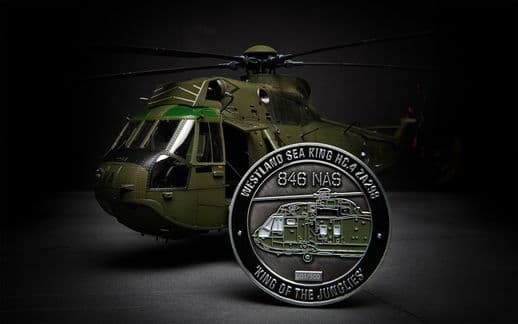
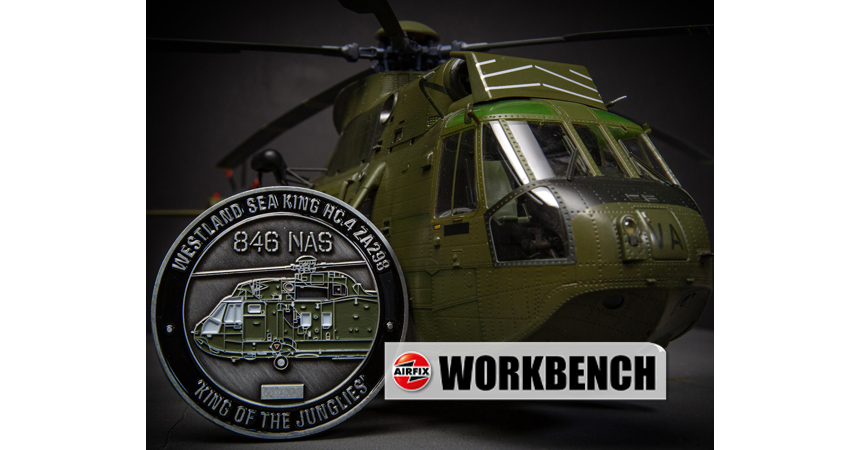
If the prospect of owning and building this Commando Assault Helicopter variant of the Westland Sea King in 1/48th scale were not appealing enough, this impending release is also linked to the next release in our popular collector coins series, with this one paying homage to the legacy of Sea King ZA298 ‘King of the Junglies’. For those people who elected to pre-order this kit via the Airfix website, the first 500 of you will receive one of these beautifully crafted coins, which features the limited edition number and ZA298 profile on one side and the equally iconic Airfix logo on the reverse.
As usual, these coins are a limited edition release of just 500 pieces and are only available to those people placing their orders via the Airfix website. The lucky 500 will find their coin inside the product packaging when receiving their kit following its release and again as usual, once all the coins have been allocated, that’s it and we move onwards and upwards, looking forward to the next forthcoming release in the series.
We are expecting the new 1/48th scale Sea King HC.4 kit to be in our warehouse over the next week or so, however, please keep an eye on our social media channels and of course the Sea King product webpage for all the latest availability information. If you’re a collector of our coins, we hope you manage to secure one of these beauties, because they really are a little bit special. With 2025 range launch just around the festive period corner, we wonder if you’d like to hazard a guess as to what the subject of our next Collector coin might be?
A real festive treat for modellers, this spectacular second release from our 1/48th scale Westland Sea King HC.4 tooling will be available for Christmas this year.
We are afraid that's all we have for you in this latest edition, but we will be back next Friday with more project development updates and the very latest Airfix kit exclusives. In the meantime, we are always keen to hear your views on all things Airfix and in particular, any thoughts and opinions you may have regarding our Workbench blog. If you would like to drop us a quick line, could we please ask that you use our workbench@airfix.com email for all correspondence.
To re-visit any of the Airfix blogs we have produced over the past seven years or so, please head to our main Workbench hub, where you will find our entire blog back catalogue and all the Airfix design projects we have already covered.
All our dedicated official social media sites can be accessed by clicking the respective link icons at the foot of this page, or by heading to the Airfix homepage. Other useful Airfix links are:
Facebook, YouTube, Twitter and Instagram official sites
Please join us for more Airfix updates next week and thank you for your continued support.