

Welcome to this latest edition of our Workbench blog and all the news, updates and modelling exclusives from the fascinating world of Airfix.
We have something just that little bit special for Workbench readers this week, as we bring you a project development update which is significant for two reasons. Firstly, we will be looking at the sometimes controversial subject of equipping the Royal Navy with an effective carrier based fleet defence fighter during the early stages of the Second World War and how they were initially denied access to the most capable option at that time. Secondly, our kit representation of the aircraft in question just happens to be one of the most attractive 1/48th scale offerings to ever appear in an Airfix range, one which modellers will be delighted to hear has just been announced as a surprise addition to the 2023 range this week, the return of our beautiful Supermarine Seafire F.XVII kit.
There's nothing like an unexpected new kit addition to any Airfix range to get us all a little excited and we think this week's announcement that our 1/48th scale Supermarine Seafire F.XVII kit is to join the current range will come as a pleasant surprise for many Workbench readers. Conversely, it will therefore come as no great surprise to learn that this latest update will be devoted to Britain's legendary fighting aeroplane of the Second World War, but not in its famous Battle of Britain mount of the 'Few' guise, but in the attempt to 'Navalise' an aircraft which was constantly developed during its service life. Could the famous Spitfire be given sea wings and provide the Royal Navy with a capable fleet defender?
As you would expect, you can look forward to an exclusive first look at not one, but two magnificent pieces of box artwork produced in support of the re-issue of this incredibly popular kit, in addition to inspecting the three very different scheme and decal options which will be included with this release. If everything goes to plan, we also hope to be bringing you a selection of built sample model images, just to raise those Seafire excitement levels a notch or two higher.
It's time to welcome the 1/48th scale Supermarine Seafire F.XVII back to the Airfix range and to discover if Britain's most famous fighter adapted to life on the ocean waves during WWII.
A Seafire pictured aboard HMS Victorious during Fleet Air Arm trials in September 1942.
Well that was a little unexpected wasn't it! We get to the midpoint of the year (or just a little after) and as many of us start considering the glide in towards longer nights and serious modelling time for many a month, Airfix go and hit us with a spectacular range addition announcement completely out of the blue. More than this, the kit in question is no ordinary addition, it just happens to be one of the most heavily requested kit reintroduction subjects of recent times, our 1/48th scale Supermarine Seafire F.XVII, and one which is joining an Airfix range for the first time in over a decade - what a very pleasant surprise that proved to be!
If you are going to make an unexpected range addition to the 2023 kit line-up, then you might as well make it a big one and for many, it doesn't get much bigger than this. Our Supermarine Seafire F.XVII kit is a real beauty and has been away from a range launch for far too long, which is why many will be overjoyed to see this week's announcement. Presented in this rather mature incarnation, the Spitfire's adoption by the Fleet Air Arm was not without its difficulties and only happened following a couple of lengthy false dawns and even though it could be argued that Supermarine's famous single seater was not an ideal aircraft type to be operated from the decks of a relatively small British aircraft carrier. However, when the call came, this exceptional aircraft was ready for service.
As we have discovered many times when looking at the aircraft designs which inspired their scale inclusion in various Airfix ranges over the years here in Workbench, the 1930s was a time of great change within aviation, with technological advances being applied to new aircraft designs on an almost monthly basis. In Britain, aircraft such as the Bristol Blenheim led the world at the time of its flight testing program, however, by the time it had undergone militarisation and entered Royal Air Force service, it was already the aircraft against which all new designs would be judged and therefore under threat almost immediately.
Nevertheless, when it initially entered service, the Blenheim was just about the fastest aircraft in the RAF, even faster than the latest single engined fighter of the day, the Gloster Gladiator. Even though both aircraft types could be described as being ground-breaking and outstanding in their own right at the time of their introductions, new aircraft such as Germany's Messerschmitt Bf 109 and Britain's own Hurricane and Spitfire ensured that both the Blenheim and Gladiator would be essentially obsolete by the beginning of the Second World War.
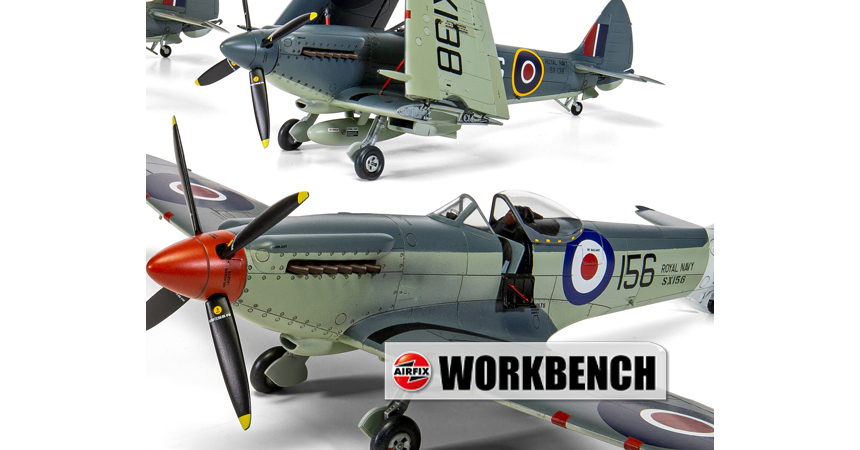
Spitfires with sea legs, this image features built samples of this week's surprise range addition, the 1/48th scale Supermarine Seafire F.XVII, in all three of the scheme options to be included with this fabulous kit.
When it comes to the subject of naval fighters, the Fleet Air Arm had a very different way of looking at the capabilities of aircraft intended for fleet protection duties. The RAF required fast, heavily armed interceptors which could quickly climb to meet an enemy force (which was expected to be bomber aircraft), efficiently dispatch them, before returning to base to re-arm and re-fuel. For them, speed and firepower were the primary considerations, as they would be operating from their bases nearby and vectored to interceptions by ground controllers - possessing great range and navigational skills were not seen as being essential requirements.
In direct contrast to this, the Royal Navy thought very differently when it came to the subject of protecting the fleet, with a differing set of requirements needed for their fighting aeroplanes. Space onboard Britain's diminutive aircraft carriers was very much at a premium, so with the greater range of tasks its aircraft were required to perform, deck space for a dedicated single engined point defence fighter was seen as being an unnecessary luxury. In any case, the performance of the latest slightly larger two and three seat single engined aircraft almost matched that of their single seat counterparts, so to their thinking, there was nothing to lose and much to gain.
Operating such types as the Blackburn Skua, Blackburn Roc and Fairey Fulmar, presented the Fleet Air Arm with aircraft possessing the attributes they deemed desirable for a fleet defender, impressive range, the ability to carry a navigation specialist and machines optimised for life onboard a busy aircraft carrier. Their greater size also meant that they could be assigned other duties, making them much more useful aircraft in this regard. This mindset may also have been the result of Germany not having a carrier fleet of their own and therefore the possibility of combat with the latest breed of land based single seat fighters was unlikely and therefore not a priority. Whilst the Navy were comfortable with the capabilities of their larger fleet defenders, things were about to change.
A Seafire Mk.IIc on the deck of HMS Formidable in December 1942. This variant didn't feature folding wings, but it did have catapult spools, in addition to also having fuselage strengthening plates.
With war in Europe now raging, huge pressure was being placed on a reorganising Royal Air Force to defend Britain against a fearsome onslaught which would surely come at any time. Bolstering these defences led to the Air Ministry issuing a decree that the Royal Navy would have to take over the responsibility for defending their own bases and installations against air attack, in an attempt to relieve some of the pressure off the RAF, even though this did cause more than a little concern within the Royal Navy hierarchy.
The Navy simply didn't have a dedicated single seat fighter for this task and with Spitfires and Hurricanes clearly out of their reach, they looked across the Atlantic for their solution and the diminutive Grumman F4F-3 Wildcat. The French had already selected the Wildcat for service in European skies and the Fleet Air Arm simply jumped aboard this same aviation bandwagon with an order of their own, even before the US Navy had selected the aircraft for home fleet service. As it would transpire, the defeat of France meant that the vast majority of their Wildcats were not delivered, with the balance simply being diverted to Britain, where it would be known as the Martlet in Fleet Air Arm service.
As a dedicated naval fighter, the little Grumman gave British designers important pointers as to what was required for an aircraft destined to defend aircraft carriers, even though the aircraft would initially be assigned the shore based base defence duties relinquished by the RAF around the time of the Battle of Britain. Historically, the Martlet would score the first air combat victory for a US built fighter type operating in the European Theatre, when a Luftwaffe Ju88 was brought down on Christmas Day 1940.
The first of two pieces of new box artwork produced in support of this surprise mid-year catalogue addition, the Rolls Royce Griffon powered Seafire F.XVII was a potent performer and incredibly easy on the eye. Should a fighting aeroplane look this good?
With its reputation now established, the Royal Navy were desperate to get their hands on navalised variants of the Spitfire at the earliest possible opportunity and indeed an order for 50 fighters was placed with Supermarine for work to commence. Unfortunately, as the RAF was still in a period of attrition recovery at that time, an Air Ministry interjection at the highest level claimed that the loss in cost and production man hours of converting these 50 aircraft would potentially deprive the Royal Air Force of around 200 desperately needed fighters. Although the accuracy of such a claim was never challenged, the order was duly cancelled and even though the Navy were eventually granted a supply of war weary former RAF Hurricanes converted for operations at sea, they probably still felt a little short changed, even though this did still represent an increase in capability for the Fleet Air Arm.
When comparing how the world's aircraft carrier forces operated at that time, its interesting to note that whilst both the US and Japanese carrier fleets had perfected the storage and operation of their aircraft from the decks of their carriers, the Royal Navy favoured storing their aircraft below deck. Unfortunately, the navalisation of former RAF Hurricanes did not extend to adopting folding wings, so the arrival of Hurricanes led to some deck space issues for handling crews to manage. They did come up with an ingenious solution, which was to weld rigid grooved steel frames to the hull of carriers, into which the tailwheel of a Hurricane could be placed, with the frame capable of supporting the aircraft when it was pushed back onto it, with the rear half basically suspended out over the ocean. Although this appeared to be quite a precarious solution, it did free up valuable deck space on Britain's carriers.
When Winston Churchill later visited the Royal Navy's new carrier HMS Indomitable in 1941, he was dismayed to learn that this magnificent new carrier would be relying on a collection of Sea Hurricanes to provide air protection, the same basic aircraft which had fought during the Battle of Britain almost eighteen months previously. He immediately ordered that a more suitable fighter be produced for the Navy, a decision which brought the Spitfire back into the picture, particularly as an American alternative would not be available at that time due to their own pressing needs.
With its unrivalled reputation, the Fleet Air Arm were obviously delighted to finally be getting their Sea Spitfires, but would the RAF's famous fighter be suitable for life on the ocean waves? With the situation being so pressing, it was obvious that compromises would have to be made, particularly as there was no time to redesign the aircraft to include all the features associated with naval aeroplanes, such as folding wings. By the end of that year, the first Sea Spitfire, or Seafire as it would be known, had completed its deck landing trials and was being readied for the transition to naval fighter.
Protectors of the fleet, the Supermarine Seafire F.XVII represented a significant upgrade in Fleet Air Arm capabilities, even though operation of these potent fighters was always a challenge for naval aviators.
Based on the Spitfire Vb, these first aircraft were former RAF fighters and incredibly, some of them had actually started life as Mk.1 variants, later undergoing re-manufacture to Vb standard. In Fleet Air Arm service, they carried the designation Seafire Mk.Ib and featured the 'b' wing armament configuration, were powered by Rolls Royce Merlin 45 or 46 engines and were fitted with a rather rudimentary 'A frame' arrester hook for wire arrested deck recoveries.
As a little interesting Seafire side note, the parallel development of the next variant of Seafire would actually see this Mk.IIc being the first variant of the navalised Spitfire to be taken on charge by Fleet Air Arm squadrons. The Mk.IIc was still based on the Spitfire Mk.V airframe, but featured the flexibility provided by the 'c' or 'universal' wing and its array of armament configuration options. The Mk.IIc was designed from the outset as a naval fighter, so is viewed in some quarters as the first true mark of Seafire. Whilst still not featuring a folding wing, the Mk.II did incorporate catapult spools under the centre sections of the wing undersides and strengthening fish plates along the length of the rear fuselage, allowing the aircraft to better cope with the stresses of arrested landings. Additional armour protection was also added to the aircraft in an attempt to restore its centre of gravity, with all this additional weight resulting in a 15 mph performance loss over its predecessor.
The Mk.II was further developed to introduce a Seafire which had been optimised for low altitude performance, with a modified variant of the Merlin engine and in some cases, the removal of wing-tip extensions to give the fighter a better roll rate during combat. It was felt that as the operating environment for fleet defence fighters in an interceptor role was typically at low to medium altitudes, this modification would make the Seafire a more potent fighting aeroplane in most combat situations.
The final Rolls Royce Merlin powered variant of the Seafire was the Seafire Mk.III, the variant which finally saw the introduction of a manual folding wing mechanism developed by Vickers Supermarine, a feature which finally saw the Spitfire becoming a naval aeroplane. For the first time, navalised Spitfires could now be stored beneath the decks of all the Royal Navy's aircraft carriers and the Seafire had come of age.
Finally displaying its naval credentials, the first two marks of Seafire did not have the ability to fold their wings and therefore had to be parked on the decks of Britain's carriers, unless that vessel had undergone modifications to their deck lifts. The F.XVII utilised a double fold mechanism to allow the aircraft to fit beneath the decks of Britain's relatively small aircraft carriers.
Although the Spitfire continues to enjoy the reputation as a fighting machine of unrivalled capability to this day, its use as a naval fighter is largely anonymous to all but the hardened aviation enthusiasts, despite the fact that around 2650 of these navalised Spitfires were actually built. From a service perspective, even when Spitfires were being operated from airfields, they could be a bit of a handful if not treated with respect, particularly during landing and take-off, with the long nose and narrow track undercarriage proving challenging for any pilot to master. The very design features which allowed the Spitfire to gracefully slip through the air at high speed and perform its interceptor role with ease, made it a bit of a challenge to operate, particularly when landing.
A thin, but relatively large wing (vision, or more specifically, the lack of), long nose housing its powerful engine (vision) and narrow undercarriage due to the thin wing (handling) all made landing a Spitfire lively to say the least, even if that landing was on an airfield. With the new Naval variant, pilots would be asked to land one of these beasts on the deck of a diminutive British aircraft carrier, potentially in rough seas, in an aircraft with a relatively high landing approach speed. With ocean on all sides if they got things wrong, there was absolutely no margin for error landing a Seafire on a carrier and it's therefore easy to understand why naval aviators thought themselves a cut above the rest, in piloting terms.
Even though the Seafire was undoubtedly a significant upgrade in capability for the Fleet Air Arm, it has to be acknowledged that it was always something of a compromise and in truth, perhaps not the ideal aircraft to operate from the deck of a British carrier. With its long nose and relatively large wing area, the Seafire offered poor forward vision for the pilot during landings and a curved approached was an absolute must for a successful recovery. In all cases, the pilot would only have a couple of seconds to check his instruments and any guidance from the Landing Signal Officer, before he was on the deck and hopefully in one piece.
As already discussed, the landing approach speed of a Seafire was higher than with other naval aeroplanes, which not only made the recovery process even more challenging, but often also resulted in heavy landings. Even if the aircraft's arrestor hook engaged with one of the ship's wires, the narrow undercarriage ensured that even a successful recovery produced a few heart-pounding moments for all concerned. Seafires nosing over and damaging propellors was a common occurrence and even a successful recovery would subject the aircraft's structure to incredible forces, but this was all in a day's work for a Seafire pilot and his mount.
The combat introduction of the Fleet Air Arm's Seafires took place during 'Operation Torch' in 1942, where the aircraft would be credited with its first kills. Although ten Axis aircraft would be destroyed as a result of air combat, or during strafing attacks, quite a high number of Seafires were lost, nearly all of which were due to landing accidents and not as a result of enemy action. This worrying trend would actually get worse the following year during 'Operation Avalanche', the codename for the Allied landings at Salerno. With the Seafire now established in service, these same problems continued to blight its operation and during extensive air operations covering the landings, only two Seafires were lost due to enemy action, whilst an astonishing 42 were written off having suffered landing accidents. There were a number of factors which contributed to this situation, however, the Seafire had started to gain something of an unfortunate reputation by that point.
A thing of aviation beauty, there really is something that little bit special about aeroplanes which served at sea, particularly if that aircraft's lineage could be traced back to the Supermarine Spitfire.
One of the major problems which affected Seafire operations from the decks of Britain's aircraft carriers was the aircraft's tendency to bounce on landing and if it did, the incredible torque generated by the Merlin engine would swing the aircraft to an almost inevitable accident. In order to address this situation, what do you think Vickers Supermarine designers set about doing? That's right, give the Seafire an even more powerful engine, the Rolls Royce Griffon.
The Griffon engine actually started its development life as a project for the Royal Navy, as they approached Rolls Royce with a request for them to develop a more powerful variant of their Merlin engine, one which could be used to power future Fleet Air Arm aircraft in development at that time, such as the Fairey Firefly. Featuring a number of significant improvements, the Griffon could boast a 36% greater capacity over its predecessor, even though it was only marginally larger in physical size. Significantly though, this V-12, 37 litre beast turned its propeller in the opposite direction to Merlin powered aircraft, which proved to be something else to catch out the unwary Seafire pilot.
Clearly, a powerplant possessing such potential was also going to be of interest to the Royal Air Force and it didn't take long before the suggestion was made to marry the Griffon with a Spitfire airframe and by association, also into the next variant of the Seafire in development. A much modified version of the RAF's Spitfire XII, the Fleet Air Arm's Seafire F.XV.
This variant was based on the Seafire Mk.III airframe, but with the installation of the new Griffon engine (as used on the RAF's Spitfire XII), retaining the manual wing fold mechanism of the previous variant, but featuring a larger, modified rudder and retractable tail wheel. Intended to equip the Fleet Air Arm with a fighter better able to cope with the low flying Japanese aircraft in the Pacific, including kamikaze attacks, the new Seafire was quite the performer and entered full production in the Autumn of 1944.
The new fighter reached FAA squadrons in May 1945 and was expected to play a major role in the coming assault against the Japanese home islands, the perfect companion for other Allied fighting aeroplanes in service at that time. The Seafire was still rather short on range and the use of the thirsty new Griffin engine didn't help matters in this regard, however, the design team at Vickers did manage to install additional wing leading edge fuel tanks into the F.XV, giving the aircraft an effective operating range of some 430 miles.
In operation, the power produced by the Griffon engine was the major issue, with aircraft discovered to have a tendency to nose over if the engine surged on start-up. This problem was effectively solved by having two or three men either sit on the aircraft's tail, or hold it down during engine start up, but once the aircraft was cleared for take-off, the pilot was on his own when it came to handling the Griffon. Obviously, with the Griffon turning the propeller in the opposite direction to all previous Seafire variants and the new rudder trim tab having a reputation for being particularly sensitive, both would require a gentle hand and the constant awareness of what was likely to happen should you lose concentration, particularly during deck landings.
A relatively large number of this variant was produced (434) and were intended to replace all Merlin engined versions of the Seafire, particularly in the carrier based fleet fighter role, although some would be retained for shore based operation and reserve taskings. The next variant of Seafire is definitely the subject of our main attention in this latest update, as this was the aircraft which served as inspiration for our highly regarded 1/48th scale Seafire kit, the one which has been announced this week as a surprise addition to the 2023 range, a very different looking Seafire indeed.
The next Seafire variant was regarded as something of an interim development, but would actually result in the introduction of a very different looking aircraft. The Seafire F.XVII was a direct development of its predecessor and one which was intended to 'hold the line' until aircraft to be powered by the two-stage Rolls Royce Griffon 60 series engines could be developed, aircraft which are generally regarded as the 'ultimate' Seafires. The F.XVII incorporated a host of improvements, which included the significant overall strengthening of the aircraft's main spar, something which not only allowed this variant of Seafire to carry a wider and heavier array of offensive armament, but also the adoption of new, longer undercarriage legs, which greatly improved the operability of these fighters.
Visually, the changes incorporated into this version were quite dramatic, as it featured a low-back fuselage arrangement (aft of the cockpit) and the adoption of a 360 degree visibility teardrop canopy, greatly increasing the pilots field of view from the cockpit. Whilst retaining many of the design features of the F.XV, the cut-down rear fuselage allowed additional fuel to be carried, or the return of reconnaissance cameras which could not be carried by its predecessor, however, if fuel was carried in this section of the aircraft, its transfer and usage would require careful handling, as if not correctly managed, the aircraft's centre of gravity could be compromised.
The additional ground clearance offered by the longer, strengthened undercarriage legs proved to be a significant improvement and all but ended the tendency of previous versions to 'deck peck' their propeller tips and its ability to carrier heavier loads certainly made this a more capable fighting aeroplane. The low back of this variant gave the F.XVII a very un-Spitfire-like appearance, although to many aviation enthusiasts, produced the most attractive variant of all the Fleet Air Arm Seafires. The Seafire F.XVII entered squadron service in late 1945, but after the end of the Second World War.
Full scheme details of this Seafire F.XVII which served in a deck landing control officer training support role.
Two images of built sample models in this lead No.767 Naval Air Squadron scheme.
The Seafire presented here was built by Westlands at their Yeovil factory during the summer of 1945 and delivered to the Aircraft Receipt and Dispatch Unit at RNAS Culham on 1st October the same year. In these striking colours, the aircraft served with No.767 Naval Air Squadron as part of the 50th Training Air Group, providing deck landing control officer training support, a unit which was colloquially referred to as the 'Clockwork mouse Squadron'. This was due to the daily operation of the unit and the almost continuous circuits and landings performed by their aircraft at their home base at Yeovilton.
In addition to adopting this attractive post war colour scheme, the aircraft is interesting as it retains its late war roundels on both the top and bottom of its wings, even though fuselage roundels have been updated. The aircraft would have usually displayed the VL lettering which identified it as a Yeovilton based aircraft, however, the application of white paint on the rear fuselage and rudder overpainted this base identifier.
Maintaining the fine traditions of the Spitfire, although this variant of Seafire entered service too late to see action during the Second World War, it was an extremely potent fighting aeroplane and if it had been called upon to engage in combat with Japanese aircraft, would have no doubt given a good account of itself. Despite possessing only fighting credentials that have to remain in the 'potential' category, the Seafire F.XVII really is a thing of beauty and powered by its mighty Griffon VI engine, would have been a very difficult aeroplane to ignore. Anyone who has been fortunate enough to see the restored Seafire XVII operated by Navy Wings on the UK Airshow circuit will no doubt attest to the fact that it is a stunning aeroplane and a fine example of a seafaring Spitfire.
Scheme B - Supermarine Seafire F.XVII SX138, No.807 Naval Air Squadron, HMS Vengeance, 1947.
This was another aircraft manufactured by Westlands at Yeovil during the late summer of 1945 and was again delivered to the Aircraft Receipt and Dispatch Unit at RNAS Culham by the middle of September 1945. She was initially allocated to No.879 Naval Air Squadron at Nutts Corner in Northern Ireland in November 1945, but by the beginning of the following month, had been transferred to No.807 NAS, even though she remained at Nutts Corner.
No.807 Squadron had the distinction of being the third operational unit to be equipped with the Seafire F.XVII in late 1945, initially based at Nutts Corner, where it embarked on a concerted period of work-up. During the late summer of the following year, the unit would spend a four week period embarked on HMS Implacable, where squadron pilots could practice deck landings using their potent new fighters, following which they would spend the next few months operating from several different stations. The unit was unusual in that it was not assigned to a Carrier Air Group, something which was no doubt instrumental in determining their later deployment to RAF Lübeck as part of the Second Tactical Air Force in Germany.
Absolutely stunning, this beautiful scheme will appeal to many looking to add a Seafire to their build schedules, a real brute of an aeroplane.
During the early summer of 1947, No.807 NAS embarked aboard HMS Vengeance to take part in extensive exercises in the North Sea and along the Norwegian coast. During this time, those assigned to the unit really did have to have a flexible approach to where they called home, as they were required to change bases on a regular basis, with time being spent at the RN Air Stations at Stretton, Gosport, Culdrose and a further spell aboard HMS Vengeance. Ultimately, these beautiful aeroplanes were scheduled for replacement by Hawker Sea Furies, with all the unit's Seafire F.XVIIs being withdrawn by the end of 1947.
Our researcher Luke has once again excelled himself with this selection of liveries included with the unexpected return of the Seafire F.XVII to the Airfix range. All three are quite different and all hugely appealing in their own right - SX138 looks particularly sinister in this wrap-around Extra Dark Sea Grey scheme and will make for a stunning addition to any display of built models.
With the war now over and with large numbers of highly capable aeroplanes in service, the Admiralty took the decision to establish the Air Branch of the Royal Navy Volunteer Reserve in early 1947, effectively creating a part-time reserve force of Fleet Air Arm aircraft, pilots and ground trades. Initially established around a core of serving personnel because reservists were not in a position to administer the day to day running of the unit, these were fully autonomous units and actually had a crucial role to play in potentially providing an immediate supplementary force in the event of conflict.
Reservists were required to complete at least 75 hours of weekend training each year, with the additional commitment of a two week training camp every twelve months, something which always proved to be the highlight of the year, as this would often include deployment with a serving front line unit. The first Royal Naval Volunteer Reserve fighter squadron was No.1831 RNVR, which was formed on 1st June 1947 at RNAS Stretton near Warrington, equipped with a collection of Seafire F.XV and Seafire F.XVII fighters at that time.
In 1949, the Admiralty decided that they wanted to test the capabilities of their reserve units and mounted full scale exercises aboard aircraft carriers, in what was intended to be as close to an operational deployment as could be simulated. After undergoing carrier drill training and as long as carrier landing currencies were in place, cleared members of No.1831 RNVR embarked on HMS Illustrious in September 1949, spending two weeks aboard the carrier, which must have been an incredibly exciting time for all concerned. In the years where a carrier deployment could not be arranged, RNVR pilots would spend two weeks on camp, where they would undertake such disciplines as gunnery practice, air to air and air to ground firing practice, the firing of unguided rockets and bombing practice, all very exciting stuff.
Featuring a new, strengthened wing spar, the Seafire F.XVII was able to carry increased weapon loads, which made this the most capable variant of Britain's navalised Spitfire to date.
No.1831 RNVR traded their Seafires for Hawker Sea Furies from August 1951, and with both being classed as the very pinnacle of piston engined single seat fighter performance, could there have been a more stimulating way to spend your free weekends than as a pilot in the Royal Naval Volunteer Reserve?
Again, this scheme is different enough from the other two to make our kit finish selection much more challenging. Seafire SX159 was produced by Westlands at Yeovil during the summer of 1945, supplied to the Royal Naval Distributing Authority on 27th September 1945 and onwards to the Aircraft Receipt and Dispatch Unit at RNAS Culham just two days later. She would serve with No.1831 RNVR Squadron from June 1947 until August 1951 and during that time, wore this iconic Fleet Air Arm scheme of Dark Sea Grey and Olive Drab. The spinner was painted in red and also sported a thick dark yellow band and the aircraft carried the JA station code of aircraft which called RNAS Stretton their home airfield on either side of its tail.
Only added to the 2023 range this week, we are looking forward to seeing this distinctive Seafire F.XVII box on model shop display shelves a little later this summer.
A final look at built sample models of this fabulous kit, with all three scheme options included with the kit represented.
All in all, it's turned out to be quite the week for Airfix fans. I suppose that if we were going to be making a previously unannounced addition to the current range, we really should make it a significant one and in the case of the 1/48th scale Supermarine Seafire F.XVII kit, we knew we were in that sort of territory. Taking its place in an Airfix range for the first time in a decade, we hope this latest update adds a little extra detail to Wednesday's Seafire announcement, a kit which is currently scheduled for a summer release - when we have definitive release availability details, we will certainly include this information in a forthcoming edition.
For now though, our 1/48th scale Supermarine Seafire F.XVII kit is available for pre-order now and if early ordering activity is to serve as an indicator, this beauty isn't going to be around for long - it really is a Fleet Air Arm cracker!
We are afraid that's all we have for you in this latest edition, but we will be back next Friday with more project development updates and the very latest Airfix kit exclusives. In the meantime, we are always keen to hear your views on all things Airfix and in particular, any thoughts and opinions you may have regarding our Workbench blog. If you would like to drop us a quick line, could we please ask that you use our workbench@airfix.com email for all correspondence.
To re-visit any of the Airfix blogs we have produced over the past seven years or so, please head to our main Workbench hub, where you will find our entire blog back catalogue and all the Airfix design projects we have already covered.
All our dedicated official social media sites can be accessed by clicking the respective link icons at the foot of this page, or by heading to the Airfix homepage. Other useful Airfix links are:
Facebook, YouTube, Twitter and Instagram official sites
Please join us for more Airfix updates next week and thank you for your continued support.