Welcome to this latest edition of Workbench and all the news, updates and exclusive announcements from the fascinating world of Airfix modelling.
With the ongoing worldwide restrictions on individuals and businesses continuing to have a significant impact on everyday life, there was always going to be the likelihood that production uncertainties would have an impact on the availability of project updates scheduled for inclusion in our Workbench blog. We appear to have reached that point now, but thankfully, we still have plenty of information to bring you, even if it is in a different order than we had originally planned. Our intention is to maintain our usual publication dates and we will update readers with any revised product release dates as soon as these become available.
So what do we have for you in this latest edition? Our first two features serve as something of a modelling jetfest, as we bring you details from two current projects which highlight the development of post war jets which have seen service with the Royal Air Force. One is a relatively small, yet extremely agile training aircraft, whilst the other is a fifth generation combat aircraft and one of the most capable multi-role combat aeroplanes in the world. We also have the pleasure of introducing our readers to the latest member of the Airfix development team and feature his handiwork on the only new 2020 aviation tooling addition to the popular Quickbuild range. We have a stunning selection of built model images featuring a relatively recent 1/72nd scale kit release, one which depicts an aircraft which was quite unique in WWII Royal Air Force terms and we end by looking back at one of this year’s few early season model shows to take place and some of the magnificent modelling we found on display at a leisure centre in West Yorkshire. Our latest instalment of Airfix news and exclusives now awaits your perusal.
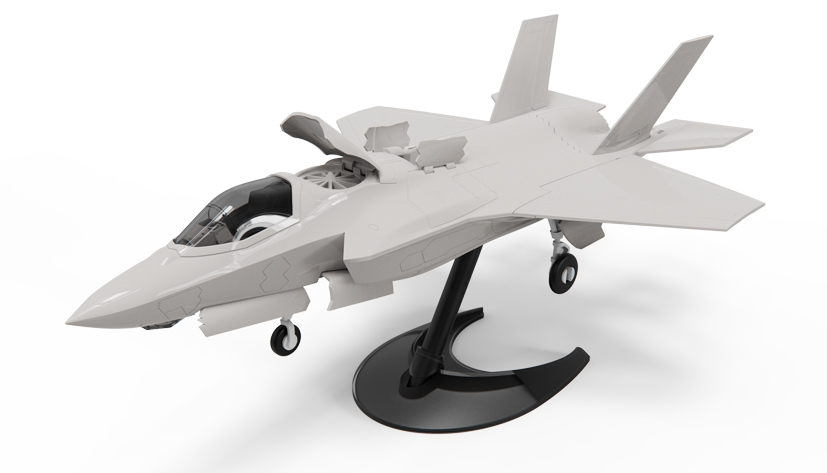
This computer rendered 3D image taken from the development of the new Quickbuild F-35B Lightning II shows how impressive this new model is, a new kit which is surely destined to become one of the most popular in the entire Airfix range
During almost five years of producing our Workbench blog, we have been in the privileged position to showcase the unique talents of the Airfix design and development team on many previous occasions, with these articles always proving extremely popular with our readers who like nothing more than being able to put a name to the latest model projects. From a production and editing perspective, it has been particularly rewarding to feature the young design professionals who are new to the team and just embarking on their Airfix careers and to see how they fearlessly step into some very big modelling hobby shoes.
Many of us mere modelling mortals have probably thought many times over the years that a job with Airfix would be right up their street and an ideal way to combine their beloved hobby with paid employment, but having read our blog development articles and discovered the specialist skillset of our small, but highly talented team, have no doubt decided that it is better if we leave this work to the experts. Having said that, Airfix are obviously always on the lookout for new design talent and we are delighted to introduce Workbench readers to the latest member of the team and the current new tooling project he is working on.
Another product design graduate from Loughborough University, an institution which has proved a fertile hunting ground for Airfix over the years, Adam French only joined the design team last November, so is definitely still the newby of the group. Following his graduation, he originally accepted a position with a firm of architects, but realised quite quickly that he wanted to work on design projects similar to those he had trained on during his time at University. When he became aware of a design vacancy with Airfix, he knew this was the career for him and immediately applied for the position, hoping that he would have a chance to show what he had to offer. Adam must have impressed, as it was not long before he was informed he had been successful and that he was now the latest member of the small, but uniquely talented team of Airfix designers.
We have previously expressed the opinion that this new breed of young designers are really quite impressive human beings, individuals who don’t appear to have any trepidation about embarking on what is quite a high profile and highly specialised career and in this regard, Adam is certainly no exception. Having accepted the job, he just had the small matter of re-locating to Kent from his home in Cheshire to negotiate, a home he would be sharing with several people he had never previously met and all in the run up to Christmas. This would surely phase most of us, however, all Adam could focus on was how excited he was to now be part of the Airfix team.
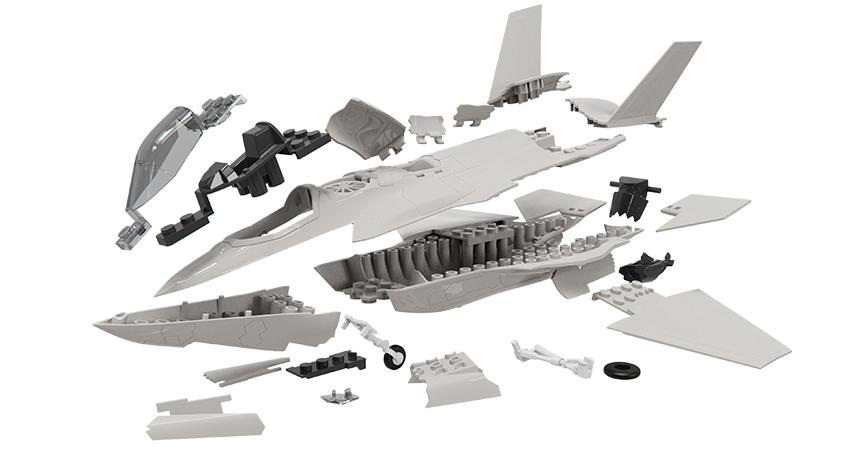
Although Adam will undoubtedly be getting involved in a multitude of future Airfix design projects, initially, his main focus of attention will be the popular Quickbuild range, developing and coordinating several new project at an exciting time in the history of this range, with his first project being a new F-35B Lightning II tooling. When he took over this project, although the tooling design had been started, it had not been finalised and Adam had the opportunity to discuss everything with one of the most experienced members of the Airfix team, in addition to picking the brains of his new colleagues. We have already seen how the design of a Quickbuild kit can, in many ways, be more challenging than working on a traditional Airfix kit. The designer will need to produce a model kit which faithfully recreates the exterior appearance of the RAF’s latest multi-role stealth jet, whilst at the same time engineering it to be deconstructed into individual parts which go together in a simple, logical manner. All this will have to be achieved without the need for glue or paint.
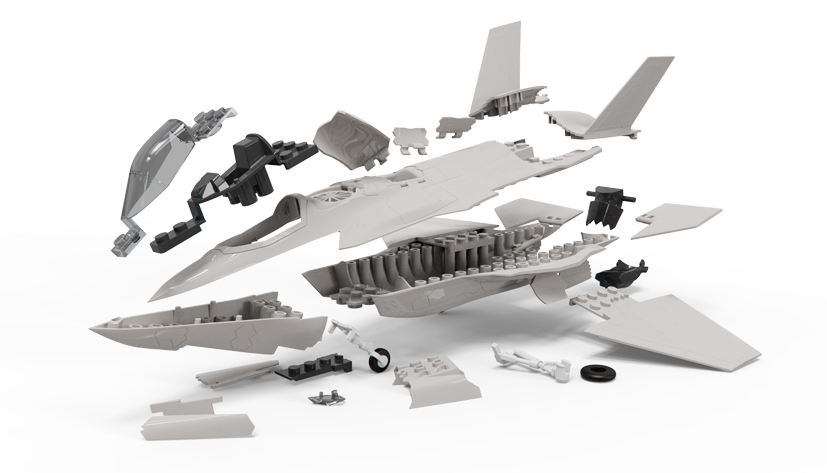
These ‘exploded view’ images of new model tooling projects have proved extremely popular with Workbench readers and not only show what Quickbuild fans all have to look forward to, but also how the model’s designer decided to split the kit into its separate components
With these models intended for a younger, rather unforgiving audience, they have to be robust enough to withstand being played with once they are built, only for them to be taken apart again and the entire process repeated time and time again. Importantly, youngsters will not want the assembled model to look like a toy, they will want it to look similar to the models in their dad’s display cabinet, the ones they are not usually allowed to touch. Above all, Quickbuild model kits are all about fun and this demanding design brief will challenge even the most experienced Airfix designer.
Once the first phase of design work has been completed on a new Quickbuild project, the designer will arrange for a 3D printed SLA prototype model to be produced and whilst this will obviously be made of a different material to the final model kit, it still has a valuable part to play in the overall shape accuracy of the new kit. With most of the design complete, there comes a stage in this process where it has to be released for tooling production, whilst still retaining some flexibility to make some minor changes to the tooling design if required. The moulds themselves are extremely complicated and incorporate additional side actions needed to create the unique parts for a Quickbuild kit, which means that tooling costs associated with these models can actually be much more expensive than other Airfix kits. This is mainly due to the fact that each Quickbuild kit may require four or five separate moulds, with different coloured parts all requiring a tooling mould of their own.
When Adam receives the first test components from the new model tooling, he knows this will be a time of feverish activity. Assessing every aspect of its construction, many small design changes may need to be incorporated, specifically around the fit and rigidity of the model assembly itself. Any areas of the build which don’t appear to assemble as robustly as intended may have to be re-designed, either by altering the placement of the pins (the little locating studs moulded into the parts), or actually re-designing the construction layout of the model. Usually, the vast experience of the designers within the Airfix team dictates than any new Quickbuild tooling is between 85 and 90 percent accurate at first components stage, but this still leaves quite a lot of work to do before the model can be released for production.
This new F-35B Lightning II Quickbuild is destined to become one of the most popular models in the entire Airfix range, particularly as it is represents of one of the latest and most dynamic aircraft to enter Royal Air Force service. A stealthy, multi-role fighter and attack aircraft, the F-35 Lightning II is packed full of the latest cutting edge aviation technology and takes its place as one of the most advanced aircraft in the world. The UK has initially committed to purchasing 138 of these highly advanced fifth generation combat aircraft, a purchase which will enable the RAF to maintain its position as one of the world’s most capable air forces.
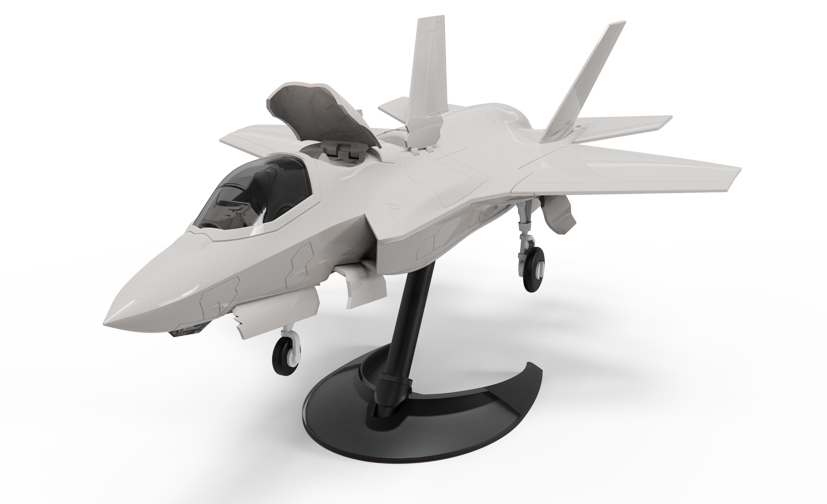
Selecting the short take-off and vertical landing (STOVL) variant of the F-35, these aircraft will have the ability to operate from standard airfields, or from the decks of Britain’s two new Queen Elizabeth class aircraft carriers. The RAF’s F-35 will actually be the THIRD aircraft to carry the name Lightning whilst in British service, after the previous P-38 of WWII and the English Electric fighter of the Cold War era.
Further enhancing the appeal of this latest Quickbuild model, the new F-35 features innovation which has not appeared on earlier designs, such as the ability to display it either in flight or in landing configuration and including several moving part options. The distinctive swivelling engine nozzle which allows the F-35B to hover is represented, as are the opening auxiliary doors on the spine of the aircraft which reveal the unique and hugely powerful lift fan inside. Although it might seem on the surface that these new hinged parts would not be too difficult to incorporate into the model’s design, Adam said that this actually proved to be quite challenging, especially when considering the rather enthusiastic audience this tactile product is intended to appeal to.
With the RAF’s F-35B Lightning II destined to be thrilling British Airshow crowds for many years to come, youngsters who will have just seen this magnificent aircraft hovering on a column of hot air in front of them, or blasting around the sky with full afterburner engaged, will probably immediately ask their parents for a model of it and that is where this new Quickbuild kit will come in. Perhaps more than any other Airfix kit currently in development, Adam’s Quickbuild F-35B Lightning II has the potential to appeal not only to existing Airfix fans, but those who have yet to experience the thrill of building their first kit, even if they are not going to need either glue or paint in this initial endeavour.
We would like to thank Adam for supplying the development images used to illustrate this feature and for spending the time discussing his first Airfix design project with us. More importantly, on behalf of our readers, we would like to extend a warm Workbench welcome him. We very much look forward to featuring more of his work in future editions of the blog.
Over the previous few editions of Workbench, several of our popular 1/48th scale model kits have featured quite heavily within the blogs, particularly as re-issues of both our Hurricane Mk.1 and Spitfire Mk.1a kits were included in the current Airfix range specifically to mark this year’s 80th Anniversary of the Battle of Britain. As both these fantastic kits have now been released and are selling faster than a Spitfire ‘Scrambled’ to intercept a Luftwaffe raid, it is time to move on to another classic re-issue in this slightly larger scale, but one which this time is a scale representation of an aircraft which was described as the RAF’s post war 'Pocket Rocket' – the Folland Gnat.
Although 1/72nd scale kits remain the dominant force in any Airfix model range, the slightly larger 1/48th scale range has definitely been finding favour with modellers over recent years and has consequently been the recipient of significant new tooling investment. Allowing both our designers, and the modeller to incorporate greater levels of detail and accuracy into their kits and build projects respectively, there can be no doubting that finished models in this scale have much more presence within any model display and particularly when the subject modelled is a WWII fighter - this scale really does lend itself to replicating the power and majesty of these mighty piston engined monsters.
From a classic British jet perspective, it could be argued that the Folland Gnat T.1 trainer is a perfect subject to be modelled in 1/48th scale, an aircraft which was relatively small for a two seat trainer, but one which possesses beautifully clean lines and went on to become one of the most famous jets in the world, during the 14 years it was the mount of the RAF Aerobatic Team, the Red Arrows. The new(ish) Airfix 1/48th scale Folland Gnat T.1 tooling was used to produce its first release in 2014 and since that date, has become an incredibly popular addition to any range in which it appeared. To the delight of many, this excellent tooling has been included in the 2020 range and we are pleased to look at this impending release in a little more detail now.
The diminutive Folland Gnat jet trainer actually began its development as a cost effective, light-weight high performance fighter/ground attack aircraft, one which would potentially not only be of interest to the Royal Air Force, but also to many of the world’s air forces. Despite possessing outstanding flight performance and showing great promise in both the light fighter and ground attack roles, the British Government decided not pursue this line of development and instead requested that the aircraft be developed as an advanced two-seat training aircraft. Such a radical change would result in the new aircraft being significantly different from the original fighter variant configuration, which included a lengthened fuselage to allow the installation of a second seat and a more powerful engine which necessitated further fuselage modifications. A new wing configuration and redesigned tail unit would also feature on this updated training variant of the Gnat.
The first production Gnat T.1 trainers for the Royal Air Force were delivered to the Central Flying School at Little Rissington in early 1962, but it would be No.4 Flying Training School at RAF Valley who would be the major operator of this beautiful aeroplane in its RAF fast jet pilot training role.

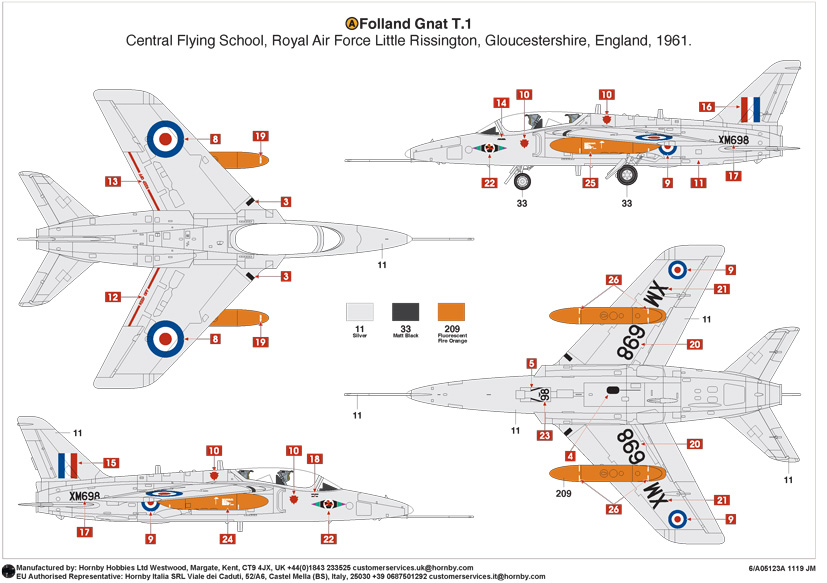
The RAF’s Central Flying School was originally established in May 1912 and was intended as an institution both to train future flight instructors and to test the competency of individual aircrew, whilst at the same time acting as a review body for the training system as a whole. It would go on to produce a constant stream of highly proficient qualified flying instructors throughout both world wars, although the structure of the school would be modified significantly during wartime conditions. CFS instructors would ultimately train thousands of pilots destined for military service all over the world, airmen who would eventually help to secure a hard fought victory for the Allied nations.
The Central Flying School was re-established at the Gloucestershire airfield at Little Rissington in 1946, a location which has since become synonymous with the unit. Interestingly, at the time of its construction, Little Rissington had the distinction of being the highest airfield in the country which was in regular use, being approximately 750 ft above sea level, a position which also made it susceptible to suffering some pretty poor weather conditions over the years. Almost as soon as the CFS arrived, the airfield was effectively cut off from the rest of the country by severe blizzards during the winter of 1946/47 and it would be two days before an intrepid party from Little Rissington made it to the sanctuary of the Old New Inn at Bourton-on-the-water.
The primary role of the CFS at Little Rissington was to provide advanced flying training for qualified military pilots and indeed was the only RAF school engaged in training flying instructors, a role it continued through the transition from piston to jet powered aircraft. The first jets to arrive at the airfield were de Havilland Vampire T.11s, but these were soon joined by the new Jet Provost which was to play such a significant role in the future training of RAF pilots. The first course of Qualified Flying Instructors to successfully graduate from a Jet Provost programme left the CFS for training postings in November 1959.
Taking RAF jet training to a new level of both speed and capability, the first production Folland Gnat T.1 trainers arrived at Little Rissington in 1962, with the first aircraft resplendent in the striking all silver livery featured above. Gnat XM698 was one of the first airframes to be received by the CFS and with the RAF keen to show off its smart new jet trainer, this aircraft would end up performing duties other than those for which it was originally intended. During the early 1960s, XM698 was displayed for the massive crowds attending the Farnborough Air Show, occupying a spot in the static display with an impressive array of weapons and stores arranged in front of it. Illustrating the offensive potential of this handsome little jet, it must have left onlookers wondering how they could possibly fit all this equipment onto such a tiny aeroplane.
After a long and successful career with the Royal Air Force, early Gnat T.1 XM698 would eventually end its days in America, where it was eventually scrapped.

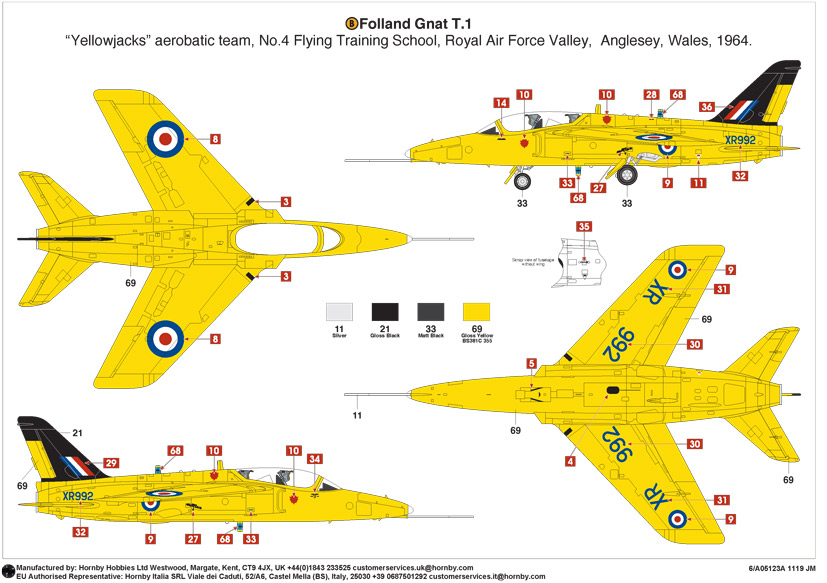
The second scheme option to be included with this latest re-issue of the magnificent 1/48th scale Gnat T.1 kit has to be considered one of the most striking to appear on any post war RAF jet. As the Folland Gnat entered squadron service, the RAF were keen to display the many qualities of their new trainer to the huge audiences at the Farnborough Air Show and a group of instructors at RAF Valley thought they had just the thing. With many RAF stations boasting a solo display aircraft, instructors at No.4 Flying Training School had the idea of forming a display team consisting of five aircraft (two either side of the leader) and as the project began to gain some momentum, it was decided that the aircraft should be painted in an unusual colour scheme. Forming unofficially during 1963, the team began training in the skies above RAF Valley, immediately attracting the attention of the locals.
It is thought that a local reporter had seen the aircraft displaying over the airfield and made an official request to watch the team practicing from the lofty vantage point of Valley’s control tower. This was granted and whilst he was marvelling at the precision flying he was seeing, he overheard the radio communications of the leader calling a break to land – using the team’s callsign, the reporter heard ‘Yellowjacks Break’, something he would later use in his newspaper article. As this seemed to be an entirely appropriate name for the team, it naturally stuck and the ‘Yellowjacks’ were born.
As information about the team began to circulate, the roads around RAF Valley began to fill with locals and holidaymakers desperate to catch a glimpse of this exciting new aerobatic display team and their brightly coloured aircraft on practice days. Indeed, the situation became so serious that the local council had to build a dedicated viewing area to accommodate at least some of the extra visitors, an area which is now used as a car park and meeting point by members of the Valley Aviation Society. The colour itself was extremely popular with enthusiasts, particularly as the jets looked absolutely stunning against a clear blue sky, especially whilst streaming white smoke. It was quickly discovered that the Gnats were much less visible on grey and overcast days, which would be quite a significant problem considering the delights of the good old British weather.
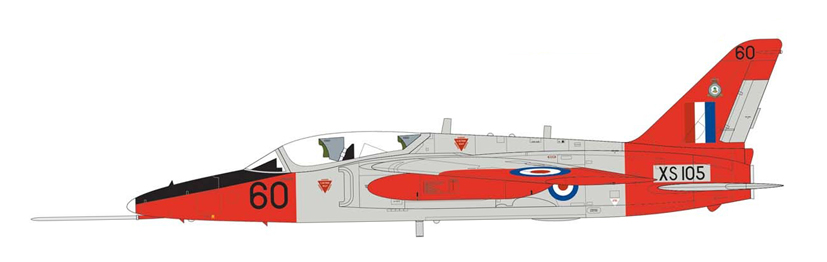
The scheme presented here was only applied to a single Yellowjacks Gnat and was a trial to see if it would make the aircraft more visible during displays in poor weather conditions. The aircraft was flown in all positions within the formation, however, it was thought that results were inconclusive and this was not rolled out across all the jets. It can be seen from the full scheme details that the rudder of the aircraft was left yellow and whilst there are many photographs in existence showing XR992 with its unusual black tail, it is thought that ‘Black Fin’ only flew during practice displays and never appeared during an official public demonstration.
With a number of RAF display teams now on the circuit, service officials were becoming increasingly concerned that individual units were spending too much time on unofficial flying activities, with the sheer number of teams causing some confusion amongst the general public. Wishing to regain some central control, but also wanting to maintain the undoubted public popularity of the ‘Yellowjacks’, the yellow Gnats were ordered down to Little Rissington at the end of the display season, where they would go on to form the nucleus of a new, official RAF Aerobatic Display Team, utilising the undoubted qualities of the Folland Gnat – a team which would go by the name of the Red Arrows.
Folland Gnat T.1 XR992 was one of the former ‘Yellowjacks’ aircraft to be transferred to the Red Arrows, but would later be destroyed in a rather unusual incident. Whilst engaged in a practice display over RAF Kemble in December 1969, the pilot of this Gnat was informed by the tower that his aircraft was on fire, so he immediately ejected from the machine. He landed safely, with the jet crashing some way in the distance, however, it was later discovered that there had been a misidentification and he had ejected unnecessarily – the actual aircraft which had suffered an engine fire was XR995, with this jet also being destroyed following the safe ejection of its pilot. Indeed, 1969 would prove to be a bad year for the Gnats of the Red Arrows, with four aircraft being destroyed during that year, with the team tragically losing one of its pilots.
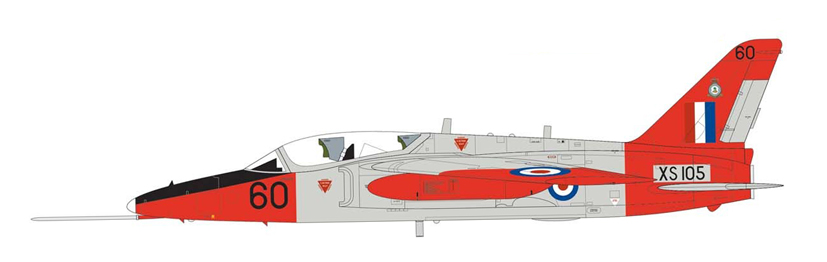
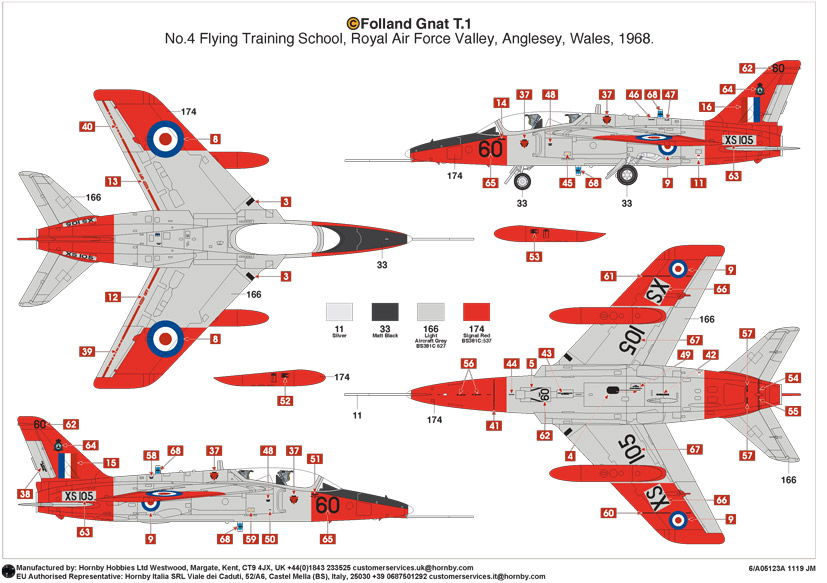
For student pilots taking their first flight in the Folland Gnat, the experience must have been absolutely unforgettable. Having safely negotiated basic flight training in the steady, but rather uninspiring Jet Provost, the Gnat must have seemed like something entirely different – real flying and surely the reason they had joined the RAF in the first place. Regarded as something of a ‘Hot Ship’, the Gnat was a delight to fly, fast and manoeuvrable and the ideal aircraft for future fast jet pilots to gain their first taste of real speed. The rather cramped cockpit must have felt somewhat reassuring for the student, almost as if they had strapped the aircraft on in preparation for their latest flight, however, the diminutive stature of the Gnat also posed some significant problems.
Although it must have been thrilling for the student, in the rear seat, the instructor was having to do his work in an extremely cramped environment, with very poor forward visibility, which must have been quite alarming for during critical phases of flight. It was also quickly discovered that taller pilots found it extremely difficult to fit in the cockpit of the Gnat and even worse than this, if they were forced to eject from the aircraft in an emergency, there was a distinct possibility that they would sustain severe injuries due to the position of the main instrument panel. This clearly could not be allowed and resulted in taller pilots being transferred to other aircraft, such as the Hunter, in order to continue their training.
Although the Gnat was an extremely pretty aeroplane to look at, it must have been an absolute nightmare for ground trades to work on. With all this advanced equipment crammed into such a small airframe and with space at such a premium, a high degree of dexterity must have been prerequisites for engineers at RAF Valley, with contortion being a definite bonus. Despite this, the Gnat proved to be a successful training aeroplane, serving for 16 years with No.4 FTS at RAF Valley, as well as being the high profile mount of both the Yellowjacks and Red Arrows display teams during their service life.
Building into a truly impressive model, the 1/48th scale Folland Gnat T.1 will undoubtedly be a popular build project for thousands of modellers following its release later in the year, even if the three included scheme options will result in a difficult selection having to be made. Whichever scheme you decide to opt for, you can be sure that you will end up with a beautiful scale example of this beautiful little training jet, the RAF’s diminutive ‘Pocket Rocket’.

Continuing our recent look at some of the smaller Airfix kits which are currently proving popular with both committed and novice modellers alike during this unusual period of lockdown, the receipt of some beautiful built model images featuring the 1/72nd scale Hawker Typhoon IB ‘Sharkmouth’ was the only excuse we needed to take another look at this stunning little kit. An aircraft type which proved particularly successful throughout the summer of 1944 and specifically in support of the D-Day landings in Normandy, the Hawker Typhoon is regarded as something of an airborne battering ram and a real brute of a close support aeroplane. In the weeks following the Normandy landings, large numbers of marauding Typhoons filled the skies over northern France ready to pounce on anything which could potentially be used against the Allied invasion forces. Bunkers, artillery emplacements, troop concentrations, rail yards and military vehicles were all to become fair game for the Typhoon and the Wehrmacht quickly learned to fear and respect the RAF’s aggressive Typhoon squadrons.
In the weeks following the D-Day landings, on days when the weather was good enough to allow flying operations, RAF Typhoons provided close air support for the advancing ground units and attempted to effectively prevent German armour from advancing to reinforce action hotspots during daylight hours. If the tanks broke from the cover of the trees and buildings which were shielding them, they immediately attracted the attention of eagle-eyed Typhoon pilots, who had become expert in attacking targets at extremely low altitudes. Although the unguided air to ground rockets the aircraft fired were not actually as effective in operation as you might think, the sheer number of aircraft in the air and the destructive potential they possessed ensured that German armour was far less effective during the battles of Normandy than they might have been.
Despite the deep chin radiator of the Hawker Typhoon perfectly lending itself to the application of some aggressive looking nose artwork, most RAF aircraft and especially Hawker Typhoons, rarely featured anything more than their standard squadron markings. One aircraft which proved to be very much the exception to this rule was Typhoon MP147 (MR-U), an aircraft which featured a fearsome array of painted on teeth and one which must have left an indelible impression on anyone unfortunate enough to be in the general vicinity of one of its ground attack sorties, whether friend or foe. There is no doubt you couldn’t fail but be impressed by the aggressive appearance of this powerful aircraft.
Thought to be the only RAF Typhoon to feature a sharks teeth representation on its radiator, MP417 (which is was reportedly referred to as ‘Sharky’), was issued to RAF No.245 Squadron in August 1944, whilst Allied units were engaged in the savage fighting around the Falaise Pocket and remained with the squadron until it was disbanded on 15th August the following year. Logbook entries show that Sharky was flown by successful Canadian pilot Flt. Lt. Harrison Taylor ‘Moose’ Mossip, who had been awarded the DFC for his previous successes whilst flying the Typhoon with RAF No.1 Squadron.
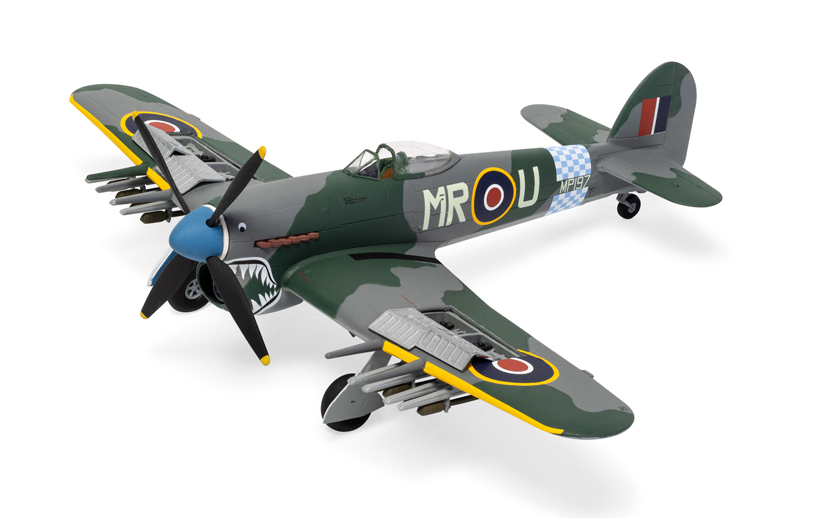
This magnificent series of exclusive build images clearly show why this unusual ‘Shark mouthed’ Hawker Typhoon IB has been such a popular kit since its release late last year. As we all settle in for another week of modelling lockdown, could this little kit be your ideal next build project?
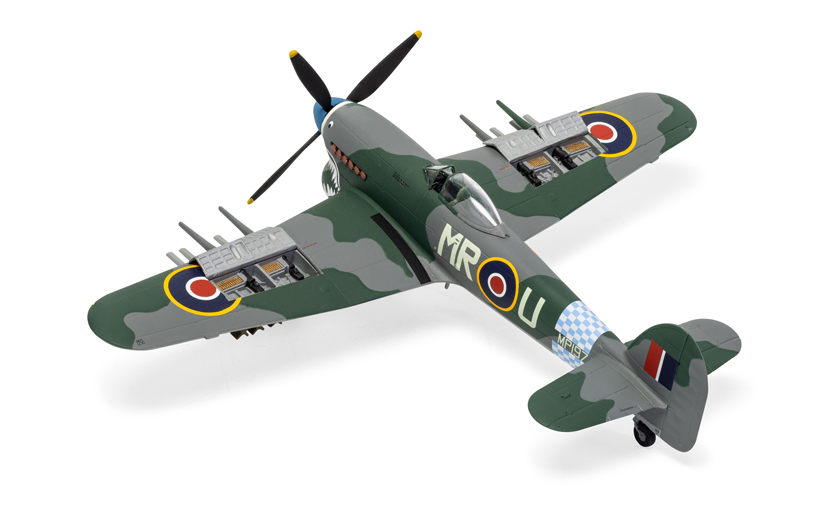
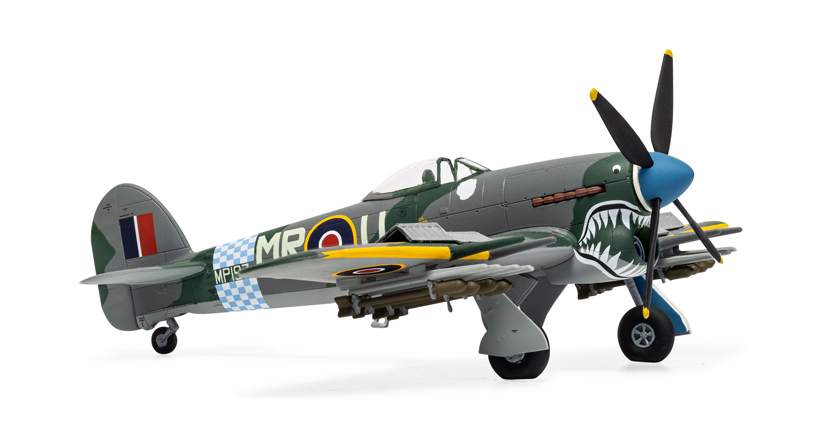

Renowned for possessing a particularly aggressive flying style, Mossip was one of the pilots who helped to earn the fearsome reputation of the Hawker Typhoon in the ground attack role, as he would fearlessly attack anything which he thought could be used to aid the Axis war effort. Like other Typhoon pilots, everything from canal barges to railway locomotives were fair game, with these perilous missions often flown at extremely low altitudes. It was also thought that the shark mouth markings were applied to this aircraft as a result of his tenacious flying style and that Mossip actually flew Sharky in these markings whilst engaged on operations during WWII.
Suffering the tragic fate of so many fellow airmen during WWII, Mossip was killed whilst flying a different Typhoon on 7th March 1945, with his aircraft reportedly striking high tension cables following a low level strafing attack on a train. Sharky would go on to be flown by Squadron Leader Tony Zweigbergk, a pilot of Anglo-Swedish heritage, who hailed from Preston, in Lancashire. Retaining the aircraft’s distinctive chin artwork, the Typhoon also inherited a blue spinner and the blue and white chequered fuselage banding during the summer of 1945, whilst the aircraft was flying sorties with the British Air Forces of Occupation in Germany.
With the disbandment of the squadron, MP417 ended its days at No.83 Group Disbandment Centre at Lasham, where it was eventually struck off charge in November 1945 – the end for what turned out to be the most distinctive Hawker Typhoon to ever see RAF service.
This extremely popular Hawker Typhoon IB kit is still available on the Airfix website, but in limited quantities, although it should also be possible to pick up an example at your usual model supplier.
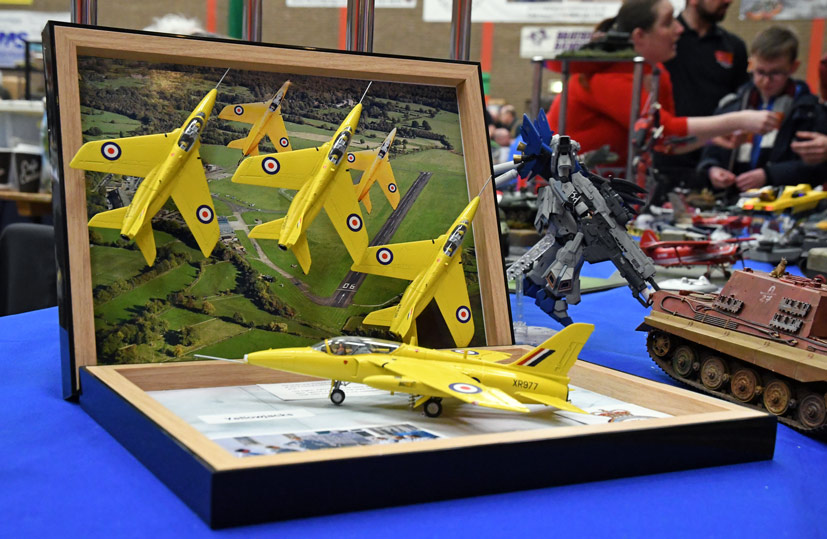
It already seems like such a long time ago that we were able to enjoy the delights of one of the UK’s many model shows and for those of us who attended one of the early season events, we really are counting ourselves extremely fortunate at the moment. Taking place on Sunday 14th February, the Halifax model show was formerly known as the Huddersfield Model Show, however, this extremely popular early season event was forced to find a new venue at short notice last year, with the North Bridge Leisure Centre in Halifax offering to accommodate them. Returning to this same venue for the second year, it is funny how you get attached to the places which host these much-loved events, especially when you are made aware of just how much effort the organisers go to on our behalf to make these events such an enjoyable success. When it would surely have been easier to cancel the 2019 event, the organisers pulled out all the stops to make it happen and the North Bridge Centre provided the support they desperately needed at that time. Let’s hope we will all be paying return visits here for many years to come.
Showcasing the modelling talents of hundreds of enthusiasts, both on the individual displays of model clubs and societies, as well as the hugely impressive competition hall tables, anyone who has attended one of these shows will know that there is so much to see that producing a review to appear in a single blog would be impossible, so we will end this latest edition of Workbench with a small selection of the many modelling highlights we discovered in Halifax.
As we previously featured the 2020 re-issue of the Folland Gnat above, there really was only one place for us to start with this review and that is on the Keighley plastic model club display table and a really imaginative ‘Yellowjacks’ display. Celebrating the unofficial exploits of this distinctive No.4 Flying Training School aerobatic display team, this beautiful display certainly helps us to appreciate why the crowds began to clog the roads around RAF Valley during 1964, once news of this new display team began to circulate. The forerunners of the Red Arrows, these beautiful yellow Gnats were only seen in the skies above the Island of Anglesey for around twelve months, even though their colourful legacy continues to endure to this day.
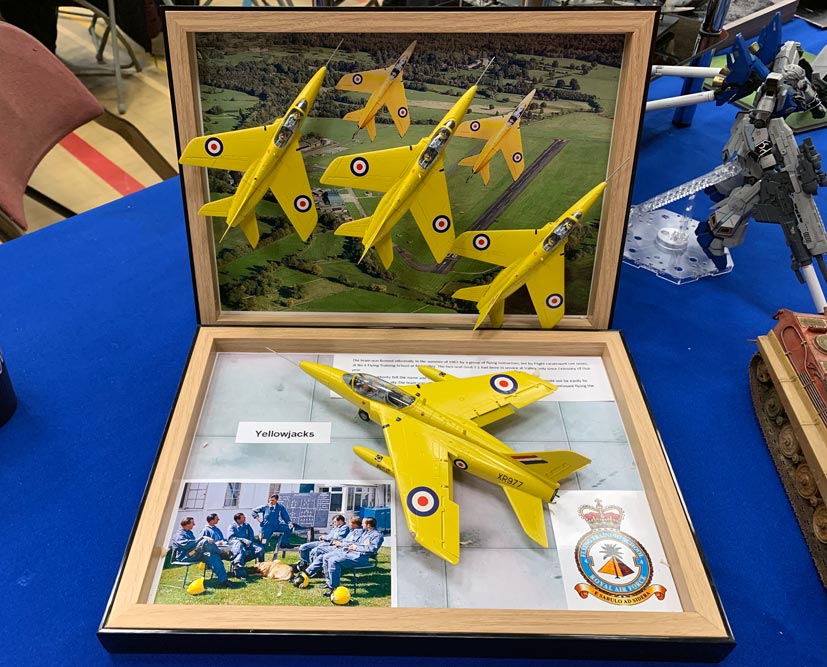
Whilst enjoying the model display on the Keighley stand, team members will usually politely invite you to vote for your favourite model, in what is clearly a keenly contested competition of friendly modelling rivalry amongst its members. With so many fantastic models to choose from, this really can be a difficult task and it is not made any easier by the fact that the team members you have just been speaking to have a vested interest in your selection and are looking on intently.
Two models which certainly caught our attention on the display were representations of a famous WWII military vehicle, but not in the role for which it was originally intended - these colourful 'Ducks' would embark on new careers following the end of the conflict. Without doubt, the ingenious amphibious vehicles developed during WWII allowed the Allies a degree of armoured flexibility which was simply not available to Axis forces and offered the crucial ability to move men and equipment quickly and efficiently to and from the landing beachheads.

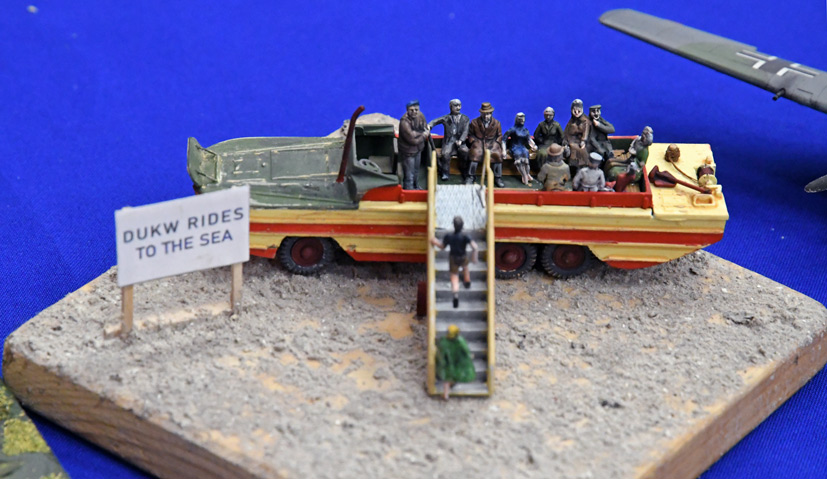
Even though the six-wheel drive DUKW amphibious truck may have appeared somewhat ungainly and is often incorrectly dismissed as something of a military vehicle folly, this opinion could not be further from the truth. In addition to possessing a surprising level of general seaworthiness, the DUWK had exceptional on-road performance and would prove to be one of the most useful Allied vehicles following the successful D-Day landings. It was described colloquially as being ‘better in the water than any truck, in addition to beating any boat on the highway’.
Many of these distinctive vehicles would go on to become familiar sights with sun seekers all over the British Isles, either offering the unusual opportunity of taking both a drive and short sea cruise in a former WWII military vehicle, or performing a much more serious role as a seaborne life saver. Two of the models attracting votes on the Keighley display stand were examples of post war representations of the DUKW, with the imaginative nature of their construction and display receiving plenty of attention during the show.
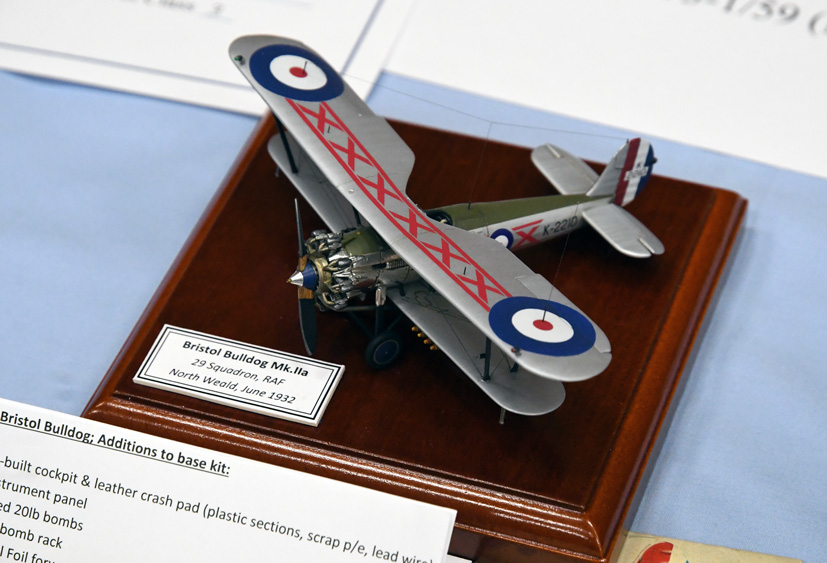
The final model we are including in this feature is an absolutely stunning representation of a classic Airfix kit. The handsome Bristol Bulldog fighter was without doubt one of the most important RAF aircraft of the inter-war period. Introduced in 1929, the strong and manoeuvrable Bulldog was Britain’s main front line single seat fighter at a time when aviation was all about style and grace and was flown by the nations most talented young airmen. One of these young pilots was Douglas Bader, a gifted airman with a flair for aerobatics but possessing something of a daredevil reputation. Whilst performing unauthorised low level aerobatics in his Bulldog fighter, the wing of his aircraft clipped the ground sending it tumbling across the airfield.
Bader was seriously injured and only survived thanks to the expertise of the surgeons at the Royal Berkshire Hospital. Suffering a double amputation of his shattered legs, the story of Bader’s recovery and subsequent struggle to re-join the Royal Air Force would prove inspirational to many and made him a national hero, as well as one of the most famous fighter pilots of the Second World War. By the time he was flying Spitfires from Duxford airfield, the Bristol Bulldog had long since been withdrawn from front line service, with just a few examples soldiering on in a secondary training role. Only two of these beautiful aircraft are known to have survived to this day.
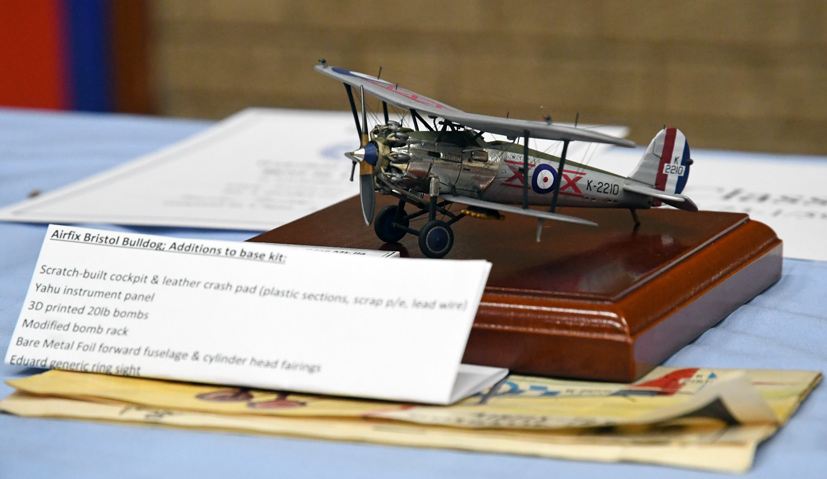
Using the classic Airfix kit, the beautiful Bristol Bulldog build featured above was entered in the model competition at the Halifax show and was finished to a truly astonishing standard, displaying levels of modelling skill which impressed everyone who was lucky enough to see it. This was a truly one spectacular little model build.
Although we would all probably struggle to finish our own model build to this incredible standard, this classic model is scheduled to be available once more as part of our popular Vintage Classics range a little later in the year and if we needed any build inspiration, the pictures above will certainly provide it.
We are afraid that’s all we have for you in this latest edition of Workbench, however, we will be back as usual in two weeks’ time with a further selection of Airfix modelling delights for your enjoyment. If you have any suggestions for subjects you would like to see covered in a future edition, please use this workbench@airfix.com link to contact us.
In between new editions of our blog, the Airfix conversation continues over on our Airfix Forum Worbench thread, with further discussions taking place on both the official Airfix Facebook page and the Airfix Twitter channel - please do get involved in the discussions and let us know what you think about Workbench.
Whenever you decide to visit, the Airfix website is always the place to be for all the latest model availability information, previous editions of our blog, a selection of modelling tips and much more.
The next edition of Workbench is due to be published on Friday 15th May, when we will have more interesting features from the world of modelling.
On behalf of the entire Workbench team, thank you for your continued support our Airfix blog.
The Airfix Workbench Team
© Hornby Hobbies Ltd. All rights reserved.