
Welcome to this latest edition of our Workbench blog and all the news, updates, and modelling exclusives from the fascinating world of Airfix.
As the Airfix team have been working hard on preparing the 2026 Airfix catalogue over the previous few weeks and the heady modelling nostalgia this always invokes, it could hardly be more appropriate that this week’s edition of Workbench see’s us returning to the world of Vintage Classics, and the latest addition to this popular range. Indeed, we don’t just have a single kit subject for your delectation this time around, we have two closely related models which many modellers regard as some of the most appealing to have ever graced the Airfix range, in a case of double Vintage Classics trouble.
The one thing each Airfix kit range has always been able to boast is the sheer variety of subjects available in scale model form, everything from famous fighter aircraft of the Second World War to dinosaurs and historical figures, and all types of craft in-between. An incredibly popular sub-range of kits over the years have been scale ships, from historic galleons to lifeboats, but also including some of the most powerful warships to have ever sailed the world’s oceans. Making for incredibly impressive built model displays, it may have been a while since we’ve seen a new tooling addition to this line up of kits, but we do still have many classics to tempt us.
This latest update features two fast attack craft from the Second World War, stunning model representations of impressive coastal attack craft which were intended to create havoc in coastal waters, one British and one German. With classic box artwork and a selection of built model images to share, we’re unquestionably in the realm of classic Airfix kits in this week’s edition of Workbench.
You’re going to be needing your sea legs this weekend, as we’re on a mission with the sea dragons of the Second World War.
Used for illustrative purposes only, the world’s largest Battleships were surely some of the most impressive machines ever created by man.
When we think about naval power and the ability to rule the world’s oceans, we usually think of massive battleships equipped with main guns capable of hurling huge shells over great distances, distances which made them almost impervious to enemy attack. For British people, the world’s oceans have always been an important part of our history, with ships and the Royal Navy shaping our heritage for centuries, and how seafaring personalities and their vessels used to be a major feature of our school history lessons.
As Britain’s empire grew, so did its reliance on the Royal Navy and how they increased in both size and capability in order to prevent any other nation from challenging their position. Massive warships joined the line to underline the Royal Navy’s rule over their dominion on the waves, with such craft as HMS Dreadnought, HMS Conqueror, HMS King George V and HMS Hood all serving to inspire and enthral, whilst at the same time striking fear into the hearts of other naval powers.
Other navies didn’t neglect their own forces during these times, with such vessels as Bismarck and Tirpitz, the US Iowa Class ships and the mighty Yamato all matching and even eclipsing the capabilities of the latest Royal Navy ships, as this floating international arms race reached its zenith just prior to the start of the Second World War, but was bigger always better when it came to battleships? True, if it was a ship versus ship engagement, the fastest, most manoeuvrable vessel with the heaviest firepower and most proficient range finding and targeting technology would probably win the day and would be quite the engagement to read about in history books, but there are always more than one way to approach any problem, even if that problem is made up of 50,000 tons of steel.
The finest naval minds across the world had been having their doubts about the invincibility of huge battleships for some time, and how there might be some really cost effective ways with which to challenge their perceived dominance. Submarines were an obvious threat to battleships, as were fast attack craft, something we will focus on a little later, but across the world, another type of weapon was posing the greatest threat to the future of the battleship, the aeroplane.
A model in striking fast, striking hard. The manoeuvrable German E-Boats were some of the fastest warcraft on the seas and posed a significant threat to British shipping.
In America, Major General William ‘Billy’ Mitchell earned a reputation as a great champion of air power, becoming a significant figure in the history of the United States Air Force. As an airman serving on the Western Front during the Great War, Mitchell had witnessed the rise of aviation and the capabilities of the aeroplane first hand, experiences which convinced him that the aeroplane would be playing a significant role in any future conflict.
This strong conviction brought him into some conflict with senior officials in both the US Army and US Navy, as he vociferously argued against continued military spending on expensive battleships, particularly as air power had now rendered them almost obsolete in his opinion. To evidence his argument, he famously arranged for a series of dramatic demonstrations to take place, where bomber aircraft attacked obsolete warships to prove the vulnerability of these floating leviathans to attack from the air. Even though he was using a collection of relatively basic aircraft for the demonstration, along with a static target, the results could hardly have been more impactful and provided real food for thought for the US military.
He followed this successful demonstration by continuing his argument that all investment currently earmarked for new battleship production should instead be immediately diverted to the creation of a powerful new aircraft carrier fleet. History has since judged Mitchell something of a visionary figure in this regard.
The dominance of air power over battleships also revealed itself during the early stages of the Second World War, when a development in the Mediterranean region left Britain in a particularly vulnerable position.
The Royal Navy had long regarded smaller, fast attack boats as a vital component in their coastal armoury.
Following Italy’s declaration of war against Britain on 10th June 1940, Britain had been thrust into a dangerous new phase of the war. With the powerful Italian Navy posing a huge threat to British forces across the Mediterranean, something had to be done, and the wheels of action were set in motion. ‘Operation Judgement’ called for Fleet Air Arm Fairey Swordfish aircraft to attack the Italian Fleet moored in Taranto Harbour and score a decisive victory against them, but could a formation of ageing biplane strike aircraft take on one of the most powerful naval fleets in the world? On the night of 11th/12th November 1940, a first attack wave of 12 Swordfish took off from HMS Illustrious with a flight time of about 2 hrs 20 min ahead of them at a cruising speed of around 80mph.
The attack was successful and for the loss of just two aircraft, the mighty Italian battle fleet had been mauled, buying British forces valuable time and highlighting to the Italians that their ships would never be safe from attack again, and how every movement would have to be covered by powerful protective forces.
Relying on the skill, courage and determination of a relatively small number of Naval airmen and their support crews, the raid showed that powerful warships were no match for air power, and how the aircraft carrier and its aircraft would now rule the waves. This successful raid was studied closely by Japanese naval commanders in advance of their infamous raid against Pearl Harbor the following year, even though that raid was significantly more powerful in terms of both the number of aircraft used, and the aircraft carriers which launched them.
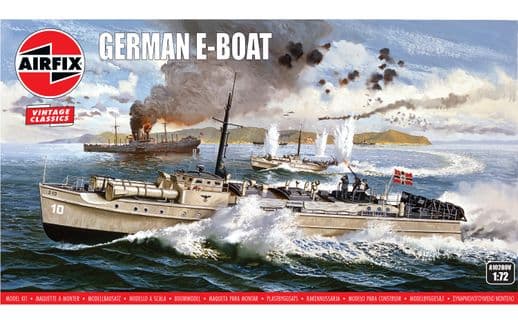
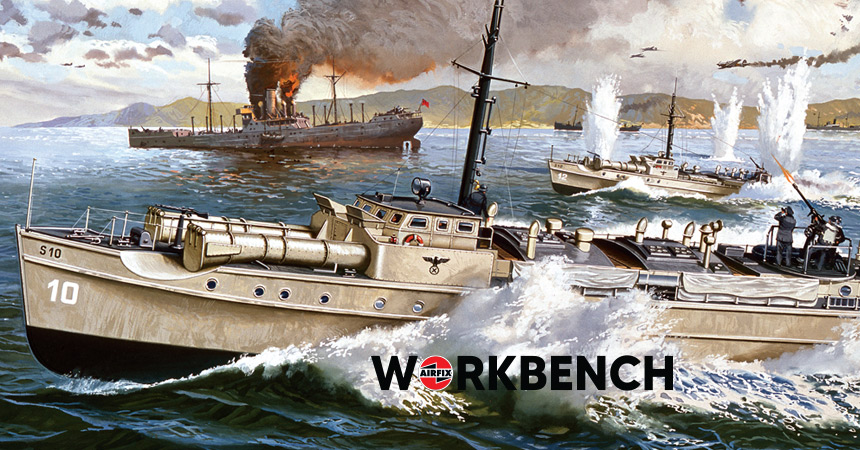
Stunning box artwork for a classic Airfix model. Ken McDonough created this artwork which saw many a modeller entering the world of ship modelling for the first time.
Just as the Fairey Swordfish strike aircraft of the Fleet Air Arm had proved that even the most powerful capital ships were no match for a determined aircraft strike and how an aircraft costing £4,500 could cripple a capital ship which had cost several million to construct. These vulnerabilities had not been lost on naval strategists, who saw the possibility of unleashing fast attack vessels against large enemy ships, especially when they were steaming through coastal waters, or relatively close to land. Just as was the case with the Swordfish at Taranto, these vessels were relatively cheap to produce, and large numbers could be deployed to mount potentially devastating attacks against enemy shipping.
The idea of fast, agile attack vessels was actually not a new one, and was first trialled during the late 19th century. It was thought that a fleet of such craft would be able to infiltrate and break up large formations of enemy warships, disrupting their effectiveness and making it easier for their own ships to pick them off. These vessels were revived as Coastal Motorboats at the start of the Great War, and further developed during the 1930s, when a new breed of fast, agile motor torpedo and motor gun boats were developed, vessels which were intended to rule the coastal waterways of both Britain and Germany.
As capable as these craft undoubtedly were, in the world of armed conflict, no weapon was perfect and every machine had its strengths and military weaknesses, with these fast attack craft being no different. Despite possessing the potential to wreak havoc amongst warships of all sizes and categories if they were able to get close, their great speed and impressive endurance usually dictated that they were relatively lightly armed, and if struck by a shell from a larger vessel, were unlikely to survive the experience.
The Vosper M.T.B was designed to create havoc amongst enemy shipping, using their speed and manoeuvrability to evade enemy defensive fire.
In addition to this, naval forces had been aware of this threat for many a year, and had developed a new breed of fast and agile destroyers intended to deal with the threat posed by fast attack craft, almost matching them for speed, but massively out-gunning them when it came to firepower. In addition to this, as motor torpedo/gun boats would usually be operating relatively close to shore, they were equally vulnerable to attack from the air, so they certainly wouldn’t have everything in their favour when it came to a strike engagement.
It also has to be considered that the movement of any large capital ship would normally require the support of cruisers and several destroyers, in an attempt to protect them from surface ship and submarine attack, and as the war progressed, air support was absolutely vital for the protection of any major warship asset. This was particularly important when either approaching or leaving port, but in most cases, they could expect regular visits from enemy bombers and torpedo strike aircraft for the duration of their stay.
With that being the case, despite these leviathans of the sea being some of the most impressive and awe-inspiring craft ever created by man, they made for incredibly tempting targets, and by the early stages of WWII, it was clear that the day of the Battleship had passed.
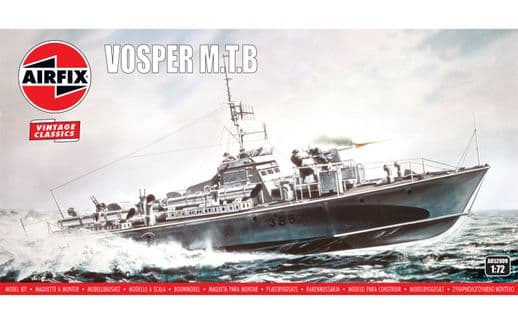
More classic Airfix box artwork, this time from the brush of Roy Cross, the man who launched millions into this hobby.
As impressive as the 1/600th scale warship kit series undoubtedly was, Airfix had something much more interesting in mind when looking to introduce the first of their fast attack craft kits in the early 1970s. With speed and manoeuvrability being the major operational attributes of these vessels, they were clearly much smaller in size than the vessels they were usually sent to attack, so whether targeting a warship or an enemy merchant vessel, they would be relatively diminutive in comparison.
If these new kits had been produced in the same scale as the existing warship models in the range, it may have provided an interesting scale size comparison opportunity, but it might have come as something of a disappointment as a build project. Designing the kits in 1/72nd scale however, proved to be something of a masterstroke, and resulted in the creation of a small series of models which have always been regarded as some of the most visually appealing models ever released by Airfix, models which make for truly impressive display pieces.
This year, we’ve already welcomed the 1/72nd scale British Power Boat Company Type Two ‘Whaleback’ Air Sea Rescue Launch kit into the Vintage Classics range to popular modeller acclaim, and now, we’re delighted to confirm that this beautiful kit has company, with both the aggressive looking Vosper Motor Torpedo Boat, and elegant looking German E-Boat also now taking their places within the Vintage Classics range. The Vosper was first released back in 1972 and featured the impressive box artwork talents of Roy Cross, a man who had more than a hand in encouraging many thousands of youngsters into taking their first steps in this hobby. The artwork also does a good job in highlighting how these fast attack craft may have been quite the performers, but how they can’t have been much fun to be on if operating in rough seas.
Although from the same family of kits, the ‘Whaleback’ Air Sea Rescue Launch didn’t hang about when making its Vintage Classics introduction, and is now sadly unavailable via the Airfix website.
This kit was joined by the even more impressive German E-Boat three years later, a long and slender attack craft which this time called upon the skills of the equally talented Ken McDonough for its box artwork. Back in those days, the enjoyment police hadn’t managed to get their claws into our beloved Airfix box artwork, and back then, we could enjoy explosions, fire, shot down aircraft and sinking ships, the very images which probably encouraged us to take up the hobby in the first place. Back then, we genuinely didn’t think about the wider implications of conflict and any human cost, we were just so fascinated by the machines we wanted the models and the exciting images used to market them – did we all turn out so bad after having access to these images?
Anyway, these were incredibly impressive new kits and for those of us with a few years invested in the hobby, with our skills increasing with every build, we could turn these into spectacular display pieces, fine representations of the vessels contesting the coastal sea-lanes of northern Europe during the Second World War. For those of us who were still getting glue on our canopies and failing to get our propellers to spin, we had to wait for our dads, grandads and big brothers to finish these kits for us, and even though they made them to much higher standards than we could have ourselves, where was the modelling fun in that?
Anyway, whether we have build memories of time spent with each of these kits, or simply remember admiring finished examples of them produced by someone else, both kits are now in stock and available as the latest additions to the Vintage Classics range, enabling us all to renew our acquaintances with them.
A05280V – Vosper Motor Torpedo Boat, Royal Navy, 1944.
Despite having one of the strongest navies in the world, the Royal Navy knew they needed a fleet of high-speed fighting ships both to challenge enemy warships and to take a heavy toll of enemy merchant vessels. Mainly relying on stealth, speed and manoeuvrability, the Vosper company had been designing such craft since the early 1930s, with the Vosper 73ft Motor Torpedo Boat being a later development of those earlier vessels. Powered by three Packard engines, the Vosper was capable of speeds over 40 knots and in this variant, featured four 18-inch deck mounted torpedo tubes, and Oerlikon 20mm cannon and up to four Vickers machine guns.
These were the smallest and fastest of the craft operated by the Royal Navy during the Second World War, and were a later development of similar attack boats already in service at the start of the war. This particular variant featured the installation of four deck mounted torpedo tubes, along with an array of deck mounted guns for protection against air attack and when engaged in close quarters actions.
These kits build into some of the most impressive models to ever grace the Airfix range, and we’re pleased they were able to take their place within the Vintage Classics range.
A Vosper crew’s usual method of attack would be to make a stealthy approach to a target area under the cover of darkness, before lying in wait for their assigned target with engines stopped, lurking in the shadows with the ship’s 13 man crew poised to strike. The attack itself would see the vessel approaching on just auxiliary power to maintain their concealment, only firing up the main engines to make a speedy getaway once torpedoes had left their firing tubes.
It's thought that actions such as these probably accounted for around 300 enemy vessels during the relatively short service period this variant of Vosper attack boat was in service. These vessels were also pressed into service laying sea mines, and for the delivery and extraction of agents and SOE operatives and Commandos right along the coastline of enemy occupied northern Europe. In a similar way to how the ‘Spy Taxi’ Lysanders of the Royal Air Force played a crucial role in the lead up to D-Day, so these Vospers engaged in clandestine operations to hasten the defeat of Germany.
A10280V – E-Boat (S6-S13), Kriegsmarine, English Channel, 1940.
Restricted by the terms of the Treaty of Versailles, the German Kriegsmarine exploited a loophole in designing a fleet of fast, wooden hulled attack craft they referred to as Schnellboots. Expertly designed, these vessels were perfected over time and by the outbreak of WWII, they had become a devastatingly effective part of Germany’s naval strength. Powered by three diesel engines and featuring a triple rudder arrangement, Germany’s E Boats were some of the fastest warships in the world and with their low profile, high manoeuvrability and torpedo armament, if they penetrated any Allied convoy, they could destroy several vessels and make good their escape before coming under return fire.
Schnellboot, or fast attack boat was the Germen term given to a series of high speed torpedo boats operated by the Kriegsmarine during the Second World War. Referred to a E-boats, short for Enemy Boats in Britain, these powerful craft were heavily armed and possessed much greater seagoing capabilities than their British counterparts, particularly during the early stages of WWII.
The Germans deployed their S-Boats to Poland following their attack against the country and used this time to perfect their attack techniques by targeting Polish shipping in the Baltic Sea. These operations quickly indicated that the greatest chance of a successful attack came if that attack was made under the cover of darkness, and to have boats painted in a scheme which helped to make them less visible under those conditions.
When Germany launched their Western offensive against France and the Low Countries, their Schnellboots clashed with British shipping for the first time, once again showing themselves to be a serious threat to Allied shipping in the English Channel. Despite that threat, actual successes proved to be relatively modest, as the Royal Navy made it something of a priority to prevent the E-Boat force from wreaking the havoc it held the potential of doing.
Sometimes, a picture says more than a thousand words could ever do!
Incredibly effective vessels, these Schnellboots were also given a mine laying capability, however, despite being ordered in large numbers, like so many other piece of German military equipment, they were proving costly and time consuming to produce, resulting in deliveries to operational units being at something of a pedestrian pace, meaning that few operations saw these units operating at anything like squadron strength, something which was perhaps just as well for the British.
This model is a representation of an early series Schnellboot, one which was powered by three 1,320 HP Daimler Benz 16 cylinder diesel engines, which made this a very speedy machine indeed. Offensive weaponry consisted of four torpedoes, a 20mm anti-aircraft gun and a selection of lighter deck mounted machine guns, and they could speed along at approaching 37 knots, capable of operating in much heavier seas than their British counterparts. It is also from the S6-S13 boat production series, which came in at a slightly heavier 78 tons.
Taking just one of those finish options as our subject for further attention, Schnellboot S-13 was launched on 29th March 1935 by the Friedrich Lürssen Works at Bremen-Vegesack, and subsequently allocated to the 1st Schnellboot Flotilla. Seeing extensive service in a training role for crews destined to serve in one of the attack boat squadrons, S-13 was already considered ‘tired’ at the start of WWII, but was still committed to action nonetheless, due to the slow rate at which newly constructed ships were arriving with operational units.
A final selection of more detailed built model images of the fabulous German E-Boat kit.
She was used in actions against British shipping in the English Channel and off the coast of East Anglia, and was reported to have been used in the destruction of an Allied submarine off the coast of France at the end of May 1940, even though the French submarine in question actually made it back safely to a British port.
In June 1942, S-13 was withdrawn from direct offensive actions and sent to serve as a submarine hunter in Norwegian waters. She would be involved in a tragic accident whilst moored in port at Bergen in March 1945, when a drunken sailor returning to his boat inadvertently launched one of the ship’s torpedoes, which slammed into a Norwegian steamer, resulting in its sinking. The incident claimed the life of the sailor onboard, who had been undertaking watch duties, and didn’t leave his post.
Following the end of the war, S-13 was handed to British forces as a war prize, but on arriving back in the UK was discovered to be in such poor condition that she was immediately sold for scrap. There is one surviving original German S-Boat in existence, with S-130 currently in the midst of an ongoing restoration prospect which will hopefully see it returning to seaworthy condition – now wouldn’t that be a sight!
This German E-Boat kit and the Vosper MTB released with it, build into really appealing models, and are certainly welcome additions to the growing Vintage Classics range. With the previously released RAF Rescue Launch in the same scale having already sold out, we don’t think this pairing will be too far behind it, so if 1/72nd scale fast attack craft from the Second World War are your thing, now might be the time to strike.
You know what they always say – there’s no point taking all those amassed Hobby Reward points into a new year, get them spent! Well, we’re sure someone might have said that at some point, even if it was just around the Airfix office.
Both the German E-Boat and Vosper M.T.B kits are in stock and available now.
We're afraid that's all we have for you in this latest edition of the Airfix blog, but we will be back next Friday with more project development updates and the very latest Airfix kit exclusives. In the meantime, we're always keen to hear your views on all things Airfix and in particular, any thoughts and opinions you may have regarding our Workbench blog. If you would like to drop us a quick line, could we please ask that you use our workbench@airfix.com email for all correspondence.
To re-visit any of the Airfix blogs we have produced over the past TEN years or so, please head to our main Workbench hub, where you'll find our entire blog back catalogue and all the Airfix design projects we have already covered.
All our dedicated official social media sites can be accessed by clicking the respective link icons at the foot of this page, or by heading to the Airfix homepage. Other useful Airfix links are:
Facebook, YouTube, Twitter and Instagram official sites
Please join us for more Airfix updates next week and thank you for your continued support.