
Welcome to this latest edition of our Workbench blog and all the news, updates, and modelling exclusives from the fascinating world of Airfix.
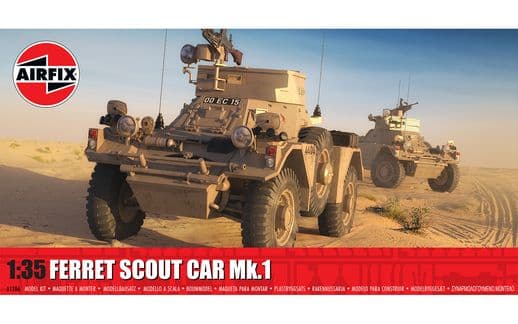
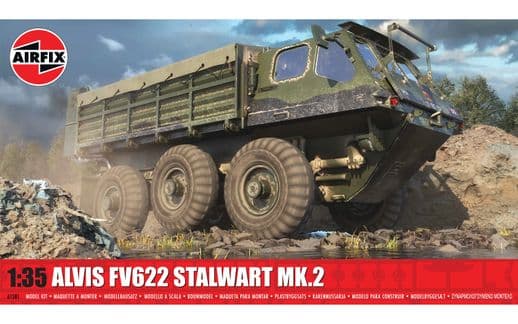
Well, isn’t that just typical - you wait almost twelve months for a new 1/35th scale all-wheel drive military vehicle addition to the Airfix kit range, then two come along in quick succession. Following on from our Alvis FV622 Stalwart Mk.2 new tooling announcement made just a couple of weeks ago, we’re delighted to be returning to the subject of new 1/35th scale military vehicle kits again this week, as we welcome what is only the second release from our Ferret Scout Car tooling. With the original release of this kit proving to be such a popular addition to the range, we know the arrival of this earlier variant of the Ferret will be finding favour with the military modellers amongst our number, so are therefore pleased to be devoting this latest update to its release arrival.
As we welcome this new Ferret kit to the current Airfix range, we will be taking this update opportunity to look a little more closely at the wider Ferret story, to showcase a beautiful selection of built model images, and to include details behind the three scheme options which are included with this highly anticipated second release.
With two different variants, and six scheme options now available across two kit releases, we can now genuinely boast a ‘business’ of Ferrets hiding somewhere within the 2025 Airfix kit range, just waiting to be discovered and given new homes.
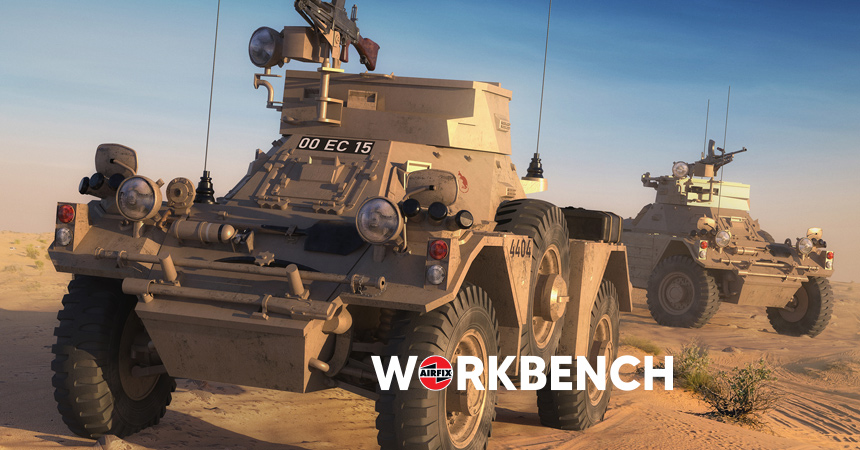
May we please take this opportunity to introduce the second release from our 1/35th scale Ferret Scout Car tooling to Workbench regulars. These models have been finished in all three scheme options included with this second, Mk.I Ferret kit offering.
On battlefields throughout the ages, the ability to know where your enemy is and in what strength they are massed was crucial intelligence which not only allows appropriate actions to be taken, but can also save many lives in the process. As we are all now only too aware, drone technologies currently play an important role in fulfilling this essential requirement and be that an expensive military drone for strategic intelligence or a small, consumer device used in close contact situations, this real-time information about the enemy you are facing can prove decisive. For these reasons, denying your enemy the ability to obtain these details is just as important as securing your own intelligence, however, in the days before the drone, this work had to be carried out by specially trained units and if they were lucky, ones who had access to a vehicle designed specifically to help them in their task.
A highly successful series of light armoured reconnaissance and liaison vehicles, the Ferret Scout Car would see widespread military service with British and Commonwealth forces from the 1950s onwards, with later variants of the Ferret still being in service and taking part in the Gulf War of 1991. A vehicle type which can trace its lineage back to the successful Daimler Dingo scout car of the Second World War, the Ferret was designed with stealth in mind, a light and fast armoured vehicle which could probe enemy positions, reporting any discovered weak points back to commanders, with their own forces moving forward to exploit what they found.
Weighing in at just over four tons when at operational weight, the Ferret was of all welded construction and featured armour protection capable of withstanding most small arms fire, but nothing much heavier, as it was never intended that the vehicle would be operating in direct opposition to heavy enemy armour. If it did find itself in a spot of bother, the 4 wheel drive Ferret was powered by a reliable 4.2 litre 6 cylinder Rolls Royce engine, which gave the vehicle a top speed of between 45 and 50 mph, a speed it could impressively also achieve in reverse should the situation require, something which might prove extremely useful if the crew found themselves in a tight spot when in contact with the enemy.
The large 'Run Flat' tyres were designed to get the Ferret back to base even when one or all of them had been damaged, so it was therefore unlikely that a crew would need to use the spare, even though they were still carried on many vehicles. What makes this all the more surprising is the fact that fitting the spare wheel to the hull of the Ferret actually blocked one of the crew emergency escape hatches, placing even more emphasis on its ability to use speed and stealth to get it out of a contact situation.
Despite being armoured, the Ferret was never intended to be placed in a position where it would have to face enemy heavy armour and instead relied on its low profile, speed and stealth to make contact with enemy units which may be engaged in a similar role. Creeping into contested territory, the Ferret was built for sniffing out the enemy, but not to actually cause trouble directly in an offensive sense. Sending real-time radio reports back to HQ, if their scouting took them out of radio range, a second HQ Ferret could be sent closer to it to receive and relay messages, helping to build up a picture of enemy activities and direct any impending offensive contact.
A ‘business’ of new built Ferret Mk.I kits. If you find yourself looking for a little modelling inspiration over the summer months, you won’t go far wrong with this delightful little Ferret kit.
If detected, the crew could extricate themselves from any combat situation at high speed and as long as they were only targeted by small arms and light machine gun fire, they would have adequate protection until the driver could get them out of range and speeding back to more friendly lines.
In operation, the Ferret was quite the capable performer, sporting a five-speed pre-selector gearbox which was accessed using a simple two position drive lever, and the ability to travel as fast in reverse as it could moving forward. The suspension units employed were robust and capable, allowing for a very pleasant ride, even at high speed and in all but the roughest of terrains and even though the steering system did not feature power assist, it was light and responsive, all leading to a vehicle with impressive operational performance.
The driver’s field of view was excellent in most operating environments and utilised several armoured hatches which would normally be open to offer an excellent view, even sporting rear armoured panels which could be opened for reversing. If the Ferret should come under fire, the hatches would be closed, and the driver would revert to a periscope unit for his driving view. The Ferret also boasted excellent water fording capabilities, with all automotive and electrical equipment protected against the ingress of water - in fact, it was thought that the vehicle would keep on going even though the crew would have been forced to abandon the vehicle due to the height of the water inside.
Each Ferret carried plenty of internal equipment and therefore, the interior was rather cramped. In normal operation, the commander would sit half out of the vehicle, just to make travel a little more comfortable, but as they approached contested areas, it would be back inside, with hatches battened down. The Mk.1 Ferret typically had a crew of three, whilst later marks would usually only be operated by a driver and commander.
Over 4,400 Ferrets were built during the ten years from 1952, and they would see extensive service with British forces across the world, in addition to those of many overseas nations. You would always be sure of spotting a Ferret or two in many of the world's hotspots during the post war years and hundreds are still in service across Africa, the Far East and the Pacific region to this day.
The sight of impactful new box artwork can only mean that the second release from our Ferret Scout Car tooling is now out and about, and causing a modelling commotion.
Whenever we release any new tooling project to the hobby, it can be a time of some trepidation for us, because to matter how experienced our team, or the skills possessed by our talented designers, the success of any new kit depends solely on how modellers receive it. That being the case, we needn’t have worried too much about the Ferret, because from the second we announced its existence, we began to see just how much affection this distinctive little military vehicle continues to be held in. In fact, throughout 2023, it really did seem as if everyone we spoke to either owned, had served on, or had an interesting story related to one of the 4,400 Ferrets produced – we even met a man who proudly proclaimed that he’d been run over by one.
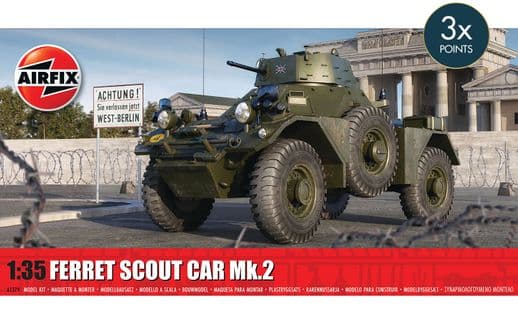
That first release presented the Ferret Scout Car in Mk.2 form, a vehicle which was officially referred to as the Car Scout 4x4 Reconnaissance (Ferret) Mk.2 FV701(E), and one which differed from its predecessor by featuring a turret. The Mk.2 was further developed to include several sub variants, with each one featuring different weapons permutations, or increased levels of armour protection.
The original Ferret Mk.I carried the designation Car Scout 4x4 Liaison (Ferret Mk.1) FV701(C) which featured an open top, something which could be covered by a specially produced canvas cover, to protect the crew from the elements. The vehicle was intended to perform internal security roles, and was armed with either a Bren Gun, or a .30 Browning Machine Gun. This version would also benefit from further development, including the Mk.1/2 (FV704) light reconnaissance specialist vehicle, which was used by infantry units to undertake forward patrols. In essence, these little armoured vehicles were sent to look for much bigger enemy AFVs, and report back on their position.
A final look at built models of the new kit finished in the liveries of each of the three scheme options included with this lovely little kit.
That earlier incarnation of the Ferret is the modelling subject of this second release from the tooling, and from all those conversations we had during our Ferret introduction year of 2023, we know you are all looking forward to getting your hands on this variant, just as much as you were all expecting it to eventually be released.
Throughout the ten year history of our Workbench blog, we’ve been fortunate to be allowed an insight into the work of our talented product designers, young people who are unique in the UK in using their design talents to create the scale model kits which mean so much to so many people. Indeed, for us mortals, it’s fascinating for us to chart the development and increasing skillset of our designers through the projects they bring to various ranges over the years, something we’ll never tire of hearing about.
When it comes to the Ferret, we were fortunate to be allowed into the design world of Ethan Barker through the medium of the Workbench blog, and how this project was impressive as the first major project he had taken on from the start – talk about making an Airfix introduction! As with every new tooling project, we covered the development of the Ferret extensively following its announcement, so will not be covering those same details this time around, but if you would like to see how Ethan attacked this exciting design opportunity in his career, you can do so by using this link.
When taking on a new design challenge, our designers will always try to include as many variations as possible regarding the subjects they’re working on within their designs, obviously without compromising the integrity of the project. For Ethan and his Ferret design, he was able to cover different variants of the vehicle within his tooling design, and this second release allows us to return to the subject of the first Ferret Scout Cars to enter British Army service.
Without further ado, let’s take a closer look at the three new scheme options which are included with the release of this Ferret Scout Car Mk.I kit.
Scheme A – Ferret Scout Car Mk.1/1, C Squadron, Ludgershall, British Army, 1980’s.
An incredibly useful and highly serviceable armoured vehicle, the Ferret was designed with mobility in mind, if not intended for direct contact with enemy heavy armour. Just like the animal after which it was named, it was intended that the Ferret and its crew would use speed, stealth and its low profile to sneak into forward positions close to the enemy, and to observe their movement and positions without being observed themselves. The task of dealing with those enemy units was assigned to other AFVs and troops bringing up the rear, but the Ferret acted as their eyes and ears.
Possessing excellent performance both on and off road, the Ferret employed a constant 4x4 drive train which made it extremely fast over most terrain and for a vehicle which could boast 4 tons of armour, was impressively fast on all surfaces, although travelling at speed on undulating ground wouldn’t have been pleasant for the crew. Indeed, the Ferret’s top speed of 50mph could be achieved in both forward, and reverse gears, although if a crew needed to travel that fast in reverse, they had probably found themselves in a spot of bother on the battlefield.
For the love of a Ferret. Just one of three appealing scheme options included with this latest kit release.
In cases such as these, the Ferret would usually discharge smoke before heading off in the opposite direction, because even though the vehicle was more than capable of protecting its crew from small arms fire, it was never intended to have to deal with anti-tank, or heavy ordnance rounds. In this original variant configuration, it isn’t difficult to see why the Ferret became such a favourite with British Army crews, as its excellent performance, general reliability and extremely low profile made it perfect for the role of reconnaissance patrol vehicle, something it did from the early 1950s, right up until the early 1990s.
This upgraded variant of the original Mk.I (FV710C) Ferret benefitted from a reinforced amphibious hull, the inclusion of a General Purpose Machine Gun and slightly more effective communications equipment, all improvements made to make Ferret operations even more effective. Used extensively by the British Army, this would see Ferrets being operated right across the world, in the name of Queen and Country, whilst also attracting orders from well over thirty countries worldwide.
The British military vehicle depot at Ludgershall on the edge of Salisbury Plain can trace its linage back to the Second World War and the build-up of Allied vehicles for the invasion of Europe. A large number of warehouses and secure buildings were erected at the site, where hundreds of military vehicles could be stored, maintained and prepared for service delivery, along with external storage areas which made this a major supply facility for the Army. Everything from heavy armour, Stalwarts and Land Rovers could be seen at the Ludgershall depot at most times during its operation, with a rail head only increasing its importance in this role.
Although closed as an armoured vehicle depot in 1997, many of its buildings and facilities remain to this day, and many a Ferret would have several stints spent at the site in their operational service books.
When we think about the awesome firepower at the disposal of Allied Coalition forces, particularly the British, at the start of the Gulf War of 1991, you’d probably think of Challenger 1 main battle tanks and Warrior infantry fighting vehicles, all AFVs designed to provide British forces with the latest battlefield equipment to assist in their dangerous work. What you wouldn’t expect to see was a small force of lightly armed scout cars which at that point, had already been in service for 40 years.
The battlefield attributes of the Ferret which made it an ideal reconnaissance, liaison and security armoured car when it was introduced during the early 1950s, were still in demand when British forces deployed to the Gulf in response to this crisis, and amongst the collection of impressive modern armour in theatre, there was also a small, but noteworthy ‘Ferret Force’ supporting them. Wearing a smart new paint scheme appropriate for these new operating surroundings, Gulf War Ferrets would actually play quite a significant role both during preparations for the ground operations, and throughout the subsequent attack, always there to offer their unique attributes in ensuring the enemy were kept on the back foot.
In the light observation role, Ferrets would often be at the head of troop and equipment columns as they headed towards their attack staging points prior to the ground assault taking place, leading armoured columns into their correct positions, mainly under the cover of darkness. Reconnaissance Ferrets could also be the home of very senior commanders, as they probed the front lines looking for breaches in enemy defences and plotting minefields which would cause problems once the assault began in earnest. Using their speed and low profile, Ferrets operated effectively in these advanced roles, often leading the way for much more modern and much more expensive assets to follow along.
Seeing combat operations 40 years after the vehicle had originally entered service, the Ferret really was an exceptional armoured vehicle, one which just didn’t know when to quit.
Once the attack began, Ferrets were called to check enemy positions which had been neutralised, making sure nothing dangerous remained, whilst also performing the grim task of marking the positions and identities of fallen troops. If they did discover casualties, they could arrange for medical services to be dispatched to the location. On more than one occasion, Ferret crews were called upon to take the surrender of large numbers of Iraqi troops, numbers which dwarfed the crews of the vehicles themselves. Clearly a dangerous time for those few soldiers involved, crew members had to search and possibly disarm enemy troops, before keeping them all under guard until relief forces could take them to holding centres.
Once a ceasefire had been arranged, Ferrets and their crews were again dispatched to find and plot enemy positions, inspecting bunkers and strongpoints to ensure all weapons had been collected and made safe, and that no booby traps had been left for the unwary. Underlining the fact that these were always intended as military vehicles, one of the final tasks Ferret crews were required to undertake was the grim task of proceeding along the Basra Road to ensure that any enemy combatant casualties both injured and deceased were dealt with in the appropriate manner.
This particular Ferret appeared to be particularly well-loved by those who came into contact with it during the Gulf War, as there are an impressive number of colour pictures available online which stand as a record of this vehicle’s service during this conflict. In a modern coalition ground campaign, there was still a need for a Ferret Force of 40 year old Scout Cars.
If the British Army intend to operate any military vehicle effectively in a service role, they need to ensure the availability of a robust and comprehensive training program for new recruits and those converting to different vehicle types to benefit from, a role which has been performed by the Royal Armoured Corps Centre at Bovington since Great War times. Ever since the tank was introduced, Bovington has played a significant role in the lives of a great many people in British Army service, as a centre for training and excellence which still operates to this day, but is now equally famous as the home of the impressive AFV collection of the Tank Museum.
Although Bovington is primarily associated with tanks, the Ferret was intended to provide reconnaissance support for heavy armour in the rear, so it therefore seems sensible to train crews in close proximity to the latest battle tanks of the day, particularly in live firing scenarios. Not a heavy offensive vehicle in its own right, the Ferret Scout Car did wield quite a powerful armoured fist when directing supporting units in any engagement, meaning that Ferret crews and their whereabouts were clearly going to be of great interest to enemy planners when operating in contested advanced areas.
With the Ferret enjoying such a long and successful service life, and with it earning an enviable reputation for rugged effectiveness, it will come as no surprise whatsoever to learn that relatively large numbers of these vehicles found their way into civilian hands following their withdrawal from service. Most of these owners will probably describe owning and driving a Ferret as being tremendous fun, in addition to being guaranteed to get you noticed on the road. It does also have to be noted though that they can also attract the attention of the authorities as an unusual vehicle type, and how reckless owners can easily find themselves in some financial hot water, as a result of perceived improper use.
An extremely well made vehicle, a well maintained Ferret is capable of being operated without too many issues, however, it does help if you have some prior experience, some mechanical skills and enjoy driving your Ferret regularly, because an inactive Ferret can be an expensive Ferret. Those people who do own one would probably describe it as their hobby, or even something of an obsession, but definitely a labour of love for them. Owning a Ferret can be an expensive and time consuming exercise, particularly if you intend to research the history of your vehicle and return it to as close to its former service condition as possible.
Although we’ve seen just how impressive a vehicle the Ferret Scout Car was, I’m not sure I’d be too happy venturing into a potential combat zone in a vehicle protected by a tarpaulin roof. Thank goodness the British Army are made of the Right Stuff.
A Ferret is also intended to be an off-road vehicle, where the natural slippage of soft ground allows the constant 4x4 drivetrain to correct itself when in danger of ‘winding’. If driven mainly on roads and prepared surfaces, the 4x4 system can have a few issues, but as long as you’re aware of this, and know that an hour or so of off-roading fun will rectify the situation, you’ll have few problems – imagine how cool you’ll look in the process too!
For those thinking about taking the plunge and doing a little prior research, some fellow enthusiasts go to great lengths in sharing their ownership and restoration project experiences with fellow Ferret fans. One owner in Canada secured a former BATUS Ferret which has a similar registration to the vehicle featured in this third scheme option, and posted a comprehensive review of his restoration work on the vehicle, including an impressive number of photographs. For anyone thinking about taking the Ferret ownership plunge, a quick web-search for this information might prove invaluable.
The story of British Army BATUS operations is an interesting one, and well worth visiting once again before we end this latest update review.
On the wide expanses of a prairie in Alberta, Canada, the British Army has been conducting large scale training and military manoeuvres since 1972, an area which is twice the size of the Isle of Wight, and so sparsely populated that it's ideal for live firing and complex combat simulations. The British Army Training Unit Suffield is an important location for the modern British Army and is home to around 400 permanent staff, 1400 soldiers in training and a great many local people who all help to keep the base running smoothly. Of even greater importance, BATUS is home to Challenger 2 tanks and Warrior infantry fighting vehicles, in numbers which constitute an entire battle group and therefore allowing training activities of this magnitude to be undertaken.
Over the years, well over one hundred thousand British Army personnel have spent time training at this impressive facility, which is used to provide the most complex testing and training exercises a British soldier can experience, with live firing and battlegroup scale scenarios providing them with the knowledge and experiences to prepare them for war. In a changing world, the role of the Army has to be flexible enough to cope with the demands placed upon it, both traditional and contemporary, with this facility undoubtedly providing troops with as real a combat situation as they are likely to experience, other than actually being in a warzone.
A Gulf War armoured curiosity, this second release from our 1/35th scale Ferret Scout Car tooling is available now, and is surely destined to be a popular addition to the range.
A delightful little model kit, this second release from our Ferret Scout Car tooling is in our warehouse and available now, and if the impact of its predecessor is anything to go by, we might have some difficult keeping this beauty in stock, and will forever be requesting further supplies from our manufacturing facility. As a build project, these lovely little models can be enjoyed by everybody, not just the committed military vehicle modeller, and with both kits currently available on the Airfix website, we can all now allow a ‘business’ of Ferret kits to get up to some modelling mischief on our workbenches this summer.
We’ll end by showcasing a recently produced built model video welcoming this second kit release into the range, just by way of keeping the ferreting fun going for a little while longer – enjoy!
We are afraid that's all we have for you in this latest edition, but we will be back next Friday with more project development updates and the very latest Airfix kit exclusives. In the meantime, we are always keen to hear your views on all things Airfix and in particular, any thoughts and opinions you may have regarding our Workbench blog. If you would like to drop us a quick line, could we please ask that you use our workbench@airfix.com email for all correspondence.
To re-visit any of the Airfix blogs we have produced over the past seven years or so, please head to our main Workbench hub, where you will find our entire blog back catalogue and all the Airfix design projects we have already covered.
All our dedicated official social media sites can be accessed by clicking the respective link icons at the foot of this page, or by heading to the Airfix homepage. Other useful Airfix links are:
Facebook, YouTube, Twitter and Instagram official sites
Please join us for more Airfix updates next week and thank you for your continued support.