
Welcome to this latest edition of our Workbench blog and all the news, updates, and modelling exclusives from the fascinating world of Airfix.
It what has turned out to be quite an unusual occurrence for us here on the Workbench blog, for the second week running, our new project update subject for this latest edition is another classic jet powered aircraft, this time one which has much more aggressive tendencies than the Jet Provost featured last week. One of the most significant early generation jet fighters produced by the Soviet Union during the early 1950s, the Mikoyan-Gurevich MiG-17 was an enhanced development of the earlier MiG-15, but one which was intended to make the aircraft more capable in a combat situation. Retaining more than a passing resemblance to its predecessor, we will be seeing why the MiG-17 was actually a very different aeroplane, one which would see widespread service throughout the Eastern Bloc nations and with the air forces of around 30 countries internationally.
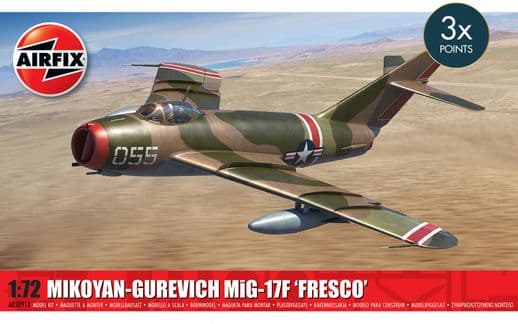
An interesting looking jet which makes for a really enjoyable modelling project, we’re pleased to be welcoming the MiG-17 back to the 2024 range and in some style, so will be taking this opportunity to look a little more closely at an aircraft which has much more to its back story than initially meets the eye. Featuring an exclusive look at the new box artwork produced in support of this new release, we will also be looking at the two new scheme options included with this kit, including one which represents an impounded MiG which was transported to America and used in extensive flight trials against the latest US aircraft in service at that time.
If you find yourself looking for a modelling project which offers something just that little bit different, we think the new MiG-17F ‘Fresco’ might be the model kit for you.
The Soviet’s early jet 'gunslinger'
A CAD screenshot image produced during the early design phase of the new 1/72nd scale MiG-17s development.
Throughout the history of aviation, there have been several occasions where aircraft technology has undergone incredible advancement in a relatively short period of time, usually during times of war, or as a result of development started during wartime. Perhaps the most significant technological leap occurred when the most powerful piston engined fighters were forced to concede mastery of the air to the first jet powered designs, with aircraft such as the Messerschmitt Me 262 and Arado Ar 234 both highlighting the limitations of existing technologies and pointing to the very future of aircraft development.
The years which followed the end of the Second World War would see the victorious Allied powers desperately trying to advance their own jet propulsion programs, often using data and technologies captured from the Germans during the final months of conflict. Indeed, securing this information became such a priority that specialist teams were established by all the Allied powers, with the sole purpose of finding, securing and transporting items relating to the German jet program back for safe keeping, creating a mistrust between allies which would set the international tone for years to come.
As a result, Europe would exchange six years of war for a peace which can only be described as ‘uneasy’ at best. Over the coming few years, all the air forces of the victorious Allied nations began to trade their huge wartime aircraft inventories for smaller numbers of more technologically advanced types, aircraft which were even more capable than the machines which had secured victory only months earlier. As political relations between former wartime allies began to sour somewhat, both sides rushed to introduce new and more capable aircraft, each hoping that the deterrent threat of their awesome capabilities might prevent the slide into conflict once more.
In design – Production of the base model utilising LIDAR scan data to first check shapes and dimensions.
It could be argued that at first, the Western powers were a little complacent in assuming that Soviet jet technology was lagging significantly behind the progress they themselves had been making. They thought that much of the information relating to the German jet program had been secured by the British and Americans, and they were now in position to take a healthy lead in this jet powered race. This thinking was only strengthened when the Soviets approached Britain to purchase jet engines to form the basis of their own fledgling jet fighter program, however, the Soviets were determined and resourceful, and would not stay in the shadows for long.
Any such preconception of Soviet technological inferiority would be exposed in dramatic fashion during the early stages of the Korean War, when Allied pilots encountered the impressive Mikoyan-Gurevich MiG-15 fighter, an aircraft which proved to be quite the capable adversary. The diminutive MiG-15 was one of the first successful transonic jet fighters to feature a swept wing configuration and its performance proved more than a match for all but the very latest US North American F-86 Sabre jet fighters. As the world descended further into a Cold War of military threats and political mistrust, to the world’s population at large, the acronym MiG would come to stand for capable Soviet air power and aircraft the West must prepare to face in the event of future conflict.
Even whilst the first frenetic jet versus jet fighter combat engagements were taking place in the skies above Korea, design engineers at the Mikoyan-Gurevich company were already at the advanced stages of developing an upgraded version of their impressive little jet. Whilst it would not be entirely accurate to describe this new aircraft as a direct replacement for the MiG-15, it did represent another technological leap forward in aviation design and incorporated many improvements over its predecessor, some of which were made as a result of feedback following operational experience. The changes were all intended to make the aircraft even more capable in the combat environment.
Using the same design files used to prepare the new kit for production, the kit’s designer will produce computer rendered images such as these to help announce the existence of a new model tooling project.
Despite being a very different aeroplane, those looking at the MiG-17 for the first time could easily confuse it with its diminutive predecessor, as the two do bear some striking similarities. Even when the differences are pointed out, you could be forgiven for thinking that the Fresco (NATO reporting name) was just a slightly larger variant of the MiG-15, however, you would still be quite wrong.
Although the MiG-17 clearly retains a strong resemblance to the fighter which preceded it, it’s actually a very different beast altogether, taking everything that was good about the MiG-15 and making it better. It is important to remember that during the Korean War, the MiG-15 would post an impressive combat victory ratio of 3:1, and the new jet fighter was improving on its capabilities in almost every way. Aviation historians have even argued that the MiG-17 Fresco was a fascinating combination of the best fighter technology from the end of the Second World War, married with the latest advancements the Soviet’s had made in transonic flight research. With its devastating array of nose mounted machine gun armament, the MiG-17 entered service prior to the availability of effective Soviet air-to-air missile technology, and is therefore often described as the Soviet Air Force’s last ‘Gunslinger’.
Although American pilots initially dismissed the capabilities of the diminutive MiG-17F during the Vietnam war, as more of their number fell to the Soviet designed fighter, so they started to acknowledge its fighting qualities.
The Mikoyan-Gurevich MiG-17 ‘Fresco’ was a fast, high-subsonic jet fighter which was designed to combat the potential threat posed by large scale Western bomber incursions into Soviet airspace. Although not intended as a dogfighter, the MiG-17 was an extremely manoeuvrable aircraft and would prove to be a feared adversary for much more modern western designs during the Vietnam War. Indeed, the Soviet MiGs caused American airmen so many problems during combat, that in the aftermath of this conflict, America initiated their lightweight fighter programme which would eventually lead to the introduction of such aircraft as the General Dynamics F-16 Fighting Falcon and McDonnell Douglas F-18 Hornet.
In the enduring quest to develop aircraft possessing ever greater speed, the MiG-17 design attempted to overcome the effects of compressibility by adopting an even greater sweep angle to its wing leading edge than its diminutive predecessor, and would become the first Soviet designed aircraft to introduce afterburner technology, allowing pilots to access greater thrust when required, at the expense of greatly increased fuel consumption.
Although possessing more than just a passing resemblance to its famous aviation predecessor, a quick walk-around the MiG-17 reveals a number of distinct differences which make identification between the two aircraft types much simpler. A feature which isn’t quite so obvious to the naked eye is the fact that the MiG-17 is actually around three feet longer than the MiG-15, however, if you know where to look, there are some clear indicators.
From this angle, you could be forgiven for thinking you were looking at a classic MiG-15 fighter, but there are some distinct differences between the MiG-17F ‘Fresco’ and its immediate predecessor, if you just know where to look.
If you concentrate your attentions on the wing of the aircraft, you will quickly see that the MiG-17 has a distinctly different wing design to that of its predecessor. In addition to being noticeably thinner, the MiG-17 incorporated a wing leading edge which was not straight along its length, having a sweep angle of 49 degrees until approximately halfway along its length, before reducing to an angle of 45.5 degrees. The wing tips were also of a more rounded design on the later model, but if you were still in need of further evidence, the inclusion of a third strake (wing fence) on the top of each side of the wing confirmed beyond all doubt that you were inspecting a MiG-17 Fresco.
Although again similar to the units featured on the MiG-15, the new aircraft was equipped with an extremely rugged undercarriage, units which were intended to allow the aircraft to be operated from rudimentary and unprepared airfields if required, an ability the Soviets thought to be important in allowing effective combat operations to still take place in the aftermath of enemy bombers striking at known jet fighter bases. Highlighting the still relatively basic technology adopted across much of the aircraft’s design, the pilot could rely on the visual indication provided by three highly visible mechanical undercarriage lock-down pins, which reassuringly ‘popped up’ when the gear was lowered and locked. The nose gear pin was positioned in front of the cockpit canopy, whilst the main gear indicators can clearly be seen on top of each wing.
Although never intended as a dogfighter, the MiG-17 proved particularly adept when in close combat situations, using its impressive manoeuvrability to bring its guns to bear on any adversary. On the subject of firepower, this was one of the most heavily armed fighters in the history of aviation to that point, employing two 23mm cannon under the port side nose of the aircraft and a fearsome 37mm cannon under the starboard side. Indeed, the entire lower nose section of the aircraft, back to just behind the cockpit, was devoted to the installation of guns and ammunition and helps explain why the MiG-17 Fresco is often described as one of the last true jet powered gunfighters.
With its combination of robust construction, extreme manoeuvrability and heavy firepower, the MiG-17 was proof that Soviet aviation technology design was not that far behind the Western powers and in some respects, could provide valuable pointers towards future development requirements on their own aircraft. Interestingly, the MiG-17 was considered to be the tightest turning jet fighter in the world, until the introduction of the 4th generation General Dynamics F-16 Fighting Falcon in 1978.
One of the most successful of the early generation jet fighters, the MiG-17 would serve with the air forces of around 30 nations worldwide and would be produced under licence in both Poland and China. This box artwork image features a Polish built LIM-5.
Discussions regarding the generational classification of fighter jet types can be a subjective one and whilst the F-16 is probably correctly classified as a 4th generation aircraft, is it right that the MiG-17 Fresco should only be considered a first-generation aircraft? First generation jet fighters include those which first flew during the Second World War, or were developed in the years which immediately followed, including the North American Sabre and MiG-15.
There seems to be quite a technological leap to be considered a second-generation jet fighter, with aircraft such as the US Century Series aircraft and the English Electric Lightning being included, but whilst the MiG-17 couldn’t really expect to be included with these classic aircraft, was it really just a first-generation jet fighter? Perhaps we should settle on a new classification of ‘First Generation plus’, just to keep everyone happy and to avoid arguments.
Although not produced in quite the same quantities as the earlier MiG-15, the faster and more powerful MiG-17 Fresco would become the standard Warsaw Pact fighter from the late 1950s onwards and would eventually see service with the air forces of around 30 different countries worldwide. The fighter would also be licence built in both Poland and China, which undoubtedly make this one of the most important early generation jet fighters of the 20th century.
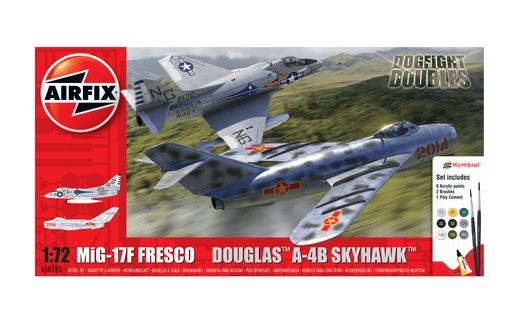
Yet another illustration of how Airfix box artwork imagery continues to provide both modelling inspiration and stimulus to our continued enjoyment of the hobby. This artwork was released in support of the Dogfight Double kit which includes the new MiG-17 model.
With its position as one of the world’s most important early generation jet fighters, you might think that the Mikoyan-Gurevich MiG-17F Fresco would have been as popular a modelling subject as something like a Spitfire, Messerschmitt Bf 109 or P-51 Mustang have been over the years, but that hasn’t exactly been the case. When respective manufacturers have produced kits of any number of different marks of Spitfire over the past 65 years or so and even gone back to re-tool existing kits once they get a little long in the tooth, the MiG-17 simply doesn’t appear to have commanded anything like those levels of interest.
For that reason, when we announced the existence of our new 1/72nd scale Mikoyan-Gurevich MiG-17F ‘Fresco’ tooling at the beginning of 2019, it came as something of a surprise to many Airfix fans, but once they’d got their heads around it, actually found themselves getting a little excited at the prospect. When our design team were preparing to greet visitors to the Airfix stand at Scale ModelWorld in November 2019, they were all a little taken aback when the first few modellers coming to speak with them all wanted to discuss the new MiG and over the course of the weekend, despite the embarrassment of modelling riches on display, the little MiG was more than holding its own when it came to new tooling interest.
Following release of the kit, the striking shape of the aircraft and the many attractive colour schemes available to tempt modellers when finishing their kits has ensured that each release has proved a popular addition to the range, and with two different standalone kit releases and a Dogfight Double to its name, we’re now ready to unleash the third single MiG-17F ‘Fresco’ kit on the modelling world. If you’re looking for a build project which offers attractive and unusual scheme options in which to finish your model, prepare to enjoy a little ‘Fresco time’.
As a British protectorate, Egypt had been supplied aircraft for its air force under a long-standing agreement and would see the Royal Egyptian Air Force operating such types as the Westland Lysander, Spitfire Mk.22 and later entering the jet age with the Gloster Meteor and de Havilland Vampire. Following independence and a steady decline in relations between the two nations, the Egyptian government wanted to break free from this reliance on Britain and her aircraft, and made advances towards Eastern Bloc nations and the Soviet Union themselves. This support was forthcoming, and they signed deals with the Soviets and Czechs to procure MiG jet fighters from them.
The first 12 Soviet built and supplied MiG-17F ‘Frescos’ arrived at Almaza Air Force Base in the Autumn of 1956 and a famous photograph of this occasion was widely circulated showing CO of No.1 Squadron and future Commander-in-Chief of the Egyptian Air Force, Shalabi el-Hinnawy, proudly inspecting his new aircraft. Despite being rushed into service and the first batch of six EAF pilots being at the advanced stages of conversion to the new Soviet fighters, none of the aircraft were operational at the outbreak of the Suez Crisis, although they would all fly numerous combat missions by the end of the conflict. At least one of the aircraft flown by these first converting pilots was lost during the fighting.
When initially entering Egyptian Air Force service, their MiG-17F fighters were presented in the natural metal finish in which they were supplied, only carrying national insignia and no individual aircraft serial markings. In what must have been quite a confusing situation, the aircraft were simply identified by their construction numbers, which were usually painted on the nose wheel door of each aircraft.
Following the start of the Six Day War and a devastating strike where Israeli aircraft decimated the Egyptian Air Force whilst still on the ground, a hasty program to camouflage remaining aircraft was initiated, with all aircraft from this date receiving a three-tone upper surface camouflage. During the 1960s, many of the Egyptian MiG-17s would also be converted to a ground attack role, with ordnance rails added to allow bombs, rockets and external fuel tanks to be carried.
Full scheme details for an aircraft which was one of the first MiG-17F ‘Fresco’ fighters to be delivered to the Egyptian Air Force.
The amount of money Egypt spent of procuring aircraft was incredible and it really did seem as if they had an insatiable appetite for obtaining as many aircraft as they could, from whoever was prepared to supply them. Once making the break from Britain, this mainly consisted of Eastern Bloc nations, and they would eventually end up with hundreds of MiG-17F fighters on strength, mainly concentrated at Almaza Air Force Base near Cairo, but also dispersed to many satellite bases around the country. In those days, it really did seem like it was a case of quantity over quality, particularly as defence and strategic infrastructure was not at the same level as Egyptian aircraft strength.
From the 1970s onwards, Egypt continued to spend eye-watering amounts of money on procuring combat aircraft, but from this point forwards, looked mainly towards the West for their aircraft types. Now taking large numbers of French and US built aircraft, they were initially helped by Saudi Arabia in funding this procurement, particularly when making good losses suffered during times of conflict, but were later left to make their own arrangements. Today, the Egyptian Air Force is the most powerful in the region and the 15th most powerful in the world, with around 1,070 aircraft on strength.
Once it had become clear that the Soviet Union had their own mature jet aircraft production program, the Americans were desperate to get hold of examples of their latest aircraft, so they could be assessed and evaluated against the latest US types. The Foreign Technology Division of the Air Force Systems Command had been given the opportunity to inspect two examples of the Mikoyan-Gurevich MiG-17F ‘Fresco’ jet fighter after aircraft had crash landed in Europe, but these were both static examples and both had to be handed back to their owners.
With US aircraft being lost over Vietnam and news that the Vietnamese People’s Air Force were now operating MiG-17F fighters in theatre, the Americans were desperate to discover why their latest generation of jet aircraft were being lost to an aircraft they regarded as inferior to their own. That opportunity presented itself in August 1968, but via a rather unusual route.
On 12th August 1968, two Syrian Air Force pilots took off from their home airfield in MiG-17F fighters to complete a navigational training sortie, one which would prove to be a rather eventful flight for them. With fuel running low and the terrain below looking unfamiliar, the lead pilot consulted his map and deduced that the airfield he could see below them was a satellite airfield near Tripoli, off the Libyan coast and indicated to his wingman that they should prepare for landing. Unfortunately for him, it later transpired that the map he had been issues with was rather old and did not show all the latest boundary details in this volatile region.
As the aircraft came to a halt, the pilots thought that the airfield facilities were particularly primitive and with debris on the taxiways and almost nobody about, they wondered where they had actually landed. They didn’t have to wait long to receive confirmation of their mistake, as armed local people soon surrounded the aircraft and placed the airmen under guard. In what turned out to be almost inconceivable bearing in mind the aircraft were conducting a navigational sortie, the MiGs were so far off course that they had actually landed at a disused Israeli Air Force airfield.
Ordinarily, we would have already shown new box artwork produced in support of a project being reviewed here in Workbench well before now, but the story behind the “Have Drill” MiG is so interesting, that we wanted to hold it back for this section.
The pilots would be returned to their homeland some years later, but their aircraft were immediately transported to the IAF base at Ramat David to undergo detailed evaluation, and on sharing details of their good fortune with their American allies, arrangements were soon made to have the fighters sent on to the US for use in their own evaluation trials.
The aircraft presented in the scheme above was the first of the two aircraft to arrive at the classified Groom Lake testing facility in Nevada on 27th January 1969, a secretive facility which most of us will know better as ‘Area 51. This aircraft was actually a Lim-5 licence built derivative of the MiG-17F manufactured in Poland, but as a complete example of this latest variant of the fighter, it was the closest in configuration to the Vietnamese aircraft which were engaging US aircraft in Vietnam at that time and was therefore incredibly useful to the Americans.
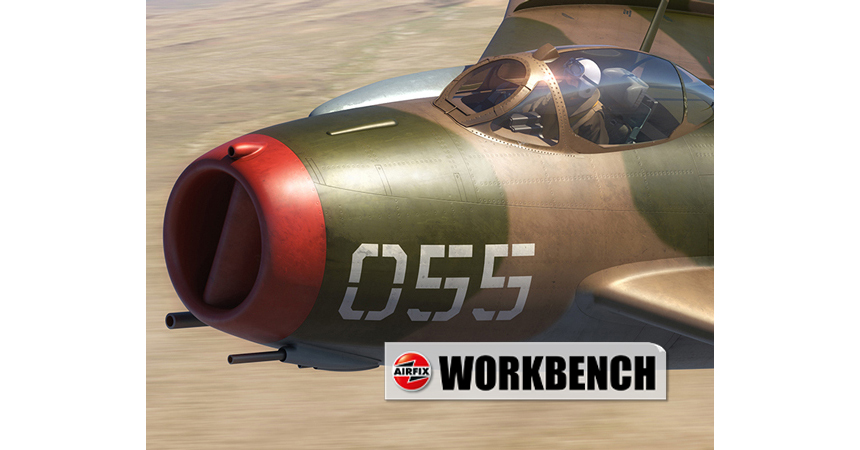
The aircraft was to be evaluated by the Defence Intelligence Agency under the program codename ‘Have Drill’, where this name was actually attached to the individual aircraft as opposed to the program itself, with this aircraft going on to wear the nose codes ‘White 055’. On arrival at Groom Lake, the aircraft was prepared to embark on a busy period of evaluation by having much of its instrumentation replaced with American equipment and would be the first aircraft of the two to fly, when it was flown by an American pilot for the first time on 17th February 1969.
Initially, the aircraft was flown by test pilots to evaluate every aspect of the MiG’s performance, allowing them to discover the strengths and perhaps more importantly, the weaknesses of the aircraft. The next phase was to allow a select group of US Air Force and US Navy pilots to fly the aircraft, before moving on to fly the aircraft in simulated dogfights against all current American aircraft in service at that time.
These simulated dogfights proved astonishing and significant for several reasons, not least of which was the fact that 100% of American crews actually lost their first combat engagement with the MiG-17. After debriefing, it became clear that each and every crew underestimated the Soviet fighter, disregarding it as a lower class of opponent and an aircraft which was of inferior technical quality of their own jets – a fatal mistake which saw 27 American jets falling to the guns of MiG-17s during the Vietnam War.
Full scheme details for what has to be described as an aircraft with an incredible story to tell.
Once their mistake had been recognised, they gave the Soviet aircraft the respect it deserved and started to concentrate on how best to engage in combat against this diminutive aircraft. The main difficulties US pilots had with the aircraft was in initially gaining a visual fix on the MiG. The aircraft was so small that they simply couldn’t see it either visually, or on their radar screens and the fact that the fighter’s engine was a relatively smoke free unit meant that it was really difficult to see.
Turning this situation on its head, Vietnamese pilots engaged against American jets had no such problem, as their adversaries were much larger aeroplanes and their dirty, smoky engines allowed them to be spotted at much greater distances. If they were allowed to get close to the American aircraft, they could bring their powerful machine guns to bear, but that wasn’t the end of the story. The MiG’s only had limited ammunition and rather basic sighting equipment, and controlling the aircraft required a great deal of strength by the pilot, particularly when pulling tight, high G manoeuvres.
Even if they could get close, getting away from American aircraft was a very different story, but as far as the American’s were concerned, as they were losing aircraft and crews to the MiG-17F, something definitely had to be done.
Following completion of the "Have Drill" program, the US initiated some changes in combat engagement doctrine, particularly when coming up against the diminutive MiG-17. Crews were instructed to never become drawn into a turning dogfight with the Soviet fighter and never to enter the low-speed envelope between 200 and 350 knots, where the MiG had a distinct advantage. They were instructed to remain at high energy in all circumstances and to never underestimate your enemy.
The full box artwork file produced to support the release of this appealing addition to the 2024 Airfix kit range.
It could be argued that the US Navy were the most effective in implementing the lessons learned from the “Have Drill” program, not only adopting the changes, but also making alterations to the way in which their aircraft were deployed in a combat environment. Looking at the wider impact, these evaluations would result in guns retuning to the design of US combat aircraft and the eventual introduction of highly manoeuvrable fourth generation aircraft, such as the General Dynamics F-16 Falcon. It would also be a factor in the US Navy establishing their Fighter Weapons School, a unit most of us know as ‘Top Gun’.
Returning to the subject of this particular MiG-17F Fresco and the “Have Drill” program, the American’s were hugely impressed with the general operability and excellent serviceability of the aircraft. This impressive little aircraft would be used to complete 172 missions in just 55 days, for a total flight time of 131 hours. On some days, the aircraft would take to the air four or five times, often with different pilots at the controls. Indeed, it would only miss two take-off slots during the test program, and these were thought to be due to issues associated with the American instrumentation.
The ”Have Drill” program was wound down in May 1969 and ‘White 055’ was subsequently returned to the Israeli Air Force.
Such a fascinating aviation story, if you find yourself looking for an engaging build project over the coming weeks and months, there can be few subjects which possess the interest levels this distinctive little MiG-17F can boast, and with its links to the Vietnam air war, this “Have Drill” scheme option could prove a difficult one to overlook.
A final look at a new kit which will have many people adding this Americanised version of the classic Soviet Mikoyan-Gurevich MiG-17F jet fighter to their summer build schedules.
We are afraid that's all we have for you in this latest edition, but we will be back next Friday with more project development updates and the very latest Airfix kit exclusives. In the meantime, we are always keen to hear your views on all things Airfix and in particular, any thoughts and opinions you may have regarding our Workbench blog. If you would like to drop us a quick line, could we please ask that you use our workbench@airfix.com email for all correspondence.
To re-visit any of the Airfix blogs we have produced over the past seven years or so, please head to our main Workbench hub, where you will find our entire blog back catalogue and all the Airfix design projects we have already covered.
All our dedicated official social media sites can be accessed by clicking the respective link icons at the foot of this page, or by heading to the Airfix homepage. Other useful Airfix links are:
Facebook, YouTube, Twitter and Instagram official sites
Please join us for more Airfix updates next week and thank you for your continued support.