

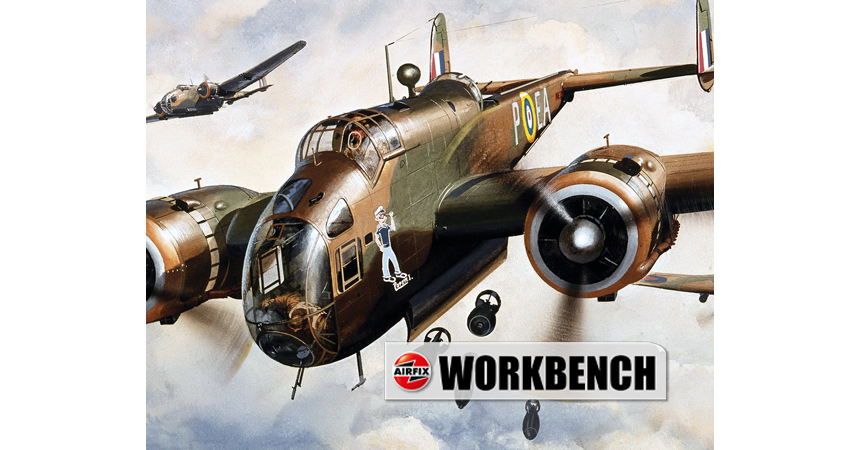
Welcome to this latest edition of our Workbench blog and all the news, updates, and modelling exclusives from the fascinating world of Airfix.
After the past few weeks where we have spent time in the company of a Royal Chipmunk, a secret Sabre and a Hawker Typhoon under restoration, we’re heading back to a true Airfix classic in this latest edition of Workbench, by looking forward to the next impending addition to the Vintage Classics range. When it comes to British aircraft which make for a compelling modelling project, there really are few that can boast the enduring appeal of the Handley Page Hampden, a medium bomber which has to be considered one of the most distinctive and therefore, one of the most interesting aircraft to ever go to war. For this reason, we’re understandably delighted to be welcoming this popular kit into the Vintage Classics range, and if pre-ordering activity is anything to go by, we know the modelling world is too.
An aircraft which could claim to be both ahead of its time when it first flew, yet almost out of time when it eventually entered service, the Hampden was forced to carry a heavy offensive burden during the first two years of the Second World War, with these aircraft being flown by heroic crews who were determined to do their duty in the face of daunting odds. We will be looking at the history and wartime service of this distinctive bomber during the course of this overview, whilst also looking more closely at the details behind the scheme option which will accompany the release of the kit. If you’re not sold already, we will also be bringing you an exclusive sight of the classic Roy Cross box artwork which accompanied the original release of this popular kit, and we know that’s something no self-respecting modeller will ever regard as anything other than a treat.
Flying tadpole or flying suitcase, we’re in the company of a Bomber Command classic in this latest edition of Workbench.
An unusual looking aircraft, the Handley Page Hampden was actually quite an advanced aircraft, fast and highly manoeuvrable.
Like so many of the British aircraft designed and introduced during the 1930s, the Handley Page Hampden was a groundbreaking new aircraft when it made its first flight, but by the time it entered service, the majority of its advantages had been overtaken by designs introduced by the air force which would ultimately become its major opposition. Tracing its lineage back to an Air Ministry requirement for an advanced, high-performance twin engined day bomber, the initial development of the aircraft was shaped by the League of Nations disarmament conference held in 1932. The conference was attempting to avoid another devastating war, although it appeared as if the only nations taking any notice of their recommendations were those who weren’t actually intent on conflict.
Wanting to be seen not to be embracing the sentiments of the conference findings, the Air Ministry revised their specifications to place weight restrictions on the new aircraft, causing Handley Page to also revise their design. Embracing the restrictions, the design team produced a proposal which offered a radical new bomber, one which placed an emphasis on performance and manoeuvrability, as opposed to the weight of bombs the aircraft would carry. Seen as an appealing compromise between range, payload and speed, the Handley Page HP.52 was particularly favoured by the Air Ministry and a prototype was duly ordered.
It’s also interesting to note that the rival proposal submitted by Vickers also proceeded, an aircraft which would become the Wellington. Both aircraft were designed to satisfy the same Air Ministry specification, however, the two aircraft could hardly have looked more different from each other. One thing they would both have in common though was how they would both be required to carry a heavy operational role as Britain was dragged into another devastating world war.
By the summer of 1936, the prototype Handley Page HP.52 was ready to make its maiden flight and to say it was a distinctive aircraft would be a bit of an understatement. Although most things about the aircraft’s design was something of a compromise, a trade off between weight, range and performance, this was actually an extremely advanced aeroplane for the time and one which was quite the performer. Just one week after its maiden flight, the aircraft was displayed at that year’s Hendon Air Display, but with the front glazed nose section covered with a tarpaulin, as many of the aircraft’s features were still highly secret.
Although attracting plenty of attention, that first aircraft would go on to have something of an ‘eventful’ time over the next few months, not only suffering an undercarriage collapse at the end of a test flight, but also having a propeller become detached mid-flight, striking the fuselage with some force, causing significant damage. Thankfully, the pilot managed to nurse the damaged aircraft back for a safe landing on just the single engine, with the propeller itself falling harmlessly onto farmland near the village of Elstree. Thankfully, the aircraft didn’t have far to get back to its home airfield on that dramatic occasion.
As the new bomber moved towards service acceptance, the production prototype aircraft became the centre of national attention on 24th June 1938, when aircraft L4032 was officially given the name ‘Hampden’ at a naming ceremony at the Handley Page factory airfield at Radlett. Named by the current Vicountess Hampden, the aircraft went on to perform for members of the press and gathered newsreels, where the company test pilot showed the impressive manoeuvrability of the new bomber.
This built model side view really does help to explain the Hampden’s nickname of ‘The Flying Tadpole’.
Even at that stage, officials were of the opinion that the new aircraft was lightly armed from a defensive perspective, but how its design meant little could be done about it. The fighting compartment of the Hampden was all in the front half of the bomber, with the four-man crew all grouped in a tall, thin fuselage which was only three feet wide. This meant that the bomb aimer/gunner in the front and the pilot were essentially confined to their positions for the duration of a sortie, with the wireless operator and main air gunner having a little more room to play with, but not much more.
The Hampden’s fuselage was so narrow that when they attempted to equip the aircraft with power operated turrets, the modifications required would have significantly affected the performance of the bomber and were shelved. They did eventually up-gun the aircraft by doubling the .303in guns in the main rearward firing positions and adding an additional gun for use against beam attacks, but these only restricted the crew’s limited available space still further and did little to improve the situation.
One noteworthy feature of the Hampden’s development was how Handley Page decided to adopt a modular method of construction, where individual sections of the aircraft could be produced separately in their own jigs, before all coming together during a final assembly process. This made production much more convenient for Handley Page, whilst also making the aircraft suitable for production by outside companies. Aircraft were subsequently produced by English Electric in Britain and by the Canadian Aircraft Association Ltd in Canada.
A Handley Page Hampden of No. 83 Squadron with crew seated on a loaded bomb trolley pictured at RAF Scampton on 2 October 1940. Image in the public domain.
The first Bomber Command Squadron to receive the new Hampden was No.49 Squadron at RAF Scampton, a unit which started to train with their new aircraft from September 1938. They would be joined by No.83 Squadron at the same airfield in the weeks which followed and by the start of the Second World War, ten squadrons of Hampdens were in service, with a total of around 130 aircraft on strength. This force joined Wellington and Whitley units in the offensive bombing role, with Bomber Command having 23 operational squadrons at that time, and were able to call upon around 280 aircraft.
Still in a period of modernisation, this was the force with which Britain could strike back at Germany at the start of WWII, a modest, yet capable force which was as yet untried in combat, but could call upon the support of brave and well-trained crews, who had some of the most capable aircraft in the world at their disposal. The Hampden, Wellington, Whitley and lighter Blenheim would all be asked to carry a particularly heavy offensive burden during the first two years of the Second World War, with crews paying a heavy price as the force showed its defiance, but struggled to become truly effective.
On the night of 3rd September 1939, the third day of WWII, but the first evening following Britain’s declaration of war against Germany, RAF No.83 Squadron Hampdens from Scampton were sent to attack the German fleet at Wilhelmshaven. Taking off at just after 18.00, the mission was subsequently aborted due to bad weather and the fear of potentially causing civilian casualties, which was to be avoided at all cost at that stage. The aircraft arrived back at Scampton at around 23.00, but it is significant that Hampden’s were assigned this offensive mission on the first night of Britain’s involvement in the war.
It's also interesting to note that one of the Hampden pilots taking part in that first aborted mission of WWII was a young pilot who was making a bit of a name for himself due to his rumbunctious nature at the time, but one who would go on to become arguably Britain’s most famous wartime pilot, Guy Gibson.
As the war entered a period where both sides appeared to be probing and assessing their opposition, without wanting to provoke a response which brought their full might to bear, Hampden crews were mainly assigned to fly reconnaissance sorties, usually against the Kriegsmarine, or coastal targets. The bombing of towns and cities was strictly forbidden at that time, as the prospect of civilian casualties would have not only provoked a Luftwaffe response, but would also have been met with international condemnation, and there were still hopes that escalation could be avoided.
Other missions performed by Hampden units were ‘Gardening’ sorties where aircraft laid mines in sea-lanes used by the Germans but not by the Royal Navy, and ‘Bumf Raids’, where they dropped thousands of leaflets on enemy cities. These raids were officially known by the codename ‘Operation Nickel’ and saw offensive ordnance replaced by bomb loads of leaflets. The leaflets implored the German people to lobby their government to end the conflict and avoid the inevitable destruction war would bring, but whilst these missions were seen as being less risky by Bomber Command officials, for the crews flying them, they carried exactly the same perils as a bombing raid. By 27th September 1939, RAF bomber squadrons had dropped 18 million leaflets over German cities.
Another built model image of this Hampden kit finished in the ‘Popeye’ scheme option.
Offensive operations were mounted by the Royal Air Force, however, these were restricted to coastal/naval targets and they were becoming increasingly costly. The belief that fast, modern bomber aircraft were no match for the fighter aircraft of the day were cruelly exposed on 29th September 1939, when the Hampdens of No.144 Squadron were sent to attack German warships in the Heligoland Bight.
The second wave of an attacking force of eleven RAF Hampdens was set upon by Messerschmitt Bf 109 fighters and despite scoring hits on their attackers, all five of the Hampdens were shot down within minutes. Not all bombing missions resulted in such horrendous casualty rates as these, but it was already clear that Bomber Command’s aircraft could not protect themselves effectively against enemy fighter attack by daylight, so by 18th December, the bomber offensive was switched to nighttime operations.
RAF Hampdens would go on to be involved in the first intentional bombing raid of the war against German targets and in many of the historic and noteworthy raids mounted by Bomber Command which followed, including the first raid against Berlin and the first of the famous 1,000 bomber raids. The type also saw heavy use in the hands of Commonwealth crews, both in the bomber role and when it made the transition to bomber trainer, following its withdrawal from bomber operations.
Well liked by the crews who flew it and unquestionably one of the most manoeuvrable medium bombers of the war, by the middle of 1942, the Hampden was no longer considered a viable option for Bomber Command, despite 79 of them being needed on the night of 30th May 1942. On that night, 1,047 bombers ran up at their respective stations and prepared to take part in a maximum effort operation, the first symbolic 1,000 bomber raid against a German target.
A really attractive aircraft, we need this Hampden kit to display alongside our Wellingtons and Whitleys, to complete our early WWII Bomber Command scale tributes.
Although the majority of the aircraft which made up this mighty force were the twin engined types developed during the 1930s, it also included Handley Page Halifaxes, Short Stirlings and Avro Lancasters, the four engined ‘Heavies’ which Bomber Command would subsequently use in ever increasing numbers to pound Germany into a night bombing campaign submission.
That wasn’t to be the end of the Hampden’s wartime contribution though, as five squadrons of aircraft, totalling some 144 aircraft would join Coastal Command as anti-shipping strike aircraft, undergoing modification to allow them to deliver a Mk.XII 18-inch air launched torpedo. The Hampden would also prove invaluable as a bomber crew trainer, where replacement crews could obtain the vital experience they were going to need, in advance of their posting to operational squadrons.
The Handley Page Hampden would eventually be produced in relatively small numbers and have quite a short service life, however, it was an important aircraft for a modernising Royal Air Force and carried a heavy load on its relatively diminutive medium bomber shoulders during the early years of the Second World War. One unusual aspect of Hampden operations was that it appeared to suffer quite badly from coming under fire from friendly units, presumably because it shared more than a passing resemblance to the Luftwaffe’s Dornier Do.17 ‘Flying Pencil’.
Soberingly, almost half of all the Hampden bombers produced would be lost on operational duty, with over 1,800 airmen posted as either lost or missing. In the memory of those brave men, its particularly sad that no restored example of the Hampden is on display in Britain today, although two projects are currently underway to try and address this situation. A further example exists in Canada, although this aircraft suffered damage some years ago and its current status in not known to us.
A modelling sight of distinction, is this one of Roy Cross’ most accomplished artworks?
Although the Hampden wasn’t deemed significant enough for an example of the aircraft to be earmarked for preservation as the Second World War approached its inevitable conclusion, this apparent official lack of recognition has not been shared by the modelling community in the post war years. With the aircraft occupying such a significant position in early Bomber Command operations, and with crews serving with such valour in the face of great danger, the legacy of the Hampden certainly lives on in scale model form, which is why we’re so pleased to be welcoming this latest impending addition to the Vintage Classics range.
When talking about the heritage of the Airfix brand and indeed some of the kits which helped to secure our proud legacy, the Handley Page Hampden has to be considered an absolute Airfix classic, one of those kits that possesses huge appeal and bags of build project inspiration. With the tooling being produced in 1968, this project was undertaken during the time when the Airfix brand benefited from the work of an illustration maestro, the incomparable Roy Cross, meaning the Hampden also benefitted from one of his magnificent artworks.
The scene Roy created was that of a trio of RAF No.49 Squadron Hampdens flying in uncontested skies, with the lead aircraft releasing its 4,000lb bomb payload over its latest target. Although not showing signs of either Luftwaffe action, or the impact of flak defences, this image helped to secure the legacy of this impressive kit, as it clearly shows the attractive lines of the Hampden and the profile which made this such an interesting aeroplane. Wearing the distinctive camouflage of a Bomber Command Hampden, this really did make for an appealing modelling proposition and I suspect a great many Workbench readers will have found the Hampden difficult to overlook if one was on display in their local model shop, no matter how many times that had built it previously.
If we’re being honest, the Vintage Classics range was created for moments like this, welcoming back a true Airfix kit classic into the current range, allowing those who have yet to discover its charms the opportunity to do so, and for those who are already acquainted, to greet an old friend once more.
By the time this latest edition is published, it will be less than a fortnight before this incredibly popular kit arrives in our warehouse and takes its place in the Vintage Classics range, however, as almost 70% of the kits have already been allocated, this is one Airfix classic that isn’t going to be around for long. Let’s take our customary look at the scheme details which will be grabbing our attention following the impending release of the Hampden:
One of the oldest units of the Royal Air Force, No.49 Squadron can trace its lineage back to April 1916 and establishment at Swingate Down, near Dover, where it spent the first months of its existence as an aircrew training unit, flying BE2c and R.E.8 aircraft. Late the following year, the unit re-equipped with the DH.4 and deployed to La Belleview Aerodrome in France as a bomber unit, where early actions would see its aircraft heavily committed during the Battle of Cambrai. Continuing its role as a dedicated bomber unit, the squadron re-equipped once more, this time with the purpose built Airco DH.9, aircraft they would use until the end of hostilities.
Once the war was over, the squadron remained in Germany as part of the Army of Occupation, but was eventually disbanded in July 1919, as Europe settled into an uneasy peace.
No.49 Squadron would re-form at Bircham Newton on 10th February 1936, at that time taking its staff and aircraft from 'C' Flight of No.18 Squadron. They were initially equipped with the capable Hawker Hind biplane light bombers, moving to Worthy Down in August 1936 where the unit’s official badge was subsequently created. Using the Latin 'Cave Canem' (Beware of the Dog) as its motto, the badge featured a running greyhound and if that seems somewhat odd for a bomber unit, it does reflect the fact that the Hind was actually one of the fastest aircraft in RAF service at that time.
In March 1938, No.49 Squadron took up residence at RAF Scampton in preparation for taking on an exciting new assignment, becoming the first unit to operate the new Handley Page Hampden bomber. As the first unit to operate this capable new medium bomber, they attracted plenty of attention from the press and official RAF photographers at the time and there are a great many historic images which show Scampton and the personnel of No.49 Squadron getting used to their distinctive new bombers. These images served to reassure the British public that the Royal Air Force were a strong and capable force, whilst at the same time warning potential enemies that a war with Britain would be both futile and costly.
On the day Britain declared war against Germany, nine Hampdens were bombed up and at full readiness at RAF Scampton, including three aircraft from No.49 Squadron. The aircraft were ordered to carry out an armed reconnaissance sweep over the German coast, and to attack any German shipping they found, but the flight saw nothing to attract their attention and returned to Scampton having seen no action. Over the coming months, the unit’s Hampdens would fly similar armed reconnaissance sweeps, conduct mine laying mission off the German and Danish coasts.
Full scheme details for Hampden Mk.I AE236 ‘Popeye’.
Inducted into the Vintage Classics Hall of Fame, this is how classic Roy Cross artwork looks 2024 style!
The German Blitzkrieg into Western Europe in May 1940 brought about an immediate change in tactics and the bombing of targets both in German held territory and against advancing German units wherever they were operating. It would also be an RAF No.49 Squadron pilot who was awarded Bomber Command’s first Victoria Cross of the war.
On the night of 11th /12th August 1940, 11 Hampdens were sent to attack the strategically important Dortmund-Ems canal, as the Germans were attempting to move barges to the Channel ports in preparation for possible invasion of Britain. Two of the aircraft were unable to find their assigned targets, whilst four others unleashed a diversionary attack intended to draw enemy fire away from the main attack.
Five Hampdens now prepared to attack the aqueduct which passed over the river in the fading evening light, knowing the area to be heavily defended by anti-aircraft batteries. As the first aircraft made its attack run, the sky lit up with enemy fire, but despite being hit many times, the first aircraft managed to drop its bombs on the target successfully. The second and third aircraft weren’t so fortunate, with one being shot down, whilst the other was so badly damaged the crew were forced to bail out and were taken prisoner.
As the fourth aircraft began its attack, the fifth aircraft, piloted by Flt Lt Roderick Learoyd, had been circling awaiting his turn to attack and had seen everything his squadron mates had been forced to endure. With searchlights shining in front of the aircraft attempting to blind the pilot and the withering effects of defensive gunfire raking the aircraft, the fourth aircraft also managed to drop its bombs on the target, despite suffering significant damage.
Now it was Flt Lt Learoyd’s turn. Despite seeing what had happened during the four previous attack runs, he immediately headed for the target, determined to do his duty. By now, the flak gunners and searchlight operators knew what was coming and were ready – the aircraft dropped to well below 200ft and prepared to drop its bombs, despite the aircraft taking multiple strikes from the German defenders. With the bombs gone and the aircraft clearing the scene, the crew assessed the damage to the aircraft which was considerable and even though Learoyd was able to nurse the Hampden back to Scampton, it was so badly damaged that he couldn’t risk the lives of his men by attempting a landing in the dark.
An unusual looking aircraft, the design of the Hampden placed an emphasis on performance, rather than bomb carrying capability, even though the aircraft was capable of carrying a bomb load only slightly smaller than that of its contemporary, the Vickers Wellington.
After spending almost nine hours in the air, but with dawn now breaking over RAF Scampton, Learoyd managed to land his Hampden safely, with the crew looking in amazement at the damage the aircraft had sustained. For his actions that night, Flt Lt Roderick Learoyd was awarded the Victoria Cross, with one of his gunners receiving the DFM – this was the first Bomber Command VC of the war.
The aircraft presented with this Hampden kit release features aircraft AE236, one of the RAF No.49 Squadron Hampdens which were so heavily committed to operations during the early years of the Second World War, but one which featured some particularly eye catching nose artwork. Sporting a large and colourful representation of Popeye on the front port side fuselage of the aircraft, the crew must have been particularly proud of their machine, as they and members of their ground crew, posed for a photograph under the artwork one afternoon at Scampton during 1941 – a small period of levity in what must have been a challenging time for all concerned.
This aircraft would be lost during a raid targeting Kiel on the night of 7th/8th September 1941, when this was one of 3 aircraft which failed to return from an attacking force of 51 aircraft – it was the only No.49 Squadron aircraft lost on that raid.
One of the aviation unsung heroes of Bomber Command, the Handley Page Hampden has most definitely been a favourite with modellers over the years, so this Vintage Classics development will surely be of interest to many. Importantly, it allows us all to create a scale tribute to one of the less fashionable British aircraft of the Second World War, and to the crews who operated them so valiantly throughout the first two years of the Second World War.
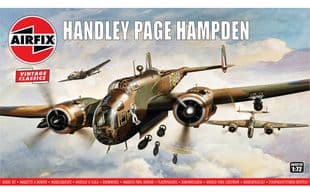
Full Vintage Classics artwork presentation for the new Handley Page Hampden kit.
We are afraid that's all we have for you in this latest edition, but we will be back next Friday with more project development updates and the very latest Airfix kit exclusives. In the meantime, we are always keen to hear your views on all things Airfix and in particular, any thoughts and opinions you may have regarding our Workbench blog. If you would like to drop us a quick line, could we please ask that you use our workbench@airfix.com email for all correspondence.
To re-visit any of the Airfix blogs we have produced over the past seven years or so, please head to our main Workbench hub, where you will find our entire blog back catalogue and all the Airfix design projects we have already covered.
All our dedicated official social media sites can be accessed by clicking the respective link icons at the foot of this page, or by heading to the Airfix homepage. Other useful Airfix links are:
Facebook, YouTube, Twitter and Instagram official sites
Please join us for more Airfix updates next week and thank you for your continued support.