

Although we're already five days into 2024, we can't embark on a new year of blogging activities without first taking this opportunity to wish each and every one of our readers a very happy and prosperous New Year, in the hope that we find you all well rested and well fed after the Christmas holidays. We have much planned for Workbench readers over the coming twelve months and as always, you can be certain that we will be sharing all the latest new model update exclusives just as soon as we're in a position to do so, so in that regard, it's very much business as usual for us. We also have exciting plans for a new modelling focussed addition to the Airfix website over the coming weeks and can't wait to share these details with you.
For this first edition of the year though, we don't intend to overload you with new information, as this will be coming in next week's edition - more on that a little later. Instead, we will be preparing for the arrival of several highly anticipated new kits which featured in bog updates towards the end of last year, starting with a kit which is already looking like being one of the most popular of the year, even though we're only a couple of days into it, our 1/48th scale Royal Air Force Blackburn Buccaneer kit. Although we couldn't include details at the time, those modellers who placed their orders via the Airfix website will find a little something extra in their Buccaneer kit when it arrives, a little limited edition something which will add much to the displaying of your finished kit.
In addition to bringing you these details, we have an important impending date to share with readers, the most enjoyable way with which to start every new year, the latest Airfix range launch. All timing details will be included later in the blog, but you won't have to wait long now - in fact, this is your final pre-2024 range launch weekend, so you'd better get all those decorations down in preparation!
Right then, let's get cracking on another year of Workbench updates.
We start a new year of Airfix modelling with news that the highly anticipated new RAF Buccaneer kit is now available and for the first 500 web orders, there is a little something extra for modellers!
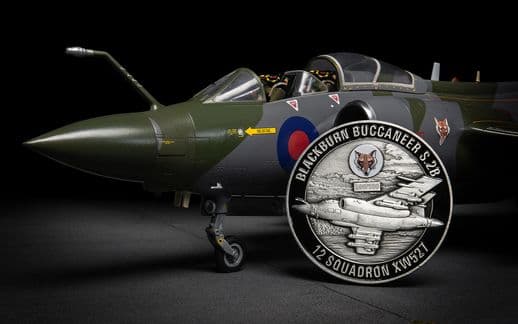
With the second release from our relatively new 1/48th scale Blackburn Buccaneer tooling already causing a major stir within the modelling community, news circulated earlier this week confirming that those pre-ordering the kit via the Airfix website can look forward to an exclusive and highly collectable addition will have only served to increase excitement levels still further. A web exclusive addition, the first 500 to order this new model will receive the latest in our series of collector coins, one which this time commemorates the Blackburn Buccaneer's Royal Air Force service and specifically XW527, the aircraft which has been immortalised as the lead scheme option of the four included with this new kit.
The coin itself features a representation of the magnificent box artwork produced in support of this impressive new kit release and in addition to including the wording Blackburn Buccaneer S.2B 12 Squadron XW527 around the raised Buccaneer detailing, also includes a representation of RAF No.12 Squadron's crest, a colourful foxes head, along with its limited edition release number.
A collectable call to action. The first 500 Buccaneer web orders will include one of these beautiful collector coins, but only whilst stocks last.
The adoption of the foxes head on No.12 Squadron's crest dates back to the 1920s, when the unit was selected to operate the sleek new high performance light bomber, the Fairey Fox. A beautiful aeroplane which represented the pinnacle of biplane technology at the time, the Fox was fully 50 mph faster than the aircraft it replaced in service and was actually as fast as the RAF's fighter aircraft of the day. Honoured to be chosen to operate this impressive new aircraft, the decision to adopt the fox on the squadron crest was proposed by a member of the squadron during the late 1920s and subsequently authorised by King George VI in February 1937.
With No.12 Squadron ultimately proving to be the only RAF squadron to operate the Fairey Fox, their motto 'Leads the Field' and the use of the Foxes head motif acknowledges their association with this highly advanced aircraft and how they proudly operated the aircraft at a time of great advancement in the world of aviation technology. The Foxes head motif would go on to appear on some of the RAF's most significant aircraft in the years which followed, as No.12 Squadron were also associated with such types as the Fairey Battle, Vickers Wellington, Avro Lancaster, English Electric Canberra, Avro Vulcan and between 1969 and 1993, the Blackburn Buccaneer. Today, No.12 Squadron operate the Eurofighter Typhoon FGR4 out of RAF Coningsby in a joint UK-Qatari training role.
As this collector's coin is directly linked to the lead scheme of four options included with this new kit, it's probably worthwhile revisiting details of this scheme options one final time.
For an aircraft the Royal Air Force didn’t really want, the Buccaneer proved to be an exceptionally capable machine and by the time it was eventually scheduled for retirement, they were extremely reluctant to let it go. Although in truth they did end up with the naval aircraft they had originally dismissed, it didn’t take long before the camouflaged Buccaneers of the RAF began to show why this was definitely not a second choice aircraft type in any way.
One of the most impressive attributes the RAF's new Buccaneers possessed was their great inherent strength, with the fact that these aircraft had been designed specifically to withstand the rigours of operation from the deck of a small British aircraft carrier only serving to enhance their land based operability. The Buccaneer was very much at home when operating at low altitude and at high speed, with the aircraft being extremely stable in this environment, providing both pilot and navigator with a great deal of confidence in their mount. As a team, a Buccaneer crew worked as one, ensuring that the workload was shared, but always placing their aircraft in the optimum position from where to launch an attack, if required.
New built Buccaneers for service with the Royal Air Force benefited from an enhanced maritime strike capability, with the ability to carry both anti-radar and anti-shipping missiles, specifically as the retirement of the Royal Navy's large carriers meant that they would now be required to provide surface vessel protection for the Navy from shore bases. These aircraft could deliver both the Martel anti-radiation and Sea Eagle sea-skimming anti-shipping missiles, both of which were stand-off munitions and fired at quite some range from its target, thus greatly increasing the survivability of the attacking aircraft. These new build Buccaneers for the Royal Air Force carried the variant title S.2B, however, former Fleet Air Arm Buccaneers which went on to serve with the RAF would also undergo some limited upgrade rework and were subsequently referred to as Buccaneer S.2As. Around 36 former Fleet Air Arm Buccaneers would be converted to this standard.
A little collectable Buccaneer addition, is there a better way to start a new year of modelling than with the latest addition to our collectable coin collection?
The Buccaneer coin will make for a great addition to any built model collection.
Buccaneer XW527 was one of the first newly built aircraft produced for the Royal Air Force, delivered at the end of June 1970 and going on to enjoy a long and successful service career. A quick internet search for this aircraft will reveal a large number of images which confirm her status as a particularly hard working RAF Buccaneer, from taking part in the 'Lime Jug 70' exercise in the November of her delivery year, to taking part in the Queen's Silver Jubilee review at RAF Finningley at the end of July 1977.
She is presented here in the attractive wrap around camouflage scheme adopted by so many Buccaneers in RAF service, a scheme she was still wearing when the last RAF Buccaneers were withdrawn from service in March 1994. Although she is presented in the colours of No.12 Squadron in this scheme option, the last pictures of the aircraft at RAF Lossiemouth have it wearing No.16 Squadron markings, another of the RAF units which operated the Buccaneer extensively. She definitely represents one of the longest serving and hardest working of all the RAF's Buccaneers.
It's thought that the nose section of this aircraft remains in good order, the prized possession of an Italian aviation enthusiast.
Although this exclusive collector coin is undoubtedly going to be of interest to a great many people, it's important to confirm that this is a limited edition run of just 500 coins and once they're gone, they're gone for good. Only available with 1/48th scale RAF Buccaneers purchased via the Airfix website, those who pre-ordered their kit prior to this announcement being made can rest assured, as they will have one of the coins included with their order, assuming stocks are still available. As the announcement went live at 10am last Tuesday morning, the coins may well have all been snapped up by the time this edition of Workbench is being published, but should their be any still available, please head over to the RAF Buccaneer product page to see if you're in time to secure one for yourself.
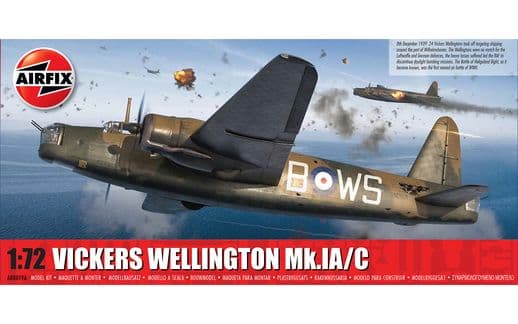
A selection of kits previously covered within Workbench are scheduled to become available during the first few days of the new year, including this beautiful Heligoland Bight Wellington.
As shipping schedules can become a little disrupted in the lead up to the Christmas holidays, we're delighted to now be able to confirm that an impressive formation of new model kits are about to show as being in stock on the Airfix website, in addition to gracing the displays of model shops around the world. All four of the new model arrivals have featured in previous Workbench updates, but by way of a new year introduction and just prior to the madness of range launch week, let's take a look at all four of the new kits now.
During the early stages of the Second World War, a restructuring Bomber Command could call on the services of 23 operational squadrons, but just 280 aircraft with which to demonstrate British fighting resolve in the face of German aggression across Europe, even though they still had to develop effective tactics on how to achieve this. Early raids had proved relatively ineffective and crews were under strict instructions at that time not to launch attacks against any targets where civilian casualties may be inflicted, no matter how tempting the target.
It was under these conditions that a significant raid was attempted on 18th December 1939, an armed reconnaissance mission against German naval targets in the Heligoland Bight/Wilhelmshaven area, attacking and sinking any enemy warships they encountered. The raid would consist of 24 Vickers Wellington bombers from three squadrons, nine aircraft from No.9 Squadron, six from No.37 Squadron and nine from No.149 Squadron, with all aircraft taking off from their respective bases at around 09.00hrs to form up over the North Sea. Two aircraft developed technical problems and returned to their bases quite soon after take-off, leaving 22 Wellingtons to carry out the mission.
Whist the Wellingtons were forming up over the North Sea, German ground controllers were watching their every move on the latest variant of their Freya early warning radar equipment and immediately passed details on to Luftwaffe fighter units in the area. Although the British bombers didn't manage to spot any German vessels in the open ocean, they could clearly see several large warships in the vicinity of Wilhelmshaven itself, however, the strict rules of engagement by which they were bound and the risk of civilian casualties prevented them from launching an attack.
This didn't prevent the aircraft from coming under fire from both Wilhelmshaven's impressive anti-aircraft defences and indeed the guns of the warships in harbour and by the time the aircraft turned for home, many had already suffered damage, with the onslaught resulting in the formation becoming separated.
The beautiful box artwork features a Wellington which sustained heavy combat damage during the Battle of Heligoland Bight and was forced to make an emergency landing at RAF North Cotes.
Unfortunately for the Wellington crews, things were about to get much worse for them. A significant Luftwaffe fighter force of around 45 aircraft, a mixture of Messerschmitt Bf 109 and Bf 110 fighters soon pounced on the British bombers, subjecting them to repeated attacks over the next few minutes and by the time they disengaged, they had left a scene of utter devastation behind them. Ten of the Wellingtons had been shot down and two more would be forced to ditch into the sea within minutes, their fuel tanks ruptured by machine gun and cannon fire. Of the ten aircraft which did manage to make it back to Britain, many were so badly damaged that they had to put down at the first airfield they came across and would not be available for operations for weeks to come.
The raid itself was a complete disaster for Bomber Command and particularly costly in terms of both crew casualties and the number of aircraft lost. Of the 22 Wellingtons which headed out over the North Sea, ten were shot down, two ditched in the sea and a further three crash landed once back over British soil, with 57 airmen losing their lives and a further five becoming POWs. German causalities were two Messerschmitt Bf 109s lost, but no damage of any significance to any of the warships sighted during these actions.
As a result of this sobering 68% loss rate, Bomber Command initiated a complete change in their attack tactics, accepting that their bombers were clearly unable to defend themselves against enemy fighter attack by daylight, therefore switching their bombing raids to night-time operations. In addition to this, their Wellington bombers were given improved armour protection, more defensive firepower and self-sealing fuel tanks, all increasing the survivability of the aircraft, but further increasing their overall weight in the process.
The Wellington was such an important aircraft to Britain's war effort during WWII and this relatively new kit serves as a fitting tribute to its aviation legacy.
Vickers Wellington N2871 was one of the nine RAF No.9 Squadron bombers which took part in this heroic, yet ultimately disastrous raid against surface vessels at Wilhelmshaven. Already damaged by anti-aircraft fire over the target area, the bomber's crew fought valiantly against the incessant Luftwaffe fighter attacks they were subjected to over a frantic period of around 20 minutes and unable to make it back to their home base at RAF Honington, would make a successful landing at RAF North Cotes.
Once the aircraft was on the ground, personnel at the airfield must have been amazed at the level of damage this aircraft had suffered, yet continued to fly on, bringing its airmen home to fight another day. Several photographs exist which show this aircraft having landed at North Cotes, with significant damage evident to both wings and the fuselage, with large sections of the aircraft's structure exposed. Although serving as sobering evidence of the onslaught those Wellington crews were forced to endure during the Battle of Heligoland Bight, they also underline the effectiveness of the Wellington's geodetic construction and specifically, just how much punishment this ingenious structure was able to withstand.
North American B-25C Mitchell, 'OH-7' 41-13207, 445th BS/321st BG USAAF, French Morocco, 1943.
The hard working Mitchells of the MTO were tasked with operating strike missions against a wide variety of enemy targets across North Africa and the Mediterranean, including artillery and anti-aircraft emplacements, command and control infrastructure, shipping, military vehicles and enemy airfields, usually at relatively low altitudes and always under heavy enemy fire. With American air units arriving in North Africa from the summer of 1942, it wouldn't be too long before the B-25 Mitchells of the 321st Bombardment Group joined them, with their aircraft having negotiated the long South Atlantic Ferry Route to get there. With staging points in the West Indies, South America, Ascension Island and Africa, this was a much longer route to fly that the Northern Route which arrived in Scotland and consequently, was significantly more expensive from a fuel perspective. They did, however, avoid facing the full might of the Luftwaffe by not transiting across Europe, as they headed for their new bases in the deserts of North Africa.
These aircraft were prepared for operations under desert skies by having their olive drab upper surfaces overpainted in a sand coloured paint finish, with their undersides benefitting from a lighter grey scheme than usual, however, once Allied advances had taken the B-25s onwards across the wider Mediterranean, additional camouflage mottling was often added to sand coloured aircraft, even though the increasing strength of Allied air power in the region rarely saw them operating without strong fighter protection.
Making their combat introduction on 15th March 1943, the bombers of the 321st BG attacked the airfield at Mezzouna escorted by a large force of P-38 Lightning fighters from the 57th FW. Although all aircraft returned safely to Aïn M'lila, they did encounter ferocious anti-aircraft fire around the target area, something crews knew they would have to get used to and fast!
The unit had its first encounter with enemy fighters whilst engaged in an anti-shipping strike just five days later, which was something else crews would have to get accustomed to. The bomber force was attacked by around 30 Axis fighters operating from their bases in Tunisia, however, the enemy appeared unaware that the Mitchell's defensive armament had recently been improved with the addition of higher calibre weapons. At least seven enemy aircraft were dispatched for the loss of just two bombers, with both of these being as a result of anti-aircraft fire, as opposed to enemy fighter actions. Not a bad start for the desert Mitchells.
Within a few short weeks, the battle of Tunisia had been won and the Allies now had their base from where offensive operations throughout the wider region could be mounted. The B-25 was quickly earning a reputation for both combat effectiveness and general survivability, something which would earn it the respect of air and ground crews alike. Indeed, the Mitchell proved so effective that Axis fighter units took to adopting drastic, if ultimately futile tactics, those of flying above bomber formations and attempting to drop bombs on them. As you might well imagine, results proved disappointing to say the least.
The 445th BS and wider 321st BG would go on to play significant roles in the invasion of Sicily and onwards into the so-called underbelly of Europe, as the Allies continued their sweep towards eventual victory.
A particularly attractive US 12th Air Force B25C Mitchell, this machine is representative of the first such bombers to arrive in North Africa and one which was destined to highlight the rugged, highly effective reputation this medium bomber would go on to earn. She was one of the original 445th BS Mitchells to make the long journey to North Africa from the US in February 1943 and would eventually be credited with completing an impressive 80 plus missions over a ten month period. On 13th January 1944, this aircraft would suffer multiple flak strikes during its latest combat mission, rupturing hydraulic lines and making a forced landing back at base inevitable. Although the pilot performed a textbook wheels up landing, this aircraft, one of the oldest still flying with the unit, would not take to the skies again following the incident.
The flamboyant nose artwork applied to this B-25 was unusually carried on both sides of its fuselage and presumably references some form of gambling or perhaps one of the crew's lucky number. If we’re a little wide of the mark in this assumption, perhaps one of our knowledgeable readers could shed some light on the subject for us.
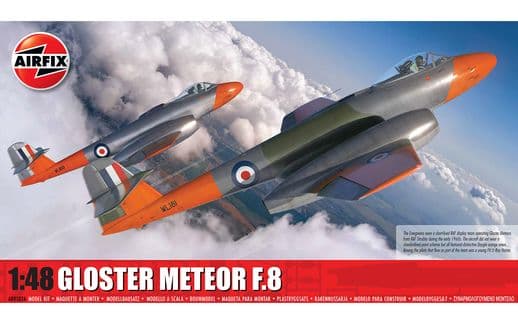
Gloster Meteor F.8 WL181, Evergreen Display Team, College of Air Warfare, Royal Air Force, 1963-64.
The Meteor F.8 was arguably the most effective variant of Britain’s first jet fighter, and for five years following its service introduction in 1950, would form the backbone of the RAF’s fighter defence force, a jet powered equivalent of the Spitfire’s which had protected Britain’s skies during the Battle of Britain just ten years earlier. With 1,183 aircraft eventually built, the F.8 was both the final single seater fighter variant of the Meteor and the most heavily produced, arguably making this one of the most important British aircraft of the post war era.
For all the aircraft’s many positives, it also has to be acknowledged that the Meteor’s introduction was not without some challenges, and it would be forced to endure something of a troubled service record. With the adoption of new technologies, pilots had to quickly make the transition from powerful piston powered fighters to jet powered flight and whilst this offered many operational improvements, management of the jet engines proved extremely challenging for pilots, and in some instances, fatal.
Despite careful management of the transition from piston to jet power, the sluggish responsiveness of the engines to pilot power input requests during take-off and landing resulted in the Meteor gaining an unwanted reputation, with many pilots misjudging these vital phases of flight with their lives. During its Royal Air Force service, almost 900 Meteors would be lost as a result accidents, with its poor safety record resulting in pilots and ground crews giving the aircraft the rather terrifying nickname of ‘The Meatbox’.
Gloster Meteor F.8 WL181 was one of the final batch of F.8 variant Meteors produced by Armstrong Whitworth at their Baginton factory during early 1954, with serial allocations issued from WL158 to WL191. She was subsequently delivered to the Royal Air Force at No.20 MU Aston Down at the end of May the same year in preparation for service acceptance and by the summer, had joined the Station Flight at RAF Tangmere and the start of a seventeen year RAF career. In addition to spending time with No.34 Squadron, it appears this aircraft also spend quite some time in the care of various Maintenance Units across the country, although records as to why she made so many visits are hard to come by.
In March 1960, WL181 joined the aircraft assigned to the Collage of Air Warfare at RAF Manby in Lincolnshire, an important location for some of the most accomplished minds in the Royal Air Force at that time. With concurrent courses running to prepare senior service personnel for the next stage of their careers, training other pilots and navigators in the most technical and demanding areas of their craft, Manby was a location for the RAF's elite and whilst flying did take place at what was an extensive base complex, the emphasis was very much on knowledge and the best instructing the best.
Full scheme details required for those intending to finish their Meteor as an Evergreens display aircraft.
With some of the RAF's most accomplished airmen spending time at Manby, it will come as no surprise to learn that the station also boasted its own aerobatic display team, 'The Evergreens' and whilst not much is known about the team and the reason for its name (was it made up of seasoned veteran pilots), it is known that Gloster Meteor WL181 was one of the aircraft assigned for their use. The team represented the College at Airshows and events around the country quite extensively between 1962 and 1964, and it's thought that three Meteors were used, each one wearing slightly different interpretations of RAF fast jet training colours of the day. One interesting fact is that renowned display pilot Ray Hanna, former leader of the Red Arrows and a man who would later be known as the world's finest Spitfire display pilot, was one of the Evergreen Display Team pilots whilst stationed at Manby.
Meteor WL181 would end her RAF career as one of the aircraft on charge with the Advanced Jet Refresher Squadron at nearby RAF Strubby, until retired to No.5 MU at Kemble in the summer of 1965. She was finally struck off charge in November 1971 and sent to RAF Acklington, where she was destined to be used as a winching load for the Westland Whirlwind helicopters of RAF No.22 Squadron.
It didn't take long before the aircraft was seen languishing on the fire dump at Acklington and with the closure of the base in 1974, her future seemed bleak to say the least. Thankfully, WL181 was purchased by the North East Air Museum before she could be scrapped and in May 1975, was dismantled to make the short journey to the museum site and a much brighter future. The aircraft is now in fine condition and lovingly cared for by the staff and volunteers at the North East Land, Sea and Air Museums, on the site of the old RAF Usworth and Sunderland Airport.
This handsome scheme option is certainly an unusual one for our 1/48th scale Meteor kit to wear and certainly begs the question, 'Could this have been one of the aircraft flown by Ray Hanna during his time with the Evergreens?'
Vintage Classics Fairey Rotodyne
The technology behind the striking Fairey Rotodyne was as impressive as it was exhaustively tested, particularly as the design team were only too aware of the fact that they must satisfy the strict CAA safety parameters placed on aircraft operating over city centres and areas of large populations if it were to realise its full potential. Clearly, power and stability were going to be major considerations for the new aircraft, but how they went about achieving these proved to be particularly impressive.
The extensive use of stainless steel throughout the design and manufacturing process was a particular feature of the Rotodyne and whilst the massive rotorhead unit certainly appears to be a complex piece of engineering, it was actually simpler in design than the units used on a traditional helicopter. Installed as a complete unit assembly, the ethos behind this major component was how it should allow for reliable and relatively maintenance free operation, ensuring the aircraft was in the air and earning money, as opposed to being in a hangar undergoing maintenance attention.
The prototype aircraft used two Napier Eland turbine engines with a maximum rated power output of 2,805 shaft horse power, both driving mighty four bladed Rotol propellers, which had an impressive diameter of 13 feet. These units also drove auxiliary compressors which fed compressed air along the length of the main steel rotor blades to tip mounted pressure jet units at their extremities, units which were powered up during both take-off and landing.
The fuselage of the Rotodyne was cavernous and unobstructed, meaning that not only were passengers transported in a certain level of comfort, but how it could also be used to carry a decent amount of freight cargo internally, using the large clamshell doors at the rear, or slinging larger and unconventional loads externally. With the rich, famous and influential being targeted as potential customers, it was advertised that their favourite car might also accompany them on their journey, so large was the aircraft's configurable hold. Exhibiting a high degree of controllability and with significant loads able to be carried, the commercial and military potential of the Fairey Rotodyne appeared almost endless.
Making its first flight on 6th November 1957, the Rotodyne immediately showed great promise, with its impressive handling characteristics and the ability to operate in all weather conditions being particularly noteworthy. As an exhaustive test and evaluation programme followed, the aircraft would go on to meet and surpass all the stringent safety requirements the aircraft had to satisfy, even capable of operating and safely landing on just a single engine if required. With a growing number of suitors registering their interest in the aircraft, both in Britain and in the US, the future was looking bright for the distinctive Fairey Rotodyne and Britain surely had yet another aviation success story on their hands.
With the new aircraft becoming something of a public relations phenomenon, the development team behind it were keen to show the Rotodyne to as many people as they possibly could, becoming increasingly confident in the capabilities of the aircraft and of its growing appeal. The aircraft managed to claim a world speed record for its classification type on 5th January 1959, the same year it performed with particular distinction at the massive Farnborough Airshow. In fact, the Rotodyne would go on to thrill and amaze many hundreds of thousands of spectators at respective Paris and Farnborough Airshows during its development programme and with the prospect of production aircraft actually being larger and featuring more powerful Rolls Royce engines, it only seemed a matter of time before the skies were full of Rotodynes.
All four models will no doubt be high on the build schedules of many a Workbench reader and as we mentioned previously, all four should be showing as in stock on the Airfix website by the time you're reading this update.
One of the few benefits of us all going back to work at the start of any new year is that we do so in the sure and certain knowledge that we are about to be transfixed by a spectacular new collection of Airfix model kits, with the launch of the latest Airfix range. Featuring a collection of new tooling projects, new scheme options and artwork for some range favourites and the return of some kit classics, range launch day usually sees the Airfix website struggling to cope with all the additional traffic, as thousands of people rush to take a first look at what kits might be tempting them over the coming months and if our designers have been hard at work producing a newly tooled example of their own favourite modelling subject.
Range launch this year will be taking place at 4pm on Tuesday 9th January, so things will hopefully have settled down by the time you get home from work, allowing you to spend a few uninterrupted minutes inspecting all the new kits we have in store for you throughout 2024. We will, of course, be posting a range overview edition of Workbench next week, where we will be taking a closer look at some of the significant additions to the range, before moving on to feature all the new tooling additions to the 2024 range in more detail over the next few months. By the time we have covered everything, we'll be ready for range launch 2025 - how time flies when you're an Airfix modeller!
With this being the case, it's time to set our alarms and phone reminders for 4pm on Tuesday 9th January and a first look at a new year of Airfix kit releases, not forgetting to secure your Buccaneer coin in the meantime. We look forward to seeing you back here next Friday, where we will be discussing all the new range launch delights in more detail.
We are afraid that's all we have for you in this latest edition, but we will be back next Friday with more project development updates and the very latest Airfix kit exclusives. In the meantime, we are always keen to hear your views on all things Airfix and in particular, any thoughts and opinions you may have regarding our Workbench blog. If you would like to drop us a quick line, could we please ask that you use our workbench@airfix.com email for all correspondence.
To re-visit any of the Airfix blogs we have produced over the past seven years or so, please head to our main Workbench hub, where you will find our entire blog back catalogue and all the Airfix design projects we have already covered.
All our dedicated official social media sites can be accessed by clicking the respective link icons at the foot of this page, or by heading to the Airfix homepage. Other useful Airfix links are:
Facebook, YouTube, Twitter and Instagram official sites
Please join us for more Airfix updates next week and thank you for your continued support.