Welcome to this latest edition of Workbench and all the news, updates and exclusive announcements from the fascinating world of Airfix modelling. We are proud to announce that this latest blog marks the 100th edition of Workbench and almost four years of bringing our readers exclusive announcements, features and updates from all the projects we have on the go here at Airfix. Quickly establishing itself as the most popular blog across the various Hornby websites, this reflects the current renaissance the modelling world is experiencing and how the Airfix brand continues to play an important role, both with the quality of the latest kits we are introducing and the modelling nostalgia associated with the Airfix name. Undoubtedly though, all this would count for nothing without the loyal support of our ever expanding family of Workbench readers, many of whom have been with us right from the start and have helped to spread the blog word amongst their fellow modellers – we would sincerely like to thank each and every one of you. We can clearly see that people all over the world are enjoying Workbench, with a growing number of readers also sending in their build reviews and interesting modelling stories for inclusion in future editions, features which are enjoyed by fellow modellers and Workbench readers. The first 100 editions was only the start and we look forward to bringing you much more engaging modelling content in the months and years to come – onwards to edition number 200!
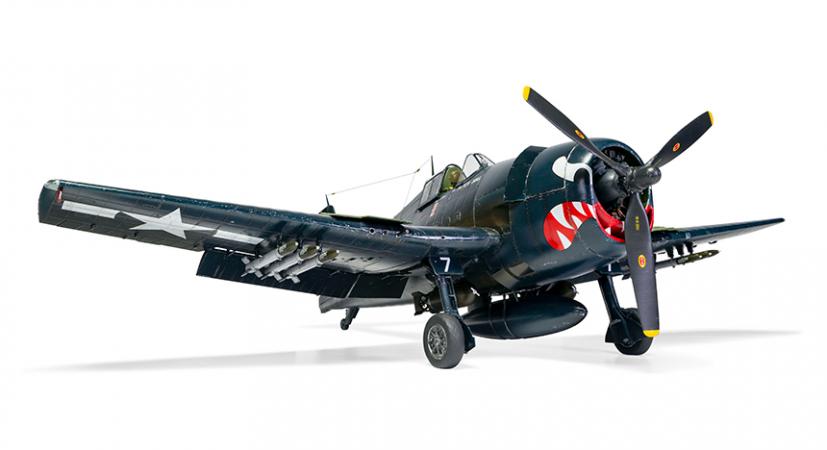
So, what do we have for you in this landmark centenary edition of Workbench? In truth, there really can only be one subject for such an auspicious occasion and that is how we took the most famous piston powered product of Grumman’s famous 'Iron Works' and immortalised it as a 1/24th scale, highly detailed model kit. In a feature positively bristling with exclusive imagery, we go back to the very start of this project to bring you early development details, comments from the project designer responsible for producing the Hellcat and an impressive series of beautiful Hellcat build images, which are being published for the very first time and will only serve to raise our excitement levels about the impending release of this stunning kit. Not yet finished with Hellcat exclusives, we bring you confirmation of the coordinated release date for this new model, as well as offering one lucky reader the opportunity to own one of these fantastic kits before anyone else gets their hands on one! We are immersing ourselves in all things Grumman Hellcat in this centenary edition of the blog, so let’s get straight in to the action.
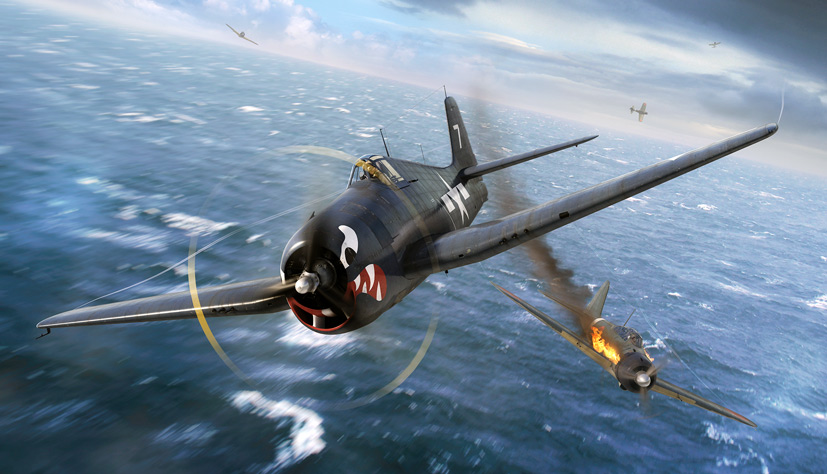
The Pacific air war during WWII effectively centres around the fortunes of two famous fighting aeroplanes, the Japanese Mitsubishi A6M Zero and the American Grumman F6F Hellcat. Following its introduction during the summer of 1940, the A6M Zero proved to be one of the most capable fighter aircraft in the world at that time, possessing speed, firepower and range, all vital attributes for an aircraft which would need to operate over vast expanses of ocean, Without doubt, its most impressive feature was the Zero’s unrivalled combat manoeuvrability, with its lightweight design making this arguably the most proficient dogfighter of the war. Operated by both Naval and Army Air Force units, the Zero ruled the skies over the Pacific for almost three years of fighting and when America was dragged into the conflict following the attack on Pearl Harbor, they quickly learned that their current naval fighters were no match for this agile Japanese fighter. Holding the line until more effective fighter aircraft could be introduced, the diminutive Grumman Wildcat was a well-built and extremely rugged aeroplane, but was at a definite disadvantage when engaging in combat with the Zero, however, US Navy pilots quickly learned not to tangle with the Japanese fighter on its terms, which was a tight turning dogfight and instead adopted high speed ‘slash and run’ tactics, which gave them a greater prospect of success. Whilst brave US Navy pilots attempted to halt Japanese advances in the region, Grumman engineers were already at an advanced stage of providing them with a new aircraft with which to take on the Zero.
The arrival of the new Grumman Hellcat fighter in the Pacific Theatre coincided with a significant change in military direction for the US Navy. Whereas the mighty Battleships of the world had previously ruled the oceans, America pinned her future military success in the region on the back of their new Essex class carriers and their associated air wings, which included the widespread introduction of the new F6F Hellcat, arguably the most effective fighting aeroplane of the Second World War and certainly the right aircraft for the job at hand. Maintaining their impressive criteria for naval aircraft design, what the Grumman engineers managed to produce was an aircraft which was ideally suited to the rigours of combat from the decks of aircraft carriers and operations over large expanses of ocean. Extremely tough and reassuringly reliable, the F6F Hellcat was powered by the mighty Pratt & Whitney R-2800 Double Wasp, a new and beautifully engineered powerplant which gave the aircraft an impressive top speed of around 400mph. With better range, speed and armament than its predecessor, the Hellcat would prove to be a nightmare for Japanese pilots in the Pacific, especially if they made the fatal error of mistaking it for the Wildcat they had been used to fighting previously. The new aircraft was also much more than just a ‘big Wildcat’, even though its similar profile may lead many to think that was the case. This was a completely redesigned aircraft in every respect, from its massive new engine to the rugged, wide-track undercarriage which made deck handling much more assured than with its predecessor – significantly, the Hellcat was 60% heavier than the Wildcat and a true fighting thoroughbred.
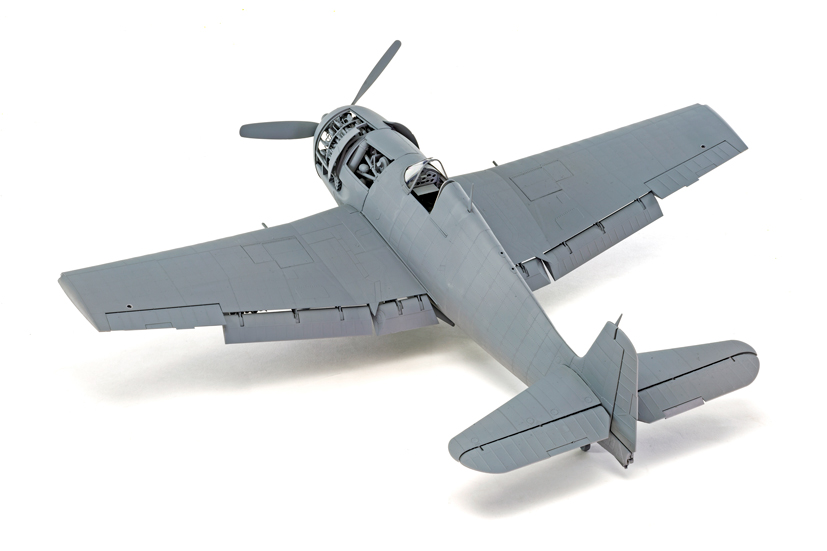
As the new Hellcat model was announced well into its development programme, we were able to show test build images such as this from the date of project announcement
Occupying a unique position in the history of military aviation, the F6F Hellcat has long been a source of fascination for enthusiasts and modellers and the announcement that we had already started a new tooling project to produce a highly detailed 1/24th scale kit of the aircraft was the cause of great excitement within the hobby. As we had been working on the Hellcat for quite some time before its official announcement at last year’s Telford Scale ModelWorld show, we had quite a lot of detailed and rather advanced project information to share at that time, with much of the initial research and development detail effectively bypassed. As this is such a significant project for the Airfix team, we thought it important to share this information in advance of the new model’s release, as this helps to tell the full story of how a relatively small team of Airfix professionals immortalised this aviation classic as a 1/24th scale model kit, the latest addition to our popular range of large scale aircraft models.
When the Workbench blog has the opportunity to announce a new Airfix tooling project, we would ordinarily begin by featuring the research phase of the project, hopefully also including some of the initial CAD screenshot images produced by the project designer responsible for the model in question, as he converts actual aircraft engineering data into files suitable for the production of scale model tooling and the injection moulding process. In the case of our new Grumman F6F-5 Hellcat announcement, we deviated from this time honoured format somewhat, primarily because this was a relatively mature project and at the time of its Scale ModelWorld 2018 unveiling, we actually had a fully built and painted sample model to show people, along with several test build section constructions on display. As we were already quite some way into the development of the Hellcat, the earliest stages of the project have not been covered until now.
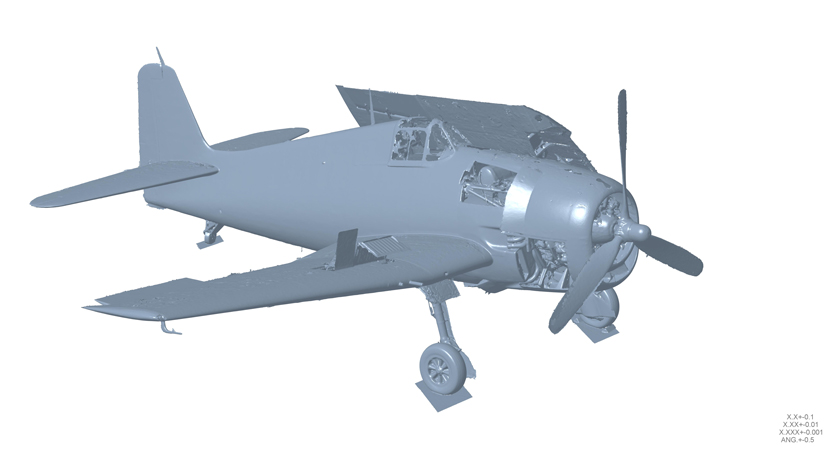
For such a significant project as the Hellcat, our lead researcher arranged to scan a preserved example of the F6F-5 variant of the aircraft, at a museum in North America
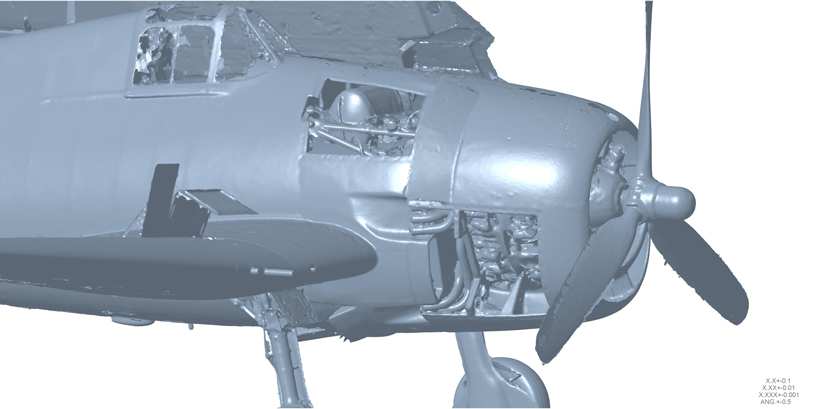
The LIDAR scan gives the development team access to an incredible amount of detail, however, this only signifies the beginning of what will be an extremely lengthy project for the design lead
The 1/24th scale Hellcat project started back in 2014, when the Airfix development team began discussing options for a potential new subject for their largest aircraft kit scale. With recent 1/24th scale projects such as the de Havilland Mosquito and Hawker Typhoon raising the modelling bar in terms of detail and accuracy, the team were once again looking to present modellers with a stunning kit featuring one of the world’s most famous aircraft, but which one should they do? With thousands of modellers only too keen to offer their own individual new tooling suggestions each year at the Telford Scale ModelWorld show, the team have a clear indication of what will be popular subjects and when combined with their own unrivalled industry experience, you can be sure that whatever they select will be a fine addition to the range. As one of the most important aircraft of the Second World War, the Hellcat will have been a popular choice for many, whilst clearly not appealing to everyone – unfortunately, that just goes with the territory when Airfix announce any new model tooling project.
Despite a combat introduction which took place relatively late in the war, the Hellcat would go on to be referred to as the ‘mount of aces’ as it wrestled superiority of the skies above the Pacific from the Japanese Zero during a frenetic two years of fighting. Posting some quite astonishing combat statistics, it has been reported that almost 75% of all aerial victories claimed by US Navy pilots were attributed to the Grumman Hellcat, which earned an impressive combat kill ratio of 19 to 1 in the Pacific Theatre. Although combat claims can be notoriously difficult to corroborate during times of war, this meant that on average, nineteen enemy aircraft were destroyed for the loss on a single Hellcat, a statistic which could not be bettered by any other combat aircraft in WWII. Perhaps most significantly, the Hellcat made ‘Aces’ of no fewer than 305 US airmen, as this rugged and reliable fighter helped the Allies clear Pacific skies of enemy aircraft and speed them towards a hard fought victory. Obviously, the Hellcat’s naval aviation heritage allowed for some distinctive build options to be included in the new kit, as well as having wide international appeal for an aircraft type which saw service with the US Navy, US Marine Corps, Fleet Air Arm and French Navy.
Once the Hellcat had been selected as the subject aircraft, our Lead Researcher set about his task of securing as much information as he could in support of this project, in order to help his design colleagues with what was clearly going to be a challenging undertaking. He was fortunate enough to be granted access to original manufacturing drawings, as well as arranging to scan a suitable aircraft, which is part of the Flying Heritage Collection in Seattle. All this information was passed over to the Airfix designer on the Hellcat project, Chris Parker-Joy, who opened his F6F-5 files in August of 2015 and began to supplement the supplied research material with additional information he felt would help him during the project. He would also have the opportunity to inspect Hellcat II (KE209) on several occasions (which is on display at the Fleet Air Arm Museum), taking a great many detailed pictures during his visits and having the ability to check various aspects of the internal workings of the aircraft. All of this detailed research information would be put to good use over the months which followed, as Chris turned digital data, drawings and photographs into a highly detailed scale version of this classic American fighter.
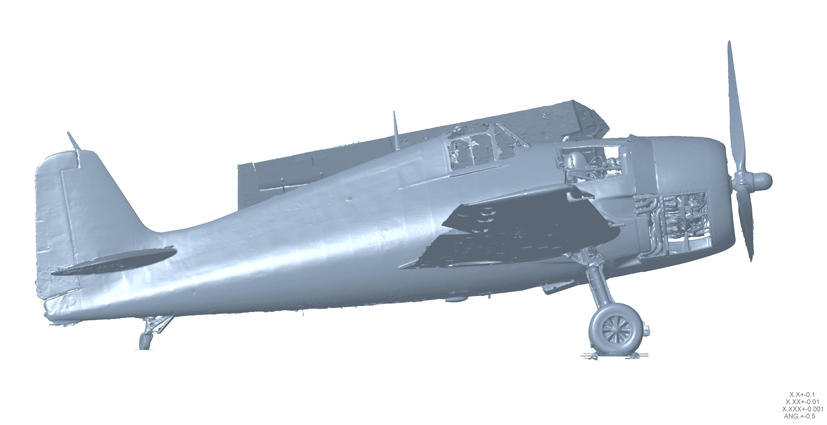
This scan image shows the Hellcat displayed with one wing in its stowed position and several of the access panels removed
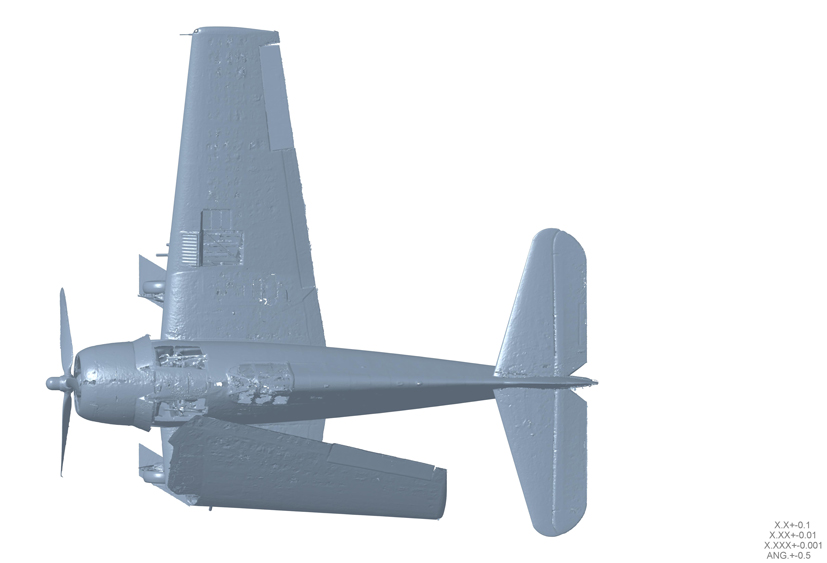
Top down scan view of the Hellcat, again showing the port wing folded back and the gun access panels opened
Over the years, we have covered the various stages of new Airfix model tooling development in some detail within Workbench, so we are purposely going to be a little light on technical detail within this feature, using exclusive project images to tell the story, as opposed to long paragraphs of detailed descriptions. Should you wish to read a little more about these stages, all previous editions of the blog are available via the community section of the Airfix website – you will easily be able to find the editions containing new tooling information.
As impressive and accurate as LIDAR scan data unquestionably is, receipt of this information only represents the starting point for any Airfix new tooling project and signifies the start of an intense period of activity for the designer responsible for the project. As detailed as this information may be, it is not available in a format which can be used by the CNC milling machines which will eventually be used to produce the model tooling blocks themselves and must be converted using more clever software and lots of design experience. Using the LIDAR scan data as a hollow outline, the designer, Chris, needed to create a 3D CAD version of the information, which served as a base model shell, from which all the individual components of the kit can be produced and allowing every aspect of their design to be assessed and perfected. As this is a 1/24th scale kit, Chris knew that he would be able to incorporate much greater levels of detail into this project than is possible with smaller scales, following the actual construction details of the Hellcat much more faithfully. Using the base model shell as his project datum, his first task was to create a fuselage skeleton, using plotted data from the manufacturing drawings and following where the natural construction formers were placed by the Grumman engineers back in 1942 when producing the actual aircraft. Once this early shape data had been completed, Chris will then set about adding all the many component areas of the model in their correct locations, even though they do not feature any detail at this point. Once everything is positioned to his satisfaction, Chris can begin focusing on all these individual areas and to start adding detail – producing this skeleton model will take him several months to produce.
As crucial as the creation of the skeleton model undoubtedly is, the feature most readily associated with Airfix 1/24th scale kits is detail and Chris spent many hours in front of his computer, using all the reference material available to him, incorporating as much fine detail into the Hellcat CAD files as he possibly could. Taking his guidance from the actual construction methods employed by Grumman during the development and manufacture of the real aeroplane, once the iconic shape of the aircraft had been accurately represented, it had to be de-constructed, for the want of a better description, producing individual components for plastic kit manufacture, whilst at the same time ensuring the highest possible levels of detail and accuracy were applied to each individual component. Significantly, each individual part has a construction relationship with a number of other parts around it. All the detail applied to each individual part is applied in layers, gradually building up until the designer is happy with the accuracy of the part, knowing that this will all have to be incorporated in the model tooling block itself and subjected to the injection moulding manufacturing process. For most modellers, we simply have no idea how complicated this design process must be for Chris and his Airfix colleagues, when we are enjoying our latest 1/24th scale build project and the sheer number of variables they must have to consider at every stage of this design work.
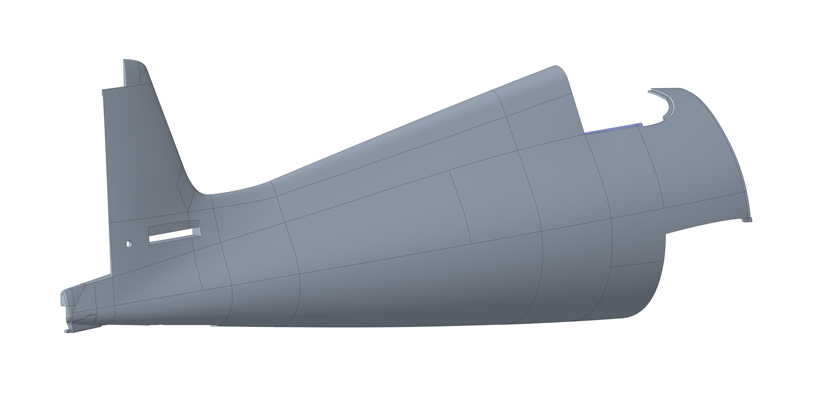
This next series of images help to illustrate how Chris developed this Hellcat fuselage side piece from the basic, accurate shape, gradually building up ‘layers’ of additional surface detail
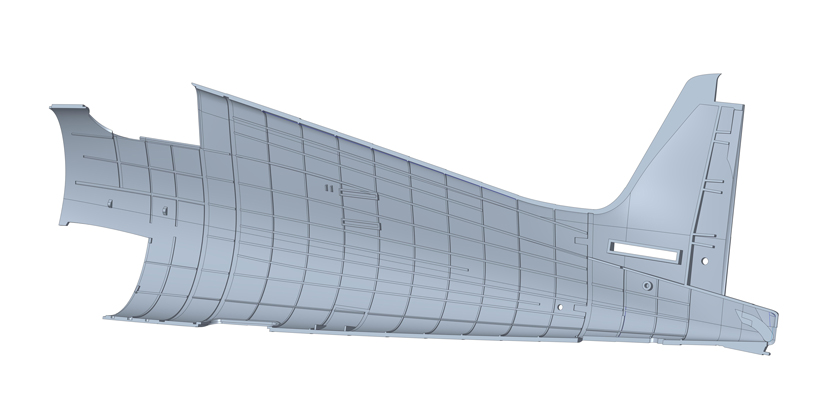
Internal detail showing the placement of fuselage ribs and stringers
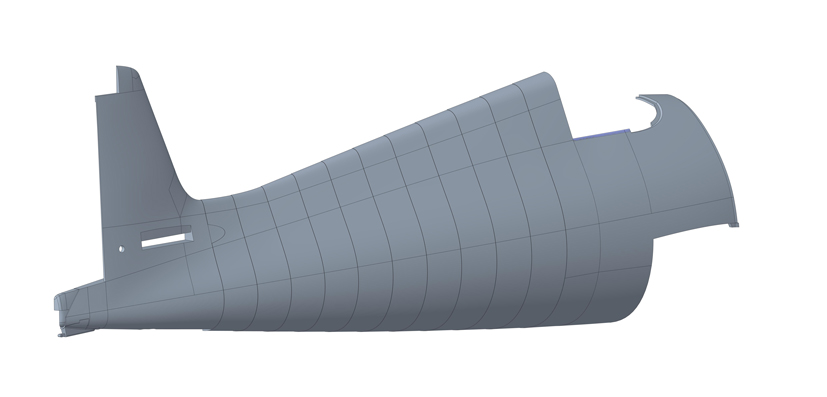
The process of adding additional surface detail has started in earnest
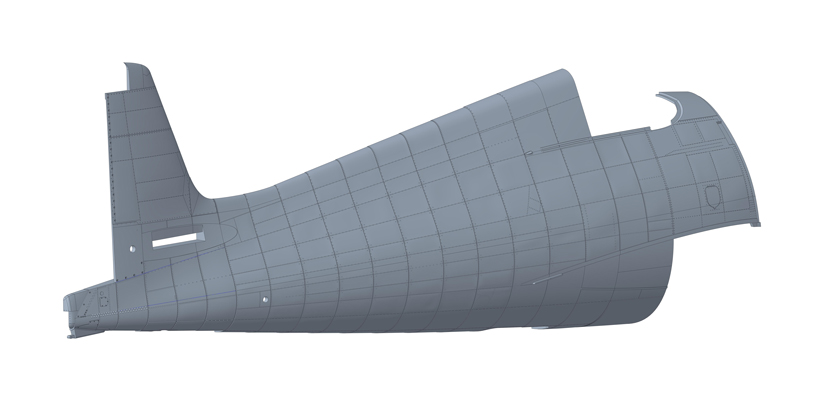
Looking much more like a real Hellcat, this image has most of the surface detail applied, including rivet and fastener detail
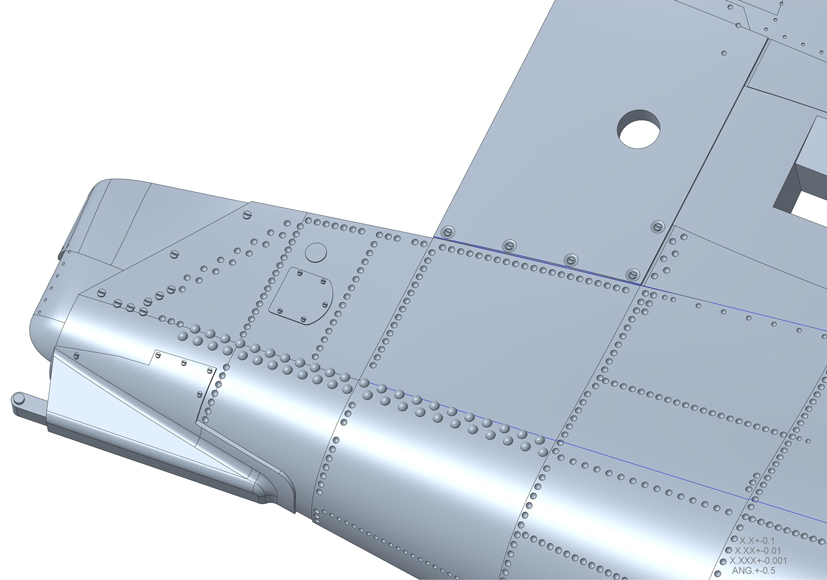
This fascinating screenshot clearly shows how Chris needed to accurately represent a multitude of different rivets and fasteners in the Hellcat’s development files
To help us gain a better understanding of this detail ‘layering’ process, Chris has kindly supplied us with this fascinating series of CAD screenshot images, illustrating how he gradually applied the detail to one of the fuselage sections of the Hellcat kit, starting with his basic shape, then gradually applying all the detail this size of kit allows him to incorporate. Modest to a tee, Chris failed to tell us that at this stage, he had already spent months perfecting the shape of the Hellcat, then breaking it down into kit component parts, ensuring that all the manufacturing formers, ribs and stringers were in their correct positions. Only after this work has been done, can he consider applying additional detail, embarking on many more months of painstaking computer work. The fuselage section images we have included show the base component part with very little surface detail initially, just panel lines which correspond to the placement of the construction formers. The next image shows the addition of more panel detail, with the third including surface detail, rivets and fasteners. As a final image to show how detailed this work can be, Chris has included a picture showing the final surface detail of the rear fuselage area, not only showing the panel detail, but also the number of different rivets and fasteners which had to be accurately represented – this is a quite astonishing image. We always like to ask product designers which aspect of the model they found most challenging or rewarding, when sharing their work on the blog for our enjoyment and quick as a flash, Chris came back with ‘Rivets’ – he described how this work seemed to take him so long and actually bordered on the tedious. He certainly feels that he is now a fully paid up member of the model rivet counters club.
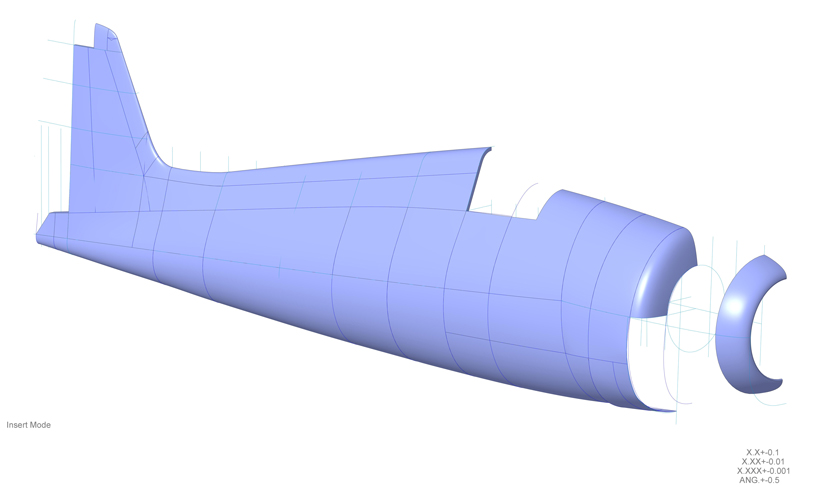
Moving on to the main fuselage components, this next series of images show how distinctive shape of the Hellcat was fleshed out with the gradual build up of internal component sections
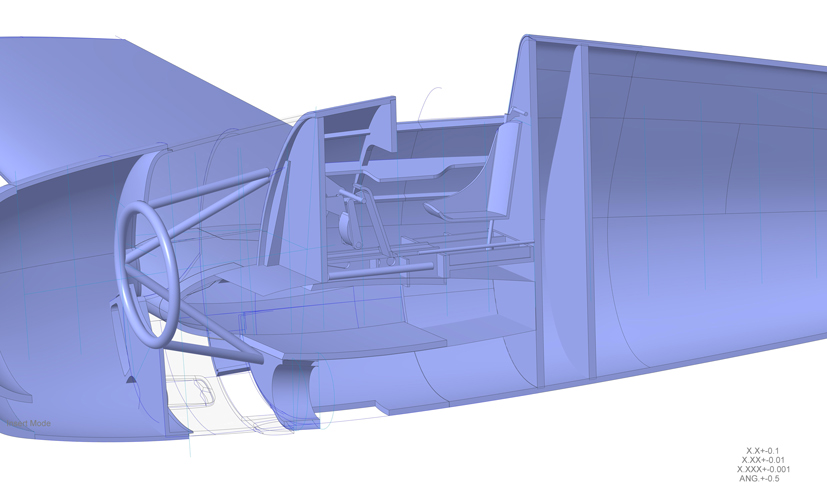
Even though detail is now gradually being added, at this stage it is still more about the correct placement of components
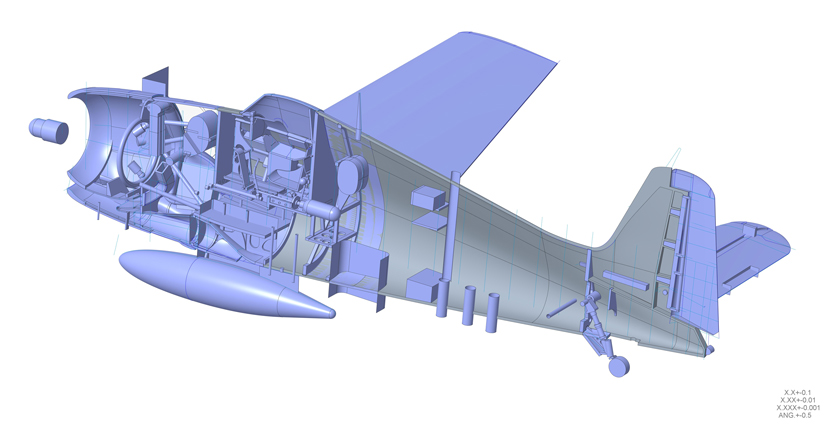
This fuselage ‘slice’ image shows the correct placement of components which will all need additional attention as the project progresses
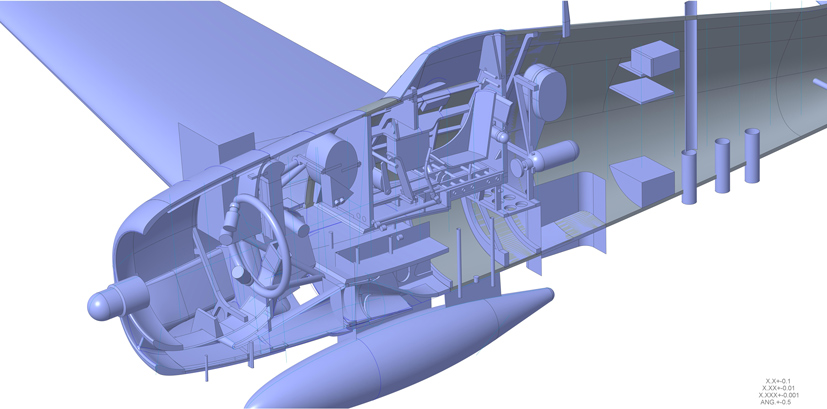
The front of the Hellcat as engine bearer and cockpit detail slowly begins to take shape
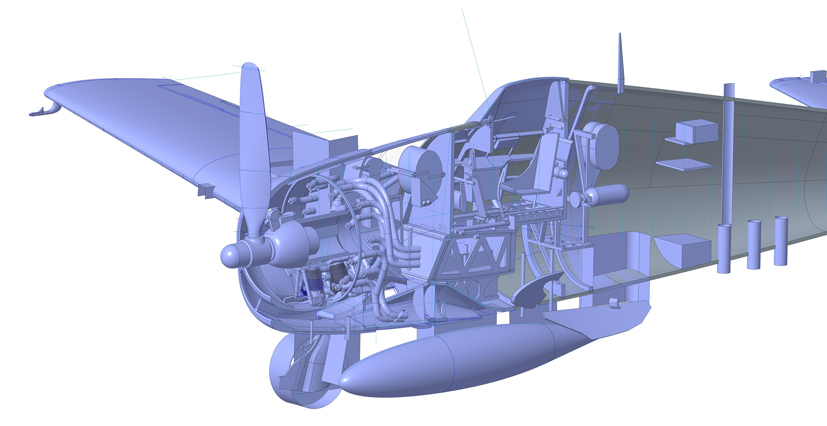
Chris can add and remove various sections of the CAD file to make his work a little more manageable, and this image shows the addition of further engine detail
This next fascinating selection of pictures provide a different view of the fuselage construction, beginning with an early stage fuselage skeleton image, which includes all the plot markings representing where natural construction formers are placed, using the scan data as an accurate shape datum. The second image shows how work has started on the placement of significant internal components, which will all have to be included in the kit and will later require their own exploded fine detail work – at this stage, it is more about placing the component sections in their correct positions, with further development work on them to come later. Subsequent images represent this gradual building up of fuselage information and how the various components relate to the overall shape of the Hellcat and connecting areas of its internal construction. Gradually, more components are added to the skeleton model, in preparation for the detail to be applied to individual sections of the aircraft and important features, such as the cockpit and engine. The image showing the full internal of the fuselage highlights all the areas which are going to require Chris’ attention in the weeks to come, but crucially, also their correct placement in the construction of a Hellcat fighter. The final image shows the front end of the Hellcat, its mighty cowling area and the first appearance of the engine detail, which will become such an important feature of the new kit.
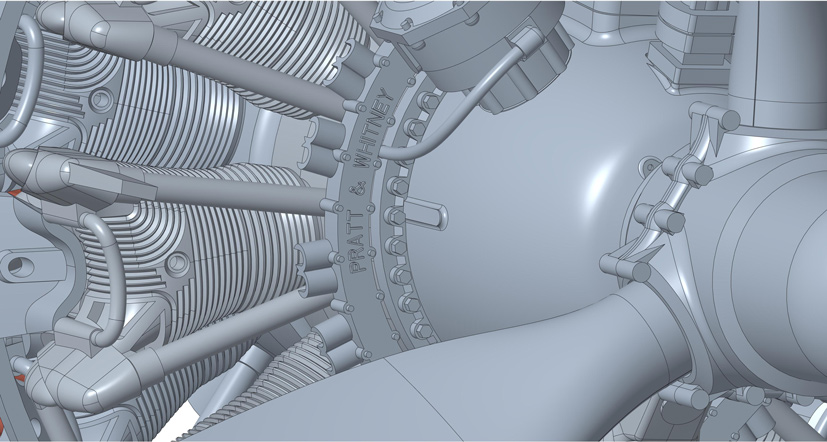
This CAD screenshot image clearly shows the incredible level of detail which has been incorporated into the new Hellcat kit
Even as the Grumman F4F Wildcats of the US Navy were battling to halt the dominance of the Japanese Zero across the Pacific region, the designers at Grumman’s ‘Ironworks’ were already at the advanced stages of designing the Wildcats replacement. Desperate to ensure their new aircraft was a significant improvement on their rugged little fighter and an aircraft squadron pilots could operate effectively without too much additional conversion training, they enlisted the help of some of the US Navy’s most accomplished combat pilots, asking them what they wanted from the new fighter. Their answer was unequivocal – more power and more guns. They were complimentary about the strength and reliability of the Wildcat, which they would not want to compromise, however, in order to beat the feared Zero, they needed an aircraft which was faster, had greater firepower and better overall performance than the F4F. If they could achieve this, the navy might have a real war winner.
Maintaining their proven design philosophy and building on the many impressive qualities of the Wildcat, the new F6F Hellcat design made use of the very best existing aviation technologies, intentionally not waiting to incorporate all the latest innovations which would delay its service introduction, but combining the best existing technology with world leading mass production quality control. At the heart of the new aircraft was the mighty Pratt & Whitney R-2800 Double Wasp engine, a new and beautifully engineered powerplant which was the most powerful unit available to the Grumman design team at that time. With increased range and better armament than its predecessor, the new Hellcat possessed an impressive top speed of around 400mph and would prove to be a nightmare for Japanese pilots in the Pacific Theatre, especially if they made the fatal error of mistaking it for the Wildcat they had been used to fighting previously. The new aircraft was also much more than just a bigger version of the Wildcat, even though its similar profile may lead many to think that was the case. This was actually a completely redesigned aircraft in every respect, from its massive new engine to the rugged, wide-track undercarriage which made deck handling much more assured than with its predecessor – significantly, the Hellcat was 60% heavier than the Wildcat and a true fighting thoroughbred.
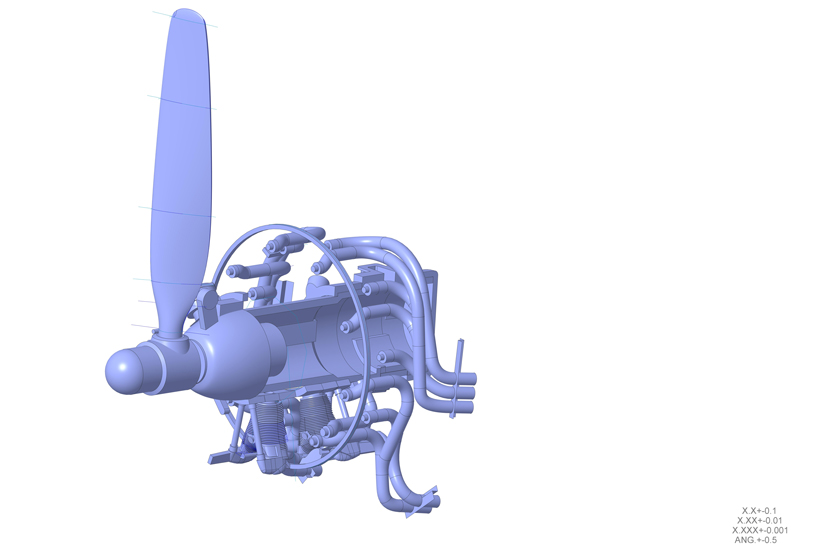
Skeletal engine detail which whilst still impressive, represents a relatively early stage in the models development
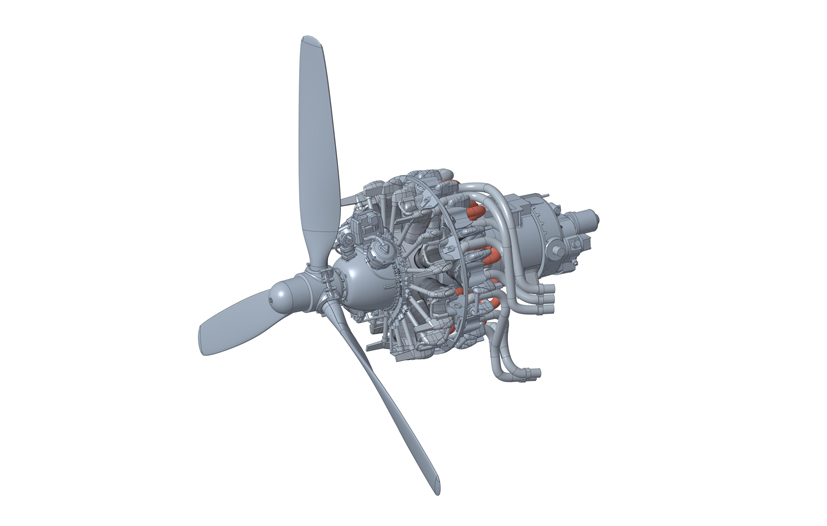
This engine assembly detail is particularly impressive
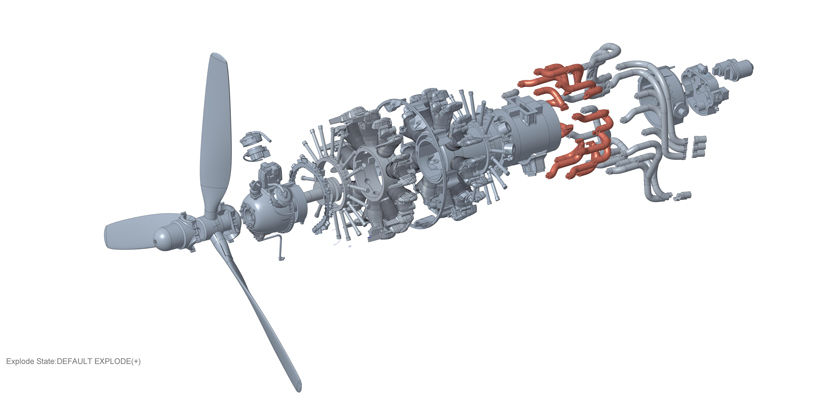
Exploded view of the engine assembly detail, which would almost make an attractive model display in its own right
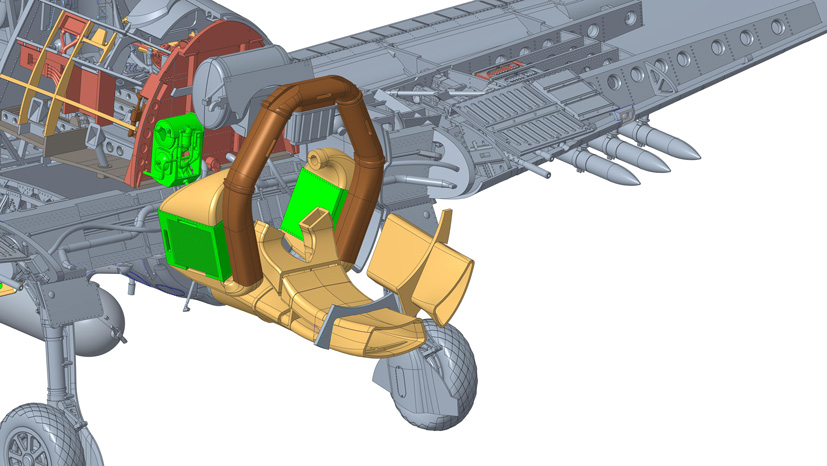
Adding a little colour, this screenshot shows engine air intake detail and how the fuselage will accept the fully constructed engine
Chris knew that the R-2800 Double Wasp engine would be a significant feature of the new Airfix Hellcat kit and much of his time was spent producing an exact scale replica of this famous powerplant, as well as ensuring it located correctly in the very busy front section of the model. A hugely powerful and complex engine, this work was as much about the network of pipes and ducting the engine required as it was about the powerplant itself. The images featured above show some of the development stages Chris went through in producing his scale Double Wasp engine for the Hellcat, including the image at the head of this section, which shows an exploded CAD screenshot view of the engine files and the manufacturers mark included in the tooling. This must be quite frustrating for the designers working on these larger scale models, as much of this detail may never be seen once the model has been constructed, if the modeller has chosen to finish his kit in flight configuration, with all the engine panels in place. At least both the designer and the modeller know that this impressive level of detail is included in the kit, which is a faithful scale representation of the real aircraft. Going back to the engine image selection we have included, the second and third images give a clear indication of the detail levels incorporated into the design of this scale engine, with the third image providing a fascinating visual representation of how the individual components go to make up the engine assembly. The final image in this section adds a splash of colour to the proceedings and shows a more complete version of the front fuselage CAD and the area which will eventually house the mighty Pratt & Whitney R-2800 Double Wasp radial engine.
Thanks to Chris, we have been able to provide Workbench readers with a fascinating insight into the earlier stages of the development of the new 1/24th scale Grumman F6F-5 Hellcat kit, information which is being shown in the blog for the very first time. We end this feature with a final selection of images which, whilst conforming to the development structures already described, show different areas of the aircraft’s design, namely the cockpit and wing areas. Again clearly illustrating the incredible level of detail incorporated in the kit, we begin by looking at the pilots seat and how this then takes its place in the wider cockpit assembly. We then go on to look at the design of the wing and whilst the first skeleton image still includes quite a lot of detail, it is still more about the accurate placement of components than the level of detail itself. Further detail is added in the second picture, but we are certain that your eyes will be drawn to the third image and the unbelievable amount of work Chris has put in to what actually looks like a real de-skinned Grumman Hellcat. The final treat is the image showing an almost complete Hellcat with engine installed and wing/cockpit detail exposed – this one really does have us all eagerly anticipating the arrival of this magnificent new model kit.
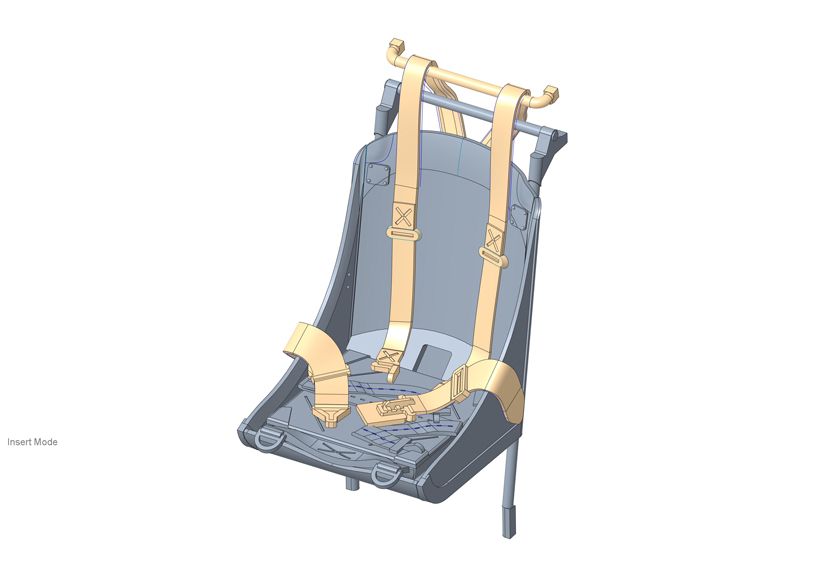
Moving on to the cockpit area, this image shows the pilot’s seat and seatbelt harnesses
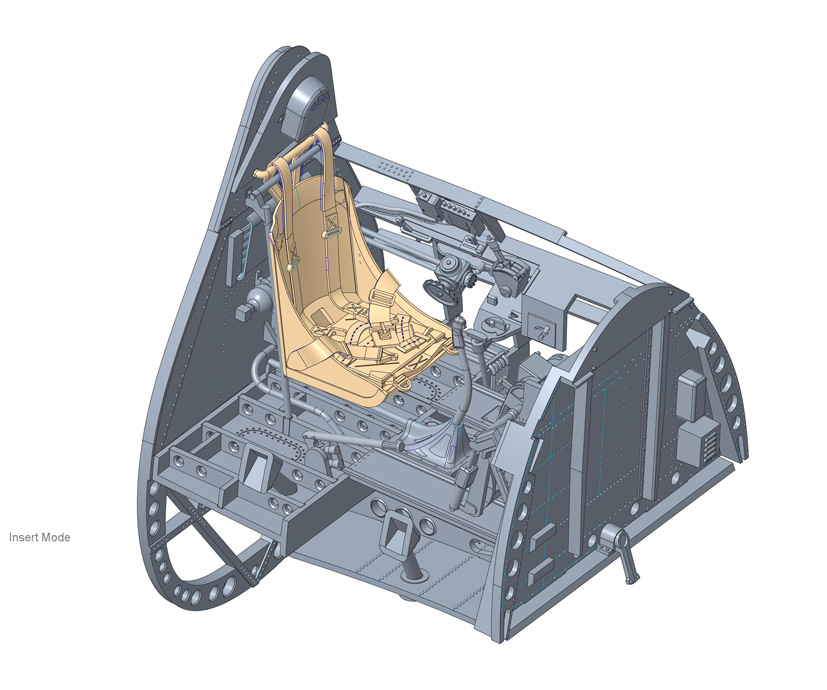
Cockpit area assembly, with the pilot’s seat in place
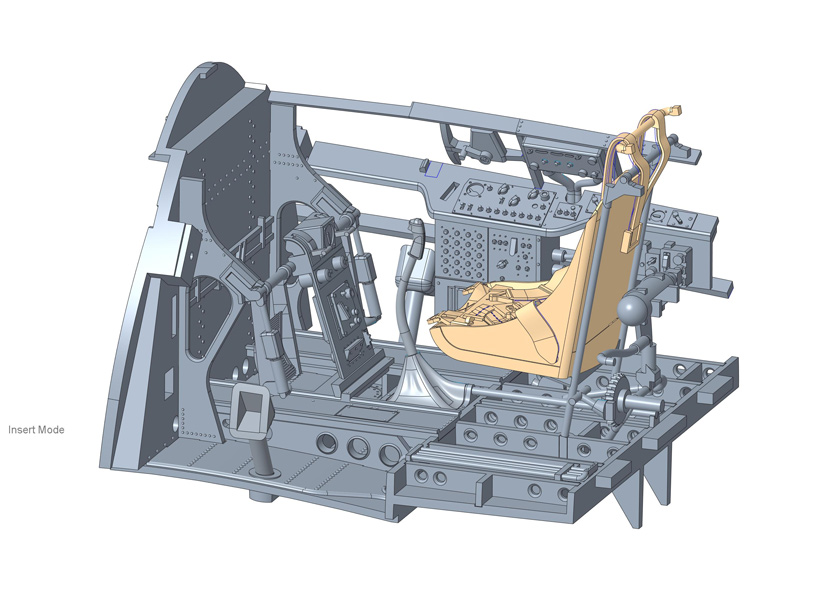
From a slightly different angle, more of the impressive Hellcat cockpit detail
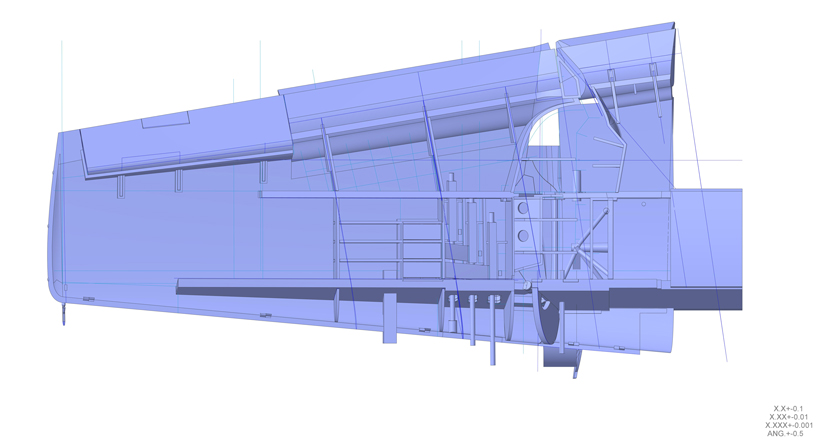
The wing sections are detailed next, starting with this skeletal view of the wing top
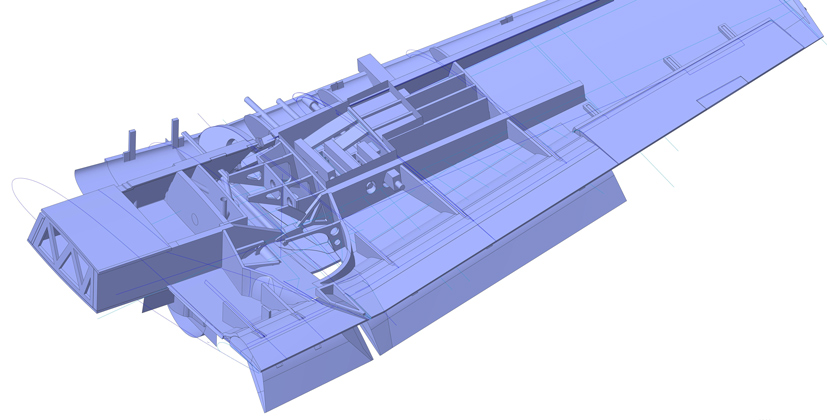
Internal wing detail has been added on this screenshot, including the mechanism allowing the wing to fold back on itself
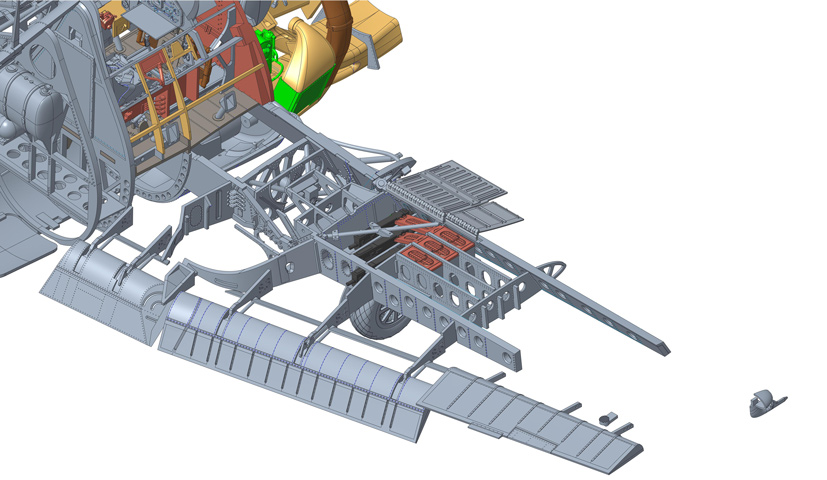
This fantastic image shows internal wing detail, with the outer skin removed
We would like to sincerely thank Chris for producing these images and allowing us this brief insight into a project which has taken up two years of his life. Asking him which part of the project he found most rewarding, Chris told us that the real thrill was making his kit as true to the construction of the real aircraft as he possibly could, using all his research material to incorporate even the finest details into the Hellcat model. He is most proud of the engine construction, which he thinks is good enough to be classed as a standalone model display by itself. In addition to this, the wing design and its folding mechanism also proved particularly rewarding, again as this faithfully replicates the design of the real aircraft and posed some significant issues during development. As for less memorable aspects of the design work, Chris simply offered one word – rivets! I think it is safe to say that he has had his fill of rivets and fastenings for the time being. With the launch of the new Hellcat almost upon us, it won’t be long before modellers all over the world are marvelling at Chris’ design expertise and facing the difficult decision of how much of this incredible detail to show on their own 1/24th scale Hellcat build.
As the new 1/24th scale Grumman F6F-5 Hellcat project was at a relatively mature stage by the time of its triumphant Telford 2018 announcement, designer Chris had already negotiated the potentially stressful stage of receiving the first test frame components produced by the new model tooling. Coming at the end of an intense year of design work on the project and after the production of a prototype sample model, the engineering phase resulted in another year of Hellcat effort, as final alterations were made to the development files and tooling plan tenders sent out. Once these plans are deemed acceptable and the authority to proceed is granted by Company officials, the toolmakers are instructed to proceed and the design work Chris has devoted so much time to is committed to metal (so to speak), as the tooling blocks themselves are designed and cut. A crucial time in the development of any new model tooling and one of great excitement (and no doubt also some trepidation) for the Airfix team, the arrival of the first test frames from the tooling in the Airfix office is the first opportunity they will have to see how the new kit will look and if all the incredible detail they have been working on is accurately reflected by the tooling. This important stage will usually see most members of the development team, including our technical illustrator (who will be responsible for producing the iconic instruction booklet for the kit), engaged in building various sections of the new kit, as they assess every aspect of its design and plan how they will help inform modellers on the most logical way in which to construct the kit.
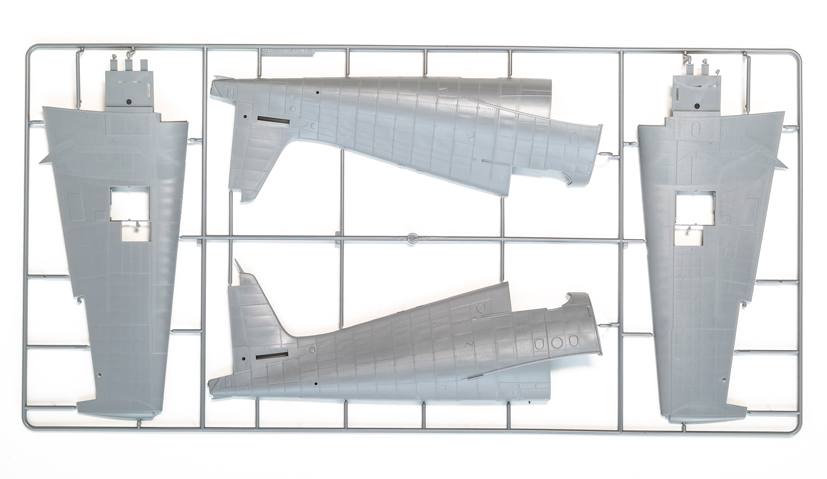
In another exclusive first for the Workbench blog, this next series of images feature all the component frames which make up the new 1/24th scale Grumman F6F-5 Hellcat kit

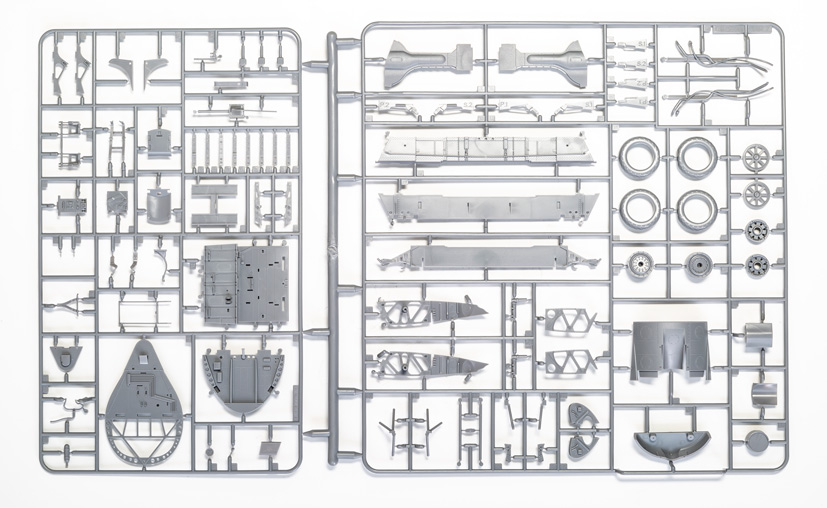
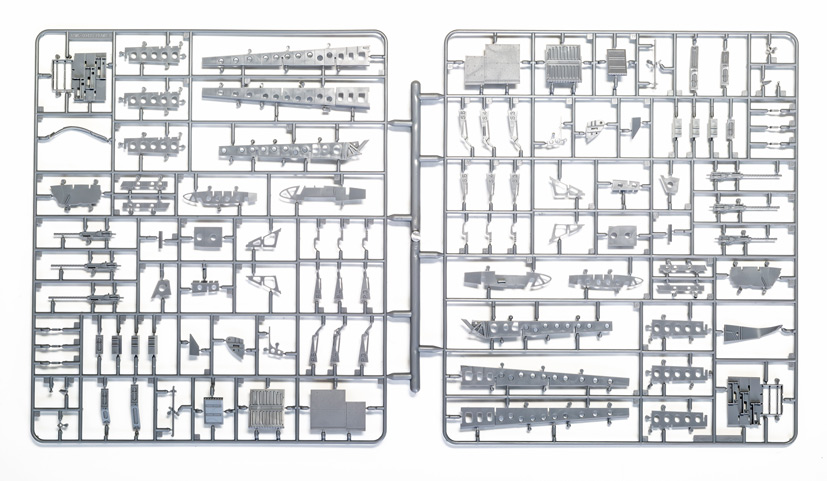
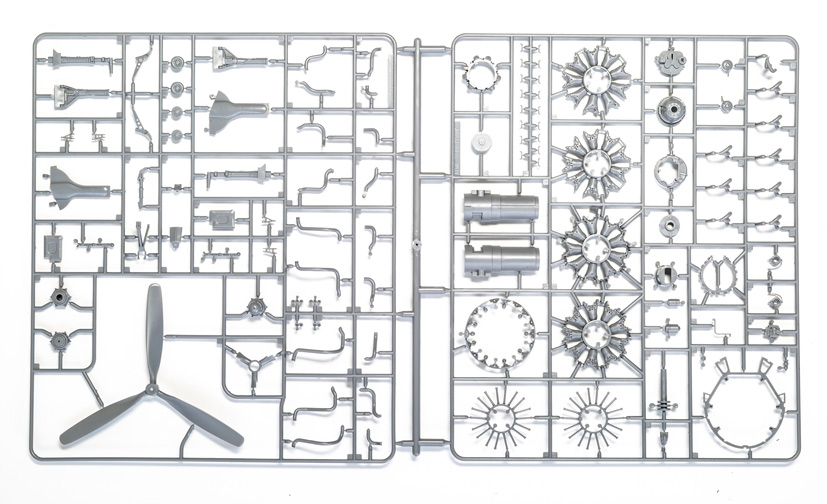
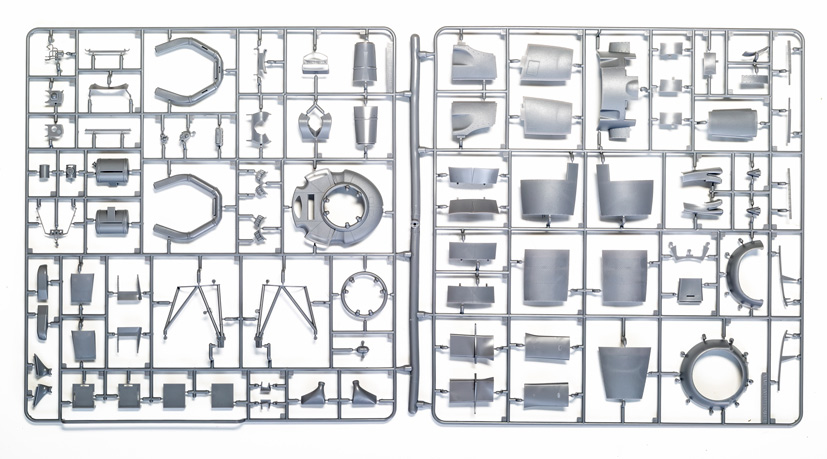
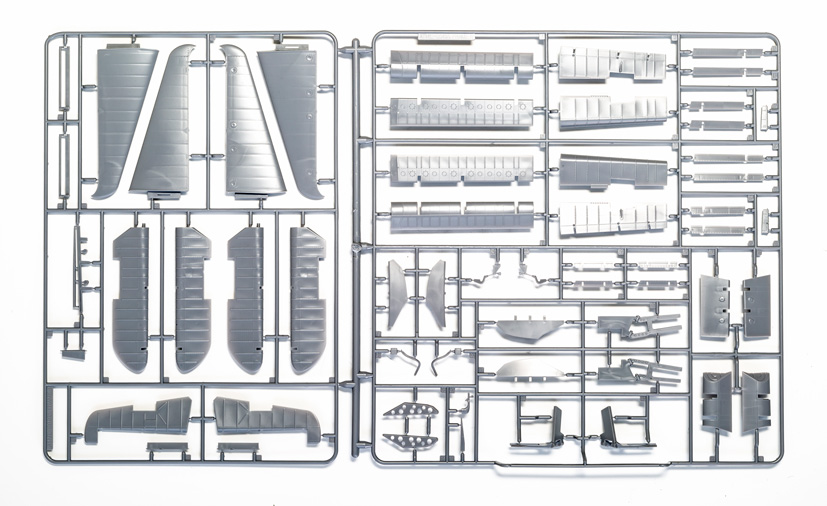

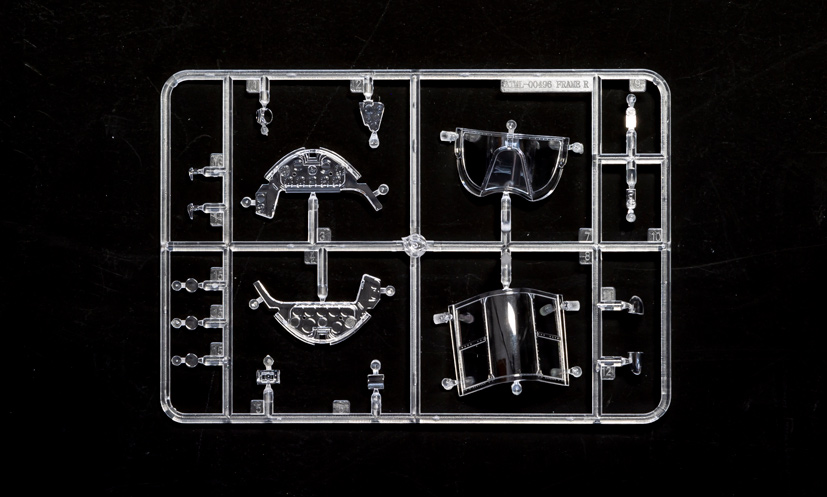
Although these initial test frames many require some modification before the tooling can be released for production, their arrival allowed the Airfix team to not only produce a series of construction images for later use on the box artwork design and inclusion in the 2019 catalogue and on the Airfix website, but also to have various build representations of the new model available on the Airfix stand at Telford. Usually, a new tooling announcement would result in a prototype model being shown at the time of the official unveiling, however in this case, we were not only able to show a fully completed and decorated Hellcat, but also several sectional builds, which effectively highlighted the impressive levels of detail incorporated into the design of this kit. The test frames arrive at our Head Office in a large, rather nondescript cardboard box and not as you might imagine, individually boxed like a normal kit release. The box will contain multiples of each and every component frame of the new kit and as we have already seen, several members of the team will be presented with a complete set of parts, not just the lead designer on the project. The exclusive selection of Hellcat frame images featured above actually represent the first set of approved tooling samples and include all the design alterations requested by Chris, the Hellcat’s project designer. In yet another exclusive for Workbench readers, the sight of these component frames are a strong indication that the much anticipated release date of the new 1/24th scale Grumman F6F-5 Hellcat is fast approaching and we had better start thinking about clearing some space on our workstations.
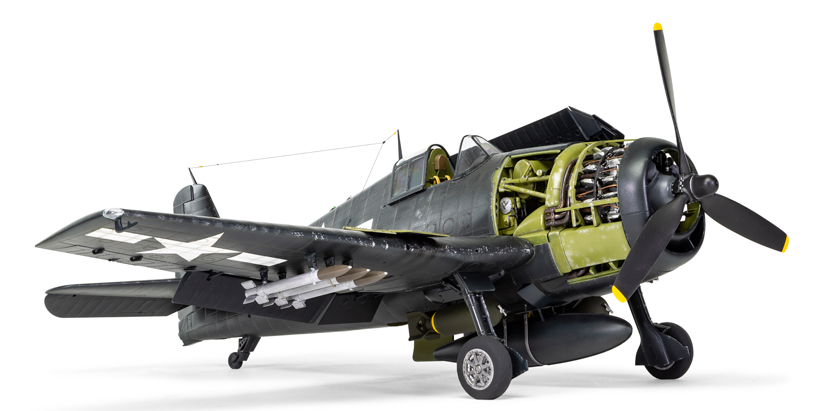
Accomplished modeller and Airfix Product Designer Paramjit built this beautiful representation of the new 1/24th scale Hellcat, which was displayed on the Airfix stand at the Shropshire Model Show
Since joining the company last year, new Airfix Product Designer Paramjit Sembhi has quickly become an important member of the team, as well as featuring in several previous editions of the Workbench blog. Readers may recall that part of Paramjit’s duties during his first Telford IPMS Scale ModelWorld show as an Airfix employee was to assist the Brand Manager in helping to adjudicate this year’s Airfix Trophy competition, a duty he attacked with his usual professionalism. A committed modeller himself, when Paramjit is not helping to design future Airfix kits, he likes to spend his free time modelling and has impressed everyone at the company with the incredible standard of his modelling talent. With his undoubted modelling skill and new Airfix design credentials to call upon, Paramjit has been in the unique position of being able to work on two complete 1/24th scale Hellcat builds in recent months, using the test frame components sent for the Airfix team to assess. One of these models was shown on the Airfix stand at the recent Shropshire Model Show at the RAF Museum Cosford and has been finished with one of the wings folded back in carrier stowage configuration, with the second having only recently been completed. Continuing the Hellcat exclusives theme of this latest blog and courtesy of Paramjit’s modelling talents, we are pleased to bring you a selection of these fantastic build images now.
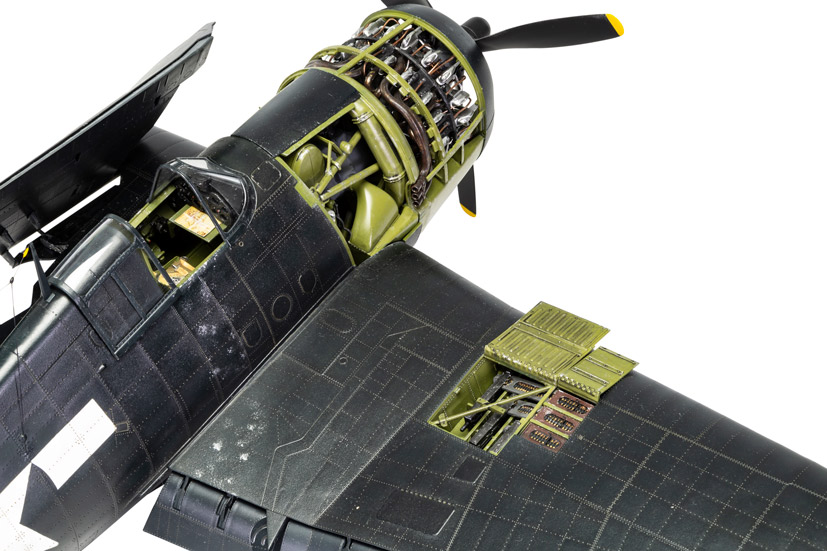
Another view of Paramjit’s first full Hellcat build, which even features a map on the pilots pull out table in the cockpit
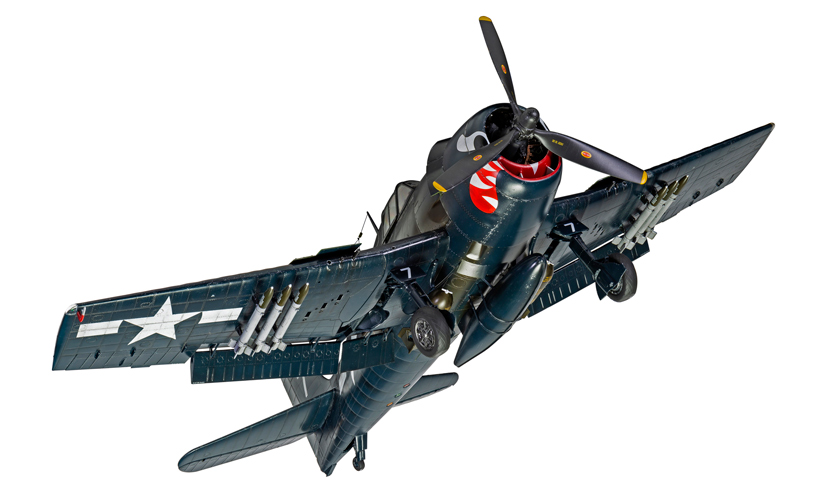
This next selection of images feature Paramjit’s latest Hellcat build, only finished a couple of days ago. He has finished the model in one of the scheme options included with this impressive kit, a VF-27 ‘Ace Maker’ ….. enjoy!
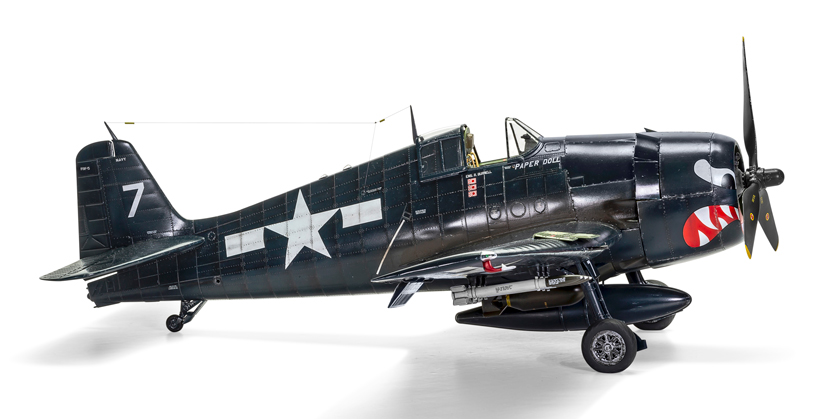
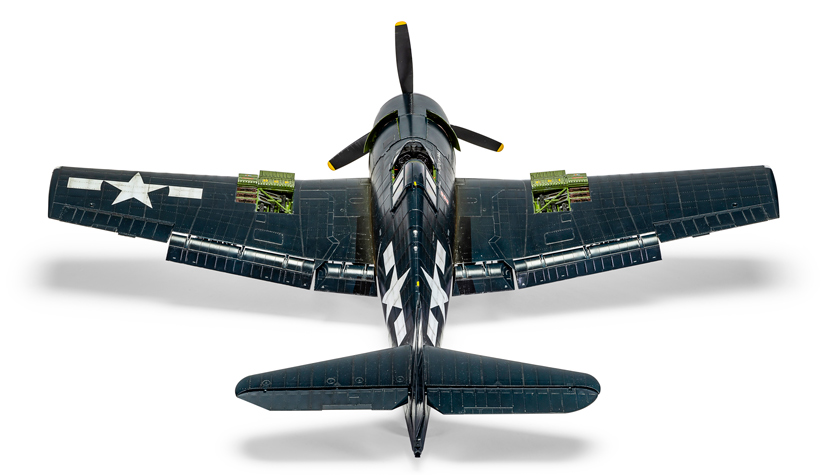
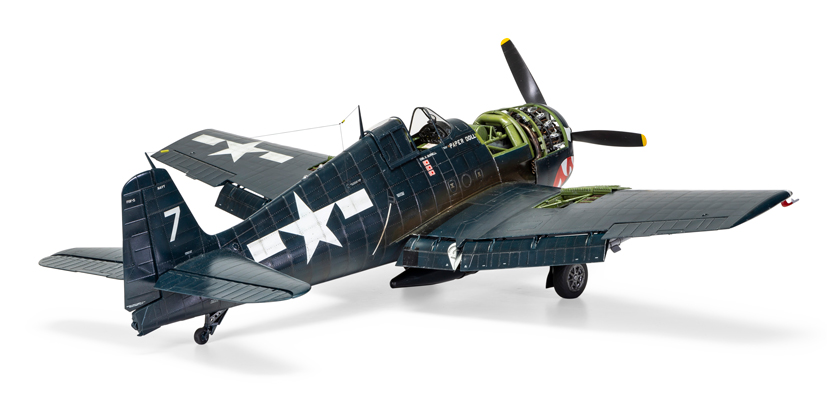
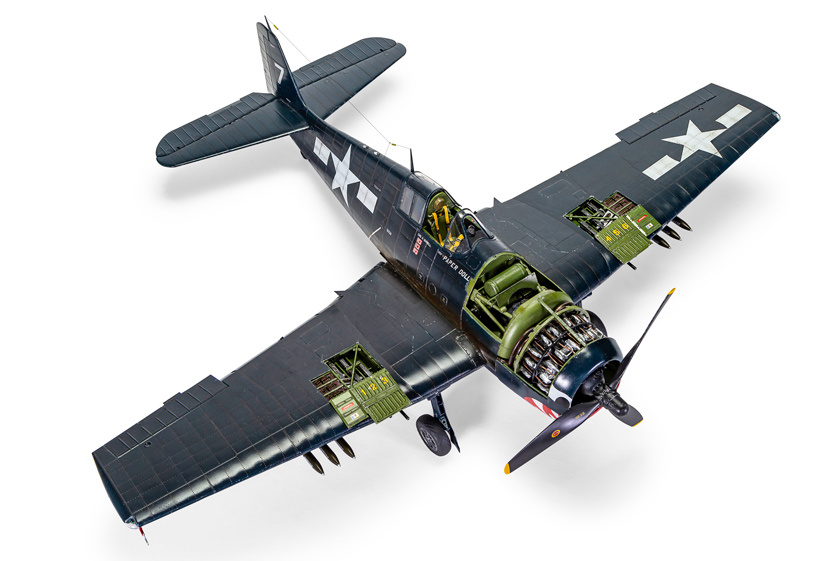
Paramjit’s first Hellcat build was intended to show many of the design features incorporated in the new model, including much of the internal detail which is available for display by the modeller, should this be required. With one wing folded back in its carrier stowage position, many of the panels around the engine have been removed to allow all this detail to be shown and the gun access panels opened to reveal gun and ammunition detail. The open canopy also allows the impressive cockpit detail to be seen and even includes the pulled out map table and the scale representation of a map, in what is a truly impressive model build. His second Hellcat follows one of the famous US Navy scheme options which will be included in the kit and presents the aircraft as it prepares to be launched against the latest Japanese air attack. As you can see from the pictures above, he still wanted the ability to show all the detail his colleague Chris had managed to incorporate into this kit, so he has retained the ability to remove all the fully painted engine panels, should his Hellcat require a little post operation modelling maintenance. As we have expressed many times here on the Workbench blog, to us, modelling is another form of art and looking at these two fantastic models produced by Paramjit, he is clearly an extremely talented modelling artist. Now, the challenge for the rest of us modelling mortals is to try and emulate this standard, when we finally get our hands on an Airfix Hellcat. Let’s take a closer look at the scheme details behind Paramjit’s impressive second Hellcat build.
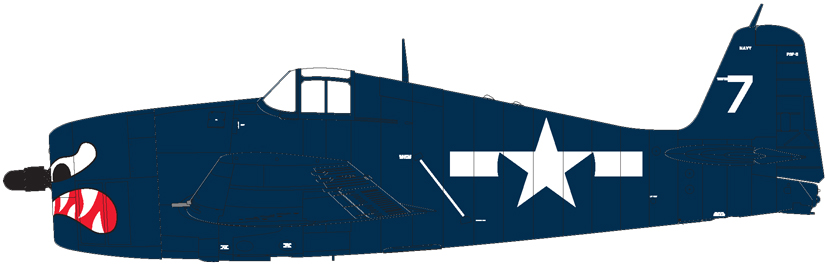
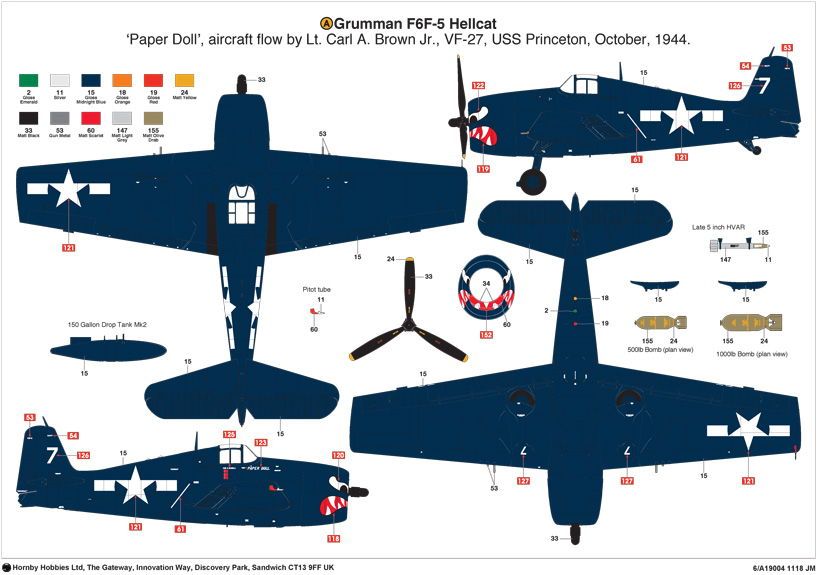
Full scheme details of ‘Paper Doll’, the Hellcat used by Lt. Carl A Brown to claim ‘Ace in a day’ status on 24th October 1944
As soon as the Grumman Hellcat arrived in the Pacific Theatre, US Navy pilots knew that they had a fighter which could take on and beat the Mitsubishi Zero, which until that point, had reigned supreme. The first time US Navy Hellcats engaged in combat with the Mitsubishi Zero was at Wake Island in October 1943 and even though the new fighter was coming up against experienced opponents, the Japanese fighters quickly began to fall to the guns of the Hellcat. The distinction of being the first US Navy Hellcat pilot to shoot down a Zero fighter was attributed to Ensign Robert Duncan and over the course of the next few days, Hellcat pilots posted their intention to gain a hard fought air superiority over the Pacific and begin the long road to eventual victory.
As capable a fighting machine as the Hellcat undoubtedly was, this was only part of the story as to why the aircraft had such a dramatic impact on the Pacific air war. Possessing great speed and firepower, the Hellcat was specifically designed for the rigours of carrier operation, with both the pilot and his ground crew in mind. A fighter aircraft is only doing its job when it is in the air fighting and is of little use if prone to excessive hangar maintenance time. The Hellcat was as tough as they come and would often be required to land, rearm and refuel, before immediately taking off on another sortie, often with a different pilot behind the controls. From the pilot’s perspective, as well as equipping him with a devastatingly effective fighting aeroplane, the engineers at Grumman had not neglected pilot protection and included armour plating and self-sealing fuel tanks in the aircraft’s design, something Zero pilots would have loved on their aircraft. With exceptional survivability rates and a rugged design which could absorb significant battle damage, Hellcat pilots were going to war in an aircraft which would not only allow then to score aerial victories over their enemy, but would also bring them home to fight another day.
To illustrate the strength of the Hellcat’s design, a late production F6F-F3 machine, which was the former mount of famous US Navy ace Lieutenant Commander Edward Henry ‘Butch’ O’Hare, was sent back to the Grumman factory for repair, having sustained significant combat damage. Displayed for all Grumman employees to see, engineers found more than 200 bullet holes in the aircraft, which had safely brought its pilot back to his home carrier, after what sounds like a rather memorable day’s combat flying. Grumman’s ‘Ironworks’ certainly built tough aeroplanes.
The rather aggressive scheme carried by F6F-5 Hellcat ‘White 7’, which was selected by Paramjit for his second Hellcat build, is a VF-27 aircraft, which made a significant contribution during the Battle of Leyte Gulf on 24th October 1944. ‘Paper Doll’ was the usual mount of Ensign Robert ‘Bob’ Burnell, but on this fateful day, it was being flown by Lt. Carl A Brown Jr. from the US carrier Princeton, known to all who served on her as ‘Sweet P’. After taking part in effective air strikes against targets in Formosa earlier the same month, USS Princeton was part of Task Force 38.3 and VF-27 were engaged in heavy fighting with large numbers of Japanese aircraft. Determined to prevent the enemy strike planes from reaching the Task Force, the pilots of VF-27 fought heroically against superior numbers and during the ensuing dogfights, no fewer than 36 Japanese aircraft were destroyed at their hand. Astonishingly, during this fighting, five VF-27 pilots achieved the status of ‘Ace in a day’, with five aerial victories to their name, one of which was Lt. Carl A Brown Jr., who claimed five destroyed and one badly damaged during a frenetic few minutes of combat. Unfortunately, his aircraft sustained significant damage during these actions and he himself had been wounded by shrapnel, a situation made all the worse when he noticed four Zeros on his tail, all lining up for an easy victory. He immediately pushed the control column forward and entered a tight turning dive, in one final attempt to shake off his pursuers, which miraculously worked – despite the damage to his aircraft, the manoeuvre could not be matched by the Zeros, who were later engaged by other US Navy Hellcat pilots.
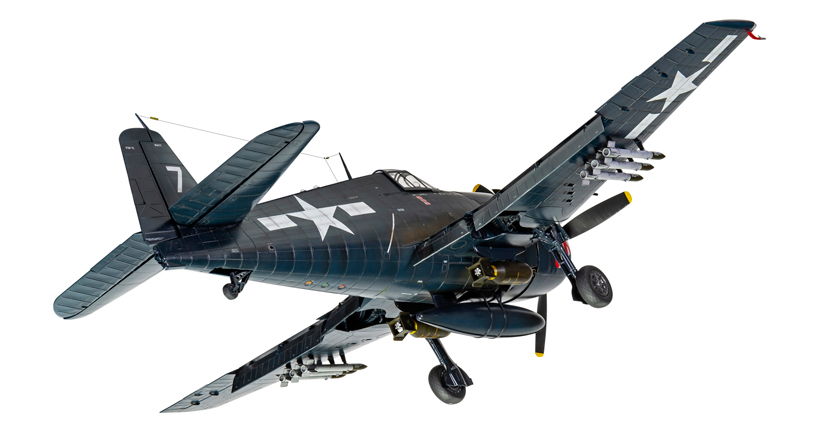
Another view of Paramjit’s latest impressive Hellcat build, featuring the scheme worn by Lt. Carl A Brown Jr. when he downed five Japanese Zeros in the same sortie, to gain the coveted ‘Ace in a day’ status
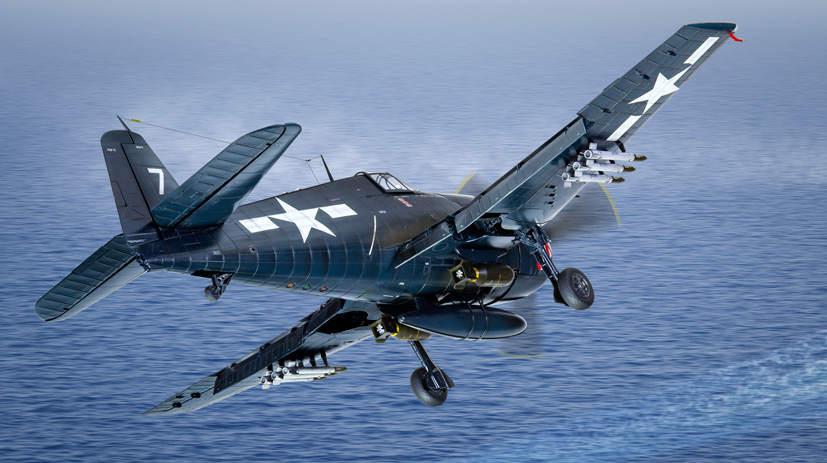
The same image, but after one of our graphic designers has worked their magic – this scene could almost be Lt. Brown on finals to USS Essex in his badly damaged Hellcat, having just splashed five Japanese Zeros and damaged a sixth. All that is missing are the 167 bullet holes in his aircraft
As if one sortie had not been eventful enough, Brown’s home carrier, USS Princeton, had just taken a direct hit from an enemy aircraft, was on fire and unable to recover aircraft. Radioing his predicament to other carriers in the Task Force, Brown was told that they were all at maximum capacity and they did not want a badly damaged Hellcat blocking their flight deck. Needing to land his aircraft immediately and quickly running out of options, Brown radioed his intention to ditch ahead of a destroyer and asked if they would be good enough to pick him up, only to have USS Essex come to his aid and offer to take him if he would land immediately. With no hydraulics and damaged instruments, Brown made a classic curved approach to the carrier and came down hard, but at least he was safe. Historic photographs exist of this aircraft having just landed on USS Essex, with its burning home carrier Princeton visible in the background. Hellcat ‘White 7’ had 167 holes in its fuselage, damage so significant that the aircraft was almost immediately pushed over the side of the carrier to a watery grave, a sad end for an aircraft which had served its pilot so well.
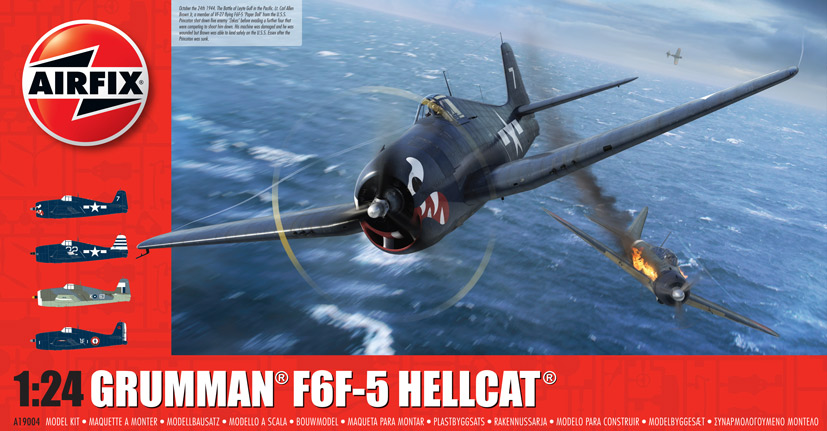
As we are celebrating the significant Centenary edition of our Workbench blog, we could not let this occasion pass without offering one lucky reader the chance to bag a spectacular Airfix prize and as the only subject of this mammoth edition has been our stunning new 1/24th scale Grumman F6F-5 Hellcat kit, it is not too difficult to guess what that prize might be? The winner of our Workbench Centenary competition will not only be presented with a production example of this stunning new Hellcat kit, but they will be receiving it before anyone else in the world gets their hands on it. This is a fantastic opportunity to take your own little piece of Airfix history and we would like to thank the Airfix team for allowing us the opportunity to offer this unique prize. We feel sure that this Hellcat development issue of Workbench will leave many modellers hoping to add this new kit to their 2019 build schedule, but for one lucky reader, they will definitely be ahead of the Hellcat game.
To be in with a chance of winning the first 1/24th scale Hellcat kit to be available anywhere in the world, simply head over to the Airfix Competitions Page of our website, where you will find all the relevant competition details, along with a simple Grumman Hellcat related question for you to answer. The competition will close on Thursday 6th June (the 75th Anniversary of D-Day), so you all have plenty of time in which to place your entry – our lucky winner will be selected at random from the list of correct entries and we will announce their good fortune in the next edition of Workbench, due to be published on Friday 7th June. This will allow us enough time to ensure the winner receives their kit in advance of the coordinated worldwide release of the Hellcat and certainly before anyone else has the chance to get their hands on it. Good luck to all who enter and to our lucky winner, please don’t forget to send a picture of you with your very special prize to the Airfix Facebook page – you will be the envy of the modelling world.

We end this bumper Centenary edition of Workbench with yet another Airfix exclusive and confirmation of a coordinated worldwide release for our new 1/24th scale Grumman F6F-5 Hellcat kit. We sort of let the release cat out of the bag in the previous competition section of the blog, however, please accept this as the official confirmation of the kit’s actual release details. Following unprecedented ordering levels and interest from countries all around the world, our international sales managers were under pressure to ensure that certain markets did not receive the new Hellcat before others did and with such large numbers of kits involved, the only way to ensure this could happen was to have a coordinated worldwide release date. That date, as confirmed by the exclusive graphic displayed above, will be June 21st June 2019 – even though this is just fifteen days after the world will have marked the 75th Anniversary of D-Day, it might be a little fanciful to describe the Hellcat’s launch as H-Day. In any case, the thousands of modellers who are eagerly anticipating the arrival of this fantastic model will not have to wait too long now and we can all start to plan how much of this glorious detail we are going to reveal as part of our own Hellcat builds.
That is the Centenary edition of Workbench done and dusted. Although we cannot promise quite as hefty an edition next time, we will be back as usual in two weeks, with a further selection of Airfix modelling delights for your enjoyment. In the meantime, if you have any suggestions for subjects you would like to see covered in a future edition of the blog, or ways in which we could enhance your enjoyment of Workbench, please do not hesitate in contacting us. We can be reached via our usual e-mail address workbench@airfix.com or by contributing to our Workbench thread over on the Airfix Forum. If social media is more your style, you could access either our Airfix Facebook page or Twitter channel, (using #airfixworkbench), where you will find plenty of modelling news, views and discussion taking place. Whichever medium is your preference, please do get in touch, as it is always interesting to hear from fellow modelling enthusiasts and the projects you have on the go at the moment.
As always, the Airfix website is the place to go for all the latest model release information, with our New Arrivals and Coming Soon sections both quickly accessed by clicking either of the links above. As updating the website is an ongoing process, a quick search through each section of the Airfix web pages will often reveal new information and updated images in many of the product sections and this is always an enjoyable way in which to spend a few spare minutes.
The next edition of Workbench is due to be published on Friday 7th June, when we will have more news and modelling features from the fascinating world of Airfix.
On behalf of the entire Workbench team, thank you for your continued support our Airfix blog.
The Airfix Workbench Team
© Hornby Hobbies Ltd. All rights reserved.