
Welcome to this latest edition of our Workbench blog and all the news, updates, and modelling exclusives from the fascinating world of Airfix.
When it comes to discussing the world of aviation, the word ‘Classic’ can sometimes be used a little too excessively, with its use in connection with various aircraft types often being the stimulus for some healthy and rather vociferous debate. Thankfully, when it comes to the subject of this week’s Workbench update, every inch of its airframe has classic written all over it, whether we’re talking about the actual aircraft, or how Airfix have immortalised it as a scale model kit. Our subject for this week is a training aeroplane of international repute, one which was a modern replacement for an earlier generation of aviation classic, but one which embraced its responsibility with confidence, the de Havilland Chipmunk.
As we prepare to welcome what will be only the second release from a tooling which was only announced back in 2021, our 1/48th scale de Havilland Chipmunk kit has already proved to be a huge favourite with modellers, so we’re confident that this update will find favour with a great many Workbench readers. In addition to taking a short historical Chipmunk reprise, we will be looking a little more closely at the three new scheme options on offer with this impending new release – you will also be pleased to hear that we will also be bringing you our latest box artwork exclusive, as we showcase the beautiful new digital artwork produced in support of a new kit which is surely destined for future range greatness.
Whether we’re talking about the actual aeroplane itself, or our scale representation of it, we have a classic Workbench weekend this time around, as we spend some time with the pilot-making de Havilland Chipmunk and an aircraft some readers may have even spent time in themselves.
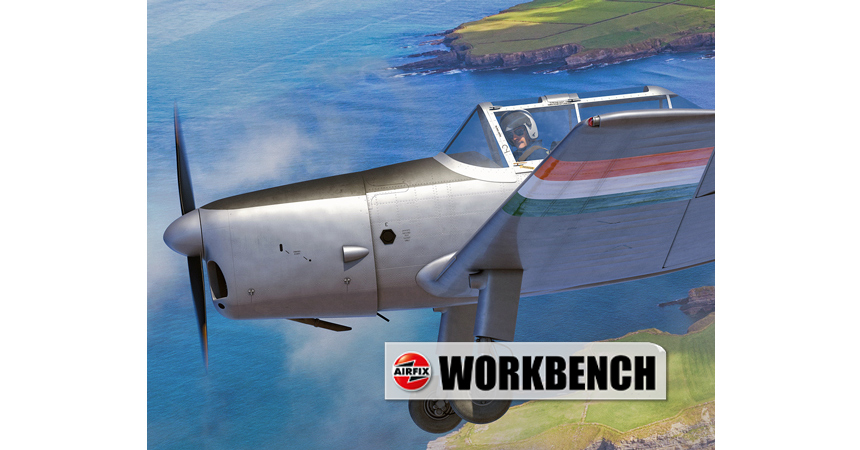
The artwork produced to announce the release of the first kit from this impressive new tooling shows the Chipmunk in the environment where it excelled, up amongst the clouds.
By their very nature, aircraft which are used to train large numbers of new pilots, in addition to allowing members of the public access to air experience opportunities, tend to be amongst the most instantly recognisable and best loved aircraft types produced, particularly if they can also claim to have a service longevity which few could have envisaged when they made their first flights. Within this exulted group of aircraft, the de Havilland Aircraft Company can claim not one, but two aircraft which performed this role with distinction, examples of which still fly in some numbers to this day, performing those same roles over ninety years since the first of them entered service.
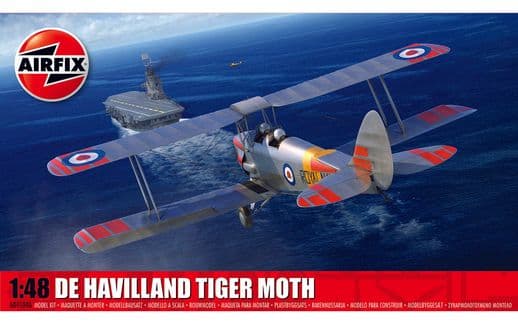
With both the de Havilland Tiger Moth and its replacement, the Chipmunk still being regular sights at airfields right across the country, these magnificent aircraft continue to provide pilot training and flight experience opportunities for many hundreds of people, in addition to being coveted by those looking to own and fly classic aeroplanes which appear destined to be flying forever. Both types have recently attracted the attentions of the Airfix design team as 1/48th scale model kit projects, and as we featured the latest Tiger Moth release earlier in the year, its about time we also featured what will be only the second release from our new de Havilland Chipmunk tooling.
With huge pressure being placed on de Havilland’s manufacturing capacity during the final years of the Second World War and with a desire to support increasing numbers of Allied airmen being trained across the Atlantic and away from the rigors of war, de Havilland established an overseas subsidiary in Canada, the de Havilland Aircraft Company of Canada. Following the end of WWII, this Canadian branch of the company began design work on producing a new aircraft, one intended as a replacement for the ageing Tiger Moth trainers still in RCAF service. A tandem two seat monoplane, the new trainer incorporated many advances over its famous predecessor, but shared many of its design philosophies, chiefly that it was intended to be both simple to maintain and relatively forgiving to fly - these aircraft needed to be in the air, earning their keep.
Scan day at Audley End, with a beautiful Chipmunk waiting to give up all its secrets digitally.
Raw scan data supplied to the designer responsible for recreating this aviation classic.
Earning the distinction of being the first aircraft type designed and built by de Havilland Canada, the very first Chipmunk took to the skies in May 1946 and almost immediately gained interest from the military. By April 1948, the Royal Canadian Air Force had taken delivery of their first Chipmunk, but they were not the only ones admiring the qualities of this extremely capable new aeroplane. Ultimately, the vast majority of the 1,283 de Havilland Chipmunks built would be manufactured under licence in Britain, in factories at Hatfield and Chester, with around 735 of these going on to see service with the Royal Air Force, again as the direct replacement for the venerable old Tiger Moth.
In RAF service, the British built machines were known as the de Havilland Chipmunk Mk.10 and they would go on to provide basic flight training support many thousands of future military aviators, in addition to providing air experience opportunities for many more as part of the University Air Squadron organisation. Despite being a Canadian design, the Chipmunk has become one of the most recognisable Royal Air Force aircraft of the post war era and has enjoyed a military career which began in the early 1950s and continues to this day.
The Battle of Britain Memorial Flight still operate two Chipmunks regularly, providing currency training for aircrew assigned to fly the unit’s historic ‘taildraggers’ and also to allow crews to reconnoitre new display venues in advance of an intended Airshow appearance. In other situations, the aircraft can be used to deliver replacement aircrew or spare parts, whilst the Flight’s Spitfires, Hurricanes, Dakota and Lancaster are out on display duties during the Airshow season. These two Chipmunks have ensured that the aircraft must now be regarded as one of the longest serving types in Royal Air Force History.
A computer rendered image produced from the design files created for he de Havilland Chipmunk project.
With such an impressive military pedigree as this, it’s also interesting to note that the Chipmunk has gone on to become one of the most popular aircraft types on the civilian aviation scene, and it’s estimated that well over 300 aircraft are still in airworthy condition worldwide to this day, with more undergoing restoration all the time. Sometimes colloquially referred to as ‘The poor man’s Spitfire’, this name is actually a term of both respect and endearment, as the Chipmunk is now regarded as a historic aeroplane in its own right, one which continues to underline the effectiveness of its design. With aircraft formerly serving with the RAF, Army Air Corps, Royal Navy and the mount of several RAF display teams, there is no shortage of attractive schemes available for you to present your Chipmunk in if you are lucky enough to own one, not to mention the fact that the aircraft would also be operated by several overseas air forces all over the world.
As a training aeroplane, it’s obvious that more people would have had and will continue to have personal experiences with the de Havilland Chipmunk, as opposed to perhaps the more glamorous Warbird types which are so popular with enthusiasts. Indeed, the greatly increased possibility of actually flying in one of these equally historic aeroplanes has ensured that the Chipmunk is held in great affection by owners and enthusiasts alike and as we have already discussed, is an aircraft type which is not out of the reach of prospective pilot/owners. Significantly, the Chipmunk is still performing the aviation role for which it was originally designed when making its first flight 78 years ago, training new pilots and allowing people to experience the thrill of flying for the first time.
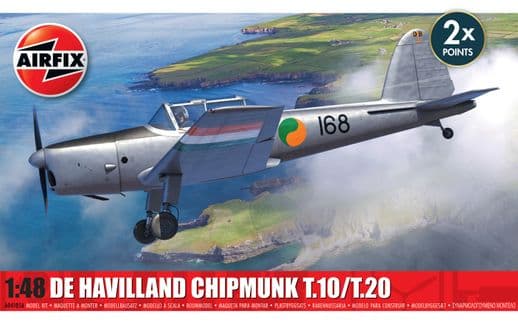
Our latest box artwork reveal exclusive. May we present our new Irish Air Corps de Havilland Chipmunk T.20.
As you may well imagine, the announcement of our project to bring a newly tooled example of the de Havilland Chipmunk to the Airfix range in 1/48th scale back in 2021 was met with a great amount of excitement and following the release of this beautiful new kit, it has proved to be an incredibly popular addition to the range. With the model now proving very difficult to come by, we felt the time was right for the tooling to go back into production once again, with this second release allowing both the T.10 and T.20 variants of the trainer to be built.
The first release included scheme and decal options to allow any one of four very different looking Chipmunk T.10 trainers to be built, however, this second, impending release will also allow the T.20 variant to be built, something which will be of interest to those who own, or who have flown in this slightly modified variant of the aircraft. The T.20 was essentially the export version of the aircraft produced for the Royal Air Force and whilst outwardly looking almost identical to most of us, Chipmunk aficionados would take great delight in pointing out the many small differences between the two. For this reason, the release of this second kit opens up this scale representation of the Chipmunk to even more people, be they owners of restored examples, or those people who simply had the opportunity to get close to one.
Many Workbench readers will be fully aware that this isn’t the first time that a de Havilland Chipmunk kit has been part of the Airfix range, as an earlier 1/72nd scale example was added to the standard range back in 1969, with the first two incarnations being of the bagged presentation variety. This was a lovely little kit and was much loved by modellers young and old over the years, as they looked to create their own scale tribute to this classic RAF trainer. The final release from this tooling arrived in model stores around twelve years ago and presented the Chipmunk in the liveries of the two aircraft operated by the Battle of Britain Memorial Flight.
As popular as this kit undoubtedly was, there was more to come from the Chipmunk in an Airfix modelling sense, and the release of this new kit in 1/48th scale has seen this become one of our most popular kits, with this second impending release only destined to further enhance its appeal.
Let’s take a closer look at the three scheme options which are included within its appealing packaging presentation.
Scheme A – de Havilland Chipmunk T.20, Irish Air Corps aircraft 168, Irish Historic Flight.
By the 1950s, the Chipmunk was very much the basic training aeroplane of the moment, an aircraft which was relatively forgiving in the hands of novice pilots, but was definitely a challenge to fly well. Also boasting excellent service and serviceability records, its no wonder the aircraft was the first choice for the Irish Air Corps when they were looking to modernise their force and prepare for a major expansion in their flying training program. They initially received six newly built T.20 aircraft in January 1952, with these aircraft arriving direct from the de Havilland factory at Chester.
During the Second World War, the Irish Air Corps had operated a collection of different British aircraft types, which included Ansons, Lysanders, Supermarine Walrus amphibians and Gloster Gladiator fighters, but by far their most capable fighting aeroplane they operated was the Hawker Hurricane. Although none of these aircraft were called upon to challenge enemy aircraft encroaching into Irish airspace, they did have to shoot down quite a number of barrage balloons which had slipped their moorings and became hazards.
Following the end of the war, Irish Air Corps capabilities were upgraded with the arrival of Seafires and a number of Spitfire T.9s, which also created a need for a more capable training aeroplane. The force would eventually operate 14 Chipmunks between 1952 and 1973, with these aircraft not only providing training support for Irish Air Corps student pilots and air experience flights for hundreds of others, but also for several years, provided flying training for prospective Aer Lingus pilots as well.
Despite the relatively forgiving flying characteristics of the Chipmunk, operations in the striking colours of the Irish Air Corps were not without incident and six of the aircraft were written off after suffering various accidents. Nevertheless, these aircraft would hold a significant position in the establishment of a modern Irish aviation service, in addition to encouraging a great many more to consider a career in aviation. The venerable old Chipmunks would eventually give way to newly acquired SIAI Marchetti SF-260 trainers, with the final aircraft being retired by 1980.
Full scheme details for a scheme option which will prove hard to resist.
Proud of their aviation heritage and with their aircraft presentation being particularly easy on the eye, aviation enthusiasts and the people of Ireland are fortunate to have an extremely committed group of people who are determined to commemorate the heritage of aviation in Ireland. The Irish Historic Flight Foundation have not only amassed an impressive collection of historic aircraft, but they also have ambitious plans to create a dedicated aviation experience for generations to come, providing inspiration for those looking towards a career in aviation, be that as aircrew or in engineering.
The pride of their fleet is a trio of beautifully restored and currently airworthy de Havilland Chipmunks, each one wearing the handsome scheme of the Irish Air Corps, and each one consecutively numbered in commemoration of their period of service – aircraft 168, 169 and 170. The aircraft commemorated with this lead scheme and the one which inspired the stunning new box artwork for this second release, 168 Construction Number C1-0464 was built as a Chipmunk T.20 at Chester and delivered straight to the Irish Air Corps.
Following an active service career, the aircraft was disposed of and fell into disrepair, but was later to be the subject of a painstaking restoration project, with the intention of returning this beautiful aeroplane back to airworthy condition, the centrepiece aircraft of a new Irish Historic Flight. With the work being carried out by Chipmunk experts Vintage Fabrics at their Audley End facility, what emerged from their hangar was a thing of aviation beauty and was not only testament to their internationally renowned capabilities, but also the determination of the IHF in literally getting this impressive project off the ground.
Unquestionably one of the most attractive airworthy de Havilland Chipmunks in the world today, this beautiful scheme option might give us all the impetus to tackle a few more Irish Air Corps build subjects and create ourselves a little Irish aviation display tribute of our own. One thing is absolutely certain, it will be quite the attention grabber.
The pilot training qualities of the Chipmunk had international appeal, and the Air Force of Portugal would not only become a major operator of the type, but would use the aircraft in a military flight training capacity for longer than most. Receiving their first Chipmunk Mk.20 trainers at the Military Aeronautical School at Sintra in 1951, the Portuguese would eventually take 76 of these aircraft, replacing Tiger Moths which had been providing the same service for the previous two decades.
The first ten aircraft numbered 1301 to 1310, were all manufactured by de Havilland in the UK, however, the following 66 were all licence built by OGMA - Oficinas Gerais de Material Aeronáutico (General Workshops of Aeronautical Material) at Alverca, near Lisbon in Portugal. Flying with the Elementary Flying Training Squadron, the aircraft were initially presented in a similar scheme to the aircraft flying in a similar role with the Royal Air Force, with natural metal fuselage and wings, with large yellow high visibility bands around both wings and the rear fuselage.
After providing 36 years of exceptional service, the Portuguese finally decided to replace their ageing Chipmunks in late 1987, signing an agreement to purchase 18 new Aérospatiale TB-30 Epsilons from France, with the first of these aircraft arriving in early 1989. Delivery of the final aircraft brought about the final withdrawal of all remaining Chipmunks, with seven aircraft being diverted to operate as glider tugs.
The Portuguese Chipmunks have ended up being some of the longest serving examples of the type.
In 1997, a major round of cost saving measures saw a new lease of life being offered the AFA’s airworthy Chipmunks, as they were seen as a highly cost-effective platform to serve as initial screening aircraft for students hoping to attend the Air Force Academy and be selected for full pilot training. These aircraft were re-engined with the more powerful Lycoming 0-360 engine and also benefitted from new propellers, an uprated braking system and a host of electronic equipment improvements. Incredibly, these aircraft remain in service to this day and are continuing testament to the capabilities of this amazing little aeroplane.
The scheme option here features one of the first de Havilland constructed aircraft delivered to the Portuguese Air Force in 1951, at the beginning of what would be a long and successful career with the service. This classic scheme, and those which followed, have obviously struck a chord with many a Chipmunk owner, as several different airworthy aircraft on the UK civilian circuit have been finished in Portuguese Air Force markings over the years, with at least a couple still active in these markings today.
As some of these aircraft are still used to assess student pilots destined for Portuguese Air Force service, this scheme option seems entirely fitting when commemorating the incredible service longevity of this famous training aeroplane.
Scheme C – de Havilland Chipmunk T.10 WP903, HRH Prince Charles’ Chipmunk, The Queen’s Flight, 1968.
As we are all now just about getting used to the fact that we have a King as our monarch after having Queen Elizabeth II as our beloved Head of State for most of our lives, aviation enthusiasts also now have the opportunity to study all the aircraft which possess royal connections, including the de Havilland Chipmunk T.10 which makes up the final scheme offering for this soon to be released kit.
London’s Westminster Abbey was the centre of the world's attention on Saturday 6th May 2023, when this historic venue played host to all the pomp and ceremony of the coronation of a new British monarch and the crowning of His Majesty King Charles III. The occasion was also marked by an impressive Coronation flypast of aircraft over central London, which saw some of the most modern aircraft in current British service paying their respects to our new King, a man who himself had strong links to the armed forces and was himself a qualified military pilot.
One aircraft which was unable to take part in the flypast due to Civil Aviation Authority regulations actually had closer links to the new King than all others in the formation and despite entering Royal Air Force service in 1952, is still very much in airworthy condition. Despite being unable to take part in the official flypast, this aircraft was to be one of the star display items at the first Airshow of the 2023 season at the Shuttleworth Collections Old Warden airfield, where it would be paying its own, rather unique tribute to the Kings coronation which took place the previous day.
Back in 1969, the then Prince Charles was studying at Cambridge University and with his keen interest in aviation, decided that he wanted to learn to fly. Arrangements were duly made and by the following year, a specially modified de Havilland Chipmunk T.10 had been allocated for his sole use, and an experienced flight instructor assigned the task of teaching the young Prince to fly. Unlike other Royal Air Force Chipmunk trainers of the day, WP908 had a very different appearance and to anyone fortunate enough to set eyes upon it, you instinctively knew that there was something a little bit special about this aeroplane.
A particularly regal scheme option for us to consider finishing our latest Chipmunk build in.
With three historic scheme options on offer, this second release from our 1/48th scale de Havilland Chipmunk tooling is going to prove a popular choice with modellers over the coming darker nights of Autumn.
As an aircraft of the Queens Flight, de Havilland Chipmunk WP908 had already provided support for members of the Royal Family looking to gain valuable flying experience and as Prince Charles was now approaching the age where he too could enjoy the same privilege, the aircraft was taken out of storage and prepared for more Royal flying duties. Resplendent in its all-over Guards Red colour scheme, the aircraft would also later benefit from the addition of a warning beacon fitted to the top of the front windscreen framing, with a bespoke framing housing fabricated to reduce the drag caused by the modification.
As this fairing resembled the curved beak of a parrot, that's exactly as it would be colloquially referred to by anyone with connections to the aircraft. Both the 'Parrot' and the colour scheme were intended to serve as a warning to other pilots and if the light was flashing on this red Chipmunk, other aviators knew there was a rather regal pilot on board this aircraft and they should stay well clear.
Prince Charles took his first flight in WP908 during the summer of 1968, where he was given an experience flight to allow his future instructor to assess his aptitude for flight training. The young Prince must have impressed, because that training started in earnest from October onwards that year. Much of this training would take place from the famous RAF fighter station at Tangmere and after clocking up 14hr and 30mins flight time with his instructor, Prince Charles was ready to make his first solo on 14th January 1969.
This actual aircraft displaying at Old Warden the day after the King’s coronation last May.
On this day, the winds at Tangmere were gusting out of limits, so it was decided that the Prince and his instructor would make a transit flight inland to RAF Bassingbourn, a base which was much closer to where he was studying at Cambridge University. Having successfully completing his first solo flight in Chipmunk WP908, Prince Charles would go on to make around 101 flights in the aircraft, clocking up more than 80 hours at her controls, clearly forming quite a bond with the aircraft and probably still holding fond memories of his time flying his personal Chipmunk. He would go on to fly the twin engined Beagle Bassett and then the BAC Jet Provost, eventually being awarded his RAF Wings in August 1971.
As for Chipmunk WP908, once her royal duties had been discharged, it was back into storage for her, eventually to be sold into civilian ownership having been deemed surplus to RAF requirements. With successive owners only too aware of the aircraft's fascinating history, they have been keen to preserve her royal heritage and maintain her in as close to the condition in which Prince Charles regularly took to the skies in this beautiful aeroplane. Colloquially referred to as the Royal Chipmunk, WP908 is currently owned by a consortium of private owners who maintain her in pristine condition and currently keep her at the famous airfield at Old Warden, where she can be admired by thousands of visitors every year.
What a tantalising trio of Chipmunk schemes to choose from, each one with a different story to tell and each one having provided flying training opportunities for many hundreds of pilots over the years. Perhaps we’re being a little optimistic with that claim in relation to the third scheme option featured above, however that aircraft’s most famous student would most definitely be able to pull rank on our behalf.
A new kit review just wouldn’t be the same without a look at the full box artwork presentation.
We are afraid that's all we have for you in this latest edition, but we will be back next Friday with more project development updates and the very latest Airfix kit exclusives. In the meantime, we are always keen to hear your views on all things Airfix and in particular, any thoughts and opinions you may have regarding our Workbench blog. If you would like to drop us a quick line, could we please ask that you use our workbench@airfix.com email for all correspondence.
To re-visit any of the Airfix blogs we have produced over the past seven years or so, please head to our main Workbench hub, where you will find our entire blog back catalogue and all the Airfix design projects we have already covered.
All our dedicated official social media sites can be accessed by clicking the respective link icons at the foot of this page, or by heading to the Airfix homepage. Other useful Airfix links are:
Facebook, YouTube, Twitter and Instagram official sites
Please join us for more Airfix updates next week and thank you for your continued support.