
Welcome to this latest edition of our Workbench blog and all the news, updates and modelling exclusives from the fascinating world of Airfix.
As promised, this second blog update of the week is intended to mark the release of the latest new tooling addition to our ever expanding range of 1/35th scale Military Vehicles, our new Austin K2/Y Ambulance kit. A beautiful little model, this kit is scale representation proof that not every military vehicle has to feature armour and a massive gun to be of interest to the modeller, as this new kit has been incredibly well received since it was first announced some months ago. Now available on the Airfix website and in all good model shops, we will be using a selection of exclusive built model imagery to highlight the many impressive features of this new kit and why it will occupy such a prominent position amongst our 1/35th scale collection of tanks and tank destroyers.
As this blog serves as a final update on this eagerly anticipated new tooling project, we will also be directing readers to our recently posted official unboxing video, where you can take a closer look at all the beautifully detailed component frames and we will see why those who already have their example will have something a little extra from Airfix to aid refreshment in these times of unusually high temperatures. It's a case of two blogs for the price of one when it comes to this weekend's latest Workbench updates.
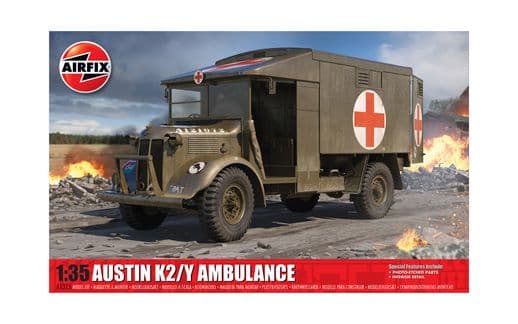
A detailed look at the box artwork produced in support of the recent launch of our new 1/35th scale Austin K2/Y Ambulance kit.
For a great many Workbench readers, Airfix kits and modelling in general have played important roles in our lives and for this reason, the mere sight of the Airfix logo always serves as something of an attention grabber for most of us. Whether we are currently active modellers or taking a hiatus from the hobby at the moment, once we have been bitten by this modelling bug, it tends to stay with us for life and no matter how hectic our lives and how stressful things might be at the present time, just a few minutes spent emersed in this subject can provide a valuable escape from everyday pressures. Hopefully, these moments of escape can include our Workbench updates, as we really do try hard to bring you all the latest updates from our latest kit projects, be they still in development or just about to hit the model outlets.
Historically, one of the most significant benefits of being an Airfix modeller has been the sheer variety of modelling subjects each successive range announcement presented us all with over the years and the irresistible way every catalogue provided numerous kit temptations to take us away from our usual modelling subject matter. Even though most modellers would agree that aeroplanes were probably the most popular subject matter in the modelling world, Airfix were rather effective in tempting even the most ardent aviologist into the world of warship, motorcar, historical figures and military vehicle modelling, with this only serving to widen our interest in the hobby. There was nothing quite like adding an airfield support vehicle or two to our aircraft diorama displays and once we had delved into this world of military vehicles, there was no going back and it was a quick hop skip and a jump to Panthers and Chieftains and a collection of slightly easier models to display than our usual aircraft kits.
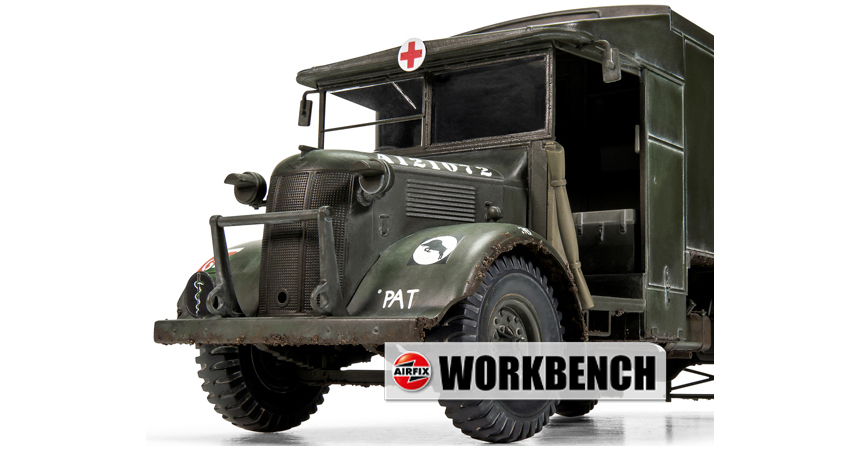
Scale tribute. Our new Austin K2/Y Ambulance kit is a faithful representation of this famous military vehicle from the Second World War.
Over the years, Military Vehicle kits have always been amongst our most popular models, with a myriad of subjects being covered in various scales since the first tank kits appeared in an Airfix catalogue back in 1962. Bringing this story up to date, the launch of our 1/35th scale range at the beginning of 2019 saw a modelling association allow a mature selection of kits to be unleased immediately, with newly tooled subjects subsequently released to further swell this impressive range. The latest addition to this impressive collection is our new Austin K2/Y Ambulance and we are delighted to confirm that those who pre-ordered this kit will probably already be in possession of their scale representation of this soft-skinned military vehicle classic.
The K2/Y can trace its origins back to the Great War and how modern, mechanized warfare brought with it a necessity to effectively supply the fighting troops with the huge amounts of fuel, ammunition, food and other commodities they would require in waging war. These supplies were crucial to the success of any military campaign and as the speed and technology of war increased, so these supply lines began to lengthen considerably. With horse drawn transportation still carrying a heavy burden during the Great War and even during the early stages of WWII, it became clear that effective motor transport would need to be introduced immediately, if armies were to be kept supplied efficiently.
During the Second World War, vast numbers of supply vehicles were pressed into military service, which initially involved taking existing utility truck designs and simply re-purposing them for military use. In addition to these vehicles, modern warfare inevitably creates casualties, both military and civilian, and the need to transport the injured from the scene of a battle or incident to a treatment station was yet another pressing mobility need - once again, existing truck designs would, in the main, have to adapt to this important new role. If you were sending men into battle, you also had to at least provide them with the reassurance that if they needed medical attention, it would be available quickly and efficiently.
An effective transition from reliable commercial to essential military vehicle, the Austin Motor Company produced one of the most important and instantly recognisable vehicles of the Second World War.
With war clouds gathering ominously on the horizon, the British Government were all too aware that their existing force of fire engines and casualty evacuation vehicles was sadly lacking and immediately set about a programme of huge expansion in this area. ‘Encouraging’ the Austin Motor Company to return to the production of trucks in support of this programme, Austin would go on to manufacture their ‘series one’ range, which included the K2 (20-cwt) and K3 (30-cwt) vehicles, rugged commercial vehicles which featured few frills, but had an enviable reputation for reliability and effectiveness. Using the existing chassis and adapted cab arrangement, they easily made the transition to military service and would go on to become hard working general supply trucks, fire appliances with a multitude of uses and ambulances for use both on the home front and increasingly, on battlefields across Europe and the Mediterranean.
One of the most famous vehicles of its type, the Austin K2/Y Ambulance was used extensively by British and Commonwealth forces throughout WWII, both in the combat zones of the world and on the home front and was the perfect combination of existing automotive technologies and specially designed body shells to perform specific tasks. The vehicle utilised Austin’s two tonne K2 chassis, with its six cylinder 3462cc overhead valve petrol engine developing a reliable 63hp, which translated to a top speed of somewhere between 50 and 60 mph. The speedometer indicated a maximum speed of 80mph, but that was more than a little optimistic and with a full load of fuel and passengers, it was more likely to be half that figure.
The widely spaced four-speed gearbox was described by many who drove this ambulance as ‘challenging’ and something which definitely required some getting used to, but once mastered would generally allow for effective, trouble free operation. The K2/Y was adapted for its ambulance role by the addition of a casualty compartment which was designed and built by the Mann Egerton coachbuilding company of Norwich, but only after consultation with the Royal Army Medical Corps to ensure total suitability for the task ahead. This rear section could carry ten seated casualties, or four stretcher cases, although military folklore tells of vehicles which regularly carried many more people. One ambulance serving in North Africa was reported to have carried no fewer than 27 wounded men, with casualties seated on the wings, bonnet and rear steps and additional stretchers suspended by rifles over the rear walkway.
The wooden casualty section of the ambulance was given an outer skin of canvas/flax, which had to be aligned perfectly to ensure all the seam lines were straight. Once the fabric had been pulled taught, it was given a liberal coat of high grade shrinking dope, so that even though the sides were only made of fabric, they still gave the impression of offering some protection. One of the main reasons why the K2/Y proved such a success was because it was so rugged and reliable, requiring only a minimum of maintenance and enabling it to be where it was needed most, transporting casualties from battlefields and incidents.
A further selection of built model images finished in the lead scheme included with this recently released 1/35th scale kit.
Earning an enviable wartime reputation, the K2/Y would see service well into the 1960s and even then, many would go on to find new civilian homes and use as anything from delivery vans to temporary homes. Underlining its importance as a military vehicle, many K2/Y ambulances have gone on to become the subject of meticulous and expensive restoration projects over recent years and they are always viewed with genuine affection wherever they appear. Restored examples are always in demand at D-Day and VE-Day commemorations, where these magnificent vehicles are just as popular as the tanks and half-tracks they share the billing with. With some 13,102 vehicles produced, the remaining restored examples serve to preserve the legacy of an iconic vehicle which shared the worlds battlefields with the fearsome armoured vehicles we more readily associate with modern warfare.
With credentials such as these, it isn't difficult to see why our decision to induct this magnificent machine into the Airfix kit hall of fame has been met with such positive feedback and we are delighted to confirm that the new Austin K2/Y Ambulance is now in stock and widely available. The images we have been using throughout this update feature a built example of this impressive new kit, finished in the lead scheme of four options included with this initial release, options which highlight just how widely this vehicle was used during its service career. The details behind this particular scheme are as follows:
The same built model as featured above, only this time positioned creatively on a suitable diorama setting by our photographer Michael Collins.
The Austin K2 ambulance was born out of the civilian K30 truck, constructed in response to their Longbridge plant’s extensive support of the ongoing war effort, with would eventually result in 13,102 such vehicles produced between 1940 and 1945. When these vehicles emerged from the manufacturing plant, they were all finished in a standard British Army olive drab scheme, however, many hundreds would benefit from future repaint to suit the operating environments in which they were required to perform. Reliable and hardworking, many of these vehicles would survive the war and following service disposal, go on to be used commercially in a variety of different manners. Unfortunately, by the nature of the work they were required to do, few received much care and attention from their owners and were basically worked until they were no longer capable of doing so, at which point they were discarded.
A Field Ambulance Unit was basically a mobile medical unit of the Royal Army Medical Corps and intended to serve with infantry divisions during the Second World War. Instilling a feeling of reassurance in the troops heading for combat, these units could be used to treat anything from general sickness and accidents, to the much more serious combat related injuries which were a result of conflict. Initially, a casualty might be received by a field aid station, where basic first aid could be administered. If injuries proved to be more significant, the casualty would be passed to the care of the Motor Ambulance Convoy, which would then transport multiple casualties onwards to better equipped medical facilities behind the lines, before returning to the front to await another group of casualties in need of their services.
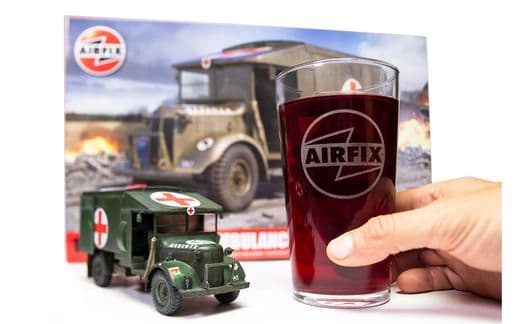
A further two images showing our latest 1/35th scale model tooling both with and on an example of the vehicle which inspired its inclusion in the range.
The formation of these units adopted a pretty rigid structure, something which was followed closely until the ambulances reached their active combat deployments - this is where things were often required a little more flexibility. As combat became more intense, this kind of essential mobile support could be required across a wide area and whilst units maintained their reporting structure, they were regularly attached to different units, as and when operational requirement demanded. In addition to combat zones, these units would have to provide mobile medical support for training units and troop concentrations at home, in addition to providing back up to the civilian population at home.
This latest addition to our 1/35th scale Military Vehicle range has been on the build radar of many a modeller since it was first announced and whilst development has taken slightly longer than we would have hoped, this beautiful model has definitely been worth the wait. In a further interesting development, the first recipients of this new kit benefitted from a rather topical addition to their order, in the shape of a free Airfix branded pint glass, just the thing you need to get you through some modelling time during the recent heatwave conditions. This exclusive glass offer is only available whilst current stocks last and the model must be ordered using the 'BUNDLEA 13' link to be eligible.
Soon to become a regular sight in model shops and on workbenches the world over, our new 1/35th scale Austin K2/Y Ambulance is a real stunner and already a popular addition to the range.
If you have still to make up your mind as to whether the Austin K2/Y Ambulance will be taking its place on your workbench over the coming months, perhaps a look at our official kit unboxing video may be of interest, as this shows everything which comes in the box, including the photo-etched parts and a review of the scheme options available. Our official YouTube channel also includes an edition of our Flight Deck series which features our K2/Y Ambulance kit meeting a magnificently restored full sized example of the vehicle, something which is well worth a watch.
Importantly, our new Austin K2/Y Ambulance kit is available now, so if you don't want to miss out, please head for the Airfix website and secure your example.
That’s all we have for you in this particular edition, but we will be back with more project updates for you next week. As always, we are interested to hear your views on all things Airfix and particularly in relation to our Workbench blog, so if you ever feel like dropping us a quick line, please use our workbench@airfix.com contact e-mail address.
All our social media sites can be accessed by clicking the respective link icons at the foot of this page, or by heading to the Airfix homepage. Other useful Airfix links are:
Facebook, YouTube, Twitter and Instagram official sites
Please join us for more Airfix updates next week and thank you for your continued support.