
Welcome to this latest edition of our Workbench blog and all the news, updates, and modelling exclusives from the fascinating world of Airfix.
One thing respective Airfix model ranges have always been recognised for is presenting the hobby world with beautiful scale kit representations of some of the world’s most famous aircraft types, a tradition which we proudly continue to uphold to this day. In addition to updating some classic kits which could benefit from passing through the latest design and manufacturing advances the modelling world has to offer, we also like to introduce new subject to the range, kits which get to wear the Airfix logo for the very first time, be that the subject itself, or the scale in which that subject has been replicated.
Our subject for this week’s Easter Workbench update is just the second standard release for an impressive new tooling project, one which recently introduced one of the most interesting aircraft of the entire Second World War to the Airfix range, the impressive looking Messerschmitt Me 410 Hornisse. Arguably the ultimate incarnation of Germany’s Zerstörer concept, the Me 410 was an excellent multi-role aeroplane, and one which would have been produced in much greater numbers had it been introduced in 1941 when initially intended. Unfortunately, its immediate predecessor proved to be a seriously flawed aeroplane, and the Luftwaffe would have to wait for its Bf 110 replacement for two long years, time which the Allied air forces would not waste.
As we prepare to welcome this second main range release of the Hornisse to the current range, we will be looking at the new box artwork produced in support of the release, in addition to discovering the details behind the two fascinating scheme options included with the kit, both of which would sit perfectly within any collection of built model kits.
Brace yourself to feel the sting of the Luftwaffe’s Hornet in this latest edition of Workbench!
Built kit example of a previous Messerschmitt Me410 release shows just how purposeful the Luftwaffe’s ultimate Zerstörer actually was.
For those of us with a fascination for the aeroplanes which took part in the battles amongst the clouds during the Second World War, we’ve probably all read how many military historians share the opinion that Germany had something of an obsession with the heavy fighter, or ‘Destroyer’ concept. With staunch supporters at the very highest levels of the command structure, they were convinced that an aircraft which was essentially a double Messerschmitt Bf 109 fighter would possess twice the destructive power of its single engined counterparts, and would be capable of sweeping any enemy aircraft from the skies. On paper, their opinions appeared perfectly plausible, however, wars are rarely fought on paper and in the world of aviation, bigger isn’t always better.
Despite performing extremely well in the air operations which lead up to the Battle of Britain, the Luftwaffe’s Messerschmitt Bf 110 heavy fighters would more than meet their match when coming up against the Spitfires and Hurricanes of Fighter Command in the skies above Britain, and actually needed single engined Bf 109s to protect them in most situations. Thankfully, the upgraded replacement for the Bf 110 was already well on the way, and it was a much more aggressive looking aeroplane. Unfortunately, all was not well with the new Destroyer and what should have been a devastating new addition to the Luftwaffe’s arsenal struggled to advance past the flight testing and service introduction stage. The Messerschmitt Me 210 was a dangerously unstable aircraft and unsuitable for the task at hand.
The new aircraft was produced utilising many existing components from the Bf 110 production lines, however, its appearance could hardly have been more different from its predecessor. With its short, purposeful nose helping to accentuate the size of the aircraft's mighty engines, this was a very impressive looking aeroplane indeed, one which really did look the part. It featuring a multi-purpose ventral weapons bay under the nose of the aircraft to minimise the effects of drag, and utilised a pair of remotely operated MG 131 machine guns, which were housed in teardrop shaped barbettes on either side of the rear fuselage, operated from the rear cockpit by a gunner using a cutting-edge electronically controlled system which utilised a hand operated pistol grip and compensated gunsight. The gunner’s targeting view was further enhanced by a blown rear canopy which extended out past the line of the fuselage, meaning no attacking aircraft could escape his gaze and therefore the attentions of his guns.
Despite its truly sinister appearance, looks can sometimes be deceiving in the world of aviation and as far as the Messerschmitt Me 210 was concerned, this was a seriously flawed aeroplane, one which many would go on to describe as being un-flyable. Once flight testing of the new heavy fighter started in earnest, it immediately became apparent that the Me 210 exhibited worrying and potentially dangerous instability characteristics. After making its first flight on 2nd September 1939, the day after Germany invaded Poland, the subsequent flight report could hardly have been more scathing of the Me 210, describing it as dangerous and unstable.
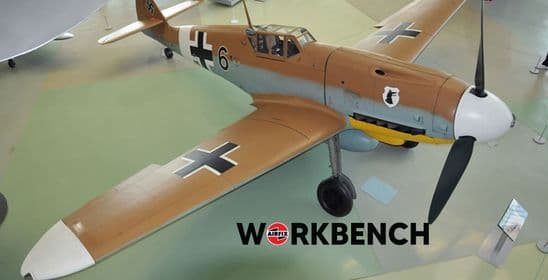
During the course of this model project, we had the privilege of being allowed to scan the only complete and on public display example of this stunning aeroplane, at the RAF Museum Midlands site, Cosford.
This was a major setback for both Messerschmitt and the Air Ministry, particularly as an order for 1000 aircraft had already been placed off the drawing board potential of the aircraft, and something had to be done about the situation. A lengthy period of testing, evaluation and modification would follow, which would last for more than the next year, however, none of this effort drastically altered the problems this aircraft was suffering from, it was just a poorly designed aircraft.
The Messerschmitt Me 210 would eventually enter service in April 1942, however, this did little to rescue the already shredded reputation of the aircraft - some reports from back then describe how Luftwaffe pilots hated it, even describing it as a machine which was trying to kill them every time it left the ground. Whether this was a result of the reputation the Me 210 had already attracted, or the fact that it was just such a difficult aircraft to fly it's difficult to say, but whatever the reason, production of the aircraft was halted only a few weeks after the first aircraft had been delivered. In the end, only 357 aircraft would be produced and most of these were built under licence in Hungary.
Less than 100 Messerschmitt built Me 210 fighters would be delivered to the Luftwaffe, with an additional 100 later supplied by the Hungarians, with the vast majority of these aircraft going on to see service in North Africa and the Mediterranean. It does have to be said that the Hungarians actually liked their aircraft and would operate them effectively throughout the remainder of the war, yet another interesting aspect of this unusual aviation story. Did the Messerschmitt designers simply cram too much innovation and advanced technology into a single aircraft design? They most definitely spent far too long trying to improve an aircraft which they knew was an extremely flawed design, and possibly beyond saving.
Ultimately, the Messerschmitt company remained convinced about the benefits of the heavy fighter concept and were confident that they could produce something of an aviation phoenix from the ashes of the Me 210, however, it would require a radical redesign of their original Messerschmitt Bf 110 replacement.
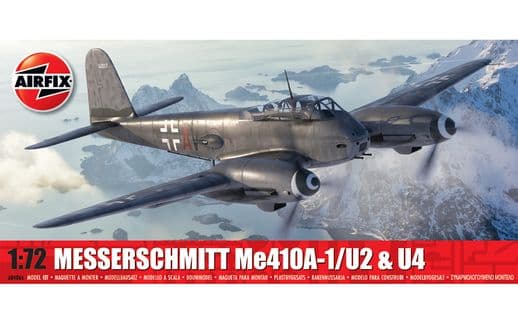
This inspirational artwork supported the release of the first kit produced from this new tooling project back in 2023, and ensured thousands of modellers spent some time with this lesser known Luftwaffe multi-role aircraft of the Second World War.
When Hermann Göring envisaged what his Zerstörer force might look like as the concept was first muted back in the mid 1930s, surely it must have been something like what a sky full of Messerschmitt Me 410 heavy fighters going into combat would have been, a truly awesome sight. Although this was essentially the development of the earlier, and extremely disappointing Me 210 and indeed, shared a great many visual similarities to its immediate predecessor, the Me 410 was a very different aircraft indeed. In fact, Hitler would go so far as to proclaim it as his 'Backbone of Germany's Home Defence', having seen a cannon armed example flown during a demonstration of his Wonder Weapons.
If you know where to look, despite the similarities shared by the two aircraft, it isn't difficult to differentiate between a Messerschmitt Me 410 and its predecessor and with it, identifying an effective combat aircraft from an extremely flawed one. Looking at a side profile of the aircraft, the Me 410 has a slightly taller and noticeably longer fuselage, with lengthened, more refined engine nacelles housing the new and more powerful Daimler Benz DB 603 engines.
These modifications alone helped to give the aircraft a more elegant appearance, if also finally realising its potential as an effective combat aircraft. The instability issues which blighted its predecessor were addressed by redesigning the wing shape, and incorporating automatic leading edge slat technology, to give the aircraft much better low speed handling characteristics. The wing of the Me 210 featured two different leading edge sweep angles, with a 6 degree sweep inboard of the engines and 12.6 degree sweep outboard, however, the Me 410 wing design did away with this, maintaining a constant 5.5 degree sweep across the length of the leading edge.
When combined with the automatic leading edge slats, these modifications virtually eliminated all the instability issues suffered by its predecessor, allowing the Me 410 to concentrate on becoming an effective combat aircraft, rather than simply staying in the air.
Although they shared many visual similarities, the Messerschmitt Me410 was a much more refined design than its disappointing predecessor, proving to be an excellent multi-role platform, capable of undertaking many different tasks and performing well in them all.
Our new 1/72nd scale Messerschmitt Me410 project was unveiled at Scale ModelWorld 2023, with the model being available straight away – we definitely had a Messerschmitt Autumn that year!
The prototype Messerschmitt Me 410 made its first flight during the Spring of 1942, immediately showing itself to be a much more capable aircraft than its predecessor, essentially the Zerstörer the Luftwaffe had been hoping to introduce two years previously. Now given the name Hornisse (Hornet), they were hoping the new heavy fighter would stir up a storm in the air, and like its predecessor, was ordered in large numbers not long after the flight of the prototype and even attracting the same priority production status.
From the outset, even though the first aircraft were produced as Schellbombers (fast bombers), it could easily be argued that the Messerschmitt Me 410 was a true multi-role aircraft, one capable of performing a variety of different tasks effectively, with flexibility intentionally built into its overall design. Could it even be suggested this was the closest the Germans ever came to producing an equivalent to the British de Havilland Mosquito they hated and admired so much?
With its ventral weapons bay which featured in the nose of the aircraft, the Messerschmitt Me 410 could be configured to perform a multitude of operational tasks, with fast bomber and heavy fighter being its primary roles, but with others such as night fighter, intruder, reconnaissance, bomber killer, torpedo bomber, dive bomber, long range/maritime strike and training roles all eventually being undertaken. In fact, something of a design industry was to grow around the concepting of proposed future variants of the Me 410 throughout its service life, even though it entered service two years later than initially anticipated.
Although developed as a Schnellbomber, many of the first Me 410s entering service were used in nightfighter/intruder or reconnaissance roles, however, it didn't take crews long to discover that this was a much better aeroplane that its predecessor, as it was welcomed into widespread service. Unfortunately, with the aircraft entering service two years later than initially anticipated, the Hornisse would have to contend with much stronger Allied air opposition, and their latest aircraft which were much more capable than the ones it would have faced in 1941.
The Messerschmitt Me 410 Hornisse was an excellent multi-role aircraft, but despite its undoubted potential, the tide of the air war across the entire European Theatre was finally beginning to turn in favour of the Allies, and the Me 410 would rarely be able to operate in uncontested airspace. Nevertheless, it has to be considered one of the most attractive, yet equally sinister looking Luftwaffe aircraft of the Second World War.
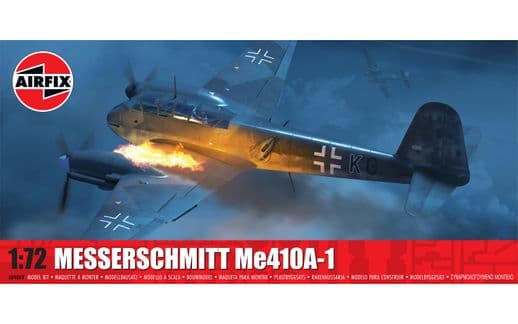
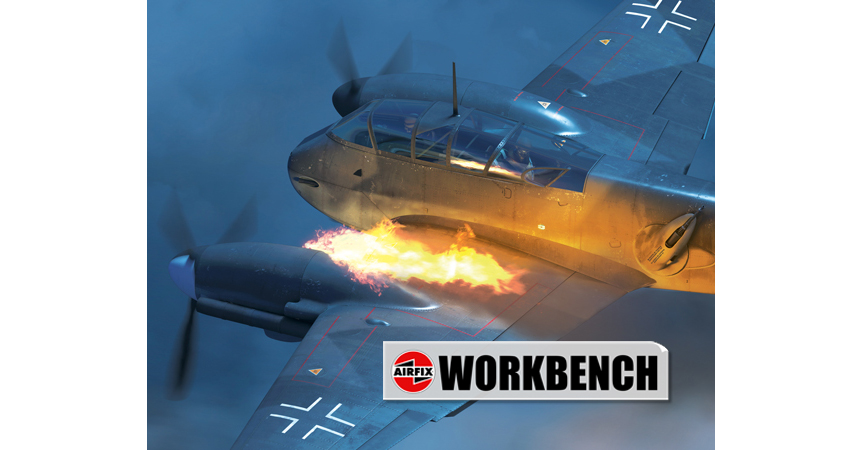
This spectacular Me410 night intruder artwork accompanies what will be only the second main range release from this magnificent 1/72nd scale model tooling.
It will come as little surprise to learn than an aircraft possessing the interest and appeal of the Messerschmitt Me 410 had no trouble whatsoever making the transition to become a modern 1/72nd scale model kit, and since its announcement at Scale ModelWorld 2023, it has gone on to become an incredibly popular addition to the Airfix range. With its good looks and sinister appearance, many people are finding out about the Luftwaffe’s ultimate Zerstörer for the first time, as despite its fighting qualities, the Me 410 is still one of the less well-known aircraft types of the Second World War.
In fact, members of the Airfix Club currently have an unusual presentation of a very specific Messerschmitt Me 410 as their exclusive Member’s Kit for this year, one which presents the same aircraft in the markings it was wearing on the day it inadvertently landed at an Allied controlled airfield in Italy in late 1943, and the same aircraft after having been repainted in British markings during evaluation test flying once sent back to the UK the following year. For many people, this really is one of the most interesting build projects available to modellers at the present time, and has seen membership of the Airfix Club increase exponentially as a result.
Whether a member of the Airfix Club or not, modellers everywhere will no doubt be interested to discover details of what will only be the second standard range release from our still relatively new 1/72nd scale Messerschmitt Me 410 tooling, and two new scheme options which offer more choice to those with an interest in Luftwaffe aircraft from WWII, and two more examples of the incredibly sinister looking Me 410 Hornisse.
Let’s take a look at both of those scheme options now.
With its speed, range and heavy firepower, the Messerschmitt Me 410 made for an ideal aircraft with which to mount long range night intruder operations into British airspace towards the end of summer 1943, looking to spread panic amongst the general population and to search for targets of opportunity, which included RAF bombers returning from their latest strikes. Often operating in pairs and utilising tactics which had been perfected during months of such operations, these fernnachtjagd raids were becoming increasingly annoying for Allied air units, if not posing a significant threat by themselves, but had to be stopped nonetheless.
Unfortunately for Messerschmitt Me 410 crews, even though they now had an excellent aeroplane with which to undertake these intruder sorties, the RAF had their own specialist aircraft, one which was even more effective at this deadly nocturnal game of hide and seek, the de Havilland Mosquito. Supported by an integrated network of enemy aircraft identification, and ever more sophisticated night interception equipment, RAF Mosquito crews trained exhaustively in the techniques required to successfully intercept enemy intruders by night, and increasingly from 1943 onwards, the sleek and relatively diminutive Me 410s were becoming their nocturnal prey.
With any light emitted from aircraft operating at night potentially giving their position away to an enemy aircraft, not only were national insignia markings usually toned down for this reason, but the most pressing issue was the flame glow from the engine exhausts. Not only would this potentially impede the crew in spotting an enemy target in the dark night sky, but it would also alert them of their position, effectively making the hunter the hunted.
For this reason, all aircraft operating at night benefitted from some form of engine exhaust flame dampening, technology which became more effective as the war progressed. This night intruder Messerschmitt Me 410 was fitted with flame suppression units over all exhaust ports, units which were delivered as complete units for specific aircraft types, but could be modified to requirements of individual crews at unit level, depending on their experience and rank. Interestingly, during a night operation over Britain, this aircraft was intercepted by an RAF nightfighter, and it wasn’t the exhausts the British pilot later reported as being the light which secured his attention.
Full scheme details for this nocturnal Luftwaffe predator.
If you saw this silhouette positioned behind your aircraft, you knew you were in a whole heap of trouble.
On the night of 7th/8th October 1943, this intruder was operating over London, having flown from its home airfield at Schiphol, in the Netherlands, when it was intercepted by an RAF de Havilland Mosquito nightfighter from No.85 Squadron operating from West Malling. Ground controllers had vectored the British fighter to the reported vicinity of the incursion, informing them that a second aircraft was flying close by, in what may have been a trap set for an unsuspecting nightfighter. The pilot reported the enemy aircraft as a Messerschmitt Me 410, later also reporting that the intruder was all lit up, with red and yellow formation lights on either wing tip, and a much brighter white light on its tail.
As the Mosquito dived in for the attack, the Me 410 pilot made aggressive evasive manoeuvres and appeared to be repeatedly attempting to get on the tail of the Mosquito and press home his own attack, something which seemed to bear out the suspicions of the ground controller. Nevertheless, in the ensuing dogfight, the Mosquito pilot was able to fire several accurate bursts at the Luftwaffe aircraft, noting strikes and flames on the aircraft’s fuselage and port wing, but as he was closing for what he thought would be the final attack, the Messerschmitt disappeared into thick cloud cover above Hastings, and the Mosquito lost contact.
Having reported the contact on landing back at West Malling, the incident was later corroborated by another Mosquito crew who were operating over the Channel, close to Hastings at the same time. They reported seeing a burning Me 410 emerging from cloud and falling to hit the sea, with burning debris visible on the surface of the water, another aircraft loss without question. The victory was subsequently awarded to the first Mosquito pilot, with the Messerschmitt crew posted at missing that same night.
These must have been very personal duels played out in the dead of night, with just the stars as their spectators, and with both victors and the vanquished meeting their fates almost in secret. It’s sobering to think that the majority of these crews would have only been in their early 20s during the wartime years.
Scheme B – Messerschmitt Me410A-1 U5+CX, 13./Kampfgeschwader 2, Coulommiers, France, August 1943.
The A-1 variant of the Me 410 was essentially the fast bomber version of this excellent aircraft, however, it was so versatile that even this variant could be adapted to undertake a variety of roles effectively. IV Gruppe of 13./KG2 was a Zerstörer training unit operating from Coulommiers aerodrome east of Paris, and was equipped with both the Messerschmitt Me 410 and the Bf 110 in this role. With its chin mounted weapons bay, the Me 410 could easily be used in a fighter bomber role, but only after crews had been trained extensively in obtaining the maximum performance of the fighter in that role.
This aircraft was equipped with external bomb racks for 50kg munitions, which carried the Luftwaffe designation ETC 50/VIIID, and were referred to as Elektrischer Träger für Cylindrische Außenlasten – this translates to Electric carrier for cylindrical external stores, which is a bit of a mouthful. These units could be attached to several different Luftwaffe aircraft types and were intended to allow the use of 50kg bombs. For training, these could be ZC-50 concrete practice bombs for air delivery, which were produced with an internal section to allow chemicals to be added, which on impact would produce smoke to allow the bombing accuracy of crews to be clearly assessed.
When actual offensive ordnance was to be used, these would be SC-50 bombs, which were a general purpose bomb and carried the designation Sprengbombe Cylindrisch, or cylindrical explosive bomb. These were available in several different permutations, from anti-shipping bombs to anti-personnel cluster munitions, all manufactured in slightly different ways. Obviously, when the Me 410 was used in a strike role, this would have an impact on the overall performance of the aircraft, reducing range, speed and manoeuvrability, until the weapons had been dropped. Nevertheless, the Me 410 was well capable of giving a good account of itself in most situations, until overwhelming numbers of marauding Allied fighters made the safe operation of any Luftwaffe aircraft questionable at best.
Full scheme details for this training unit Messerschmitt Me410, complete with external bomb racks and your choice of practice, or live 50kg bombs.
The airfield at Coulommiers was originally established for the French Air Force in 1938, even though the site had been used for aviation related activities since the very early days of manned flight. The first residents at the new airfield were French Morane-Saulnier MS406 and Bloch MB220 fighters, however, during the Battle of France, other French types and British fighters of the RAF Advanced Air Striking Force would also be stationed there.
Following the fall of France, the airfield was taken over by the Luftwaffe, who operated Junkers Ju-88 bombers from here throughout the Battle of Britain and into the Blitz which followed. After a later period of significant expansion, the airfield entered the fray once again, this time a home for twin engined aircraft engaged in night fighting and intruder operations into Britain, but also an active home for the Zerstörer training unit 13./KG2, operating both the Me 410 and Messerschmitt Bf 110. It would later become an important base for Luftwaffe nightfighter operations, as radar the equipped Bf 110 aircraft of NJG4 attempted to stem the inexorable tide of RAF heavy bombers as they pounded German targets right across enemy occupied Europe.
German only left the airfield in the months which followed the D-Day landings, as Allied advances threatened to overrun the airfield.
This beautiful kit will allow the modeller an opportunity to further improve their Luftwaffe paint mottling skills, which if executed effectively, looks absolutely stunning. When applied to an aircraft as aesthetically pleasing as the Messerschmitt Me 410, wonderful modelling things can happen, and we end up with a model display which is guaranteed to secure many an admiring glance from those fortunate enough to inspect it. This particular scheme also includes the ETC 50 external bomb racks, which again set this model apart as an unusual addition to any built model display.
A Messerschmitt quandary. Do we go for the new night intruder variant of this magnificent kit, or do we join the Airfix Club to get our hands of the Luftwaffe Me410 which joined the RAFwaffe? Either way, if we want an engaging build project, we really can’t go wrong.
This really appealing addition to the current Airfix range is scheduled to be in our warehouse and available early next month, and we expect this second standard release from this still relatively new tooling to be just as popular as the first release has been. If you would like to make it a trio of interesting Messerschmitt Me 410 kits passing over your workstation over the coming months, you might want to consider joining the Airfix Club, as the current Club kit provides us with a cracking Me 410 Luftwaffe/captured scheme.
We are afraid that's all we have for you in this latest edition, but we will be back next Friday with more project development updates and the very latest Airfix kit exclusives. In the meantime, we are always keen to hear your views on all things Airfix and in particular, any thoughts and opinions you may have regarding our Workbench blog. If you would like to drop us a quick line, could we please ask that you use our workbench@airfix.com email for all correspondence.
To re-visit any of the Airfix blogs we have produced over the past seven years or so, please head to our main Workbench hub, where you will find our entire blog back catalogue and all the Airfix design projects we have already covered.
All our dedicated official social media sites can be accessed by clicking the respective link icons at the foot of this page, or by heading to the Airfix homepage. Other useful Airfix links are:
Facebook, YouTube, Twitter and Instagram official sites
Please join us for more Airfix updates next week and thank you for your continued support.