

Welcome to the latest edition of our weekly Workbench blog, and all the news, updates, and modelling exclusives from the fascinating world of Airfix.
Our subject area for this latest edition of the Airfix blog sees us venturing into the fascinating world of post war rotary aviation, but more specifically, our model tributes to some of the most significant examples of these aircraft to ever see British service during that time. Taking our 1/48th scale modelling tributes as our focus, the lead subject is the latest release addition to this impressive range, one of the most agile helicopters to have ever taken to the skies, the incredible Westland Lynx AH-7.
In addition to looking at the history of the Lynx and the THREE scheme options available with this latest kit release, we will also be taking this opportunity to feature some of its 1/48th scale rotary brothers in arms, kits which are also currently available on the Airfix website, kits which really do have to be considered as some of the most impressive modelling projects to have ever worn the Airfix badge.
There isn’t a fixed wing aircraft in sight as we head into ‘Rotary Weekend’, with the incredible Westland Lynx at its vanguard.
Early British helicopter royalty done the Airfix and Roy Cross way. The Westland Whirlwind helicopter.
If you were to force people to consider the subject of aviation and suggest the aircraft types they were familiar with, most people would probably offer such aircraft as the Spitfires and Lancasters which helped secure Allied victory during the Second World War as their suggestions, or perhaps the Lightnings and Vulcans which helped to maintain an uneasy peace during the terrifying Cold War period. If we took more of a civilian aviation approach to that question, Concorde will always be an aviation favourite, but aircraft such as the Boeing 737s and Airbus A320s will surely also feature heavily, as these are the much loved machines that whisk us all off on our summer holidays each year.
If we were to qualify that question slightly, by asking people which aircraft they would hope to see if they found themselves in difficulty and needed to be rescued, the reply would be unanimous and unequivocal, a helicopter!
The development of rotary technology gained real impetus in the years which followed the end of the Second World War, with the helicopter showing itself to possess the ability to do things other aircraft types were simply incapable of doing, making them invaluable assets in so many situations, both military and civilian. As helicopters became more reliable, with engine technology enabling them to carry ever heavier loads, their incredible versatility would see them positioned at the forefront of many a military intervention, and similarly spearheading relief and humanitarian responses in times of international crisis.
Whether supporting military operations around the globe or coming to our rescue in times of need, the helicopter is viewed as an angel on our shoulders, and indispensable in so many situations.
An early Westland design, the Dragonfly may have looked a little ungainly, but it was beginning to show the incredible potential the helicopter possessed.
Man’s fascination with flight goes back centuries, with the ability to fly like a bird being something many great minds have contemplated over the years, not just at speed, but also to soar and hover like raptors and hummingbirds. Those early experiments all centred around the idea of having horizontally rotating blades positioned to produce lift, but as designs slowly started to jump from the drawing board to manufacturing workshops, it soon became apparent that there were significant limiting factors that would always pose challenges. These were the lack of a powerplant light enough to get the craft in the air and a lack of controllability.
The Wright Brothers would captivate the world with their stunning flight achievement in December 1903 and with it, took the search for manned, powered flight in a different and arguably more attainable direction. Despite their incredible success, rotary pioneers quietly continued their work in the background, making modest advancements and obtaining valuable research data, but with many attempts still resulting in failure and frustration.
Those primitive, early machines aften have something of a comedic appearance to them, but were no laughing matter for the brave men attempting to fly them, because they were literally taking their lives in their hands. Slowly overcoming the challenges of power and controllability, those early tests all involved aircraft tethered to the ground for safety reasons, but always saw modest advancements in their quest to develop aircraft with the ability to hover. Autogyros were an interesting development, nut were still more traditional aircraft than helicopter, but the technology was advancing and it wouldn’t be long now.
During the 1930s, rotary aviation started to see some real advancement, with many significant ‘firsts’ for helicopters all taking place during this decade. In Germany, the potential of rotary powered flight was spectacularly demonstrated to the world when test pilot Hanna Reitsch flew the Focke Wulf Fw-61 inside the Deutschlandhalle Sports Stadium, with this craft taking the distinction of being the world’s first successful, practical and fully controllable helicopter.
In America, another true pioneer of rotary power, Igor Sikorski, was achieving significant successes of his own, with his company going on to become arguably the most important helicopter manufacturing company in the world, albeit with the benefit of captured German helicopter technology. We’ll be hearing more about Mr Sikorski and his helicopter designs a little later.
This famous old British aviation company was founded in 1915, initially to construct other companies aircraft under licence for the British government, but later to successfully design and produce their own aircraft. The company started to introduce their own in-house designs from around 1917 onwards, but in wouldn’t be until the introduction of the Westland Wapiti ten years later that they would have their first truly successful commercial design. This large single engined two seat general purpose aircraft saw service with the RAF and Commonwealth air forces in the Army Cooperation, reconnaissance and light bombing roles, used extensively in Iraq and India. These aircraft started to be withdrawn from RAF service during the mid 1930s, although some were used by the Indian Air Force during the early stages of the Second World War.
One of the most famous Westland designed aircraft of the Second World War was the STOL Lysander, of which just under 1,800 were built.
During WWII, Westlands were probably best known for producing more Supermarine Spitfires than any other manufacturer, but would also go on to design and built their own front-line aircraft. Their Whirlwind was an innovative, twin engined heavy fighter, one which has to be regarded as one of the more interesting British aircraft to see service during the Second World War, and we all know about the many impressive qualities of the STOL capable Lysander, another Army Cooperation aircraft, but one most fondly remembered as an aerial ‘Spy Taxi’.
During the immediate post war years, Westlands introduced their impressive Wyvern, a mighty carrier based strike fighter which was powered by a massive twin contra-rotating propeller, another design which illustrated the design credentials of this forward thinking company. It was around this time though that officials at the company decided to take Westlands in a new direction, turning their backs on the world of fixed-wing aircraft production, to concentrate on the manufacture of the latest helicopter designs.
With a manufacturing agreement with the industry leading American Sikorsky Corporation in place, this decision would prove significant for the future of Westlands, as they themselves would become world leaders in the production of helicopters and the further advancement of rotary air power. Their rotary future started to take shape with the licenced production of the Sikorsky S-51 helicopter, with the Westland design making its first flight in 1948. The British built variant was referred to as the Westland-Sikorsky WS-51 Dragonfly and seventy-two of these extremely distinctive helicopters would eventually be produced in the UK for the Fleet Air Arm.
These aircraft performed training, communications and search and rescue roles, but with its high fuselage, distinctive heavy glazed cabin area and incredibly long tail boom, this aircraft must have been an incredibly difficult one to operate form the confined decks of a British aircraft carrier.
As rotary technology continued to evolve, the Westland Aircraft Company would go on to produce such classic helicopters as the WS-55 Whirlwind, the WS-58 Wessex and the WS-61 Sea King, in addition to the earlier and slightly smaller Sioux, Scout and Wasp designs.
Marking the welcome return of the 1/48th scale Westland Lynx AH-7, we’re pleased to feature this new box artwork image in all its glory, one which takes inspiration from the first of three scheme options included with this kit.
With a series of successful collaborative Sikorski helicopter projects already behind them, when work on the new Westland type WG.13 helicopter began in the mid 1960, things would be rather different from what had gone before. This new helicopter project was intended to provide a modern replacement for both the Westland Scout (Army) and Westland Wasp (Navy) utility helicopters already in British service, potentially even possessing the ability to replace the larger Wessex design.
Significantly though, this project would mark the continuation of an agreement signed in 1967 between Westland and the French manufacturer Sud Aviation (later to become Aerospatiale), where the combined technical, manufacturing and marketing strengths of both companies would be brought to bear in developing an industry leading new multi-role helicopter. The French company would take a 30 percent stake in the production work for the new helicopter, leaving Westlands with the majority share of the work, but with the deal also seeing France committing to purchase significant numbers of the new helicopter.
Both the French Army and Navy were scheduled to be equipped with the new helicopter, with the Army taking a much modified armed reconnaissance variant of the aircraft, but with Britain committing to purchase both the Aérospatiale Gazelle and Puma for their own armed forces, a deal which seemed to work well for both countries. As proved to be the case, Britain did take the two French helicopters, however, the French Army subsequently withdrew their interest in the new helicopter, leaving the project to progress without this important sales support.
The new Westland helicopter (Lynx) was going to be an advanced, multi-purpose design possessing both military and civilian market application potential. An incredibly ambitious design, the Lynx was always intended to be a ground-breaking aircraft, one incorporating radical new technologies and cutting edge manufacturing techniques, one which would go on to set many performance records in the world of rotary aviation. In this regard, it has to be regarded as something of a rotary aviation classic.
The Airfix Westland Lynx in Royal Navy guise – this kit is still currently available.
When the Westland Lynx prototype embarked on its maiden flight on 21st March 1971, it was clear from that early stage that the company had a very special aeroplane on their hands. As these developments flights continued into the following year, the Lynx would go on to set several new speed records for a helicopter, something the Lynx would continue to both pursue and be associated with for the rest of its service life. Indeed, on 11th August 1986, it would go on to set the absolute speed record for a helicopter of 249 mph, a record it would hold throughout its service career and one which still stands for a helicopter of traditional rotorcraft configuration.
For a helicopter which possessed so many groundbreaking features, the Lynx would also go on to attract plenty of military orders, and to have a long and illustrious service career. The British Army would initially place an order for 100 Lynx helicopters which were designated AH.1 (Army Helicopter Mk.I), with these aircraft required to perform a variety of essential roles, including that of tank/armour destroyer.
The Royal Navy would also take the Lynx, designating their aircraft as HAS.2 machines, aircraft which differed markedly from their Army counterparts. In addition to possessing the ability to carry different weapons for use in maritime operations, the Navy Lynx differed visually in that they replaced the skid landing gear of the Army Lynx helicopters with an unusually angled tricycle undercarriage arrangement.
These aircraft also employed an ingenious deck restraint system to hold the helicopter securely when landing on the moving deck of a ship at sea, mounted Sea Spray radar equipment on the nose of the Lynx, and incorporated folding rotor blades for ease of stowage aboard a Royal Navy ship. These Navy Lynx derivatives also incorporated an emergency flotation system, an essential safety feature should an aircraft suffer damage or mechanical malfunction and be forced to make a landing on water.
Crucially though, with the Westland Lynx now in service, Britain now had one of the most advanced helicopters in world service at their disposal, and they were keen to show what their new Lynx could do.
One of the built model samples produced in support of this latest Lynx kit release.
As one of the world’s most significant post war helicopter designs, the Lynx has long been a popular kit subject within the Airfix range, appearing initially in British Army AH-1 variant guise back in 1975, and subsequently as the Navy derivative the following year, both released in 1/72nd scale. Going on to prove a perennial best seller with modellers both here in the UK and across the world, the Lynx as a modelling subject would also go on to receive a significant tooling upgrade boost in 2021, with the launch of a spectacular new 1/48th scale kit. This stunning new kit, which was again released in two variant options, with the British Army AH-7 appearing first, followed by the Mk.88A/HMA.8 and MK.90B Naval variants.
This larger scale really does suit the appealing lines of the Lynx, with this kit unquestionably standing as one of the most accomplished kits in the entire Airfix range, one which builds into a spectacular display piece, a fitting scale tribute to the legacy of this record-braking helicopter. As such, the 1/48th scale Lynx kit has always enjoyed plenty of support from modelling enthusiasts everywhere.
For these reasons, having a 1/48th scale Lynx kit in our range is always something to celebrate, so as we hadn’t previously had the opportunity to mark this latest triumphant release addition to the current range, we thought it about time we let the Lynx have its time in the blog spotlight. With new artwork and built kits finished in each of the three new schemes available at our disposal, rotary modelling enthusiasts are in for a real treat this time around.
As one of the fastest and most agile helicopters in the world, the Lynx was quick to make a name for itself on a world stage, but in British Army service, established itself as a rugged and capable battlefield support helicopter. Although the Lynx is always associated with its impressive speed and agility, it would also serve the British Army with distinction for more than 38 years, taking on any role attributed to it with consummate ease, and proving invaluable on the battlefield.
When configured to carry troops, it could carry between six and nine troops dependant on the role they were being deployed to perform and the amount of equipment that would require, and for self-defence, two plinth mounted machine guns ensured that this rotary big cat was more than capable of showing its claws.
When used in an anti-tank/anti-armour role, the Lynx could be equipped with eight BGM-71 TOW missiles, more accurately described as Tube launched, Optically tracked, Wire guided missiles, carried in two banks of four launch tubes on either side of the aircraft. In this configuration, the Lynx was fitted with roof mounted sighting equipment, allowing the crew to mount look-down attacks against tanks, armoured vehicles and against enemy fortified defensive positions. Even when not equipped with TOW missiles, Lynx crews could be called upon to reconnoitre enemy positions to target armour for other units, or stealthily deliver ground based anti-tank crews to strategic locations on the battlefield.
Operationally, the Lynx would make its combat debut during the Falklands War of 1982, but during its impressive service career, would serve through no fewer than 22 conflict hotspots and equip 17 Army Air Corps Squadrons at one time or another.
During that impressive career, the British Army Lynx would benefit from one main upgrade programme, but it was a significant one. The Lynx AH-7 variant benefitted from more powerful Rolls Royce GEM turboshaft engines, be made even more robust an aircraft, and receive a host of other performance enhancing improvements. These included a new, more capable gearbox, new main rotor blades and a new, larger composite tail and tail rotor design, all ow which were intended to make this already capable helicopter even more effective in all its many roles.
Peacekeeping British Army Lynx. This next series of images all feature the lead scheme option of the three available with this impressive new kit release.
Twelve examples of this new, upgraded variant were produced by Westlands, however, the majority of the Army’s AH-7 Lynx force was made up of existing AH-1 helicopters which underwent upgrade to this new configuration. This programme was so extensive that we forgot to mention the Lynx’s improved avionics equipment and upgraded defensive aid package – this was quite the machine.
Ultimately, time even managed to catch up with the mighty Lynx, and in an age of digital technology, the Army’s hands-on helicopter was starting to show its age. She made her service bow in 2018, but only did so by passing on many of its secrets to its replacement, the Wildcat Mk.I, an aircraft with which it shares many visual similarities.
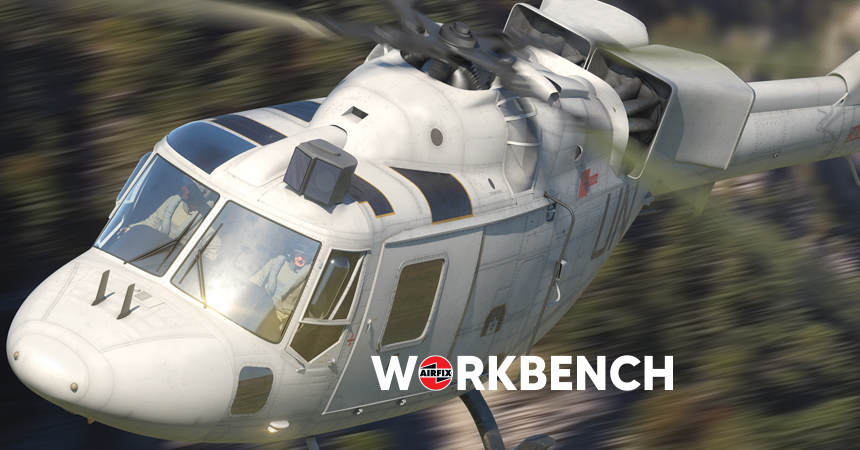
In an international attempt to stabilise the hostile situation in the Balkan region during the 1990s, United Nations and NATO peacekeeping forces were deployed to the region in some force, with the helicopters of the British Army Air Corps making a significant contribution over a twelve year period. They deployed Lynx and Gazelle helicopters, with some arriving loaded in the back of Hercules transport aircraft, but with others making the 1,500 mile flight under their own steam.
Although these helicopters were often required to operate in remote, mountainous regions and throughout all seasons, the reason they were painted white was to make them highly visible to all sides in this conflict, including the international peacekeeping forces. This distinctive scheme was intended to identify the helicopters as performing a peacekeeping role, and not operating in support of any of the former warring factions, hopefully endearing them to the locals and keeping crews safe from being targeted by small arms.
There are several really clear pictures showing this distinctively presented UN Lynx operating out of Split Airport, each one showing how mountainous the surrounding terrain was for crews, and an indication of just how important a strong helicopter presence in the area was from a peacekeeping capacity.
One of the most significant deployments of British Army Lynx helicopters during their 38 year service history was their service in Northern Ireland during the troubles. A real hot rod of a helicopter, Army Lynx helicopters used their legendary speed and manoeuvrability to operate from and into fortified bases, using tactics to make targeting the aircraft extremely difficult for those with a desire to do so. More capable than any other helicopter type available in Ireland in terms of agility, these helicopters were used to support British Army, Ulster Defence Regiment and Royal Ulster Constabulary operations throughout the region, and were highly regarded in this role.
With the possibility of ambush and roadside bomb attack becoming such a risk for policing forces travelling throughout Northern Ireland from the mid 1970s onwards, helicopters proved essential for the effective movement of troops, UDR and RUC personnel, with bases becoming vital locations for security and supply operations. AAC Lynx crews would be involved in the daily movement of troops and supplies, would fly escort missions for larger helicopters flying with heavy cargo and underslung loads, but also turn their hand to medical evacuations, medical staff transportation and the movement of prisoners and detainees.
This scheme commemorates the vital contribution British helicopters made during the troubles in Northern Ireland.
The Lynx also saw heavy use in flying aerial patrols and reconnaissance gathering missions, all intended to disrupt and deter IRA operations in Northern Ireland, but also making them high profile targets for those with nationalistic views. Several aircraft came under small arms and heavy machine gun fire over the years, and the fact that military officials thought the IRA had access to SAM weapons made the work of the AAC crews in Northern Ireland all the more impressive.
One of the Lynx helicopters which operated from Aldergrove during this time is now in the care of the Ulster Aviation Museum, a fitting location for one of these hard working and highly capable helicopters, aircraft which served valiantly in trying to bring peace to this troubled region.
The aircraft covered by this scheme option was built in 1986 and allocated the airframe construction number 325. She wears the iconic Army Air Corps markings which were synonymous with British Army Lynx operations, paying tribute to those aircraft and crews which served in Northern Ireland. At the end of her service career, she served as an instructional airframe at the Defence College of Aeronautical Engineering at Arborfield, but with the closure of this facility, was subsequently transferred to the Defence School of Electronic and Mechanical Engineering at Lyneham, where she is thought to still remain.
In the aftermath of conflict breaking out in Bosnia and Herzegovina during the early 1990s, NATO embarked on its first major crisis response to the region, with an Implementation Force deploying in late 1995, to be replaced by a Stabilisation Force the following year. The aim of the stabilisation force was to ensure a stable and safe environment for civil and political reconstruction and to this end, mounted patrols to reassure the population of their presence, and to deter any resumption of hostilities.
Additional duties would involve the search for and arrest of those accused of war crimes, supporting the massive de-mining operation and providing armed support for any official bodies engaged in those same activities.
Vital to the support of these important operations, helicopters were deployed in large numbers, with Britain sending aircraft from all branches of their armed forces, including the speedy Lynx AH-7 aircraft of the Army Air Corps. These helicopters undertook all manner of mission taskings, from humanitarian and casualty evacuation flights to high profile patrol flights and supply drops, with crews able to respond at a moment’s notice and being capable of operating both into and out of even the most inhospitable of locations.
These missions were crucial in also serving as high profile policing flights to ensure all sides honoured any ceasefire agreements in place, whilst at the same time providing reassurance to the civilian population that the international community was taking their plight seriously, and were there to ensure things didn’t get out of hand and return to conflict. UN SFOR Lynx helicopters would also be regularly called upon to undertake supply drops and support missions but always carrying the threat of bringing aerial firepower to bear, should any situation require such a response.
More peacekeeping duties for this UN SFOR Lynx helicopter.
With the ability to operate from land bases such as the one at Divulje Barracks, or from ships holding off the coast, these aircraft were invaluable when it came to this type of operation, helping to ensure peace, but never relinquishing its offensive threat.
Lynx ZE378 was built as an AH-7 variant in 1986 and allocated the construction number 322. She would later undergo upgrade to the final AH-9A variant and would be one of the very last Lynx helicopters in Army Air Corps service. In fact, she was one of six aircraft to take part in a special commemorative flypast on Friday 31st July 2015, as this small formation commemorated the 70th Anniversary of No.671 Squadron AAC, and more importantly, the retirement of the Lynx from Army Air Corps service.
This must have been a sad day for all those connected with the Lynx in British Army service, but one also instilling immense pride in what this aircraft had achieved over its long service period. It was reported that following her ceremonial duties, she was stripped for parts at Middle Wallop, however, a quick web search also shows that she was allocated to a ground instructional role at Cranwell in 2020, which seems a much more fitting retirement for a much loved Lynx.
A great looking helicopter from any angle, the Westland Lynx really does lend itself to scale representation in the slightly larger 1/48th scale, and when you have one residing majestically within any collection of built models, it isn’t hard to understand why the Lynx continues to be so highly regarded as a helicopter type, and sorely missed by those who served in and around them.
The new Wildcat is clearly much more capable than its predecessor and bears more than a passing resemblance to it, but does it possess the same charm? Only time will tell if it will ever occupy a similar position in our hearts, but in order to fuel our Lynx devotion, we’re delighted to say that our 1/48th scale Westland Lynx AH-7 is now in stock and available.
Unquestionably one of the best looking model kits to ever grace the Airfix range, make sure you grab at least one of these beauties whilst you can, as you don’t want to run the risk of it being another ten years before it’s released again.
Well, we are in Rotary Weekend! Big brother of the Lynx, the Sea King is perhaps the best loved of all the Westland produced helicopter types.
Over the years here on Workbench, we’ve discussed the many modelling merits of kits produced in 1/48th scale, and how these slightly larger models manage to convey the power and majesty of some of the world’s greatest aircraft in a more appealing manner. We have mainly mentioned this when talking about fighting aeroplanes of the Second World War, such as the Mustang, Curtiss P-40 and Blenheim, but it also holds for post war helicopters, like the Lynx, but also the Westland Sea King. When our 1/48th scale Sea King kit was announced as a surprise release back in 2023, we really did catch the hobby off guard somewhat, but presented them with a kit many modellers have been dreaming of for some time. Though we say so ourselves, we think we really delivered with this beauty.
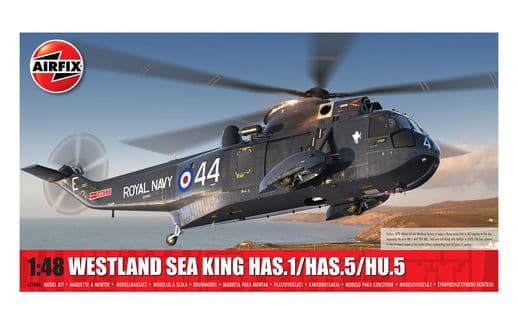
As we currently find ourselves in ‘Rotary Weekend’, we couldn’t let this opportunity pass without also including the current Sea King kit offerings we have available, but only by featuring the scheme options which inspired the creation of their respective box artwork images. Starting with the first release, this kit presents the Sea King at the very start of its British service story, in the colours of the Fleet Air Arm.
Sea King XV666 was built as part of the first Royal Navy order for 56 HAS.1 helicopters by Westland Helicopters at Yeovil in 1970, making her first flight on 23rd June that year. Early the following month, she was delivered to the Royal Navy at RNAS Culdrose and initially allocated to No.826 Naval Air Squadron and given the codes E.144. Although assigned to HMS Eagle, one of her earliest taskings was to represent the future of the Fleet Air Arm at that year's Farnborough Airshow, where she arrived resplendent in her distinctive overall navy blue scheme to the delight of the gathered masses, an example of one of the most advanced aircraft of her kind to be found anywhere in the world.
In HAS.1 configuration, the Sea King was a submarine hunter/killer first and foremost, with the capability to perform any number of less offensive, yet still important duties as and when required. The spacious cabin of the Sea King provided plenty of room for equipment installation and allowed crew members to stand up when moving around in this section of the aircraft, with all this additional space surely making this quite a pleasant environment to work from. The Sea King featured an array of advanced features which had been perfected for use on helicopters over the years, including a sophisticated auto hover system, which proved invaluable both when attempting to detect submarines and whilst performing the Search and Rescue role.
This is the first time that these built model images of ‘Damien’ have appeared in a Workbench blog.
Other automated systems fitted to the aircraft made the task of operating this aircraft in the demanding environments it was required to work in, much less onerous for its crew and with its increased operating range, combined with the reassurance of twin-engine serviceability and built in systems redundancy, the Sea King quickly became a favourite with those selected to serve aboard them. Significantly, the Sea King presented the Royal Navy with an exceptional aircraft which possessed the ability to operate over greater distances than ever before, with longer on station capability and the ability to operate in all weather conditions by both day and night. The Sea King had already started to build its impressive reputation.
In the anti-submarine role, a typical crewing would consist of the pilot, who would captain the aircraft, and co-pilot who would actually fly the aircraft. These would be joined by a sonar operator and anti-submarine control officer, with the latter having the responsibility of taking control of the aircraft when involved in a search and attack scenario. Using a combination of its powerful sonar and navigation equipment, the Sea King could detect an enemy submarine, whilst at the same time coordinate operations with other friendly aircraft and surface vessels in the vicinity and should an attack be authorised, it was more than capable of dealing with the detected threat. The HAS.1 could be equipped with four Mk.44 homing torpedoes, or four Mk.II depth charges, but if the situation demanded, could also deliver a nuclear depth bomb. It provided the Royal Navy with a truly autonomous anti-submarine detect and destroy capability.
In addition to operating from RNAS Culdrose, which at that time was the largest and busiest helicopter base in Europe, XV666 'Damien' operated from the decks of both HMS Tiger and HMS Eagle and would go on to have a long and illustrious career.
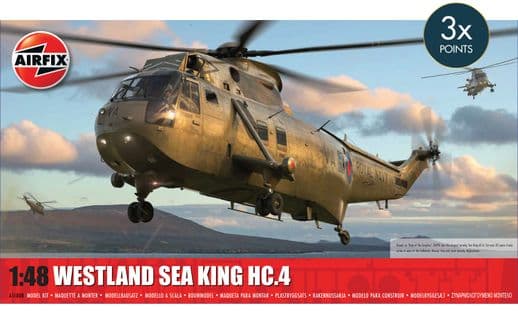
The second release from our Westland Sea King tooling presented this iconic helicopter in ‘action mode’, an aircraft which may still have retained its naval identity, but one used to transport shock troops to action hotspots around the world. These Sea Kings really did mean business and were helicopters with attitude. The lead scheme presents the Commando in its beautifully sinister olive green finish, making an interesting contrast to the initial release which preceded it.
Although the Falklands air war is usually associated with the Sea Harriers which performed with such distinction in protecting the British Task force, or the Avro Vulcans which mounted the longest bombing raid in history, the contribution made by Britain’s helicopter force during the conflict was also crucial to the eventual success of the operation. Westland Sea King HC.4 ZA298 (c/n WA912) was built by Westlands in 1981, making its first flight on 21st August that year, prior to being delivered to the Naval Aircraft Support Unit at RNAS Culdrose. Unusually, she returned to Westlands later that year to be used on a sales tour of Algeria, where the aircraft wore the civilian registration G-BJMN.
ZA298 was one of fifteen Fleet Air Arm Sea King HC.4 helicopters to take part in ‘Operation Corporate’, Britain’s military operation to re-take the Falkland Islands from Argentinean invasion in 1982, where they would work tirelessly transporting troops and supplies, and delivering and extracting special forces around the region. She was assigned to HMS Hermes at the start of the operation, but was detached to the amphibious assault ship HMS Fearless, from where she assisted with the evacuation of personnel and casualties HMS Coventry after she had been hit by bombs from Argentinean A4 Skyhawks.
Sea King ZA298 would herself be targeted by A4 Skyhawks on 13th June 1982, when two aircraft screamed over the Falkland Islands and took pot-shots at the helicopter having just released their bombs. A 30mm cannon shell hit one of the helicopter’s rotor blades, with the aircraft being forced to make an immediate heavy landing. Incredibly, in the heat of battle, technicians replaced the blade in less than two hours, with ZA298 taking to the air again immediately after, continuing to provide her invaluable support. Just two days later, she was used to transport Argentinean General Menendez to HMS Fearless to begin surrender negotiations.
Westland Sea King HC.4 ZA298 is unquestionably one of the most significant British aircraft of the post war era.
After a baptism of fire such as this, you might think that the rest of this helicopter’s service career would be a little less dramatic, however, you would be mistaken, as this aircraft would be remembered as the longest serving Sea King Mk.4 and even be given the title ‘King of the Junglies’.
To say that Sea King ZA298 would go on to have a significant career would be something of an understatement, because essentially, wherever British forces were required to operate over the next 30 plus years, this incredible aircraft would have probably been there too. In addition to serving with such distinction during the Falklands War, she would go on to serve in Northern Ireland, Bosnia, during both Gulf Wars and in Afghanistan, coming under fire during most of these deployments. Whilst helping to rescue civilians during the Bosnian Crisis, the aircraft was raked by small arms fire and whilst serving in Afghanistan, had a sizeable hole blown in her fuselage side, after being struck by a rocket propelled grenade.
Whilst the helicopter was landing at a checkpoint in Helmand Province in 2009, ZA298 was struck by a Taliban RPG, causing significant damage to the aircraft and heralding the start of an extremely hazardous recovery operation for the British military. In an exercise which was a technically challenging as it was dangerous, a specialist team prepared to airlift the helicopter back to Camp Bastion, where the damage could be fully assessed and consideration given to onward transportation back to the UK for repair.
Once she was back at Camp Bastion, the full extent of the damage could be seen and whilst the decision was subsequently made to transport the aircraft back to the UK, it did appear to many that the damage was so severe that a repair attempt would be neither cost effective, or possible. Thankfully, that proved not to be the case, and a decision was taken to allow the repairs to take place and over the course of an eighteen-month period, the engineers at Vector Aerospace did a splendid job in returning this aviation stalwart to her former glory.
As was befitting an aircraft of this stature, despite returning to service with Commando Helicopter Force, the remaining service years of ZA298 would be much less dramatic, unless, of course, you include the fact that she was the aircraft which carried the Olympic flame at the start of the London Olympics ceremony in 2012, where a Royal Marine Commando abseiled down from the helicopter into the grounds of the Tower of London, before transferring the flame to Dame Kelly Holmes.
Fittingly, ZA298 is now preserved for the nation and is on public display as part of the impressive collection at the Fleet Air Arm Museum, one of the most famous aircraft to have ever seen British service and significantly, only 7 miles from the factory which built her back in 1981. Her illustrious career stands testament to both the capabilities of modern helicopters and the effectiveness of the mighty Sea King.
Representing the pinnacle of post war British helicopter technology, the kits featured in this week’s edition are our tribute to some of the most significant aircraft to see British service since the end of the Second World War, aircraft which could do things that others simply couldn’t even dream of attempting. Underlining the fact that helicopters are now invaluable assets in a modern world, these magnificent machines perform a multitude of military and civilian tasks, but crucially, when any military situation requires boots on the ground, that can’t happen without the support of helicopters.
If you’re of a mind to produce a scale modelling tribute to these incredible aircraft, the current Airfix range has plenty of inspiration for you and currently, all the kits featured in this latest edition are in stock and available.
We're afraid that's all we have for you in this latest edition of the Airfix blog, but we will be back next Friday with more project development updates and the very latest Airfix kit exclusives. In the meantime, we're always keen to hear your views on all things Airfix and in particular, any thoughts and opinions you may have regarding our Workbench blog. If you would like to drop us a quick line, could we please ask that you use our workbench@airfix.com email for all correspondence.
To re-visit any of the Airfix blogs we have produced over the past TEN years or so, please head to our main Workbench hub, where you'll find our entire blog back catalogue and all the Airfix design projects we have already covered.
All our dedicated official social media sites can be accessed by clicking the respective link icons at the foot of this page, or by heading to the Airfix homepage. Other useful Airfix links are:
Facebook, YouTube, Twitter and Instagram official sites
Please join us for more Airfix updates next week and thank you for your continued support.