
Welcome to this latest edition of Workbench and all the news, updates and exclusive announcements from the fascinating world of Airfix modelling.
It’s difficult to believe that this is the penultimate edition of Workbench for 2020, before we head into our Christmas and New Year break - where on earth does the time go? It truth, 2020 will probably be a year most of us will want to forget as quickly as possible, although our hobby has certainly helped to ease us through an extremely challenging time. Thankfully, with the prospect of effective vaccines just around the corner and the New Year offering more hope than most, it might not be too long before we can all start enjoying a gradual return to something close to what we would call normal. Unfortunately for most of us, it still seems as if the hugely enjoyable model shows which take place during the first few weeks of a new year will still fall victim to the restrictions, however, we are definitely looking forward to attending our first show of 2021 and seeing what you have all been working on over the past year or so.
In this latest blog, we are delighted to be including a full selection of exclusive artwork reveals, built model sample reviews, scheme detail confirmations and the return of a truly classic Airfix model kit, as we cover all the bases with the exception of announcing a new model tooling. Having said that, with the new 2021 range launch going live on the Airfix website in the first week of the new year, you are not even going to have to wait too long for these details either. We begin this edition of Workbench by looking at the latest release from a beautiful 1/48th scale tooling which has been a real modelling revelation since it was first announced back in 2017 and marks one of the Second World War’s most important British aircraft. Many readers will be delighted to hear that we follow this up with a final update from our highly anticipated new RAF Blackburn Buccaneer S.2B kit, as we bring you several exclusive images of a full model build which has been finished in the lead scheme to be included with this new kit. We bring this edition to a close with a true Airfix classic and a kit we will all be aware of, but one few of us will have dared to tackle, the stunning 1/12th scale 1930 Blower Bentley. Let’s get stuck in straight away.

Our latest box artwork reveal is an absolute delight and shows an RAF Blenheim Mk.I engaged in combat with Fiat fighters of the Regia Aeronautica over a Mediterranean landscape
When it comes to the subject of aircraft, every modeller will undoubtedly have their own particular favourite type and even though we will often stray into other subject territory from time to time, it only takes the release of a new kit, new decals or new extra market detail accessory to tempt us back into our comfort zone. Having said that, our subject allegiances can sometimes be temporarily side-tracked when we look a little deeper into the history of certain aircraft, or the exploits of their heroic crews, affording us a better, if still relatively temporary appreciation for this alternative subject. When discussing ground-breaking British aircraft and ones which played a crucial role during the early stages of the Second World War, one aircraft stands head and shoulders above the rest, even though it rarely receives the recognition it undoubtedly deserves, the superb Bristol Blenheim. Thanks to the skill and dedication of one of our extremely talented product designers, the relatively recent release of a new Blenheim kit in 1/48th scale has brought this magnificent aeroplane to the attention of modellers some eighty three years after the type entered Royal Air Force service. The first release from this tooling presented the Blenheim in its heavy fighter/light attack aircraft configuration, but for the second release, modellers have scheme options to build the light bomber version of the aircraft, the role for which this aircraft was originally intended.
When newspaper magnet Lord Rothermere initiated a programme to produce a world leading light civilian airliner in 1934, his intentions were to regain some semblance of aviation credibility for a British nation which he felt was falling behind developments taking place in the rest of the world and more specifically, in Germany. The Bristol Type 142 design which was the result of this work could hardly have been more impressive - a sleek, twin engined aircraft with a profile which was dominated by two powerful Bristol Mercury radial engines, an aircraft which was bred for speed. Incorporating a host of advanced technologies, the new aircraft was of all metal stressed skin construction and featured retractable undercarriage, flaps, and variable pitch propellers. A significant leap forward in aviation technology, the Bristol airliner proved to be exactly what Lord Rothermere had been hoping for, especially when it later captured the world speed record for a civilian passenger aircraft. Symbolically naming his impressive new aircraft ‘Britain First’, he gifted it to the nation, hoping that it would attract interest from the military.
In truth, the Bristol Type 142 was something of an embarrassment for the RAF. Having only recently introduced the latest Gloster Gauntlet fighter into squadron service, it was found that the new Bristol airliner was actually 77 mph faster than the RAF’s home defence fighter. It was not lost on them that under most circumstances, the RAF would be incapable of intercepting this new civilian airliner, a situation which had to be addressed. Impressed by its world beating capabilities, British military officials immediately placed an order for a bomber variant of the Bristol Type 142 an aircraft which carried the official designation Bristol Type 142M (Military), but one which would soon be known as the Blenheim Mk.I. Thanks to his intervention, Lord Rothermere managed to increase the pace at which the Royal Air Force was modernising, with his Blenheim Mk.I heralding the arrival of a new breed of advanced aircraft. With the clouds of war already gathering in Europe, this development would prove crucial in the years to come.

This image features the first production Bristol Type 142M aircraft with the serial K7033, a historic aircraft in its own right, which served as the only prototype for this military derivative of the aircraft which would go on to be named the Blenheim
Entering Royal Air Force service in March 1937, when No.114 Squadron traded their Hawker Hind biplanes for the new Bristol Blenheim Mk.I, the squadron’s crews knew that they were at the cutting edge of world aviation. Immediately presenting them with an aircraft which was capable of speeds approaching 100 mph faster than their previous mount, the Blenheim was the fastest light/medium bomber in the world at that time and the aircraft against which all other future designs would be judged. Indeed, when conducting air combat exercises, Blenheim crews were instructed to fly slower than the aircraft was capable of doing, just so RAF fighters had the chance to intercept them. Unfortunately though, the impressive 307 mph top speed of Lord Rothermere’s civilian prototype could not be matched by the military variant of the aircraft, once all the additional weight of military equipment had been added and the Blenheim would be needing as much speed as it could get if the RAF was forced to go to war.
Historically, the Bristol Blenheim occupies such an important position in the annals of the Royal Air Force that it is difficult to understand why it doesn’t receive the widespread recognition it undoubtedly deserves. At the outbreak of the Second World War, the Royal Air Force had more Bristol Blenheims in service than any other aircraft type and its crews would be asked to carry a heavy load during the early years of the conflict. Underlining the strength of its design, the Blenheim could easily be described as a multi-role aircraft type, as it served in the bomber, fighter, strike fighter, reconnaissance and nightfighter roles during the war, even though it could be argued that it was not ideally suited to any of them at that time. Nevertheless, new operational requirements continued to be placed on the Blenheim and their brave crews continued to carry them out.
The announcement of our new 1/48th scale Bristol Blenheim tooling which was made in an edition of Workbench back in 2017, came as a pleasant surprise for most modellers, particularly as this is quite a large subject for this scale. When compared to the single engined fighters which make up the majority of this range, the Blenheim is a bit of a beast and when modelled in this larger scale, you really do get a better appreciation for the impressive design of this important aircraft. From a modelling perspective, it also allows us to show off all the skills we have picked up over the years, as the kit incorporates lots of fine detail for us to pick out. If nothing else, it makes a fascinating change from building a Spitfire or Hurricane, but as their brother in aviation arms, looks magnificent when displayed next to both of these famous fighters.
The second release from this impressive tooling comes complete with scheme options to finish your model as either an RAF Blenheim in service in the year before the outbreak of the Second World War, or a machine involved in the heavy fighting which took place in the Mediterranean Theatre during 1941. Both options present the bomber variant of the Blenheim, with either scheme serving as an effective contrast to the fighter variant modelled with the initial release in 2018. As you can see from the images above, the stunning box artwork we are delighted to be exclusively revealing above takes inspiration from the lead scheme option included with this kit, an aircraft which was engaged in combat with Fiat CR.42 Falco fighters of the Regia Aeronautica in the clear blue skies of the Mediterranean. You will also note that we are showing two appealing variations on this same theme with regard to this particular release, something we often do when commissioning our artwork.

Sometimes, good things actually come in pairs and that is most certainly the case when it comes to this latest 1/48th scale Blenheim Mk.I box artwork, as two variations on the same theme have been produced. If you were the Airfix Development Manager, which of the two would you authorise as the preferred option?
With the magnificent artwork which graces the boxes of Airfix kits being regarded by many as one of the iconic features of this famous hobby brand, in most instances, a great amount of thought goes into how we think this image should look, even before the brief is sent to our digital artist. With much industry experience behind him, the Airfix Development Manager has a lifelong love of aviation and a real eye for detail and as he shepherds the current year’s projects through the various stages of development, he will already have a good idea of what he thinks the box artwork should look like. Working closely with the exceptionally talented digital artist Adam Tooby, they work together to bring this idea to life, not only providing a striking visual inspiration for modellers who make the kit in question their next build project, but also helping to tell the stories of the subject aircraft in a rather unique way. Although we may have access to black and white imagery taken some eighty years ago, this artwork really does bring the stories of famous incidents and engagements to life, acting like something of a full colour representation of our imaginations - perhaps that’s why these artworks have always been so popular with people.
In some instances, our DM has some difficulty deciding which view of a particular scene would work best as artwork for certain releases and may request an alternative representation of a particular scene, with the two often looking quite different from each other. As you can see from the two versions of the new Blenheim Mk.I box artwork, both are based around the same theme of RAF Blenheim’s engaged in combat with Italian Air Force fighters, but whilst the background and aircraft included are basically the same, the main images actually look quite different. One of the pictures will definitely work better as a box artwork image, with the other usually making it onto the side panels of the box. With both artworks looking equally appealing, this is just another fascinating example of the various stages a new kit has to negotiate before it makes it onto our modelling workstations. With this artwork being so popular with Airfix fans all over the world, most of us wouldn’t complain if there were always several alternatives of every piece of box artwork produced for our viewing pleasure, although Mr Tooby might have something to say about that, from a workload perspective. It would be interesting to see what Workbench readers think about this - if it were your call, which of the two versions above would you select as the new Blenheim box artwork? Please drop us a quick line at workbench@airfix.com and let us know.
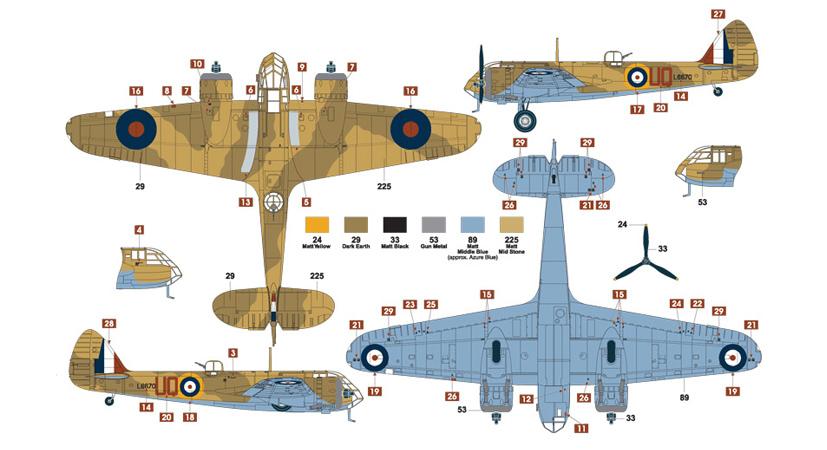
Let’s now take a closer look at the two scheme options which will be included with the early January 2021 release of Bristol Blenheim Mk.I A09190 in 1/48th scale.


As part of the huge expansion of the Royal Air Force in the years immediately prior to the start of the Second World War, No.211 Squadron re-formed at Mildenhall during the summer of 1937 as a day bomber unit, initially equipped with the Hawker Audax single engined biplane light bomber, but quickly trading these in for Hawker Hinds. By April of the following year, the squadron had been sent to help settle tensions in the Middle East and it was whilst they were overseas that they re-equipped once more, this time with the much more capable Bristol Blenheim Mk.I. When the Middle East erupted into conflict in June 1940, the squadron was heavily involved operations against Italian forces in both Libya and the Western Desert, where they would enjoy some notable successes. After the Italians also moved against Greece, No.112 Squadron formed part of the British Air Forces Greece contingent sent to support Greek defensive operations against the invaders, with the entire unit relocating to the Greek mainland. When the squadron arrived at their new airfield home at Menidi/ Tatoi, they were greeted like heroes by the local people, who were confident that the British would prove significant in helping defend their country.
The squadron would be heavily involved in flying bombing missions in support of Greek Army operations, targeting Italian troop concentrations, supply ships, ammunition and fuel dumps and if they did come across the Regia Aeronautica, they were more than capable of holding their own. With the combined forces repelling most of the Italian advances during this period, the deteriorating situation for the Axis powers forced the hand of the Germans and by the beginning of April 1941, they invaded Greece through Yugoslavia and Bulgaria in some force, including the arrival of battle hardened Luftwaffe units, who immediately began to take a heavy toll of Allied squadrons. Despite the valiant efforts of an ever diminishing number of Blenheim’s available for operations and with overwhelming odds making their position almost untenable, an inevitable withdrawal of remaining units was soon ordered.
With the remnants of the squadron arriving in Egypt via Crete and after suffering horrendous casualties, No.112 Squadron were withdrawn from operations and allowed a six month period of rest and replenishment. The scheme option presented here is a fine example of a Blenheim Mk.I bomber which fought hard to prevent Greece from falling to Axis forces, but eventually had to succumb to the overwhelming strength of the enemy. The subject of several unusually clear wartime photographs taken during the squadron’s Greek deployment, they show the aircraft returning to Menidi airfield following the completion of yet another infantry support sortie and show the aircraft to be in strikingly good condition. This is a fine example of a Mediterranean Theatre Blenheim bomber from this period and these attractive colours only serve to enhance the appearance of this handsome Bristol twin - this scheme is also strikingly different to the other scheme option included with this new kit, not to mention the two fighter schemes included with the initial Blenheim release.


For pilots selected to fly the new Blenheim bomber, the sense of anticipation must have been quite daunting. The aircraft they were used to flying were in the main, single engined biplane bombers and whilst these were still high performance aircraft at the time of their introduction, the Blenheim represented something completely different. An aircraft which possessed extreme performance, it also introduced several new features which they simply would not have encountered previously during their careers. These included such things as variable pitch propellers and retractable undercarriage, not to mention the fact that they would now be flying a twin engined aircraft, something most would again be doing for the first time. As they walked out to the aircraft to make their first flight, it would invariably have been taking place after a long night studying the pilot’s notes for the aircraft and with a crib sheet of instructions in hand, which they intended to attach to the control column as a first flight aide-memoire.
Despite some trepidation, as they walked out to their beautiful new aircraft, they must have felt just a little special, because the aircraft they were about to fly were without doubt amongst to most advanced in the world and the fastest thing in British skies at the time, making them something of elite flyers. Representing a new era for aircraft design, the sleek and purposeful appearance of these first Blenheim bombers must have looked as if Bomber Command could achieve anything they set out to do, but there was one drawback - the Blenheim would now be the aircraft against which all others would be judged and unless it could better Britain’s new light bomber, there was no point developing it further. In addition to this, the 307 mph top speed of ‘Britain First’ was attained by a machine unencumbered by the weight of war and the RAF’s military derivatives were very different aircraft than the one which was their predecessor. Nevertheless, the RAF ordered Blenheims in their hundreds and by the time Europe erupted into conflict once more, there were more Bristol Blenheims in RAF service than any other aircraft type.
RAF No.90 Squadron can trace their history back to the Great War and operations as a fighter unit, originally based at Shawbury in Shropshire, preparing pilots for future operations over the Western Front. Reforming once more in March 1937 to operate as a light bomber unit from the grass aerodrome at RAF Bicester, the squadron was initially equipped with Hawker Hind biplanes, but quickly traded these for the new Bristol Blenheim light bomber. One of the initial units charged with introducing this cutting-edge new high performance aircraft into RAF service, the squadron’s pilots were rightly proud of their place in the hierarchy of a fast modernising Royal Air Force, with crews being more than happy to do their bit in promoting the force, helping to encourage thousands of young men to join the RAF. This particular Blenheim (K7059) was the subject of some stunning air-to-air photographs whilst conducting a pre-war training flight high above the British countryside. These images were circulated widely and appear in many Blenheim publications to this day. The appealing scheme of dark earth and dark green over night undersides is typical for a Blenheim of this period, however, the images show that the A1 roundels have had their yellow outer band overpainted with camouflage and masks to replicate this development have been included as an option with this new kit.
At the start of the Second World War, No.90 Squadron would become a training unit, preparing Blenheim crews for Bomber Command service, crews who would be asked to carry a particularly heavy burden during the early months of the war, but whose heroic efforts ensured Britain remained defiant in the face of seemingly unrelenting German aggression.
There is no doubting that the new 1/48th scale Bristol Blenheim tooling is a hugely popular addition to the Airfix kit range and a real triumph for our product designers, bringing a new appreciation for an aircraft which stands as one of the most significant in the history of the Royal Air Force. This second release allows us to present the Blenheim in either a pre-war home based bomber, or as one of the attractive aircraft which fought in Mediterranean skies against overwhelming odds, attempting to prevent Axis forces occupying the Greek mainland. A truly stunning new kit, Bristol Blenheim Mk.I A09190 will be available very early in the new year and will make an ideal build project with which to attack 2021, from a modelling perspective.

In the previous edition of Workbench, we provided readers with a comprehensive update from our new RAF Buccaneer project and from the response this feature generated over the past two weeks, it seems the country can’t wait to get its hands on one of these magnificent new kits. We are pleased to be in a position to further report on the advancement of this kit towards its impending release, by showcasing an exclusive series of built model images featuring the new RAF Buccaneer kit and as such, are once more indebted to the immense modelling talents of our now famous product designer Paramjit Sembhi. When we are not showcasing Paramjit’s talents as a designer and looking at the various development stages of his latest new tooling project, we are marvelling at his skills as an accomplished recreational modeller, even though we have no idea how he manages to produce as many beautiful builds as he does. Thankfully, both his colleagues at work and Workbench regulars are the fortunate beneficiaries of his amazing modelling stamina and we are all lucky to be able to share in the fruits of his labours.
Paramjit recently completed a full build of the new RAF Blackburn Buccaneer S.2B kit and members of the Ulster Aviation Society will be delighted to see that he elected to finish the model in the scheme of the aircraft which is now one of the most impressive exhibits in their ever growing collection. With our equally hard working photographer David ensuring that we had several images to include in this latest blog, we don’t think readers will mind too much if we return to the scheme information regarding this particular aircraft, whilst enjoying the sight of these beautiful built model images.

This stunning selection of built model images show a recent project completed by our Product Designer Paramjit, who elected to finish the model in the scheme option of the aircraft which is now part of the Ulster Aviation Society collection

With the original Royal Navy Buccaneer S.1 aircraft entering service back in 1962, it would probably now be fair to say that today’s most famous examples of this magnificent machine are the ones preserved in museums around the UK, with several different variants available to be admired. One of the most impressive of these is Buccaneer S.2B XV361, the prized possession of the Ulster Aviation Society at their Maze Long Kesh site, Lisburn, Northern Ireland, an aircraft which possesses a particularly interesting history. The aircraft was delivered to the Fleet Air Arm in 1968 and went on to serve with Nos.809 and 800 Naval Air Squadrons in both the strike and airborne tanking roles, with spells based on both HMS Eagle and HMS Ark Royal. Later upgraded to S.2B standard, the aircraft was transferred to the Royal Air Force, where she would provide a further 16 years of exceptional service, which ended with her becoming one of the six airframes selected to commemorate Buccaneer operations on the eve of the aircraft’s retirement.
This collection of aircraft were repainted in the colours of all six of the Royal Air Force squadrons to have had operated the Buccaneer during its service life and XV361 was presented as a No.15 Squadron aircraft for the tribute. Following the Buccaneers service withdrawal in 1994, she was put up for disposal by the Ministry of Defence and purchased by the Ulster Aviation Society, with plans immediately being drawn up to fly the aircraft to RAF Aldergrove. Once there, that’s where the Buccaneer fun really started to happen. Northern Ireland may now have its example of a Buccaneer, but how would they transport the aircraft from Aldergrove to their original museum site at nearby Langford Lodge, a satellite station of the wartime RAF Aldergrove?

More RAF Buccaneer model goodness, which highlights why this impending release is proving to be so popular with thousands of modellers


Despite the rigidity of the Buccaneer’s impressive undercarriage, it was deemed impractical to transport the aircraft by road, which left just one viable option – to fly it one final time. In April 1994, Buccaneer S.2B XV361 made a record breaking flight for the Buccaneer, when it took off from Aldergrove and landed at the Langford Lodge site, a flight which lasted just 92 seconds - this even included the crew making a flyover of the intended landing site. It will not surprise you to learn that this was the shortest ever flight for a Buccaneer and one which was so short that the crew didn’t even bother retracting the undercarriage. On landing, the aircraft was finally passed to the care of the Ulster Aviation Society.
Buccaneer XV361 was moved one final time to the society’s new site at Long Kesh in 2005 and is now housed in a former WWII hangar, part of an impressive and extremely historic collection of aircraft and artefacts which celebrate the significant aviation heritage of Northern Ireland. When the museum is open to the public, you have the opportunity to get really close to their Buccaneer, which gives you a real appreciation of just how huge this aeroplane actually is and leaves you wondering how on earth they managed to land these monsters on the decks of Britain’s relatively small aircraft carriers. It is also interesting to note that this aircraft was the one scanned by our lead researcher when he was preparing his files for this impressive new Airfix model tooling project.
As promised in our previous blog, we can now update readers with the latest release information regarding this new Royal Air Force Buccaneer S.2B kit A06022 and can confirm that it is scheduled for release very early in the new year and barring a complete shipping disaster, during January.

Another Vintage Classic Airfix model and the sight of more iconic Airfix box artwork, this time one from the extremely talented hands of Roy Cross
Just as enthusiasts all over the world have their own personal favourites when it comes to the subject of modelling different aircraft types, so the world of motoring and motorsport has its own favourites, be they classic or contemporary racing cars, or the super cars of the rich and famous. From the perspective of Airfix modelling history, there can be no doubt that the most iconic vehicle kit to ever take its place in an Airfix range line-up is the 1/12th scale 1930 Supercharged Bentley 4.5 Litre, and this magnificent model is about to ignite a rush of Airfix nostalgia as it takes its place in our popular Vintage Classics range.
A kit tooling which was originally produced in 1971 and featured a stunning box artwork illustration created by Roy Cross, this was one of the larger scale ‘super kits’ released by Airfix which really defined the hobby, a kit which was a high profile addition to the range and one which was seen as a more challenging build to be tackled by only the most proficient of modellers. For those of us who were just fledgling modellers at the time, this beautiful Bentley was way out of both our price ranges and our build abilities, as we continued to work our way through the affordable bagged kits we usually bought from Woolworths. We could only dream of being presented with such an impressive kit in those days, but now is perhaps our opportunity to get this particular modelling monkey off our backs.
With its front mounted supercharger, the 4.5 litre Bentley became the quintessential British sports car of the 1920s and 30s. It was shaped from the earlier 4-cylinder 3 Litre, but produced substantially more power with its blown engine. As such, it was a stunning road car and a perfect contender for endurance racing. Due to its dramatic appearances at Le Mans and successes in speed trials at the Brooklands circuit, racing and winning became synonymous with Bentley during this period and few other models capture this image as well as the 4.5 litre Bentley. The number 9 car featured in this kit, UU5872, is the original Birkin Team Car known as 'Birkin Blower No. 2'. This is the car that made a dramatic appearance at the 1930 Le Mans 24 Hour Race.
In 1929, Bentley replaced the 4.5 litre and opted to race the higher capacity Speed 6. Three 'Birkin Blowers' were entered to compete alongside the Bentley Speed 6’s at the 1930 Le Mans. In the event, only one ‘Blower’, (Birkin’s own No. 2 car), started the race. Under Walter Owen Bentley’s tactical team management, Birkin’s role was to draw the Mercedes of Carraciola and Werner into a high speed duel, which he successfully achieved. The Blower lead from the start, swapping the lead with the Mercedes throughout the night, until eventually the German car withdrew with a blown engine. Birkin’s success came at a cost, as he had to retire after 20 hours with a bent valve, leaving the two Speed 6’s to take 1st and 2nd Places.
Whilst working on this update feature, members of the Airfix team remembered a beautiful example of this model which won multiple accolades in the model competition at Scale Modelworld 2015, including being judged the winner of the Airfix Trophy for that year. Knowing we would be including this model in our latest blog and following a little modelling detective work, we managed to track down the talented creator of this stunning model and drop him a line. The man who produced this perennial model competition winner was Mr Peter Buckingham and he kindly spent a few minutes chatting to us about the model and how it has fared over the past five years - thankfully, he also allowed us to include a selection of fantastic pictures of his model.
Peter told us that this model still brings him a lot of pleasure and we were delighted to hear that it is still very much intact and takes pride of place in his study. A model project which most definitely could NOT be described as a straight from the box build, he described how this model was quite an undertaking for him and although he did manage a couple of other kit builds during the period of this project, his Bentley took around two years to complete. Peter based his build around three original photographs he had which showed Sir Henry ‘Tim’ Birkin’s racing configuration Bentley he drove whilst taking second place in the 1930 French Grand Prix.

This magnificent montage of images feature Peter Buckingham’s breath taking 1/12th scale 1930 Supercharged Bentley 4.5 Litre model build, one which scooped the Airfix Trophy at Telford’s Scale Modelworld show back in 2015 and is still winning modelling competitions to this day

In support of this build, Peter was indebted to the wonderful people at the National Motor Museum at Beaulieu, who allowed him to spend a full day taking photographs and measurements of their magnificent Bentley, details which would prove absolutely invaluable in the months of modelling endeavour to come. Peter enhanced to kit quite significantly, not only using his modelling skills to replace some of the kit parts, but also fabricating many additional parts for the model. Quite an amount of metal pipework components were replaced with actual metal parts, using rolled brass sheet to create a more authentic representation, something which was also quite user friendly when it came to weathering and burnishing. A new wooden floor for the model was made using thin plywood and bodywork rivets which were moulded in plastic on the kit were replaced with resin alternatives.
A section of the build which proved to be both challenging and time consuming was the upgrade of the kit’s wheels. Each one was re-spoked using nickel rod and aluminium tubing, with the process taking two weeks of hard labour to complete. The additional fuel tank which was a feature of these racers was scratch built in metal and the distinctive leather bonnet straps also had to be fabricated, this time using thin lead sheet. Finally and to add a further touch of scale realism, Peter cut the passenger door so it could be displayed open, to better allow the stunning detail in the cockpit of the racer to be viewed.
Peter described how this build went right to the wire, when it came to having it ready for display at Telford and indeed, the day before the show, some damage to his Bentley required a little midnight oil to be burned, so it was ready for its starring role. Thankfully, his masterpiece was ready for its public debut and took its place on the competition tables at Scale Modelworld the next day. As we now know, two years of effort was proved to be time well spent and Peter’s model not only scooped the Airfix Trophy at the 2015 show, but was also judged to be the Best Civilian Vehicle model at show and in addition, given the Airbrush Heaven award.

It is also interesting to note that Peter is an active member of two modelling clubs in his local area and as part of their regular displays, his Bentley is still exhibited at model shows periodically. Looking at the photographs featured above, it will not surprise our readers to hear that the model continues to scoop awards and accolades to this day.
We would like to thank Peter for spending time discussing his beautiful model with us recently and for allowing us to include this stunning selection of images to illustrate the feature. The 1/12th scale 1930 Supercharged Bentley 4.5 Litre is about to become another iconic addition to our Vintage Classics range in the very near future and may finally tempt some of us to delve into the nostalgic world of classic scale motorsport modelling. It would be interesting to know how many of us would be prepared to spend two years on an individual build project.

With a new Airfix model range to finalise and a punishing blog schedule to maintain, it’s not often that we have the spare time to spent checking the latest posts on the various modelling related social media sites, but when we do, we sometimes stumble across something really special and something which is definitely worthy of further investigation. That was certainly the case when we came across a post made by Australian modeller Brad Cancian recently, one which featured a stunning build of one of our classic 1/72nd scale Albatros D.Va kits, a build which was as impressive as it was imaginative. We contacted Brad to see if we could include details of the build in a future edition of our blog and he kindly sent us a selection of photographs and a short summary of the project - over to Brad.
I am pleased to share my latest model build completion with you, a 1/72 scale example of the Albatros D.Va kit from Airfix. This kit’s moulds originally date from 1957, making the mould around 63 years old, which is actually 24 years older than I am myself! The example I built here is the kit which was reissued in the early 2000s and is one I managed to pick up for $4 at a swap and sell.
For this particular build, I wanted to try and re-kindle that childlike feeling of building something just for fun, with minimal modifications and not really caring about overall accuracy. To correct issues with what is now a very old Airfix tooling would be to spend a lot of time scratch building components and that is not what I wanted to do, so in the spirit of fun, this one was built largely out of the box. Well, I say out of box, but in truth, I couldn't help myself from making a couple of changes, but these were very basic and limited only to things I just wouldn’t have been able to live with. I added a rudimentary cockpit, replaced the engine and guns (both from Roden), heavily modified the spinner and replaced the propeller which came with the kit. I also sanded and refined the flying surfaces, refined the detail on the wheels, sanded down the raised fuselage panels and re-scribed them, although I did keep the characteristic louvers and rivets on the nose. These are a prominent feature of this classic mould, even if not entirely accurate.

This image montage shows just how appealing Brad’s classic Airfix Albatros build turned out to be and how his idea for displaying the model is a real triumph
When construction work was completed, the model was painted using acrylics, but also using oil paints to represent the distinctive wooden construction of the fuselage. The model was painted in the markings of a machine from Jasta 4 in late 1917 and I rigged the model using elastic.
Not content with the kit build itself, I also decided to have a little bit of a play at creating a display base, with the intention being to replicate one of the old early 1980’s release boxes, from the era when Palitoy owned Airfix. Palitoy released a number of Airfix kits with box art showing the built model on a blueprint, for those who can remember and it is interesting to note that as far as I can recall, Airfix never reissued the Albatros in this style of boxing again. For that reason, I just thought this made everything just that little more quirky in producing a unique model base presentation.
As a final bit of fun, I also created a ‘box top’ artwork representation for what might have been, had Airfix released this one during the Palitoy era in the early / mid 1980s.

Will the sight of Brad Cancian’s beautiful Albatros build have us all rooting through our model stashes for WWI aircraft kits over the coming weekend?
It never ceases to amaze us just how talented a bunch you modellers are and Brad has certainly managed to produce something really impressive, using quite an old kit as his modelling canvas. The finished model and display presentation is absolutely stunning and a real credit to Brad and his ‘vision’. We would like to thank Brad for allowing us to include his Albatros build in Workbench and for potentially starting a new display phenomenon for Airfix modellers everywhere. We definitely think this feature will have hundreds of fellow modellers rummaging through their kit stashes to find a couple of classic WWI aircraft kits to have a go at this weekend!
That’s all we have for you in this latest edition of Workbench, however, we will be back as usual in two weeks’ time with a further selection of Airfix modelling delights for your enjoyment. If you have any suggestions for subjects you would like to see covered in a future edition, please use this workbench@airfix.com link to contact us.
In between new editions of our blog, the Airfix conversation continues over on our Airfix Forum Worbench thread, with further discussions taking place on both the official Airfix Facebook page and the Airfix Twitter channel - please do get involved in the discussions and let us know what you think about Workbench.
Whenever you decide to visit, the Airfix website is always the place to be for all the latest model availability information, previous editions of our blog, a selection of modelling tips and much more.
The next edition of Workbench is due to be published on Friday 11th December, when we will have more interesting features from the world of modelling.
On behalf of the entire Workbench team, thank you for your continued support our Airfix blog.
The Airfix Workbench Team