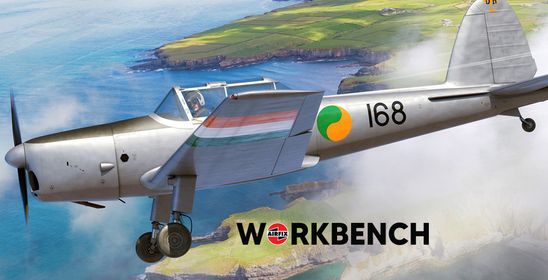
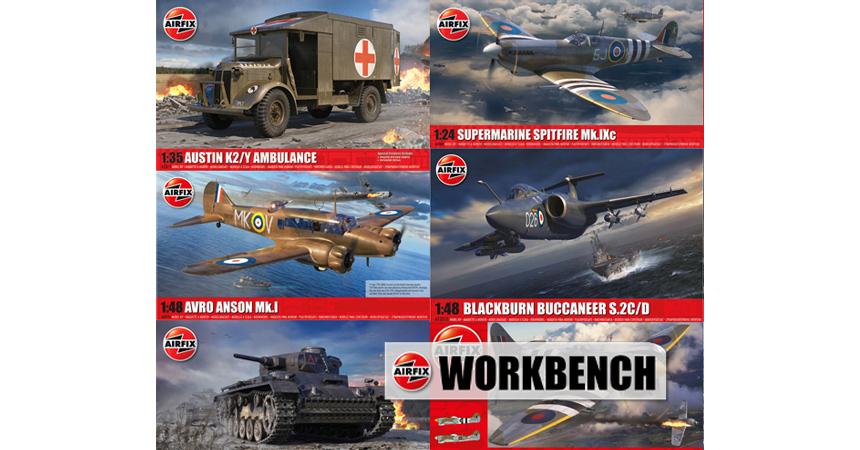
Welcome to this latest edition of our Workbench blog and all the news, updates and modelling exclusives from the fascinating world of Airfix.
As we find ourselves at that time of year when we can all reflect on a busy twelve months past and another exciting year of Airfix modelling enjoyment to come, we wanted to take this opportunity to do things a little differently for this final edition of Workbench for 2022. Just by way of a little festive fun, we wanted to ask two members of the Airfix team to nominate a kit from the current range they would they like to find wrapped up under the Christmas Tree with their name on it this year and to explain their choice, just because at this time of year, anything goes from a blog subject perspective. We had initially thought that restricting the feature to two people might cause a few issues, but as it turns out, for holiday, seasonal illness and a couple of other reasons, you are actually stuck with myself (your blog editor) and the Development Manager (or the god of Airfix, as we like to refer to him) for these seasonal selections. The big question is will we both choose the same kit, or have we been seduced by different new tooling delights this year?
Our final feature of the year rightly comes from one of our reader contributors and another build feature which highlights the incredible skill and creativity you all apply to your modelling, something we never get tired of admiring here at Airfix. Our subject on this occasion is a new tooling release from last year, but a build project which we have to say we didn't expect to see in this form - we think you're going to love it.
Without any further ado, let's grab a mince pie or two, a nice warm glass of mulled wine and settle back with the final edition of Workbench for 2022.
When it come to this time of year, if your significant other happens to be a modeller, choosing a suitable gift shouldn't really be too much of a problem.
Can you remember back to when we were kids and how Christmas was such a special time for those of us of a modelling persuasion? All year, in addition to moving from one model kit build to another, the Airfix catalogue was the publication by which we lived our lives and as Christmas approached, how it became an invaluable visual aid in providing our parents with solid evidence as to which of the slightly more expensive kits in the current range might make for suitable Christmas gifts. In those days when it was still important to get your letter into Santa in good time and to make sure we weren’t on his naughty list (well at least during December), I wonder how many pages of various Airfix catalogues were removed and sent to Lapland, just to make sure Santa was completely on the same pressie page that we were on?
Unfortunately for me, my younger brother was something of a present hiding place sleuth and no intended gift was ever safe from his prying eyes - the only problem was that he always managed to find my presents, whilst his remained concealed, something which really did blight my formative years at Christmas. One year, he managed to find every single one of my presents before the big day, but as there was a handsome selection of model kits, the frustration was that I had to wait a few days before I could get my hands on them. For modellers, having the model you had been dreaming of actually be there under the tree or in your present pillowcase was a source of unbridled joy and even to this day, if we unexpectedly receive the gift of a model kit at Christmas, you just watch our faces light up!
So, that being the case, we thought it might be interesting to see which of the many kits we have been following the development of throughout the year in Workbench, would different members of the Airfix team like to find in their own pressie pile this year, just for a bit of seasonal fun. On reflection, if we had asked all our designers for a nomination, they would surely suggest one of their own designs, which might be a little predictable as a feature, but as it has transpired, due to staff holidays, illness and other factors, just myself and Development Manager Martin were available for consultation. Ordinarily, rank would dictate the order of whose suggestion takes precedent, however, Martin, being such a pleasant chap, was happy to let me go first, so here comes my kit selection.
When you invest so much time and effort in bringing all the latest project updates to our huge Workbench blog audience, it isn't difficult to become completely besotted with some of the fantastic new models our designers have been working on, particularly as there are fascinating stories behind each and every one of them. In my role as blog editor, I have the honour of speaking to our incredibly talented designers and to bring their latest design projects to our blog audience, add in a little supporting historical context and include the fascinating development imagery our designers kindly supply us with, a recipe for blog success which is as strong today as it has been throughout seven years of publication. With the ability to follow the latest Airfix projects right through from initial announcement to eventual release, each new project will usually feature in several different editions during the year and as such, we are able to take a slightly different angle each time, something which helps us form real attachments to these projects.
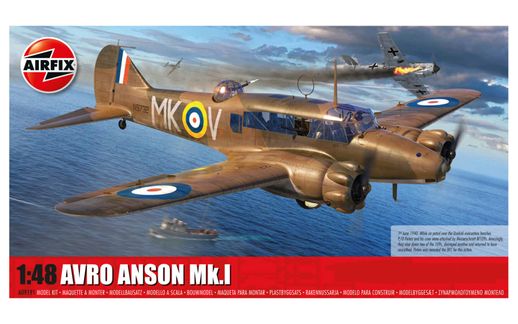
As any modeller will tell you, it can be difficult to select your next build project with so many fantastic kits out there just waiting for our attention, but if one of our designer interviews or the details behind one of our scheme options provides a little inspiration, then we see that as a blog well posted and hope that you enjoy your build experience. So, from all the new tooling projects covered this year, which one would I like to find under my tree, that would be the 1/48th scale Avro Anson Mk.I.
As a proud Northerner, any project which shines the spotlight on Britain's aviation industry in this part of the country will always grab my attention and when it concerns an aircraft type which was built and test flown only minutes away from my home, then that may well be the future model build project for me. Add to this the fact that the model subject in question was the most heavily produced Avro aircraft type ever and arguably one of the most unsung aviation heroes of them all, then now we are talking a modelling subject of real stature. I actually remember building the 1/72nd scale Airfix Anson as a youngster and being really impressed with it, a type I didn't really know all that much about back then, but one which certainly built into a stunning little model. Okay, it wasn't a Beaufighter or a Mosquito, but it was a chunky little beast and had a real presence about it.
An unsung aviation hero, the Avro Anson makes for an ideal modelling subject and in this larger scale, has some real presence about it. The perfect gift for the modeller in your life.
Move this experience forward around forty years and I remember being at Head Office and seeing our Design Manager Matt Whiting deep in thought at his workstation, as he was closely inspecting some component frames which had just arrived in the office, his first test frames from the 1/48th scale Avro Anson Mk.I he had designed. I instinctively pulled up a chair and started asking him questions, and whilst he answered every one in his usual expert, but friendly manner, he never took his eyes of what he was pouring over the entire time, so deep were his levels of concentration. He told me that the new kit made use of some new industry innovation and they had tried something just that little bit different during production and these were the things he was assessing, but as he passed me a wing component frame to inspect, I remember being astounded at the levels of detail he had managed to incorporate into the kit's design, particularly on those beautiful wing surfaces.
Since then, I have had a major soft spot for the Anson and it has been a source of real pride to see how the kit has been received by the modelling community since release and how this important aircraft is finally receiving a level of enthusiast attention that befits its undoubted aviation status. Starting life as the Avro Type 652 long-range, mail-carrying charter aircraft built for Britain's Imperial Airways, the machine which would become the Anson was a militarised variant of this impressive aircraft, but one which had to cope with the additional weight associated with the inclusion of essential military equipment. This would include the installation of armament, in the form of a large manually operated dorsal turret with single Lewis gun and a fixed forward firing Vickers machine gun located in the aircraft's nose, and operated by the pilot and the ability to carry a modest bomb load, something which would again go on to increase its operational effectiveness, and place further strain on the engines.
The Anson received plenty of attention at the recent Scale ModelWorld show.
Making its maiden flight from Avro's Woodford airfield on 24th March 1935, the aircraft would later be flown to Gosport and the Coast Defence Development Unit, where it operated in a series of suitability trials with its competition rival, the de Havilland DH89M Dominie, the military derivative of the Dragon Rapide biplane. Emerging victorious from these trials, the Avro 652A triumphantly returned to its home airfield at Woodford to be followed almost immediately by an official Air Ministry order for 174 new aircraft. With its intended use as a maritime patrol and reconnaissance aircraft, it was decided to give Avro’s new fighting twin the name Anson, after George Anson, a former Admiral of the fleet and First Lord of the Admiralty, something which was actually the cause some consternation amongst RAF officials, who would go on to be the largest operators of the type.
As we all now know, the true forte of the Anson proved to be in a training role and many hundreds of these aircraft would take to the skies every day right across Britain and the Commonwealth nations, to ensure the Allied war machine had a continual supply of well-trained and highly motivated aircrews, who were all intent on playing their part in an eventual Allied victory. The reliability and adaptability of the Anson made it an ideal aircraft in this role and whilst it was not without its vices from a handling perspective, was a patient and relatively forgiving teacher. Simply getting on with this vital wartime task in a truly stoic manner, perhaps this is why the Anson rarely came to the attention of many people in the years following the end of the Second World War and certainly from a modelling perspective. Not the fastest, most hard-hitting or impressive looking aircraft of WWII, the Anson nevertheless performed a vital role and without it, we would have certainly been in a spot of bother.
For these reasons and the fact that it is a tooling design masterclass from Matt, the new Avro Anson Mk.I is definitely my choice for kit pressie of the year.
When it came to Martin's selection, he laughed and told me that the Anson would also have been his selection this year, but as I had already pinched that one, he had another which had made a similar impression on him. In his position as Development Manager, it must be quite difficult for Martin to help with such a blog request as this, not only because he has his finger on the pulse of every facet of the Airfix business throughout the year, but also how attached he must get to the team of designers he works with. Working in this design field which is truly unique in this country and requires a skillset which is really difficult to find these days, Martin must get really attached to his team and similarly attached to the projects they safely negotiate. With designers ranging from seasoned veterans (that doesn't mean old, chaps) to enthusiastic recent additions to the team, it must make him incredibly proud to see how they develop and how their skills allow them to create some truly magnificent model kits for the latest Airfix range. Then here I come and ask him to select a specific kit for our Christmas blog, a task which must be tantamount to being asked to say which of your children is your favourite!
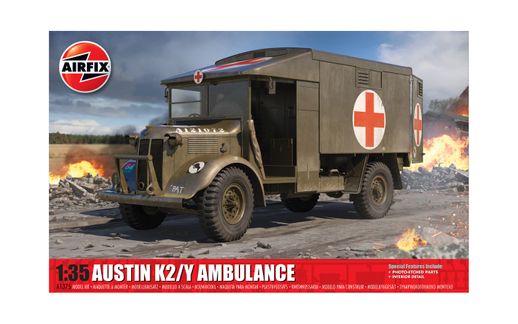
Having thankfully avoided that dangerous territory and discovered that he too had a leaning towards the Anson, Martin told me that he was also particularly fond of the new Austin K2/Y Ambulance, a kit which took quite a long time to negotiate its various development stages, but is now gracing our growing range of 1/35th scale military vehicle kits. When our designers are at the advanced stage of any project, one of the most important phases in the production of any new kit is the arrival and assessment of the latest test frame components produced from the latest iteration of the tooling design itself. Having closely inspected the frames for detail and accuracy, a designer will then take just as much care in undertaking a test build of the parts, once again assessing every aspect of the process, before compiling a report of required modifications to be sent back to the toolmaker, before the entire process begins again.
Usually, with his incredibly long list of tasks to oversee each and every day, Martin rarely has the opportunity to build one of the test frame projects members of his team are engaged with in any given year, however, with the new Austin K2/Y Ambulance, he made an exception. Having built several versions during the development of this kit, he was not only impressed with how each newly modified set of components included ever greater levels of detail, but also how they built into a really impressive little kit, a soft skinned military vehicle which could hold its own against any of the armoured behemoths in our 1/35th scale range.
The new Austin K2/Y Ambulance kit proves that not all military vehicle models have to feature huge main guns to attract the interest of the modelling public.
I remember walking past Martin's desk many a time and seeing a built K2/Y sitting underneath his monitor, unpainted but complete and always with its back end facing towards him, doors open and with all that interior detail revealed, again something which gives this kit real character. With its reputation for reliability and the nature of its role to provide medical assistance for those when they needed it most, is it any wonder that the Austin K2/Y Ambulance was held in extremely high regard during its wartime service career and since its induction into the Airfix range, also now with the modelling world.
This particular kit was actually first announced back at the start of 2021 and even though it doesn't feature a big gun or armour plating anywhere on its chassis, it did take quite a while for our toolmakers to perfect - it seems that soft skinned vehicles, or the scale representation of them can actually pose quite a few challenges when committing them to model form. Thankfully, the kit is now out there for all to enjoy and commands a position of prominence within our 1/35th scale Military Vehicle range, already a firm favourite with modellers. It just goes to show that there is much more to military modelling that a huge main gun, although I don't suppose any K2/Y crew would have relished the prospect of crossing the path of a German Tiger 1 .... heaven forbid!
Although found on most of the battlefields contested by British and Commonwealth troops during the Second World War and extensively on the home front, it was perhaps the vast expanses of the Desert War with which this vehicle would become most closely associated with, certainly in the eyes of the general public and certainly for filmgoers. The hostile environment of the deserts of North Africa would witness some of the most savage fighting of the entire war, lasting for over three years from early June 1940. Initially, this fighting was between British and Italian forces, with the vast expanses of desert and the ebb and flow of combat gains and retreats placing a heavy burden on the machinery of war and the men having to operate it.
In this punishing environment, the robust qualities of the Austin K2/Y ambulance really did prove to be invaluable, a hardworking vehicle which required a minimum of maintenance and was always ready to do its essential duty. One feature of the vehicle which proved to be particularly noteworthy were the ambulance’s tyres, with the compound used giving these units incredible durability and the ability to operate in both on and off-road situations. Indeed, the K2/Y was equipped with a bespoke tyre inflation unit, but these proved to be virtually redundant due to the quality of tyres used.
A really interesting modelling project, the Austin K2/Y will surely be a popular resident under plenty of Christmas trees this festive season.
Another interesting K2/Y Ambulance fact is that each and every one of these vehicles was painted in British Army olive drab when they left the Austin factory, but could potentially receive additional paint if their intended operational deployment could be compromised by the colour. By far and away the most dramatic scheme to feature on a K2/Y Ambulance was known as the Caunter or ‘Dazzle’ scheme - devised for desert application only, the Caunter scheme was a disruptive paint pattern intended to break up the profile of the vehicle and was one which had been in development with the War Office before the start of the war.
Several different permutations were considered, with the variation included as an option in our new 1/35th scale kit being the most distinctive and the one which actually made it onto British service vehicles. With painting instructions and paint stocks supplied to units training for desert deployment, the Caunter scheme adopted a three colour design and straight lines, which must have required the use of paint masking and making the process quite challenging.
So there you have it, two Airfix kits Martin and I hope to find under our respective Christmas trees over the next few days, although we might find ourselves in a spot of bother if we attempt to start building them straight after dinner! I wonder what new tooling delights we will have to select from this time next year. Of course I do know, but this particular modelling secret is still guarded by the Grinch himself, so enough said on that particular subject.
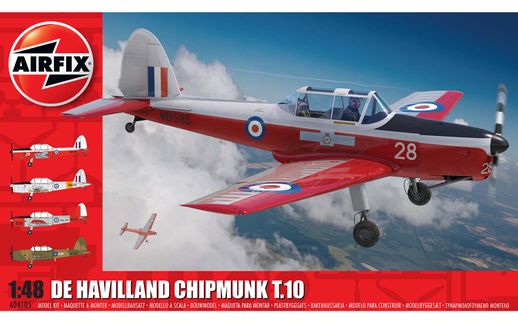
We have to admit that we didn't expect to see one of our 1/48th scale de Havilland Chipmunks finished with a bird's nest in the engine compartment.
As modellers, even though we are all pretty confident in our own abilities, there is nothing quite like seeing how fellow modellers attack their build projects, both in the name of general curiosity and perhaps to discover a little inspiration for one of our own future builds. No matter how long our own modelling journey has been, there are always occasions when we can't fail to be impressed by a particular build, the skill in its execution or indeed the story behind it, something which continues to make this hobby so engrossing.
This happened to us at this year's Scale ModelWorld show, when we were talking with one of our modelling friends and got onto the subject of our 1/48th scale de Havilland Chipmunk kit. He informed us that he had a friend who had done something a little bit different with his Chipmunk and finished it with a bird's nest in the engine cowling. As you might imagine, we simply had to find out more and to see pictures of both the Chipmunk and the bird's nest.
Having made contact with modeller Sully and discovered he is actually quite the modelling celebrity, we asked about his Chipmunk build and if he would be happy to send us a selection of images to share with fellow Workbench readers. Kindly agreeing to our request, he also went on to tell us the story behind the build and a little more about his modelling and work exploits, both of which were fascinating. It transpires that Sully works at the RAF Museum Cosford, or to give it its current title the Royal Air Force Museum Midlands and as an avid modeller, is always on the lookout for modelling inspiration whilst on duty.
One of the museum artefacts he regularly walks past is the wing of what he thinks is a Jet Provost in classic RAF Training Command colours, propped up outside the conservation centre, with its dilapidated outdoor condition being the thing that always fascinates him. He has always wanted to try and replicate the naturally weathered condition of the wing on one of his model builds, just because he thought it would be a fun thing to do and would look really unusual within any model display. Perhaps this would be the right time to mention that Sully hates finishing his models in pristine condition and will go to great lengths to avoid going down that route on more than a couple of builds each year. With weathering being such a hugely subjective skill, there are so many different effects to be recreated and always something new to try, even though it can be a little subjective.
It really is interesting to see how different modellers approach the same model build and in the case of Sully's Chipmunk, how his love of weathering has produced something truly magnificent.
For this particular build, Sully told us that he had already started building the Chipmunk, but as his kit had a damaged canopy, he was waiting for a replacement to arrive before going much further. Unfortunately, we didn't have any available at the time and as he didn't want to halt the build and start something else completely, he thought it was time to start getting creative. Knowing the aircraft would have to incorporate the damaged canopy, he thought this might be his chance to try the dilapidated RAF Training Command finish he had been thinking of, perhaps serving as something of a reconnaissance build for a concerted effort at a later stage.
His initial idea was to mask the canopy damage by placing a scratch-built tarpaulin over the entire cockpit area, but as he worked through the build, he thought it would be even more effective if he built the Chipmunk as an aircraft which had been stored outdoors for many a year and was just awaiting that fateful day when it could be dragged inside a hanger and embark on a period of renovation to either museum display or even airworthy condition.
As the project progressed, his love of weathering really came to the fore and as he became more and more pleased with how the build up of the finish was coming along, so the build started to go in a slightly different direction, at the same time as inheriting ever more of a grimy appearance. Indeed, as the aircraft was going to be very much an outdoor Chippy, it may as well be a home for something, and if not a pilot or his student, why not a bird? That is where this particular idea began to form, but how he was going to achieve that, Sully had no idea - what he did know was that it was going to involve some modelling trial and error. If it turned out okay, he would leave the nest, but if not, he could always try something else, or lose the feature altogether.
Thankfully, as you can see from the pictures Sully kindly sent us, this actually turned out to be one of the most endearing features of this unusual Chipmunk build, along with straw in the cockpit, a detached control panel and all that really appealing grime! Although taking one of our latest model toolings and making it look anything but pristine, Sully has managed to produce a truly spectacular model build, one which is full of interest and character, whilst at the same time displaying an impressive level of modelling skill.
Who says that producing a model in a less than pristine condition does not have at least the same levels of interest as one which looks like it has just come out of the paint shop?
Sully ended our chat by telling us that he has a second Chipmunk kit to build, one which he intends to finish in a much better condition, whilst at the same time still exhibiting some of his trademark weathering, just not quite so much this time. The aim will be to display the two models side by side and it will be interesting to see which finish attracts the most attention from those inspecting the builds and indeed if they manage to spot the nest. We can't wait to see this pairing and hope to feature it in a future edition of Workbench, but until then, we would like to thank Sully for allowing us to include his magnificent 'Bird's nest Chipmunk' as our final blog feature for 2022, a truly fitting way to bring our year of Workbench blogs to a close.
That's it for yet another edition of Workbench and indeed for 2022. The team will be taking a short break now, returning with our first blog of the new year on Friday 6th January, just before 2023 range launch. That being the case, could we take this opportunity to thank each and every one of you for your incredible support throughout the year and for making the production of our weekly blog such an absolute joy. We hope you all have a very Merry Christmas and a happy, prosperous and peaceful New Year, when we can all meet again to discuss all the latest Airfix modelling developments.
As ever, we are always keen to hear your views on all things Airfix and in particular, our Workbench blog, so if you would like to drop us a line, please use workbench@airfix.com for all correspondence. To re-visit any of the Airfix blogs produced over the past seven years, please head to our main Workbench hub and scroll through the available pages.
All our dedicated official social media sites can be accessed by clicking the respective link icons at the foot of this page, or by heading to the Airfix homepage. Other useful Airfix links are:
Facebook, YouTube, Twitter and Instagram official sites
Please join us for more Airfix updates next week and thank you for your continued support.