
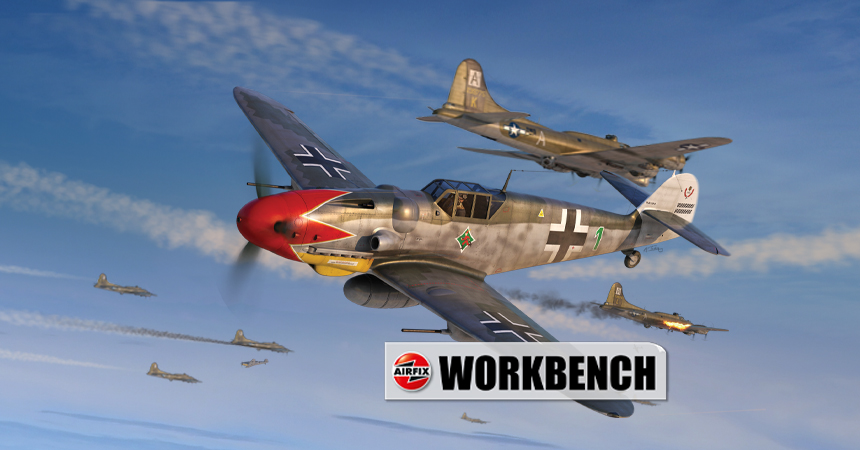
Welcome to this latest edition of our Workbench blog and all the news, updates and modelling exclusives from the fascinating world of Airfix.
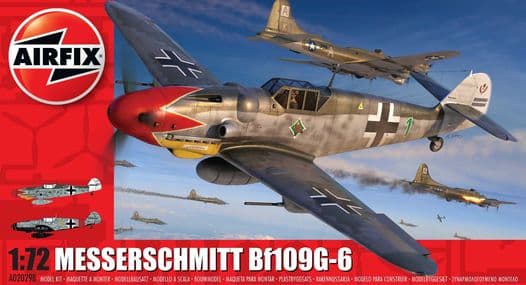
With a title such as this, there can be absolutely no doubt about the subject of this latest edition of Workbench, as we are going to be spending some time looking at one of the most famous fighting aeroplanes in the history of flight, or more specifically, how we are currently representing it in scale model form. Marking the recent release of Messerschmitt Bf 109G-6 A02029B and its lead scheme which features one of the most flamboyantly presented ‘Gustavs’ of WWII and the mount of celebrated Luftwaffe ace Hermann Graf, we will also go on to look at several other Bf 109 kits currently available on the Airfix website, covering several different scales and different versions of this famous fighter.
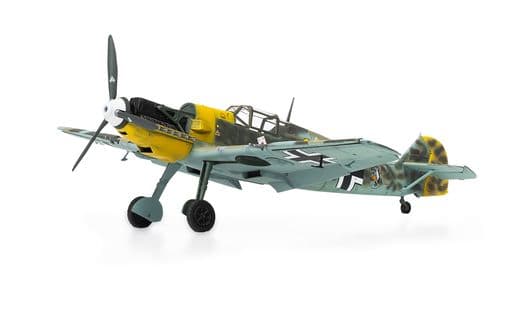
Using a series of exclusive and extremely appealing built model images to illustrate the feature, we will see why this aircraft, which has the reputation of being the Spitfire’s major wartime adversary, has always been a hugely popular subject with modellers across the world and an important component of many an Airfix model range over the years. With stunning box artwork spanning almost half a century of Airfix history, along with some of the fascinating stories behind several of the scheme options available with each kit, it’s time to clear some space on our workstations and prepare for the arrival of some scale versions of Willy Messerschmitt’s aviation phenomenon.
Entering Luftwaffe service in the same month the Royal Air Force introduced their new Gloster Gladiator fighter, the diminutive Messerschmitt Bf 109 must be considered one of the most important aircraft in the history of aviation, one which pointed the way towards a new generation of fighting aeroplanes.
Perhaps more than any other aircraft type, the Messerschmitt Bf 109 series of fighters came to represent German aerial prowess and professionalism during the Second World War, famous for being the RAF’s main aerial adversary throughout the conflict and one which like the Spitfire, remained in use until the final days of the war. More than this, the Messerschmitt Bf 109 is one of the most important military aircraft ever produced, one which was ahead of its time and one which pointed the way towards the future of world military aviation.
The origins of the new Messerschmitt fighter go back to 1934 and specifications issued for the production of a new breed of aircraft, a fast and manoeuvrable monoplane fighter at a time when the aviation world was dominated by biplane designs. As Germany was still bound by the restrictive terms of the Treaty of Versailles, it is interesting to note that when the prototype Messerschmitt Bf 109 made its first flight at the end of May 1935, it was actually powered by a British Rolls Royce Kestrel engine, as the aircraft’s intended Daimler Benz powerplant was still in development at that time. Just five years later, the latest incarnations of Daimler Benz and Rolls Royce engines would be powering opposing fighter aircraft during the savage aerial duels taking place in the skies above southern England, during the Battle of Britain.
Taking many of its design philosophies from the earlier and extremely successful Bf 108 Taifun four seat sports aircraft, the Messerschmitt Bf 109 was intended for one thing and one thing only, domination the skies. Quite a diminutive aircraft, everything about the 109 was cutting edge, from the inclusion of automatic leading edge slats to the fuselage mounted fully retractable undercarriage, this aircraft was intended to give the Luftwaffe an advantage when war eventually broke out, whilst at the same time being relatively easy to manufacture in large numbers. When the prototype made its first flight in May 1935, the aircraft looked dramatically different to the front line fighter types which were in service with most of the world’s major air forces at that time. With fast and manoeuvrable biplane fighters very much being the order of the day at that time, Messerschmitt’s sleek monoplane was a completely new direction for aviation, possessing exceptional speed and manoeuvrability, designed to outfly anything in the skies.
Interestingly, some of the first pilots to fly the new fighter were not overwhelmingly complimentary about the Messerschmitt, with its advanced features and very different handling characteristics presumably coming as quite a shock to airmen who were more used to flying open cockpit, wide fuselage aircraft with the perceived security of a second wing. They would have to do everything much quicker and think much further ahead when flying this cutting edge fighter, but they had better get used to it fast, because the age of the biplane was already over.
Entering service in February 1937, the Messerschmitt Bf 109 made its combat introduction during the Spanish Civil War and whilst it certainly showed itself to be an exceptional fighting aeroplane, these early combat experiences allowed its designers to interview pilots and immediately make modifications and improvements which were all incorporated in new built aircraft prior to the start of the Second World War. Just to put this situation starkly into focus, in the same month the Messerschmitt Bf 109 entered service with Luftwaffe units, the Royal Air Force also introduced their latest front line fighter aircraft type, the Gloster Gladiator biplane.
An enduring struggle. The German Messerschmitt Bf 109 and British Supermarine Spitfire would battle for supremacy of the skies throughout WWII, as both aircraft were constantly upgraded to keep them at the forefront of fighter design and combat effectiveness.
For Workbench readers, it will come as absolutely no surprize to hear that an aircraft which possesses the historical importance of the Messerschmitt Bf 109, its place in the Airfix range has been long and rather illustrious. First appearing back in 1956, just one year after our first aircraft kit was released (Spitfire BT-K), this first Messerschmitt kit proved so successful, that it was superseded by a new upgraded tooling just ten years later, the classic Bf 109G-6 bagged kit, which will be familiar to many thousands of modellers the world over.
It is difficult to explain the popularly of the Messerschmitt as a model kit subject, particularly when built examples are often displayed next to its aviation nemesis, the Supermarine Spitfire. Where the Spitfire is all about grace and aesthetic appeal, something of an aviation thoroughbred, the Messerschmitt Bf 109 is much more the fighting thoroughbred, with its appeal being the fact that it looks like the warplane it was designed to be, without any attempt to disguise the fact. The fascination with the Messerschmitt is that it is beautiful in a rugged, purposeful way, combined with the fact that it represents the enemy and everyone knows that a Spitfire has to be chased by something, right? Clearly, the fact that this aircraft represented the enemy during WWII and how very few survive to this day, make it a source of fascination, so it is perhaps not that surprizing that this diminutive fighter continues to captivate modellers and convince model companies to keep introducing newly tooled examples of this aviation heavyweight.
As the Second World War progressed, the Messerschmitt Bf 109 would undergo many alterations and upgrades, as it attempted to keep pace with the constant requirement for ever increasing performance, range and firepower, underlining the effectiveness of the aircraft’s basic design. The final ‘Kurfürst’ K-4 variant of the fighter was the fastest of the Daimler Benz powered 109s and was capable of speeds in excess of 440mph, some 110mph faster than the ‘Emils’ which had fought the Battle of Britain during 1940. Constantly developed and upgraded, the sleek and cultured late war machines bore little resemblance to the angular fighters which swept across Europe in the early months of WWII, despite the basic airframe remaining almost the same. Contrary to common misconception, the Messerschmitt remained an extremely competent fighter aircraft throughout the Second World War and in the hands of an experienced pilot, was more than capable of challenging the very latest Allied fighters in an aerial combat situation.
Marking the release of the latest 1/72nd scale Messerschmitt Bf 109G-6 kit A02029B and the iconic markings of its lead scheme, let’s take a look at the details behind the aircraft depicted, using a series of built model images to illustrate why this release will only enhance the ongoing reputation of this Airfix modelling classic.
Messerschmitt Bf 109G-6 ‘Green 1’, Aircraft flown by Major Hermann Graf, Jagdgeschwader 50, Wiesbaden/Erbenheim, Germany, Autumn 1943.
A talented footballer, Hermann Graf would have two passions during his formative years, playing goalkeeper for his local football team and his fascination with flight. Spending his free time in pursuit of one or the other, his local gliding club encouraged him to actually build his own glider, an aircraft he would fly in regularly once built and one which would later almost claim his life. When the political situation in Germany changed, Graf applied to join the Luftwaffe and was immediately accepted, mainly due to his extensive previous flying experience, albeit of the unpowered kind. As one of the oldest students amongst his contemporaries, he was initially streamed to fly transport aircraft, but quickly applied for fighter training school, once he saw an opportunity, with war clouds now quickly gathering.
Having not been trained to fly a modern fighter aircraft, his first flight in a Messerschmitt Bf 109 proved to be a sobering experience to say the least and ended with a crash landing, however, this particular airman was destined to achieve air combat greatness and this was just the start of his Luftwaffe story.
Although the early months of his Luftwaffe combat career were relatively uneventful, a posting to the Eastern Front would prove significant for Hermann Graf, allowing him to hone his fighting skills and steadily increase his victory tally. Already an ace by the time he and the rest of 9./JG52 moved east, the savage fighting in Soviet airspace and almost daily combat sorties, would claim the lives of many pilots on both sides, however, Graf simply kept on scoring victories. By the end of May 1942, his victory tally was already standing at an impressive 108 and he was beginning to attract the attention of senior military officials back in Germany.
The flamboyant presentation of this Messerschmitt Bf 109G-6 was reserved for an air combat master, Hermann Graf, the first fighter pilot in history to be credited with 200 aerial combat victories. These exclusive images feature a built sample of this magnificent little kit.
Following a brief period of leave and a well-earned rest, he returned to the fighting in Russia once more, taking his place in a highly publicised propaganda race to become the highest scoring Luftwaffe ace of the war. During the month of September 1942, Graf would shoot down no fewer than 62 Soviet aircraft, during which time he became only the second pilot in history to achieve more than 150 aerial victories. With the pace of aerial combat at fever pitch, this month would also see Graf secure the coveted title of the Luftwaffe’s ‘fastest scoring ace’ and he regularly scored multiple victories on a single day, due to the fact that there was never a shortage of missions to be flown and seemingly no shortage of Red Air Force aircraft to be shot down.
Significantly, Hermann Graf secured his place as a national hero on 26th September 1942 when he became the first pilot in history to score 200 aerial victories, a feat which earned him even more adulation and a promotion to the rank of Major.
With his new found national fame, he would spend the next few months back home on a propaganda tour of Germany, helping to raise the nation’s morale and to encourage young men to enlist for military service. Itching to return to flying duties, he was assigned to a position as an instructor at a unit based in occupied France, where he was ordered to prepare young pilots for transfer to the Eastern Front, where a rejuvenated Red Air Force would be awaiting for them. Unable to replace the thrill of combat, he constantly tried to engineer a return to action and when he was offered the opportunity to head up a new fighter unit back in Germany, he jumped at the chance.
Prolific ace Hermann Graf would eventually be credited with 212 aerial victories, making him the ninth most successful air ace in history.
In June 1943, Graf was sent to the airfield at Wiesbaden/Erbenheim near Frankfurt, to set up a new fighting unit with orders to stop the RAF’s high altitude Mosquito incursions which were proving such an embarrassment for the Luftwaffe. Although he would manage to claim one Mosquito shot down during the first weeks of operation, the war would take a significant turn during this period, as the USAAF began mounting much larger daylight bombing raids against targets deeper into German territory and Graf’s new unit had to respond to this challenge.
Officially redesignated Jagdgeschwader 50 on 15th August 1943, Graf and his unit would be forced to spend more time in combat with the USAAF bomber streams than they would hunting for high altitude Mosquitos, but on a personal level, despite this change in combat operations, Graf would continue adding to his score, although admittedly at a much more sedate pace than he had previously.
Looking at these built sample images, it isn’t difficult to see why the Messerschmitt Bf 109 has always proved such a popular build subject with the world’s modellers.
With the war now turning against Germany and with Luftwaffe pilots facing far stronger numbers of opposition air power, Allied airmen were also seen to be executing good battle plans and becoming increasingly aggressive in their defence, further increasing the terrible attrition facing German fighter pilots. On 29th March 1944, Graf would score his final aerial victory, when he downed a Mustang which was conducting a fighter sweep in advance of the next incoming bombing raid. With other US airmen racing to their comrade’s aid, Graf and his Messerschmitt became embroiled in a savage dogfight and during the ensuing melee, his aircraft collided with one of the Mustangs. Injured and badly shaken up, he managed to clamber out of his stricken fighter, but with his parachute failing to fully deploy, the heavy landing resulted in him suffering significant injury, wounds which were severe enough to bring an end to his combat flying career. He would finally be accredited with 212 aerial victories from 830 combat missions flown, a tally which would see him occupy the position of the 9th most successful air ace in the history of aerial warfare.
Hermann Graf’s Messerschmitt Bf 109G-6 ‘Green 1’ was flamboyantly decorated with a red tulip design on the nose and cowling and a white tail and rudder which displayed his impressive victory tally. It is thought that as the first Luftwaffe fighter ace to reach 200 victories, Graf was afforded certain privileges, which clearly included the ability to decorate his aircraft in this distinctive manner. Although clearly an extremely proficient fighter pilot, these markings would have made him particularly conspicuous during combat situations and whilst he would be clearly visible to other members of his own unit, the fighter’s unusual appearance would have also singled him out for plenty of attention from enemy fighter pilots, who would have been excited at the prospect of claiming such a high-profile victory. This aircraft also features the under-wing cannon gondolas which were used widely on this G variant of the Bf 109, as they provided the aircraft with heavier firepower to combat the massive American bombers which were now entering German airspace in ever increasing numbers.
With the mighty Messerschmitt being such a popular Airfix modelling subject over the years, examples of this famous fighter have appeared in all the major scales, in kits from 1/72nd to 1/24th scale.
With the Messerschmitt Bf 109 being such a popular build subject with modellers all over the world, we couldn’t let this blog opportunity pass without taking a quick look at some of the other kit offerings in the current Airfix range this festive season, or at least at the time of writing this blog. If modelling this aviation fighting classic is on your list for Santa, then hopefully this feature will be of some assistance. We will not be covering every Bf 109 kit currently in the range, instead choosing to look at different examples of the aircraft currently available in different scales, but should you wish to see ALL Messerschmitt Bf 109 models currently available, simply head for the Airfix website and type Messerschmitt into the search bar at the top of the page and click the search button, or enter on your keyboard. As we will use Hermann Graf’s 109 to cover 1/72nd scale options, let’s move on to the slightly larger 1/24th scale.
1/48th scale - A05120B - Messerschmitt Bf 109E-4 W.Nr.1480 <+-, Oberleutnant Franz von Werra, Gruppen-Adjutant l/JG 3, Samer, France, August 1940.
Although the Bf 109 was joined in the fight against Allied air forces by the excellent Focke Wulf Fw 190 from August 1941 onwards, several of the world’s most successful air aces achieved their incredible victory scores whilst exclusively flying different variants of the 109 fighter. A statistic which can sometimes be difficult for us to comprehend, is how the Messerschmitt Bf 109 proved to be the mount of the three top scoring air aces in the history of warfare, who between them claimed an astonishing 928 aerial victories against various Allied air forces.
A fighter pilot who may not have achieved the victory feats of the Luftwaffe elite, but would become notorious nonetheless, Franz von Werra seemed to epitomise the brash, devil may care confidence of Germany’s Teutonic knights of the sky at the beginning of WWII, joining the air force at an early age to fly the world’s most capable fighting aeroplane, after enjoying something of a privileged upbringing. As German forces Blitzkrieged their way across Europe, von Werra immediately began to score aerial victories and his reputation started to build amongst fellow pilots and his superiors. Possessing something of a playboy reputation, he kept a lion cub (Simba) as his squadron’s mascot and featured in several famous pictures playing with his big cat on the Messerschmitt fighter as he was scoring victories in. As you may well imagine, these pictures were widely circulated amongst the population of Germany, serving to reassure them that everything was going well with the war and their confident boys were heading towards victory.
At the height of the Battle of Britain, von Werra was shot down over Kent in his Bf 109E-4, having sustained damage in combat with Spitfires, breaking away from the fighting and attempting to limp home on his own. He was intercepted again by another RAF fighter which eventually brought the Messerschmitt down, however, he did manage to successfully crash land his aircraft in a field near the village of Marden, surviving the incident relatively unscathed, but immediately being taken prisoner. The victory was originally credited to Pilot Officer Gerald ‘Stapme’ Stapleton of RAF No.603 Squadron, but records studied after the war indicated that several pilots may have been involved in this particular victory.
Scheme details from the currently available 1/48th scale Franz von Werra Messerschmitt Bf 109E-4 kit.
Franz von Werra would become famous for continually making escape attempts during his time in captivity, which was to become a source of fascination in the years after the war and formed the basis of a book and film, further increasing the pilot’s notoriety. Becoming something of a nuisance to the authorities in Britain, he was later transported to Canada with other German prisoners, which only served to aid his bid for freedom and eventually saw him crossing the border to neutral America and on to Mexico with the help of the German Consulate in New York. Taking a long and perilous route via Mexico, Brazil, Spain and Italy, he eventually arrived back in Germany in April 1941, where he was understandably elevated to the status of national hero, becoming a favourite of the Fuhrer himself.
He returned to active duty later the same year, initially on the Easter Front, where his victory tally would increase to 21, before eventually returning to Germany for conversion to the new ‘Friedrich’ variant of the Bf 109 and a subsequent posting to Holland. On 25th October 1941, Franz von Werra suffered catastrophic engine failure of his new Messerschmitt fighter which crashed into the sea. The pilot’s body never found, which only served to fuelling the story of the enigmatic Franz von Werra.
In the years which followed his death, it has been reported in several sources that many of the exploits claimed as fact by von Werra were very much exaggerated and putting it politely, were a consequence of his effervescent personality and the fog of war allowing such accounts to be accepted as fact. Proving to be such an interesting character to discover, it somehow doesn’t seem right that we should let the truth get in the way of such a fascinating wartime story.
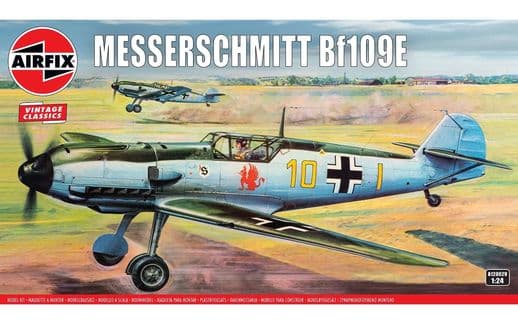
Classic Roy Cross artwork and a Messerschmitt Bf 109 in 1/24th scale … what is not to like?
1/24th scale - Messerschmitt Bf 109E-3 ‘Yellow 10+I’, 9/Jagdgeschwader 26 ‘Schlageter’, France, Summer 1940.
For an aircraft which enjoys such a big reputation, the arrival of Airfix ‘Super kits’ on the modelling stage required that our Messerschmitt kits simply had to go BIG. Following on from the success of the first kit in this large scale, the Mk.I Spitfire released in 1970, its equally famous wartime adversary followed three years later, a kit which at that time was the most accurate model representation of this classic fighting machine. As was the case with the Spitfire which preceded it, the Messerschmitt would benefit from the impressive artistic talents of Roy Cross and box artwork which ensured this kit became an instant hit with the modelling world and one every modeller wanted to test themselves by building. This stunning model and its original artwork made a triumphant return to the Vintage Classics range in 2020 and as we write these words, is still available on the Airfix website.
One of the most famous Luftwaffe fighter units of the Second World War, Jagdgeschwader 26 was given the name ‘Schlageter’ on 1st May 1939, mainly for propaganda reasons and in connection with a German national hero. As one of their highest profile fighter squadrons, JG26 would usually expect to be amongst the first units to receive the latest variant of the Messerschmitt Bf 109 fighter, which certainly proved to be the case at the beginning of 1939, when they began training with the Bf 109E-1 variant.
Claiming its first victory of the Second World War on 28th September 1939, JG26 would go on to see extensive service throughout the French campaign, where records show that the unit accounted for at least 160 French and British aircraft. Now battle hardened and supremely confident, with the surrender of France, they looked towards Britain and expected a swift victory over the Royal Air Force. Flying from bases in the Pas-de-Calais area, the fighters of JG26 would be kept extremely busy during the Battle of Britain, with their pilots going on to earn the respect of their RAF adversaries.
With the more experienced pilots ordered to fly three and sometimes four combat sorties each day, it was not long before morale and fighting effectiveness began to suffer, as mounting losses and the fatigue of combat began to take their toll. Nevertheless, by the end of the Battle, the Geschwader claimed no fewer than 285 British fighters shot down for the loss of 56 of their own number. Notable JG26 aces were Adolf Galland, Gerhard Schopfel and Joachim Muncheberg.
Full scheme details for Wilhelm ‘Willy’ Fronhofer’s Battle of Britain ‘Hellhound’ Bf 109E-3, the aircraft which served as inspiration for Roy Cross’ iconic original Airfix 1/24th scale kit box artwork.
The aircraft scheme presented here was one of the more distinctive aircraft to represent the Geschwader and one which failed to return to its base in France following combat during the Battle of Britain. Featuring classic German fighter camouflage of the period and the large red Höllenhund (Hell Hound) emblem of 9./JG26 on the side of its fuselage , this aircraft was the mount of Lt. Wilhelm ‘Willy’ Fronhofer and on the afternoon of 31st August 1940, he flew his final mission of the Battle of Britain. Caught in a hail of bullets from a British Hurricane fighter, Fronhofer was forced to crash land his Messerschmitt in a field on Jubilee Hall Farm, Ulcombe, near Maidstone. Luckily for the pilot, he escaped unharmed and was taken prisoner, but his fighter was just one of many Luftwaffe aircraft which fell in the county of Kent during the savage fighting of Battle of Britain.
With the Messerschmitt Bf 109 being one of the world’s most famous aircraft and as a consequence, one of the most popular subjects for modellers, Workbench readers will probably have tackled this particular aviation thoroughbred many times over the years and if there is one build which you are particularly proud of, or one which has an interesting story behind it, please do let us have details and you may well find your build starring in a future edition of our blog. As always, could we please ask if you would use our workbench@airfix.com contact address.
We hope you have enjoyed spending a little modelling time with the Luftwaffe’s most famous fighting aeroplane and its place in Airfix kit history.
That’s all we have for you in this latest edition of Workbench, but we will be back next week with more modelling news and exclusive images from the wonderful world of Airfix. As always, if you have any comments about the blog or would like to suggest a subject you would like to see covered in a future edition, please do drop us a quick line at our usual workbench@airfix.com address.
To catch up with all the latest Airfix news, please check our various official social media sites, or head for the Airfix website.
Thank you for continuing to support our Airfix Workbench blog.