

Welcome to this latest edition of our Workbench blog and all the news, updates, and modelling exclusives from the fascinating world of Airfix.
In this edition of Workbench, we will be looking at our latest scale model kit tribute to an aircraft which has to be considered one of the most notorious of the entire Second World War, one which became synonymous with the destructive intentions of the all-conquering Luftwaffe, the Heinkel He-III bomber. Unquestionably one of the most distinctive aircraft of WWII, the Heinkel He-III was one of several inter-war aviation projects which started development as a fast, modern civilian transport aircraft, only to later reveal its true intentions as a strike bomber. Produced in large quantities, wherever the Luftwaffe were operating, so you would expect to see the sky full of Heinkels.
As we prepare to welcome the H-6 torpedo attack variant of this aircraft to the current Airfix range, we will be spending this edition looking at how this famous aircraft was able to adapt to take on a great many operational roles, and become the Luftwaffe’s main attack bomber for the duration of the Second World War.
In other news, can you believe that this summer marks the 10th Anniversary of our Workbench blog? That being the case, and with this clearly being an opportunity to celebrate, we will be announcing our ‘Workbench Aluminium Anniversary Competition’ shortly, with an impressive Airfix prize haul awaiting our lucky winner, something no self-respecting Workbench reader will want to miss.
We had hoped to launch our competition this week, however, the technology gods have not been on our side, so it’s going to be something to look out for in next week’s edition, so this is just our way of putting everyone under starter’s orders.
On to matters pressing, and we have a classic WWII Luftwaffe kit addition to the 2025 range firmly in our sights in this latest edition of your weekly Workbench blog.
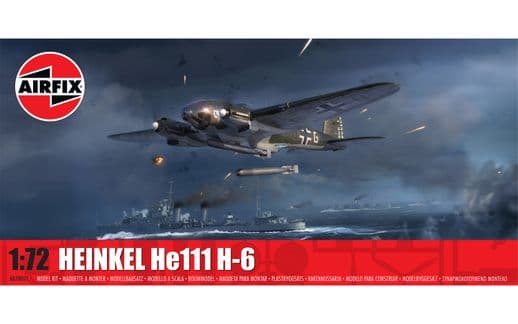
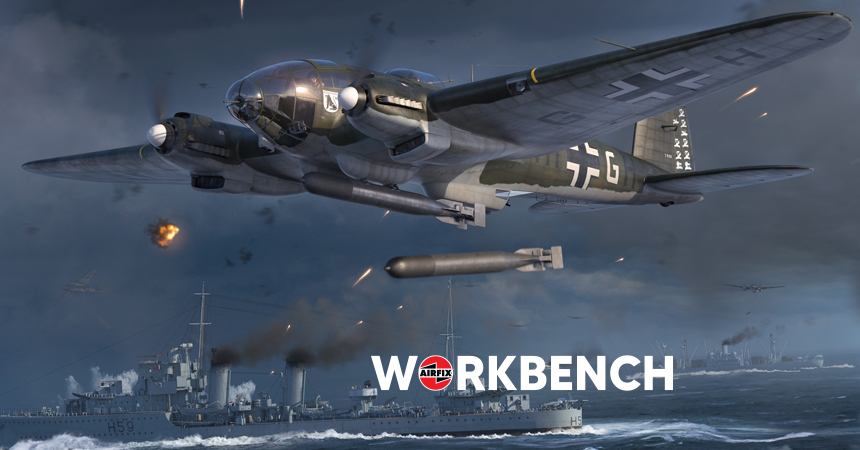
This incredible artwork was created to mark the first release from this new model tooling, and features the aircraft we scanned at the start of this project, and the actions it was involved in during April 1940.
As far as notorious aircraft designs of the Second World War are concerned, perhaps no aircraft has historically come to represent the destructive intent of the wartime Luftwaffe than the Heinkel He-III, an aircraft which could be described as being robust, workman-like and functional, as opposed to being a thing of beauty. Although developed under the guise of being a fast, modern passenger transport aircraft, this aircraft was one created with much more sinister intentions in mind, the backbone of a new and capable Luftwaffe, one intended to rain down terror from the skies across Europe. It could even be suggested that this was an aviation ‘wolf in sheep’s clothing’, one just waiting for the opportunity to strike.
The service introduction of the Heinkel He-III can trace its lineage back to before the start of the Great War, and the famous aircraft designer and manufacturer Ernst Heinkel. Initially employed at the Albatros works, Heinkel would go on to work at the Hansa-Brandenburg company, where he was involved with the design of several of their successful aircraft. He was later appointed as head designer at Caspar-Werke, however, some management differences led him to break away and form his own aviation business, the Heinkel Flugzeugwerke at Warnemünde in northern Germany in 1922.
Initially having to work within the restrictions imposed on German manufacturing by the terms of the Treaty of Versailles, several designs during this period would actually be built outside Germany, most notably in Sweden and Japan, but allowing the company to develop and perfect their design skills. During the early 1930s, the company developed and manufactured their distinctive Heinkel He-70 Blitz (Lightning), an advanced high speed monoplane which was produced for service with Deutsche Lufthansa, the design of which would be seen again in a much larger, more famous design.
During the summer of 1933, Heinkel was visited by the Minister for Aviation Albert Kesselring, a man who had been charged with organising Germany’s aviation industry and laying the foundations for a modern Luftwaffe. He encouraged Heinkel to move to a new purpose built facility at Rostock, one built with the intention of introducing mass production to aircraft manufacturing in the country, and one which pointed to the hostile intentions of the new order in Germany.
Ernst Heinkel was driven by his fascination for high speed flight, and amongst his company’s many achievements would be the development of both the world’s first turbo-jet powered aircraft, and the first rocket powered aircraft, underlining the influence of the company within a re-arming Germany.
The advanced Heinkel He-70 Blitz would donate many of its design features to the larger He-III which followed it off the production lines.
The ‘Doppel-Blitz’, or as the world would come to know it as, the Heinkel He-III pictured at around the time of the Battle of Britain. It would become one of the most famous and feared aircraft of the Second World War.
Building on the success of their He-70 Blitz, the Heinkel Company set about producing a more ambitions twin engined aircraft with their next design, one which was again intended to push the boundaries of aviation technology, and one which possessed both impressive performance and handling capabilities. A twin engined design, the Company initially referred to their new aircraft as the ‘Doppel-Blitz’ (Double Lightning), as it was, for the want of a better description, a larger, twin engined variant of their successful He-70, with the design retaining the large and distinctive elliptical wing and cylindrical fuselage used on its predecessor, in addition to a traditional stepped fuselage layout.
It was an attempt to produce a fast and sleek modern aircraft to capture the world speed record for a civilian aircraft at that time, and whilst being outwardly presented as an airliner/transport aircraft to remain within the conditions of the Treaty of Versailles limitations, its impressive size and performance suggested this masked more sinister intentions. The aircraft made its first flight in February 1935 and was found to possess exceptional handling characteristics, particularly at lower speeds, something which made both the landing and take-off procedures relatively trouble free for pilots.
Indeed, it was documented that during that first test flight on 24th February 1935, the test pilot was instructed not to land back at the company’s factory airfield at Rostock-Marienehe, as it was too short for the new aircraft to land safely. Having been impressed with the aircraft’s handling during that first flight, the test pilot chose to ignore those instructions, and duly landed back at his home airfield, with the new aircraft easily landing within the available space. During his flight debrief, he was full of praise for the new aircraft, particularly its impressive manoeuvrability at low speed.
An incredible wartime survivor, Heinkel He 111 P-1 Nr.1526 is on display at the Norwegian Armed Forces Aircraft Collection at Gardermoen near Oslo, and was the aircraft we LIDAR scanner at the outset of this project.
A series of development images which show how the design phase of this project evolved from scan to CAD screenshot.
This prototype aircraft and the ones which immediately followed it, would all be handed to Deutsche Lufthansa in an attempt to continue the development subterfuge, with the type being unveiled to the German public and the wider aviation world at Tempelhof Aerodrome as advanced passenger and mail carrying transport aircraft on 10th January 1936. By this time however, development of the military version of the aircraft was well underway, with Germany now no longer concerned with the pretence of trying to plicate the other European nations. Effectively, Germany's 'secret bombers' were secret no more and Europe was now on course for war.
The earliest versions of the Heinkel He-III were quite different in appearance from the aircraft which would later take part in the Battle of Britain and the profile which we’re all now so familiar with. Although still adopting the large whale-like fuselage and distinctive elliptical wings and horizontal stabilisers first seen on the He-70 Blitz, the nose of the bomber was very different, longer and more pointed in appearance, arguably adopting a much more traditional design. Although these first aircraft were now equipped with the machine guns which clearly identified its military intentions, it has to be said that the aircraft wasn't exactly bristling with defensive armament at that stage.
As this was one of the fastest aircraft in the world at that time and capable of outrunning most of the fighter aircraft in service with the world's air forces, the Luftwaffe hierarchy didn’t envisage their new bomber having to defend itself against fighter attack, and therefore only equipped the aircraft with three light machine guns, should they need to fend off aerial challenges.
One of the most recognisable profiles in aviation, the fully glazed nose of the Heinkel He-III only appeared with the introduction of the ‘H’ variant of the bomber and beyond.
The iconic Heinkel He-III under construction, one of around 7,000 aircraft of different variants produced between 1935 and 1944.
Significantly, from the Heinkel He-III 'P' model variant onwards, the bomber underwent a design modification which would see it receive arguably its most iconic feature, whilst at the same time updating the aircraft's capabilities with a host of additional improvements. In addition to adopting the ubiquitous Daimler-Benz DB 601 engine as its powerplant, this variant also saw the introduction of a redesigned cockpit and front fuselage section, an upgrade which made for a roomier, more streamlined working environment for both the pilot and his bombardier. This development certainly gave the aircraft a much sleeker appearance and very much improved the frontal visibility for the pilot, however, with this shorter, taller nose section now being completely glazed, the Heinkel He-III had been given its most distinctive feature, one which would make it amongst the most recognisable shapes of the entire Second World War.
In addition to giving the Heinkel its unmistakable profile, the new fully glazed cockpit afforded the pilot an exceptional field of view, but on the downside, also made the front of the bomber a tempting target for enemy fighter pilots, affording the unfortunate crew very little in the way of protection in such circumstances.
Sweeping all before them during the early stages of the war, the Battle of Britain would prove to be a chastening experience for Luftwaffe, and for Heinkel crews in particular, as the speed and manoeuvrability advantages the aircraft has possessed when it first entered service had now been nullified. Against the determined attacks of RAF fighters, Heinkel bombers were extremely vulnerable, unless they were protected by large numbers of supporting Messerschmitt Bf109s. Although considered essentially obsolete as a bomber capable of operating in contested airspace from this point in the war onwards, the Heinkel He-III would have to soldier on in a variety of offensive roles for the remainder of the war, with almost 7,000 of these distinctive bombers having been produced by the time the final aircraft rolled off the production lines in September 1944.
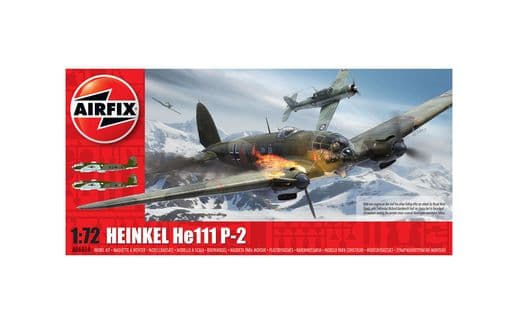
Spectacular new box artwork befitting a truly fascinating kit addition to the current Airfix range.
As one of the most famous aircraft to see service during the Second World War, the Heinkel He-III bomber has always been a popular subject with the world’s modelling community since the very establishment of the hobby, and has been a feature of the Airfix range since the early 1960s. Since the introduction of that first 1/72nd scale kit, with its interesting shape and historic notoriety, it must be considered one of the most popular kit subjects in our history and has probably been built by hundreds of thousands of modellers since that time.
An aircraft which along with the Messerschmitt Bf 109 and Junkers Ju-87 Stuka would become the very embodiment of German military aviation might during the Second World War, the Heinkel He-III has always been staple modelling fare within our beloved hobby, perhaps because it is such a distinctive looking aircraft, but maybe also by virtue of the fact that so few examples remained after the war, with even less subsequently finding their way into museum collections around the world. This type scarcity has certainly cemented the Heinkel’s legacy as a popular modelling project over the years.
Due to the length of time this original kit spent in the range, and the enduring popularity of the aircraft as a modelling subject, the Heinkel He-III attracted the attentions of a new breed of Airfix product designers in 2014, who felt that a subject of this pedigree was deserving of a design revisit, and a new kit benefitting from all the latest design innovations the industry had to offer.
An interesting computer rendered CAD images showing the alternative parts which needed to be designed to allow this H-6 variant of the Heinkel to be modelled.
Announced with the launch of our 2015 kit range, the new Heinkel He-III tooling would actually be featured in just the fifth edition of the then very new Workbench blog, where we exclusively revealed CAD imagery of the additional component frames introduced to allow the Junkers Jumo 211 powered 'H' variant of the bomber to be produced.
Arguably the most effective version of the famous Heinkel He-III series of bombers and certainly the one which was built in the greatest numbers, the He III ‘H’ series attempted to address many of the shortcomings which were evident on earlier models of the bomber, in addition to upgrading the general performance and combat survivability of this widely used Luftwaffe aircraft. Although the Heinkel He-III could no longer claim to be an entirely effective attack bomber on the Western Front, following the losses experienced during the Battle of Britain, however, it would go on to serve with distinction in a variety of different roles, and in every theatre of operations where Luftwaffe aircraft flew.
Successive upgrades enabled the aircraft to deliver a more effective weapons payload over greater distances, whilst at the same time providing Heinkel crews with much more effective defensive armament. The internal weapons bay was no longer used to carry bombs, but was instead converted to house additional fuel and oil tanks, allowing for much longer sorties to be mounted, many of which would be over water. This development also allowed these later Heinkels to carry larger, more devastating weapons from external hard points, which included air launched torpedoes and the SC1000 2,200lb ‘Hermann’ bomb.
The latest release from this relatively new and incredibly popular tooling is scheduled for imminent release and includes two interesting schemes which mark the different offensive ordnance options crews flying this variant of the aircraft had available to them.
Scheme A – Heinkel He-IIIH-6, WNr.7098/1H+GH, 1,/Kampfgeschwader 26, Bardufoss, Norway, July 1942.
Perhaps the most interesting missions carried out by ‘H’ model Heinkel He-IIIs were those of the torpedo carrying maritime attack bombers, aircraft which flew at wave-top height, before delivering their payload of two air launched LT-F5b torpedoes against their target vessels. Operating from the airfield at Bardufoss in northern Norway, the anti-shipping Heinkels of 1./KG26 were involved in the infamous attack against Arctic Convoy PQ17, an episode which proved to be one of the most disastrous episodes in the history of the Royal Navy.
Leaving Iceland, bound for Arkhangelsk in Russia, the convoy consisted of 35 merchant vessels and a large protecting force of naval ships. Historically, these convoys had been established to provide the Soviet Union with a constant stream of weapons and supplies, in the wake of the German invasion of their country, allowing them to remain in the war and to keep German forces committed to combat in their country. Bringing everything from tanks and aircraft to bullets and shells, the Germans knew only too well what the British were attempting to do, and knew that if the supplies reached Russia, they would take a heavy toll of their forces, but if they could be destroyed at sea, that many German lives could be saved.
Convoy PQ17 was the largest Arctic convoy ever assembled to date, which for the first time, brought together warships of both the British and American navies to protect a massive shipment of war supplies for Russia. The Germans knew about the convoy and were determined to prevent these supplies from getting through, assembling a mighty force of aircraft, submarines and surface ships to be hurled against it. The scene was set for a monumental clash and an unprecedented British naval disaster.
Once detected by the shadowing Germans, and when it was within striking range, the first attack came from a large force of Heinkel He-III torpedo bombers from KG26. Warned of their approach, the escort vessels put up a murderous wall of defensive anti-aircraft fire, which claimed four of the Luftwaffe bombers destroyed.
Determined in their attack, the torpedoes did their damage, and several ships were sunk and the defensive shield of the convoy disrupted. A second wave of aircraft was even more determined, but the warship ring again put up accurate defensive fire, ensuring that all but the most committed of Luftwaffe pilots would have found it difficult to execute their attacks effectively.
Full scheme details for an aircraft which took part in the merciless attack against Allied Convoy PQ17, but was one of just five Luftwaffe aircraft reported lost during these actions.
A computer rendered image showing the weapons options available with this modified tooling release of the famous He-III.
Back in Britain, the Admiralty started to receive reports claiming that the mighty German battleship Tirpitz had left port and was steaming towards the convoy. Despite the strength of the force protecting Convoy PQ17, senior officials knew that if challenged by Tirpitz, many of the ships would be lost, so in one of the most tragic decisions of the entire war, Allied warships were ordered to return to port, with the merchant convoy simultaneously ordered to scatter and make for Arkhangelsk alone. In some of the most inhospitable seas in the world and with hundreds of miles still to negotiate, the Admiralty essentially abandoned Convoy PQ17 to their fate.
Over the next few days, the German air and submarine attacks on the merchant vessels were relentless, but in some way, the order to scatter did make their job more difficult. Nevertheless, 24 vessels from the convoy were sunk, and just eleven extremely overdue ships eventually made it to Arkhangelsk or Murmansk, which proved to be a miracle in itself.
A devastating loss for the Allies, official sources claim that only five Luftwaffe aircraft were lost during these operations and significantly, how Tirpitz didn’t put to see throughout the entire attack.
The scheme option presented here marks one of the 26 Heinkel He-III bombers which took part in the largest air attack against the convoy on 4th July 1942, the final air attack of the day. Pilot Lt. Konrad Hennemann flew his aircraft low over the sea having selected his target, the SS Navarino, releasing a single LT F5b torpedo towards the ship in his sights. The torpedo slammed into the merchant ship causing irreparable damage, but not before accurate anti-aircraft fire from the destroyer ring had crippled the attacking Heinkel.
The aircraft hit the water and disintegrated, with the crew later being listed as missing in action. Pilot Konrad Hennemann would later be posthumously awarded the Knight’s Cross for his bravery under fire.
Scheme B – Heinkel He-IIIH-6, WNr.4856/6N+EJ, 6,/Kampfgeschwader 100, Kalamaki, Greece, April 1942.
An aircraft type which would see service in every theatre the German Luftwaffe contested, elements of KG100 were sent to southern Europe in April 1942, to operate from the airfield at Athens-Kalamaki. From there, the unit’s Heinkel bombers were in a position to cause havoc across the entire Mediterranean, mounting long range strikes against Allied held ports, enemy shipping and strategic targets as far away as North Africa.
The H-6 variant of the Heinkel didn’t employ internal bomb bays but instead had two robust ordnance hardpoints fitted beneath the forward fuselage, which were capable of accepting a wide variety of stores, including the SC 1000 (Sprengbombe Cylindrisch 1000) general purpose bomb, which was colloquially referred to as the ‘Hermann’. It’s open to interpretation as to whether this was a term of endearment, or simply reference to the rather portly appearance of these bombs, one which resembled the physique their beloved Commander-in-Chief.
These bombs were designed for maximum blast effect, used to shatter industrial infrastructure, such as docks, airfields and production facilities, but could also be incredibly effective when used against shipping, even if the bomb only exploded near its intended target.
On the evening of 24th April 1942, six Heinkel He-IIIs of 6./KG100, along with five Junkers Ju88s from I./LG1 and a Heinkel from KG26 acting as the force pathfinder, carried out a bombing attack against the British held airfield complex at Qotafiyah II (LG 104) in Egypt. Although the raid did cause significant disruption at the airfield, only two Wellingtons of No.70 Squadron were damaged, resulting in it only being a partially successful raid.
Full scheme details for this unusually presented Mediterranean Theatre aircraft.
The aircraft covered in this scheme option took part in the attack, but was struck by the airfield’s anti-aircraft defences on the run into the target, damaging it sufficiently to cause the aircraft to crash into the desert sands nearby. Tragically, the four-man crew all perished in the crash and were officially posted as being missing in action.
This aircraft is unusual in its presentation, and therefore of great interest to the modeller. These non-standard markings were applied after the aircraft had arrived in Greece, and consisted of black undersides and large RLM 80 Olivgrün camouflage markings over RLM Sandgelb II. During the painting process, only the most vital identification markings were re-applied, making these aircraft particularly interesting.
At the time this aircraft was lost, II./KG100 were also using unorthodox fuselage codes, which is the reason why this aircraft carried the letter J in its coding, which denotes an aircraft allocated to 6 Staffel. The front section of the spinners are painted in red, marking this as a II Gruppe aircraft. The unit operated from Athens-Kalamaki airfield for just eleven days short of one year, during a particularly active period of air activity in this theatre of operations.
Although marking a tragic wartime episode, this latest Heinkel release benefits from spectacular artwork and two fascinating scheme options, which seem destined to make this one of the most popular releases of the Airfix year.
Two fantastic scheme options for this most popular of toolings, this latest impending addition to the 2025 range is certain to find favour with the wider modelling audience, although choosing one over the other may prove to be quite the challenge. One thing is certain, whichever one we eventually go for will make for an attractive addition to our model displays, but with the 85th anniversary of the Convoy PQ17 disaster coming up in 2027, this might prove too tempting an option to overlook.
We're afraid that's all we have for you in this latest edition of the Airfix blog, but we will be back next Friday with more project development updates and the very latest Airfix kit exclusives. In the meantime, we're always keen to hear your views on all things Airfix and in particular, any thoughts and opinions you may have regarding our Workbench blog. If you would like to drop us a quick line, could we please ask that you use our workbench@airfix.com email for all correspondence.
To re-visit any of the Airfix blogs we have produced over the past TEN years or so, please head to our main Workbench hub, where you'll find our entire blog back catalogue and all the Airfix design projects we have already covered.
All our dedicated official social media sites can be accessed by clicking the respective link icons at the foot of this page, or by heading to the Airfix homepage. Other useful Airfix links are:
Facebook, YouTube, Twitter and Instagram official sites
Please join us for more Airfix updates next week and thank you for your continued support.