
Welcome to this latest edition of our Workbench blog and all the news, updates, and modelling exclusives from the fascinating world of Airfix.
With almost 400 Workbench blogs now successfully under our belts, we’re never afraid to try something just that little bit different when putting one together, with this current edition being something of a point in case. When announcing the latest kit additions to the current Airfix range, we sometimes unearth something very special, be that new information revealed in support of an included scheme option, or new box artwork which triggers fond memories for a former British serviceman. That’s exactly what happened when former member of the Royal Artillery Alister Constantine first saw the new box artwork for the second release from our Ferret Scout Car tooling, because it was the very same vehicle that he operated throughout his service during the Gulf War.
Kindly, Alister dropped our marketing team a line to inform us of the close link he had with our artwork, which was the start of a fascinating period for members of the Airfix team, particularly our lead videographer Nathan. He was fortunate enough to meet Alister, where they discussed all things Ferret, and this Ferret in particular. Nathan was also given access to a fascinating collection of Gulf War imagery featuring Alister and Ferret 00 EC 15, details which really provide this latest Ferret kit release with irresistible provenance, and build project character which is second to none.
In this latest Workbench update, we will be sharing details of Alister’s Gulf War time with Ferret 00 EC 15, including some of those fascinating pictures taken at the time, and including the two related Videos recently created by Nathan within this edition. We need little excuse to have one of our new Ferret kits on the workbench as a build project, but after this, we think we know the scheme many Airfix enthusiasts will be opting to go for.
We’re on scale Gulf War deployment with a particularly interesting British Army Ferret Mk.1 Scout Car and its crew in this latest edition of Workbench.
When we published details of our second kit tribute to the Ferret Scout Car, we were delighted to make the acquaintance of Alister ‘Connie’ Constantine, and the news that we’d just done his Ferret.
When members of the Airfix team attend events all over the country each and every year, it’s always humbling to hear the many stories people tell us about their personal association with the Airfix brand, and how our kits often played such a significant role in their lives, at one time or another. Sometimes, these stories go a little deeper, with people describing how they, or members of their family actually helped with research in support of a new tooling project, or supplied details to one of our researchers over the years in support of a kit scheme option, and always how they’re pleased to have been able to be involved in some small way.
The release of our new 1/35th scale Ferret Scout Car kit in 2023 brought us into contact with so many people who either served in, worked on, or actually own one of these distinctive vehicles, that we were left in absolutely no doubt whatsoever that this was going to become a much loved addition to the Airfix range. In fact, when we attended the Scottish National Scale Model Show in Perth that year, we even met a former squaddie who had been run over by one whilst he was sleeping! Thankfully, this didn’t include the need for medical intervention, as he was sleeping in a ditch at the time, so didn’t feel a thing.
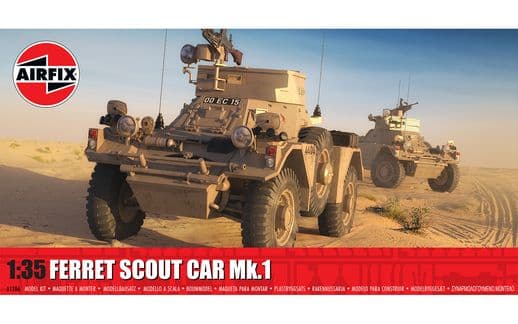
The release of our second kit from the new Ferret tooling brought no let up in the affection in which this former British Army vehicle is clearly held, and brought a call into the Airfix office from a man who wanted to tell us something about the box artwork produced in support of this release – it was an image of the Ferret he operated whilst deployed to the Gulf during the early 1990s. Clearly, this news was of great interest to us, something we just had to follow up, and was the beginning of a truly fascinating period where we met a man, his Ferret and some rather specific Ferret memories.
Once it became clear that British servicemen were going to be deployed in support of the coalition response to the Iraqi invasion of Kuwait in August 1990, it didn’t take long before those qualified to perform specific roles were assigned to new units. One such serviceman was Alister ‘Connie’ Constantine, who was assigned to No.40 Field Regiment and subsequently to 129 Battery. He possessed the requisite skills to operate the Ferret Scout Car in liaison and forward observation roles, and was sent to prepare for deployment to the Gulf region.
The box artwork image which led to Alister getting in touch with the Airfix team, and the start of a fascinating period of additional subject research and information.
When he and the others in his group arrived to inspect their assigned Ferrets, they found them to be in quite a state, so spent much of their initial training period attempting to make them as battleworthy as possible, commandeering as many parts and useful equipment from other vehicles not assigned to the coming task as they could. As they were expecting to be sent into forward ‘contact’ areas when in theatre, their actual preparations involved recognition and familiarity training, so they would be fully conversant in the types of vehicles they may come across when in theatre, both coalition and enemy.
Once initially deployed to Saudi Arabia, this training continued whilst crews awaited the arrival of their vehicles, a period which Alister described as being particularly enjoyable, as they worked closely with elements of the US Marine Corps at that time. Once their Ferret had arrived, it was time for action and initially, surveying potential Allied gun positions, both in defence of further Iraqi Army advances, then on to offensive operations.
Initially, the Ferret’s role in the Gulf would be that of reconnoitring territory and positions, but also acting as a general liaison vehicle as and when required. This would move on to seeing them used as general ferry vehicles for both men and equipment, to and from larger supply positions behind the lines. Eventually though, the British Army Ferrets would revert to type and move to forward positions to be used as artillery observation points and working alongside tanks and other armoured fighting vehicles, where their proficiency as stealthy reconnaissance vehicles could be brought to bear.
As the fighting took a turn in favour of coalition forces, Ferrets would be used to check former enemy positions and to scoop up Iraqi troops who were looking to surrender along the way, which was a role not without its dangers for Ferret crews, as these enemy troops were still often armed. Ferret crews would then be charged with escorting these prisoners back to holding points behind the front lines, before speeding back to potential action hotspots, at speeds only a Ferret to hope to achieve.
This next series of images are absolutely fascinating, and are a record of Alister’s time with Ferret 00 EC 15 whilst both were deployed during the Gulf War. Alister has kindly allowed these images to be shown for the benefit of Airfix modelling enthusiasts, however, those intending to re-publish them in any format whatsoever must seek prior permission from him before doing so. He retains full copyright ownership of all the personal images shared here – please be respectful. All images © Alister Constantine.
The soft sand of Saudi Arabia posed a few problems for British Army Ferret crews. All images © Alister Constantine.
Where else would you want to be over the Christmas period? A small reminder of home for Alister and his crew mates was the addition of a small Christmas Tree to their Ferret during the festive period of 1990. All images © Alister Constantine.
More of that damned soft sand for Alister to deal with. All images © Alister Constantine.
Checking abandoned Iraqi hardware. All images © Alister Constantine.
Gulf War home from home – Ferret 00 EC 15 displaying a rather ‘lived in’ look. All images © Alister Constantine.
Many of the pictures kindly supplied to us by Alister show his Ferret with Pressed Steel Planking attached to the front of his vehicle, something he described as being essential during their time in the Gulf. As their Ferret wasn’t fitted with special sand tyres, operations in the soft sand dune conditions of Saudi Arabia were often problematic and if the Ferret was left in the same position for any length of time, it would become bogged down in the soft sand. As a consequence, digging the vehicle out using the PSP and shovels was a regular requirement, although the strategic positioning of the steel planking would definitely buy the crew a little more time in such circumstances.
Alister also described how the end of ground operations in the Gulf saw British Army Ferrets whizzing up and down the Basra Highway, both on official duties and with crews checking abandoned Iraqi equipment for weapons and ammunition (plus maybe the odd item to serve as a souvenir of their time in the Gulf). This saw their vehicles astounding their American counterparts as the speed the British Ferrets could attain on open roads, even faster than their own modern Humvees.
By the end of their time in the Gulf, their trusty old Ferret 00 EC 15 was beginning to show the strains of deployment, particularly when a broken manifold made her sound more like a main battle tank than a stealthy little reconnaissance vehicle.
As a record of one Ferret’s time spent on deployment in the Gulf, the pictures Alister has allowed us to share are truly fascinating, one man and his Ferret during a particularly volatile period in world history. They also serve to provide modelling inspiration for anyone looking for an engaging model build as we head into the longer nights of winter, particularly if you fancy allowing a desert Ferret onto your own workstation over the coming few weeks.
Once again, could we extend our sincere thanks to Alister Constantine for helping us with both the publication of this latest edition of Workbench, and the production of the two recent videos we’re showcasing here, videos which provide a fascinating insight into his time serving through the Gulf War.
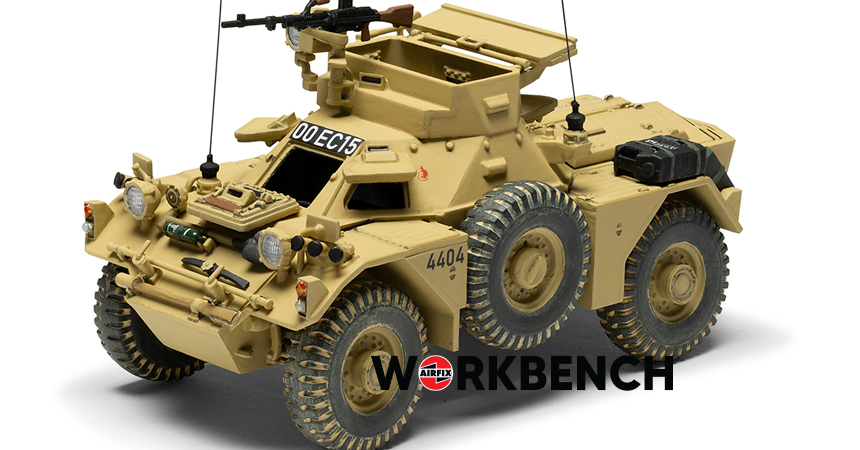
This second release from our Ferret Scout Car tooling includes three scheme options for this earlier variant, including the subject of our latest update.
On battlefields throughout the ages, the ability to know where your enemy is, and in what strength they are massed was crucial intelligence which not only allowed for appropriate action to be taken, but could also save many lives in the process. As we are all now only too aware, drone technologies currently play an important role in fulfilling this essential requirement and be that an expensive military drone for strategic intelligence or a small, consumer device used in close contact situations, this real-time information about the enemy you are facing can prove decisive. For these reasons, denying your enemy the ability to obtain these details is just as important as securing your own intelligence, however, in the days before the drone, this work had to be carried out by specially trained units and if they were lucky, ones who had access to a vehicle designed specifically to help them in their task.
A highly successful series of light armoured reconnaissance and liaison vehicles, the Ferret Scout Car would see widespread military service with British and Commonwealth forces from the 1950s onwards, with later variants of the Ferret still being in service and taking part in the Gulf War of 1991. A vehicle type which can trace its lineage back to the successful Daimler Dingo scout car of the Second World War, the Ferret was designed with stealth in mind, a light and fast armoured vehicle which could probe enemy positions, reporting any discovered weak points back to commanders, with their own forces moving forward to exploit what they found.
Weighing in at just over four tons when at operational weight, the Ferret was of all welded construction and featured armour protection capable of withstanding most small arms fire, but nothing much heavier, as it was never intended that the vehicle would be operating in direct opposition to heavy enemy armour. If it did find itself in a spot of bother, the 4 wheel drive Ferret was powered by a reliable 4.2 litre 6 cylinder Rolls Royce engine, which gave the vehicle a top speed of between 45 and 50 mph, a speed it could impressively also achieve in reverse should the situation require. This ability might prove crucial if the crew found themselves in a tight spot when in contact with the enemy, and needed a quick getaway.
The large 'Run Flat' tyres were designed to get the Ferret back to base even when one or all of them had been damaged, so it was therefore unlikely that a crew would need to use the spare, even though they were still carried on many vehicles. What makes this all the more surprising is the fact that fitting the spare wheel to the hull of the Ferret actually blocked one of the crew emergency escape hatches, placing even more emphasis on its ability to use speed and stealth to get it out of a contact situation.
Despite being armoured, the Ferret was never intended to be placed in a position where it would have to face enemy heavy armour and instead relied on its low profile, speed and stealth to make contact with enemy units, units which may themselves be engaged in a similar role. Creeping into contested territory, the Ferret was built for sniffing out the enemy, but not to actually cause trouble directly in an offensive sense. Sending real-time radio reports back to HQ, if their scouting took them out of radio range, a second HQ Ferret could be sent closer to it to receive and relay messages, helping to build up a picture of enemy activities and direct any impending offensive contact.
A couple of exclusive images showing CAD screenshots from the Mk.1 variant of the Ferret kit’s development, kindly supplied by the kit’s designer Ethan Barker.
If detected, the crew could extricate themselves from any combat situation at high speed and as long as they were only targeted by small arms and light machine gun fire, they would have adequate protection until the driver could get them out of range and speeding back to more friendly lines.
In operation, the Ferret was quite the capable performer, sporting a five-speed pre-selector gearbox which was accessed using a simple two position drive lever, and the ability to travel as fast in reverse as it could moving forward. The suspension units employed were robust and capable, allowing for a very pleasant ride, even at high speed and in all but the roughest of terrains and conditions. Even though the steering system did not feature power assist, it was light and responsive, just another impressive feature which endowed the Ferret with impressive operational performance.
The driver’s field of view was excellent in most operating environments and utilised several armoured hatches which would normally be open to offer an excellent view, even sporting rear armoured panels which could be opened for reversing. If the Ferret should come under fire, the hatches would be closed, and the driver would revert to a periscope unit for his driving view. The Ferret also boasted excellent water fording capabilities, with all automotive and electrical equipment protected against the ingress of water - in fact, it was thought that the vehicle would keep on going even though the crew would have been forced to abandon the vehicle due to the height of the water inside.
Each Ferret carried plenty of internal equipment and therefore, the interior was rather cramped. In normal operation, the commander would sit half out of the vehicle, just to make travel a little more comfortable, but as they approached contested areas, it would be back inside, with hatches battened down. The Mk.1 Ferret typically had a crew of three, whilst later marks would usually only be operated by a driver and commander.
Over 4,400 Ferrets were built during the ten years from 1952, and they would see extensive service with British forces across the world, in addition to those of many overseas nations. You would always be sure of spotting a Ferret or two in many of the world's hotspots during the post war years and hundreds are still in service across Africa, the Far East and the Pacific region to this day.
When we think about the awesome firepower at the disposal of Allied Coalition forces, particularly the British, at the start of the Gulf War of 1991, you’d probably think of Challenger 1 main battle tanks and Warrior infantry fighting vehicles, all AFVs designed to provide British forces with the latest battlefield equipment to assist in their dangerous work. What you wouldn’t expect to see was a small force of lightly armed scout cars which at that point, had already been in service for 40 years.
The battlefield attributes of the Ferret which made it an ideal reconnaissance, liaison and security armoured car when it was introduced during the early 1950s, were still in demand when British forces deployed to the Gulf in response to this crisis, and amongst the collection of impressive modern armour in theatre, there was also a small, but noteworthy ‘Ferret Force’ supporting them. Wearing a smart new paint scheme appropriate for these new operating surroundings, Gulf War Ferrets would actually play quite a significant role both during preparations for the ground operations, and throughout the subsequent attack, always there to offer their unique attributes in ensuring the enemy were kept on the back foot.
In the light observation role, Ferrets would often be at the head of troop and equipment columns as they headed towards their attack staging points prior to the ground assault taking place, leading armoured columns into their correct positions, mainly under the cover of darkness. Reconnaissance Ferrets could also be the home of very senior commanders, as they probed the front lines looking for breaches in enemy defences and plotting minefields which would cause problems once the assault began in earnest. Using their speed and low profile, Ferrets operated effectively in these advanced roles, often leading the way for much more modern and much more expensive assets to follow along.
Seeing combat operations 40 years after the vehicle had originally entered service, the Ferret really was an exceptional armoured vehicle, one which just didn’t know when to quit.
We couldn’t end without a final look at some of Alister’s fascinating Ferret 00 EC 15 pictures. This time, we have a beautiful Gulf war study of the vehicle, plus a second one where she’s keeping a watchful eye on some of the locals. All images © Alister Constantine.
Once the attack began, Ferrets were called to check enemy positions which had been neutralised, making sure nothing dangerous remained, whilst also performing the grim task of marking the positions and identities of fallen troops. If they did discover casualties, they could arrange for medical services to be dispatched to the location.
On more than one occasion, Ferret crews were called upon to take the surrender of large numbers of Iraqi troops, numbers which dwarfed the crews of the vehicles themselves. Clearly a dangerous time for those few soldiers involved, crew members had to search and possibly disarm enemy troops, before keeping them all under guard until relief forces could take them to holding centres.
Once a ceasefire had been arranged, Ferrets and their crews were again dispatched to find and plot enemy positions, inspecting bunkers and strongpoints to ensure all weapons had been collected and made safe, and that no booby traps had been left for the unwary. Underlining the fact that these were always intended as military vehicles, one of the final tasks Ferret crews were required to undertake was the grim task of proceeding along the Basra Road to ensure that any enemy combatant casualties both injured and deceased were dealt with in the appropriate manner.
This particular Ferret appeared to be particularly well-loved by those who came into contact with it during the Gulf War, as there are an impressive number of colour pictures available online which stand as a record of this vehicle’s service during this conflict. In a modern coalition ground campaign, there was still a need for a Ferret Force of 40 year old Scout Cars. Thanks to Alister’s intervention, we now know why.
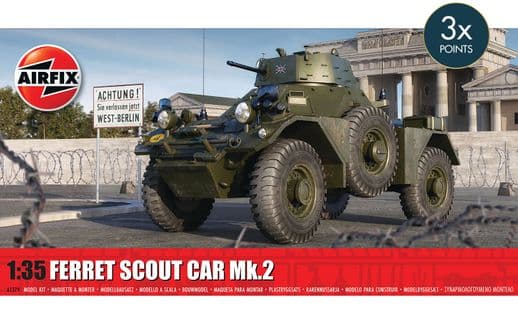
This second release from our new 1/35th scale Ferret Scout Car also includes to other scheme options for modeller’s to consider, but as they aren’t really related to this latest, rather specific Ferret update, we’ll include this link access to be taken to the previous edition of Workbench where these were covered.
In addition to this, as we discovered during our conversations with Alister, he actually has a Ferret of his own, obviously not the one featured in this update, but one he’s spent the best part of twenty years restoring to its current, impressive condition. You can join Alister for a guided tour of his restored Ferret, and discover some of its service history by watching the video embedded below.
Finally, if you fancy a little Ferret build project to ease your way into the winter months ahead, both this second Ferret Mk.I kit and the original Mk.2 release which preceded it are both currently available on the Airfix website, both fantastic scale representations of this impressive little post war military vehicle, one which had 40 years of British Army service to its name.
We're afraid that's all we have for you in this latest edition of the Airfix blog, but we will be back next Friday with more project development updates and the very latest Airfix kit exclusives. In the meantime, we're always keen to hear your views on all things Airfix and in particular, any thoughts and opinions you may have regarding our Workbench blog. If you would like to drop us a quick line, could we please ask that you use our workbench@airfix.com email for all correspondence.
To re-visit any of the Airfix blogs we have produced over the past TEN years or so, please head to our main Workbench hub, where you'll find our entire blog back catalogue and all the Airfix design projects we have already covered.
All our dedicated official social media sites can be accessed by clicking the respective link icons at the foot of this page, or by heading to the Airfix homepage. Other useful Airfix links are:
Facebook, YouTube, Twitter and Instagram official sites
Please join us for more Airfix updates next week and thank you for your continued support.