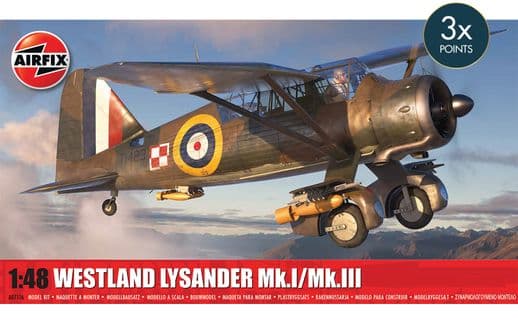

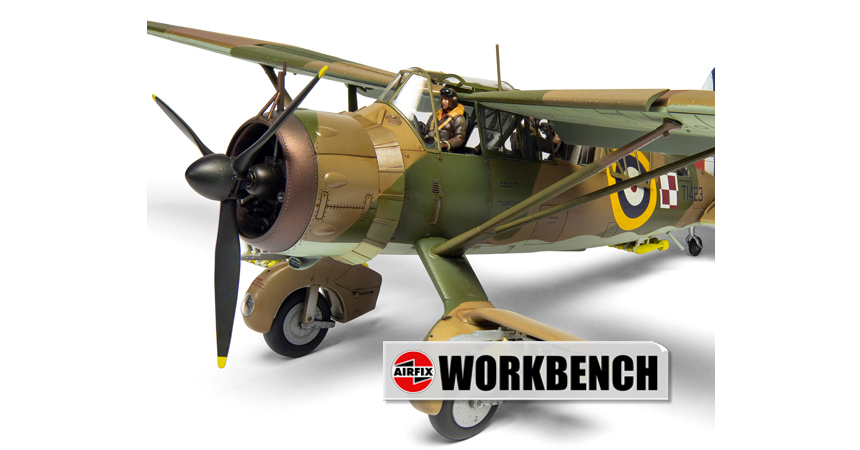
One of the benefits of exhibiting at this year’s Bolton show was not only the chance to show a selection of our range launch announced new tooling projects in development form, but also to introduce our recently released 1/48th scale Westland Lysander kit to her modelling audience in this part of the world. A truly impressive addition to the range, taking Lizzie up north was rather fortuitous for us, as it allowed us to tell all those who have been struggling to get hold of one that we’ve just taken delivery of a second consignment of the kit, so it should be available in your favourite model store very soon, but is in stock on the Airfix website right now.
It also gives us another opportunity to feature a kit which is our scale tribute to one of the more interesting British aircraft types of the Second World War, one which equipped several squadrons by the start of the conflict. When Britain’s Air Ministry initially communicated their requirements for a new Army cooperation aircraft to replace the Hawker Hector and Hawker Audax in this role, they invited proposals from the Hawker, Avro and Bristol companies, whilst ruling out Westlands, by virtue of the relative inexperience of their design team. After some internal wrangling and after officials had seen the impressive automatic slat and flap system the company had been developing, they relented and allowed the Westland Aircraft Company of Yeovil to also submit proposals.
Under the direction of Westland’s relatively inexperienced design manager William ‘Teddy’ Petter, the company embarked on an exercise which saw officials spending a great deal of time interviewing pilots who were currently engaged in Army cooperation flying, in an attempt to find out what they liked about their aircraft and more importantly, what they thought could be improved. These discussions helped to build a picture of what capabilities the new aircraft must possess and what Westland’s design team had to deliver, if their new aircraft was going to prove successful.
The Army wanted an aircraft which could take on a variety of roles, including reconnaissance, artillery observation, general duties and light bombing, whilst the pilots who were already serving in these roles wanted a capable new aeroplane which offered excellent ground visibility at all times, was rugged in operation and possessed excellent short field capabilities. Petter and his team at Westland set about designing an aircraft which could satisfy both.
A fine photographic study of a Westland Lysander, kindly supplied by our friends at Key Publishing and part of the Key Publishing Collection.
What they produced was an unusual looking, if rather advanced aeroplane, but one which wasn’t without its vices. The high-set cockpit and extensive glazing afforded both the pilot and his observer an exceptional field of view, with the high mounted, unusually shaped wings not only helping to support this, but also incorporating a few little design tricks of its own. The wing design included the introduction of an automatic slat and flap arrangement which gave the aircraft exceptional low speed and short field performance, but due to its design, did have to be managed carefully.
During the landing phase, if a pilot attempted to make a three-point landing at slow speed, the angle of attack at such a speed would immediately deploy the automatic slats and flaps, causing the aircraft to rear up and potentially stall, something which could have a catastrophic outcome for both the crew and their aircraft. With the power of the Bristol Mercury radial engine though and with careful handling, the Lysander could be an impressive performer, with a stalling speed of just 65 mph allowing this aircraft to be operated in incredibly short distances.
Another significant design feature of the Westland aircraft was its rugged, fixed undercarriage, something which made it easy to operate whilst on the ground, with the rigidity to allow it to be operated from all but the most uneven of landing grounds. The wheel spats themselves were streamlined, but also housed a pair of fixed, forward firing Browning machine guns, which were away from the arc of the propeller and therefore didn’t require the use of interrupter gear.
These wheel spats were strong enough to allow small stub wings to be fitted to each outer section, so that if the aircraft was to be used in an offensive or supply capacity, their hardpoints could be used to deliver small bombs, supplies or as would later prove to be the case, rescue equipment. An additional Light Series bomb carrier could be fitted under the rear of the aircraft’s fuselage to allow a further four 20lb bombs to be carried and defensive armament consisted of a plinth mounted single or twin Browning/Lewis machine gun arrangement in the observer’s section of the aircraft, behind the wings.
Westland submitted their design proposal during the summer of 1935 and a contract to produce two prototype aircraft (which would carry the internal designation P.8) was duly awarded. Almost exactly twelve months later, the new aircraft made its maiden flight from the Westland airfield at Yeovil and before that month was out, the aircraft had also been exhibited at that year’s Society of British Aircraft Manufacturers Display at Hatfield. The following month, the aircraft flew to Martlesham Heath, where it was put through its paces by the Aeroplane and Armament Experimental Establishment, to discover if the new aircraft possessed the qualities needed for the intended role.
In competition with the Bristol Type 148 monoplane for the contract, the Westland aircraft quickly emerged as the most suitable aircraft and a subsequent order for 144 production aircraft would be placed even before the second prototype aircraft had flown. Trials at Martlesham Heath and Farnborough continued, but with a view to testing the proposed armament arrangement for the new aircraft, which would subsequently be named Lysander, after the historical Spartan military leader.
The new aircraft was introduced to the public at the Hendon Air Pageant in June 1937, where it was celebrated as a ground-breaking new type, one which proved that Britain’s aviation industry led the world at that time, and that the RAF would be equipped with the most capable aircraft in the skies in the event of war, or so they would have the public believe. When British Movietone News images of the Lysander were shown, they described the aircraft as having world-leading short field performance, with a top speed which whilst still being secret at that time, could rival the world’s most capable single engined fighters.
Unfortunately for Lysander crews, that boast proved to be something of an exaggeration and even though the Lysander was an excellent aeroplane, it was no match for the Luftwaffe’s latest fighters.
Lysanders would enter Royal Air Force service with No.16 Squadron during the summer of 1938 and by the start of the Second World War, seven squadrons of Lysanders were in service, having worked up to perfect this excellent aircraft’s capabilities in a cooperation/general duties role. As part of the air component of the British Expeditionary Force sent to France in October 1939, four squadrons of Lysanders operated in support of this force, flying reconnaissance, spotting and light bombing duties in advance of the German onslaught. Despite the many admirable qualities the Lysander possessed, the aircraft was not one that could be used effectively in contested airspace and France would prove to be a baptism of fire for Lysander crews.
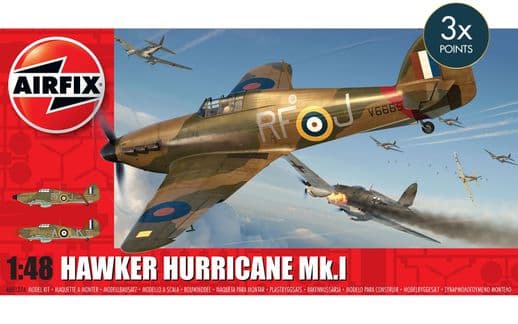
Often operating in areas close to the fighting, if Lysanders were caught by marauding Luftwaffe fighters, they were incapable of defending themselves effectively, not manoeuvrable enough to evade the attentions of the agile Messerschmitt Bf 109, whilst at the same time making for a rather large and tempting target for them. Even when protected by RAF Hurricanes, the Lysanders were too slow to evade their attackers, once they had dealt with the Hurricanes sent to protect them. Ultimately, of the 175 Lysanders sent to operate in France and Belgium, 118 would be destroyed either in the air or on the ground and by the time the RAF flew back to Britain to prepare to face their own onslaught, plans were put in place to replace the Lysander in the Army cooperation role with aircraft which were significantly faster.
Another fabulous Lysander image from the Key Publishing Collection.
Lysander crews would have to soldier on as Britain prepared to face invasion and despite their mauling at the hands of the Luftwaffe during their time in France, would remain in an offensive role for the time being. Mounting coastal patrols looking for signs of enemy commando landings, U-boat incursions, or any German shipping activity, Lysanders were in the air around the clock and in the event of invasion, would have been hurled against the invasion beaches to unleash everything they had! Rugged and dependable, Lysanders would have operated from bases as close to the landing beaches as possible, and would more than likely have given a good account of themselves in such a situation.
The Westland Lysander would be produced in three major variants during its production life, each one using a different engine, with the Bristol Perseus XII equipped Mk.II being the fastest of them all at 230 mph. In addition to performing the duties for which it was intended, the Lysander helped to establish a cohesive Air Sea Rescue service for airmen downed in the seas around Britain, with earlier variants also going on to see extensive service overseas. It would also find an operational niche as a special operations aircraft later in the war, serving as an agent taxi and clandestine supply aircraft, as the Allies prepared for D-Day, but that’s a fascinating subject for a future blog.
A total of 1,786 Westland Lysanders were built before production halted in 1942, a figure which included 104 sent to Canada and a further 225 which were built under licence in the country. Several other nations would operate the Lysander both during WWII and after, however, of this number, only two remain in airworthy condition in Europe today, with both being incredibly popular performers on the UK Airshow circuit.
An impressive looking aircraft from any angle, the Westland Lysander can be a surprisingly agile performer in the air, and it doesn’t take much to see why this aircraft was pressed into service as a clandestine, cross-Channel agent shuttle aircraft, relying on a compass, map, moonlight and piloting skill to arrive at a designated field in France in the dead of night. All this had to be attempted in the knowledge that German troops would likely be in the vicinity of the landing zone, and they would be desperate to stop such incursions taking place.
Now available once more, the new 1/48th scale Westland Lysander makes for s compelling build project proposition.
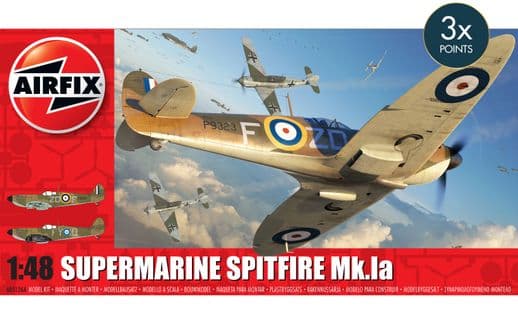
As a modelling project, the Lysander really is something a little bit different, serving as a nice distraction from the scale Spitfires and Messerschmitts which are usual fare for many of us within the modelling community. As we will be commemorating the tumultuous events of 1940 throughout this 85th Anniversary year, it’s interesting to note that whilst the more famous aircraft for both the Luftwaffe and the Royal Air Force will undoubtedly be front and centre when it comes to modelling projects over the coming months, RAF Lysander squadrons were fully committed throughout this period and it would be a nice diversion to commemorate the actions of those brave crews through our modelling exploits this year more than any other.
Whenever you decide to spend time with our new 1/48th scale Westland Lysander kit, we think you will quickly gain a real appreciation of this unusual aircraft, and perhaps look a little more deeply into the history of Westland’s Army cooperation STOL phenomenon.
We are pleased to confirm that the Lysander is now back in stock.
One thing we forgot to mention in the excitement of range launch week was the current availability of the latest edition of the Airfix catalogue. The continuation of a catalogue tradition which has been important to modellers since our first illustrated leaflets were produced over 66 years ago, our latest range includes our usual selection of expertly engineered new tooling projects, exciting new schemes for existing models and a host of returning favourites. In fact, we think our world in scale has never been so appealing!
The Airfix catalogue has served as an appealing modelling aide memoir for millions of enthusiasts over the years, not only a source of model kit information, but also including details which make the hobby more enjoyable for us all. The latest incarnation includes all the models which make up our latest collection, complete with an indication of when you might expect each release to be available.
If our recent attendance at the Bolton show is anything to go by, the annual catalogue still has a significant role to play in the hobby, but as we didn’t have any available for sale with us last weekend, we did promise to add an availability footnote to this week’s edition of Workbench. Currently, there are actually two ways with which you can get your hands on the 2025 catalogue on the Airfix website, firstly by simply taking the catalogue as a standalone purchase using this Airfix 2025 catalogue link.
In addition to this, and representing something of an unbelievable range launch bargain, we also have a web exclusive deal where for just an extra £1.00, you receive your catalogue together with a mystery kit, a great way to embark on a new year of modelling. This is just a limited availability offer and will end once either the kit/kits allocated run out, or the catalogues sell out, so this is an opportunity not to pass up. You can use this catalogue and kit bundle link to be taken straight to the webpage in question.
We are afraid that's all we have for you in this latest edition, but we will be back next Friday with more project development updates and the very latest Airfix kit exclusives. In the meantime, we are always keen to hear your views on all things Airfix and in particular, any thoughts and opinions you may have regarding our Workbench blog. If you would like to drop us a quick line, could we please ask that you use our workbench@airfix.com email for all correspondence.
To re-visit any of the Airfix blogs we have produced over the past seven years or so, please head to our main Workbench hub, where you will find our entire blog back catalogue and all the Airfix design projects we have already covered.
All our dedicated official social media sites can be accessed by clicking the respective link icons at the foot of this page, or by heading to the Airfix homepage. Other useful Airfix links are:
Facebook, YouTube, Twitter and Instagram official sites
Please join us for more Airfix updates next week and thank you for your continued support.