
Welcome to this latest edition of our Workbench blog and all the news, updates and modelling exclusives from the fascinating world of Airfix.
In this second blog posting of the week, we will be making only our second development visit to the new 1/35th scale Ferret Scout Car Mk.2 tooling project, as this really interesting new tooling advances further towards release. With the project now in the latter stages of its development, this latest update will be featuring the new box artwork produced in support of the Ferret's release, in addition to looking at the THREE scheme options which will be available with the first release from this tooling. As you will see, our researcher has tried to provide modellers with three very different Ferret schemes to mark its triumphant arrival on the modelling scene. As this is just the second time the Ferret has featured in a Workbench blog, we will begin by looking at the story behind the development and military service of the vehicle, before moving on to feature the individual vehicles which are about to be immortalised as scale plastic models, with the release of this beautiful new kit.
Before we head off onto Ferret territory, could we please just remind you that our second Gulf War RAF Buccaneer blog has also been posted this weekend, so if you fancy spending a little time with the Sky Pirates after all this Ferreting, then clicking one of the links above will take you straight to that posting.
Right then, who's up for a Ferret update?
A computer rendered image taken from the Ferret design files produced by product designer Ethan.
It seems to have been quite a while since we first introduced our new 1/35th scale Ferret Scout Car Mk.2 to our Workbench audience, but since then, it would be fair to say that this little model appears to have made quite an impression on the modelling world. Having already attended several model shows in an official capacity this year, we have been surprised at just how many people have expressed their support of the new Ferret and as a modelling subject, how they are very much looking forward to getting their hands on one. It appears that a great many modellers have come into contact with this popular and long serving military vehicle and are pleased that it has finally made it into the modelling world as a widely available, detailed and accurate representation in kit form. Indeed, when we exhibited at the recent Scottish National Scale Model Show, we even met a former soldier who has a very specific connection with the Ferret - he was run over by one! He told us that his unit was camping out on exercise and their concealment was so good that an unwary Ferret driver actually ran over his sleeping position. Thankfully, he was in a semi recessed spot, so the incident passed without him sustaining injury, and just receiving an unusual alarm call.
In our previous Ferret posting, where we introduced this exciting new project to our blog audience, we also introduced readers to Product Designer Ethan, the man who is responsible for spending many long hours at his computer ensuring that his new Ferret was designed to his own exacting standards and a kit thousands of modellers would enjoy building once it's released. This blog included details of how Ethan secured the position as an Airfix Product Designer and was lavishly illustrated with CAD imagery from across the design phase of the new Ferret project and as such, is well worth a look if you have yet to see it, or a project refresh if you already have. To save you searching through our main blog hub, you will be taken straight to that edition by clicking on this Ferret Introduction link.
Speaking to Ethan earlier this week, he informed us that he is now working on another, as yet 'Top Secret' project at the moment and how the Ferret seems to have been such a long time ago for him now. Having said that, he is delighted how the model has turned out and confirmed that we can expect to hear much more from the project in the very near future, as it heads towards the final stages of its development. He is very much looking forward to modellers having the opportunity to build the kit following its release and hopes it will bring a little AFV recognition to a vehicle which was so successful throughout its lengthy service career.
Although this colourful design image has been shown on in a Workbench blog previously, it definitely helps to increase the excitement levels as we prepare for the first release from this spectacular new tooling project.
Throughout the history of land military engagements, the ability to know where your enemy is and in what strength they are massed is vital intelligence information which not only allows appropriate actions to be taken, but can also save the lives of a great many soldiers in the process. As current conflicts have highlighted only too starkly, drone technology now plays an important role in fulfilling this essential requirement and be that by using an expensive military drone for strategic intelligence or a small, consumer device used in close contact situations, this real-time information about the enemy you are facing can prove decisive.
For these reasons, denying your enemy the ability to obtain the same information you are attempting to secure is just as important as securing your own intelligence, however, in the days before the drone, this work had to be carried out by the men of specially trained units and if they were lucky, they had access to a vehicle designed specifically to help them do their work.
A highly successful series of light armoured reconnaissance and liaison vehicles, the Ferret Scout Car saw widespread military service with British and Commonwealth forces from the early 1950s onwards, with later variants of the Ferret still being in service and taking part in the Gulf War of 1990. A vehicle type which can trace its lineage back to the successful Daimler Dingo scout car of the Second World War, the Ferret was designed very much with stealth in mind, a light and fast armoured vehicle which could probe enemy positions far in advance of their own forces, reporting their findings back to commanders, who would draw up their plans accordingly.
Small but perfectly formed, the new Ferret Scout Car is packed full of detail and is a really interesting subject - modellers are going to love it!
Weighing in at just over four tons when at operational weight, the Ferret was of all welded construction and featured armour protection capable of withstanding most small arms fire, but nothing much heavier than that, as it was never intended that the vehicle would be operating in direct opposition to heavy enemy armour. If it did find itself in a contact situation, the 4 wheel drive Ferret was powered by a reliable 4.2 litre 6 cylinder Rolls Royce in-line engine, which gave the vehicle a top speed of between 45 and 50 mph using a 5 speed pre-selector gearbox. Impressively, this unit allowed the Ferret to achieve these speeds in reverse should the situation require, something which might prove extremely useful if the crew found themselves in a tight spot when reconnoitring enemy positions.
The distinctively large 'Run Flat' tyres were actually quite an important feature of the vehicle and very much added to the survivability and operability of this extremely useful vehicle. Designed to remain inflated and fully serviceable despite sustaining quite significant damage, they were intended to allow the Ferret and its crew to get back to base, even when one or all of them had been damaged. For that reason, it's sometimes a little baffling to note that many Ferrets also carried a spare tyre, even though it was highly unlikely that it would either be needed, or indeed safe to change in a contact situation - it must have been quite heavy too. What makes this all the more surprising is the fact that fitting the spare wheel to the hull of the vehicle actually blocked one of the crew emergency escape hatches, placing even more emphasis on its ability to use speed and stealth to extricate itself from a contact situation.
These impressive tyres certainly helped to make the Ferret the overwhelming success that it was, allowing the vehicle to operate over virtually any terrain, something which must have been a prominent feature of the Ferret's initial design brief. With military operations being as much about towns and cities as it is open countryside, the high speed performance of the Ferret could be brought to bear in a wide variety of operational situations, something which would ensure its service longevity. Just as much at home patrolling the streets of Belfast as it was looking for enemy positions from a concealed hedgerow position, the Ferret could be used on traditional roads just like a normal car/truck, where heavier tracked vehicles would undoubtedly cause damage to such surfaces.
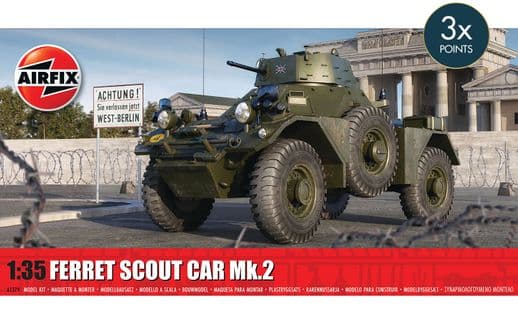
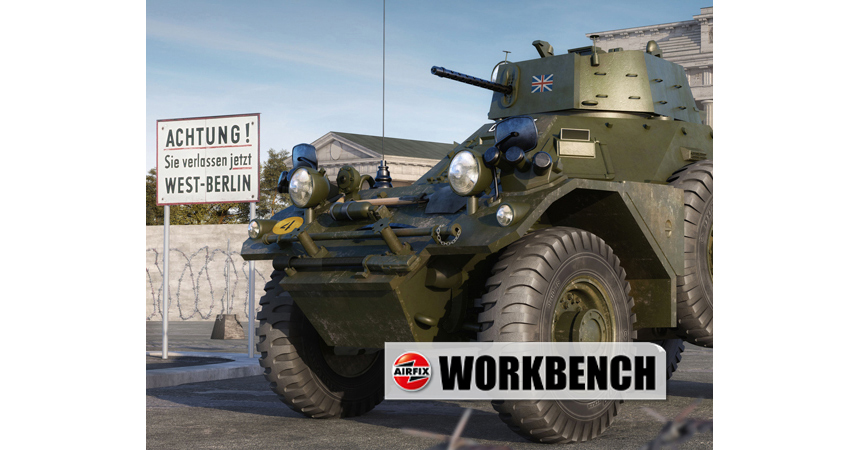
This stunning new artwork features a Ferret which served with the British Army in Berlin during the historic erection of the Berlin Wall.
The general usability of the vehicle is perhaps one of the reasons why the Ferret has now become so popular with enthusiasts who not only restore the vehicles to their former glory, but also use them regularly at events and military vehicle parades, with the ferret effectively driving like a car on our normal roads, but with much more attitude. There is nothing like pointing that deactivated 30 cal Browning machine gun at a car blocking your way to encourage them to move.
From a British Army perspective, these vehicles saw widespread service from the early 1950s onwards and they loved them. Performing many high profile military policing and control roles, the Ferret also acted as an effective deterrent against possible trouble and if one was called to respond to an incident, you knew one would be there in short order, due to its impressive performance. The Army worked their Ferret crews hard and through the effectiveness of their constant training, were proud to proclaim their Ferrets to be arguably the most effective armoured scout cars in the world.
Found across the world wherever British forces were deployed, it is thought that during the late 1950s and throughout the 1960s, around 2000 of these vehicles (in various marks and configurations) were in service and due to the role they performed, were amongst the most visible military vehicles operated by the British Army. Also used extensively by Commonwealth forces, the Ferret would also find favour with many overseas armed forces and it's thought that many could still be in use to this day. During a lengthy service career, Ferrets would be involved in many wars, rebellion and civil unrest situations across the world.
A robust and rugged little vehicle, the Ferret will be a welcome addition to the Airfix 1/35th scale Military Vehicle range and if our event attendance experiences are anything to go by, a great many Workbench readers will be looking forward to getting their hands on one. Let's take a closer look at the three scheme options which will be included with the inaugural release of this new kit.
Scheme A - FV 701(C) Ferret Armoured Car, West Germany, August 1961.
Despite sporting armour, the Ferret was never intended to be placed in a position where it would have to face enemy heavy armour and instead relied on its low profile, speed and stealth in order to make contact with enemy units, some of which may be engaged in a similar reconnaissance role. Creeping into contested territory, the Ferret was built for sniffing out the enemy, but not to actually cause trouble directly in an offensive sense. Their role was to send real-time radio reports back to HQ, and should their scouting take them out of radio range, a second HQ Ferret would be sent to a position between them and command headquarters, so it could receive and relay messages. The Ferret was tasked with providing senior planners with a picture of enemy activities and therefore, helping to direct any impending offensive actions.
If detected, the crew could extricate themselves from any combat situation at high speed and as long as they were only targeted by small arms and light machine gun fire, they would have adequate protection until the driver could get them out of harms way and speeding back towards friendly lines.
In operation, the Ferret was quite the capable performer, sporting a five-speed pre-selector gearbox which was accessed using a simple two position drive lever, enabling the Ferret to travel as fast in reverse as it could going forward. The independent suspension units employed were robust and capable, allowing for a very pleasant ride, even at high speed and over all but the roughest of terrains. Even though the steering system did not feature power assist, it was light and responsive, all leading to a vehicle with impressive operational performance.
The early 1960s were a time of great tension for British Army units stationed in Germany. During the early hours of 13th August 1961, senior military commanders started to receive reports of unusual activity along the border between East and West Berlin, which appeared to be being blocked off by Soviet troops. All surrounding roads were clogged with hundreds of military vehicles and a heightened military presence was joined by what appeared to be construction vehicles and lorries carrying building materials and barbed wire.
A schoolboy's dream, could anyone other than German youngster Erwin Schabe claim to have had a British Army Ferret accompany them on their journey to school?
What they were witnessing was the early stages of the construction of the Berlin Wall, a symbolic divide between East and West, but for those living through those volatile times, a frightening development for a capital city which was still recovering from the horrors of the Second World War. The wall would become a physical symbol of international mistrust and military posturing, at a time when the Cold War had already been descending to dangerously towards conflict. For ordinary Berliners, this was further confirmation that they were under occupation, with everyday journeys thousands of people made now becoming impossible - how long would this barrier last?
Highlighting the very real impact this situation had on ordinary people, schoolboy Erwin Schabe immediately found his daily journey to school much more difficult following this development. Living in a little village which skirted the contested territory, he would usually cycle four miles down a narrow country track each day to school, however, the new wall and increased security patrols saw him being bothered by East German police both on the way there and when coming back home.
On describing the situation to his parents, official protestations were made, which resulted in immediate action and a somewhat unlikely outcome. The British Army sent a Ferret Scout Car to escort Erwin to school, with his new armoured friends ensuring that the harassment at the hands of the East German border police immediately ceased, with Erwin left to go about his daily business in peace. There are a number of truly fascinating official images which prove the authenticity of this story, with Erwin and his bicycle pictured on the country track, with Ferret 02DA63 (the one depicted in this scheme) behind him, making up this unlikely school convoy.
Although there wasn't too much free space inside a Ferret, when it came to the driver’s field of view, this was excellent in most operating environments. This view was the result of several armoured hatches which would normally be left in an open position and offered an excellent view from all angles, even sporting rear armoured panels which could be opened when reversing. Should the Ferret come under fire, the hatches would be closed and the driver would revert to a periscope/episcope unit for his driving view, with the vehicle featuring three such units, with a fourth usually carried internally as a spare, in case of damage.
The Ferret could also boast excellent water fording capabilities, even though it was not exactly waterproof, with all automotive and electrical equipment protected against the ingress of water. In fact, it was thought that the vehicle would keep on going even when the crew had been forced to abandon the vehicle due to the sheer height of the water pouring into the interior of the vehicle.
Each Ferret carried a host of internal equipment and therefore, the interior was rather a cramped working environment. In normal operation, the commander would sit half out of the vehicle, just to make travel a little more comfortable, but as they approached contested areas, it would be back inside, with all hatches battened down. The Mk.1 Ferret typically had a crew of three, whilst later marks sacrificed the radio operator and would usually be operated by just the driver and his commander.
Over 4400 Ferrets were built during the ten years from 1952 and they would see extensive service with British forces across the world, in addition to those of many overseas nations. You could always be sure of spotting a Ferret or two in many of the world's hotspots during the post war years and hundreds are still in service across Africa, the Far East and the Pacific region to this day.
Wearing quite distinctive markings, this Ferret served at the British Army Training Unit Suffield in Canada, where troops were able to train at a battlegroup on an area twice the size of the Isle of Wight.
On the wide expanses of a prairie in Alberta, Canada, the British Army has been conducting large scale training and military manoeuvres since 1972, an area which is twice the size of the Isle of Wight and so sparsely populated that it's ideal for live firing and complex combat simulations. The British Army Training Unit Suffield is an important location for the modern British Army and is home to around 400 permanent staff, 1400 soldiers in training and a great many local people who all help to keep the base running smoothly. Of even greater importance, BATUS is home to Challenger 2 tanks and Warrior infantry fighting vehicles, in numbers which constitute an entire battle group and therefore allowing training activities of this magnitude to be undertaken.
Over the years, well over one hundred thousand British Army personnel have spent time training at this impressive facility, which is used to provide the most complex testing and training exercises a British soldier can experience, with live firing and battlegroup scale scenarios providing them with the knowledge and experiences to prepare them for war. In a changing world, the role of the Army has to be flexible enough to cope with the demands placed upon it, both traditional and contemporary, with this facility undoubtedly providing troops with as real a combat situation as they are likely to experience, other than actually being in a war zone.
This particular Ferret was one of many which had been based at the BATUS facility in Canada over the years and is unusually presented with distinctive markings to its sides and turret, presumably to provide this stealthy vehicle with an additional means of identification whilst on the live firing ranges. As we have already seen, the Ferret may be capable of withstanding small arms fire, however, it would not be the place to be if it was inadvertently targeted by a tank or anti-tank gun unit.
Without doubt, the most distinctive option of the three schemes included with the first release of the new Ferret is this vehicle, one which served in a UN peacekeeping capacity on the Island of Cyprus during 1974. Following the establishment of the Republic of Cyprus in 1960, Britain negotiated an agreement whereby they were allowed to retain a number of strategic sites on the island, including two airfields and approximately forty other sites, ranging from radar stations to service living quarters.
Over the next few years, an uneasy peace descended on the Island, however, it always harboured the potential for violence, with Greek and Turkish communities often disagreeing on the future of an independent Cyprus. An upsurge in violence during the 1970s led to a Turkish invasion on the north of the Island, with territorial gains being held by Turkish forces, forming a division across the country. A negotiated settlement to the conflict was secured, with a United Nations peacekeeping force establishing a demilitarised zone between the Turkish Cypriots in the north and the mainly Greek population in the south. An agreement amongst UN member nations to provide both funding and a commitment to provide manpower and equipment to effectively police the UN Buffer Zone was reached in 1974 and the Island once again returned to an uneasy and now physically peace.
Surely the most distinctive scheme of the three included with this new kit, this Ferret was engaged in providing high profile UN peacekeeping duties in the demilitarised zone which divides the Island of Cyprus.
Along with the forces of other member states of the United Nations, British troops were sent on UN detachment to Cyprus on six monthly tours, operating autonomously of other British forces on the Island whist performing their UN duties and fully adopting the role of UN peacekeepers. Wearing the famous blue beret of the UN peacekeepers, vehicles such as this Ferret Scout Car would be given a liberal coat of white paint when in this role, just as a clear visual indication of their peacekeeping intentions and how they were not affiliated to one side of the island or the other. A reassuring presence in this troubled Island, serving as a UN Peacekeeper is something most service personnel are proud to have on their record.
This rather distinctive Ferret benefitted from the application of a coat of white paint in advance of performing its UN peacekeeping duties, even though this seems to have only been to the upper surfaces - much of the undersides, wheel wells and wheel hubs have retained their British Army green colour. The turret also proudly displays the marking of the Parachute Regiment, with the UN logo also carried in several positions. Presumably, the white paint would have helped the driver in particular cope with the heat much more pleasantly, as the vehicle was operating in the heat of the eastern Mediterranean sun.
A future release of note, many people are very much looking forward to getting their hands on one of our new 1/35th scale Ferret Scout Car kits.
The new Ferret is a delightful little kit and we can't wait to bring you pictures of the build sample models we have under construction at the moment, which will hopefully be in just a few weeks’ time. We know that many readers are looking forward to adding a Ferret to their build schedules, so we promise to bring you all the latest updates from the project just as soon as they become available. At the moment, we are looking at an early September release for this kit, however, this may change, but we will bring you a confirmed release date when we have it. For now though, we hope this second project update has managed to keep your Ferret interest simmering and will leave you with the challenge of deciding which scheme you intend to finish your model in.
Please don't forget that we have posted TWO blog updates this week and if you would like to do a little Gulf War Buccaneering this weekend, this link will take you straight to that edition.
We are afraid that's all we have for you in this latest edition, but we will be back next Friday with more project development updates and the very latest Airfix kit exclusives. In the meantime, we are always keen to hear your views on all things Airfix and in particular, any thoughts and opinions you may have regarding our Workbench blog. If you would like to drop us a quick line, could we please ask that you use our workbench@airfix.com email for all correspondence.
To re-visit any of the Airfix blogs we have produced over the past seven years or so, please head to our main Workbench hub, where you will find our entire blog back catalogue and all the Airfix design projects we have already covered.
All our dedicated official social media sites can be accessed by clicking the respective link icons at the foot of this page, or by heading to the Airfix homepage. Other useful Airfix links are:
Facebook, YouTube, Twitter and Instagram official sites
Please join us for more Airfix updates next week and thank you for your continued support.