

Welcome to this latest edition of our Workbench blog and all the news, updates and modelling exclusives from the fascinating world of Airfix.
As we still find ourselves in catch-up mode when it comes to blog update subject matter, we are once again looking at a double posting Workbench weekend, with iconic single engined fighter aircraft of the Second World War being the focus of our attentions this time. Always amongst the most popular subjects in any Airfix model range, our first port of call this weekend is our latest 1/72nd scale tribute to a true aviation legend, an aircraft which only made its combat introduction in December 1943 (Merlin engined variant), but would go on to be regarded as one of the finest fighting aeroplanes in the history of warfare, the magnificent North American Mustang. As we welcome this new kit to the 2023 range, we will see how this release highlights the valuable contribution Mustang pilots made in attacking Luftwaffe airfields throughout 1944, claiming as many aircraft destroyed on the ground as they did in the air. If the Luftwaffe wouldn't come up to fight, they went to find the Luftwaffe.
Our second subject for the week has been posted separately, as is now traditional and features an even more famous icon of the air that the Mustang, Britain's very own Spitfire. Looking forward to the impending release of our latest 1/72nd scale Supermarine Spitfire Mk.Vc kit, we will see why this particular model offers something just that little bit different for the modeller and two fantastic scheme options which would provide any Spitfire model display an appealing Supermarine focal point. If you like your Spitfires a little different, then this could be the kit for you.
If Mustangs and Spitfires are our blog update subjects in any given week, you know you're in for a classic Workbench weekend and that's exactly what we have in store for you this time. As always, our main Workbench hub is the main access point for these and all previous editions of our blog.
The unmistakably clean lines of the North American P-51D Mustang, one of the premier fighting aeroplanes of the Second World War. It's astonishing to think that the story of this aircraft begins with a British request for North American to produce Curtiss P-40 fighters for them under licence. This is a computer rendered image taken from a larger scale Airfix Mustang design project.
As arguably one of the most popular modelling subjects in the history of our hobby, the North American Mustang has become familiar to many millions of people over the past eighty years or so, even though this knowledge may have been gained in the main by reading the supporting information supplied with various model kits, or by conducting a little additional research having been captivated by the artwork gracing the packaging of your kit. As such, most Workbench readers will probably be all too familiar with the details behind the development of the Mustang and how this American aviation classic owes much to Britain and their desperate need for aircraft during the Second World War.
With America crucially allowing Britain to place orders for US built fighters during the early stages of WWII, even though America was itself not yet at war, the British Purchasing Commission were looking to place an order for Curtiss P-40 fighters, however, as Curtiss were already working at maximum capacity, new manufacturer North American Aviation were approached to fulfil the order. In a bold move for a company which had never previously built fighter aircraft, let alone design one from scratch, North American said they could build a new aircraft which was superior to the P-40 and far more suitable for Britain's requirements.
Incredibly, the British accepted the proposal, even though this move probably highlighted the depth of their wartime predicament, rather than having their judgement clouded by North American's boast. Nevertheless, their faith was justified and the rest, as they say, is the stuff of aviation legend. In what proved to be one of the most impressive design and engineering feats of the 20th century, what the inexperienced team at North American managed to achieve in a relatively short period of time was nothing short of astonishing. With their new aircraft designed to incorporate many highly advanced new features and utilising the very latest manufacturing techniques during production, their prototype aircraft (NA-73X) was rolled out on 9th September 1940, only 120 days after the production contract had been signed.
The first flight of the new fighter took place 47 days later and other than the usual issues associated with the first flight of a new aircraft type, it immediately showed great promise and was clear vindication of the confidence North American Aviation had in their design capabilities. Rather than this being a stopgap first attempt at producing a fighter aircraft in record time, what they had actually produced was a thoroughbred aeroplane, one which would end up being a war winner, although clearly they didn't know that at the time.
European Combat debut for the new Mustang
The first RAF Mustangs which entered service in early 1942 looked quite different from this fighting thoroughbred we have all come to know so well. Anther computer rendered image produced from Airfix Mustang design files.
The Royal Air Force would subsequently give the Mustang its combat debut in the European theatre, with the first aircraft arriving in the UK in October 1941 and after work up, seeing operational service from early the following year. These first machines were powered by the tried and trusted Allison V-1710 V-12 liquid cooled engine and whilst perfectly adequate, the lack of a supercharger did restrict its overall performance. Whilst the Mustang found plenty of roles to perform, these were usually at lower altitudes and not as a fighter, however, pilots loved the aircraft and just had a feeling that it was capable of much more.
When it came to the Mustang, everything always seemed to have happen quickly and that certainly proved to be the case when it came to unlocking its true potential. The excellent handling qualities of the aircraft, but disappointing performance of its Allison engine soon caused pilots to lament the fact that the Mustang didn't have a Rolls Royce Merlin engine, and once a Rolls Royce test pilot had the chance to fly the aircraft, technological wheels were set in motion.
In August 1942, the Mustang X program saw several Mustang airframes experimentally fitted with Rolls Royce Merlin 61 two speed, two stage supercharged engines and the results were nothing short of spectacular. This combination propelled the Mustang to an impressive 441mph at 29,800ft, a speed which was approximately 100mph faster than the Allison powered Mustang I at the same altitude, a truly startling development. The Mustang had just come of age!
With Rolls Royce produced Merlin engines being in such short supply, the Packard Motor Car Company would actually produce the engines for the next variant of the Mustang under licence in the US, with aircraft build at Inglewood, California carrying the designation North American P-51B, whilst those manufactured in Dallas were identified as P-51C Mustangs. The combination of the Mustang's advanced laminar flow airframe and the Packard Merlin engine transformed this promising aircraft into a world-beating fighter, one which was to have a dramatic impact on the course of the Second World War.
The new Merlin powered P-51B Mustang entered service in the European theatre from December 1943 and immediately presented Allied commanders with an aircraft with which to clear the skies of Luftwaffe aircraft in advance of the proposed Normandy landings. Equipped with new lightweight external drop tanks, USAAF daylight bombing raids could now be supported by fighter protection all the way to their targets and should the Luftwaffe put in an appearance, Mustang pilots were only too happy to show them what their impressive fighter could do. The European air war had shifted significantly in favour of the Allies.
The beautiful image artwork produced in support of this latest P-51D Mustang kit release.
For an aircraft possessing the illustrious pedigree of the North American Mustang, it will come as no surprise to Workbench readers to hear that the Mustang has been part of the Airfix range since 1958 and is therefore amongst the first aircraft model kits introduced to our famous brand. Millions of Airfix Mustang kits have been produced since that date, with the original P-51D tooling being replaced by a new design in 1974 and again with another in 2012, so important to the range was this iconic fighter. The P-51D was joined by the first Merlin powered variant of the fighter, the P-51B, in 1978, but as yet, the 'razorback' Mustang has not benefitted from tooling upgrade - is this something which needs addressing in the not too distant future?
As you can see from the details above, the P-51D Mustang has benefitted from three separate Airfix new tooling design projects over the years and that's just in the hobby standard 1/72nd scale. The Mustang has also appeared in 1/48th and 1/24th scales over the years, with the enduring popularity of the aircraft ensuring that it must always remain on the table as a potential new tooling subject awaiting the attention of one of our design team.
The Mustang model kit we are featuring here is the latest P-51D release from our most recent tooling of the fighter in 1/72nd scale and it presents the aircraft in arguably its ultimate incarnation, the variant of the Mustang which finally hammered home Allied superiority in European skies during the final months of the Second World War.
Despite the fact that USAAF Merlin powered Mustang fighters only made their ETO combat debut at the end of 1943, constant development of the aircraft and a desire to produce the best fighting aeroplane of the war by listening to the combat experiences of pilots in the field quickly led to the introduction of arguably the definitive variant of the Mustang, the P-51D. Working closely with combat units and listening to the combat experiences of pilots flying the existing B/C variant, the already impressive credentials of the Mustang were further refined in an attempt to hammer home its superiority in European skies. One of the main concerns pilots had related to the relatively poor field of view from the framed canopy of the first aircraft and as any fighter pilot will tell you, in combat, vision is everything.
Recent advancements in moulding technologies allowed a single piece 'blown' teardrop canopy to be manufactured, one which greatly enhanced the pilot's field of view from the Mustang. The design of the fighter was modified behind the cockpit to allow the new canopy to sit high on the fuselage, with this modification incorporated into all the new D and K model Mustangs manufactured from 1944 onwards. Introducing a host of additional improvements, this ultimate Mustang also featured a modified wing, increased armament and the continued development of lightweight external fuel tanks, something which would further extend the operational range of this magnificent aircraft, and much to the dismay of the Luftwaffe.
Once again, production of this latest variant of Mustang was split between the two existing manufacturing plants at Inglewood and Dallas, although this time all aircraft manufactured would retain the same ‘D’ nomenclature. The only sub-variant of this 'Bubbletop' Mustang were aircraft equipped with a different propeller, due to the preferred Hamilton Standard unit being in such short supply. Mustangs fitted with the slightly smaller Aeroproducts propeller were referred to as P-51Ks.
Incredibly, the P-51D Mustang was in combat service for just about twelve months before the end of the war in Europe, something which dictated that its post war service career would be longer than its wartime career, ruling the skies until this responsibility was passed to the first jet powered types to enter service.
Full scheme details for North American P-51D Mustang 44-72437 'Pauline', the mount of Lieutenant Colonel Joseph L. Thury of the 505th Fighter Squadron.
The scheme included with this latest Mustang kit release is the handsome P-51D which was the personal mount of ace USAAF pilot Lieutenant Colonel Joseph L. Thury of the 505th Fighter Squadron during the late summer of 1944. A native of St Paul Minnesota, Thury began his flying career when accepting a place on a cadet training course in June 1941. Qualifying by February the following year, he was assigned to various units in the US, before eventually joining the 505th Fighter Squadron, of the 339th Fighter Group in August 1943.
The 339th FG were sent to fight in the European air war in early 1944, arriving at Station 378, the former RAF Fowlmere on 4th April 1944, with the distinctive red and white chequerboard noses of their fighters helping to identify them to other friendly USAAF units. The airfield at Fowlmere was the satellite airfield for RAF Duxford and during the Battle of Britain, a series of famous pictures showing RAF pilots enduring what appeared to be rather basic facilities at Manor Farm helped to create the legend of the 'Few' and how nothing could deter them from stopping the Luftwaffe from taking control of Britain's skies.
By the time the USAAF took up residency at Fowlmere, the airfield had expanded to accommodate an entire fighter group and was much more appropriate for the significant job at hand. From August of 1944, Joe Thury had been given command of the 505th Fighter Squadron and led his squadron in a hectic period of fighting in preparation for D-Day.
An aviation thing of beauty. Despite its relatively short wartime service, the Mustang would earn a reputation for ruthless effectiveness and is regarded as one of the finest fighting aeroplanes to ever take to the skies.
'Operation Jackpot II' was the Allied designation for a coordinated plan to mount powerful tactical air sweeps over German occupied northern France from 15th April 1944 onwards, in a concerted effort to reduce the fighting capacity of the Luftwaffe in advance of the D-Day landings. These sweeps didn't differentiate in the manner in which Luftwaffe aircraft were destroyed, only that this task be achieved with ruthless effectiveness. To this end, certain units began to develop specific tactics to target enemy aircraft at their home airfields, not even allowing their pilots to get in the air and pose a combat threat.
Arguably, these missions were even more dangerous than engaging in aerial combat, with these low level sorties exposing pilots and aircraft to the fearsome network of airfield anti-aircraft batteries Luftwaffe bases had prepared for them, with no end of small arms fire and ground obstacles all posing serious threats to their safety. Nevertheless, these Jackpot missions were vital to the success of D-Day and would take a heavy toll of existing and replacement Luftwaffe aircraft.
The 505th Fighter Squadron would become a specialist unit engaged in these airfield strafing operations, with its pilots destroying twice as many Luftwaffe aircraft on the ground as they did in the air. Joe Thury and his Mustang 'Pauline' would prove to be particularly successful in gaining air to ground victories, with his tally of 25.5 aircraft destroyed marking him as the second most successful strafer in the Eighth Air Force, only 1.5 victories behind the 55th Fighter Group's Elwyn Righetti, who took the top honour.
Lieutenant Colonel Joseph L. Thury would survive the war with 25.5 ground victories and a further 4 aerial combat victories to his name, with two of these victories shared with other 339th Fighter Group pilots. North American P-51D Mustang 44-72437 'Pauline' would be lost on operations on 17th January 1945, whilst the fighter was being flown by another USAAF pilot.
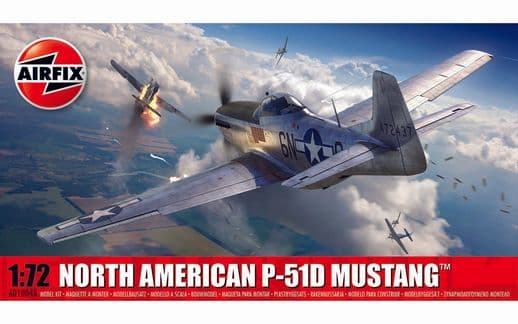
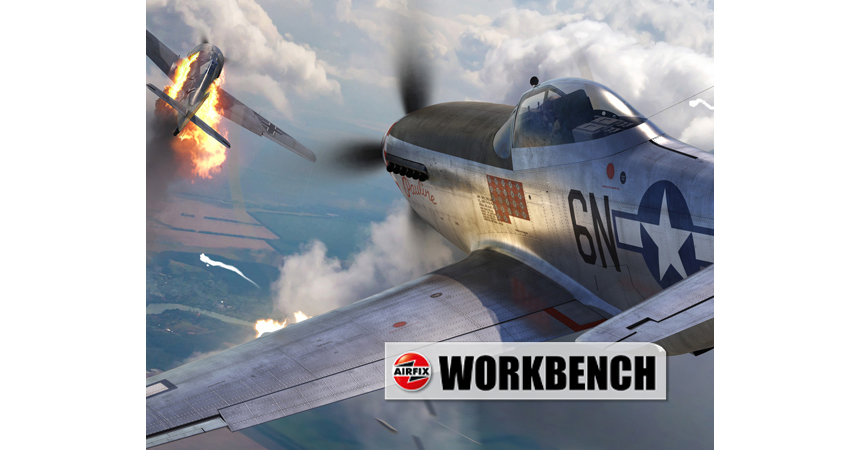
Full box artwork presentation which identifies this as the latest Airfix P-51D Mustang release.
Although the enthralling box artwork shows this Mustang in the process of securing one of its aerial victories, this fantastic release helps to tell the story of the airfield strafers of the late Second World War and how their contribution was no less significant than the air aces who have historically commanded the attention of so many historians and modellers alike over the years.
A01004B - 1/72nd scale North American P-51D Mustang 44-72437 'Pauline' is available now.
We are afraid that's all we have for you in this latest edition, but we will be back next Friday with more project development updates and the very latest Airfix kit exclusives. In the meantime, we are always keen to hear your views on all things Airfix and in particular, any thoughts and opinions you may have regarding our Workbench blog. If you would like to drop us a quick line, could we please ask that you use our workbench@airfix.com email for all correspondence.
To re-visit any of the Airfix blogs we have produced over the past seven years or so, please head to our main Workbench hub, where you will find our entire blog back catalogue and all the Airfix design projects we have already covered.
All our dedicated official social media sites can be accessed by clicking the respective link icons at the foot of this page, or by heading to the Airfix homepage. Other useful Airfix links are:
Facebook, YouTube, Twitter and Instagram official sites
Please join us for more Airfix updates next week and thank you for your continued support.