
Welcome to this latest edition of our Workbench blog and all the news, updates and modelling exclusives from the fascinating world of Airfix.
Now a major product line within the wider Airfix portfolio of kits, our ever-expanding range of Quickbuild models benefit from the same expert design techniques and manufacturing advances that our more traditional kits have always relied on, but in many ways, can actually be more challenging and time consuming to bring to market. In this latest edition of Workbench, we will be going behind the scenes of two new Quickbuild projects with our product designer Adam French, as he allows us into his world and guides us through some of the finer points of designing a new Quickbuild kit. Using two recently released Jeep models as his subjects, we will be looking at how he managed to add the rugged Jeep Gladiator Overland and exciting Jeep Quicksand Concept to the Quickbuild range - we will also be able to call upon the support of an impressive selection of CAD imagery to help illustrate all the points he will be making.
We can sometimes be guilty of overlooking the Quickbuild range here on Workbench, as our usual model kit development update schedule is so hectic to negotiate each year, however, these really are impressive little kits and thanks to Adam's expert input, we intend to do our level best to change that right now. A product range which really does come into its own at this time of year with Christmas fast approaching, we will be seeing why Quickbuild models really are the model gifts that just keep on giving.
Although building into an attractive display model, a Quickbuild kit is a brick based, no glue construction model at heart.
If we were to take a straw poll of Workbench readers, it would be interesting to find out how many have actually come across one of our Quickbuild models and if so, what they thought of them, not just being aware of their existence, but actually getting stuck into building one. A continually growing range of kits which may not exactly be the usual construction fare for most modelling enthusiasts, these models are still designed to produce accurate and appealing representations of the machines on which they are based, but employ a very different method of construction to the one we are used to. The brick build, snap-together construction method these models employ may suggest that they are aimed at younger modellers, particularly as an extremely pleasing model can be made without the need to use glue or paint, however, it is clear that these fantastic models have a much wider appeal than that.
As most people's Christmas planning is now well underway, this tends to be the time of year when Quickbuild models find their way into thousands of homes, making for ideal stocking filler gifts and ensuring hours of construction fun over the festive period. If you are invited to take part in a family Christmas Quickbuild challenge, please do take a little time to inspect the model a little more closely when all the fun has calmed down a little, to see just how the models have been designed and how much thought has gone into them - they really are rather impressive.
It is interesting to discover that designing a new Quickbuild model kit can actually be more challenging than working on what most of us would consider to be a more traditional Airfix model kit and for the designer responsible for the project, there are several very different considerations they have to bear in mind when embarking on such a project. Clearly, as these models are intended for younger, more enthusiastic hands, they have to be robust enough to withstand some rough treatment, go together intuitively and once constructed, be strong enough to cope with the rigors of some serious playtime. With paint and glue not required, the designer has to make use of different coloured plastic to both add to the visual appeal of the kit and to make sure the finished model looks like a real model and not a brick built toy. When you consider that he also has to design clear parts and rubber tyres, these really are rather impressive little model projects.
As a consequence of this, the tooling moulds themselves can be extremely complicated to produce and often incorporate additional tooling ‘side actions’ to create all the individual parts required for a Quickbuild kit. This can also mean that tooling costs associated with these models can often end up being much higher than with a traditional Airfix kit, which leaves the designer with little room for error or delays. This is mainly down to the fact that most Quickbuild kits will usually require four or five separate moulds to be manufactured, because each different colour of plastic used, in addition to the clear parts, will all require the production of separate tooling moulds, which will all need designing, checking and manufacturing. We don't ask much of our designers, do we!
Taking the two new Jeep models as our subjects, a Quickbuild design takes the iconic subject vehicle on which it is based, before working inwardly to cleverly ensure it breaks down into a kit of parts which assemble securely into a push fit, no glue model construction kit.
Two Jeeps for the price of one, we will be hearing how the Quicksand Concept provided more than a few headaches for designer Adam.
From a historical perspective, the Quickbuild range of models first appeared back in 2013 and the subjects selected to announce the arrival of these models were a Supermarine Spitfire and a Messerschmitt Bf 109E, two of the world’s most iconic fighter aircraft of the Second World War. From those humble beginnings, the range has gone from strength to strength, adding new models with almost every annual range announcement, to a point where is can now boast an impressive selection of cars, with both classic and contemporary 'Super Car' receiving the Quickbuild treatment, in addition to a selection of vans and utility vehicles, aeroplanes, helicopters and tanks. In fact, with the finished models being impressively accurate representations of the machines on which they are based, there are now enough kits in this range to allow anyone to create a colourful model display in its own right, one which you can take apart and re-assemble many times, as and when the mood takes you.
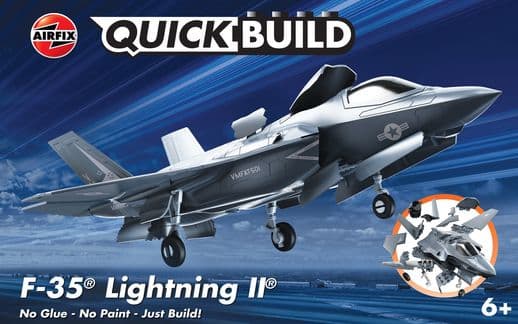
The range has benefited from the addition of several new models over the past couple years, with car subjects receiving the most design investment support, but with the impressive F-35 Lightning II also swooping in and proving to be one of the most popular models the Quickbuild range has ever known. That range support continued only recently, with the release of two new Jeep vehicle subjects, one a rugged, go anywhere utility vehicle, with the other being an exciting hot rod of a concept vehicle, but both incorporating all the latest design and manufacturing advances this range can now call upon. With the Christmas gifting period traditionally being the time when many people first come into contact with one of our Quickbuild kits, we thought it might be a good idea to pay a timely re-visit to this range by welcoming the two new Jeep kits to the range with a full designer interview and to ask a few searching questions about what it takes to get one of these unique kits into production.
Colourful and distinctive, with a Quickbuild kit, you are guaranteed hours of modelling fun.
Workbench regulars will no doubt recall reading several previous blogs which featured the work of designer Adam French and how he has been instrumental in designing many of the impressive new kits which have swollen the ranks of the Quickbuild range over the past few years, and we are delighted to say he has been at it again. It's always a delight speaking to Adam about his work, not just because he is so unselfish in giving us some of his valuable time, but also because he is so passionate about the Quickbuild range and how he is continually looking to use the latest industry developments to make the models ever more accurate when finished, but always being fun and enjoyable to build. Adam isn't exclusively Quickbuild and there have been some exciting project career developments for him in recent times, however, these projects are still very much under wraps at present, so we're going to have to wait a while before we can speak to him about those.
Before we started speaking to Adam about his recent dual Jeep Quickbuild project, we have to admit that we were thinking that the longer, more challenging project for him would have been the large and impressive Jeep Gladiator Overland model, as this was significantly larger than the more diminutive Quicksand Concept, but we couldn't have got that assumption more wrong. Nevertheless, we will take our look at both projects in that order, starting with the Gladiator Overland first.
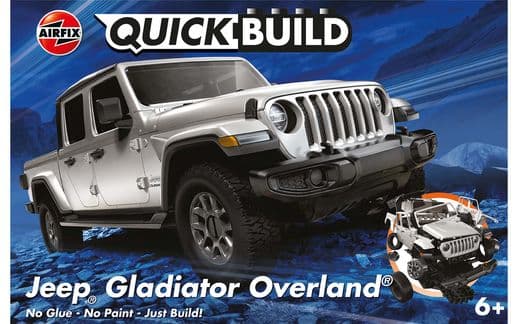
Box artwork featuring the new Jeep Gladiator Overland.
When looking at the sheer size of the muscular Jeep Gladiator Overland, we automatically assumed that Adam would have had his work cut out right from the start in designing his Quickbuild kit representation of this off road monster, however, this proved to be wrong on two significant fronts. Firstly, Adam told us that the Jeep company proved to be incredibly helpful throughout the entire project and right at the outset, supplied him with extensive CAD data files, which he was able to fully utilise during the early design phase of this new kit. Secondly, and perhaps even more importantly, Adam and the Airfix team had recent experience in designing just this type of vehicle, as the Ford F-150 Raptor which joined the range back in 2020 acted as something of a design blueprint for him. Although the two vehicles were clearly quite different and are produced by completely different motor manufacturers, from a product design perspective, the two share so many similarities that the Raptor actually acted as something of a Jeep Gladiator Overland design template.
With the experience gained whilst designing the Ford Raptor, Adam already knew that the new Jeep Overland would be using a similar layout, structure and build sequence as the earlier project did, something which made the initial stages of design and research quite trouble free. Adam went on to describe how when faced with embarking on a new Quickbuild project, there are two major considerations a product designer has to overcome. Firstly, even though these kits don't require the use of glue or paint in their construction, when it has been fully built, it has to look like an accurate and extremely appealing representation of the car, utility vehicle or aircraft on which it is based and at no point will a caricature representation be acceptable. Although supplied in kit form, these models will rarely be kept in this state and once constructed, even if disassembled in future for more building fun, they are usually kept in a fully assembled state as part of a model collection.
A thing of motoring beauty, the CAD files Adam had to work with reproduced the iconic lines of the Gladiator Overland - all he had to do now was to break this down into a Quickbuild classic, a model which was of robust, intuitive construction, but one that looked like this when fully assembled.
Secondly, and of equal importance, as these kits are destined to be played with by a particularly demanding section of our modelling audience, inherent strength of the overall design is absolutely essential, with the model needing to withstand multiple construction and disassembly of the model and the owner enjoying many hours of playing fun once the kit has been assembled. With these parameters accepted as design requirements, the kit could actually be described as being designed from the outer appearance inwards, with the split of parts and work around material thicknesses all now becoming the major challenges facing the product designer.
As a Quickbuild subject, the Jeep Gladiator Overland is a particularly appealing one for this range, a vehicle which possesses all the qualities which have made Jeep such a household name across the world, but one which promises the motoring enthusiasts the best of all worlds. Historically renowned for producing rugged, no nonsense off road vehicles that can tackle all manner of terrain with a minimum of maintenance fuss, this particular Jeep possesses all that impressive heritage, but once you have negotiated its purposeful exterior, there is something a little bit different inside. Although the type of vehicle you would choose if you have a hard day's work ahead, or a hectic day of adventure to look forward to, surely you would want to set about your day in a certain level of style and comfort. Stout of heart and ready to take on anything, the Jeep Overland does not compromise when it comes to the cabin experience, something which makes this an adventure vehicle that can be used every day and for every occasion.
If the exterior features and options available to a potential Jeep Gladiator Overland owner are a little bewildering at first, they shouldn't expect these decisions to be any easier when it comes to the internal spec, because even though you might not expect a vehicle of this kind to offer such a list of internal equipment options, it can be configured to be as sumptuous as any high end luxury saloon. The big difference is that no family saloon could ever dream of doing things that this combative beast of a vehicle can do as standard, at least not if it hopes to escape the experience unscathed. This is a machine which is bred for adventure or one to be used by people who live and work off the beaten track.
Having now gained plenty of experience in designing these models which use a brick based method of construction, Adam likes to challenge himself on every new design project, using all the latest advancements available to him in design and manufacture, whilst at the same time always looking innovate and improve the modeller build experience. One of the main challenges he faces concerns the thickness of the material used to produce the parts, how securely each individual part locates in position and how it connects with those surrounding it. From the perspective of someone building the kit, this part identification and ease of construction has to inspire great confidence, as this will ensure the entire process is an enjoyable and trouble free one, whilst at the same time showing the Quickbuild range in a good light - if you enjoy the experience, Airfix definitely want you to come back for more.
What Quickbuild is all about, this fascinating selection of images show how Adam slowly built up his design with all the required features, but using the classic push fit brick style construction method these models are famous for.
As we have already seen, Quickbuild models employ the use of different coloured plastics to represent component details and to remove the need to paint the finished model. Each different plastic colour used requires the production of a new tooling block, something which can make these models incredibly expensive to bring to market and challenging for the designer to negotiate. Clearly, our design managers will be keen to keep development costs to a minimum, which means that the designer on a Quickbuild project has to be clever when designing the model, using innovation and intelligent design splits to ensure the model looks good, whilst at the same time keeping colours used and therefore tooling costs to a sensible level.
At this point, we wanted to ask Adam about any challenges he may have faced when designing this particular model and if anything provided him with more headaches than he was expecting. He was quick to tell us that for a model which was a representation of a rugged, no nonsense off road vehicle, he had to make sure that the forces a playing youngster was going to subject this model to once constructed had to be distributed evenly across the entire structure. This would clearly have to be centred around the four locating points where the wheels would be attached, but in order to take the strain off these important components, also incorporated clever design across the wider floor pan and body shell itself. When it comes to Quickbuild, playability definitely has to come as standard.
Other challenges Adam told us about were connected with individual part thicknesses and trying to push the design envelope as far as he could with regard to visual representations of the car's detail in this model form. When it came to the receipt of prototype model components, he discovered that in a couple of these areas, the design looked great but may have led to problems once the model was in the marketplace. Some components were so fine that he was worried about possible manufacturing warping on the final production model, in addition to the overall strength of the completed model in these areas - neither of these things could be risked, so modifications were made to the design at the prototype stage. Several sections of the kit's design had to be made a little more robust, however, Adam managed to achieve this without taking the parts too far out of scale, but keeping squarely within his demanding design brief these kits require.
This final selection of images show how Adam's design gives him plenty of opportunity to innovate, however, it has to go together embracing the Quickbuild ethos and build into a detailed and accurate model kit.
We also asked Adam to tell us about which aspects of his design he was most pleased with, but how whatever he tells us will no doubt be closely scrutinised by Workbench readers who go on to build the kit themselves. Firstly, he said that the experience he has built up whilst working on his various Quickbuild designs has definitely allowed him to innovate, using clever design nuances to enhance the overall aesthetic appeal of the kit. An illustration of this on the Jeep Gladiator Overland are details such as the black door handles and side vent panels which are a different colour that the rest of the body shell, but were achieved by designing the black coloured components behind the outer skin of the model to extrude through gaps in the lighter coloured outer plastic parts, something the thought worked extremely well. In previous designs, this detail might have been represented by using stickers, but this design innovation is a much cleverer way of approaching the representation of this detail and much more appealing to the young modeller.
Another area Adam was pleased with was the amount of internal detail he managed to incorporate into the design, but how it can be a little frustrating to think that most of this will not really be evident once the kit is fully constructed with the solid roof attached. Never mind, he said, 'At least the builder would have seen it during construction and I know it's there!'
There is no doubt that these rugged little kits have come a long way since they first appeared on the scene back in 2013 and in addition to providing some real constructing fun for all the family, also build into really attractive models which don't look out of place on any display shelf. Adam's newly designed Jeep Gladiator Overland Quickbuild kit is available now and will no doubt prove to be a popular addition to this impressive range.
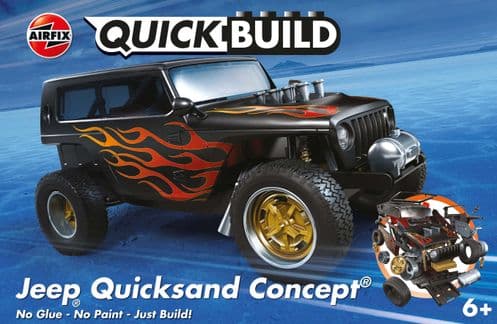
Hot rod heaven for Quickbuild fans, the new Jeep Quicksand Concept kit is sure to be a hit with thousands of young modellers this coming holiday season.
Thinking back to when we were kids and the cars which appealed to us back then, the uniquely presented American dragsters and hot rods certainly held a particular fascination for many of us slightly more conservative Brits, even though deep down, we all knew that all those exposed engine components probably wouldn't fare too well in our unpredictably damp climate. Back in those days, such a thing as a Jeep Hot Rod would have proved simply irresistible to tens of thousands of kids and now, thanks to the Quickbuild range, a new generation of kids will have their change to be captivated by one of these unique and distinctive vehicles.
When Adam was given the Jeep Quicksand Concept design project, we incorrectly assumed that the design licence such a vehicle presented him with would have made his job much easier than with a traditional Quickbuild, but how wrong could we have been. Compared to the Gladiator Overland which is a representation of an actual production vehicle, this is a concept and as such, there was very little information available to him at the outset of the project. He was sent some CAD data, but this proved to be quite basic and as a concept vehicle, you suspect that the team behind its construction may have used components from many current Jeep vehicles across the range and sort of made it up as they went along. For an Airfix designer, this can be a bit of a problem, as they need certainty when embarking on a project, as designing a representation of any machine can be difficult enough, even when you have full CAD data to hand.
To put this project starkly into perspective, the Quicksand Concept was only Adam's third Airfix project and was almost exclusively designed during the lockdown restrictions we had to work under a couple of years ago - it definitely turned out to be his most challenging to date. The lack of robust CAD data at the start of the project meant that he was forced to create his own research file, something which obviously didn't include having the opportunity to go and inspect the single concept vehicle over in America - if only, we can hear Adam say!
How does Adam turn this into the collection of parts in the image below? That is where he and the rest of our product design team really get to show what they can do!
Once he had the research information he needed, Adam embarked on the design phase embracing the usual challenges of a Quickbuild model, an appealing representation of an actual vehicle which has inherent strength built in as standard. As a slightly smaller vehicle with lots of open space and exposed engine, exhaust and suspension detail, Adam knew that this would be a challenge from the start - he knew this model would be coming in for some rough treatment once it was being played with, but how could he build the required rigidity into a vehicle which had few of the design features associated with a traditional vehicle? Overcoming this did require quite a bit of flexibility, lots of patience and even a design rethink when it came to assessing the prototype components, but centred around the floor pan and roll cage, design features which would have to carry most of the strength requirements for this design.
The main challenge for Adam on this design was how he incorporated all the separate detail parts which go to make this such a unique model into the wider build, knowing that if the parts were too small, they would make the model much more difficult to build and may even compromise the structural integrity of the overall design. He had to find a way to accurately represent this detail, make it clearly visible on the finished model, whilst at the same time, designing them as larger components, combining several features into the same part, but all without either overcomplicating the build or making it less intuitive. One of the main features of this model's design was how Adam managed to ensure this collection of slightly larger parts all interlocked with each other to ensure the model had the strength it required.
Although pleased with his design, once Adam had the opportunity to inspect the prototype SLA components following the initial manufacture of the tooling blocks, he was a little disappointed with how some of the smaller, more detailed parts had actually turned out during the manufacturing process. Some of these small part were just too small and fiddley and he knew they were just not suitable for a kit of this type and immediately went back into CAD to redesign these sections. One of the benefits of the prototyping phase of any new tooling project is that it allows the designer to assess every aspect of his new model design before that design is committed to metal tooling, or at least before that metal tooling is finalised and released for tooling. In the case of the Quicksand Concept, it proved absolutely crucial and Adam is delighted with the finished model.
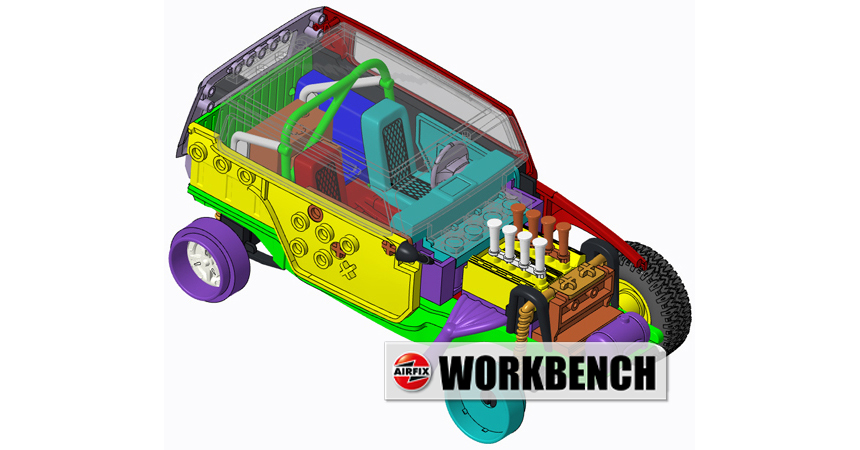
Another series of images which show how Adam built up his design files to make a scale representation of this unique vehicle, whilst all the time adhering to the Quickbuild range ethos.
Once again asking Adam to describe some of the more challenging aspects of this model's design, he told us that once again, providing the model with the overall strength and rigidity it needed posed the greatest challenge, but how making sure there was enough interest and detail without including small parts which would be difficult for youngsters to hold and incorporate into their build was not that far behind. As always, designing the model within the material thickness constraints dictated by the manufacturing process also produced its moments, however, this was a project which definitely allowed Adam to design innovate and he is very pleased with how the Quicksand Concept turned out.
When it comes to design aspects which Adam is particularly pleased with, there are actually quite a few with this new model. In addition to making this arguably the most distinctive Quickbuild model in the current range, the wheels of the model were an area which could have been an expensive headache for him, but actually ended up being a really clever piece of design innovation. Looking at these impressive units, they all incorporate the large rubber tyres, two tone rim and hub design and as can clearly be seen from the box image, also use two distinctly different wheel types. As we have already seen, each different coloured plastic used requires a separate tool to be designed and manufactured and if two completely different wheel types had to be manufactured, this could have created a cost issue which may have seen this kit not progressing from the design phase.
The solution proved to be a simple if extremely clever one. Adam designed the wheels differently on both sides, so that the deeper rimmed style could be used at the rear of the vehicle, but when attached the opposite way around, had the shallow rims which were a feature of the real vehicle. Simple, if you have a young mind and lots of product design experience! The final tool count for this model is five component tools, with a separate one for the impressive tyres, well within Adam's Quickbuild design remit.
Perhaps of even greater significance than the wheel solution, Adam is pleased with this design because he thinks it brings something a little different to the Quickbuild range, a model that may just appeal to a wider target audience than most and could even be a real door opener for the Quickbuild range. He describes this as a slightly more mature Quickbuild design, one which is perhaps a little more challenging to build, but one which could be described as being closer to a traditional Airfix kit, just without the need to use glue and paint, of course.
A final selection of images which illustrate how a Quickbuild model may be a fine representation of the subject vehicle on the outside, it poses some real design challenges on the inside, which could hardly be more different in appearance - all really clever stuff!
If you would like to see whether you agree with Adam's assessment of his impressive Jeep design duo, you can do so right now, as both the Jeep Gladiator Overland and Jeep Quicksand Concept are already available on the Airfix website and in all good model stores. With the holiday season now almost upon us, these impressive Quickbuild models make for ideal and appealing gifts and as we can all sometimes struggle for inspiration when it comes to Secret Santa or stocking filler gift inspiration, the Quickbuild range may just come to your rescue this year. The challenge we adults will all have is to not stick our noses in when our kids are enjoying a little Quickbuild time - maybe we should just put a couple of Quickbuild kits on our own lists to Santa this year.
We would like to than Adam for his time in allowing us this fascinating insight into his Quickbuild design world and in particular, for providing us with this interesting selection of design images, pictures which really helped our understanding of the details he was describing to us. We very much look forward to speaking with him again, when we he is allowed to tell us about his latest Top Secret design projects.
We are afraid that’s it for another edition of Workbench, however, you can be sure we will be back again as usual, same time, same place, with plenty more Airfix project updates for your information and enjoyment next week.
As ever, we are always keen to hear your views on all things Airfix and in particular, our Workbench blog, so if you would like to drop us a line, please use workbench@airfix.com for all correspondence. To re-visit any of the Airfix blogs produced over the past seven years, please head to our main Workbench hub and scroll through the available pages.
All our dedicated official social media sites can be accessed by clicking the respective link icons at the foot of this page, or by heading to the Airfix homepage. Other useful Airfix links are:
Facebook, YouTube, Twitter and Instagram official sites
Please join us for more Airfix updates next week and thank you for your continued support.