

Welcome to this latest edition of our Workbench blog and all the news, updates and modelling exclusives from the fascinating world of Airfix.
When it comes to the subject of unusual stories involving frontline Royal Air Force aircraft, there can be few which come close to rivalling the one which features in this week's edition of Workbench, an almost unbelievable event which would bring an end to the career of a pilot who was proud to call himself an RAF airman. Marking the release of our latest 1/48th scale Hawker Hunter kit, we have a fascinating selection of exclusive imagery to bring you, including CAD screenshots and built sample images, as for the first time in this scale, we bring modellers the FGA.9, FR.10 and GA.11 variants of this most famous of classic British jets. We will be reviewing the three scheme options which accompany the release of this fabulous kit, including the lead scheme, which immortalises one of the most incredible feats of airmanship and personal protest Britain's capital has ever witnessed, all in scale plastic modelling form. We also have details of a limited edition bonus available to early takers of this stunning new release, but we will have more on this a little later.
Anyone fancy going low level over central London in a Hawker Hunter jet this weekend?
If it looks right, then it probably is right and in the world of aviation, that was certainly true about the Hawker Hunter, one of the most beautiful aircraft designs ever to take to the skies.
Although the Supermarine Spitfire was one of the most famous and capable fighting aeroplanes of the Second World War, few people would argue that whilst the designers at Vickers Supermarine undoubtedly created an aviation masterpiece, they also designed a fighter which was as beautiful to look at as it was deadly in operation, creating a legendary status which endures to this day. As the world moved into the jet age, could an aircraft ever be designed to rival the Spitfire in the looks department, and could a British company rise to such an aesthetic challenge? We wouldn't have to wait long to have our answer.
Making its first flight in 1954 and entering RAF service three years later, the same year which marked the last operational sortie for the Spitfire, the Hawker Hunter would prove to be an incredibly important aircraft for Britain, the first Hawker designed jet type for the Royal Air Force, but also one which would go on to earn the reputation as being arguably the most attractive aeroplane to ever take to the skies. There is an old adage which states that if it looks right, then it is right and in the case of the Hunter, its difficult to argue against such thinking and many people still hold the aircraft as one which certainly rivals the Spitfire when it comes to looks.
With a string of highly capable piston powered aircraft designs to their name, as the Second World War entered its final stages, the Hawker Aircraft company were already working on a new fighter design, but one powered by the future of aviation propulsion, the jet engine. Having already had an initial proposal for a new RAF jet fighter turned down by the Air Ministry, Hawker's Chief Designer Sydney Camm turned his attention to producing a jet powered equivalent of the powerful Sea Fury, a project which would eventually result in the first flight of the sleek and graceful Hawker Sea Hawk. An elegant aeroplane, the Sea Hawk adopted relatively conventional design philosophies, but was the first Hawker aircraft to feature a nose wheel design, something which made it much more suitable for carrier based operation. This design would become the Hawker company’s first jet aircraft design to enter British military service.
The Sea Hawk project would allow Camm and his team the opportunity to learn many lessons about jet technology and the ever increasing speed requirements of modern fighter designs, all of which could be incorporated into their next major project. Initially taking the Sea Hawk layout as its basic design shape and sweeping the wings and horizontal stabilizers back at an angle of 35 degrees, the design was further revised by incorporating air intakes in the wing roots and a single jet pipe at the rear of the aircraft, producing an extremely attractive and slender looking aeroplane. Designated the Hawker P.1081, the new aircraft showed great promise and provided Camm and his team with valuable data in their quest to produce a new interceptor for the Royal Air Force. Tragically, this prototype aircraft was lost in an accident, claiming the life of test pilot and former Battle of Britain hero Trevor Sidney ‘Wimpy’ Wade.
Our latest 1/48th scale Hunter release allows the modeller to choose between three different variants of the famous British jet, the RAF's FGA.9 and FR.10, as well as the Fleet Air Arm's GA.11. Whichever one you go for, you can be sure it will be a looker!
A revised Air Ministry requirement calling for an aircraft which was capable of attaining a speed of 629 mph at 45,000, a high rate of climb and the ability to carry significant armament saw Hawker’s develop their P.1067 fighter, which first flew from RAF Boscombe Down on 20th July 1951. Incorporating all the development lessons learned from their earlier jet designs and based around the new Rolls-Royce Avon turbojet, the new aircraft proved to be an instant success and held great promise for future development. As had been the case with several earlier Camm designs, he seemed to have a design philosophy which embraced the adage ‘if it looks right, then it probably is right’ and this was certainly the case with his new jet fighter. It was extremely easy on the eye, arguably the most attractive jet fighter ever to take to the skies and most definitely an early jet fighter 'classic'. With a long, slender fuselage and swept-back wings and tail surfaces, the new Hawker jet was a real beauty, yet possessed all the attributes to make it a devastatingly effective fighting aeroplane, speed, manoeuvrability and firepower.
The outbreak of the Korean War and Britain’s significant commitment to it, resulted in the search for a capable new jet interceptor for the Royal Air Force taking on even greater importance. It also led to a radical Air Ministry decision to procure not one, but two proposed future designs from different aviation companies ‘off the drawing board’ so to speak, as the situation was given a high priority status – they also needed an insurance policy, should one of the projects fail to produce a viable aircraft option. The two companies involved were Supermarine, with their design which went on to become the Swift and Hawker Aircraft with their new Hunter and both aircraft would go on to enter RAF service, although the Hunter proved to be the significantly superior aircraft, with almost 2,000 examples eventually being built and earning the title of aviation classic.
The Hawker P.1067 (Hunter prototype – WB188) made its first flight on 20th July 1951, with famous test pilot Neville Duke at the controls and heralded a period of continual development for the aircraft, as the new fighter was prepared for its RAF acceptance programme. Early 1953 saw the first flight of the first production standard Hunter F.1, which came from an initial batch of 20 aircraft, all of which served in the role of a pre-production series, with each one incorporating modifications and improvements, ensuring each aircraft was more or less unique.
Just like the Spitfire which preceded it, the Hunter may have been easy on the eye, but it was also ruthlessly effective at the roles it was required to perform.
A significant development in the Hunter programme occurred on 7th September 1953, when the heavily modified first prototype aircraft WB188 (by then designated as the only Hunter Mk.3 variant) captured the world air speed record for a jet powered aircraft. Once more in the hands of Hawker’s Chief Test Pilot Neville Duke, the aircraft took off from RAF Tangmere and flew a course between Bognor and Littlehampton, setting a new world record of 727.63 mph and marking a significant achievement for Britain and the Hunter development team. In what turned out to be a poignant twist of aviation fate, this record would only stand for less than three weeks, as it would be bettered by the Hunter’s main rival, the Supermarine Swift, on 25th September.
Entering RAF service in July 1954, the Hawker Hunter F.1 continued a proud company tradition of supplying the Royal Air Force with ground-breaking and capable new fighting aeroplanes, following on from such classics as the Fury, Hurricane and Tempest over the previous two decades. The RAF now had their capable high speed interceptor fighter and could begin to replace the several first generation jets which were currently in service, types such as the Meteor, Venom and the US designed Sabre, all of which were unable to match the Canberra jet bomber for speed. The Hunter proved to be highly manoeuvrable, possessed exceptional performance and was a relatively easy aircraft to both operate and keep serviceable, all vital components of a successful service aircraft.
As first Hawker designed jet aircraft for the Royal Air Force, the Hunter went on to claim several notable 'firsts' for the RAF, such as being the first high-speed jet aircraft to be equipped with radar and fully powered flight controls, and the first to be equipped with the ADEN gun pack, a system which could be replaced 'as one' from the aircraft in an effort to increase both serviceability and speed of operational turn-around. Despite its impressive credentials as an interceptor and later a strike fighter, the Hunter was also a beautifully graceful looking aeroplane and is still regarded by many aviation historians and enthusiasts as the most handsome jet aircraft to ever have seen Royal Air Force service and a proud achievement for the famous Hawker company.
Supporting the arrival of what is just the third release from this impressive new tooling, this latest Hunter features this stunning artwork which commemorates an almost incredible incident which occurred on the 50th anniversary of the establishment of the Royal Air Force, one man's defiant gesture to highlight the state of the force at that time. It also happens to be the lead scheme option available with this beautiful new kit.
Our design project to introduce a newly tooled version of the Hawker Hunter to the Airfix range was first communicated to the modelling world at the beginning of 2018 and to say this news was greeted with enthusiasm at the time would be something of an understatement. Recognised as one of the most attractive aircraft to have ever seen military service, the prospect of having an accurate model kit of this stunning aircraft in the larger 1/48th scale appealed to a great many people, as the extra size of modelling in this scale really does allow the presence and stature of the subject aircraft to be more effectively replicated and in the case of the Hunter, its stunning good looks.
The first release of this impressive kit presented the Hunter in mature F.6 form, however, this was followed by a second release which included additional parts to allow the earlier smooth wing F.4 and F.5 variants to be modelled, further highlighting the development of this famous aeroplane in model kit form. This latest development update coincides with the release of what is only the third kit from this impressive 1/48th scale tooling, a model which has so many new features to its name that it really did require an audience with the kit's designer, Christopher Joy, to guide us through all the details, just so we could inform the Workbench audience correctly. We will come on to the subject of box artwork, schemes and an appealing limited edition bonus for those getting in early a little later, but first, we wanted to ask Chris about any differences between this latest kit and its predecessors.
A CAD screenshot showing the new raised drill locations Chris designed to allow the outboard pylons to be more accurately positioned if they are to be used.
As one of our most experienced designers, Chris Joy has many significant Airfix design projects to his name and as such, he will be familiar to many as the man behind our new Avro Vulcan kit in 1/72nd scale, as well as the Hellcat and Spitfire IX in 1/24th scale to name but a few. As Workbench readers now know only too well, all our designers can often have several projects on the go at any one time and how when talking about the latest and greatest Airfix new tooling releases, that particular project may have been a sign off for them many months ago. That proved to be the case for Chris and the Hunter, however, he remembers this project as being a little unusual because it involved some additional design work and some slight modifications to the tooling itself, a little while after the kit's initial release.
When a designer receives a research brief for their latest project, it will include details of all the different variants the new model kit will need to include and whilst some of the component frames may not be included in all the intended releases (particularly with the first release), how this work needs to be completed as part of the main project itself. For obvious reasons of logistics and cost, design projects are rarely re-opened to allow tooling modifications to be made once a model has proceeded to production, but that's not always the case. On rare occasions, if a designer feels that he needs to modify his design files to better represent a particular feature of the subject, or having been in receipt of further specialist detailed data which wasn't available at the time of the original design project, this can be done if there's a commercially sound reason for doing so.
With that in mind, Chris informed us that following the successful release of the Hunter kit, he felt that there were a couple of areas where he could make some slight design modifications to further enhance the accuracy of his design, having had the benefit of some additional expert input on the subject. This work would involve some slight modification to the inner external fuel tank pylon, a slight repositioning of the hidden (internal) guide holes should the modeller wish to utilise the outer wing station pylons and an additional corresponding aerodynamic fairing fitted to the top of the wings above that outer wing pylon position, a fixture which housed the pylon ERU (Ejector Release Unit) mechanism.
More new Hunter CAD imagery, this time showing the redesigned inner external fuel tank pylon detail and outer pylon ERU fairing.
This screenshot shows the modified wing flap shape for when the larger 230 gallon inboard drop tanks developed for these variants of the Hunter are in use and the newly designed aerodynamic ERU (Ejector Release Unit) fairing.
All this sounds very impressive to us, but did create a few problems for Chris. Perhaps of greatest significance, with the model already in production, the tooling blocks were now with the manufacturing plant and not with the toolmaker in the Far East, with the logistics of sending these heavy units back to the toolmaker for re-work, only to have then shipped out again to the manufacturing facility clearly being an option of last resort. Thankfully, the solution proved to be a simple one and whilst the work would not be carried out by the toolmaker we work so closely with on so many of our new projects, they were instrumental in guiding the in-house toolmakers at the manufacturing plant on how they should approach the situation, and between them, they completed a first class piece of work.
From a designer's perspective, Chris told us that when making modifications and alterations to an existing tooling design, there are several important factors which must be considered prior to embarking in this procedure. When looking at the component images he has kindly supplied, if the modification includes the design of raised guidance detail on the kit part in question (remember we are working in reverse when talking about a tool producing moulded kit parts), this will involve cutting into the tool, which is typically the easier design modification to make. If the opposite is the case, adding metal back to the tool is a more complex and much less desirable an undertaking and will normally only be attempted in the most extreme of circumstances.
The next consideration when adding parts is where they are going to fit within the existing kit frames and will their inclusion affect the flow of plastic during production and thus create further unacceptable issues. Chris has plenty of experience in such matters now and will have a good idea of where the most appropriate positioning of any additionally tooled parts should be located on the tooling plan, but whilst he will make his suggestions to the toolmaker prior to the process being completed, he will always be guided by their expert opinion on such crucial matters, even though a design repositioning is rarely required. As you can see from the interesting CAD image supplied by Chris, in the case of his Hunter, the most appropriate place for his newly designed parts was on the main fuselage frame, the parts in the red colour, with their corresponding feed-gates in pink.
A really interesting image sent to us by Chris, showing the tooling plan he created to support the production of the new parts required for these latest variants of Hawker Hunter in this third release from the tooling.
Chris had to give careful consideration to where the most effective positioning of the newly designed parts would be within the existing tooling, with the new fuel tank pylons and ERU fairing all finding a home on the main fuselage component frame.
In addition to these design modifications, this latest release of the Hunter tooling introduces the FGA.9, FR.10 and GA.11 variants of the aircraft to the range, so additional parts have been included to allow any one of these variants to be modelled. Chris has kindly supplied us with an image of the tooling layout plan for these parts, which includes the larger 230 gallon inboard drop tanks and their pylons and the cut out sections which prevent the flaps on either wing from snagging on these new, larger units when in operation. The reconnaissance nose for the FR.10 is also included, with other parts such as the braking parachute housing and arrestor hook also supplied, but on frames which were already part of the Hunter kit component selection.
In summary, this new kit not only allows the modeller to produce any of the three later variants of the famous Hawker Hunter shown above, but also enhances the overall accuracy of the existing tooling, using some very clever design techniques to replicate this aviation icon even more accurately in 1/48th scale model kit form. When all this is combined with the three very different scheme options which accompany the release of this new kit, most of us will find this latest Hunter an appealing proposition, with the lead scheme just crying out for it to be part of an impressive diorama display, but we will have more on that in just a moment. For now though, we would like to thank Chris for his help with this section of the article and for guiding us through the work he did on modifying what was already a popular addition to the Airfix range.
As the RAF prepared to mark the 50th anniversary of their establishment at the beginning of April 1968, the heroics of the pilots of the Battle of Britain may still have been fresh in the minds of the general public, but a further period of financial austerity appeared to be having a very different effect on the government of the day. A continued lack of investment in the Royal Air Force was now beginning to have a real impact, with successive recent studies all seemingly questioning the future viability of the force in the face of ever more capable missile technology suggesting a continuation of this ever-diminishing funding.
Bringing the situation to a head, to the frustration of many in the air force at that time, the significant 50th anniversary of the force was being allowed to pass without any official commemorative flypast event over the nation's capital being planned and other than station dinners and a few on-base displays, ministers were showing little interest in celebrating the occasion.
At RAF West Raynham, senior pilot Flight Lieutenant Alan Pollock was dismayed by this lack of official recognition and was determined to highlight the plight of the modern Royal Air Force to those in power. He and three of his fellow officers from No.1 (Fighter) Squadron were due fly their Hawker Hunters to RAF Tangmere, former home of No.1 Squadron, to attend a dinner the night before and perform a formation display to mark the 50th anniversary for base personnel and gathered dignitaries on the 5th April. As they set off on their flight to Tangmere, Pollock began to formulate a plan, one which would remind ministers in London that they still had an air force.
Having marked his route on a suitable map, once the four Hunters had taken off from Tangmere en route back to their home base, Pollock quietly slipped away, alerting his colleagues that he was experiencing communication problems and had lost sight of them. He would make his way back to West Raynham alone, but was at pains to reassure them that his aircraft was in perfect flying condition, other than its radio. Once safe to do so, he set course for London, flying at extremely low altitude to avoid commercial airspace, but all the time keeping an eye out for light aircraft and helicopters.
A beautifully built sample model finished in the lead scheme of this spectacular new release, the aircraft in which Flight Lieutenant Alan Pollock made his daredevil London protest on the 50th anniversary of the establishment of the Royal Air Force.
Pollock's intension was to fly over both the Houses of Parliament and No.10 Downing Street making as much noise as he could, reminding ministers that the Royal Air Force was still there and how they should be marking their 50th anniversary in the air and not around station dinner tables. Until then, he intended that his route should attract as little attention as possible, and to him, the most appropriate route was to follow the track of the River Thames, which he proceeded to do.
Dropping down to a height of around 150 feet, as he passed over the famous bridges of the Thames, he could see Westminster fast approaching and prepared to perform several circuits of the area, pushing the throttle forward, determined that his presence would be noticed by those he intended to protest to. Once he had made his point, the Thames also offered the most sensible route of egress, so it was back over the river once more, dipping his wings in salute as he flew past the RAF Memorial at Whitehall and onwards over Waterloo Bridge.
As his aircraft flashed over the famous landmarks of central London, an unexpected sight began to loom large in his windscreen, Tower Bridge. Although clearly aware of this most famous of London landmarks, Pollock had not factored this into his flight plan and as it now loomed large, he had a split second decision to make. With people using the bridge and even a red Routemaster bus preparing to cross, the safest and most logical decision would have been to fly over the bridge and return to lower altitude once it had been passed, however, Pollock was an accomplished low flyer and he had come this far - the temptation proved too great for him to refuse. In any case, this would be a memorable way with which to end his RAF career.
To the absolute astonishment of everyone in the vicinity, an RAF Hawker Hunter flew through Tower Bridge at high speed and as it disappeared into the distance, surely most of them would have been asking themselves, 'Did that really just happen?'
Back at RAF West Raynham, an officer ran into the crew room and announced to those gathered that, 'Someone had just flown an RAF fighter trough Tower Bridge!'. It has since been written into RAF folklore that to a man, they all looked at each other and simultaneously said, "Pollock!' They all instinctively knew that their talented and outspoken colleague was the only one both capable and motivated enough to do such a thing and of course, they were right.
Full scheme details of the Tower Bridge incident Hunter FGA.9 and a little something extra from the good people at Airfix - more on this a little later!
On his arrival back at West Raynham, Pollock destroyed his unofficial flight map and prepared to receive the admonishment which would soon follow from his superiors and the distinct possibility of a court martial. He was quite prepared to accept this punishment and to use this platform to articulate his feelings about the plight of the Royal Air Force at that time and whilst he was duly detained and placed under house arrest, things didn't exactly play out as he had expected. Although there was the expected ministerial complaints about the incident, the station also received hundreds of congratulatory messages and telegrams from RAF offices past and present, all in support of Pollock's actions. He even received a barrel of beer courtesy of BOAC.
With further support coming from ministerial level (presumably those who had service and RAF careers behind them), Pollock avoided a court martial and was instead granted a medical discharge, with officials probably fearing the fallout from a court martial and giving Pollock the opportunity to point the finger at those in government in such a high profile manner. It was reported that following the incident, Alan Pollock said that he had absolutely no regrets about performing his unauthorised protest flight and how he was proud to have represented the Royal Air Force during his career and bring it to a close flying such a superb aircraft as the Hawker Hunter.
When the RAF commemorated their Centenary in 2018, they did so in some style, presumably with the actions of Flight Lieutenant Alan Pollock and his Hunter flight through Tower Bridge 50 years earlier fresh in their minds.
Another variant of the Hawker Hunter which was a development of the F.6 fighter, the FR.10 was intended to provide the Royal Air Force with an upgrade to its high speed reconnaissance capability, replacing the Supermarine Swift in this role. Several type permutations were trialled before it was decided that a three camera system mounted in a modified nose section was the most suitable configuration. Externally, other than the nose mounted camera bays the FR.10 was similar in appearance to the FGA.9 variant, featuring the same 230 gallon external fuel tanks on the inner wing pylons, with the smaller 110 gallon tanks carried on the outboard stations.
Internally, the installation of the reconnaissance cameras required a change in the positioning of the main gunsight, however, the main difference was a change in the aircraft's centre of gravity, something which was counteracted by the fitting of further armour protection panels for the pilot, something which would certainly prove reassuring during low level intelligence gathering missions over contested territory. A total of 33 FR.10 variants were produced, with initial service deliveries presenting the aircraft to No.4 Squadron at RAF Gütersloh, destined to provide vital low-level reconnaissance support for RAF Germany squadrons during some of the most volatile times in post war Europe.
Full scheme details of the RAF Germany Hunter FR.10
These Hunters were regarded as the most effective aircraft in this role during their service in Germany, excelling in the gathering of photographic reconnaissance images at low altitudes and at high speed, regularly beating their NATO contemporaries during the inter-service reconnaissance competitions which were held annually. The RAF FR.10s of Nos 4 and 2 Squadrons gained a reputation for reconnaissance excellence, with the Hunter proving to be an exceptional platform for this kind of work.
Hawker Hunter XF459 was issued to RAF No.208 Squadron on 12th March 1958, initially serving in the Middle East, before moving back to the UK with No.19 Squadron some months later. Sent back to Hawker Siddeley for conversion to Fighter Reconnaissance FR.10 configuration, she would spend her final years in RAF service patrolling the NATO border with the Warsaw Pact nations, serving with both Nos 4 and 2 Squadrons in Germany. With her RAF career over, she was purchased by Hawker Siddeley, before undergoing conversion to T.66E standard and a career with the Indian Air Force.
Scheme C - Hawker Hunter GA.11 WT806 - 838, Fleet Requirements and Aircraft Direction Unit, Royal Naval Air Station Yeovilton, Somerset, England, 1976.
Hawker Hunter WT806 was built at Hawker Aircraft's facility at Kingston-upon-Thames as a Mk.4 variant for the Royal Air Force in late 1954/early 1955, making her first flight on 31st March 1955, before being delivered to No.14 Squadron based at Oldenburg in Germany. Interestingly, this would prove to be the aircraft's only Royal Air Force assignment, because after suffering an unfortunate inflight incident, the fighter was sent back to Hawker for repair, never to return to RAF service.
Following repair and upgrade to GA.11 configuration, she was delivered to the Fleet Air Arm at RNAS Lossiemouth in June 1962, where she would wear the colours of No.738 NAS and go on to have quite the eventful career with them. Suffering several relatively serious bird strike incidents in a short period of time, the aircraft earned a reputation as something of a lucky ship, as she always brought her pilot home safely, however, despite a relatively active period of flying during her time based in Scotland, she would be sent for maintenance and storage at RAF Kemble until late 1974.
A further period of service with the Fleet Air Arm required further maintenance and upgrade before she could be delivered to the Fleet Requirements and Air Direction Unit at RNAS Yeovilton in July 1975. She would remain with the unit until February 1987, when she was flown to RAF Shawbury, in preparation for a further period in storage, however, just one month later, she would be flown to RAF Chivenor, returned to an RAF camouflage scheme, with the intention of maintaining her in airworthy condition. Unfortunately, these ambitious plans did not come to fruition and she returned to Shawbury once more, eventually to be put up for disposal.
Purchased by a private buyer in November 1994, she was taken by road to a new home in East Anglia, however, despite this move holding the prospect of a bright future for the aircraft, nothing really happened over the next five years, until she was offered for sale once again. Her next owners were Northbrook Collage, who moved her once again, this time to Shoreham Airfield, where she would embark on a career as a technical training aid, but also becoming a popular static star of many a Shoreham Airshow.
Full scheme details of this ultra-attractive Fleet Air Arm Hunter GA.11 option, the third of three very appealing and very different scheme option choices included with this new kit.
All three scheme options in finished sample form, with that little something extra positioned next to our scale representation of the aircraft it commemorates.
In late 2010, WT806 was on the move once more, this time having been bought by an owner who had links to the collection of classic jets gathered at Bruntingthorpe Airfield. Her new owners intending to return her to running condition, so she could take part in the popular Cold War Jets events which attracted such large crowds to this famous old Leicestershire airfield. During this time, she was also returned to her attractive Royal Navy livery and complete with her distinctive nose mounted Harley Light, made for a beautiful addition to this impressive collection of British Cold War Jets.
The Fleet Requirements and Air Direction Unit (FRADU) was a rather enigmatic feature of Britain's aviation scene for 30 years following its establishment in December 1972, operating its former military aircraft under contract to the Royal Navy until it was stood down in 2013. Operating a fleet of aircraft which included single seat Hunter GA.11s and two seat Hunter T.8Cs, the largest aircraft on their register were a collection of English Electric Canberras of various marks, a collection of classics which thrilled UK aviation enthusiasts wherever they appeared. FRADU's single seat Hunters were used in a weapons training role for the Royal Navy, with guns removed but with the addition of an arrestor hook and in some instances, installation of the distinctive nose mounted Harley Light.
On 6th September 1975, the FRADU created history when it flew the first civilian jet aerobatic display by a team using military aircraft, when four of the unit's Hunters displayed as the 'Blue Herons' at the RNAS Yeovilton Air Day. The Blue Herons would perform at quite a number of shows over the next few years, attracting lots of attention and earning several display accolades during that time. With the arrival of the BAe Hawk in the FRADU role, the days of the Hunter were numbered and with more Hawks becoming available sooner than originally anticipated, a decision to withdraw the Hunter from service was taken in December 1994, with all remaining aircraft arriving at RAF Shawbury for storage and subsequent disposal by the summer of 1995.
The Fleet Requirements and Air Direction Unit stood down in 2013, having provided the Royal Navy with a first rate service for over 30 years.
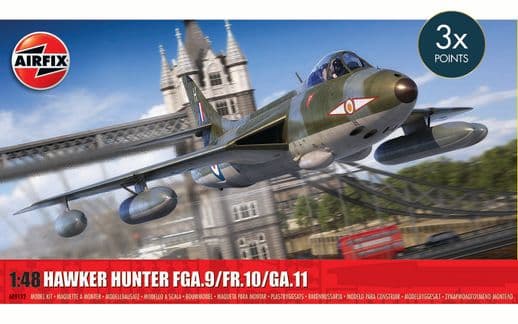
Out now and awaiting its place on your Workbench, this magnificent box presentation is the one to look out for when visiting your favourite model supplier. If you don't have one, the Airfix website is the place to go.
As you can see from the features above, our researcher has not made our decision for selecting a scheme in which to complete our new Hunter an easy one, as all three have interesting stories and all three present this famous aircraft in differing variants. With the lead scheme being linked to such an incredible story, we suspect many will go for this option and we look forward with some excitement to this year's Scale ModelWorld show, where someone is bound to incorporate their Hunter build as part of a spectacular Tower Bridge diorama build - we can hardly wait!
Our latest Hawker Hunter FGA.9/FR.10/GA.11 kit is available now and for those who are quick off the mark, there's an appealing bonus addition to get excited about, but only whilst current stocks last. Please see below for details.
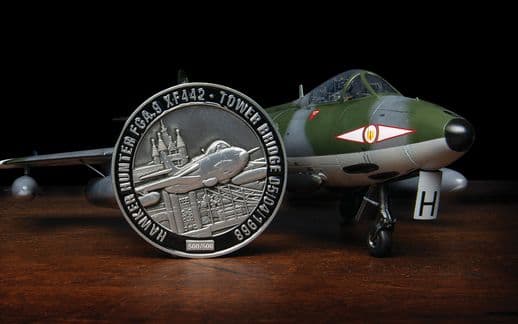
If the prospect of recreating the famous Tower Bridge Hunter incident from 5th April 1968 in 1/48th scale kit form were not appealing enough a modelling project, the first 500 people to buy this new kit from the Airfix website will be in for a little additional treat, the inclusion of a beautifully crafted collector's coin commemorating the events which inspired the lead scheme option included with this kit.
A highly collectable piece of memorabilia in its own right, this handsome coin has been meticulously crafted in an antique silver effect finish, with the reverse side featuring the Airfix logo in all its glory. Surely, this is the ideal display companion for any build commemorating Flt Lt. Alan Pollock's unbelievable protest sortie over central London, the lead scheme offered with our latest 1/48th scale Hunter release.
Limited to just 500 coins, if you are lucky enough to get one, this will make for an appealing addition to our finished model display, but will probably only make sense if completing the model in the lead scheme option.
This latest kit is such an enticing prospect in its own right, with three fascinatingly diverse scheme options to consider, each one a different variant of this famous British jet, with the kit featuring both new parts and several updates and additions, which include:
• FR.10 Nose
• 230 Gallon underwing drop tanks (with support arms)
• Amended flap arrangement components
• GA.11 variant specific parts
• Outer pylon ejector fairings
• Revised inboard wing pylons
• Amended outer pylon location
Unfortunately, as this kit has already been attracting plenty of attention, many of the 500 coin bundles have been snapped up and we expect them all to have gone by the end of the weekend. If you are still reading this and not heading for the Airfix website, what on earth are you doing? Use this New Hawker Hunter kit link to visit the product page and see if any of these hugely appealing kit and coin bundles are still available.
If they have all gone, please don't despair as this is a fabulous kit in its own right and might be the ideal model on which to spend your accumulated reward points.
With the UK Airshow season now in full swing, it’s probably a good time to remind Workbench readers that after an extremely successful inaugural season, the Airfix Aviation Photo Awards are now live and accepting submissions for a second year. As we will all no doubt be attending different events over the coming months and will all have our cameras with us, why not share your photographic talents with the rest of the Airfix community and see if your image scoops one of this year's prizes.
Our guest judge for this year is renowned and internationally published aviation photographer Darren Harbar, a man whose work will be familiar to millions of people the world over. Darren's experience in photography spans over 20 years and started with him working in a camera store, an apprenticeship which led him to become editor of Which Digital Camera? magazine.
From the covers of national magazines to calendars, appearing regularly in Flypast, Light Aviation and Pilot magazines, Darren’s photographs have been seen by huge numbers of aviation enthusiasts all over the world. He has been running his own business, Darren Harbar Photography since 2011, specialising in a wide range of photography services (Aviation, Commercial, Portfolio etc.).
A love of training people on how to use their cameras has led to Darren offering a range of photography workshops in order to share his knowledge with others. He believes that ‘a good photographer knows how to handle a camera without having to think about it!’
His keen eye will be cast over each and every submission to the latest Airfix Aviation Photo Awards, but which image will emerge as his winner - could it be yours?
For all the details you might need when considering entering this year's competition, please head over to the Airfix Aviation Photo Awards page on the Airfix website.
We are afraid that's all we have for you in this latest edition, but we will be back next Friday with more project development updates and the very latest Airfix kit exclusives. In the meantime, we are always keen to hear your views on all things Airfix and in particular, any thoughts and opinions you may have regarding our Workbench blog. If you would like to drop us a quick line, could we please ask that you use our workbench@airfix.com email for all correspondence.
To re-visit any of the Airfix blogs we have produced over the past seven years or so, please head to our main Workbench hub, where you will find our entire blog back catalogue and all the Airfix design projects we have already covered.
All our dedicated official social media sites can be accessed by clicking the respective link icons at the foot of this page, or by heading to the Airfix homepage. Other useful Airfix links are:
Facebook, YouTube, Twitter and Instagram official sites
Please join us for more Airfix updates next week and thank you for your continued support.