
Welcome to this latest edition of our Workbench blog and all the news, updates and modelling exclusives from the fascinating world of Airfix.
There is so much going on in the world of Airfix at the moment, that we find ourselves in need of posting something of a catch-up edition of Workbench. With several new 2023 kit releases having already arrived in our warehouse but have yet to feature in one of our update blogs, the only appropriate course of action is to have the latest of our dual post weekends, basically two update blogs for the price of one.
In this first feature, we will be marking the return of the Hawker Siddeley Harrier GR.1/AV-8A kit in 1/72nd scale, looking at both the British and US markings this delightful little kit features, including those of an early Harrier which was used in sea trials to highlight the aircraft's Fleet Air Arm potential. Our second update returns to the fascinating subject of new Starter Set kit design and production, as we welcome the newly tooled and recently released 1/43rd scale Aston Martin DB5 to the current Airfix range. With the benefit of input from the kit's designer and a host of exclusive CAD screenshot imagery to bring you, we will be discovering some of the many challenges faced when introducing such a classic vehicle into this new series of simplified construction kits.
In line with recent tradition, both blogs will be posted separately, but can be accessed either from the foot of the main Airfix webpage, or by heading to our main Workbench hub.
Airfield not necessary. The introduction of the Hawker Siddeley Harrier provided the RAF with an aircraft which could operate from many dispersed locations, including forest clearings, motorways and school playgrounds, should this ever be required.
As regular readers of Workbench will no doubt agree, when it comes to the subject of aviation, it's usually quite easy to find something interesting, historically unique or unusual about most aircraft types if you look hard enough, especially if that particular aircraft managed to find itself inducted the Airfix scale hall of fame over the years. Clearly, some subjects will always have more noteworthy credentials than others when it comes uncovering interesting facts about them, however, few aircraft types can claim to be in the same league as this latest subject, both in terms of the modelling hobby and popular affection of the nation, the Hawker Siddeley Harrier.
An aircraft which was revolutionary in aviation terms at the time of its introduction, the Harrier was capable of doing things no other fixed wing jet powered aircraft was able to do and in addition to providing the Royal Air Force with an incredibly flexible new weapon, also highlighted the effectiveness of Britain's aviation industry at that time. The envy of the aviation world during the late 1960s and early 1970s, the Harrier was the aviation pride of the nation and whilst service aircraft undoubtedly proved to be something of a compromise operationally, everyone only saw the Harrier for the many things it could do.
The search to develop an effective V/STOL aircraft was being progressed by several nations during the late 1950s, each exhibiting varying degrees of success, but with one or two holding real promise for future operational potential. Britain was very much at the forefront of this research and with years of V/STOL research endeavours to call upon, finally appeared to have a workable design to develop. The first flight of the experimental Hawker Siddeley P.1127 heralded an exciting new phase in this work and the very real prospect of a workable, controllable design. Powered by a new type of powerful Bristol jet engine, one which could direct its thrust using a series of rotating nozzles and additional control ducts, the P.1127 prototype had advanced to the stage of static engine testing by the summer of 1960.
Before the aircraft could fly conventionally however, the development team wanted to fully explore how the aircraft could be controlled by a pilot in the hover, so the first flight of the aircraft on 19th October 1960 would see it tethered to the ground by strong cables, allowing this work to be done with a greater degree of safety. As the programme advanced further and confidence grew, so the length of these tethers increased, to a point where the test pilot insisted that if they were to advance any further, the aircraft must be allowed free flight. On 13th March 1961, the Hawker P.1127 made its first conventional flight, performing a successful horizontal take-off - they had done it, but there was still much work to do if this incredible hovering jet was to attract the sales support it needed.
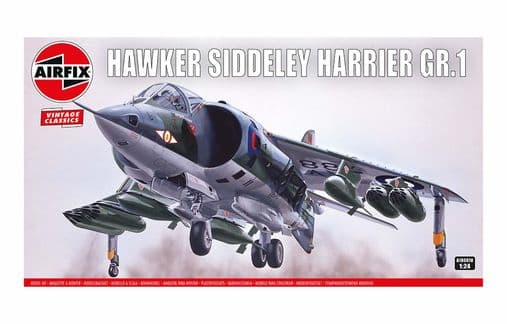
A previous iteration of Airfix Harrier GR.1 box artwork, showing an aircraft operating away from its home base at RAF Wittering.
In total, six P.1127 development aircraft were constructed, however, in a situation which illustrated the ground-breaking nature of this new aviation technology, three of these aircraft would be lost during the punishing test and evaluation program. With the world already enthralled by this incredible new aeroplane, the final day of the 1963 Paris Airshow seemingly brought this project right back down to earth, quite literally.
Displaying alongside a French V/STOL rival, the P.1127 was coming towards the end of a thrilling display which had held the massive crowd completely spellbound, when something went badly wrong. As the aircraft neared the runway at Le Bourget, it appeared to lose power and came crashing down in a very heavy landing, sending shattered undercarriage components flying in all directions. Not the most auspicious of international debuts for Britain's new hovering jet, but this was only a setback and there would be no stopping the Hawker team now!
The next aircraft to appear in the lineage of Harrier development was the Hawker Siddeley Kestrel, a fully developed military variant of the P.1127 and an aircraft which was intended to be the forerunner of production aircraft destined for Royal Air Force service and hopefully capturing wider international sales in the process. Underlining both the success of the previous P.1127 programme and the undeniable potential the new aircraft possessed, a tripartite agreement between Britain, the US and West Germany was signed in 1961, with the intention of establishing a joint squadron of aircraft to fully evaluate the operational potential of the aircraft in as near to service conditions as could be achieved. Nine aircraft were ordered and would go by the name of Kestrel FGA Mk.I, the first of which commenced test flying in March 1964.
The sun setting on a glorious 42 year service career for the RAF's Hawker Siddeley/BAe Harrier.
The Kestrel was essentially a P.1127 prepared for combat flying, differing from its predecessor by having a new wing which featured a 40 degree sweep at the leading edge, a taller, modified tail, redesigned fuselage and the installation of a more powerful Pegasus 5 engine. Forming the Tripartite Evaluation Squadron at RAF West Raynham, pilots from Britain, West Germany and the US would be trained to fly the new aircraft, whilst at the same time, around 200 ground crews from all three nations would learn how to handle the aircraft in an operational environment. Crucially, the additional financial backing the partner nations brought with them provided a new impetus to the project at a time when financial austerity had the potential to derail the programme altogether, with this funding effectively going on to see the aircraft through to service introduction.
As was agreed at the outset of the evaluation programme, once the Tripartite Evaluation Squadron had completed its work, six of the Hawker Siddeley Kestrel jets were shipped to the US for further evaluation trials, as the Americans were keen to see the aircraft positioned for entry into their own armed forces, particularly with the US Marine Corps, who were similarly impressed with the new aircraft. Back in the UK, the Kestrels had already achieved their aim and the Royal Air Force were about to welcome their new Harrier GR.1 into service.
In the interest of accuracy, it does have to be accepted that Britain's amazing new V/STOL jet was always something of a technological compromise. Despite being able to do things no other individual aircraft type could hope to do, it was not the fastest aircraft in the world, had relatively poor range and if operated in anything other than a conventional manner, could only carry a modest weapons load. On the flip side of this, it possessed the ability to be operated away from traditional airfield facilities, dispersed to anything from a stretch of motorway to a school playground, whilst still offering close air support to ground units much more effectively than any other aircraft types.
In the midst of the terrifying Cold War period of posturing and uncertainty, the Harrier offered NATO a new and effective deterrent threat, an aircraft which could not be pinned down like traditional machines and could strike back at a moment’s notice, re-arming and returning for further strikes in short order - the Harrier's time had most certainly arrived.
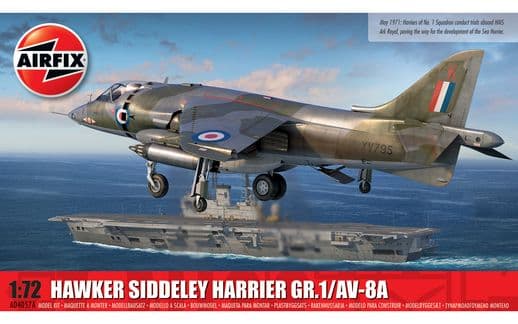
The new artwork gracing the packaging of this latest 1/72nd scale Harrier release, depicting one of the aircraft which took part in the deck operation trials aboard HMS Ark Royal in May 1971.
Our association with this magnificent aircraft goes right the way back to 1963 and the 1/72nd scale release of our Hawker Siddeley P.1127, a hugely significant aircraft in the history of post war British aviation. This classic kit has not been part of an Airfix range for almost 23 years now and surely must be up for consideration in the Vintage Classics range. This kit was joined by a newly tooled scale representation of the Hawker Siddeley Harrier in 1969, as Britain's modellers had already accepted their enduring fascination with this aircraft.
Marking the continued popularity of the Harrier as a modelling subject, a completely new kit was designed in 2013 and is the tooling which has been used for this latest scale homage to this incredible aeroplane, one which many Workbench readers will still miss terribly, even though our new Lockheed Martin F-35 jets are trying their level best to do Harrier impressions. The two scheme options included with this new kit really do demonstrate the early appeal of the Harrier, with the flexibility it offered not only appealing across different branches of Britain's armed forces, but also to those of overseas air arms. Let's take a closer look at both these finish options now.
The first example of a production Harrier was delivered to the Royal Air Force on 1st April 1969, a date with symbolic significance for them, as it marked the 51st anniversary of the establishment of the force, however it would be Harrier XV746 which became the first aircraft to be delivered to a front-line squadron, as she arrived with No.1 Squadron at RAF Wittering around three weeks later. The history books record that the Harrier officially entered RAF service on 1st April 1969 with the establishment of the Harrier Operational Conversion Unit (No.233 OCU), which was also based at Wittering, a unit which would be tasked with the honour of introducing this incredible new aircraft into RAF squadron service.
The Harrier's service arrival would be marked in a high profile manner, as the jet was entered in the 1969 Transatlantic Air Race, an event which was taking place to commemorate the 50th anniversary of the first non-stop airborne crossing of the Atlantic by aviators Alcock and Brown in their modified Vickers Vimy aircraft. Taking off from the cleared area of an old railway coal yard near St. Pancras Station in central London, an area which the RAF had colloquially christened RAF St. Pancras for the occasion and even had an airfield station sign erected to cheekily identify the location of its latest (temporary) base, Harrier XV741 made it to New York in a time of 6 hours, 11 minutes and 57.15 seconds, thus taking the record.
In the eyes of the British and American public, this amazing new aircraft was cutting edge technology and rather than ask the question should our armed forces have it?, their leaders were probably discussing, How many can we get hold of!
As No.1 Squadron took the honour of becoming the world's first operational V/STOL unit when it formed at Wittering on 1st October 1969, it really did seem as if the eyes of the aviation world were fixed on their every move - how would this incredible aircraft adapt to life in a front line unit. Clearly, Hawker Siddeley were keen to ensure that this introduction went as smoothly as possible, as future orders, particularly those from overseas suiters, very much depended on it. With this in mind, RAF Harriers from No.1 Squadron would be involved in carrier landing trials during 1971, to hopefully prove that this magnificent aircraft was ideally suited to life aboard a British carrier, even though it has to be said that at the time, the Admiralty remained somewhat sceptical.
The potential of operating the Harrier at sea had been explored from relatively early on in the aircraft's pre-service development work-up, with Hawker Siddeley P.1127 XP831 being the first V/STOL aircraft to land on board HMS Ark Royal in February 1963, three months before this aircraft suffered its very public accident at the Paris Airshow. This was followed by further trials in 1966, when a Kestrel successfully operated from the command carrier HMS Bulwark, further underlining the flexibility offered by the aircraft.
Full scheme details featuring one of the aircraft which took part in the carrier operations trials aboard HMS Ark Royal during the early summer of 1971.
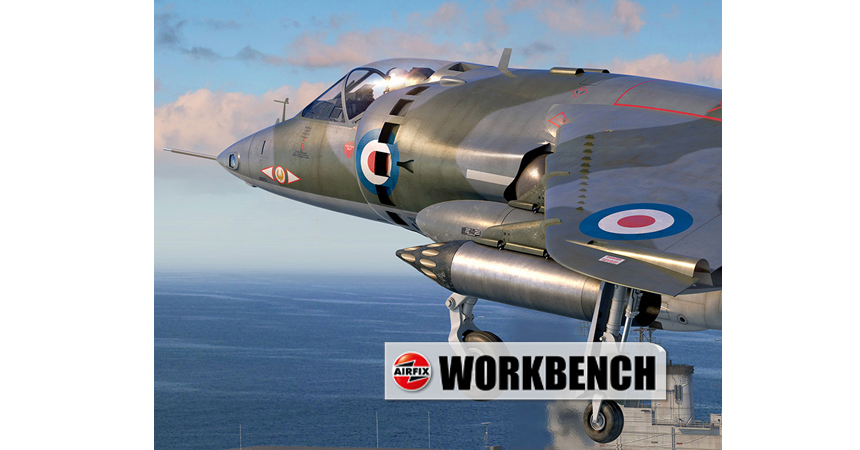
In May 1971, Harriers from No.1 Squadron were called upon to perform more robust sea trials, operating from the decks of HMS Ark Royal, which was under steam in the Moray Firth. At that time, Ark Royal was home to the Phantoms of the Fleet Air Arm, however, these mighty aircraft had already been put on notice of impending retirement, as the government had decided they wanted to cease all Royal Navy fixed wing aircraft operations from carriers. With that being the case, No.892 Naval Air Squadron was thought to be the final FAA fixed wing squadron to be commissioned and as a consequence, their aircraft carried the Omega symbol on their tails.
These trials were intended to prove the viability of the Harrier as a fixed wing alternative for the Royal Navy, with extensive trials taking place between 4th and 8th May 1971 and again between 11th and 19th May. There is some conjecture regarding the number of Harriers which actually took part, with most reporting two aircraft and four pilots, whilst others claim that four aircraft were assigned to the task.
The trials were extensive and involved approach, landing and unassisted Harrier launches from the carrier, with full Search and Rescue helicopter support and a full compliment of ships staff to provide the necessary deck handling support. Pictures and videos captured during the deployment show a huge crowd of gathered crew members during the entire deployment, obviously desperate to see if this magnificent new aircraft could be given sea legs.
At the end of what proved to be incredibly successful trials, the Harrier must have left a favourable impression, because as we all know, the Sea Harrier would be developed from the mid 1970s, entering Fleet Air Arm service in 1978. It was reported that following the end of the trials in 1971, a handful of No.1 Squadron personnel who remained on Ark Royal after the main party had returned to Wittering, cheekily painted the words FLY RAF, FLY V/STOL on the side of the ship, a decoration addition which didn't stay in place for long, but one which was tolerated long enough for an official photograph to be taken. There's nothing like a bit of inter-service friendly banter.
Harrier XV795 would later go on to be upgraded to GR.3 configuration, but was lost following a mid-air collision with a Harrier T.4 during a combat air training exercise in February 1983.
As the Harrier GR.1 entered Royal Air Force service with No.1 Squadron at Wittering, the US military stepped up their interest in acquiring this unique aircraft, as they had their own requirement for a close air support fighter for their Marine Attack Squadrons. This interest encouraged Hawker Siddeley to continue developing the aircraft, ensuring that they improved and perfected the already successful Harrier design, making it the best combat aircraft it could possibly be. Significantly, this included ensuring any US test flying programme would be performed by pilots who were fully conversant in every aspect of Harrier operations. With this in mind, two senior US Marine Corps test pilots were given a high level introduction to the aircraft from the most experienced Harrier test pilot in the world and it didn't take long before they too became infatuated with this unique aeroplane.
The US Marine Corps were in need of a go anywhere close air support aircraft which could do everything their existing aircraft could do, but using less runway and able to operate from smaller airfields and many of their ships. Having obtained congressional support for the purchase, in the UK, the Hawker Siddeley company sent their agents to the US with the aim of securing a manufacturing partner for the AV-8A programme, eventually signing an agreement with McDonnell Douglas, due to their experience in producing highly effective naval jet aircraft. A 15 year agreement was duly signed between the two companies, in tandem with a similar agreement with Rolls Royce and Pratt & Whitney to further develop the aircraft's vectored thrust Pegasus engine.
Although it was initially intended that production would get underway in the UK before later transferring across to the US, despite this being ratified by congress, all of the AV-8A Harriers would actually be produced in the UK by Hawker Siddeley. This agreement would however have important implications for future Harrier development, as the Harrier II programme would subsequently be led by the Americans.
The AV-8A Harrier first entered US service in 1971 at the Navy's Flight Test Centre at NAS Patuxent River, Maryland, as the aircraft was prepared for wider squadron service. The first operational Marine Corps Squadron was VMA-513 'Flying Nightmares', a unit which had previously been flying the Phantom, a very different aeroplane altogether. The 'Nightmares' became operational with the AV-8A Harrier in May 1971 at MCAS Beaufort in South Carolina.
One of the most unusual representations of an early generation Harrier, this machine would later be reduced to spares, with parts potentially still flying on aircraft still in the US Marine Corps fleet.
The aircraft covered here in this unusual scheme is AV-8A 158702, construction number 712099, an aircraft which was used extensively in a flight testing role for the US Marine Corps, but also for a short while, was seen wearing this striking winter exercise scheme. The aircraft was attending winter exercises at Naval Air Station Fallon in 1983 and is assumed to have benefitted from the application of a temporary white overpaint, most likely applied using brushes. The white was applied over the aircraft's green camouflage, however, for whatever reason, the green was not completely overpainted and was still visible across several sections of the airframe.
Its not known how long this aircraft retained its temporary winter paint scheme, but it would go on to have a long and active service career, later undergoing upgrade to AV-8C standard, before eventually being sent to an Aviation Maintenance and Regeneration Centre in 1986. This suggests that parts from this aircraft may well still be flying across the remaining USMC AV-8B and TAV-8B fleets.
Although this fabulous kit might be a small build project in the grand scheme of modelling things, the two fascinating scheme options included really do help to tell the fascinating early story of this magnificent aircraft and how despite having already entered Royal Air Force service, there was still work to do for both the RAF and Hawker Siddeley in helping ensure the Harrier realised its full aviation potential.
Already available on both the Airfix website and in your local model store, it's time to continue our modelling infatuation with the incredible Hawker Siddeley Harrier.
A04057A Hawker Siddeley Harrier GR.1/AV-8A is available now.
Please don't forget that we have a second update feature for you this week, with our new Aston Martin DB5 Starter Set being the focus of our attention in our other blog.
We are afraid that's all we have for you in this latest edition, but we will be back next Friday with more project development updates and the very latest Airfix kit exclusives. In the meantime, we are always keen to hear your views on all things Airfix and in particular, any thoughts and opinions you may have regarding our Workbench blog. If you would like to drop us a quick line, could we please ask that you use our workbench@airfix.com email for all correspondence.
To re-visit any of the Airfix blogs we have produced over the past seven years or so, please head to our main Workbench hub, where you will find our entire blog back catalogue and all the Airfix design projects we have already covered.
All our dedicated official social media sites can be accessed by clicking the respective link icons at the foot of this page, or by heading to the Airfix homepage. Other useful Airfix links are:
Facebook, YouTube, Twitter and Instagram official sites
Please join us for more Airfix updates next week and thank you for your continued support.