
Welcome to this latest edition of our Workbench blog and all the news, updates and modelling exclusives from the fascinating world of Airfix.
As mentioned in our lead blog for this week, the Airfix team will already be in situ at this weekend's Royal International Air Tattoo by the time you are reading this latest edition of our Workbench blog, an edition which is unashamedly dedicated to bringing you our latest aviation model related updates. If you are heading down to Fairford over the coming weekend, please do drop by and say hello to the team and perhaps seek a little respite from all that sunshine we are expecting. Our display marquee will be situated in the RED Zone at the eastern end of the Fairford crowdline and in addition to having model displays and items for sale, our make and paint tables will also be in operation over the course of the weekend. Please do come along and see if you recognise any of the team members from the telly!
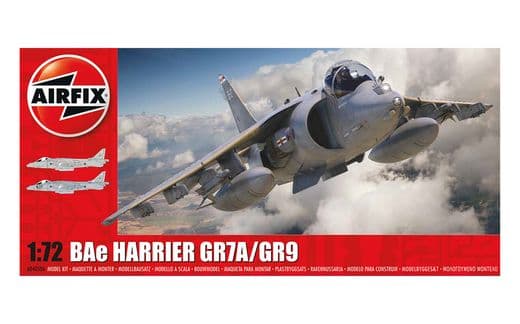
As promised, this second blog of the week marks the welcome re-introduction of the hugely popular RAF BAe Harrier in GR7A/GR9 Harrier II guise, an aircraft which we are certain many Workbench readers still be lamenting the passing of. Soon to be available again in 1/72nd scale, we will be taking a look at the latest Adam Tooby artwork classic which will be gracing the box of this kit, before moving on to feature details behind the two scheme options which will accompany the summer release of this appealing kit. Oh what we wouldn't give to be seeing an RAF Harrier displaying at this year's RIAT show, but never mind, at least we have a scale alternative for you in this latest blog.
The Harrier was an aircraft which captivated the British public and attracted admiring advances from military officials on the other side of the Atlantic.
It is difficult to imagine how the aviation world viewed the strange looking Hawker Siddeley P.1127 jet when it first took the skies back in the 1960s. Designed to meet a NATO requirement for a new light tactical support strike fighter, the vectored trust Pegasus engine allowed the jet to almost perch on a column of hot air and by the end of 1960, this amazing new aircraft had already achieved vertical take-off and the successful transition to normal flight. The new Hawker aircraft was already showing great potential, but such ground-breaking aviation technology would never be developed without some significant challenges along the way. As the weight of the aircraft began to increase, so must the power output generated by the impressive Bristol Siddeley Pegasus engine, with this seemingly never ending quest for more power remaining a major concern throughout the development of the aircraft.
The ability to effectively control the aircraft at slow speeds and during the vertical phase of flight would also challenge the capabilities of the Hawker design team, who were very much working in uncharted aviation territory with the Harrier. Despite several of the early development aircraft suffering crashes, including a high profile accident at the 1963 Paris Airshow, this stunning aircraft had already shown itself to be unique in so many ways and almost constant airframe and engine improvements resulted in the RAF placing a significant order for the aircraft in 1965, which was by that time known as the Harrier. The new ‘Jump Jet’ was an instant hit with the British public, who marvelled at the ingenuity of their aviation industry, which was once again proving to be the most accomplished in the world. As the consummate performer, the Harrier was an instant hit with aviation enthusiasts and Airshow crowds alike, which was a relationship that was to last throughout its long service career – no Airshow was complete without a display from Britain’s world leading Harrier.
From the very early stages of Hawker's new V/STOL aircraft development programme during the 1960s, the US military had shown great interest in the project, not least because several of their own aviation companies were also working on VTOL and V/STOL (vertical and/or short take-off and landing) programmes. Initially, this interest would have certainly been with a view to incorporating British technical innovations into their own home grown designs, but as the Hawker aircraft progressed towards acceptance by the Royal Air Force, this interest increased towards securing the Harrier for their own forces. US interest was backed up with significant financial support and a welcome sharing of development and implementation costs, with several prototype aircraft heading to the US for test and evaluation purposes - if Britain’s Harrier jump jet was going to work, then America would be looking for a piece of the VSTOL action.
As the Harrier GR.1 entered Royal Air Force service with No.1 Squadron at Wittering, the US military stepped up their interest in acquiring this unique aircraft, as they had their own requirement for a close air support fighter for their Marine Attack Squadrons. This interest encouraged Hawker Siddeley to continue developing the aircraft, ensuring that they improved and perfected the already successful Harrier design, to ensure it was the best combat aircraft it could possibly be. Many political commentators on both sides of the Atlantic criticised the aircraft as something of a white elephant, one which might be able to take-off and land vertically, but was this just a party trick for an aircraft which only had limited endurance and striking capability.
Thankfully, the incredible flexibility and future development potential the Harrier possessed won the day and the aircraft (which was referred to by the US military as AV-8A) entered service with US Marine Corps Attack Squadrons in 1971. The new aircraft would be used as fast, fixed-wing close air support for amphibious US Marine operations, based amphibious assault ships for the initial strike, then further support operations flying from forward air bases on land. The flexibility offered by the aircraft meant that they could be operated from even the most basic of landing areas, operating either as single aircraft, or in small groups to support ground based Marine operations.
As the aircraft would invariably be stationed so close to the front line, both RAF Harrier and USMC AV-8A pilots would gain a much clearer picture of the battlefield situation, something which would greatly enhance their operational effectiveness. Being much closer to the action, they could quickly re-fuel and re-arm to be back on station much quicker than conventional jet aircraft and negating the concern that the aircraft were too lightly armed and short on range. Within the fast-paced framework of a modern battlefield, the Harrier was never too far away from the action and provided a unique fixed wing strike platform with which to disable and disorientate enemy forces.
With the incredible operational flexibility offered by the Harrier, but at the same time accepting there were some definite limitations with the first aircraft, work on developing a more powerful variant of the aircraft began almost as soon as the Harrier entered service. The aircraft clearly possessed so much potential that this programme got underway as a joint venture between Hawker Siddeley in the UK and McDonnell Douglas in the US, although not everything would proceed as smoothly as you might think, something which regularly affects multi-nation aircraft projects. Making extensive use of composite materials throughout construction of the Harrier II, this would be an extensively modified aircraft, one which was designed to be stronger, lighter and possess greater power, increasing both its operational range and the weapons loadout it could carry.
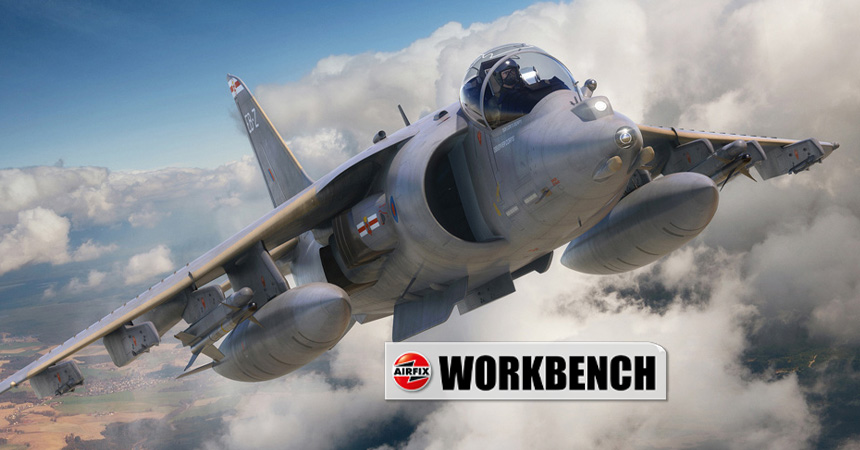
Stunning box artwork showing one of the last RAF Harriers flying high above its Rutland home base at RAF Cottesmore.
Although visually sharing many similarities with its famous predecessor, the Harrier II was a very different aviation beast altogether and can be thought of as a completely different aircraft in its own right. Effectively, this new generation of Harrier was related to its predecessor, but was a much more capable aircraft in every respect, a space age development on a similar VSTOL theme. The programme would result in the introduction of the much more capable Harrier GR.5 in 1987 and further successive upgrades over the next couple of decades which would keep the Harrier as one of the world's foremost strike/attack aircraft and one which possessed such unique attributes that it was described by many as being the most valuable fixed wing aviation asset available to any air arm.
With increased range, power and weapons carrying capability, this new generation of Harrier was intended to strike hard and fast, often at the outset of any military engagement, before returning once refuelled and rearmed to support infantry units in their endeavours. Always on station and always in the thick of the action, is it any wonder why military personnel hold the Harrier in the same affection in which the public always have.
This latest impending Harrier kit addition to the Airfix range presents the aircraft in the form most Workbench readers will probably remember it, that in the latter stages of its RAF career and in its most devastatingly effective form. An aircraft Britain always relied upon when it came to offensive overseas deployments, or when an aviation show of strength was required, let's take a look at the two scheme options which will accompany the impending release of this new BAe Harrier GR7A/GR9 kit.
With the changing face of the political landscape on both a World and European stage during the 1990s, the traditionally perceived military threats faced by Britain had altered significantly. The close air support capability and the ability to operate from aircraft carriers anywhere around the world made the British Aerospace Harrier arguably the most useful asset available to military planners and it was to be deployed successfully on numerous occasions in the years following the Falklands conflict. It was in this knowledge that the Government of the day issued their Strategic Defence and Security Review in October 2010, which amongst other savage cost saving measures, included the announcement of the early retirement of the highly capable Harrier force. Surely this was a mistake and would result in a sensible U-turn well before the intended date of retirement.
Despite immediate lobbying by aircrew and senior RAF officials alike and the realisation that this move would effectively leave Britain without a naval surface strike capability for many years to come, the proposed withdrawal date for Harrier was not removed and incredibly, was actually moved forward. In a move which still causes military observers and aviation enthusiasts alike to scratch their heads, less than two months after the SDSR plan was delivered to Parliament, the Harrier had been ignominiously wrenched from service.
An occasion which appeared to arrive with undue haste, the December 15th 2010 is a date which will live long in the memory of the UK aviation enthusiast, for all the wrong reasons. Whilst most of the population were preoccupied with last minute Christmas shopping, large numbers of aviation enthusiasts headed for a cold RAF Cottesmore, to witness the final flights of the RAF operated Harrier, to pay their own personal respects to an aircraft which many in attendance had grown up with. In the weeks leading up to this day, the weather across Britain had been extremely poor and the remaining pilots of Joint Force Harrier had seen opportunities to fly their aircraft seriously curtailed. That being said, they had no intention of letting this magnificent aircraft disappear into the history books without giving it a spectacular send off.
The day itself saw a continuation of the poor weather the country had been suffering and as the crowds assembled around the airfield boundary at Cottesmore, a blanket of low cloud shrouded the airfield, which was worryingly silent. As the snow began to fall, would the Harrier be allowed one final hurrah and a massed formation take off, before flying formation salutes over RAF stations and other locations linked with Britain's famous Harrier? Thankfully, the weather, although less than ideal, improved enough to allow sixteen aircraft to launch and embark on their proposed flypast route, however, it transpired that the weather around the country was equally bad, causing the planned formation flypasts to be cancelled.
Full scheme details of this specially presented RAF Harrier on the occasion of the retirement formation flight launched from its home base at RAF Cottesmore.
Returning to Cottesmore around an hour later, the conditions were so poor that the final formation passes over their home station could not be performed safely, so they broke into groups of four, before entering the pattern for landing. As RAF Cottesmore again fell silent once more, a very cold collection of enthusiasts made their way back to their cars and whilst this could never be described as an enjoyable experience, at least they could say that they were present when Britain’s Hawker Siddeley (British Aerospace) Harrier made its final official flight in UK skies.
One of the Harriers taking part in that fateful final flight, BAe Harrier GR9 ZG857 was built as a GR7 variant from an order placed in 1988 and given the construction number P89. Making its first flight in November 1991, it would be delivered to the RAF in January the following year and would later be upgraded to the more capable GR9 standard. During her final year of service, this RAF 41 Squadron Harrier was given special markings to commemorate the 70th Anniversary of the Battle of Britain, carrying the codes EB-Z on her tail, to represent the Spitfire Mk.IIA which was the mount of Squadron Leader Donald Finlay, the Commanding Officer of No.41 Squadron at RAF Hornchurch during 1940.
Finlay's Spitfire was one of two Spitfires which were purchased with funds raised by personnel of the Observer Corps and carried the name 'Observer Corps' proudly on its fuselage. Harrier ZG857 carried the Spitfire's EB-Z codes on either side of its tail and the legend 'OBSERVER CORPS' on both sides of its fuselage, under the cockpit canopy - an interesting presentation for an aircraft in the final days of RAF Harrier operations.
Scheme B - British Aerospace Harrier GR7A ZD437 'Michelle', Harrier Detachment, Operation 'Herrick', Kandahar, Afghanistan, November 2006.
Without doubt, the feature which made the Harrier famous and cemented its place in the hearts of aviation enthusiasts everywhere was its ability to take off and land vertically, a capability which gave the aircraft incredible versatility and making it something akin to a helicopter with the speed and hitting power of a fixed wing jet. In truth, performing a vertical take-off in an operational situation was something which rarely happened, as it would use too much fuel, place a strain on the engine and not allow the aircraft to operate with anything like an effective weapons load. A rolling take-off would still see the Harrier taking to the air in a much shorter distance than traditional strike aircraft, but would also allow it to carry a much more effective weapons load and additional fuel.
At its heart, the Harrier was a mud mover, an aircraft ground forces could rely on to help them dislodge enemy strongholds or particularly stubborn areas of resistance, saving the lives of countless troops in the process. As the Harrier II continued to be developed, this famous aircraft would become ever more effective, be that whilst operating from a land base, or from the deck of an appropriate ship - the Harrier didn't even need a large aircraft carrier from which to conduct offensive operations. As one of the most capable aviation assets in RAF service, Harriers were never too far from the world's conflict hotspots, such as Operation 'Herrick', Britain's commitment to supporting British and NATO personnel on operations in Afghanistan.
Providing air cover, ground close air support and air strikes against enemy insurgents, the first detachment of six RAF Harriers arrived at Kandahar Airfield in 2004, with aircraft remaining in theatre until Harriers were relieved by RAF Tornados in 2009. Flying a punishing schedule of these vital missions in support of ground operations, Harriers from Nos 3, 1 and 4 Squadrons would rotate through Kandahar during that time, augmented by No.800 Naval Air Squadron from September 2006 until January 2007.
During one of the busy periods of operational flying from Kandahar, a morale boosting visit was arranged for British troops to meet two rather high profile celebrities between flying commitments. Page three pin up girls Michelle Marsh and Lucy Pinder travelled to Afghanistan to show their support for the troops and in preparation for their visit, ground crews made two rather unique additions to a pair of their Harriers. Harrier ZD437 had a silhouette of Michelle Marsh applied to her nose at the head of her impressive mission marking scoreboard and was also named Michelle. Harrier ZD404 benefitted for a similar application, but this time a representation of Lucy Pinder and was named Lucy.
A scheme which will prove difficult to resist, this Harrier was one of the two Operation Herrick aircraft which benefitted from distinctive artwork additions to mark the visit of two page three celebrities to the RAF base at Kandahar.
The two ladies appeared to be rather taken with this unique tribute and several photographs of them posing with their respective Harriers were taken and used for publicity purposes. Unfortunately, RAF officials were less enthusiastic and quickly ordered the artwork removed, meaning that these Harriers would only carry their rather notorious artwork for a relatively short period. During Operation Herrick, the vast majority of British aircraft committed to the operation were based and operated from Kandahar.
BAe Harrier GR7 ZD437 made its first flight on 3rd November 1989 and was delivered to the RAF later that same month. She was one of the aircraft still based at Cottesmore on the occasion of the final flight on 15th December 2010, although she had long since shed her famous page three nose artwork.
As proved to be the case with most of the airworthy Harriers withdrawn from service in 2010 and in a move which infuriated a great many people at the time, the remaining British Harrier fleet of around 74 airframes, plus all available spares and associated equipment, were sold as a single lot to the Americans in 2011. They needed the aircraft in order to maintain their own fleet of US Marine Corps Harriers, which they intended to keep in service for many years to come. With many of the British aircraft only recently having undergone upgrade and re-fit at significant expense to the treasury, the Americans were getting something of an aviation bargain – one knowledgeable commentator at the time described how the US were ruthlessly taking advantage of the situation, benefiting from all the money the Brits had only recently spent on their Harriers. ‘It’s like we are buying a car with only 15,000 miles on the clock at a knock-down price’ and with that cost being just £110 Million, this was certainly a shrewd piece of aviation business.
A box to look out for - the re-introduction of the Harrier will be welcomed by a great many Workbench readers who don't need much of an excuse to spend some modelling time with this particular aviation classic.
The Harrier occupies such a unique position within the history of British and American aviation that it is perhaps no wonder that the aircraft is still remembered so fondly by so many people and when remembering how it was withdrawn from service in such dramatic circumstances, can still cause some quite heated debate to break out. This latest re-introduction of our 1/72nd scale Harrier GR7A/GR9 kit will therefore no doubt be an extremely welcome addition to the 2022 range, particularly as it includes two schemes which were at RAF Cottesmore on that fateful day in December 2010 and includes one of the infamous pin up Harriers. What we wouldn't give to see a Harrier display at this year's Royal International Air Tattoo.
That’s all we have for you in this latest edition, but we will be back with more project updates for you next week. As always, we are interested to hear your views on all things Airfix and particularly in relation to our Workbench blog, so if you ever feel like dropping us a quick line, please use our workbench@airfix.com contact e-mail address.
All our social media sites can be accessed by clicking the respective link icons at the foot of this page, or by heading to the Airfix homepage. Other useful Airfix links are:
Facebook, YouTube, Twitter and Instagram official sites
Please join us for more Airfix updates next week and thank you for your continued support.