Having safely negotiated the excesses (and floods) of the festive period, it is always nice to get back to some sort of normality and get stuck into some good honest work. For Airfix Workbench readers, that means more information from our beloved hobby and all the latest news and views from Britain’s major plastic kit manufacturer.
Our Workbench blog started at the beginning of July last year, and since this first issue we have brought you news of a large number of new Airfix model toolings, product updates and a host of other modelling related information. Thankfully, readers of the blog seem to enjoy receiving our regular updates and reader numbers continue to increase as each new edition of Workbench is published. Importantly, all the interesting information contained within previous Workbench blogs will remain on the Airfix website, so new and existing readers can view this content at their convenience. We will certainly be looking to continue this successful formula throughout 2016 and to further enhance the benefits available to Workbench readers – thank you very much for your support over the past six months.
As we only started publishing our development blog during the summer of 2015, some of the superb models that are now appearing on the Airfix website, and at your favourite model supplier, have not yet featured in Workbench which is something of a shame. These beautiful models have been developed using the highly advanced production processes now in place at Airfix, which has won the company so many modelling plaudits over the past few years. As we continue with our fortnightly blog production schedule, we intend to include some of this previously unseen existing model development information, along with the new tooling and product update information you have come to expect from Workbench. For this twelfth edition of Workbench, we will begin by looking at a classic 1/72nd scale model tooling from Airfix, which marks one of the most enigmatic fighter aircraft to ever see RAF service and heralded the end of an aviation era. Even though it is a couple of years since this particular kit was released, it is well worth taking a look at the development of this magnificent model.
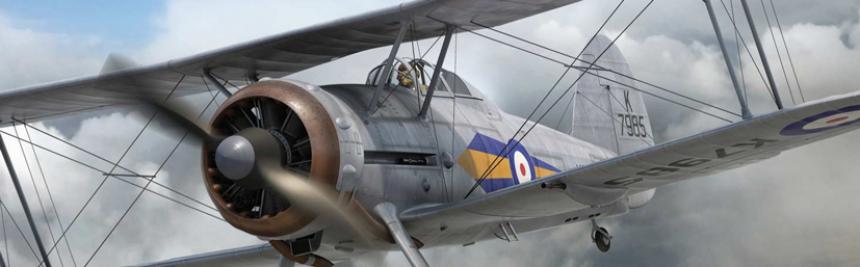
 The unmistakable profile of Britain’s ultimate biplane fighter
The speed of aircraft development following the Wright brothers' first powered flight in December 1903 proved to be nothing short of astonishing. Just 33 years after the Wright Flyer 1 made its historic flight in the skies above North Carolina, the prototype Supermarine Spitfire was blasting into the air at Eastleigh aerodrome, near Southampton and with it heralding the age of the monoplane. For many aviation enthusiasts though, the period of aviation between the Wright Flyer and the Spitfire is regarded as the golden age of aviation, with some of the most significant and aesthetically appealing aircraft taking to the skies during this time. The age of the biplane finally allowed man to conquer the skies once and for all and transformed the aeroplane from a flimsy powered glider, to arguably man's most notable invention, with a multitude of military and civilian applications.
Britain has always been at the forefront of aviation design and the period immediately prior to the start of the Second World War saw British aviation companies producing any number of aeroplanes, which were at the very pinnacle of aviation technology at that time. Aircraft such as the Bristol Bulldog, Fairey Swordfish, Hawker Fury and Gloster Gauntlet were some of the most advanced aircraft in the world and were pushing the performance of biplane technology to its very limits, as the RAF were desperate to stay ahead of any potential adversary. At the head of this group of RAF biplane fighters was the majestic Gloster Gladiator, which proved to be the last aircraft of its type to see RAF service and for many, was one of the most beautiful aircraft ever produced. Unfortunately for the Gladiator, despite its place as the most accomplished RAF biplane fighter, it entered Squadron service as both the Hurricane and Spitfire were clearly showing the future of British fighter design.
 The beautiful Gloster Gladiator Mk.I of the Shuttleworth Collection
As the last in the line of RAF biplane fighters, there is no doubting that the diminutive Gloster Gladiator has an extremely important place in the history of British aviation, not to mention the fact that it happens to be arguably one of the most attractive aeroplanes Britain has ever produced. It has certainly been a popular subject for the aviation modeller over the years and since the original 1/72nd scale Airfix model was released in 1956, it has proved to be one of the best selling kits in the range and I am sure that many of us have attempted to build it at least a couple of times. As one of the most appealing RAF fighter aircraft, the Gladiator was crying out for an upgrade to modern manufacturing standards. After serving the Airfix range faithfully for over 57 years, the original Gloster Gladiator tooling was replaced with a magnificent new example in 2013, bringing this attractive aircraft to the attention of a new generation of modellers.
At the start of any new model tooling project, obtaining the most accurate supporting research material is absolutely crucial to the success of the potential new kit. The Airfix designers have amassed an impressive collection of aviation plans, drawings and reference materials in their library, but should they require more specific, or difficult to corroborate information, they can call on the help of some invaluable aviation industry contacts should they need to. For the new Gladiator project, the team already had a robust research file in place, but they desperately wanted to produce the most accurate model that they possibly could. Even though 747 Gloster Gladiators of all production marks were manufactured between 1934 and 1940, very few of these aircraft survive intact to this day. Fortunately for Airfix and the UK aviation enthusiast, not only can we find examples of the Gladiator at a number of museums in the country, but we are also lucky enough to have the only two airworthy Gloster Gladiators in the world based in the UK. An important part of the research process for this new model was the opportunity for the Airfix team to inspect an airworthy Gloster Gladiator at close quarters, taking detailed measurements and hundreds of photographs in the process.
 Research is the key. Members of the Airfix team inspect the Gladiator
Thanks to the magnificent people at Old Warden Aerodrome in Bedfordshire, which is home to the famous Shuttleworth Collection, the Airfix team were allowed to inspect the collection’s incredibly rare Gladiator Mk.I, which provided invaluable data for the new model. The Shuttleworth Gladiator (L8032 / G-AMRK) was for many years, the only airworthy Gladiator in the world and as such, one of the most important historic aircraft in Britain. Coming to the collection in 1960, following an extensive period of restoration by the original manufacturers of the aircraft, the Shuttleworth Gladiator has been presented in a number of schemes over the years, but the current livery is that of Gladiator Mk.I K7985, which flew with RAF No.73 Squadron between June 1937 and July 1938. During this time, the Squadron was based at RAF Debden for a short time, before transferring to RAF Mildenhall – having spent just a year flying the Gladiator, the No.73 Squadron converted to Hawker Hurricanes in July 1938, with No.3 Squadron taking their biplane fighters.
 Gloster Gladiator L8032 G-AMRK at Old Warden aerodrome
Once the Airfix team returned from their trip to Old Warden, the valuable information they gathered was collated and used to produce a digital base model CAD file (raw shell data file), which is a highly detailed 3D data version of the technical information, which will be used as a design trace for the project. Once this impressive software has processed all the available data, the design trace files it produces are incredibly flexible and allow the designers access to a multitude of options as they begin to construct the individual parts for the new model. This stage of the process can be incredibly time consuming and depending on the complexity of the particular kit they are working on, may take several months to complete. Not only do all the individual parts of the model have to be designed, they also have to consider the manufacturing process itself and the minimum/maximum tolerances that will be required by the injection moulding process.
During this stage, the new model can really be brought to life digitally, as the design software allows for screen grabs of the model to be taken, which can be further enhanced by running it through a clever shading process, known as rendering. These 3D computer rendered images are incredibly detailed and very appealing to the modeller – they bring the entire project to life and can be used as an extremely effective marketing tool, once the new model has been cleared for announcement. Even though this seems to suggest that the model is quite advanced and may be due for release in the near future, there is still much work to do and it will be many months before test frame shots of the kit are delivered to the designers.
 Computer rendered 3D image of the classic Gladiator Mk.I
 This computer rendered image shows the unusual main wheel skis attached, as seen on A02063
 Computer rendered 3D image of the Gladiator engine detail
Once the team are happy with the 3D CAD files, they are sent to a professional prototype model maker, who will produce an accurate resin prototype model, which will be used to check the general shape and dimensions of the new model. The resin model may be supplied in a number of component pieces, which will need to be assessed and assembled by the design team, but this important stage of the process will highlight any issues regarding the fit of individual kit parts that will need to be addressed before the model can proceed to tooling production. Once the design has been approved and the project finance has been agreed, the model can proceed to tooling production and could theoretically be announced at any time from this point.
That is as far as we will go with the development of a new model for this edition of Workbench and will look to cover the tooling production process and beyond in detail as part of a future edition. The details above really do illustrate how technically demanding and time consuming the production of a new model kit actually is and how a modeller's latest build project will have been produced following many months of development work by the Airfix researchers and designers.
 Box front artwork of 1/72nd scale Gladiator Mk.1 A02052
As most Workbench readers will already be aware, the 1/72nd scale Gloster Gladiator kit has been available for a couple of years now, but it is currently still available on both the Airfix website and at your preferred model stockists. There are currently two separate kits available, both of which offer the modeller two decal options with which to complete your model – they are:
 The Shuttleworth Collection Gloster Gladiator Mk.I - A02052
A02052 – this kit builds as a Gloster Gladiator Mk.I and includes options to complete your model as either:
Gloster Gladiator Mk.I, K7985 (L8032 / G-AMRK), The Shuttleworth Collection, Old Warden Aerodrome, Bedfordshire, 2012, Presented in the colours of K7985, RAF No.73 Squadron, RAF Debden, 1937
or
Gloster Gladiator Mk.I, Black 26, No.1 Fighter Squadron, Irish Air Corps, Baldonnel Aerodrome, Ireland,1940

A02063 – This separate kit builds as a Gladiator Mk.II and includes alternative parts, including the interesting option to construct this kit with undercarriage skis, which allowed the Gladiator to be operated from frozen lakes in Finland. The two model scheme options included are:
 This unusual Gladiator is equipped with undercarriage skis
Gloster J-8A, ’13-F’, Flyflottilj 19, (Swedish Voluntary Air Force), Finnish Air Force, Kemi, Northern Finland, 1940
or
Gloster Gladiator Mk.II, N5583 HE-Q, RAF No.605 (County of Warwick) Squadron, Tangmere, Sussex, August 1939
I am sure that many of our readers will have already completed this latest incarnation of the Airfix Gladiator in one of the above schemes and it will be looking resplendent on your display shelf! Some of you will have decided to finish your model in different markings, but whatever the scheme, please do send us your pictures and we may include them in a future edition of Workbench, or add them to the Airfix website for all to enjoy.
 The magnificent box artwork for the new 1/48th scale Defiant Mk.I
Without doubt, one of the most eagerly anticipated new model tooling releases is that of the magnificent 1/48th scale Boulton Paul Defiant Mk.I turret fighter. Arguably one of the most interesting RAF aircraft of the Second World War, the Defiant has long been a favourite subject with the modeller and this new, highly detailed kit will certainly create a surge of interest in this most unusual fighter of the Battle of Britain era. If the prospect of getting your hands on this fantastic new kit was not exciting enough, feast your eyes on the magnificent box artwork that will accompany this release – I really don’t think there is any need for words!
For this latest edition of Workbench, we are pleased to be able to tell you that the estimated release date for the 1/48th scale Defiant is the end of February this year and the decal options that will be available in the kit are as follows:
 Decal scheme for the RAF No.264 Squadron Defiant Mk.I
Scheme A: Boulton Paul Defiant Mk.I, L7026 / PS-V, RAF No.264 Squadron, Martlesham Heath, Suffolk, July 1940
 Decal scheme for the Army Cooperation Defiant Mk.I
Scheme B: Boulton Paul Defiant Mk.I, N1572 / KO-I, RAF No.II (Army Cooperation) Squadron, Hatfield Woodhouse, South Yorkshire, September 1940
It is safe to say that this is going to be an incredibly popular new addition to the Airfix range of 1/48th scale kits and potentially, one of the most significant modelling releases of 2016. To make sure that you are one of the first people to receive one of these superb new Defiants, head for the Airfix website now and pre-order your kit.
 The night attack artwork used on the Blenheim Mk.IF is stunning
You may recall that the last edition of Workbench posted in 2015 included an update on the forthcoming new 1/72nd scale Bristol Blenheim Mk.IF release, including details of the decal schemes that would be available with the kit. We can now confirm that the estimated release date for the Blenheim is March 2016 and we are now in a position to issue the final update on this new tooling release – the box artwork. Over the years, Airfix have enjoyed a proud history in providing highly appealing box artwork to accompany their model releases, but it has to be said that the standard of the latest artwork is absolutely outstanding. The image that will adorn the new Blenheim Mk.IF release shows this enigmatic scene of a night duel being fought above a burning city and will surely inspire many modellers to build this particular version of the Bristol Blenheim. Not long to wait for this one now folks!
 Box artwork on the recently release 1/72nd scale Stuka A
We end this latest edition of Workbench with the exciting news that the new 1/72nd scale Junkers Ju-87B-1 Stuka (A03087) has been released and is now available on the Airfix website or at your usual model supplier.
This new tooling release has been produced using the very latest design and manufacturing technologies and builds in to an extremely impressive model of this distinctive WWII attack aircraft. Arguably the most feared component of Blitzkrieg, the Stuka was a devastatingly effective strategic dive bomber and close support aircraft, which helped to speed the advance of the Wehrmacht right up to the northern coast of France. The air battles above the Dunkirk evacuation and the Battle of Britain proved to highlight the vulnerability of the Stuka to enemy fighter attack and although it continued in production until the end of 1944, the Stuka would rarely operate in opposed airspace without the protection of its own fighter cover. The picture below features a test build example of the new Stuka, which was photographed on a recent visit to Hornby HQ and illustrates the fine levels of detail available with this new kit. As usual, if you have just built one of these new Stuka kits, please do let us have your model pictures, so that we can post them on the Airfix website.
 The detail on the new Airfix Stuka is certainly impressive
That’s your lot for this edition of Workbench - we hope that you have enjoyed the read and that we had something of interest for you. We will see you back here in two weeks for another instalment of Airfix goodness, but in the meantime, if you have any suggestions for future editions, or if you have any kit build images you would like to send us, please do so.
You can get involved in all the latest Airfix modelling chat on our dedicated Workbench thread on the Airfix Forum, or alternatively, via our Facebook or Twitter social media channels, using #airfixworkbench.
Until next time, enjoy your modelling and be careful with that glue!
The Airfix Workbench Team
© Hornby Hobbies Ltd. All rights reserved.