Welcome to this latest edition of our Workbench blog and all the news, updates, and modelling exclusives from the fascinating world of Airfix.
It’s somehow fitting that whilst we still find ourselves just about in the 85th Anniversary year of the Battle of Britain, that our 1/48th scale model tribute to the RAF’s most unusual fighter type to take part in this aerial duel has just returned to the current Airfix range. An aircraft which remains relatively anonymous to the majority of the world’s population, and can be quite divisive amongst those who are aware of it, the Boulton Paul Defiant may well have been a fighting contemporary of the Supermarine Spitfire and Hawker Hurricane, but it has never been able to compete with either in the aviation popularity stakes, despite being far more interesting a design than both in the eyes of many.
Unquestionably one of the more interesting British aircraft types of the Second World War, whilst we won’t be producing a Defiant charm offensive edition of Workbench this weekend, we will be welcoming the re-introduction of our beautiful 1/48th scale kit version of the aircraft to the current range by looking at why Britain’s turret fighter is definitely worthy of modelling subject consideration. We will also be challenging one or two popular misconceptions about the Defiant in operation, and how no modelling tribute to the ’Few’ can be considered complete without the inclusion of at least one Boulton Paul Defiant within that display.
We prepare to sign off on this 85th Anniversary year of the Battle of Britain with the Defiant return of a classic 1/48th scale model kit in this latest edition of Workbench.
A fighting stablemate of the Spitfire and Hurricane during the Battle of Britain, the Boulton Paul Defiant was an interceptor with a difference.
The subject of aviation history continues to be a source of fascination for millions of people around the world, and is full of interesting stories and details which elevate some aircraft types to almost iconic status, whilst others remain firmly lurking in the shadows. During the summer of 1940, the British nation was fighting for everything it held dear, and the stakes could not be higher. At the start of a devastating conflict, British and Allied forces had suffered a succession of crushing defeats, and with their enemy appearing invincible during those early months of war, they were now massing ominously for an assault attempt against our island.
With hundreds of fighter aircraft being lost during the fighting over France, and during the miraculous evacuation of Dunkirk, which was still another military defeat, it now seemed that the fate of the nation depended on around 600 operational fighter aircraft and their pilots who were mainly combat novices. If it were down to just numbers on a balance sheet, then surely Britain should be preparing to approach German officials to discuss terms for a secession of hostilities, but thankfully wars are not fought on paper and Britain stood ready and determined to repel the raiders.
At a time when the Royal Air Force were undergoing a concerted period of modernisation and upgrade during the 1930s, the Air Ministry issued a specification for a new two seat monoplane fighter, one able to operate by both day and night and one which featured a powered gun turret. At that time, the thinking amongst military officials was that any major future conflict would see large formations of bomber aircraft attempting to bomb their enemies into submission, with these formations able to defend themselves against enemy attack, making traditional fighters effectively obsolete.
That being the case, the idea of a turret fighter was seen as being a significant advantage, with the aircraft able to fly alongside formations of bombers, bringing the withering directional firepower from its machine gun arrangement against the enemy using a broadside attack, in a similar way to how a battleship will bring all its main guns to bear against a target.
That brings us nicely to the subject of popular misconceptions relating to the Boulton Paul Defiant and its intended operational use. Often described as a bomber killer, it may well have been conceived and developed to bring down enemy bombers in aerial engagements, but the Defiant was a fighter aircraft pure and simple, just one equipped with a turret. It was intended to be used as part of a combined defensive force, alongside more traditional single seat fighters, with the combined force aiming to take a heavy toll of any enemy aircraft sent against them.
Built model examples of this fantastic kit wearing both of the scheme options included with this release.
The second misconception concerns the widely held view that the Defiant could not defend itself by firing forwards, which again isn’t exactly a true reflection of its actual capabilities. It’s fair to say that the intended attack profile for the fighter was for the pilot and gunner to act in perfect unison, bringing the four machine guns in the turret to bear against enemy aircraft in a wide arc of firing situations, and that the Defiant wasn’t equipped with fixed forward firing guns in its wings like a Spitfire or Hurricane. Having said that, a Defiant pilot did have a firing button on his control column spade grip, but why would he need this if the guns couldn’t be fired forwards?
In certain situations, the Defiant’s guns could be fired forwards, but it would require the gunner to hand control of the weapons to his pilot beforehand. The turret would be traversed fully forward, and the guns elevated to an angle of around 22 degrees from level, to avoid the bullets striking the aircraft’s propeller – if the fire control switch had been moved to ‘PILOT’, then he had control and was free to fire the guns. Obviously, this would be extremely useful if attacking an enemy aircraft from behind and below, a tactic often employed during night attacks, but we’ll come to that a little later.
The Prototype Defiant made its maiden flight from Pendeford Airfield, Wolverhampton on 11th August 1937, powered by the new Rolls Royce Merlin I engine, but at that time, minus the dorsal turret which was to become such a controversial feature of the aircraft. A second prototype, this time powered by a Merlin II and featuring the turret, made its first flight from Boulton Paul’s factory site on 18th May 1939, cutting it a little fine considering what was about to happen the following September.
The first production Defiant Mk.I flew on 30th July 1939, this time powered by the 1,030 hp Rolls Royce Merlin III engine, posting a top speed of 304 mph, a service ceiling of just over 30,000 ft and with an operational range of 465 miles. The first operational squadron equipped with the Defiant was No.264 Squadron in late 1939, and they would be joined by No.141 Squadron in April the following year, which clearly illustrates how the Boulton Paul Defiant made both its first flight, and RAF squadron introduction later than both the Hawker Hurricane and Supermarine Spitfire.
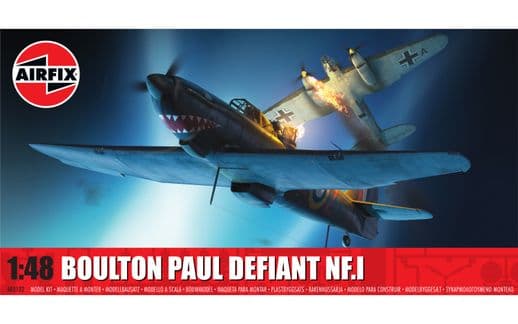
Airfix box artwork showing how the Defiant was intended to be used in the interceptor role by day.
Early combat operations for the RAF’s new turret fighter proved to be rather successful, with the additional arc of fire proving to be a most unwelcome surprise for Luftwaffe fighter pilots who had misidentified the Defiant with a Hurricane. The usual method adopted by fighter pilots in attempting to claim an aerial victory was to close in behind their intended victim, where he would both find it both difficult to see you and to defend himself. If you did manage to gain this advantageous position, you had your enemy right where you wanted him, indeed any station behind your adversary placed you in an advantageous combat situation.
Having a very similar profile to the Hawker Hurricane, the Defiant would initially score some significant combat successes against Luftwaffe aircraft, even against the much vaunted Messerschmitt Bf 109 fighter, due to their unfamiliarity with the type. Attacking the Defiant as they would a Hurricane, Messerschmitt pilots would soon realise their mistake, because when they lined up to press home their flank attacks, they would be caught in a hail of bullets from the Defiant’s four 0.303 Browning machine guns.
If they were fortunate enough to survive this significant misidentification error, their experience could be relayed back to fellow fighter pilots, who would be sure to look for the fighter with a turret during their next combat sortie. Confident and extremely well trained, Luftwaffe pilots were quick to identify the strange new British fighter and crucially, how to exploit its defensive weaknesses during an attack. The Defiant’s big secret was out and the additional weight of that turret and extra crewman made it easy prey for the highly manoeuvrable Messerschmitts.
The most successful day for Royal Air Force Defiant Squadrons would come on 29th May 1940. Flying operations covering the evacuation of troops from the beaches at Dunkirk, Defiants from No.264 Squadron claimed an impressive 37 Luftwaffe aircraft destroyed whilst flying two operational sorties that day. Amongst the enemy aircraft claimed were nineteen Ju-87 Stukas, many of which were destroyed as they pulled out of their bombing dives, when the aircraft and their disorientated crews were at their most vulnerable.
They also dispatched nine Messerschmitt Bf 110 heavy fighters, eight Messerschmitt Bf 109 single engined fighters and a solitary Junkers Ju-88 bomber, but perhaps the most significant factor behind these figures was how they were achieved for the loss of just one Defiant air gunner, a fact which is in itself worthy of further explanation.
The Defiant in which the gunner was flying was involved in savage combat with a Luftwaffe Messerschmitt Bf 109 fighter, one which seemed determined to claim their aircraft as potentially his first Defiant victory. In order to try and shake the enemy fighter from his tail, the Defiant pilot performed a series of violent evasive manoeuvres, erratic flying which appeared to be going on for much longer than his gunner had anticipated. Further back in the fighter, the gunner couldn’t get a clear shot at the enemy fighter, possibly because his guns, or even the powered turret itself had stopped working.
Another view of the built model images, this time with the subject schemes displayed in reverse order, with the sharkmouth Defiant at the rear.
An unusual and fascinating image. Shown exclusively for the benefit of Workbench readers, this shows the digital artwork files for the Defiant concept artwork in layered format, before the image background had been added.
As he could see bullets flashing past the Perspex of his turret and he couldn’t communicate with his pilot, he must have assumed that the violent ride was the result of him having been killed or sustaining serious injury, so feeling that his situation was now desperate, he released his harness and rolled out of the turret, taking to his parachute. Incredibly, the Defiant managed to evade the attentions of the attacking Messerschmitt and make it back across the English Channel, and as a result, not a single Defiant was lost that day. The damaged aircraft was repaired and returned to active duty just a few days later.
Despite those initial successes, Luftwaffe pilots had already worked out the limitations of the Defiant as a day fighter and as the Battle of Britain fighting intensified, so Defiant crews became increasingly vulnerable to enemy fighter attack. This situation was brought tragically into focus on 19th July 1940, when the Defiant’s of No.141 Squadron were almost wiped out within the first few minutes of a single engagement.
Sent to provide air cover for a convoy just off the coast of Folkestone, the Defiant’s were bounced by the Messerschmitt Bf 109s of Jagdgeschwader 51, who’s pilots made no mistakes in identifying the British turret fighters. During the opening seconds of the attack, six Defiants were shot down almost straight away, with the remaining aircraft all suffering heavy damage. Indeed, the damaged aircraft not shot down during the first pass only managed to make it back to base thanks to the intervention of the Hurricanes of No.111 Squadron. It was obvious that the Defiant simply couldn’t defend itself against enemy fighters in heavily contested airspace, and unless they could rely on their own fighter protection, were unlikely to make it back unscathed.
The heavy losses experienced during the Battle of Britain would see remaining Boulton Paul Defiant fighters immediately withdrawn from daylight operations. Remaining aircraft were sent north for a period of respite and replenishment, tasked with providing protection for cities in the Midlands and the Northwest, whilst exhausted crews were given the time they needed to re-train for night defence operations. This switch didn’t come without its own problems, as crews had not been trained to use their aircraft in a night operations role, and would be developing their own interception techniques as they flew more night sorties.
They learned quickly and soon began to score victories against the Luftwaffe night raiders, with the Defiant and its crews helping to establish both a cohesive night defence system for the country, and rebuild the tarnished reputation of the much maligned Boulton Paul Defiant. These all black painted ‘nocturnal hunters’ would go on to become some of the most distinctive RAF aircraft of the Second World War, and provide vital night defence support as the Luftwaffe mounted their Blitz campaign. It’s interesting to note that only two squadrons operated the Defiant as a day fighter during the Battle of Britain, but thirteen would be equipped with the aircraft in the nightfighter role.
Defiant artwork in all its glory. The night shark in hunting mode!
Workbench regulars will be only too aware that the publication of our development blog over the past decade or so, has allowed us the opportunity to follow the design of all the most recent Airfix new tooling additions to the range, from initial announcement right through to their initial release. Historically, the 1/48th scale Defiant was announced in just the second edition of Workbench, the first 1/48th scale project to be unveiled in this manner.
That exclusive announcement included details of how the team secured the information they needed in support of this project, including how they had the opportunity to visit the Medway Aircraft Preservation Society back in 2012, whilst they were in the process of restoring the RAF Museum’s original Defiant, the aircraft which is now on display at the RAF Museum Midlands, only a few miles from where it was produced during 1940. Although the project wasn’t on their schedule at the time, the opportunity to inspect this unique aircraft during a restoration project was just too good to refuse.
This beautifully accurate scale representation of one of Britain’s most unusual wartime aircraft eventually joined the Airfix range in 2016, and since that date, has become a firm favourite with the modelling community. As mentioned earlier, we’re absolutely delighted to have the Defiant available once again, particularly as we still just about find ourselves in this 85th Anniversary year of the Battle of Britain. Presenting the aircraft in its more successful nightfighter role, let’s take a closer look at the two appealing scheme options included with this popular kit re-introduction.
There can be no doubt that Boulton Paul Defiant Mk.I N3328 has to be one of the most interesting aircraft to ever see RAF service during the Second World War. It was unusual for home based Royal Air Force fighters to be adorned with any form of nose artwork, let alone something as distinctive and elaborate as the markings carried by Defiant N3328. Sporting a gaping shark mouth and eyes which made it seem as if this aircraft was a living, hunting being, the markings look all the more impressive because they were applied to an aeroplane wearing a black nightfighter scheme – it really does look magnificent.
Wearing the colours of RAF No.151 Squadron, this aircraft was flown by future ace pilot Henry Bodien, as well as Battle of Britain ace Warrant Officer James Hopewell, but despite the distinctive nature of its appearance, the origins of the artwork and why officials allowed to continue flying whilst wearing them remains something of an aviation mystery. Was it a morale boost for Defiant crews who had suffered at the hands of the Luftwaffe during the Battle of Britain, or was it to strike fear in the hearts of Luftwaffe bomber crews being stalked by this nocturnal predator?
For people living in the Northwest of England, this Defiant has particular significance for them, even if for particularly tragic reasons. With this aircraft having been sent to a maintenance unit for repair or upgrade towards the end of 1941, Defiant N3328 was allocated to No.1 Air Armament School at Manby in Lincolnshire and from there, subsequently onto No.10 Air Gunners School at Walney Island in Cumbria.
Following that latest allocation, pilot Flight Sergeant John Leslie Goulter was flown as a passenger to RAF Manby on 23rd October 1942, with orders to pick up N3328 and fly it back to his home base at the Walney Island Air Gunners School the following day. The cross-country transit route for the flight back should have taken the pilot just over an hour to complete, with the aircraft taking a route which took it over Doncaster, Selby and Harrogate, before arriving in the circuit at RAF Walney, near Barrow-in-Furness on the Cumbrian coast.
Full scheme details for this unusually presented nocturnal Defiant, followed by a built model finished in this appealing scheme.
As the Defiant took off from Manby at 10.40am on 24th October, it seems as if the pilot had decided to take a more direct route to his home airfield than originally planned, and whilst he was flying over the Lancashire village of Barnoldswick, the aircraft was met by a freak, violent hailstorm. The storm was so severe that it caused the pilot to become completely disorientated, but aware that there was high ground in the vicinity, he began to orbit the town below, presumably hoping for a break in the weather, so he could confirm his position.
Unfortunately, there was no let-up in the conditions, which actually seemed to be deteriorating still further, leaving the frantic pilot with few options, but no points of visual reference to help him get his bearings. Fearful of the high ground nearby, it seems that the lack of visual references causing him to stall the aircraft, something which would have tragic consequences.
Local people who witnessed the incident later described how they could hear the aircraft flying above the village in the storm, and how the engine appeared to be surging erratically, however, this may have been exacerbated by the high winds and stormy conditions. As the hailstorm gave way to driving rain, the engine sound became much louder, and witnesses saw the Defiant emerging from the low cloud at a 45-degree angle and at high speed. Tragically, the Defiant impacted the ground at that same high speed, without the pilot taking any corrective actions.
It was unusual for a home based RAF fighter to feature such elaborate nose artwork as this night fighting Defiant.
Due to the speed at which the aircraft impacted the ground, it settled deep into the wet soil, and as there were no signs the pilot had managed to take to his parachute, there were obvious concerns for his safety. A subsequent inspection of the wreckage reported that the aircraft’s wing had impacted hailstones filling the gap between the extended flap and the wing itself, something which may have been a significant contributory factor in causing the crash, and clearly highlighting the severity of the storm.
Later that same day, the local Home Guard unit recovered the body of the unfortunate pilot who had indeed perished as a result of this unfortunate incident. Flight Sergeant John Leslie Goulter was from Queensland, Australia and was a young man of just 22 years. He was just one of so many pilots to lose their lives serving in overseas lands during the Second World War, far away from their homes and loved ones, but determined to do their duty. This was his first time he’d ever been ordered to undertake such a cross-country aircraft ferry flight, flights which tragically took the lives of so many pilots during the Second World War.
Early RAF nightfighter operations must have been challenging and extremely frustrating for Defiant crews attempting to intercept the latest German raid. Having scrambled from their home airfields and been vectored towards the approaching raid, crews would often fail to locate any enemy aircraft at all, even though they could clearly see the glow of fires from the bombs falling on nearby towns and cities. In addition to this, due to their lack of experience in flying at night, they would be constantly checking their instruments, trying to ensure that their aircraft was flying straight and level, as it was so easy to become disorientated in dark night skies. This understandable self-preservation left the pilot little time for scanning the night skies looking for enemy aircraft.
As Britain struggled to establish an effective night defence force, there were also tragic cases of friendly fire incidents, as the confusion of fighting at night made the identification of friendly aircraft incredibly difficult for crews and anti-aircraft gunners alike. In some cases, pilots had absolutely no idea that the aircraft they may have just engaged was an enemy machine, with the true impact of these incidents only coming to light many years later.
As Luftwaffe losses began to mount during daylight raids, they increasingly turned their attentions to bombing Britain by night and the RAF’s fledgling nightfighter force had to quickly find its feet as a cohesive fighting force, meeting this new challenge head-on. They would have plenty of opportunity to perfect their skills.
Boulton Paul Defiant N3313 was the regular mount of Battle of Britain Spitfire ‘ace’ pilot Squadron Leader Philip Sanders, a man who continued to fly operational missions despite being assigned to an administrative post at No.11 Group headquarters. Flying throughout the Battle of Britain with No.92 Squadron, Sanders was credited with 6 enemy aircraft confirmed destroyed, a further aircraft unconfirmed and two noted as probable victories. He was also involved in an unusual story that would result in him requiring a period of hospitalization for what could be described as self-inflicted injuries.
Although not featuring shark teeth markings, this second Defiant scheme option is nonetheless rather unusual in presentation.
Returning to Biggin Hill in his Supermarine Spitfire which had been damaged during combat with the Luftwaffe over Dover, a relieved Sanders climbed out of the cockpit of his fighter and lit a cigarette to help alleviate the stress of the situation, and promptly burst into flames. Unbeknown to him, his batman had removed a stain from his pilot’s tunic using 100 octane fuel the night before, a potential peril he could not have foreseen!
Thankfully, his injuries were not severe, and Sanders would eventually go on to take command of No.264 Squadron and their night fighting Boulton Paul Defiants, before heading to the US during 1942, where he would spend time as a fighter test pilot.
This aircraft was also previously flown by successful Defiant partnership of Flying Officer Desmond Hughes and his gunner Sergeant Fred Gash, a pairing who managed to master this unusual aircraft and claim several Luftwaffe aircraft destroyed. As we can see from the profile artwork above, this aircraft featured a thin yellow surround to the toned-down fuselage roundels, yet retained the white section on the fin flash, making this a rather strange representation of the Defiant in nightfighter form.
One of the more interesting aircraft of the Second World War, the Boulton Paul Defiant makes for a stunning modelling project and in this larger 1/48th scale really does look superb. The two scheme options available with this re-introduced kit present the Defiant in the role for which it’s best remembered, and the one in which it arguably had its ‘finest operational hour’.
A significant part of Britain’s rich aviation heritage. I wonder how many people have walked right past this magnificent aircraft without realising its historical significance.
When it comes to British aviation heritage, the Royal Air Force Museum have long been the custodians of some of the most significant preserved aircraft in the world, with many of them on display for visitors to admire all year round. Some of them are far more important than most people realise, and thousands of regular visitors walk right past them, without fully embracing their historic significance, including one at RAF Cosford which is on display just a few miles from where it was built back in 1939.
An aircraft which arrived at Cosford as part of the RAF Museum’s RAF Centenary renovations, Boulton Paul Defiant Mk.I N1671 is for many people in the Midlands region, the most important aircraft currently on display at Cosford (or more accurately, the RAF Museum Midlands). The only surviving complete and original example of its type to be found anywhere in the world, this aircraft was originally manufactured at Boulton Paul’s Pendeford Wolverhampton factory in late 1939, a site which was situated just a few miles from where the aircraft is currently on public display. As such, its relocation was welcomed by many as something of a homecoming for the aircraft, and whilst the factory site is now long gone, it’s hoped that the Defiant will remain at Cosford indefinitely, as this superb museum is surely the most fitting home for this unique aeroplane.
Allocated to No.307 Lwowski (Polish) Squadron at Kirton-in-Lindsey in September 1940, N1671 has the distinction of serving with the first and only RAF Polish nightfighter unit of the Second World War. As the unit trained up for night operations, they would be relocated to RAF Jurby on the Isle of Man, where they would engage in shipping patrol flights, whilst also continuing with their training for the night defence of the Northwest of England. The fighter’s first operational sortie took place on 12th December 1940, which turned out to be a relatively uneventful flight lasting 1 hour and 35 minutes. This would set a pattern of operational things to come, as this aircraft would go on to have a relatively uneventful service career.
Built just a few miles down the road, it is to be hoped that Defiant Mk.I N1671 will be allowed to remain at Cosford for many years to come, as a tribute to the aviation industries of the West Midlands
In January 1941, the aircraft was sent to No.6 MU at Brize Norton to be fitted with VHF and IFF radio detection equipment, where she would also be repainted in an all-black nightfighter scheme. When she flew back to her Squadron, they had moved to Squires Gate airfield at Blackpool, ideally placed for the night defence of Manchester and Liverpool.
After negotiating its service career relatively unscathed, N1671 was selected for potential museum display duties, a decision which thankfully saved this magnificent aircraft from being scrapped, like so many of its contemporaries. One of the significant restoration projects undertaken by the Medway Aviation Preservation Society many years later, the Defiant is perhaps their greatest achievement and took a team of 30 volunteers an impressive 30,000 man hours to complete, an achievement every one of them should be rightly proud of.
The aircraft was returned to the RAF Museum Hendon in December 2012 and by March the following year, it was reassembled and back on public display, for many, the most interesting aircraft in their impressive Battle of Britain hall. Perhaps the most important journey in this aircraft’s recent history occurred at the end of 2016, when it made the road trip from Hendon up to Cosford in a blaze of publicity across the West Midlands. As this unique aircraft was to go on display just a few miles from where it was constructed and made its first flight, Britain’s only remaining original Defiant had finally come home!
On the loose again, this fabulous kit is a fine way with which to sign off on this year’s 85th Anniversary commemorations of the Battle of Britain.
Such a beautiful aeroplane, this 1/48th scale kit representation is a fitting way with which to make more people aware of this unusual aircraft, and to give it the historic recognition it has missed out on since its service introduction just prior to the start of the Battle of France, and subsequent Battle of Britain. An aircraft type which can always be relied upon to stimulate plenty of debate, there is no doubting how spectacular it looks either on display at Cosford, or as part of a scale model display, and as a single engined fighter sporting a powered dorsal turret, it’s always guaranteed to demand attention, particularly if displayed next to a Spitfire and Hurricane.
A05132 Boulton Paul Defiant Mk.I is in stock and available now.
We're afraid that's all we have for you in this latest edition of the Airfix blog, but we will be back next Friday with more project development updates and the very latest Airfix kit exclusives. In the meantime, we're always keen to hear your views on all things Airfix and in particular, any thoughts and opinions you may have regarding our Workbench blog. If you would like to drop us a quick line, could we please ask that you use our workbench@airfix.com email for all correspondence.
To re-visit any of the Airfix blogs we have produced over the past TEN years or so, please head to our main Workbench hub, where you'll find our entire blog back catalogue and all the Airfix design projects we have already covered.
All our dedicated official social media sites can be accessed by clicking the respective link icons at the foot of this page, or by heading to the Airfix homepage. Other useful Airfix links are:
Facebook, YouTube, Twitter and Instagram official sites
Please join us for more Airfix updates next week and thank you for your continued support.