

Welcome to this latest edition of our Workbench blog and all the news, updates, and modelling exclusives from the fascinating world of Airfix.
We did start our previous blog posting for this week by telling you we had something very different in mind for you this week. The eagle-eyed amongst our fellowship of the blog will have no doubt noticed that the Airfix website announced a sale event earlier this week, and whilst we would usually just let such a thing look after itself, we thought it might be a good idea if we got involved this time around. With a host of fantastic models available at reduced prices, most people are going to be spoilt for choice with the selection on offer, however, there are four particularly appealing deals we felt were worthy of Workbench recognition.
That being the case, we will be showcasing all four of these kits in this sale review edition, but restricting our focus to the box artwork and the corresponding scheme which inspired its creation. We have two kits in 1/72nd scale, plus a further two in 1/48th scale, with the common denominator being the fact that all are extremely appealing kits, and all currently available at extremely attractive prices.
For our second, separately posted blog for this week, we are using the recent receipt of some new built model imagery to look at our modelling tributes to the iconic Westland Sea King in different scales, a military helicopter which posted a 49 year service record with the Royal Navy and Royal Air Force. A stalwart of the Airfix range since 1969, we will be featuring our latest tributes to the Sea King in both 1/72nd and 1/48th scale.
Right then, who’s in the mood to inspect some Airfix model kit bargains?
When it comes to enjoying our hobby, there can be many reasons why we take on our latest model build project. It might be that the kit just happens to be an appealing scale example of our favourite car, aircraft or military vehicle, or that we were simply inspired by the story behind a particular subject, but whatever the reason, having the right kit is only the start of our interaction with such a project. As we all need a little pick me up when life throws up so many challenges these days, a little time spent modelling can always be a pleasant and much needed distraction from everything else we might have going on at any given time.
Whether we have a hundred kits in our stash, or just a handful, the sight of an appealing model bargain will always have us considering whether we need to add one to our longer-term build strategy, particularly if it’s a kit we’ve had our eyes on for quite some time, because at the end of the day, we all love a bargain, right? With that being a statement based on personal stash increasing experience, many Workbench readers will have probably noticed a sale event going live on the Airfix website over the past few days, or may have received an email notification or seen a social media post. However it came to our attention, this sale offering includes an impressive selection of model kit bargains. Most of you will have already checked in to see which scale delights were available, but for those of you yet to do so, we wanted to include what we thought were some particularly noteworthy additions in this week’s dual blog update.
With a host of standard kits, Starter and Gift sets and Quickbuild models included, we really are spoilt for choice, but with models already starting to become unavailable, we wanted to share a selection which we feel are worthy of note, starting with two 1/72nd scale kits and moving on to a pair of 1/48th scale beauties. The one thing they all have in common is that each one resides squarely in bargain country and as such, will undoubtedly have wide appeal across the hobby,
The Hawker Tempest could be described as the culmination of Hawker Aircraft Limited's long-standing desire to produce a worthy successor to their famous Hurricane, an aircraft which would be able to dominate the skies and live up to their self-described 'Super Hurricane' tag. The aircraft itself was a further development of the Hawker Typhoon which preceded it, a real brute of an aeroplane and one which was an aviation attempt to marry the most powerful piston engine available at the time with a relatively diminutive, yet robust airframe.
Although developed as a medium to high altitude interceptor fighter, it quickly became apparent during development trials that the Typhoon would not be suitable for such a role, as the thickness of the aircraft's wing actually hampered its performance at higher altitudes. Nevertheless, the Typhoon would go on to find its operational niche, and Hawker designers would eventually have their ‘Super Hurricane’.
During the final months of the war, there developed something of a rivalry between RAF Tempest units and those operating the new jet powered Meteor, an aircraft which may have pointed to the future of aviation, but at that time, was still in the very early stages of its technological development. Proud of their new jet fighter, the RAF were happy to allow the misnomer that the Meteor was the only British aircraft fast enough to catch the German V-1 Doodlebugs which were being hurled towards Britain in the weeks and months which followed D-Day to propagate, but this is simply not the case. Any former Tempest pilot will tell you in no uncertain terms that their aircraft was more than capable of chasing down a V-1 and indeed, many more Doodlebugs would fall to the guns of Tempests than they would to any other aircraft type. This determination to put the record straight was made all the more important for them as Tempest units were prevented from joining the rest of the RAF in immediate post D-Day operations. As the RAF's most potent fighter, they were held back for home defence duties, however, the V-1 onslaught gave them their opportunity to make a telling contribution to the air war.
RAF No.26 Squadron would actually spend their time in preparation for D-Day by retraining to perform a vital naval gunnery spotting role, using their Spitfires to provide real-time information to naval gunners engaged in the bombardment of strategic coastal targets. By the end of the year, they would revert to a traditional reconnaissance role, flying operations over Holland using their new Mustangs, but by the spring of the following year, would once again be called upon to provide their specialist naval gunnery support. In April 1945, the squadron would spend two weeks supporting French warships as they targeted pockets of remaining German resistance off the French coast, which they quickly neutralised.
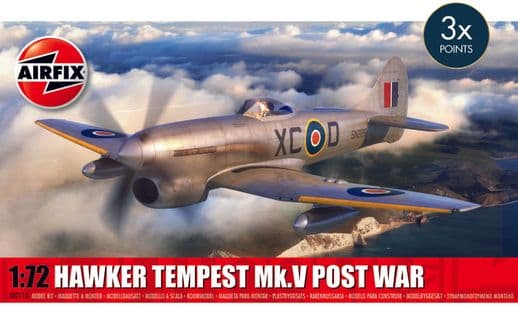
Just look at that panel detail. In this natural metal finish, you really do get a much clearer appreciation of the beautifully clean lines of this stunning aeroplane, one of the most potent piston engined fighters to have ever taken to the skies.
Following their final naval spotting commitment, the squadron would go on to operate from bases in Germany, but with the end of the Second World War, the 2nd Tactical Air Force, or the British Air Force of Occupation as it was renamed, would undergo quite a period of change. In April 1946, No.26 Squadron was disbanded, but on the same day, No.41 Squadron was re-numbered No.26 Squadron and as part of No.135 Wing, would fly their Tempest fighters at Wunstorf for the remainder of the Tempests service in Germany. It does have to be said that before Tempests were finally withdrawn from Germany the Bristol Centaurus powered Tempest II had replaced many of the earlier Mk.V variants in service.
From a modeller's perspective, perhaps the most interesting period of RAF Tempest operations came from March 1945 onwards, when orders were issued that Fighter Command could dispense with wartime camouflage and replace it with either a silver doped or natural metal finish. Despite this, aircraft already in service and those already in production would generally retain their wartime markings, so during this period, the appearance of silver and natural metal aircraft proved to be the exception rather than the rule. By 1946, a firm order was issued for the removal of all camouflage from fighter aircraft and the drab, weathered appearance of war weary Hawker Tempests was transformed almost overnight, with gleaming natural metal speedsters emerging from paint shops in RAF Germany and didn't they look spectacular!
Both of the scheme options on offer with this impressive kit. Making for an interesting subject change from building something like a Spitfire or Messerschmitt Bf 109, the Hawker Tempest was reputedly the Allied aircraft Messerschmitt Me 262 pilots would least like to come across during operational sorties.
It's interesting to note that the subject of this lead scheme, Tempest SN228, was the former personal mount of New Zealand fighter ace Wing Commander Evan Dall 'Rosie' Mackie, in his role commanding No.122 Wing, the 'Tempest Wing'. Mackie would end the war as the most successful New Zealand fighter ace of WWII, with 21.5 confirmed aerial victories and 5.5 of this number scored whilst flying the Hawker Tempest. SN228 would later pass to the care of No.41 Squadron and was still there in April 1946 when the unit was re-numbered No.26 Squadron. There, it would become the personal aircraft of Squadron Leader Henry 'Poppa' Ambrose, during whose tenure the aircraft would be stripped of its camouflage paint scheme and presented in a smart natural metal finish, showing of the purposeful lines of this most potent fighter aircraft.
Our Researcher at the time wanted to have this as the lead scheme option for this second Tempest release because it was just so different to the two finishes included with the first release from this impressive new tooling and many of us will find this an irresistible option when building our kit. During his Tempest research, he came across an interesting logbook entry whilst searching through artefacts held at RAF Manston History Museum.
He discovered an entry which detailed a logged flight by Sqn Ldr Henry 'Poppa' Ambrose at the end of April 1946, where he returned to RAF Manston in his natural metal Tempest having recently taken part in dive-bombing exercises on the Fassberg Ranges in Germany. This inspired him to commission the stunning artwork which will be featured on the box of this future release, commemorating not only a beautifully presented Hawker Tempest, but also one of the most impressive modes of transport anyone could have ever used as their personal conveyance. When Sydney Camm envisaged what his 'Super Hurricane' would look like, surely it must have looked something like this.
With its reputation for producing one of the finest fighting aeroplanes in the history of aviation, when Britain was looking to fully commit to the jet age, the Supermarine Company were well placed to be strong contenders. It is interesting to note however, that the first successful jet aircraft they introduced came with the impressive name ‘Attacker’, but rather than going on to see service with the Royal Air Force, this was exclusively a Fleet Air Arm jet fighter.
With a successful jet design now behind them, the Supermarine team set about producing a new fighter for the RAF, one which initially attracted an Air Ministry ‘super priority’ project designation. Unfortunately, a protracted development soon resulted in the new aircraft (which was subsequently named the Swift) being relegated to the position of back-up project for the now favoured rival Hawker Hunter project. Nevertheless, the Swift represented an important aircraft type for Britain’s aviation industry finding its way in the jet age, even though it would never match the Spitfire in terms of the aviation legacy it would forge.
Once in service, the Supermarine Swift would prove to be an exceptionally robust, if slightly heavy aircraft, a result of combining traditional aviation design and construction techniques, with the very latest, if still rather immature, jet propulsion technology it also utilised. It would, however, prove to be an incredibly fast aeroplane, with Supermarine Swift F.4 WK198 establishing a new world absolute speed record of 737 mph for Britain on 26th September 1953.
As this was a time of great change and almost constant technological advancement, the Swift would only hold this prestigious aviation record for a short eight day period, as US Navy’s Douglas Skyray soon wrestled the record back for America. Historically though, the Supermarine Swift is significant as holding the distinction of being the last British production aircraft to claim the world absolute airspeed record.
Although the Swift would only enjoy limited success as an interceptor fighter for the Royal Air Force, it did go on to excel as a low-level, single-seat, high speed reconnaissance platform and was used effectively in this role until the type was withdrawn from service. By the second half of the 1950s, it was clear that the Hawker Hunter was going to be the RAF’s main jet fighter for some years to come, so there was little sense in spending money unnecessarily on the further development of the Swift as an interceptor platform. Indeed, despite the fact that the Swift proved to be an excellent reconnaissance aircraft, the Hunter would eventually wrestle even this role from the Swift and with it, effectively consigning Supermarine’s only RAF jet fighter to the aviation history books.
By virtue of the fact that this early jet fighter bore the historic Supermarine name and entered RAF service in the same year that the famous Spitfire was making its final operational flights in service, the Swift has to be considered an important aircraft within the wider history of British aviation. Although ultimately proving to be far less successful than either its famous predecessor or the superb Hawker Hunter, things could have been very different had this project not been beset by a series of frustrating development setbacks, allowing the Swift to actually have a claim to being the RAF’s jet powered Spitfire.
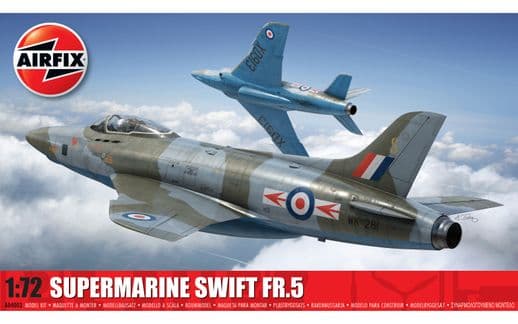
This particular Swift (WK281) was built by Vickers Armstrong in the mid 1950s and assigned to RAF No.79 Squadron at Gütersloh in West Germany, where it was to fly low altitude tactical reconnaissance missions during one of the most volatile periods in world history. The nose of the FR.5 housed 3 F.95 oblique cameras, which were capable of capturing incredibly detailed images of any target crews were required to photograph, however, the pilots flying these missions were of the opinion that the verbal report they relayed back in real time was arguably of greater tactical importance than the pictures they were sent to gather. Only when the later inspection of images revealed concealed weapons in dense woodland would they concede the value of such imagery.
The cameras were capable of capturing even the finest detail during these high-speed missions, with pilots becoming incredibly proficient in developing the most efficient method of addressing the target in order to obtain the images they were sent to secure. This could be either a fast flat approach, a slightly wing down attitude towards the target, or even a roll over the top of it, but these missions were always a one pass and gone affair, because returning to a target your enemy had seen you photographing was tantamount to suicide.
Computer rendered image produced from the Supermarine Swift FR.5 design files.
Supermarine Swift box artwork in all its glory.
Pilot Flt. Lt. Nigel Walpole joined the RAF in 1951 as a short service officer training to become a navigator, however, before he could complete his course, he was selected to attend the RAF College where he expected to continue in a navigation role, but instead joined the officers training to become pilots. After receiving his wings, he was assigned to RAF No.26(F) Squadron, where he flew the Hunter F.4 in the interceptor role at Oldenburg in Germany. Europe was on a state of high alert at that time and Walpole would spend two years flying the Hunter, in a constant state of readiness to repel any potential act of Warsaw Pact aggression.
After serving on the Hunter, Flt. Lt. Walpole was posted to No.79 Squadron at RAF Gütersloh, to fly the Supermarine Swift in a low-level armed reconnaissance role, with these missions requiring every ounce of skill and experience the pilot had to give, particularly as these demanding missions were usually flown close to hostile borders and with the very real threat of coming under fire from enemy anti-aircraft defences as a consequence. Although flying at high speed and at low altitude, the Swift was regarded as an extremely effective and impressively stable platform from which to gather this vital information and even though they ultimately relinquished this role to PR variants of the Hunter, those pilots who flew both types regarded the Swift as the more effective aircraft in this role.
In 1959, Flt. Lt. Walpole was fortunate enough to be offered an exchange posting with the USAF, where he went off to continue flying tactical reconnaissance missions, but this time in the McDonnell RF-100 Voodoo, operating out of Shaw Air Force Base in South Carolina.
Supermarine Swift WK281 was recovered to Church Fenton following the type’s withdrawal from RAF service, then later on to an ATC Squadron at Uxbridge, where she was assigned an instructional airframe number. Noted on display at several different RAF stations around the country during subsequent years, the Swift eventually arrived into the care of the RAF Museum in the 1980s. She was loaned to the Tangmere Military Aviation Museum in 1994, where she can still be found on display to this day, a fine and extremely rare example of this handsome early British jet fighter.
Staying with the subject of significant early British jet fighter types, the distinctive de Havilland Vampire is always forced to play second fiddle to the more famous Gloster Meteor, however, had luck been on the side of de Havilland engineers and had the only serviceable Goblin 1 turbojet engine not been ordered to be sent to America to assist their jet program, the Vampire may have actually beaten the Meteor into service.
Making its first flight on 20th September 1943 (six months after the Gloster Meteor), de Havilland DH.100 ‘Spider Crab’ LZ548/G took off from the company’s Hatfield airfield in the hands of chief test pilot Geoffrey de Havilland Jr. As a matter of interest, the ‘G’ used at the end of the aircraft's serial number highlights the secret nature of the project and was an instruction that the aircraft must be placed under guard at all times whilst on the ground.
Posting Impressive performance right from the outset, an order was almost immediately placed for the diminutive new jet fighter, but as de Havilland’s manufacturing capacity was still fully committed to existing wartime aircraft production, these first Vampire jets would be manufactured and test flown by English Electric at their Samlesbury factory, near Preston in Lancashire. Because of the production delays suffered and the incredulous engine decision mentioned earlier, the Vampire would occupy the historic position of Britain's second jet fighter and the seventh jet powered aircraft in the world to fly.
It would, however, be Britain’s first single engined jet fighter.
Even though this was still relatively new aviation technology, de Havilland cleverly designed their Vampire to be simple to maintain and operate, earning the aircraft an enviable reputation for reliability amongst air and ground crews alike, whilst at the same time allowing more pilots to safely make the transition from piston to jet powered flight. With a number of significant 'firsts' to its name, the Vampire was the first RAF aircraft to exceed 500 mph, with the extra range of the later F.3 variant also allowing it to be the first jet fighter to cross the Atlantic and all on just that single engine. The Vampire would also have the notable distinction of being the first jet aircraft type to equip Britain’s Royal Auxiliary Air Force.
RAF No.502 (Ulster) Squadron was originally formed in May 1925 as a reserve bomber squadron based at RAF Aldergrove in Northern Ireland, initially made up of a mixture of full time regulars and reserve personnel. During the Second World War, the unit served as part of Coastal Command, fighting against the U-boat threat and attacking surface shipping, using such aircraft types as the Armstrong Whitworth Whitley and Handley Page Halifax.
Following the end of the war and the reactivation of the Auxiliary Air Force, No.502 Squadron reformed once again, with Aldergrove as its home base, but this time as a light bomber unit equipped with de Havilland Mosquitos. A later directive that all RAuxAF Squadrons should convert to a day fighter role saw the unit trading their Mosquitos for Spitfire F.22 fighters, however, they would use these potent piston engined fighters for less than three years, before entering the jet age with the de Havilland Vampire at the beginning or 1951. Within a matter of weeks, the squadron had traded their original Vampire F.3s for FB.5s and these would be joined by additional FB.9 variants from July 1954, with the unit operating both concurrently until the RAuxAF was disbanded in March 1957.
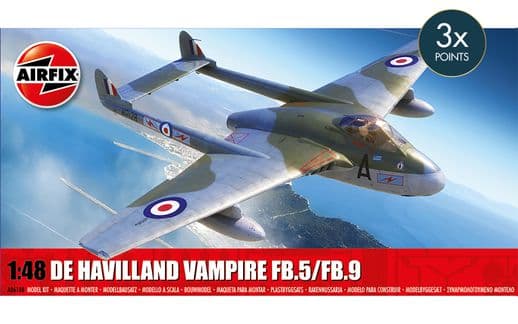
A beautifully finished de Havilland Vampire FB.9 kit wearing No.502 (Ulster) Squadron, Royal Auxiliary Air Force markings. The Vampire was really unfortunate not to beat the Gloster Meteor into Royal Air Force service as Britain’s first jet fighter.
Reformed at Aldergrove once again in September 2013, No.502 (Ulster) Squadron has the distinction of being the oldest of all the reserve squadrons, and now is engaged in preparing a new generation of service personnel for a wide variety of roles within the force, embracing the technologies and challenges facing the modern Royal Air Force.
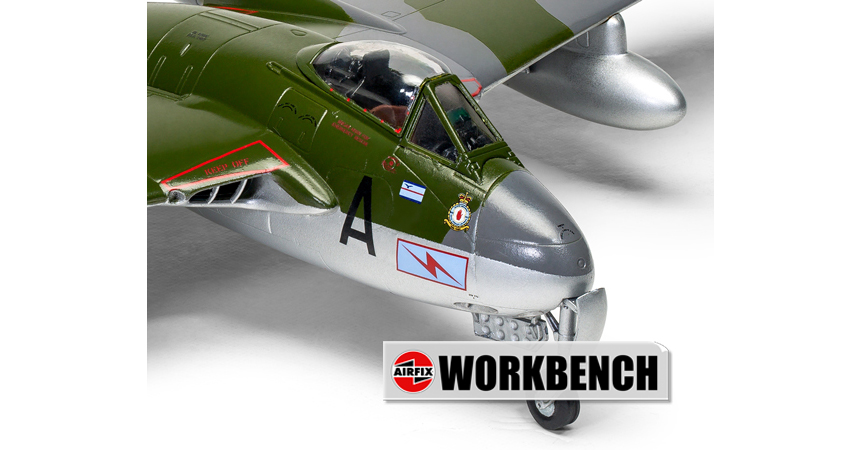
De Havilland Vampire WR128 was built at Broughton, Chester and delivered to the Royal Air Force in April 1952 as an FB.9 variant of this jet fighter-bomber. During her time with No.502 (Ulster) Squadron, she also served as the Squadron Leader's personal aircraft, resplendent with squadron crest, Squadron Leader's pennant and red lightning flashes on blue rectangular backgrounds - she must have made for a most attractive sight. Unfortunately, as was the case with many of these aircraft, WR128 only had a relatively short service life and by September 1960 had been sold for scrap and was awaiting collection by Messrs H H Bushell & Co of Birmingham, and an all too familiar fate.
Have we saved the very best until last? The answer to that question is very much a matter of opinion, but if you’re looking to take on a model build which possesses real class, and a finished model which just has to be described as magnificent, then the Hawker Sea Fury FB.11 might just be the kit for you. Making this opinion almost something a ‘no brainer’ of a decision, as part of the latest sale event, this stunning kit is available for just £14.99 whilst current stocks last.
Representing the very pinnacle of piston powered fighter performance and technology, the Hawker Sea Fury started life as the company’s 'Light Tempest Fighter', an aircraft project looking to provide the RAF with a powerful new fighter possessing exceptional performance. Despite pushing the very boundaries of known flight performance, Britain’s Air Ministry had already been captivated by the possibilities offered by jet powered aircraft, and they ultimately didn’t follow up their initial interest in the new Hawker Fighter.
At around the same time, Britain’s Fleet Air Arm were looking to procure a capable new fleet fighter/fighter bomber to replace the various types which had been in service during WWII and in anticipation of the many US aircraft supplied under lend lease either going back to America, or having to be paid for. The Hawker company were certain that their Fury Mk.II design (Light Tempest Fighter) could be adapted to take on this task and set about navalising their new fighter, a derivative of the original design which was given the name Sea Fury.
The Sea Fury may have started its life as a land based fighter design, however, the Fleet Air Arm were certainly not getting a second rate aircraft, this was a thoroughbred aeroplane in every sense of the word. With a five bladed constant speed propeller attempting to harness the 2,500 hp of power generated by the 18 cylinder Bristol Centaurus 18 sleeve valve engine, the Hawker Sea Fury didn't just purr, it growled menacingly, and if you ever found yourself in the vicinity of an ‘active’ Sea Fury, you unquestionably knew you were in the presence of the ultimate piston engined fighter.
Hawker Sea Fury FB.11 WH588, No.724 Squadron, Royal Australian Navy, Naval Air Station Nowra, New South Wales, Australia, 1961-62.
For an aircraft as capable as the Sea Fury, Hawker's final piston engined fighter would not be without its international suitors, with Commonwealth nations being at the head of this aviation pack. In 1947, the Australian Government approved the purchase of two light fleet carriers from the Royal Navy, with the additional procurement of Sea Fury and Firefly aircraft to equip them. The Fleet Air Arm of the Royal Australian Navy was subsequently formed in 1948, and their first aircraft would serve aboard the new HMAS Sydney (the former HMS Terrible) and HMAS Melbourne (the former HMS Majestic), in addition to equipping the shore based station at Nowra (HMAS Albatross).
The first batch of eleven Sea Furys were delivered in May 1949, forming No.805 NAS, the Royal Australian Navy's first front line naval fighter bomber unit. In total, the Fleet Air Arm of the Royal Australian Navy would purchase 101 Sea Furys and 108 Fireflys from Britain, with quite a number of these aircraft going on to serve with distinction during the Korean War. RAN Sea Fury fighter bombers remained in front line carrier service until 1956, when they were replaced by jet powered de Havilland Sea Venoms, however, the Sea Furys operating out of Nowra would remain in service until the early 1960s, earning a reputation as some of the best looking military aircraft in the world at that time, with the scheme going on to feature on several machines performing on the world Airshow scene over the years.
No. 724 Squadron was re-commissioned into the Royal Australian Navy at Naval Air Station Nowra on 1st June 1955, with the unit having the responsibility of providing fixed wing conversion and currency training for front line Fleet Air Arm squadrons. In this role, the unit would be equipped with several different types of aircraft, including the potent Hawker Sea Fury, but also operating a combination of piston and jet powered aircraft types.
Amongst their other duties, from 1958 onwards, the unit also provided target towing services for live firing training exercises, something which would continue until October 1962, when the unit's Sea Furys were finally retired.
Such a beautiful aircraft. This Royal Australian Navy scheme really does suit the clean lines of the Hawker Sea Fury, but having said that, something this attractive would look good in whatever scheme you finished it in.
Hawker Sea Fury WH5885 was constructed as an FB.II variant in 1951 and taken on charge by the Royal Australian Navy on 7th March the following year. She would be transported to Australia abord the carrier HMAS Sydney and went on to serve with No.724 Squadron at Nowra Naval Air Station, in a training and conversion role. Struck off charge in September 1963, she would be snapped up by a civilian owner who repainted her in a smart red and white scheme and modified her to take on target tug duties, wearing the civilian registration VH-BOU.
Changing owners once more in 1970, she was subsequently sold to a dealer/collector in America, where she would go on to enjoy a long and successful career on the US aviation scene, competing regularly in the Unlimited Class of the National Championship Air Races, always wearing a two tone grey Australian Navy scheme.
In 1977, the aircraft was purchased by British Warbird collector Paul Morgan, who arranged to have the fighter shipped to the UK and once there, onwards to its new home at Sywell aerodrome. She was repainted into a stunning blue Royal Australian Navy No.805 Squadron scheme and wearing the civilian registration G-EEMV, would spend the next few years thrilling UK Airshow audiences with its displays of grace and brute power. Tragically, the aircraft was written off following a landing accident at Sywell on the 12th May 2001, when the aircraft nosed over on the soft ground at the airfield.
A kit with real presence, this Hawker Sea Fury kit comes supplied with these three stunning scheme options – how on earth can we be expected to choose between these?
We elected to include this final picture featuring built models finished all three of the scheme options included with this stunning kit purely and simply because they’re all winners, and it’s just so difficult to choose between them. Basically, with this kit in hand, you really can’t go wrong with whichever scheme you eventually go for, and could be forgiven for taking on all three at the same time, they really are that good. Although positioned as one of the ultimate piston-engined fighters the world has ever seen, the Sea Fury is just so pleasing on the eye, and therefore making for such a fantastic modelling project. Is it just me, or do you also find the Hawker Sea Fury in 1/48th scale just so completely irresistible?
As this kit is currently available for just £14.99 in our sale whilst stocks last, it really is time to get a couple of these in your on-line basket.
We are afraid that's all we have for you in this latest edition, but we will be back next Friday with more project development updates and the very latest Airfix kit exclusives. In the meantime, we are always keen to hear your views on all things Airfix and in particular, any thoughts and opinions you may have regarding our Workbench blog. If you would like to drop us a quick line, could we please ask that you use our workbench@airfix.com email for all correspondence.
To re-visit any of the Airfix blogs we have produced over the past seven years or so, please head to our main Workbench hub, where you will find our entire blog back catalogue and all the Airfix design projects we have already covered.
All our dedicated official social media sites can be accessed by clicking the respective link icons at the foot of this page, or by heading to the Airfix homepage. Other useful Airfix links are:
Facebook, YouTube, Twitter and Instagram official sites
Please join us for more Airfix updates next week and thank you for your continued support.