
Welcome to this latest edition of our Workbench blog and all the news, updates, and modelling exclusives from the fascinating world of Airfix.
As the world prepares to celebrate Space Week, there really could only be one subject for this latest edition of Workbench, an edition which really could be described as being out of this world. Unquestionably the most impressive machines ever conceived by man, space launch vehicles represent the very pinnacle of man’s technological prowess, not to mention how they utilise the most powerful engines ever created. With the launch sequence itself being a sight so spectacular that it captivates billions of people each and every time, is it any wonder that space travel and exploration remains as arguably man’s most impressive achievement to date.
International Space Week sees the world celebrating the latest advancements in science and technology, not only in relation to space exploration, but also how this technology eventually finds its way into everyday life for much of the world’s population, stimulating ever more impressive advances in all manner of fields. Those fields include computer design and manufacturing processes which allow model companies to produce beautiful scale representations of the most impressive spacecraft to have ever left the surface of the earth, and on to new adventures amongst the stars.
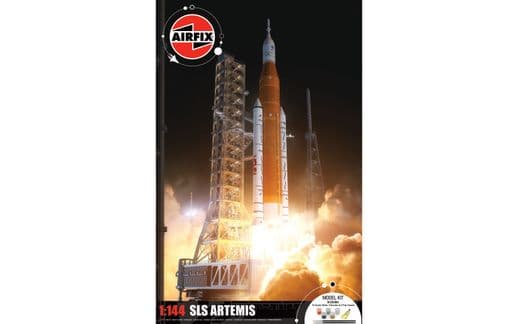
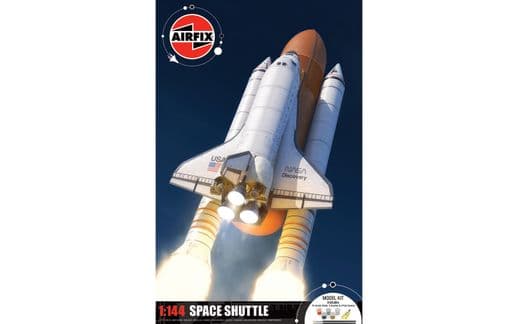
In celebration of this latest Space Week, our newly tooled SLS Artemis kit has now been released and has already been joined by our classic Saturn V kit, with the pair about to be welcome our Space Shuttle onto the modelling launchpad, each on presented in 1/144th scale and each one an iconic kit representation of man’s ultimate desire to explore beyond the stars.
As countdown to Space Week enters its final stages, we’re heading for the stars in this latest edition of Workbench.
The Space Race and man’s continued exploration of space has resulted in the creation of some of the most spectacular and technologically advanced craft in human history. Is it any wonder the subject continues to fascinate so many of us.
The latter stages of the Second World War saw technological expertise advancing to such a level that German scientists created a terrifying weapon against which there was little defence. Once launched, their V2 rocket (Vergeltungswaffen 2) travelled at great speed and was capable of skirting the earth’s atmosphere, meaning that its fall back to earth took the weapon beyond the speed of sound, meaning that those on the receiving end couldn’t even hear it approaching, let alone attempt to avoid it. This technology and the scientists behind it, were coveted by the victorious Allied nations, and would ultimately be the stimulus behind one of the most fascinating developments of the post war years, the Space Race.
As the nuclear age brought about a terrifying arms race between the USA and the USSR, the fear which threatened to grip the world’s population was offset by another race which brought together technological advancement and engineering excellence in support of the most ambitious chapter in man’s enduring desire to explore. The Space Race may have been a high profile statement of intent and capability of the military prowess of each nation, but the race to conquer the stars was one which captivated the attention of the entire world.
As both sides made significant advances, the Soviet Union would be the first to put both animals and humans into space, with cosmonaut Yuri Gagarin becoming the first human to travel into space on 12th April 1961. This huge success for the Soviets was followed just over two years later with Valentina Tereshkova becoming the first woman in space, as the Soviets took a significant lead in this high profile race, a race which both sides were determined to win.
With that being the case, US president John F. Kennedy addressed the nation on 12th September 1962 and proclaimed his administration’s determination to land a man on the surface of the moon before the end of the decade, and crucially, to bring him home safely again. Calling on the pioneering spirit of the American nation to explore new frontiers in space, the race was on in earnest, and the population were gripped by the possibilities this project held.
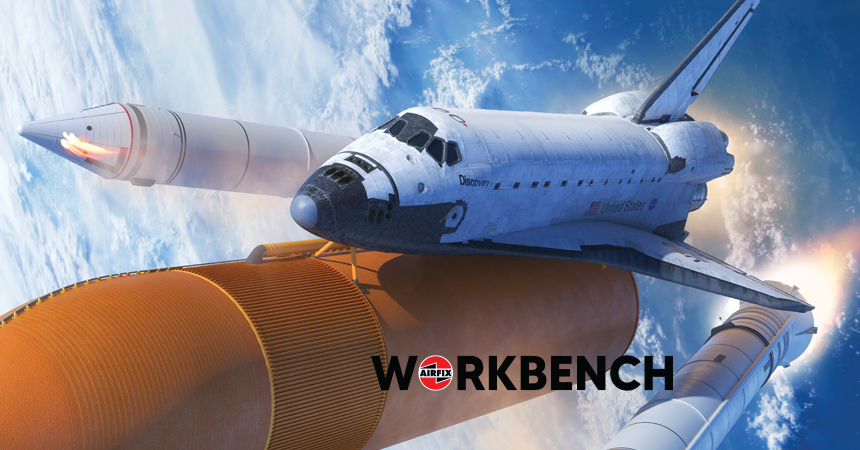
Airfix celebrate Space Week with a selection of bespoke graphics to be shown across all our platforms.
Whether we would describe ourselves as space exploration enthusiasts, science fiction fans, or just someone with a passing interest in either subject, it’s no exaggeration to say that space, or more specifically space launch vehicles and the launch sequence itself, are without doubt the most spectacular sights a human being could ever hope to witness. The awesome power possessed by these incredible launch systems surely represent the absolute pinnacle of man’s technical ingenuity, with everything associated with the space program being cutting edge, from a scientific perspective.
Even though the vast majority of the world’s population will have only ever watched such spectacles from the comfort of their own homes via a TV screen or computer, they have always managed to leave a significant impression on us all, along with an enduring fascination for anything connected with space and space exploration, be that the sight of stunning astro photography, or models and collectables of the actual spacecraft themselves.
That being the case, for those people who witnessed the moon landing during the summer of 1969, the events of that particular year will no doubt be remembered as arguably the most significant in their lives, as they and the rest of the world watched on in amazement, and some disbelief, as two members of the crew of Apollo 11 actually set foot on the surface of the moon.
As astronaut Neil Armstrong delivered his “One small step for man, one giant leap for mankind” quote on becoming the first human to set foot on the surface of the moon, not only did he become the most famous man on our planet, but he also promoted America as the lead player in this incredible space race, and success for their greatest technological minds.
More classic Airfix space box artwork which is entirely appropriate for this week’s space exploration update. Although this particular kit is not part of our 2025 range, a 1/144th scale version of the Apollo Lunar Lander is included in the Saturn V rocket kit.
This fascination with space exploration would continue throughout the 20th Century and into the 21st, as spacecraft became ever more capable, and the technologies behind them becoming ever more spectacular. Scientists even addressed the sobering cost of space exploration by developing technologies which could withstand the incredible heat and punishing forces imposed on them during the launch procedure and subsequent re-entry into earth’s atmosphere, to be re-used later in the program.
Over recent years, space exploration appears to have taken on a renewed impetus, with commercial companies entering the race, and technology advancing at an even greater pace, keeping the world watching in awe, with ever more people having access to such launch footage. The latest breed of new and exciting craft are taking humanity into the realms of science fiction, but for real, with the moon becoming just a stepping stone for further exploration, and ever more ambitious endeavours.
In propelling astronauts and new technologies towards the stars, we’re all now fully aware that much of the technology used during these latest attempts will ultimately find its way into our everyday lives in the years to come, which is just one more reason as to why space exploration as a wider subject, continues to be hold such enduring fascination for millions of people, and that’s without referring to Captain James T Kirk and the Starship Enterprise once!
Even as this latest blog takes shape, another Space X test launch has been successfully completed, as man’s quest to explore and conquer outer space continues with renewed impetus and seemingly unlimited investment, bringing with it the promise of more spectacular launch events for the world to marvel at.
Marking significant investment in new tooling projects, several space related model kits were introduced in 1970.
As some of the most incredible machines ever conceived by man, which also support some of man’s most significant achievements, scale model kit representations of various spacecraft have been a feature of many an Airfix model range over the years, with 2025 marking a significant chapter in this continuing story. Thinking back to the incredible achievements of the summer of 1969, it will come as absolutely no surprise to Workbench readers to learn that those historic events also stimulated significant tooling investment in several new space related kit projects for the Airfix range, with no fewer than five new space related kit/figure releases all joining the range the following year.
With space and space exploration being the subject on everybody’s lips back then, those kits were both impressive in size, and proved incredibly popular within the hobby, as modellers were desperate to get their hands on them, and a great many space enthusiasts were attracted to the hobby for the first time as a result of the new kits introduction. Kits such as the Soviet Vostok 1, Saturn 1B, Saturn V and Apollo 11 Lunar Module all joined the range in 1970, with a set of astronaut figures keeping them all company.
The incredible Space Shuttle took its place in the collection towards the end of the decade as space subjects continued to be incredibly popular, and even James Bond 007 got himself into the space action, courtesy of the new Space Shuttle kit’s introduction.
The current Airfix range can now claim a return to those days of space exploration fascination, with not only two of those existing models being re-introduced to captivate a new modelling audience, but also with a spectacular new tooling release based on NASA’s impressive new launch system for the 21st century taking its place in the range. With two of these kits already available and the Space Shuttle scheduled to join them later this month, let’s now take this opportunity to look at each one in chronological ‘Blast Off’ order, using built model sample imagery to illustrate our review.
Standing as one of the most impressive machines ever produced by man, everything about the Saturn V rocket was incredible and groundbreaking, requiring the concerted efforts of some of the greatest minds on earth. A development of the Saturn I and IB rockets which preceded it, the Saturn V was a super heavy lift launch vehicle developed by NASA in support of their Apollo program, one which had the goal of placing a man on the surface of the moon for the first time.
As of this year, the Saturn V remains the only launch vehicle to have carried humans beyond low earth orbit and free from the effects of earth’s gravitational pull, also holding the record for carrying the largest payload capacity to low earth orbit, the 140,000 kg required when sending the Apollo Command and Service Modules to the Moon.
Developed at NASA's Marshall Space Flight Centre under the direction of the engineering genius Wernher von Braun, this largest in a family of liquid propellant powered rockets provided enough thrust to solve the problem of getting to the moon. The three stage rocket was taller than a 36 story building and was the largest, most powerful rocket ever built to that point. A total of thirty-two Saturn rockets of all types were eventually launched without suffering a single failure, thirteen of which were Saturn Vs, with a further two used for testing purposes.
The rocket was constructed mainly from aluminium, titanium, polyurethane, cork and asbestos, although other rare and specialist metals were also required during production. What this system also employed was the finest craftsmen in their fields, using manufacturing techniques which were unmatched anywhere on earth – there was no room for errors of any kind on the Apollo program. Standing 111 metres tall (363 feet) and with a diameter of 10 metres at its base, a fully fuelled Saturn V on a moon landing mission had a mass of around 6,537,238lb, standing ready to provide one of the greatest spectacles on earth, a NASA Saturn V launch.
A selection of built model imaged showing this truly spectacular kit, one which has been a favourite every time it takes its place in an Airfix range.
The first stage of the rocket employed five massive Rocketdyne F-1 engines, each one capable of developing 1.5 million pounds of thrust, for a combined launch total of 7.5 million pounds. The temperatures developed were incredible, as you might imagine, however NASA engineers developed ingenious ways of keeping both the propellent liquids at the right temperatures and routing them through the engine structure to provide the cooling effect required, without introducing unnecessary additional weight.
The centre engine of the five was the only fixed unit, with the four outer engines all being mounted on gimbals and able to provide directional control for the rocket during its journey into space. Every aspect of the rocket’s design had failsafe and redundancy technology built in, and a powerful instrumentation/computer ring section towards the top of the third stage, something which was critical to the performance of the rocket. This allowed Mission Control (on earth) to check and guide the Saturn V through the launch procedure, checking the launch vehicle was at the correct trajectory on its way to the moon.
The mighty first stage had a burn time of 150 seconds, by which time the rocket would be travelling at approximately 6,000 mph, but creating a significant new challenge for NASA engineers. They would have to slow the first stage by just enough to allow separation, as this would continue on its current trajectory, whilst the rest of the rocket accelerated onwards into space. This was achieved by the use of reverse thrusters which slowed the first stage just enough to allow for first stage separation, where five Rocketdyne J-2 engines would take over the thrust responsibilities.
At this point, it’s interesting to look at the very top of the rocket and the distinctive pointed section, which for all the world looks like a spear to pierce a hole in space. This is, in fact, an escape system for the astronauts, and should the launch run into difficulties, this contains four powerful rocket motors which would fire the escape module free from the main rocket, and hopefully away from trouble. Once the first stage had been jettisoned and the 2nd stage rocket motors had fired, the escape system (pointed top) was itself jettisoned, as it was no longer required.
A kit that’s out of this world. Is it any wonder that space subjects have always proved so popular as model kit build projects.
Once the launch procedure had been safely negotiated and NASA controllers were happy to proceed, things really started to get interesting for the crew. Before they could proceed on to the moon landing phase, the Command/Service Module had to perform a Transposition docking with the Lunar Module (lander) which was stored in the section beneath it. This required the crew to use booster rockets to separate from the main section, before turning around and docking with the Lunar Module, which was now revealed by four large clamshell sections opening on the storage section of the main third stage.
In a manoeuvre which must have been fraught with potential for disaster, the two craft carefully docked, allowing an ingenious automated system to pull the craft together and create an air and pressure tight seal, a crucial aspect of the entire mission. That successfully completed, it was now just the simple matter of a three day journey to the Moon, and a place in history for the crew.
The first manned Saturn V rocket sent the Apollo 8 astronauts into orbit around the moon in December 1968. Following two more missions where the Lunar Module itself was tested, another Saturn V launched the crew of Apollo 11 into space in July 1969, and on to that historic first manned landing on the surface of the moon. Using the Saturn V rocket, the Apollo program resulted in 12 crewed missions being launched between 1968 and 1972, with six of these successfully landing men on the surface of the Moon. 24 astronauts went to the Moon and 12 of them actually set foot on its surface, all thanks to this incredible machine.
Standing taller than both the Space Shuttle and SLS Artemis, the Saturn V rocket is truly an engineering marvel, and one which shows what man is capable of achieving when embracing the latest technology and the finest minds. Everything about the Saturn V is spectacular and as a scale modelling project, could there possibly be a more impressive, or more historic subject for us to tackle. A fitting centrepiece for any model display, this kit really should be a modelling mission for us all to take on.
Taking the space baton from the Apollo Program to continue NASA’s space exploration endeavours, the Space Shuttle may well have been conceived at a time of international unrest, and space exploration being of a lower national priority, however, it once again represented the very pinnacle of engineering and technological excellence, becoming a spacecraft for the ages.
Designed specifically to incorporate reusable components, but to be even more capable than the missions which preceded it, in launch configuration, the Space Shuttle consisted of four main elements – the Shuttle orbiter craft itself, the main external tank and two additional solid rocket boosters. The rocket boosters provided 83% of the thrust power required for launch, with the Shuttle’s three Rocketdyne RS-25 (SSME – Space Shuttle Main Engines) providing the remaining 1,125,000 lbs of thrust.
The most complex machine ever conceived to take humans into space, and to bring them back safely again, beneath the sleek, aircraft-like exterior of the Space Shuttle lay an incredible network of wiring, pipework and equipment all intended to get these amazing craft into space and safely back again, but significantly, for them to be used again on subsequent launch missions. A new generation of engineers and technicians brought their expertise to bear on this program, each one a ‘difference maker’ and each one determined to play their part in ensuring the safe delivery and recovery of the latest Space Shuttle crew.
As for the crews themselves, they would train exhaustively in every aspect of their upcoming mission, from mundane, yet essential tasks, to safety and emergency simulations which were so important, the conducting of science experiments and experiencing everything in conditions of simulated weightlessness. Absolutely nothing was left to chance, and only the finest, fittest and brightest minds were engaged in this work.
Model making brings us into contact with some iconic subject matter in scale form, however few have the interest, or display presence of a NASA space launch vehicle.
Once in space, the Shuttle’s large cargo hold allowed respective crews to engage in any number of important tasks, from cutting edge science, to launching space probes, and repairing satellites. Significantly, Shuttle crews also helped with the construction of the largest man made structure in space and the platform for future space exploration, the International Space Station.
With their work completed, the Shuttle would begin its re-entry descent from around 400,000ft some 4,300 nautical miles from the landing airfield, eventually touching down at a glide speed of 226 mph. Once assessed, there was every chance that the Shuttle could be used again on a future mission, and indeed several times during its service life.
Following the success of NASA’s Apollo program, their next phase in space exploration was to develop a partially reusable, low earth orbital space transportation system, one which would allow many more astronauts to travel into space by further extending the boundaries of engineering excellence. For this spacecraft combination to work as intended, one million individual components would have to work in unison and impressively, over a 30 year period, five of these Space Shuttles would manage to successfully achieve earth orbit, with ‘Discovery’ becoming their most active craft. This incredible spacecraft completed 39 flight mission and spent an impressive 365 days in space.
During the 30 year history of the Space Shuttle program, a total of eight were built including prototypes, but with just five of them being space-worthy. Those Shuttles flew 135 missions and allowed 852 people to experience space travel, opening up this experience to more human beings than ever before. For the first time, NASA had a true Spaceship, and science fiction had become science fact.
Once again space exploration had produced another significant technological achievement for man.
Bringing NASA’s space exploration endeavours right up to date, and representing an exciting new model kit tooling addition to the current Airfix range, SLS Artemis is a new generation of super heavy lift launch vehicles designed to be ‘evolvable’, changing over time, and adaptable enough to be used to carry numerous different payloads into space.
This incredible coming together of technologies will allow a new generation of the earth’s population to witness the development and impressive achievements of a contemporary NASA space program, as the Space Launch System is their latest and most powerful rocket launch system to date, one intended to take mankind back to the surface of the moon and beyond.
The latest generation of super heavy lift launch vehicles, to the uninitiated, SLS and the Orion spacecraft capsule almost appears to be a combination of both Apollo and Space Shuttle technologies, however, this incredible program does represent the absolute pinnacle of engineering technology as we know it today, and the means by which man will venture deeper into space than ever before. Blasting off from launch pad 39B at Kennedy Space Centre in Florida for an unmanned maiden launch on 16th November 2022, the Artemis generation began in successful manner, with the new spacecraft harnessing 8.8 million pounds of thrust from its outer solid rocket boosters and main Aerojet Rocketdyne RS-25 engines.
The first manned launch is now planned for early 2026, when the Orion capsule will embark on a lunar flyby, the precursor to man’s long awaited return to the surface of the moon and deeper space exploration to follow. It’s intended that Artemis technology will drive NASA’s space program for decades to come, with this impressive space delivery system evolving to adapt to different mission demands, and the size of payload to be delivered into space. Indeed, as the weight of those payloads increase, so will the capability of the rockets needed to power them, as the Artemis Generation will create rockets which become ever more capable, claiming ever more achievements in the process.
The latest kit addition to our space range, SLS Artemis represents the future of NASA’s space exploration endeavours and a new chapter in the history of space flight.
From a space exploration perspective, we’re at the beginning of an exciting new chapter for humankind, many of whom will never have seen a live space launch in their lives. Certain to captivate audiences old and new, SLS Artemis will take mankind’s desire to explore to new heights, with the drawdown in associated technologies going on to benefit everyone over the coming years.
As we prepare to witness the ‘Next Beginning’ in space, what achievements will Artemis missions be claiming in the years to come, and how many of us are as excited at witnessing this prospect as those people who heard Neil Armstrong’s famous words were back in July 1969?
Whatever happens, we now have a beautiful new model kit of SLS Artemis to act as a space centrepiece for our collections, and you never know, someone building one may go on to make their own contribution to the NASA space program.
Both the new SLS Artemis and classic Saturn V kits are available now, and we expect the Space Shuttle to be joining them in our warehouse later this month. As all three kits have been produced in 1/144th scale, not only can we now chart the development of NASA’s space program through the years in model form, but we can also gain a good visual appreciation of the size differences between each of the different launch system. It will also confirm that in modelling terms at least, space related models still hold and incredible appeal across the hobby, arguably appealing to more people than any other subject matter.
Of course, as Gift Set releases, all three of these kits come complete with a selection of acrylic paints, two paint brushes and poly cement, everything you might need for a stellar modelling experience.
With the most powerful engines and the highest speeds for manned flight, what’s not to like about rockets and spaceships and our scale representations of them!
We're afraid that's all we have for you in this latest edition of the Airfix blog, but we will be back next Friday with more project development updates and the very latest Airfix kit exclusives. In the meantime, we're always keen to hear your views on all things Airfix and in particular, any thoughts and opinions you may have regarding our Workbench blog. If you would like to drop us a quick line, could we please ask that you use our workbench@airfix.com email for all correspondence.
To re-visit any of the Airfix blogs we have produced over the past TEN years or so, please head to our main Workbench hub, where you'll find our entire blog back catalogue and all the Airfix design projects we have already covered.
All our dedicated official social media sites can be accessed by clicking the respective link icons at the foot of this page, or by heading to the Airfix homepage. Other useful Airfix links are:
Facebook, YouTube, Twitter and Instagram official sites
Please join us for more Airfix updates next week and thank you for your continued support.