
Welcome to this latest edition of our Workbench blog and all the news, updates and modelling exclusives from the fascinating world of Airfix.
We have another dual subject blog posting for you this weekend, as we prepare to welcome two new models to the 2022 Airfix kit range and as you have probably already guessed from the title above, we will be straying away from the subject of aviation for this latest update. With two impressive new armour subjects about to join our ever expending range of 1/35th scale Military Vehicles, we will be looking at both of the new kits in detail, in addition to suggesting reasons why model kits of armoured fighting vehicles have always enjoyed such great support from the modelling community. As you would expect, we will not be letting you down when it comes to exclusive imagery this week, as we will not only be covering the scheme detail options available with each of the new kits, but will also be exclusively revealing the beautiful box artwork created in support of both releases in all its glory.
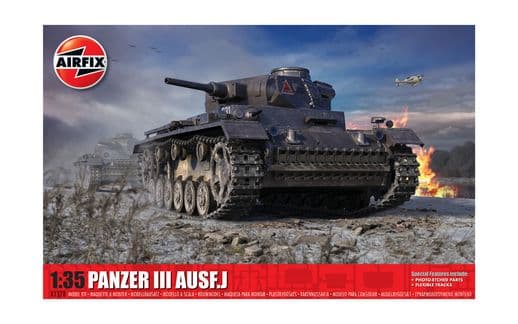
As has become the norm with Workbench blogs in recent times, each update will be posted as its own separate blog, easily accessible via the main Workbench hub, with the additional benefit being that each will be more 'visible' for those coming across the posts via a standard on-line search. This first blog will feature the new Sturmgeschütz StuG IV (Early variant), with the second supporting blog featuring the ubiquitous Panzer III in Ausf.J guise, as famous armoured vehicles from the Second World War take over the blog proceedings this weekend.
Despite its reputation as a devastating tank destroyer, even the German Sturmgeschütz couldn't overcome the combined might of Allied air and ground power during the final months of the Second World War.
Since the first tanks had been used on the Somme battlefield at Flers-Courcelette in September 1916, the incredible strategic potential offered by these metal monsters meant that warfare would never be the same again and whilst the need for infantry could never be replaced by tanks, the further development of armoured fighting vehicles would make them an essential component of any future conflict. Although clearly a terrifying prospect for infantry units who had to face them, even this first successful use of tanks highlighted some major concerns about their use and how further development of these vehicles would be needed if they were to achieve their full undeniable potential.
Despite their frightening invulnerability to traditional infantry weapons, unless an advancing tank had the support of its own infantry units to secure any territorial gains made, it would eventually either run out of fuel and ammunition, or simply break down due to mechanical issues, where it would be overrun by the enemy and either destroyed or captured. Nevertheless, the potential shown by these early tank operations cannot be overstated and the world's battlefields would never be the same again.
One major consideration as tank design and development continued to mature was the trade-off between protection, firepower and mobility. The ability to quickly respond to a changing strategic situation, knocking out enemy strongpoints and consolidating those gains was clearly of greater importance than simply shocking the enemy with the sight of ever larger and more impressive vehicles to get stuck in the quagmire of the Western Front. As the Great War didn't really witness a full scale tank versus tank confrontation, most tank assaults still took place following a heavy artillery barrage, with artillery remaining the most devastating weapon available to either side during the conflict. That being said, military planners could immediately see the potential of combining artillery guns with this new tracked technology, providing infantry units with mobile and highly effective real-time heavy fire support.
This was the thinking which would eventually result in the inter-war development of such vehicles as the German Sturmgeschütz series of armoured fighting vehicles, as the German military attempted to re-equip and reorganise its armed forces during the 1930s, under the restrictions imposed by the Treaty of Versailles. These machines were intended to provide effective mobile fire support for fast moving infantry units and as such, would be attached to infantry units in much the same way as traditional artillery was, only providing a more immediate and accurate level of support. Developed at a time of huge expansion and reorganisation, these AFVs would have to make use of existing tank designs already in production, therefore simplifying the manufacturing process, but ensuring their introduction with a minimum of delay.
As it turned out, the first vehicles carrying this Sturmgeschütz classification were seen in prototype form during 1937, however, they would not enter actual production until 1940, a delay which would eventually prove rather costly. Once actually in the field, these first vehicles, which were based around the chassis and existing components of the Panzer III, would prove incredibly effective, with their low profile making them difficult for enemy gunners to target. In fact, during high-level evaluation of the StuG's performance in Western Europe and on the Eastern Front, it was found that in most cases, these vehicles actually outperformed traditional tanks in the field, despite the fact that they were both quicker and cheaper to produce.
These early machines were also modified to become highly effective self-propelled anti-tank vehicles, trading their bunker busting short-barrelled 75mm L/24 main gun for either the L/43 or L/48 75mm Kampfwagenkanone 40 anti-tank gun. With their low profile and ability to be concealed easily, these tank killing StuGs would take a heavy toll of Allied armour for the remainder of the Second World War.
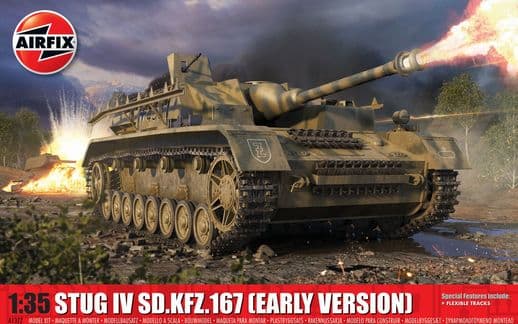
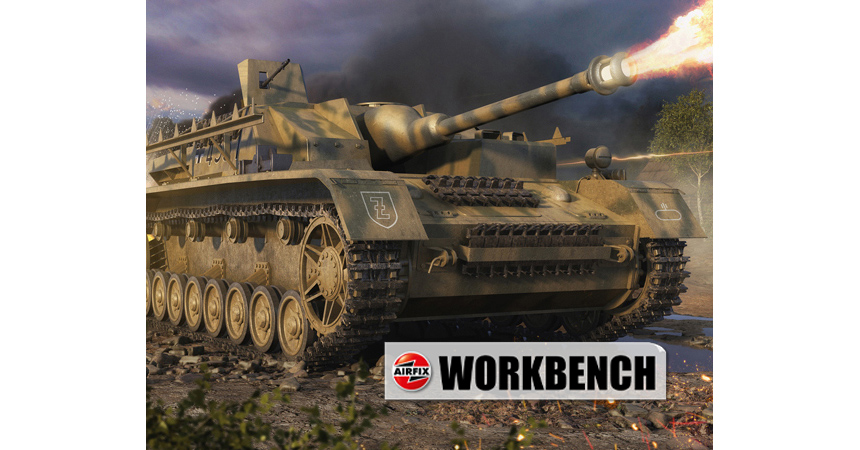
As one of the most devastatingly effective anti-tank vehicles of the Second World War, our new StuG IV kit certainly required spectacular new artwork to support its release.
In early 1943, the German Minister for Armaments and War Production, Albert Speer' approached the Krupp manufacturing company with a request to design a new, more effective variant of the Sturmgeschütz, one which built on the strengths of the existing vehicles and again utilising major components from military vehicles already in production. Based around the Panzer IV Ausf.F chassis, the resultant design incorporated a re-designed superstructure which boasted increased armour protection and endowed the vehicle with excellent combat survivability, however, during testing, it was discovered that all this additional weight made the vehicle as heavy as a standard turret equipped Panzer IV. When this was combined with the additional manufacturing time required to produce the new vehicle, it was decided it should not go into production and factories should continue churning out the existing variant in the vast numbers needed at that time, without disruption. Krupp would, however, soon get the call to start producing StuGs once more, but not as they had initially intended.
With the war situation new deteriorating significantly for the Germans and Allied bombing raids becoming increasingly effective, the destruction of the main Alkett StuG manufacturing facility in Berlin during November 1943 created a significant problem for the Germans. At a time that could hardly have been more disastrous, the almost total loss of StuG III production created a problem which required an immediate solution, with Krupp asked to intervene once more. It was assessed that if Krupp used the chassis of the Panzer IV tanks they were used to producing and matched these with a slightly modified version of the casemate superstructure used on the StuG III, they could re-start production of these important vehicles in relatively quickly. The solution was agreed and the program given the highest level of official priority, accompanied by some crazy and completely unachievable production numbers imposed by Hitler.
Clearly, this decision would have an impact on the production of standard Panzer IV tanks, but as these were due to be gradually phased out in favour of the new Panzer V (Panther tank), the disruption was deemed to be acceptable - it was hoped that more StuG IVs could be produced than standard Panzer IV tanks once the plant was working at full capacity. History went on to show how the Panther would have its own production and operating difficulties and how Panzer IV production would actually continue right through until the end of the war.
A built sample model of the new kit, constructed using final production sample components produced from this impressive new tooling.
This capable new tank killer was thought to be something of a game changer for beleaguered Wehrmacht ground units and if they could only flood the battlefields of Europe with these vehicles which were much quicker and cheaper to produce than the more famous heavy tanks of the period, surely they would be able to take a heavy toll of Allied armour. Unfortunately for the Germans, the tide of war had turned against them long ago and no matter how many StuG IVs they were able to produce, they never seriously stood a chance of halting the inexorable tide of Allied advances across Europe.
Initially modifying the Panzer IV tanks they already had on their production lines, the first few StuGs produced by Krupp can definitely be described as hybrid vehicles, however, as full production got underway, they halted production of the gun tank to concentrate on hitting the ambitious StuG production targets they had been set. Final assembly and production of the chassis and running gear was all done 'in house', however, they would require many components to be supplied by other manufacturers around the country, with the obvious potential for production disruption should these be delayed. The main guns for the Sturmgeschütz IV were either supplied by Škoda or Wimag and the existing StuG III superstructure was manufactured by Brandenburgische Eisenwerke.
Interestingly, despite the fact that the StuG IV used the larger chassis of the Panzer IV and was a visibly larger machine, production versions would actually be a full tonne lighter than its predecessor. The larger, more spacious fighting compartment made life much more bearable for crews and the additional stowage space allowed for a welcome additional nineteen rounds to be carried, something which definitely increased the overall combat effectiveness of these machines. Krupp managed to produce 30 StuG IVs by the end of December 1943, which was actually quite an achievement under the circumstances and by the end of February 1944, a further 214 machines were on their way to front line units.
The 4th SS Polizei Panzergrenadier Division was one of 38 divisions fielded as part of the Waffen SS (combat branch of the Nazi Party) during the Second World War, although initially, members of this unit were police officers and retained that status, rather than being enrolled as SS officers. That status would change during their first period of service on the Eastern Front, where the unit officially adopted the insignia of the SS. Involved in heavy fighting in Russia, the unit experienced heavy losses and were withdrawn to retrain as a Panzergrenadier Division and when committed to combat once more, were this time sent to Northern Greece to quell partisan operations in the region.
With the situation on the Eastern Front becoming increasingly desperate, the unit was deployed to Russia once more during August 1944 in a vain attempt to stem the advance of the Red Army, which is where the details for this StuG scheme have been taken. Camouflaged against the terrane in which the unit was fighting, the extremely low profile of the StuG made it a difficult for enemy gunners to target and its own powerful main gun was effective against all but the most heavily armoured Russian tanks at medium ranges. In close combat situations, even the heaviest Russian tanks would fall to the anti-tank armament of the Sturmgeschütz IV.
This lead scheme is the one which inspired the creation of the new StuG IV box artwork
In the majority of cases, new StuGs were supplied wearing their standard overall dark yellow/sand paint finish and whilst camouflage top coats were initially also applied at the factory, this practice largely stopped for quite a period of the war, with field and service units supplied with camouflage pastes to be applied as they felt appropriate. Whilst they were given a certain amount of autonomy when it came to how they applied the camouflage, official paint stocks could often be scarce and they were instructed to use them sparingly. Paint pastes were often thinned with water or fuel to make them go further and were generally applied with brushes or rags, but if spray guns were available, they would be the painting method of choice. If an alternate scheme was later required, the thinned paints were easily removed with fuel, although it is difficult to imaging such a procedure ever taking place in the field.
With this general lack of official guidance, the modeller has almost unlimited artistic licence when it comes to applying camouflage to their built kits, due to the fact that there were such wide variations in German AFV schemes that it would be difficult to challenge any particular representation. Some units elected to camouflage their vehicles with great care and in relatively similar patterns, whilst others were much more haphazard with their application and when you build in the fact that individual crews often added to the camouflage of their vehicle just to gain even the slightest advantage in the field, we do have quite some latitude in this area. With mounting losses and a supply situation which was beginning to collapse, who was going to challenge a tank commander in the field on how his machine had been painted?
Having said that, this wide variation in presentation did lead to some problems and even some friendly fire incidents, so in late August 1944, German High Command decreed that all new tanks, assault and anti-tank guns were to be painted in an 'ambush pattern' at the factories, which is another fascinating subject all of its own and one for another day.
Although the original idea behind the development of Sturmgeschütz vehicles was to provide heavy fire close infantry support for Wehrmacht units in the field, they actually proved so effective and were always close to the fighting that they would also often find themselves in actions against Allied armour. At close range, the shells from the short barrelled 75mm L/24 main gun could penetrate all but the thickest armour, however, the introduction of new HEAT (high-explosive anti-tank) rounds at the end of 1941 gave these vehicles even greater success against enemy armour, further improving the operational effectiveness of these excellent combat vehicles.
The success of the new HEAT rounds would lead to thoughts turning to an up gunned, dedicated anti-tank variant of the Sturmgeschütz, one which could be equipped with a variant of the standard anti-tank field gun in service at that time, the L/43 75mm Kampfwagenkanone 40. The obvious difference between these anti-tank StuGs and their infantry support predecessors is the length of the gun barrel, with the longer barrel belonging to the tank hunter variant. Much cheaper to produce and having a lower profile than the tanks which provided their chassis and running gear, not everything about the StuG's performance was better than a tank, as its gun only had a limited traverse and if a significant degree of re-targeting was required, the entire vehicle would have to move.
As the war progressed and German military operations became much more defensive in nature, units would often organise 'firetraps' for unwary Allied armoured units, placing two or three StuGs in strategic, concealed positions, to tie up Allied units long enough to allow a German counter attack to be mounted, or for other units to pull out and re-deploy to a more favourable position. In many of these cases, the diminutive Stug was difficult to hit even when its position had been identified, by which time, several Allied vehicles would usually have been knocked out.
Not the usual kind of built sample model images we usually feature in Workbench, the recent arrival of these two models in the Airfix office had our Brand Manager quickly taking some pictures for inclusion in the blog, just because we thought you might like to see them. The final image also includes the new Panzer III kit which is the subject of our other blog for this week.
When assessed in conjunction with the StuG's low profile, the armour protection of the vehicle was more than adequate, thicker at less angled areas and less so where enemy shells could be expected to deflect away, due to the steep angle. Crews would often attempt to improve the combat survivability of the vehicle in several ways, including adding concrete to the superstructure, something which added unnecessary weight to the vehicle and actually had little benefit operationally. Some vehicles were also covered with Zimmerit ant-magnetic mine coating, which again added more weight to the vehicle for little advantage and was actually dropped altogether from the end of September 1944. From the modellers perspective, the application of Zimmerit is another area where we can be creative, as different factories adopted different patterns during application and if damaged in operation, was often not replaced - is it any wonder we love building AFV kits with all these variations!
Of more strategic benefit, Schürtzen was the addition of 5mm thick protective side armour, attached to a rail welded to the side of the vehicle's hull and used as defence against Soviet anti-tank rifles. Whilst these side skirts would not prevent a round from passing through, it did disrupt its trajectory and reduce its velocity, so when it did strike the hull of the vehicle, it would usually ricochet harmlessly away, or just bounce off the main armour. These skirts also proved effective against hollow charge anti-tank weapons.
During the summer of 1944, Waffen SS units received around 70 StuG IV machines, in many cases due to the fact that the tanks they were supposed to be re-equipped with were unavailable due to the dire manufacturing situation in Germany at that time. Thankfully, the StuGs proved to be excellent replacements and whilst still fighting in retreat, always gave a good account of themselves in combat.
It is estimated that over 10,000 Sturmgeschütz vehicles of all types were produced during the Second World War, making this the most heavily produced German armoured combat vehicle of the war. Between them, they were also responsible for destroying more armoured vehicles than any other type during WWII, with estimates ranging anywhere from between 20,000 to 30,000 Allied armoured vehicles destroyed, depending on where you take your information from. What is not open to debate is the fact that these were absolutely critical to the German war effort during the Second World War and whilst the mighty Panthers, Tigers and King Tigers are usually the AFVs which attract all the enthusiast and modeller attention, it was the actually Sturmgeschütz force which inflicted the most damage on Allied armoured units during the conflict.
Short in stature and neither a tank nor an artillery piece, the Sturmgeschütz was without question one of the most important military vehicle types of the 20th century and one which is deserving of much more modelling attention than it usually receives. Our 1/35th scale modelling tribute to the Sturmgeschütz IV (SdKfz 167) (early version) is on the verge of being released and should be on its way to those who pre-ordered it by the end of this month.
A final look at the new Sturmgeschütz IV (SdKfz 167) (early version) artwork, this time complete with full Airfix branding.
That’s another Airfix update blog finished, but please do check out our other Panzer III Ausf J related blog, which can be accessed via our main Workbench hub. We will be back as usual next Friday with more Airfix project updates for your enjoyment, but in the meantime, if you would like to drop us a line regarding anything Workbench or Airfix related, we would be delighted to hear from you. As always, could we please ask that you use our workbench@airfix.com contact e-mail address for all correspondence.
All our dedicated official social media sites can be accessed by clicking the respective link icons at the foot of this page, or by heading to the Airfix homepage. Other useful Airfix links are:
Facebook, YouTube, Twitter and Instagram official sites
Please join us for more Airfix updates next week and thank you for your continued support.