We are pleased to be bringing you the latest edition of Airfix Workbench, where we attempt to give our readers a flavour of everything that is going on in the world of Airfix. In our previous edition, we brought you a fantastic feature build project of the recently released RAF SEAC Dakota Mk.III and from the supportive comments we have received over the past few weeks, it seems like you enjoyed this too. We will be looking to include more of these reviews in future editions, including some of the new kits that are due for release during 2016.
In this latest edition, we are going to be looking at two relatively new models from 2015 which have proved to be so popular with modellers that it has been incredibly difficult to keep them both in stock. Following a recent re-stock which featured both of these kits, it seems a good time to take a longer Workbench look at both the Supermarine Swift FR.5 in 1/72nd scale and the Hawker Hurricane Mk.I in the larger 1/48th scale and include some of the development imagery that has not previously featured in our blog. Without further delay, let’s look at both of these classic British fighter aircraft, which although represented the adoption of totally different aviation technology, were actually only a few short years apart.
 Supermarine Swift FR.5 WK277 at the Newark Air Museum
As the only Allied fighter to remain in production throughout WWII, the Supermarine Spitfire saw near constant development during this period, as design teams tried desperately to produce faster and more capable machines. As these speeds approached 450 mph, it became clear that the design of the Spitfire’s wing would prove problematic at such high speeds and would require re-design. The Spitfire’s intended replacement, the Spiteful, incorporated new laminar flow wing technology and redesigned fuselage, but the actual increase in performance proved to be much less than had been originally anticipated. With the advent of the jet age and significant advances in both engine and airframe technologies, the Supermarine designers turned away from the piston engine and looked firmly towards jet propulsion for their new fighter.
We are certainly using some poetic licence with the title of this particular section, but Britain’s love of everything Spitfire and the post war development of the fighters designed by Supermarine was a link too good to pass up. In actual fact, the first successful jet fighter produced by Supermarine was the Attacker, which was more of a jet powered Spiteful than a Spitfire, but very much illustrated the adoption of new jet propulsion technologies. Using the laminar wing technology developed for the Spiteful, the Attacker was a straight winged jet fighter developed for the Fleet Air Arm and had the distinction of being the first dedicated jet fighter to enter Royal Naval service.
 The magnificent box artwork used on the Airfix Supermarine Swift release
Taking everything they had learned from the Attacker project and continuing to strive for even greater speeds, Supermarine began to develop their Type 510 jet fighter, which was basically an Attacker fuselage with improved swept back wings and horizontal stabilisers. Aeronautical engineers had discovered that the secret to achieving higher operating speeds was to sweep the wings backwards and thus reduce the effects of compressibility and they hoped that the adoption of this technology would see this new fighter reach even greater speeds than its predecessors.
Supermarine’s new RAF jet fighter was not without some significant development issues, particularly around engine performance and a series of unexplained flying accidents. Despite the new fighter being initially designated a ‘super priority’ project, the protracted development problems quickly saw the Swift relegated to a back-up project for the favoured Hawker Hunter and although it is still an important aircraft type in the progression of British aviation into the jet age, it was certainly not to prove as important as the Supermarine company’s classic piston engined fighter of WWII.
The Swift proved to be an extremely strong and rather heavy aircraft, which was very much a result of the marriage of traditional aviation construction techniques, with the latest cutting edge jet propulsion technology. It was also an extremely fast aeroplane and on 26th September 1953, Supermarine Swift F.4 WK198 secured the World Absolute Speed Record for Britain, as it attained a speed of 737mph. Unfortunately, it only held this prestigious record for eight days, as a US Navy Douglas Skyray wrestled the record back for America, but the Swift was to be the last British production aircraft to hold the world absolute air speed record.
 Profile artwork of Swift FR.5 XD972/W from No.11 Squadron RAF Germany
Although the Swift only enjoyed limited success as an interceptor fighter for the Royal Air Force, it excelled as a low-level, single-seat, high speed reconnaissance platform and was used effectively in this role until the type was withdrawn from service. By the mid 1960s, the more successful Hawker Hunter had also taken this reconnaissance role from the Swift and consigned Supermarine’s only RAF jet fighter to the history books. By virtue of the fact that this early jet fighter bore the historic Supermarine name and entered RAF service in the same year that the famous Spitfire was making its final service flights, the Swift has to be considered to be an important aircraft in the history of British aviation. Although it eventually proved to be far less successful than the superb Hawker Hunter, things could have been very different had this project not been beset with a series of frustrating development setbacks and the Swift would have been referred to as the RAF’s jet powered Spitfire.
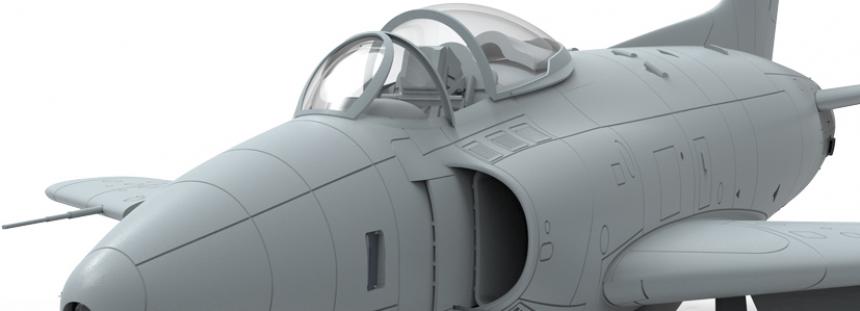
 Computer rendered 3D image of the magnificent Airfix Supermarine Swift
The announcement that Airfix intended to produce a new kit of the distinctive Supermarine Swift was understandably greeted with great excitement by the aviation modelling community. Incorporating all the latest design and development technologies available to the Airfix team, this newly released model has been produced with impressive levels of detail, whilst faithfully reproducing the unique shape of the Supermarine Swift.
The version of the Swift produced by Airfix (A04003) is the most successful FR.5 variant of the aircraft, which proved to be an accomplished high speed, low level, single seat reconnaissance platform. Incorporating a longer, modified nose section to accommodate the essential camera installations for the aircraft’s reconnaissance role, these specialised Swifts flew valuable information gathering missions against the former Warsaw Pact countries, from their RAF bases in Western Germany, until these too were replaced by reconnaissance versions of the Hawker Hunter.
 More computer rendered 3D images from the Airfix Supermarine Swift project

Although not one of the most instantly recognisable British jets of the early years of the jet age, the Supermarine Swift still occupies an important place in the history of British aviation. With its unique and extremely attractive profile, the Swift was one of the important aircraft that helped the Royal Air Force make the transition from the classic piston engined fighters of WWII, to the modern jet aircraft that would be the future of aviation. As you can see from the development images we have used to illustrate this feature, the new Airfix Supermarine Swift FR.5 in 1/72nd scale is a fine representation of this early jet fighter and has rightly proved popular with modellers all over Europe. The original release of this kit saw the entire consignment disappear in no time at all, as modellers were keen to add this new model to their inventory – thankfully, this hugely popular kit has now arrived back in stock and is available once more. The decal options included with the kit are:
 Option A – Supermarine Swift FR.5, WK281/S, Flown by Flt. Lt. Nigel Walpole, RAF No.79 Squadron, Royal Air Force Germany, Gutersloh, Germany, April 1956
This particular aircraft is one of the few Swifts that survive to this day. WK281 is now on public display at the Tangmere Military Aviation Museum.
 Option B – Supermarine Swift FR.5, XD972/W, RAF No.11 (AC) Squadron, Royal Air Force Germany, Jever, Germany, 1956
This Swift was written off after suffering a ground accident at RAF Jever, in August 1960. The damage was deemed significant enough to see the aircraft broken up for spares the following month.
 Evocative box artwork used on the 1/48th scale Hawker Hurricane Mk.I
If the new Airfix Supermarine Swift has proved to be an incredibly popular new release in 1/72nd scale, Hawker Hurricane Mk.I A05127 has enjoyed similar success in the larger 1/48th scale range. Many modellers see 1/48th scale kits as the perfect scale for single engined fighter aircraft from WWII, as the extra size allows for the inclusion of greater levels of detail over the more traditional 1/72nd scale, yet the finished models are not too large to be displayed effectively. Many modellers believe, however, that the extra size of 1/48th scale helps them to produce a model that better portrays the power and majesty of these awesome fighting machines - popularity which has seen the Airfix 1/48th scale range increase significantly over recent years.
As much of the development work on the 1/48th scale Hawker Hurricane Mk.I had been done before we started producing our Workbench blog, and as there was so much new information to bring you regarding the latest model announcements, this fantastic model passed under the radar somewhat. To mark the return of this hugely popular model back into stock, it is high time we took a closer look at this magnificent new Hurricane. In previous editions of Workbench, we have shown you how the Airfix designers approach their work with different model scales and how the upscaling of a particular base model CAD file from 1/72nd scale to the larger 1/48th scale can be much more challenging than you might think. As the larger model will require much more detail to be incorporated into the kit design, this will need to be reflected in the manufacturing tolerances applied to the production of the tooling block itself. Quite simply, if a 1/48th scale version of an earlier 1/72nd scale model release is produced, it is very much a totally separate design, requiring almost the same level of detailed development as the previous model – the time savings are predominantly around the initial research and information gathering stages of the project.
 Computer rendered 3D images of the 1/48th scale Hurricane Mk.I project

As 2015 saw Britain commemorate the 75th anniversary of the Battle of Britain, the release of this new Airfix Hurricane Mk.I proved to be a spectacular success and this has been one of the most heavily ordered models of recent years. The Hurricane may not have enjoyed the notoriety of its fighting partner during the Battle of Britain, but it was absolutely essential to the outcome of the battle and the RAF’s ability to continually challenge the Luftwaffe. Although larger and heavier than the Spitfire, the Battle of Britain Hurricane was available to the RAF in larger numbers than any other fighter and was an excellent gun platform – the concentrated firepower from its eight .303 Browning machine guns could be devastating. Crucially, the Hurricane was easier and faster to construct and was much easier to patch up in the field – this was an important factor in allowing the RAF to keep fighting, even when their backs were very much against the wall.
 This computer rendered 3D CAD image was used to promote the new Hurricane model
There can be no doubting that the Hurricane continues to be held in extremely high regard with enthusiasts and modellers alike and the announcement of this newly tooled example in 1/48th scale was received with some excitement. By the time the initial consignment of models arrived at the Airfix warehouse, they were almost completely allocated and it was difficult for anyone who had not reserved one to obtain an example – for this reason, news that Hurricane A05127 has now arrived back in stock will stimulate some significant ordering activity and will be the first opportunity for many modellers to get their hands on this fantastic model. As the Hurricane is now available once more, let’s take a closer look at the decal schemes that are available with the kit:
 Option A – Hawker Hurricane Mk.I, V6799 / SD-X, Plt. Officer Ken William Mackenzie, RAF No.510 Squadron, Kenley Airfield, 7th October, 1940
As one of the most accomplished fighter pilots during the final months of the Battle of Britain, Mackenzie achieved some notable successes against the Luftwaffe. Of particular interest was a combat that took place on 7th October 1940 – during a dogfight with several Messerschmitt Bf 109 fighters, Mackenzie singled out an aircraft and pressed home his attack. The ensuing melee saw him score multiple hits on the Me 109, but exhausting his ammunition in the process – the Luftwaffe fighter was damaged, but continued to fly on. Determined to press home his attack, Mackenzie intentionally collided with his adversary, shearing off the tail of the Messerschmitt, but losing the outer section of his wing in the process.
Despite this damage and coming under further attack from Luftwaffe fighters, Mackenzie managed to make a forced landing in a field near Folkestone, without sustaining any further damage to his aircraft. Hawker Hurricane V6799 was recovered and repaired and went on to serve in a training role for the remainder of the war.
 Option B – Hawker Hurricane Mk.I, R4118 / UP-W, RAF No.605 (County of Warwick) Squadron, RAF Croydon, Surrey, September 1940.
A true Battle of Britain veteran, this magnificent aircraft was the subject of a high profile restoration project, following its acquisition from an Indian University, where it had been stored in the open air for 54 years. In December 2004, the aircraft took to the skies for the first time in 60 years and immediately became one of the most historic WWII aircraft in the world. It can be seen performing at Airshow events around the UK and with its genuine Battle of Britain combat credentials, is a firm favourite with enthusiasts. It was announced in late 2015 that this magnificent aircraft would remain in the UK, having been put up for sale by the team that managed the restoration. It will be based at Old Warden, where it will be operated alongside the celebrated Shuttleworth Collection.
Hawker Hurricane Mk.I A05127 is again available on the Airfix website and at all good model stockists across the country – make sure you secure one before they disappear once more.
 Diorama figures included in the 1/48th scale WWII RAF ground crew set
There can be no doubting the detail and quality of the current crop of models in the Airfix range but having lavished many hours of effort into producing your latest model masterpiece, there is nothing like a diorama display to present your models in eye-catching style. As many modellers like to have their completed build projects as the centrepiece in a larger, more ambitious display, Airfix have produced a number of kits to help them achieve this. In support of this week's restock of the 1/48th scale Hurricane Mk.I, we would like to draw your attention to a couple of diorama kits that go hand in hand with the fantastic 1/48th scale RAF Battle of Britain fighter models in the Airfix range and will certainly enhance any such build project.
One of the most important features of Britain’s eventual success during the Battle of Britain was the RAF’s ability to quickly refuel and rearm their fighters quickly and send them back into battle, sometimes several times a day. Many of the historic photographs from this dramatic period show RAF fighters with ‘erks’ clambering all over them, desperately trying to prepare their aircraft for its next sortie. For this reason, many modellers are keen to try and replicate these iconic scenes by producing model dioramas, which certainly have an engaging aesthetic appeal for anyone with even the slightest interest in aviation, or British history. In the past, modellers would be forced to search for suitable after-market products, or to consider scratch building items in order to create such dioramas, but thanks to the designers at Airfix, professional looking diorama displays are now available to modellers of all abilities – you really can let your creative juices flow. Two sets currently available to enhance the fantastic 1/48th scale Hurricane Mk.I are:
 The inclusion of diorama models can bring your model project to life
This magnificent diorama set will benefit any of the latest 1/48th scale Battle of Britain aircraft releases, including the Hurricane Mk.I (A05127), Defiant Mk.I (A05128) and Spitfire Mk.I (A05126). It includes eight RAF ground crew figures, two pilot figures, one trolley accumulator, one oil bowser, one ammunition trolley and a host of miscellaneous items. Although this set will certainly benefit any 1/48th scale RAF fighter build project, it does not include the aircraft model itself, which must be purchased separately.
 Modelling scene reminiscent of a Battle of Britain airfield
A more robust set than the WWII RAF Ground Crew Set, this particular kit will allow the modeller to produce a complete diorama display, using only the contents of this model. Included in this Gift Set are one Hurricane Mk.I kit (1/48th scale), one Albion AM463 3-point fueller, one Bedford MWD utility vehicle, ten ground crew figures and accessories, twelve acrylic paints, 2 paint brushes and two tubes of poly cement.
As you can see from the images used to illustrate this section, these diorama sets certainly help to enhance even the most accomplished model builds and are a magnificent way to display any 1/48th scale Battle of Britain aircraft model.
 Classic box artwork featuring the Airfix 1/32nd scale Crusader Mk.III Tank
Although the Airfix range is dominated by kits of aircraft in various scales, there are a multitude of other models which cater for all interests and abilities. Included in this group is a magnificent 1/32nd scale tank which has just returned to the range to the delight of many older military modellers. The distinctive Crusader Mk.III tank may not be as enigmatic as the unusual Churchill, or widely used Sherman tanks of the British Army, but was absolutely critical in allowing Britain to continue to challenge Rommel and the Afrika Korps during the early years of WWII.
A relatively light and manoeuvrable tank, the Mk.III Crusader was up-gunned to utilise the 6 pounder gun, which allowed the tank to perform favourably against the ubiquitous Panzer III and IV tanks of the German Army. The Mk.III first saw action during the second Battle of El Alamein, where around 100 machines took part in these operations, performing well with their more capable armament. Despite the British Army having a heavy reliance on the Crusader tank during the campaigns of North Africa, it would not see widespread action away from this theatre.
 Built Crusader Mk.III displayed on the Airfix stand at IPMS Telford
Building into a really attractive model the Crusader Mk.III Tank (A08360) is available now on the Airfix website, or at all good model stores across the UK.
New tooling releases and model re-stock updates
Our latest ‘On Finals’ update comes during the midst of an extremely hectic release period for Airfix and we have a lot of model arrivals to tell you about. The BIG news for this week is that much anticipated 1/48th scale Gloster Meteor F.8 (A09182) and Sea King HAR.3 Gift Set (A55307) models are now in stock and available. As usual, please remember that you can keep up to date with all the impending Airfix New Tooling releases, please keep checking the Coming Soon Section of the Airfix website, which is regularly updated with all the latest availability information.
New models released, or due for imminent release:
 The magnificent new RAF Sea King HAR.3 is a spectacular new release
A09182 - Gloster Meteor F.8 - 1/48th Scale
A55307 - Sea King HAR.3 Gift Set - 1/72nd Scale
A02005C - Red Arrows Hawk T.1 - 1/72nd Scale
A50177 - Fokker E.II & BE2c Dogfight Double - 1/72nd Scale
A02101 - Royal Aircraft Factory BE2c - 1/72nd Scale
A01086 - Fokker E.II Eindecker - 1/72nd Scale
Model re-stocks:
A05127 - Hawker Hurricane Mk.I - 1/48th Scale
A55205 - Hawker Siddeley Harrier GR.1 - 1/72nd Scale
A55200 - Jaguar E-Type Starter Set - 1/32nd Scale
A06014 - Heinkel He-III P.2 - 1/72nd Scale
A50097 - Vulcan to the sky Gift Set - 1/72nd Scale
A50059 - HMS Illustrious Gift Set - 1/350th Scale
A08016 - Armstrong Whitworth Whitley Mk.V - 1/72nd Scale
A07112 - D.H Mosquito PR.XVI - 1/48th Scale
A05125 - Supermarine Spitfire Mk.Vb - 1/48th Scale
A08360 - Crusader Mk.III Tank - 1/32nd Scale
A06361 - 17 Pdr. Anti-Tank Gun - 1/32nd Scale
A09170 - E.E Lightning F.1/F.1A/F.2/ F.3 - 1/48th Scale
A16001A - Focke Wulf FW 190A-5/A-6 - 1/24th Scale
For the latest information on the release of new and re-stocked model kits, please keep checking the Coming Soon and Back in Stock areas of the Airfix website, which will have all the latest availability details for you. We will have more release information for you in our next Workbench.
I am afraid that is all we have for you in this latest edition, but we look forward to bringing you more news from the fascinating world of Airfix in the next edition of Workbench. Please continue sending us your ideas, pictures and stories for future editions, as we are always pleased to receive your contributions and you may just feature on the Airfix website for all to see. In support of this latest Workbench, we would particularly like to see your model diorama displays and how you like to display your completed models.
As usual, you can get involved in all the latest Airfix modelling chat via our dedicated Workbench thread on the Airfix Forum, or if you prefer, by logging onto our Facebook or Twitter social media channels and using the #airfixworkbench.
Until next time, enjoy your modelling and thank you for reading.
The Airfix Workbench Team
© Hornby Hobbies Ltd. All rights reserved.