
Welcome to this latest edition of our Workbench blog and all the news, updates and modelling exclusives from the fascinating world of Airfix.
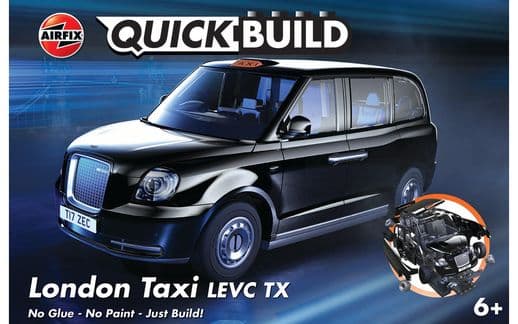
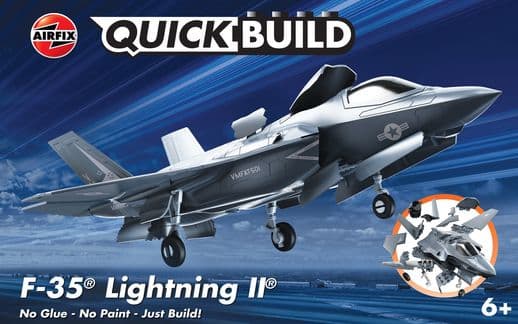
This week, we return to the subject of our popular Quickbuild model kit range and the latest new tooling addition which is definitely just that little bit different to anything that has gone before it. Rather than presenting the modeller with an example of one of the world's latest fifth generation jet fighters, or one of the most expensive supercars currently available, our Quickbuild designing guru Adam French has brought us a slightly less glamorous (in the minds of some people) mode of transport, but one which is as distinctive as it is iconic, a London black cab. Having had the opportunity to recently speak with Adam about this latest addition to the range, we can promise you not only a fascinating insight into the design phase of this new kit, but also sight of an exclusive selection of design screengrab imagery which mark this as possibly the most interesting new Quickbuild model addition for many a year and one which quite possibly might be found in more outlets than any Quickbuild kit before it.
Forget your glue and paints, its time spend a little quality Workbench time in the wonderful world of Quickbuild.
Released this week, could this new kit have more market exposure than any other kit in the Quickbuild range?
We are using a little poetic licence with the above title, because whilst this does provide us with a fitting introduction to this feature, we should really exchange the word hail for design to be completely accurate, however, we hope you will forgive our tardiness when we get stuck into this latest development review. When talking about the subject of iconic modes of transport across the globe, there are quite a few which come to mind, and some which also identify the part of the world you might be visiting. If you find yourself in New York, you might be attempting to flag down one of the city's famous yellow taxi cabs, or if trying to cross Victoria Harbour to Hong Kong Island, you might be looking forward to a ride on a Star Ferry. A visit to Japan could see you riding on one of their Bullet Trains and our own capital city can claim one of the most distinctive modes of transport, in the red Routemaster bus.
In fact, London can claim to have two extremely distinctive modes of transport available for passenger use, with the sight of either immediately identifying your location to anyone checking your latest social media update picture, with the second being a black cab, a vehicle which has been through quite a green revolution in recent times.
When talking about iconic modes of transport across the world, there are actually quite a few which instantly come to mind and how if your latest social media update included one in the background, how everyone would immediately know which country, or even which city you were currently visiting. Included in this enigmatic grouping would be the famous yellow taxi cabs of New York, riding the Star Ferry from Kowloon to Hong Kong Island and perhaps a blurred image of a Bullet Train, as it speeds through the Japanese station you were waiting at. London would also be included in this list, with our very own classic or modern Routemaster buses being such a familiar sight for many, however, London can also boast a second mode of transport which has to be included, one which enjoys similar iconic vehicular status, the black London taxi, or Hackney Carriage.
Although they can be found in towns and cities all over the world, black cabs are synonymous with the City of London, were they are often referred to as Hackney Carriages, a term which is thought to have its origins in the horse drawn carriages from centuries past and specifically to those operating, or based in the London borough of Hackney.
More recently and following the widespread adoption of vehicles powered by the internal combustion engine, London's motorised hackney cab trade became established, initially using a variety of different vehicles for the task, but usually designs imported from France or Italy, each offering different levels of style and comfort. During the 1930s, vehicle importers Mann & Overton approached the Austin company with a proposal for them to produce a variant of one of their vehicles specifically for the London taxi market. The resultant vehicle was so radical a design that it was initially viewed with some scepticism, however, the Austin FX3 and its successor the (British Motor Corporation, by that time) FX4 would go on to rule the London taxi market for the next seventy years, becoming a feature of London life which was recognisable the world over.
What Adam was looking to replicate, the current incarnation of one of the most iconic vehicles found working the streets of London.
Taxi for Quickbuild! A design screengrab which shows the culmination of Adam's design travails.
Although there has never actually been an official directive that all London cabs should be painted black, from the end of the Second World War, these famous vehicles were only ever manufactured in that colour - when placing your order, you could choose any colour you wanted, just as long as it was black! Obviously, this gave rise to the term 'Black Cabs' over the years, but when this term was used, you knew exactly what your ride would look like.
As our world moves inexorably towards a greener future, the diesel powered traditional London cabs were in need of a technological upgrade, as stringent new emission restrictions were placed over many of the operating districts covered by the vehicles. Although London's taxis needed to undergo a propulsion revolution, their image stature dictated that the new vehicles should pay more than a passing resemblance to their iconic predecessors, something which would pose many challenges for the company responsible for producing such a vehicle. That vehicle would be the LEVC TX, a purpose built hackney carriage designed and manufactured by the London EV Company, one which is powered by a full electric hybrid drivetrain and is equipped for a modern London.
The vehicle drives in full electric mode all the time, but can be recharged using an integral 81 hp, 1.5 litre three cylinder turbocharged Volvo petrol engine, with its main drivetrain being a powerful 110 kw (148hp/150ps) Siemens built engine, drawing from a 33 kwh battery pack. Should the battery become depleted, the vehicle's petrol engine will temporarily kick in, ensuring that no journey is ever interrupted from a passenger perspective. By the spring of last year, well over 5,000 of these vehicles were in service, with around one third of the Capital's taxi fleet being the new LEVC TX variant, with more coming on stream with each passing week. The manufacturing plant in Coventry are aiming to produce around 36,000 units each year, for service both here in the UK and to many overseas operators.
Important images for both this fantastic new model and our review explanation of its design, fascinating images of the assembly instructions.
Cleverly retaining the classic appearance of the original and iconic Austin and BMC London taxis, these vehicles are, and will be for the foreseeable future, as London as Buckingham Palace and whilst initially not seeming to be a particularly strong subject for inclusion in the Airfix Quickbuild range, having given the matter some further consideration, could there possibly be a more suitable new tooling subject? Uniquely distinctive and familiar to millions of people, the new LEVC TX kit will not only appeal to existing Quickbuild modellers, but also holds the potential of attracting many new users to this ever popular range, all keen to have a go at building one of these iconic vehicles.
From an availability perspective, surely these new kits will be available in more sales, gift and souvenir outlets than possibly any other Airfix product, anywhere which carries London memorabilia products and as such, could have a significant role to play in not only introducing new people to our models, but consequently also to the future of the brand. There is quite a lot resting on the chassis of this little model.
The new London Taxi kit will definitely be a welcome addition to the Quickbuild range and could quite possibly be the most distinctive and unusual model we have ever produced for Quickbuild, although the VW Beetle and Camper van do occupy similar territory. As the model is just so different, we wanted to find out if the design of the LEVC TX posed any particular problems when it came to its inclusion in the range, and in this regard, we knew exactly who to speak to.
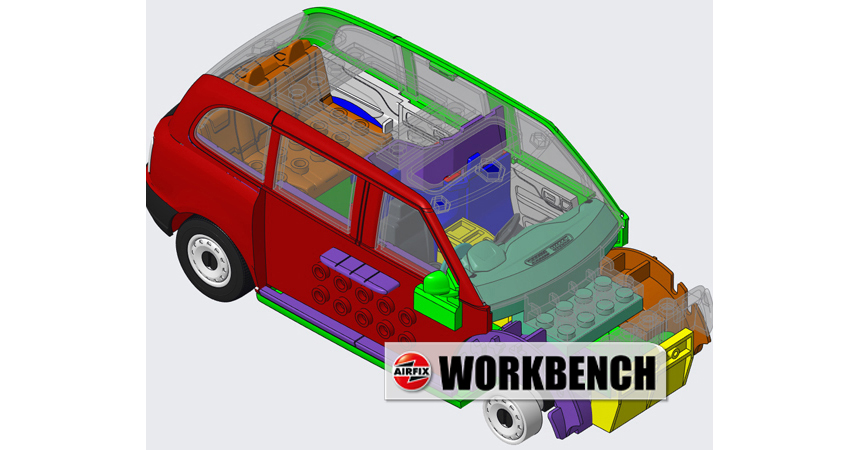
The culmination of many hours of design expertise, this CAD image shows internal detail of the new London Taxi model, with outer sections removed to allow a better view.
Over the course of the past couple of years, Workbench readers have become familiar with the Quickbuild range and with the talents of Product Designer Adam French, a man who has more Quickbuild design experience than any other within the current Airfix team. During that time, the range has benefitted from some significant development support, with new tooling projects attracting hefty financial backing from the powers that be, ensuring that Adam has spent quite a lot of time in the Workbench spotlight, but how his enthusiasm for his work is hugely infectious - Adam, we're afraid we need your specialist input yet again.
One of the most significant features of being an Airfix modeller over the years has been the sheer breadth of modelling subject matter respective ranges have given enthusiasts access to and in addition to this, how Airfix have never been afraid to try new things, whilst always maintaining the relationship with their core audience. One range of kits which is a current manifestation of this continuing heritage, our ever-expanding selection of Quickbuild models may well be targeted at a younger, less experienced class of modeller, but is still 100% Airfix and now has a mature, diverse range of subject matter for people to choose from, subjects which now include the London Taxi LEVC TX.
This impressive range of kits employs an ingenious brick build, snap-together method of construction, and whilst these models may well be aimed at younger modellers, possibly even those who may have never previously attempted to build a model kit of any description, they also appeal to those who have a little more time invested in the hobby. The whole ethos behind Quickbuild is fun and enjoyment and whether you intend to simply admire your finished model, or spend many happy hours playing with it, the finished model will always be an accurate and appealing representation of the car, aircraft or tank on which it's based.
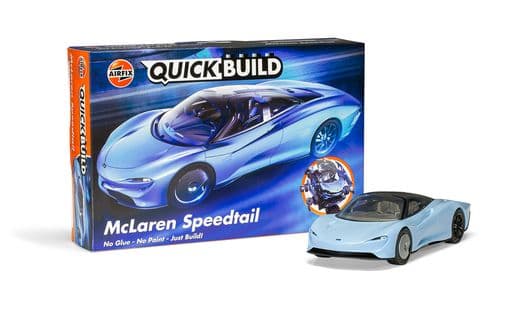
As the new London Taxi could hardly look more different from the previous project we covered here in Workbench, the McLaren Speedtail, we wanted to ask Adam if the physical height of the new model posed any specific design challenges and if this was any different to working on a representation of a Supercar?
A series of images taken straight from Adam's computer and representing the early stages of the London Taxi's design. They show the skeleton model and the initial stages of part slip work.
As our designers are often working on multiple projects at any one time and how our scheduling means that they are often working far in advance of proposed release dates, Adam stared by saying that this was quite an enjoyable trip down memory lane for him, as he started working on the taxi project around 18 months ago, but how our timing couldn't be more poignant, as the London Taxi LEVC TX has just arrived in stock. He began by telling us that with every Quickbuild design project, there are some parameters which must be strictly adhered to in every case, particularly bearing in mind the intended target audience for these models and they are a low part count and ease of construction, but all within the initial budgetary constraints of the project proposal.
From a designers perspective, once you know the limitations within which you are working, their aim is to produce a faithful representation of the subject, whilst introducing new design innovation wherever possible, but all with the enjoyment of the modeller as a primary consideration. As these kits are destined to be enjoyed by a particularly demanding section of our society and how they will be subjected to many hours of robust play, the need for the design to possess inherent strength is nearly always his starting point, looking at the shape of the subject and deciding which parts are going to form the strength backbone of the design.
With regard to the new taxi, the height of the model certainly introduced additional concerns around the splitting of parts and the need to give the design inherent strength, however, as long as you know what you need to achieve, it's simply a question of finding the most logical way of going about this. Adam told us that his experience in designing many a previous Quickbuild project helps him to spot potential problems before they become issues, but how something he has learned on previous design work will always find its way into his current project. There is no substitute for experience, and overcoming previous problems is the best way to ensure your latest project turns out as intended and more than this, how it helps you think about introducing different, more innovative ways of overcoming those previously faced problems. At the beginning though, the three words Adam thinks about when embarking on any new Quickbuild design are strength, strength and strength - if this is right, everything will quickly fall into place.
Always popular with our readers, this next series of images show the build-up of components in a sequence similar to how the kit will be assembled, but showing the design skills Adam brought to the new model.
For the new taxi, the strength of the model all comes from the main chassis and wheel arch construction and once Adam was happy with this, it became the spine of the design phase. With this as his anchor, the distinctive height of the LEVC TX actually posed few problems, and became more about keeping the part count down to a reasonable number, whilst at the same time including enough detail, as opposed to worrying about overall strength. The driver/passenger cabin dividing screen had an important role to play in this regard, including enough detail to make the finished model look realistic, but being of sufficient size and strength to support the roof structure of the taxi.
A quick look through the instruction sheet images we have included reveal that this kit features an impressively large single clear part to represent all the vehicle's windows, a part we think is perhaps the largest single clear plastic part we have ever produced and certainly the largest one for a Quickbuild model. This part also has a significant role to play with regard to providing the model's strength and rigidity, whilst also serving as an anchor point for other components and having the depth to extrude through other adjoining components - we will explore this further in a little while.
As we have previously learned when reviewing new Quickbuild design projects, these models utilise several different colours of plastic within their design, but how each separate colour and indeed the clear parts, will all require the production of individual manufacturing tools, something which clearly has an impact on overall cost. The designer has to make a judgement not only on which colours and how many different ones he intends to use, whilst also tailoring his design to incorporate these colours effectively. As this range continues to evolve, this can often include different coloured parts which pass through cavities in other, internal parts, to provide greater levels of detail and authenticity to the finished model, in the form of extruded detail.
A further selection of CAD imagery from the latter stages of Adam's work, culminating with a screengrab of the intended fully assembled kit as designed.
Interestingly, with regard to the new London Taxi kit, this included door details which had to extrude quite some distance through other components before it could take its aesthetically pleasing position within the overall build, but certainly adds a greater level of detail to the finished model. In addition to the clear parts, the new taxi features grey, silver and of course black plastic components and Adam informed us that the challenge here was not designing which colours should be used where, but how the parts which were not clearly visible once the kit was assembled, could be shared out between the colours, thus keeping tooling costs to an acceptable level. Even though these parts would have an important role to play in the overall rigidity of the model, each tool should be of a similar size and complexity, so sharing these parts out across the colours was definitely a design consideration.
Taking this a step further, Adam would also first have to decide if any of these colours would be needed to provide extruded detail for other parts of the build, something which would dictate their whereabouts within the assembly process and how they must locate with adjoining parts - as you can see, designing a Quickbuild model poses many more challenges than initially meets the eye.
Obviously, we couldn't let Adam go without asking him about aspects of the design which he is most pleased with and what he thinks modellers tackling the new London Taxi LEVC TX Quickbuild will be impressed with and what we should all look out for. He told us that there's actually quite a lot to talk about on this kit and how he's extremely pleased with how it turned out - he hopes we all love it. He said that he is particularly pleased how the levels of interior detail turned out in both the driver's position and the passenger cabin, and how without increasing the part count, he managed to design this detail as integral parts of larger components, thus maintaining the overall strength of the design.
A huge Workbench exclusive, Adam has kindly sent us this series of images which show 3D CAD views of the mould tool itself, or should we say the one designed to produce the black plastic parts.
He is also pleased with how the headlight detail has been replicated and how applying a sticker decal to a tab on each of the two front wing pieces creates a really appealing 3D lens representation once the headlight clear part is fixed over the top of it. The front grille and rear boot detail has also worked well, with both featuring extruded part detail design which really does add some appealing detail to the fully assembled model and also the tyres. This tyre detail is linked to another project Adam recently worked on, so please forgive us if we save these details for a forthcoming update.
Finally, Adam told us that he was particularly pleased how he managed to include detail on many of the load bearing structural parts and how the huge clear part allows much of this impressive detail to be seen and enjoyed once the model has been assembled.
The new London Taxi LEVC TX model is something just that little bit different for Quickbuild and an exciting new direction for this popular range. Importantly, review articles like this allow us to give a little more detail about the model and about the design expertise which allowed it to take its place within the Airfix range, giving it a personality all of its own and making this kit more than just another new model addition to the Airfix range.
Yet more exclusives, starting first with this picture of the SLA prototype model, an important stage which allows Adam to assess every aspect of its design. This is followed with an exploded part view of the new model, the box artwork we should all be looking out for and a final look at how the completed mode should look, from a design model perspective.
We would once again like to thank Adam for being so generous (and enthusiastic) with his time and for guiding us through the design phase of his latest Quickbuild masterpiece. We are particularly grateful for the spectacular selection of CAD imagery he sent us, every one of them a Workbench exclusive, including for the very first time, 3D CAD images of the actual mould tool design and layout - thanks so much Adam.
Now it's over to the modelling world, what will you make of Adam's new Quickbuild London Taxi LEVC TX? This fantastic new kit is available NOW.
We are afraid that's all we have for you in this latest edition, but we will be back next Friday with more project development updates and the very latest Airfix kit exclusives. In the meantime, we are always keen to hear your views on all things Airfix and in particular, any thoughts and opinions you may have regarding our Workbench blog. If you would like to drop us a quick line, could we please ask that you use our workbench@airfix.com email for all correspondence.
To re-visit any of the Airfix blogs we have produced over the past seven years or so, please head to our main Workbench hub, where you will find our entire blog back catalogue and all the Airfix design projects we have already covered.
All our dedicated official social media sites can be accessed by clicking the respective link icons at the foot of this page, or by heading to the Airfix homepage. Other useful Airfix links are:
Facebook, YouTube, Twitter and Instagram official sites
Please join us for more Airfix updates next week and thank you for your continued support.