Welcome to this latest edition of Workbench and all the news, updates and exclusive announcements from the fascinating world of Airfix modelling. We are excited to be bringing you this third anniversary edition of our blog, as the Workbench team celebrates another successful year of ever growing readership figures, increased worldwide circulation and sharing Airfix information with modellers at the earliest opportunity possible. Clearly, all this would mean nothing without the steadfast support of our loyal readers and each and every member of the Workbench team would like to sincerely thank you all for your continued support in helping make our blog such a success and especially to everyone who has sent in messages, ideas and model images over the past twelve months.
So, as this is such a special occasion, what could we possibly bring you by way of a worthy anniversary edition of Workbench? We can almost hear the word you are shouting at your computer screens right now – EXCLUSIVES! You will be pleased to hear that we have several exclusives for you in Edition 78, including the very latest built sample images from a new 1/48th scale tooling announcement which is already proving to be destined for Airfix ‘classic’ status when it is eventually released and final updates, scheme details and artwork reveals for two impending releases, all of which are being shown for the first time. As this is an anniversary edition, we also have a competition for you all to enter, with a main prize which includes a couple of recently released kits and runners up prizes of two pairs of Airfix mugs, which will allow two recipients to toast our anniversary in style. With much to get through, let’s make a start straight away.
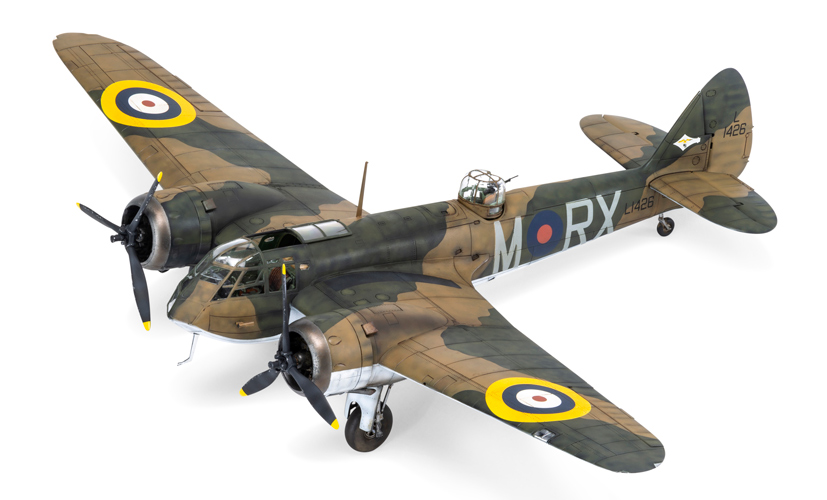
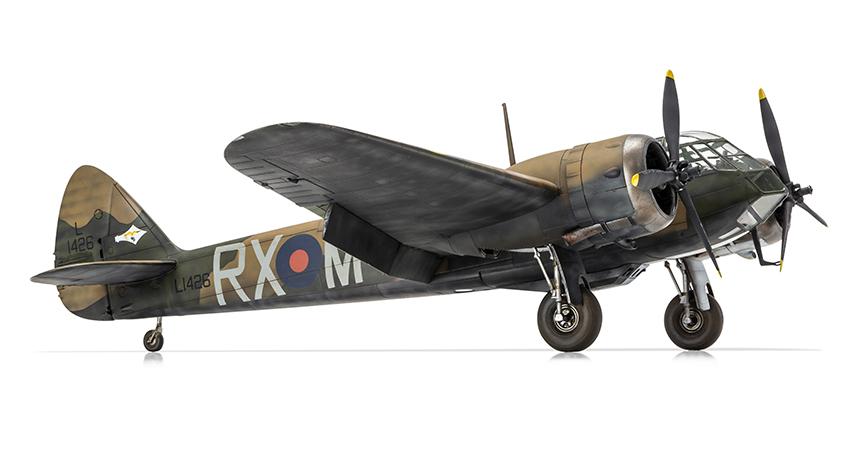
The latest Workbench exclusive includes a number of images taken of a beautiful test build of the new 1/48th scale Bristol Blenheim Mk.IF which has been causing such a stir over recent months.
Although not enjoying the same status as the Spitfires and Hurricanes which were in Royal Air Force service at the beginning of the Second World War, the Bristol Blenheim light bomber/night-fighter has to be regarded as one of the most important British aircraft of that period and was responsible for both stimulating a significant aviation expansion programme and leading Britain’s military response to Germany’s invasion of Poland. The original aircraft was not designed for, or ordered by the RAF, but was a project financed by wealthy newspaper owner Lord Rothermere, who was growing increasingly frustrated that Britain was lagging behind the rest of the world with regard to significant aviation achievements. He announced that he would fund a new aircraft project, but only if the resultant machine was the best in the world and put Britain firmly back on the world aviation map. The project proved to be a resounding success, with the Bristol Type 142 twin engined monoplane posting a top speed of 307mph, which was significantly faster than the current RAF front-line fighter of the day. Rothermere gifted his aircraft to the nation and flight trials soon convinced RAF officials to develop the aircraft into a new high speed light bomber for the air force.
As the the Second World War erupted in Europe, the Royal Air Force had more Bristol Blenheims in service than any other aircraft, in both fighter and bomber roles and they were to see extensive service during the battles to come. Significantly, just 63 minutes after Britain had declared war against Germany, a Blenheim of No.139 Squadron from RAF Wyton carried out the RAF’s first operational sortie of WWII, as it conducted a reconnaissance flight over the German naval base at Wilhelmshaven – the crew became the first British airmen to cross the German coast in WWII. The following day, Blenheims of Nos 107 and 110 Squadron attacked shipping at Wilhelmshaven but were forced to make their attack run from inland and flying out towards the vessels at sea. This was intended to avoid the possibility of inflicting unintentional civilian casualties on the local German population – the first wave had the element of surprise and was virtually unopposed, however as a second attack force approached the target minutes later, ground defenses and the Luftwaffe were now prepared and savaged the oncoming raiders. Five Blenheims and three Vickers Wellingtons were shot down during this operation, becoming the first RAF aircraft casualties of the war and unfortunately for Blenheim crews, a sign of challenging times to come.
The attractive design of the Bristol Blenheim and the significant place it occupies in the history of the Royal Air Force ensured that it has always been a popular aircraft in kit form and many Workbench readers will have fond memories of building the Airfix Blenheim in its light blue plastic during their formative years, a kit which always managed to produce pleasing results. Originally released back in 1968, the 1/72nd scale Blenheim kit received a much needed re-tooling upgrade in 2014, bringing this popular aircraft up to the standards modellers have now come to expect from the Airfix design team and even though this ensured the continued modelling legacy of this famous aircraft, there was even more to come. The announcement of a new 1/48th scale tooling of the Blenheim in October 2017 was received with much excitement and the sight of the prototype sample model on the Airfix stand at last year’s Telford show only served to increase our anticipation – the greater size of this new model helps to better illustrate the design and features of the Blenheim and produces an incredibly impressive scale representation of this important aircraft. With so many of you looking forward to adding this beauty to your future build schedules, we are pleased to bring you this exclusive series of build images, featuring advanced sample components which have been built and finished by one of our talented modelling supporters.
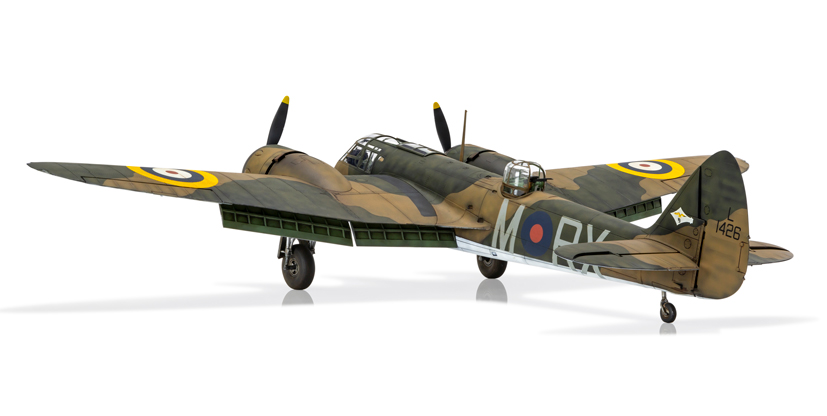
Workbench readers are the first to see this collection of images featuring a fully completed sample of our new 1/48th scale Bristol Blenheim, which is scheduled for release this coming October.
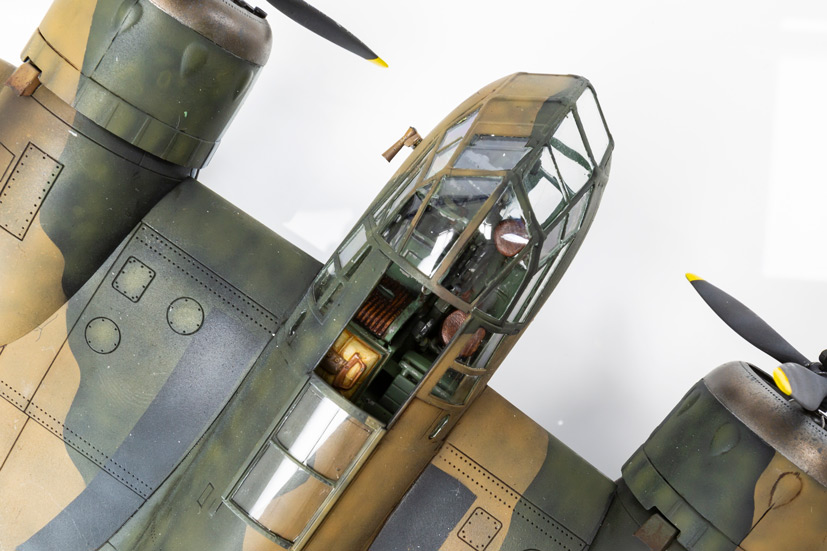
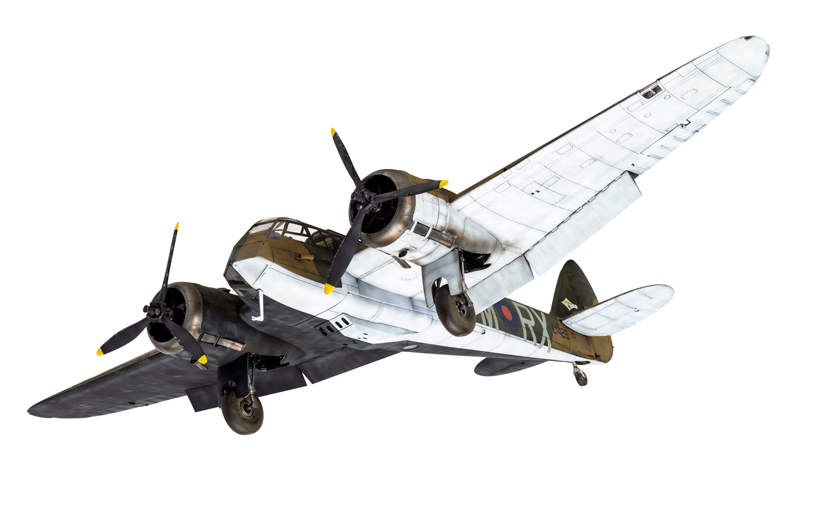
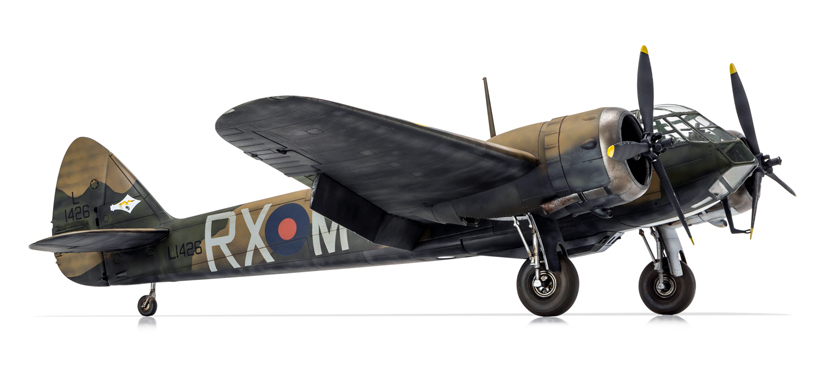
This magnificent build has been completed in a scheme which will not be supplied as one of the options included in the new kit, but certainly shows off the impressive lines of the Bristol Blenheim. This Mk.IF machine (L1426/RX-M) was on strength with RAF No.25 Squadron, based at Northolt in August 1939 and features both the four .303 machine gun pack in the belly of the aircraft and the striking black and white underside identification markings synonymous with this early period of the war, which you have to say looks extremely impressive on this larger model. This particular Blenheim was written off after being involved in an accident on 17th December 1939 – taking off from Northolt to perform an air test, one of the engines seized as it attempted to climb clear of the airfield boundary, forcing the pilot to make a wheels up landing in the first field he could see. L1426 suffered extensive damage and was later written off as being uneconomical to repair, however the crew were fortunate to escape the incident with relatively minor cuts and bruises.
As we bring you the latest information concerning this handsome new kit, let’s next take a look at the scheme options which will accompany the release of 1/48th scale Bristol Blenheim Mk.IF A09186.
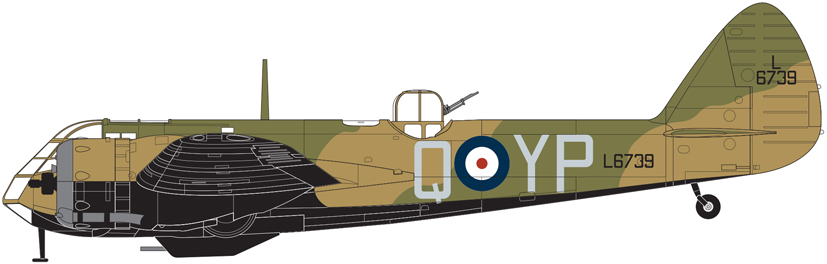
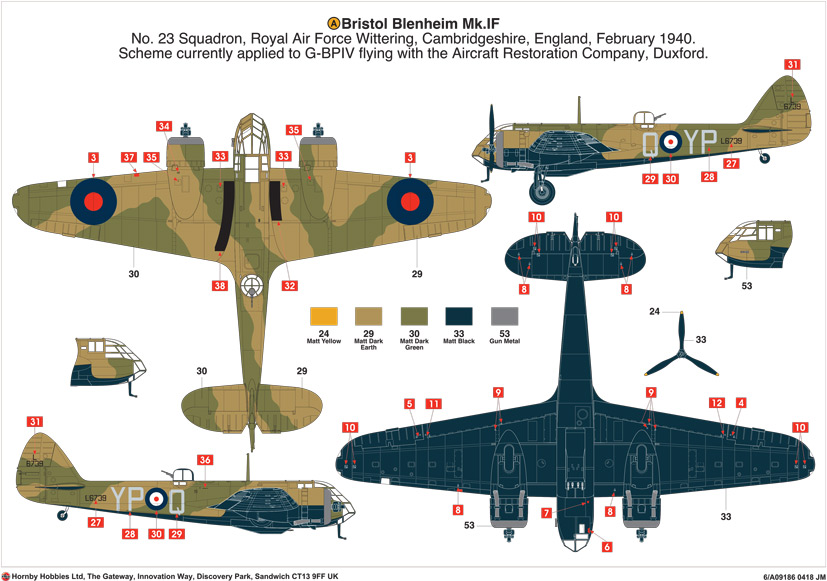
Full scheme details featuring the world’s only airworthy Bristol Blenhiem, which is operated by the Aircraft Restoration Company from their Duxford airfield site.
The Bristol Blenheim occupies a significant position in the history of British aviation, at one time being the most advanced aircraft of its type in the world, but by the beginning of its WWII combat introduction, was outclassed by the fighter aircraft which had entered service only months earlier. Over 4,400 Blenheims were produced during its production run, but with just a single example remaining in airworthy condition, this rare bird is without doubt one of the jewels in the crown of the UK historic aviation scene – it has, however, endured some difficult times in the past. Wearing the UK civil registration G-MKIV, the first Blenheim restoration only flew for a short but glorious four week period, before crashing during an Airshow appearance in June 1987. Thankfully, the team responsible for her restoration were determined not to let their efforts and expertise go to waste and a second restoration project began almost immediately, resulting in a second aircraft making its first post restoration flight just five years after the crash of the first Blenheim. This time carrying the new civil registration G-BPIV, the Blenheim would thankfully spend much more time delighting enthusiasts and veterans on the Airshow circuit, allowing younger audiences the opportunity to see one of these beautiful aircraft in the air, rather than in the aviation history books. Sadly, tragedy would strike the Blenheim team once again and the aircraft crash landed whilst returning to Duxford following its latest Airshow appearance, sustaining significant damage, though thankfully no loss of life. Had Britain lost her airworthy Blenheim for good this time?
The damage to G-BPIV was certainly significant, but not beyond repair and this proved to be all the encouragement the Blenheim team needed - a further restoration was undertaken, this time with something of an interesting aviation twist. The previous two restorations had been completed as long-nosed Mark IV versions of the Blenheim, however this latest attempt would aim to produce an early short-nosed IF fighter version of the aircraft, giving it a dramatically different appearance. The team had secured the nose section of Blenheim L6739, which had a rather interesting story behind it. Blenheim Mk.I L6739 was issued to No.23 Squadron at RAF Wittering following its construction, where it would serve as a night fighter throughout the period of the Battle of Britain. Struck off charge in December 1940, it went back to the manufacturers, where it was simply left to deteriorate in their scrapyard. After the war had ended, an innovative electrician by the name of Ralph Nelson who was working at Bristol's, was given permission to buy the nose of the aircraft, which he then went on to convert into an electric car. After mounting it to the chassis of an Austin 7 he fitted an electric motor of his own design and registered it as a 'Nelson' with the index JAD347. Ralph drove the car for 10 years before it suffered a fire which damaged the systems beyond repair, however, he had heard of the ongoing second Blenheim restoration at Duxford and donated the car to the project in 1992.
With the restored nose section now mated with the rest of the Blenheim airframe, L6739 made her first post restoration flight as a short nosed Mk.I at the end of May 2014 and has since gone on to be one of the most popular historic aircraft on the UK Airshow scene – a true aviation classic in this significant RAF centenary year.
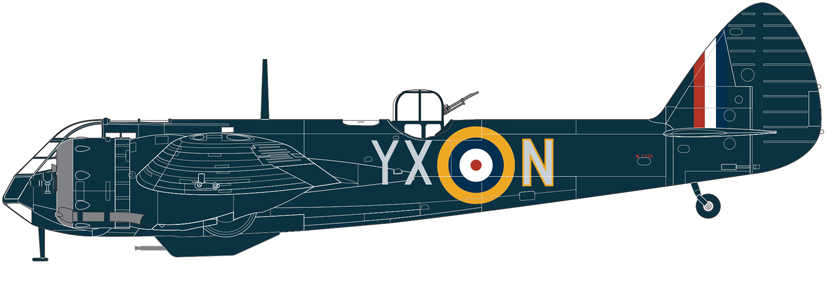
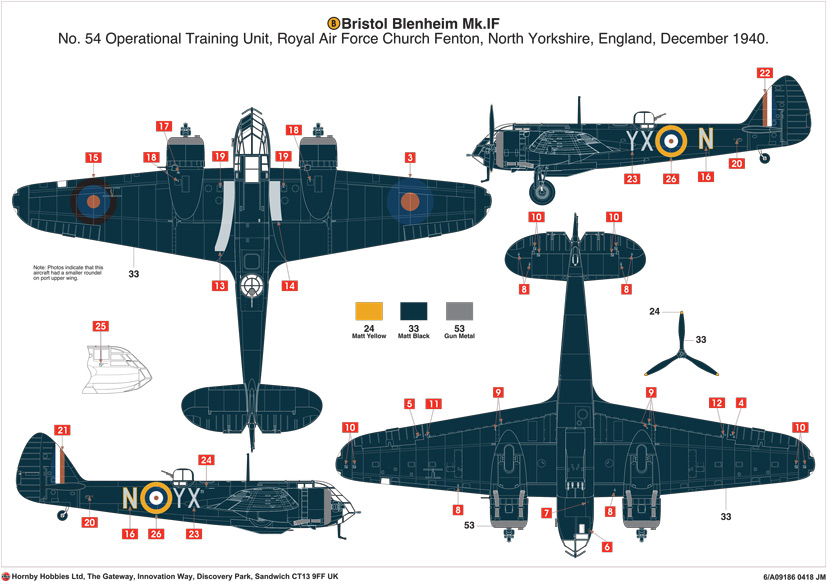
This beautiful black night fighter training aircraft will look extremely impressive in this new larger scale.
Equipping more RAF Squadrons than any other aircraft type at the outbreak of the Second World War, Blenheim crews would be called upon to perform many roles in defence of the nation, some of which were not initially apparent to them whilst engaged in their exhausting training schedule. Flying a great many practice sorties in formation with and in conjunction with RAF fighters as they prepared for war, Blenheim crews were also unwittingly helping to perfect the network of radar and Observer Corps stations across the country, as the British military prepared to repel the anticipated German attack which would surely come. Thinking they were helping fighter crews to develop their attack strategies, they were actually aiding radar ground controllers in detecting and vectoring Fighter Command’s response to simulated air raids, which would prove to be crucial in the battles soon to come. Blenheim night fighter units would also be called upon to help perfect the rather crude and unreliable early versions of airborne interception radar, which whilst initially proving to be of little help in stalking enemy raiders in the dark, were constantly fine-tuned, allowing the later Beaufighter and Mosquito nocturnal hunters to become much more effective in their role. Despite many initial challenges, it would be a Blenheim night fighter which would claim the first RAF victory over a German aircraft whilst equipped with airborne radar, yet another claim to fame for this magnificent aircraft.
This handsome black night fighter scheme presents Blenheim Mk.IF K7159, which was assigned to No.54 Operational Training Unit based at RAF Church Fenton during late 1940. Following their losses during the Battle of Britain, the Luftwaffe maintained their onslaught against Britain by mounting devastating night raids against cities, factories and airfields, clearly illustrating the need for an effective night defensive force of aircraft, capable of shooting down night raiders in significant numbers. Once again, the venerable Bristol Blenheim was pressed into service, not only in helping to perfect the technology of night warfare, but also in training the crews which would be required to fight this nocturnal game of cat and mouse. The airfield at Church Fenton, near Tadcaster was just far enough north to allow night fighter crews to train effectively without too much disruption from enemy action - although Luftwaffe bombers were still a constant threat and raids in the area were still mounted, they were at the extreme range of German operations and therefore relatively sporadic.
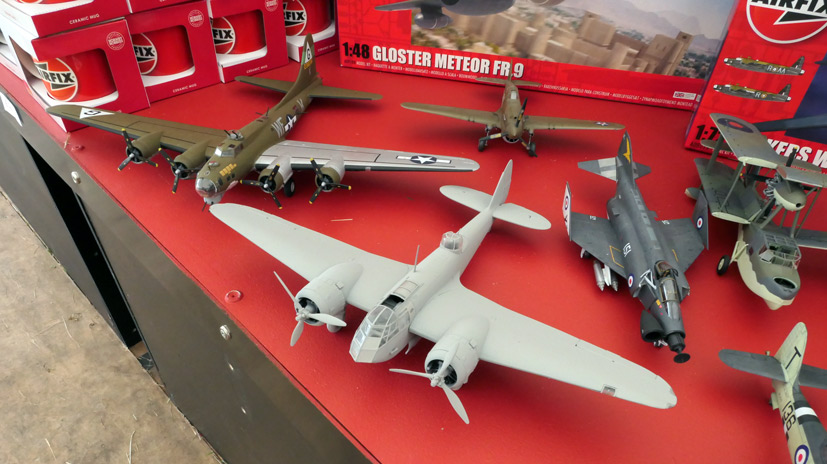
The Blenheim built model sample caused quite a stir when it was spotted on the Airfix stand at the recent Royal International Air Tattoo at Fairford.
In this new larger scale, the Blenheim looks mightily impressive and certainly allows a much greater appreciation of the virtues of this magnificent aircraft. Many Workbench readers will be very much looking forward to building one of these fabulous new kits and we will provide you with all the latest details as Bristol Blenheim Mk.IF A09186 speeds towards its October release date – the exciting box artwork reveal will be next folks!
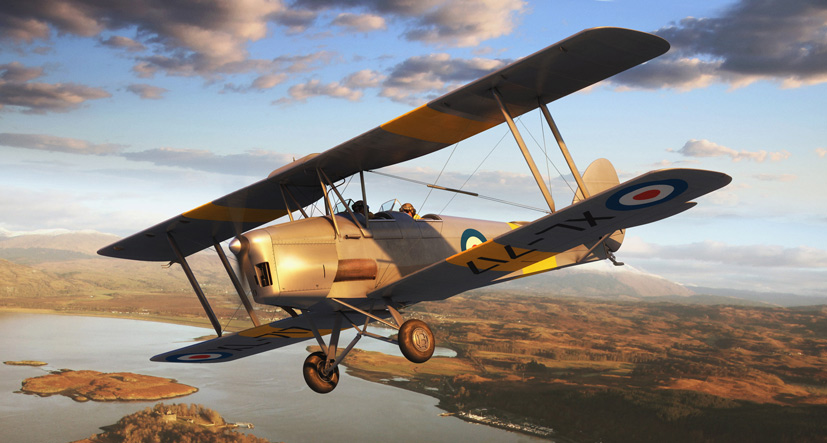
Exclusives galore in this anniversary edition of our Workbench blog. This de Havilland Tiger Moth artwork reveal shows a Royal Navy Tiggie flying over the idyllic Scottish coastline.
Although we currently find ourselves in the centenary year of the Royal Air Force, it is unlikely that many of the events held during 2018 will extol the aviation virtues of the de Havilland Tiger Moth training aircraft, in spite of the fact that it must be considered one of the most important aircraft in RAF history. It is easy to enthuse about the Spitfires, Lancasters and Mosquitos of the Second World War, but a training biplane with a top speed of just over 100mph is usually found languishing in the background, however unjust this may be. Despite this undeniable fact, without the availability of thousands of Tiger Moths to train a constant stream of pilots for military and civilian service, Britain and her Commonwealth would have been in real trouble and most pilots who would go on to fly the numerous aircraft types of the Second World War would have more than likely spent some time on this classic training aircraft.
Coming from a line of successful biplane designs, the DH.82 Tiger Moth made its first flight in October 1931 and was the result of the Company’s founder wanting to produce an aircraft superior to its predecessors and possessing enough appeal to attract interest from several different aviation sectors. Its success resulted in an immediate order from the RAF, who viewed the aircraft as an ideal primary trainer for pilots beginning on their flying careers. Their modest original order was followed up with several subsequent orders and as the world descended into conflict, the RAF could boast around 500 Tiger Moths on strength, with many additional aircraft owned by flying clubs all over the country also pressed into military service. With its growing reputation, the aircraft also secured many overseas orders, ensuring that the de Havilland production lines were fully committed in the production of this superb aircraft.
From the perspective of the student pilot, the Tiger Moth was a relatively stable and forgiving aircraft to fly, with few handling vices and generally supportive of the odd silly mistake. It has been described as an ‘easy aeroplane to fly but a difficult one to fly well’, which seemed to have made this the ideal aircraft to serve as a primary/basic trainer for large numbers of future pilots destined for the war effort. As Britain prepared for invasion during the early summer of 1940, there were plans for the good natured Tiger Moth to show a much more aggressive side and support the Spitfire and Hurricane pilots they had previously trained by attacking any potential invasion force by all means at their disposal. ‘Operation Banquet’ called for the use of every available aircraft in the defence of Britain’s coastline, equipping even the most unlikely aircraft with bomb racks and giving them an offensive capability. Should a German invasion have been attempted, there would have been the very real possibility of swarms of bomb laden Tiger Moths raining fury on the enemy troops below, as Britain used every means in their power to ensure the failure of such a cross channel incursion. Thankfully, due in no small part to the qualities of this effective pilot maker and the resolve of the Royal Air Force, German invasion plans were indefinitely postponed following the Luftwaffe’s inability to score a decisive victory during the Battle of Britain.
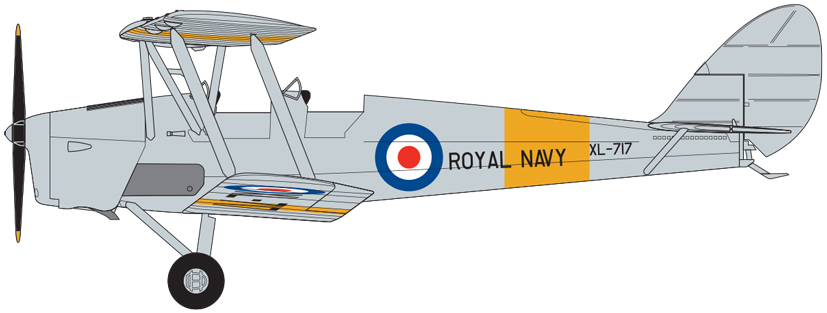
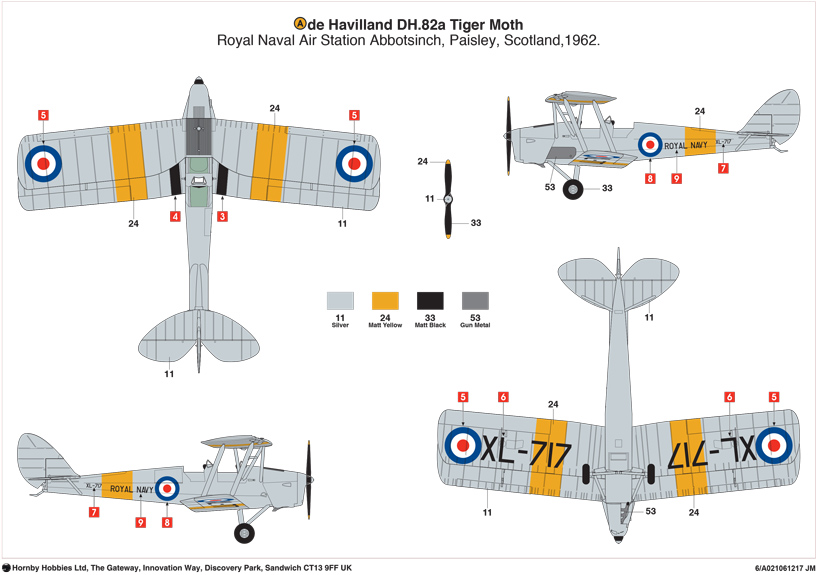
The Tiger Moth not only trained tens of thousands of pilots during the Second World War, but went on working long after the end of hostilities and is still an important tail dragger trainer to this day.
This particular Tiger Moth was built by Morris Motors at their Cowley plant for the Royal Air Force and went on to serve with a number of Elementary Flying Training Schools before being sold to a civilian operator after the war. She was later bought by the Royal Navy and allocated to Britannia Royal Naval College with the serial XL717, but would go on to see plenty of service north of the border, with several units based in Scotland. Whilst based at RNAS Lossiemouth, this aircraft performed a number of valuable duties, such as providing training and currency support, glider towing duties and representing the Navy at Airshows and open days around Scotland. Wearing this smart silver and yellow training scheme, XL717 was noted as attending the 1962 Royal Naval Air Station Abbotsinch (HMS Sanderling) Open day, where she will have been just one of a great variety of naval aviation types present on the airfield for this event.
RNAS Abbotsinch was in use by the Royal Navy from 1939 until1963 and was a major facility for reserve aircraft storage, aircraft maintenance and various training facilities. The regular Open Days were extremely popular events and would attract thousands of people from the surrounding areas, keen to support their local base and see what interesting aircraft they currently had stored there. In October 1963, the Navy handed the base over to civilian operators, who gradually developed the airfield for the growing air travel market in Scotland and is today the site of Glasgow International Airport. The airport still retains links with its former Naval heritage and displays HMS Sanderling’s ships bells in the main hall and has a bar and restaurant named ‘The Sanderling Bar’ in the main terminal building. Tiger Moth XL717 returned to RNAS Yeovilton and the Fleet Air Arm Museum in 1972 and was later repainted to represent Sir Alan Cobham’s G - ABUL and take its place in their Inter War Years aviation exhibition.
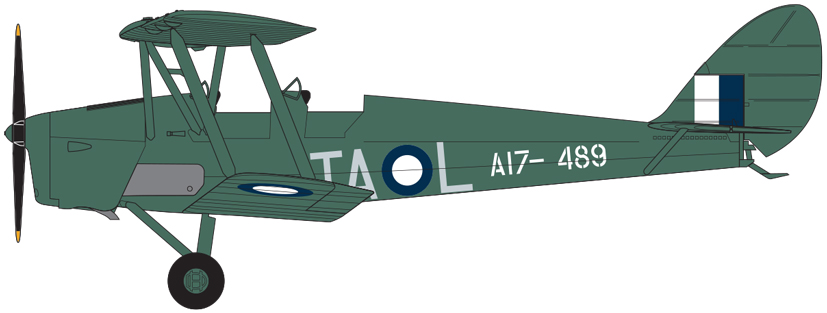
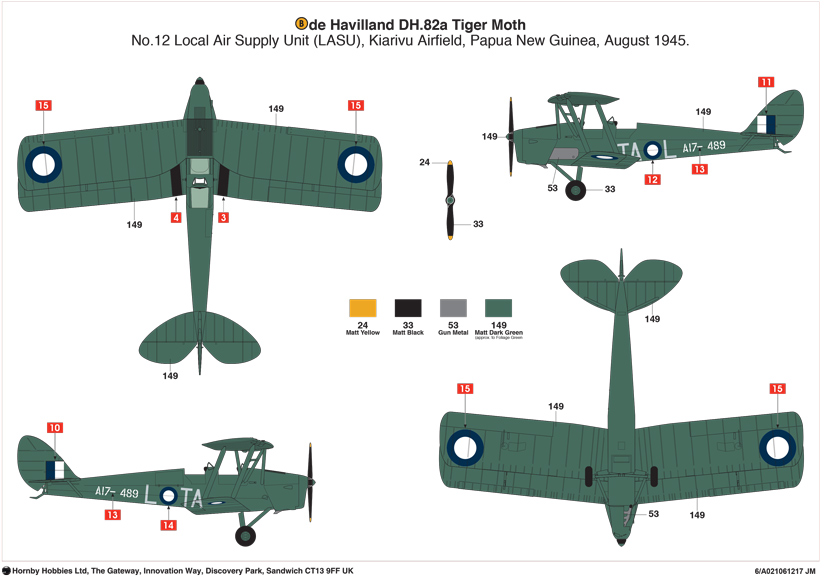
The training credentials of the Tiger Moth ensured that the aircraft was a significant export success, used by many air forces across the world, including the Royal Australian Air Force.
Built by de Havillands in Australia, this aircraft was delivered to the Royal Australian Air Force in May 1942 where it would go on to serve in a training and communications role for the next three years. May 1945 would prove to be a particularly eventful time in the operational history of this aircraft - during this month, the aircraft was assigned to 12 Local Air Supply Unit (LASU) and coded L-TA, however early into its LASU service it struck an obstacle during its take-off run and suffered not insignificant damage. Following its repair, it was involved in another incident just two months later, when it struck tree tops after a particularly low transit across the airfield boundary and despite sustaining further significant damage, the aircraft was once again repaired back to airworthy status.
On 13th August 1945, A17-489 was the first aircraft to land and take off from the newly constructed Kiarivu Airfield, which is interesting as the runway was still soft from construction and parachute bundles from previous air supply drops were used to indicate the most suitable sections of the runway for the pilot to use. Perhaps of even greater significance, this famous Tiger Moth was used the following month to transport surrendered Japanese Army Commander Lt. General Hatazo Adachi in its front cockpit, returning once again to Kiarivu Airfield, where he was brought back to his former headquarters to face trial and internment.
Following the end of the war, the aircraft left military service and was sold to a civilian operator for the princely sum of £175 pounds, however its eventual fate is unknown and it is thought to have been either scrapped or may even be lying undiscovered at some old disused airfield. This interesting scheme is a representation of the many Tiger Moths which went on to see service with overseas air arms and underlining the effectiveness of this exceptional aeroplane. Just as it was during the war years, the Tiger Moth is still proving to be an important aircraft in the training of pilots hoping to progress to fly Warbirds on the historic aviation scene, allowing them to gain valuable tail-dragger experience in this proven flying tutor. It also allows members of the public to enjoy experience flights in what must surely be considered one of the most significant aircraft in the history of flight. de Havilland DH 82A Tiger Moth A02106 is scheduled for a September release and will therefore be gracing our workbenches in the very near future.
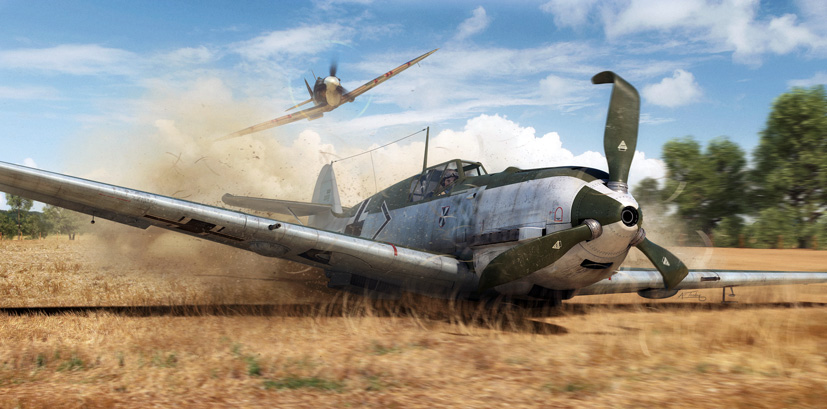
When viewing magnificent images such as this, it is no wonder why the Battle of Britain continues to hold an enduring fascination for many modellers.
Few aircraft in the history of flight can claim to have the notoriety or aviation credentials of the Messerschmitt Bf 109, the most heavily produced fighter the world has ever seen and one of the most important aircraft in the history of warfare. This highly advanced monoplane fighter made its first flight in May 1935 and unusually, due to the delayed development of its intended Jumo engine, this first flight was made under the power of a British Rolls Royce Kestrel Vl engine. Entering Luftwaffe service at the beginning of 1937, the fighter was first blooded in action during the Spanish Civil War, but by the opening day of WWII, was now the mainstay of the Luftwaffe fighter force. As Germany swept through Poland and on through Western Europe, the seemingly invincible Bf 109 appeared to have mastery of the air, earning a fearsome reputation for ruthless effectiveness as it went. By the time the Germans reached the French channel coast, they would be pitted against the organised and well trained airmen of the Royal Air Force, flying their Spitfires and Hurricanes in defence of their homeland. For the first time, the much vaunted Messerschmitt would be at a tactical disadvantage and despite possessing greater numbers, Luftwaffe fighter pilots would soon see that their fighter was not quite as invincible as they had previously thought.
The Messerschmitt Bf 109 was developed constantly throughout the duration of WWII and saw service from the first day of conflict to the last, initially sharing the skies with biplane fighter designs and later witnessing the dawning of the jet age. It was also the mount of the three top scoring air aces in history, who between them claimed an astonishing 928 aerial victories against Allied air forces. The fighting credentials of the Bf 109 are second to none and it stands as one of the great aeroplanes of all time, a thoroughbred fighting machine. For this reason, the Bf 109 in its various marks, have always been amongst the most popular modelling subjects with enthusiasts and this latest release from our impressive 1/48th scale tooling will certainly be no exception. Supplied complete with three equally appealing scheme options, Messerschmitt Bf 109E-4/E-1 A05120B will be an extremely difficult kit for modellers to overlook.
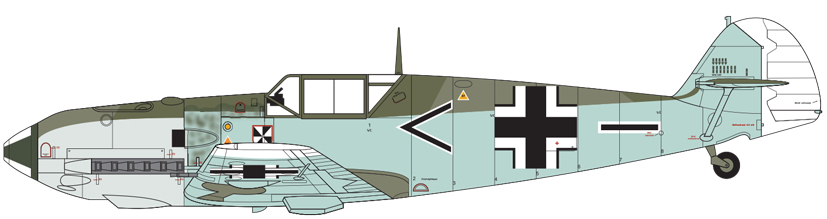
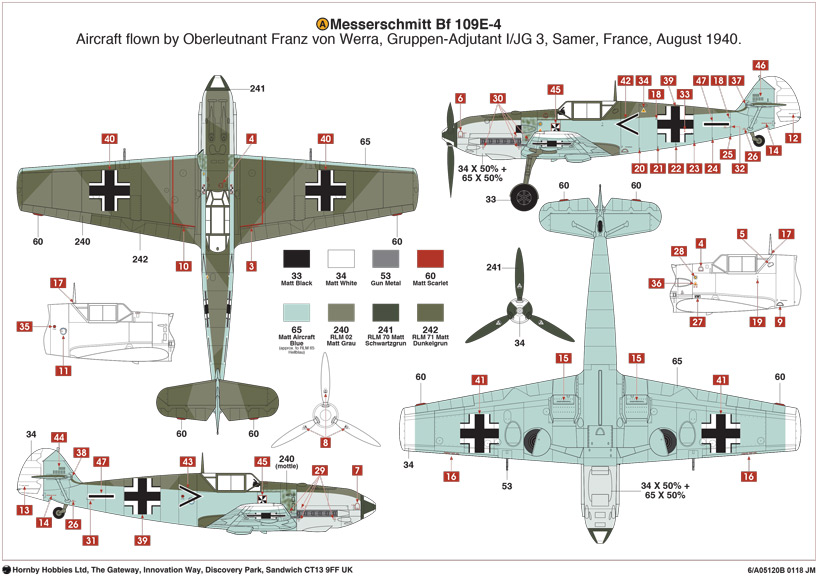
As one of the most famous Luftwaffe pilots of the Battle of Britain era, Franz von Werra’s Bf 109 will prove to be a tempting option for many.
Luftwaffe fighter ace Franz von Werra seemed to epitomise the brash, devil may care confidence of Germany’s Teutonic knights of the sky, joining the air force at an early age to fly the world’s most capable fighting aeroplane after enjoying something of a privileged upbringing. As German forces Blitzkrieged their way across Europe, von Werra began to score aerial victories and his reputation started to build amongst fellow pilots and his superiors. Labelled as something of a brash playboy, he kept a lion cub as a squadron mascot and was featured in several famous pictures playing with the animal on his Messerschmitt fighter as he relaxed between sorties – as you may well imagine, these pictures became popular with the German public and reassured them that their confident boys would surely be victorious in this war.
At the height of the Battle of Britain, von Werra was shot down over Kent in his Bf 109E-4, but managed to crash land his aircraft in a field near the village of Marden, surviving the incident intact, but immediately becoming a prisoner of war. The victory was originally credited to P.O Gerald ‘Stapme’ Stapleton of RAF No.603 Squadron, but records studied after the war indicated that several pilots may have been involved with this particular victory. Franz von Werra became famous for making persistent escape attempts during his captivity, which was to become a source of fascination in the years after the war and formed the basis of a book and film, further increasing his notoriety. Becoming something of a nuisance, he was later transported to Canada with other German prisoners, which only served to aid his bid for freedom and eventually saw him crossing the border to neutral America and on to Mexico with the help of the German Consulate in New York. Taking a long and perilous route via Mexico, Brazil, Spain and Italy, he eventually arrived back in Germany in April 1941, where he was instantly elevated to the status of national hero and favourite of the Fuhrer. He returned to active duty later the same year, initially on the Easter Front, where his victory tally would increase to 21, before withdrawing to Germany for conversion to the new ‘F’ variant of the Bf 109 and a subsequent posting to Holland. On 25th October 1941, Franz von Werra suffered catastrophic engine failure of his new Messerschmitt fighter which crashed into the sea - his body never recovered, further fuelling the enigma that was Franz von Werra.
In the years following his death, it has been reported in several sources that many of the exploits claimed as fact by von Werra were very much exaggerated and were a consequence of his effervescent personality and the fog of war allowing such accounts to propagate. Proving to be such an interesting character to read about, it somehow doesn’t seem right that we should let the truth get in the way of such a fascinating wartime story.
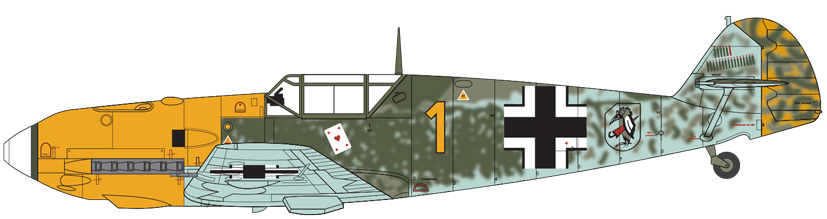
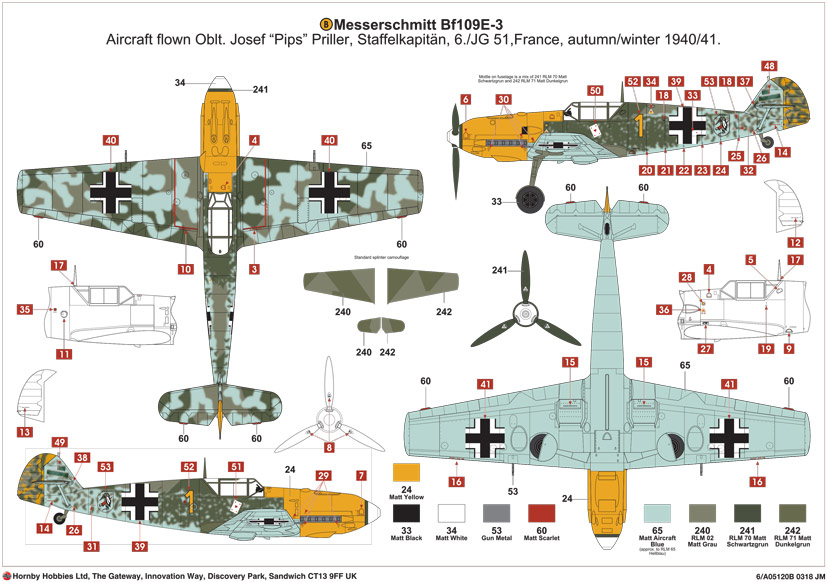
Josef ‘Pips’ Priller was one of the most successful Luftwaffe fighter pilots of the Battle of Britain and would end the war with an impressive total of 101 aerial victories and no fewer than 68 Spitfires destroyed.
As one of the most capable fighting aeroplanes the world had ever seen, the diminutive yet powerful and heavily armed Messerschmitt Bf 109 allowed the Luftwaffe to clear the skies above continental Europe in advance of their ground forces striking out in all directions. With many pilots already gaining combat experience during the Spanish Civil War, the Luftwaffe were well equipped to take on any air force in the world, making relatively quick work of their less effective and poorly organised adversaries. As they swept through Poland, the Low Countries and then France, Bf 109 pilots began to score victories, increasing their confidence and allowing them to hone their combat skills, however as they began to arrive at captured airfields in Northern France, they were facing a significant new challenge. The English Channel would prove to be a great leveller and ensured the Luftwaffe would not have everything their own way in the struggles to come. Fuel management would now be a critical consideration and any combat or mechanical issues over enemy territory would probably result in capture or worse, but at the very least the end of their war. Their British opponents were also much more organised than the fighters they had previously come up against and would be able to fly for longer and undertake more sorties, as they battled to save their country from potential invasion – also, should they need to bail out of their damaged aircraft, they could be back with their squadrons in a matter of hours. With the Spitfire being closely matched in performance to the Bf 109 and the Hurricane proving to be a much better fighting aeroplane than is was given credit for, the Battle of Britain would turn out to be an attritional survival of the fittest, claiming the lives of many young airmen on both sides.
Already a Luftwaffe fighter ace by the start of the Battle of Britain, Josef ‘Pips’ Priller and his fellow pilots of JG51 would be heavily involved in the fighting against the RAF during the summer of 1940, with the savage aerial battles over southern England claiming many airmen as casualties. Priller and his trusty Messerschmitt Bf 109E-3 would go on to score at least 14 victories during the Battle of Britain, making him one of the most successful fighter pilots of this famous conflict. He would later become one of the world’s most successful air aces in history, eventually ending the war with an astonishing 101 victories from just 307 combat missions flown. Amongst this number, Josef Priller was to claim at least 68 Spitfires destroyed, which was the highest Luftwaffe ace tally against Britain’s most famous fighter during WWII - in addition to this, he was also one of only a small number of Luftwaffe aces to fight solely in the West, coming up against the very best aircraft available to the Allied air forces.
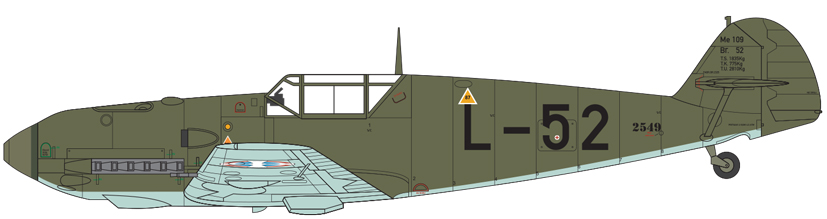
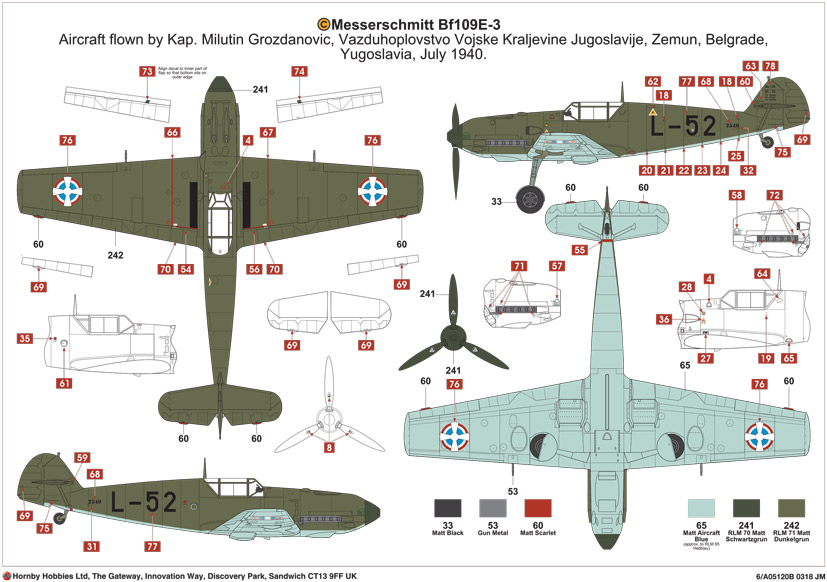
During the invasion of Yugoslavia, the skies were contested by Messerschmitt Bf 109E fighters being used by both sides, causing more than a few headaches for ground based anti-aircraft batteries.
This fascinating third scheme option may tempt many modellers to stray away from the more common Bf 109 Luftwaffe subject matter and complete their fighter in the colours of this unusual operator of the type. Desperate to modernise their air force as Europe seemed to be heading inexorably towards war, the Royal Yugoslav Army Air Force placed an order for 100 Messerschmitt fighter with the German company, including a deal to supply spares and train their pilots and ground crews in its operation. This order was later increased further, but due to the worsening political situation in Europe, only 73 aircraft would actually be delivered. The VVKJ were equipped with an eclectic collection of aircraft, which also included British Hurricanes, Blenheims and Hawker Fury II biplanes, along with a small number of indigenous types, however their Messerschmitt Bf 109 force was to form the mainstay of their air defence capability.
On 6th April 1941, Axis forces launched a devastating attack against Yugoslavia, as Hitler decreed that he intended to make these lands German again. With such a large border to defend and hostile nations across its length (other than their border with Greece), the country had little hope of withstanding the onslaught. Despite this, the pilots of the VVKJ fought valiantly in whichever aircraft type they were assigned to fly and claimed many enemy aircraft destroyed. For the duration of these aerial battles, there was the unusual occurrence of German made Messerschmitt fighters engaged in savage combat with Luftwaffe Bf 109s, which must have made target recognition a nightmare in the melee of combat. Indeed, Yugoslav pilots also ran the gauntlet of effective ground fire from friendly forces as they sped to and from combat, with anti-aircraft units having great difficulty distinguishing between the opposing Messerschmitts. The fighting was to last for ten days before an unconditional surrender was signed. The vast majority of the aircraft operated by the VVKJ were destroyed in the air or whilst still on the ground, despite the pilots brave efforts to defend their country, including this significant force of Bf 109s which had been unusually sent into combat against their creators.
This latest release from our popular 1/48th scale Messerschmitt Bf 109E tooling (A05120B) is due to arrive in model stores during September and will include the above scheme options, making your finish choice a rather difficult one. Whichever one you go for, it will still include the classic lines of this famous fighter, which continues to captivate modellers and enthusiasts to this day.
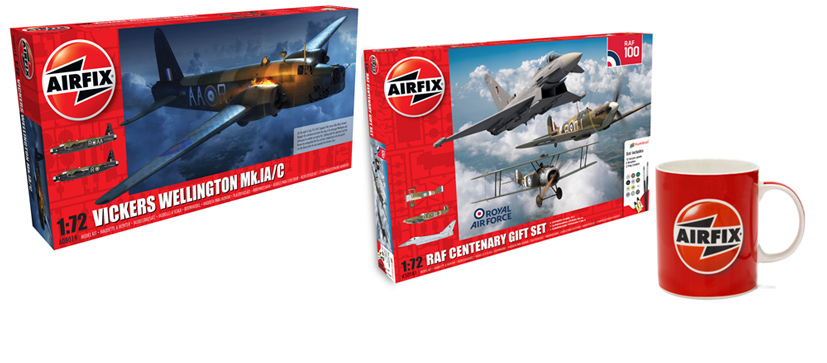
Kick-start your summer modelling with this fantastic selection of prizes available to the lucky winners of our 3rd Anniversary competition.
There has been a lot of information to cram into this latest edition of Workbench, but as it marks the 3rd Anniversary of our blog, we could not let the occasion pass without launching a little competition, with some interesting Airfix goodies up for grabs. Our lucky first prize winner will receive an example of the recently released 1/72nd scale Vickers Wellington Mk.IA/C kit, as well as one of our rather topical RAF Centenary Gift Sets. There will also be two runners up prizes of a pair of Airfix mugs, the only way for any self-respecting modeller to be seen with the beverage of their choice.
For the chance to win one of these prizes, simply head over to the Airfix Competitions Page, where you will find an aviation related question to answer, one which is linked to some significant news for the RAF coming from the Farnborough Airshow over the previous few days. As usual, there will be three possible answers for you to select from, with one being the correct answer – all you have to do is choose that one to be in with a chance of winning. Our winners will be selected at random and published in the next edition of Workbench in two weeks’ time - the competition itself will remain open until midnight on Tuesday 31st July and we wish everyone who enters the very best of luck!
That’s it for this whopping 3rd Anniversary edition of Workbench, but we will be back as usual in two weeks’ time with more Airfix delights for your enjoyment. In the meantime, if you have any suggestions for subjects you would like to see covered in a future edition of the blog, or ways in which we could enhance your enjoyment of Workbench, please do not hesitate in contacting us. We can be reached via our usual e-mail address workbench@airfix.com or by contributing to our Workbench thread over on the Airfix Forum. If social media is more your style, you could access either the Airfix Facebook page or our Twitter channel, using #airfixworkbench where you will find plenty of modelling news, views and discussion. Whichever medium you decide to use, please do get in touch, as it is always interesting to hear from fellow modelling enthusiasts and the projects you have on the go at the moment.
As always, the Airfix website is the place to go for all the latest model release information, with our New Arrivals, Coming Soon and Last Chance to Buy sections all accessed by clicking on the above links. As updating the website is a constant process, a quick search through each section of the Airfix web pages will reveal new information and updated images in many of the product sections and this is always an enjoyable and rewarding way to spend a few minutes.
The next edition of Workbench is due to be published on Friday 3rd August, when we look forward to bringing you all the latest news, updates and exclusives from the fascinating world of Airfix modelling.
On behalf of the entire Workbench team, thank you for continuing to support our Airfix blog.
The Airfix Workbench Team
© Hornby Hobbies Ltd. All rights reserved.