

Welcome to this latest edition of our Workbench blog and all the news, updates and modelling exclusives from the fascinating world of Airfix.
In this first Workbench double blog posting of the year, as we have not one, but two eagerly anticipated new model releases now on final approach to our warehouse, we wanted to take this blog opportunity to enjoy one final development overview of both, even though both kits have already been featured since the turn of the year. Both kits are just the second releases from their respective new tooling designs and both clearly qualify as future classics in their own right, so we feel certain that few readers will be disappointed with this decision. To help our cause, we have an exclusive selection of built model images from both projects for your viewing pleasure, using advanced production sample components from each of the kits, providing us with all the inspiration and visual confirmation we might require in order to decide whether either one, or both will be in our 2023 build schedules. We will be posting each update as its own separate blog, just to make each model slightly more visible for those coming to us via a basic web search. As ever, our Workbench blog back catalogue can be accessed by heading to the main Workbench hub and on that particular blog subject, can you believe that this summer, we will be celebrating eight years of Workbench and all that fascinating Airfix development detail.
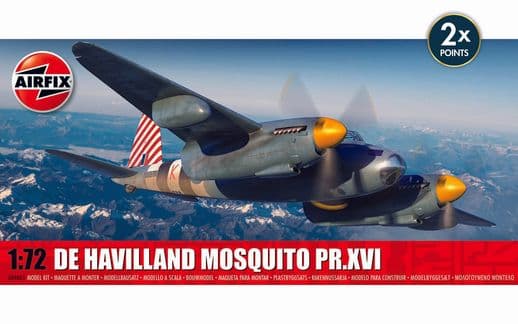
This second update of the week is our final return to a project which will see a beautiful 1/72nd scale kit representation of one of the most popular aircraft of the Second World War joining the 2023 Airfix range, a multi role aircraft which forged a reputation unmatched by any other type during the conflict, the incomparable de Havilland Mosquito. Just the second release from this stunning new tooling, this latest kit marks the Photo Reconnaissance variant of the Mosquito, a task for which this wooden speedster was ideally suited and as you will see from the pictures included, did so in quite a visually appealing manner. The other blog posting for this week features our equally appealing new 1/72nd scale Hawker Tempest V kit and if you head over to that update, you will see an exclusive selection of images which highlight the appeal of this potent performer, one of the most capable piston engined aircraft ever to see Royal Air Force service and the eventual realisation of designer Sydney Camm's dream of producing his 'Super Hurricane'. It's potent piston powered aircraft all the way in this first dual workbench blog posting for 2023.
Do we ever need an excuse to look at stunning artwork featuring a de Havilland Mosquito?
The British public has always had a strong affinity with the de Havilland Mosquito ever since the first aircraft entered Royal Air Force service towards the end of 1941, maybe down to the fact that we Brits always love an underdog and how this particular aviation world-beater managed to survive against all the odds. Initially, the Air Ministry showed little, if any enthusiasm for de Havilland's idea of producing a new fast, unarmed bomber aircraft and actually didn't want them to continue with its development, fearing such a project would be a distraction from existing essential production commitments. Even if proving successful, it would place an unacceptable strain on manufacturing capacity and materials at a crucial period in British history. Even when de Havillands informed them that the new aircraft would be produced using non-strategic materials, the Ministry then expressed their concern that the use of wood in its construction was a backward step from a technological standpoint and a return to outdated manufacturing methods of years past.
The use of wood in its construction would also later prevent the Mosquito being produced under licence in America, despite the fact that their own officials were extremely impressed with the performance of the British aircraft. Their manufacturing companies didn't want to use this method of construction, convinced that their latest all metal aircraft types, such as the P-38 Lightning, could do everything a Mosquito could and more, although this was probably simply down to the fact that they lacked the expertise in working with the wood lamination processes perfected by de Havilland and didn't want to take it on. Thank goodness officials at de Havilland were certain they were on the right track and steadfast in their determination to see their speedy new aircraft take to the skies.
For these reasons and how this magnificent aircraft was built by joiners and cabinet makers, the fact that Britain's 'Wooden Wonder' managed to take on and beat the aviation world is such an inspirational story that the impressive reputation of the Mosquito continues to endure to this day and how the nation would love to have an example on the UK Airshow circuit. For those of us with a few years under our belts, we will remember with some affection that until 1996, we did have a solitary airworthy Mosquito on the UK display circuit and at any event where this aircraft was about to perform, it would be standing room only the entire length of the crowd line in anticipation of its display slot. A potent performer, the Mosquito is also a beautiful sight and for those of us who were lucky enough to see it in the air, left us with a feeling of pride, knowing this magnificent aircraft we were admiring may have been fondly referred to as 'flying furniture', but was capable of outpacing anything the Luftwaffe could throw at it, at least until the advent of the jet powered Messerschmitt Me 262.
Tragically, Britain's Airshow Mosquito T.Mk.III RR299 was lost in an accident during a display performance in 1996 and since that date, almost thirty years have passed without a Mosquito seen in UK skies, however, with a couple of concerted restoration projects currently underway, could this situation be about to change and a new generation of enthusiasts come under the spell of the majestic Mosquito?
Built Mosquito models finished in the two PR scheme options included with this second release from our new Mosquito tooling.
The latest release from our new 1/72nd scale Mosquito tooling is a representation of a fascinating variant of this famous aircraft and arguably, the most effective airborne reconnaissance aircraft of the entire Second World War, the PR.XVI. From the very outset, the attributes of the Mosquito made it an ideal platform from which to obtain detailed photographic reconnaissance imagery, with its speed, larger size, effective range and additional crew member all making this a more suitable 'Spy in the sky' than a modified Spitfire. Despite this, even though the initial military prototype order was for a photo reconnaissance version of the new de Havilland twin, its first flight would be delayed because it would be needed following damage to the original prototype W4050, which was undergoing service trials at Boscombe Down. It was discovered that the tail wheel of this aircraft was faulty and resulted in increased stress forces being placed on the fuselage of the aircraft during operation, stresses which would eventually result in a structural failure.
Nevertheless, when the Photo Reconnaissance prototype did take to the air, it would be the only one of the three prototypes to later be used operationally, as it was handed over to the Photographic Development Unit (PDU). It would later go on to be one of the nine PR Mosquitos based at RAF Benson with the PDU and No.1 Photographic Reconnaissance Unit. Following its introduction, the work undertaken by PR Mosquito crews was absolutely vital and they would be kept extremely busy flying sorties for all branches of the military, covering targets across the length and breadth of Europe. It is interesting to note that of the required attributes a successful photo reconnaissance aircraft must possess, the only one Air Ministry officials were concerned about with the Mosquito was speed and as a result, wanted to see how the aircraft would perform against their current aviation jewel in the crown, the Spitfire. They arranged to conduct performance trials between an early PR Mosquito and the Spitfire of the moment, the Mk.V, to see if the Mosquito could get close to matching the Spitfire's speed, however, it didn't take long for them to get their answer. During these trials, it was the Spitfire which was left in the wake of the Mosquito at most, if not all altitudes tested and any lingering doubts they may have had about the operational effectiveness of their new 'Eye in the sky' were quickly dispelled.
The crews engaged in performing those early Mosquito reconnaissance sorties were quite pioneering, as they were flying these specialised missions at faster speeds, at higher altitudes and over greater distances than they had ever been flown previously, so their debriefs were not only vital to understanding the images they brought back, but also directing the future of Britain's wartime airborne reconnaissance operations. With great demands being placed on their expertise, they were given every opportunity to perfect their art, as pictures of everything from potential bombing targets in Europe to the whereabouts of the Kriegsmarine's warships were required and the better they got at securing these images, the more sorties they were given.
Rhapsody in blue, this second release from our de Havilland Mosquito tooling includes scheme options for aircraft operated by the Royal South African Air Force and the USAAF.
Aircraft would often be required to undertake several sorties a day and with the development of incredibly powerful flash units and the use of flash bombs, also even at night. With the continued development of the Rolls Royce Merlin engine and new variants of the Mosquito subsequently entering service, the capabilities of the Photo Reconnaissance Mosquitos continually improved, with all of Europe now coming under the prying gaze of their cameras and how the Germans hated them.
To assist crews in better dealing with the rigors of prolonged exposure to operating at high altitudes, the design team at de Havillands developed the B.Mk XVI variant of the Mosquito, an aircraft which featured a pressurised cockpit in addition to a host of other improvements. A variant which also featured the latest incarnation of the Rolls Royce Merlin engine, it was of obvious interest to photographic reconnaissance units and when combined with its additional fuel carrying capacity in this role, was arguably the most effective photographic reconnaissance platform of the entire war. It would become the most heavily produced of all the PR Mosquitos with 435 aircraft produced from November 1943 onwards and in the months leading up to the D-Day landings, would prove vital in providing detailed imagery of enemy occupied Europe and delivering real time weather information for bomber units about to embark on their latest raid.
Able to fly higher, faster and over greater distances than ever before, these latest reconnaissance Mosquitoes could go almost anywhere and see everything the Germans didn't want the Allies to see, actually driving some of their most secret projects underground. Even then, the PR Mosquitos photographed the rail access and entrances to these underground factories and took evidence of their findings back to waiting intelligence officers in the UK.
Photographers at RAF Benson testing cameras before installing them in a PR Mosquito - (left to right) two F24 14-inch lens vertical cameras, one F24 14-inch lens oblique camera, two F52 vertical cameras with 20-inch lenses.
The PR Mosquitoes made use of a high quality photo reconnaissance camera which had been in use since the mid 1920s, the Williamson F24. A widely used aerial reconnaissance camera, the design of the F24 was influenced by the Royal Aircraft Establishment and was intended to be lighter and more user friendly than the cameras used during the Great War. Utilising the very finest optical equipment, the F24 unit was of modular construction, featuring six separate components - Film magazine, Camera body, Shutter unit, Film advance gearbox, a timepiece/Veeder counter and the Lens unit. This combination was capable of producing incredibly detailed images and with a wide selection of lens options available to PR units, this combination was perfect for obtaining intelligence images from low to medium altitudes.
In operation, the F24 could be used hand held, or more typically housed in specially prepared positions in modified aircraft, with the lenses pointing through window openings in the aircraft's fuselage or bomb bay. At the end of each sortie, the entire unit would be removed from the aircraft, allowing the exposed film to be processed and analysed and the equipment to be cleaned, tested and if required, calibrated, before being fitted in another aircraft for a further sortie. The F24 used a film format of 5" X 5" and had a film roll capacity of around 250 exposures. Shutter speeds of between 1/100th and 1/1000th of a second were selected on the ground and were dependant on the type of mission being flown and the camera array was positioned to ensure overlap coverage of 10% in one plane and 60% in the other, as this provided an incredibly detailed view of the target subject, with no areas of uncertainty.
As the effectiveness of German anti-aircraft defences improved, so the altitudes at which Mosquito reconnaissance flights were undertaken had to increase, something which required different photographic equipment to be used. The F52 Photo Reconnaissance camera was a development of the F24 which preceded it in service and one which was optimised for higher altitude operations. The F52 was a larger format 8.5" x 7" unit and featured a new film magazine which was capable of taking up to 500 separate exposures. Significantly, this camera was designed to be used with lens units of much longer focal lengths and would therefore become the standard PR camera in use for this type of work from 1942 onwards, even though a combination of F52 and F24 units would typically be used on most photo reconnaissance sorties.
With the benefit of this beautiful selection of built model images to captivate us, let's take one final look at the two scheme details which are included with the new 1/72nd scale PR.XVI Mosquito kit which is available now.
This unit was initially formed as No.1 Survey Flight in December 1940 and tasked with operating photographic reconnaissance flights in Italian East Africa. At that time, these fledgling operations were flown using a twin engined British Aircraft B.A.IV Double Eagle aircraft, a pre-war utility monoplane which had been requisitioned from an aerial surveying company. The unit would later be renamed No.60 (PR) Squadron and operated as a component of the Desert Air Force, at first using Martin Maryland medium bomber aircraft, but later trading these for its successor, the Martin Baltimore. In February 1943, the work of No.60 Squadron was seen as being so vital that following the personal intervention of Field Marshall Montgomery, they received Mosquito photo reconnaissance aircraft, providing him with the intelligence he needed to finally push Axis forces out of North Africa.
With the North African campaign effectively over by May 1943, No.60 Squadron moved to a new base at San Severo in Italy, from which date, their Mosquitos would fly wide ranging photographic reconnaissance missions across the entire Mediterranean region and into central Europe, providing vital information in the operations which would pave the way for the D-Day landings. During their time at San Severo, they shared the base with several USAAF units, many of whom were also engaged in undertaking reconnaissance intelligence flights. In fact, the base became something of a centre for information gathering during this stage of the war, in part due to the influence of a young scientist. Harold Edgerton developed an ingenious high powered flash unit system which worked in conjunction with the photographic equipment carried by reconnaissance aircraft. Synchronised to fire with the shutter release of the camera, this system produced pictures of incredible clarity, whilst allowing the aircraft to operate at much higher altitudes than usually was the case and therefore out of the range of enemy anti-aircraft fire. The result of this was that aircraft operating from San Severo could do so with relative impunity from enemy interference, meaning that within their area of operation, a vast collection of detailed intelligence imagery was gathered.
The Mosquito is already a handsome looking aeroplane, but in these Photo Reconnaissance colours, it really is a stunner.
Kit finished in the markings of a San Severo based No.60 Squadron South African Air Force Mosquito PR.XVI
One of the more disturbing aspects of the information gathered by No.60 Squadron PR Mosquitos during their time operating from San Severo was how one of their aircraft inadvertently obtained the first photographic evidence of the Nazi death camps which were operating in Europe. Sent to photograph what was thought to be a rubber production facility near the town of Oswiecim, what they actually came back with were pictures of the Auschwitz-Birkenau camp and when the pictures were analysed later by photographic interpreters, the full horror of what was happening at this complex was discovered.
Following the end of the war, No.60 Squadron would be pressed into service providing support for the accurate mapping of Greece, before finally returning home to South Africa with their Mosquitos in late August 1945. They would continue flying their aircraft over the next few months until a fatal accident resulted in the immediate grounding of the entire fleet. It was discovered that the humid conditions in the country had adversely affected some of the Mosquitos wooden components and therefore they were no longer airworthy and immediately withdrawn.
Once USAAF operations from bases in England were in full swing, the American's admiration of the de Havilland Mosquito led to an official request for aircraft to be provided for their use. They were particularly looking for Mosquitos that could be used for reconnaissance, meteorological flights, bombing support sorties and night fighting duties, all roles at which the Mosquito excelled. Their eventual allocation would include 79 new Mosquito PR. Mk.XVI aircraft to supplement the 40 Canadian built F.8 photo reconnaissance variants already in service.
The operation of American Mosquitos in the PR role during WWII was fascinating, as they didn't simply use their Mosquitos for taking intelligence pictures. Assigned to the 653rd Bomb Squadron at AAF Station 376 Watton, two squadrons of these aircraft undertook deep penetration missions into Germany using the additional fuel carrying capability offered by this variant and with only their speed and service ceiling for protection against enemy interception. Whilst the gathering of photographic intelligence information was always high on their priority list, the American Mosquitos took on several other roles, the most crucial and numerous of which were to fly meteorological reconnaissance flights deep into Germany, often in advance of specific raids, with these raids only given the green light after receiving the early morning report from the returning Watton based Mosquito flight. Weather reconnaissance missions undertaken prior to final target selection were referred to as 'Blue Stocking' missions.
Watton's 25th BG PR Mosquitos were also used to provide last minute weather condition reports over the intended target area, arriving slightly in advance of the bomber force and with the authority to change the target if conditions proved too poor to ensure good accuracy. Should the primary target be under heavy cloud, the Mosquito would move on to a secondary and subsequent targets until more favourable conditions were found, with the main bomber force dutifully following in their wake.
The USAAF were particular admirers of the Mosquito during WWII and used it for several unusual roles during the final months of the conflict.
Other missions, known as 'Redtail' were command and observation flights, with the Mosquito carrying the raid commander over a particularly important target around 20 minutes prior to the arrival of the bomber force. Last minute instructions regarding target indication, weather and enemy activity could be relayed to the lead bomber, with the Mosquito clearing the area just prior to the first bombs being dropped. After the bombers had left the area, the Mosquito would return to photograph target damage, so an accurate assessment of the raid's effectiveness could be made.
Other missions undertaken by American Mosquitos were 'Greypea' missions, which saw the dropping of 'chaff' to confuse German radar in advance of a raid, or by way of a diversionary tactic and 'Joker' missions, which was the use of M46 photo flash bombs to illuminate a target for photographic purposes. It was estimated that each of these units possessed something like 700 million candle power of illuminating strength, enabling these images to be taken.
By far the most clandestine of all American Mosquito missions towards the end of WWII were the Joan-Eleanor Project sorties, or Red Stocking missions mounted in support of the Office of Strategic Service (OSS), who were essentially the forerunners of the CIA. This was a top secret operation to deliver highly trained agent operatives deep into enemy territory, all fluent German speakers and often German nationals with a hatred of the Nazi regime. Following a period of intensive training, the agent would be smuggled to a remote building on the outskirts of an airfield in England, with several (including Watton) used for this purpose, equipped with forged papers, money, a pistol, food, a map of their intended area of operation and the most vital piece of their equipment, a specially developed small radio transmitter. This radio had been developed in the US and operated on a shortwave frequency with a range of around 20 miles, but crucially, a frequency which it was unlikely German surveillance would be able to detect.
The method of operative delivery was by aircraft travelling at very high speed and at low altitude, so these flights were not for the faint hearted. Often conducted by a 25th BG Mosquito, the agent, wearing a thickly padded jump suit, was bundled into the aircraft's bomb bay, where they would lie for the majority of the flight. Immediately prior to the drop, the pilot would switch on a warning light in the bomb bay to tell the agent to attach his parachute fixed line and adopt a kneeling position for the drop. The aircraft would then reduce speed and at between 300 and 350 feet, the bomb bay doors would be opened and after two swings of an inflated parachute, the agent would hit the ground, hopefully not too heavily. After burying everything he didn't need, the agent was effectively a German citizen and would go about their vital clandestine work.
Always a popular subject with modellers, the de Havilland Mosquito was one of the fastest aircraft of the Second World War and ideally suited to the role of airborne reconnaissance platform.
The mission for these agents was to infiltrate their area of operation and gather intelligence which may be of use to the Allies as their forces advanced deeper into occupied Europe and onwards into Germany itself, right under the noses of the Germans. The information they gathered was relayed back to Allied intelligence experts using their small Joan-Eleanor transmitter at a pre-arranged time, usually in the evening. Waiting to receive their report was a specially trained operator huddled in the rear fuselage of a Mosquito orbiting in the night sky high above them, with his powerful radio set able to pick up the agent’s report, which was delivered in plain speech. This was central to the success of the system, as it was much quicker and therefore much safer for the agent on the ground and there was less chance the information could be misinterpreted by the radioman, who could simply ask for clarification if and when needed.
The radioman in the Mosquito was hunched in a small cabin section in the rear fuselage of the aircraft, with access gained through a small door which had been cut into the fuselage itself. He was equipped with a thick heated suit and could talk to the pilot via a rudimentary internal intercom, but was effectively completely in the hands of the pilot, with little hope of getting out if the aircraft got into difficulties. The normal operating height for receiving an agent transmission was 30,000ft and even though the additional fuel carrying capacity of these PR Mosquitos gave the aircraft impressive range, if a particular sortie took them deep into German airspace, they always had the option of diverting on to an Office of Strategic Service airfield in Italy, returning to England over the next few days and on to their next dangerous assignment.
The Mosquito was well liked by American pilots who came to rely on its speed, range, operating altitude and excellent manoeuvrability whilst conducting operations deep into enemy occupied Europe. An aircraft which was also relatively easy to fly, perhaps the attribute which impressed them most was the Mosquitos versatility and the fact that there didn't appear to be an aviation tasking this magnificent aircraft couldn't take on - it truly was an aviation marvel and worthy of the title 'The Wooden Wonder'.
Our beautiful new 1/72nd scale de Havilland Mosquito PR.XVI is available now and is already proving to be an extremely welcome addition to the 2023 model range. When combined with the new Hawker Tempest V kit, they will make for an appealing scale display of two of the fastest Allied aircraft types of the Second World War, two aircraft which also happened to be amongst the most feared and hated by the German forces opposing them. That being the case, it almost seems frivolous to describe both as being really attractive types, but they most certainly were good lookers.
Already inducted into the Airfix kit hall of fame, the second release from our new de Havilland Mosquito tooling is now available and awaiting your attention.
A final look at a pair of completed models, each one finished in one of the two appealing scheme options included with this beautiful new kit.
We are afraid that's all we have for you in this latest edition, but we will be back next Friday with more project development updates and the very latest Airfix kit exclusives. In the meantime, we are always keen to hear your views on all things Airfix and in particular, any thoughts and opinions you may have regarding our Workbench blog. If you would like to drop us a quick line, could we please ask that you use our workbench@airfix.com email for all correspondence.
To re-visit any of the Airfix blogs we have produced over the past seven years or so, please head to our main Workbench hub, where you will find our entire blog back catalogue and as this is a dual blog release week, please don't forget to check out the Hawker Tempest V update edition posted separately.
All our dedicated official social media sites can be accessed by clicking the respective link icons at the foot of this page, or by heading to the Airfix homepage. Other useful Airfix links are:
Facebook, YouTube, Twitter and Instagram official sites
Please join us for more Airfix updates next week and thank you for your continued support.