
Welcome to this latest edition of our Workbench blog and all the news, updates, and modelling exclusives from the fascinating world of Airfix.
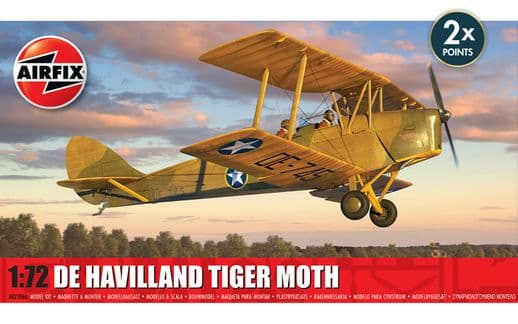
We appear to be welcoming classic kit releases to the current Airfix range with agreeable regularity at the moment, with this current edition serving to mark the latest release from our 1/72nd scale de Havilland Tiger Moth tooling. Joining the range in time for the busy wintertime modelling season, this new Tiger Moth kit includes two unusual scheme options, both used by international air arms, with one being just that little bit cheeky, if not rather rude, however fascinating nonetheless.
Following our usual new kit Workbench welcome format, we will be taking a short look at the development history of the Tiger Moth and how this amazing aeroplane is still doing the job for which it was originally designed over 93 years ago. We will see how this most famous training aeroplane was actually quite a groundbreaking design when it first took to the air back in 1931, and how this little biplane has been responsible for providing initial flight training support for tens of thousands of pilots over the years. We will also be covering the details behind the two scheme options included with this new kit, including the lead scheme which served as the inspiration behind the new box artwork which will no doubt encourage many of us to add the Tiger Moth to our winter build schedules.
This true titan of the aviation world is the latest subject of our weekly Workbench update blog.
A classic training aeroplane, the de Havilland Tiger Moth was a relatively forgiving aeroplane to fly, but a difficult one to fly well.
The 1930s proved to be a seismic period for British aviation, with aircraft evolving from the Great War biplane types which were still in service at that time, to the groundbreaking monoplane fighters which represented the very future of aviation. With young men of the period all aspiring to fly the most advanced aircraft of the day, types such as the Bristol Blenheim, Gloster Gladiator and Hawker Hurricane, they would all have something in common - if they were going to realise their dream, they were all likely to have to spend time in, and learn to tame the same aircraft, the de Havilland Tiger Moth.
Although they didn’t know it at the time, the rather benign appearance of the Tiger Moth served to mask the credentials of a true aviation classic, and aeroplane which really could be flown by anybody with average levels of dexterity and aptitude, but could also bring out the best in those who had aviation in their blood. As such, whether you were just an average pilot, or were destined to become a future flight leader, the Tiger Moth was an aircraft they were going to have to spend quite some time in the company of, and for both, this was the aircraft which was going to introduce you to the wonders of flight.
The Tiger Moth was one of the many aircraft designs to come from the brilliant aviation mind of Geoffrey de Havilland, a man who had been fascinated by aviation all his life and who had built his first aircraft in 1907, using money borrowed from a family member. Unfortunately, he subsequently crashed that first aeroplane during its maiden flight, but undeterred, immediately started work on a second, improved design, one which would become the foundation achievement of a successful career in aviation. He taught himself to fly in that second, much more successful aeroplane, and used it to secure an excellent position at what was to become the Royal Aircraft Factory. He even sold his aircraft to his new employers for the princely sum of £400, with the aircraft subsequently becoming the F.E.1, the first aircraft to be attributed a Royal Aircraft Factory designation.
Although he would later take up a position within the Royal Flying Corps during the Great War, this would only provide him with limited experience of being a squadron combat pilot, as his design expertise was simply too valuable to the War Ministry. He would therefore go on to oversee the design of several successful aircraft types which served during the conflict, aircraft such as the Airco DH4 and Airco DH9.
Following the end of the war, de Havilland would establish his own aviation company, taking many employees from the former Airco factory with him and embarked on the design and production of a series of light aircraft and sports utility aeroplanes, all of which would carry the name Moth. A keen lepidopterist, de Havilland gave many of these aircraft the ability to fold their wings back along the length of their fuselage for ease of storage, something he described as being ‘Like a moth’, with this series of aircraft becoming some of the most important of the inter-war years.
De Havilland’s intention with the Moth series was to produce aircraft which would have wide appeal across the world of aviation, possessing qualities which put them at the forefront of the industry when it came to effectiveness and usability. Central to his thinking was to produce a training aeroplane suitable for Royal Air Force use and whilst he thought his DH60 Moth was eminently suitable for this role, the Royal Air Force were less enthusiastic. Although the DH60 was loved by flying clubs up and down the country, the RAF felt that with the top wing being located over the forward cockpit, if an instructor or pilot had to get out of the aeroplane in an emergency, they might have difficulty doing so whilst wearing a parachute.
With its credentials as the consummate basic flight training aircraft, the Tiger Moth was of interest to a great many air arms around the world and for many years following the end of the Second World War.
Confident that his aircraft had all the attributes a successful pilot trainer needed, de Havilland set about modifying the design of the DH60, most significantly by moving the top wing forward to allow for better access for the instructor, also including small fold down doors on the port side of each cockpit section, to further aid access when crews were wearing parachutes. Clearly, this re-location altered the lift coefficient of the wing, however, de Havilland cleverly overcame this by sweeping the angle of the wings back, whilst at the same time increasing the dihedral of the lower wing. Adding a host of other improvements, the Moth was now ready for Royal Air Force service and this new Moth had just become a Tiger!
Interestingly, the wing ribs retained their original planform, so angling them backwards slightly meant that they now didn’t line up with the aircraft’s direction of forward flight, something which is quite unique in the world of aviation.
Construction of the aircraft was of relatively traditional design, with welded steel tubing being covered with fabric and the extensive use of wood throughout. Adopting traditional flight controls, the flight instrumentation was almost identical in both cockpits, however, only the rear cockpit had a mixture control lever for the 4 cylinder in-line inverted 130 hp Gypsy Major engine. To maintain the aircraft’s centre of gravity, if the aircraft was being flown by a single pilot, they would use the rear cockpit, hence the placement of the engine mixture controls.
Only the lower wings featured ailerons, whilst the top wings had leading edge slats, which were used during take-off and landing and also during aerobatic manoeuvres. The fixed landing gear featured a system of dampening to make even the most heavy-handed landing bearable for both student and instructor, and whilst the aircraft didn’t feature brakes, the tail skid effectively slowed the aircraft once it was on the ground. The engine was fed by a fuel tank positioned centrally on the top wing and above the front cockpit, with a heavy-duty panel on the cowling top allowing people to stand on it when refuelling the aircraft. The tank’s 18-gallon capacity gave the Tiger Moth a range of around 300 miles and the aircraft featured a protruding fuel gauge on top of the tank, the fill level of which was clearly visible from the front cockpit.
A hard working aeroplane, the de Havilland Tiger Moth was an essential aircraft in providing a constant stream of qualified pilots for the Royal Air Force and Fleet Air Arm.
The new de Havilland biplane took to the skies for the first time in October 1931 and whilst the aircraft’s designer was clearly confident in the capabilities of his aeroplane, he could never have envisaged that his DH.82 Tiger Moth would go on to become one of the most important aircraft of the 20th century and astonishingly, would still be performing the flying training role for which he intended it to be used over 90 years later.
Clearly impressing military officials, flight tests resulted in an immediate order from the Royal Air Force, who now viewed de Havilland’s biplane as an ideal primary trainer for pilots starting out on their flying careers. That relatively modest original order was followed up by several subsequent orders and as the world descended into conflict, the RAF could call upon the support of around 500 Tiger Moths on strength, with many additional aircraft owned by flying clubs all over the country also soon pressed into military service. With its growing reputation, the aircraft also secured many overseas orders, ensuring that the de Havilland production lines at Hatfield were fully committed to the production of this superb aircraft.
From the perspective of a student pilot, the Tiger Moth was a relatively stable and forgiving aircraft to fly, with few handling vices and generally supportive of the odd silly mistake committed by a novice airman. It has since been described as an ‘easy aeroplane to fly, but a difficult one to fly well’, which seemed to have made this the ideal aircraft to serve as a primary/basic trainer for large numbers of future pilots destined to fly many different military aircraft types operationally. The aircraft didn’t like operating in crosswinds greater than 10 knots, but from a serviceability perspective, it was generally a case of filling the aircraft with fuel and oil and she was ready to go again – the Tiger Moth just wanted to be in the air.
As Britain prepared for possible invasion during the early summer of 1940, there were even advanced plans for the mild-mannered Tiger Moth to show a much more aggressive side of its nature, supporting the Spitfire and Hurricane pilots of Fighter Command they had previously helped train by attacking any potential invasion force by all means at their disposal. ‘Operation Banquet’ called for the use of every available aircraft in the defence of Britain’s coastline, equipping even the most unlikely aircraft with bomb racks and giving them an offensive capability.
Should a German invasion have been attempted, there would have been the very real possibility of seeing swarms of bomb laden Tiger Moths raining fury down on the enemy troops below, as Britain planned to hurl everything at any such cross-channel incursion, in an attempt to ensure it had little chance of success. Thankfully, due in no small part to the contribution this effective ‘pilot maker’ made in training the heroic pilots of Fighter Command, Germany’s invasion plans for England were indefinitely postponed following the Luftwaffe’s inability to score a decisive aerial victory during the Battle of Britain, and the distinguished Tiger Moth didn’t have to sully its reputation by being forced into carry bombs.
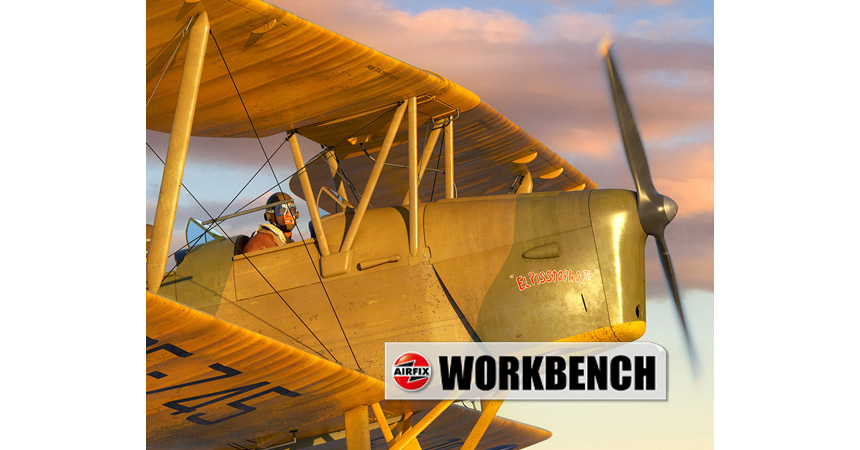
Our latest new box artwork exclusive, this latest work was inspired by the story behind the first of the two options included with this kit, one which benefits from the addition of some rather uncouth nose artwork.
It will come as absolutely no surprise to Airfix fans that an aircraft which possesses the rich aviation heritage the de Havilland Tiger Moth boasts, also holds a significant place in the history of the Airfix model kit range. Recognised as the aircraft which helped make Spitfire and Lancaster pilots alike during the war, and continued to provide initial pilot training support for many decades after, the Tiger moth originally attracted the attentions of Airfix designers back in 1957, marking this as being amongst the earliest aviation subjects in the range.
Moulded in its iconic yellow plastic, at least the first four release iterations of this kit appeared in the bag and header card/instructions configuration which was synonymous with those early kits, the kits which many older Workbench readers will remember so fondly as the items we spent all our pocket money on back in the day. Once assembled, the Tiger Moth was equally at home displayed next to a built Spitfire as it was a Lancaster, as this magnificent aircraft was probably the aircraft which both of these scale pilots learned to fly those respective machines.
A kit which served the Airfix range so spectacularly for many years, the de Havilland Tiger Moth in 1/72nd scale passed across the workstation of one of our Airfix designers once again in 2012, with this newly designed kit making its range debut the following year, continuing the modelling world’s fascination with this extraordinary little aeroplane. This traditional scale for an aircraft kit example of the Tiger Moth was joined by a larger 1/48th scale example in 2019, however, as we are talking about the latest release from the 1/72nd scale tooling, were going to limit our discussions to that kit in this review.
With the latest 1/72nd scale de Havilland Tiger Moth kit having arrived in the Airfix warehouse earlier this week, let’s take a closer look at the two new scheme options this new kit will be tempting modellers with over the coming few months.
As one of the world’s foremost training aeroplanes, the de Havilland Tiger Moth was clearly of interest to a great many operators both military and civilian, with aircraft seeing service across the globe. Despite having their own highly capable training aircraft, the USAAF placed an order for around 200 Tiger Moths from se Havilland Canada as part of the lend-lease arrangement, however, these aircraft were never actually delivered and were instead diverted to the Royal Canadian Air Force and their own active pilot training programme.
That may well have been the end of the matter, had it not been for the eleven or twelve aircraft loaned to the USAAF in England from 1943 onwards (there is some conjecture about the actual number of aircraft delivered to the Americans). Many American volunteer pilots joining the Royal Air Force at the start of the Second World War would have spent time at the controls of Tiger Moths prior to moving on to RAF fighter Squadrons and their Spitfires and Hurricanes, with the type also being evaluated by the Americans prior to their order for 200 aircraft being placed.
The aircraft which were eventually allocated to 8th Air Force Command Fighter Groups in the UK during 1943 were to perform a variety of tasks, but officially to be used as liaison, light communications hacks across several operational stations in England. The aircraft were well liked, and it was something particularly prized by American pilots to get time in one of the few Tiger Moths to sport American markings. The aircraft were delivered in standard RAF camouflage upper surfaces, with yellow undersides, initially retaining their RAF roundels. These were simply modified by the Americans to display their white star on blue background, whilst retaining the yellow outer circle.
Full scheme details for this rather unusual USAAF operated wartime Tiger Moth.
One of the aircraft assigned to the Americans in 1943, the Tiger Moth presented in this scheme was given the serial DE-745 and flown by the 353rd Fighter Group during the summer of 1943. At that time, the Group were flying the mighty Republic P-47 Thunderbolt, so the arrival of the diminutive little Tiger Moth biplane must have been quite the occasion. The unit moved on to Station 366 Metfield in Suffolk, which is probably where this aircraft received its name ‘Dorothy’, which was painted on the port side of the aircraft’s fuselage, between the aircraft’s two cockpits.
During her time in American markings, the aircraft was involved in several mishaps, which is perhaps understandable, as the Thunderbolt US pilots were more used to flying could hardly have been more different. Metfield was described as perhaps the most isolated of all the USAAF stations in Britain, which makes this particular story relating to Dorothy the Tiger Moth all the more relatable.
This scheme option proved irresistible when it came to the decision of selecting the inspiration behind the new kit’s box artwork.
Whilst attempting a take-off in the aircraft during a stiff crosswind, Dorothy apparently clipped a small hedge on the boundary of the airfield and flipped over into an adjoining field. Thankfully, both pilot and passenger survived the incident unscathed, but their Tiger Moth was lying ungraciously upside down on her top wing, with the crew looking rather sheepish. Several photographs documenting the incident are in existence, with one showing one of the airmen with a rather Laurel and Hardy type ‘That’s another fine mess’ look on his face.
The aircraft was repaired and returned to service, and it was reported that following this ‘flipping’ incident, she inherited more unique nose artwork, this one being much less appropriate, bordering on the risqué. Possibly in reference to the mishap above, or simply because the Americans seemed to be a little accident prone when it came to the operation this particular Tiger Moth, the starboard side cowling was adorned with the wording "El Pisstopho Jr." in the same style as the name ‘Dorothy’ carried on the port side, but probably the least said about this the better.
The aircraft was eventually returned to the Royal Air Force in 1945 and subsequently sold on in September the following year, however this story and indeed the markings of this particular aircraft has been recognised with an impressive recent restoration project, something which also marks the continuing exploits of the Tiger Moth on the world’s Airshow circuit. Under the guidance of famous warbird pilot and aircraft restorer/painter Clive Denney, a Tiger Moth wearing these rare WWII USAAF markings was rolled out of the Vintage Fabrics Audley End hangar in June 2022, to take its place as one of the more interesting aircraft on the UK Airshow circuit.
A major operator and indeed manufacturer of the Tiger Moth, Australia originally received around 20 aircraft in kit form, which were initially intended to satisfy a South African Air Force requirement, but were subsequently redirected to Australia. These aircraft were assembled by de Havilland Australia, acting as forerunners of a manufacturing operation which would eventually see just under 1,100 Tiger Moths constructed in the country.
With the establishment of the Royal Australian Navy Fleet Air Arm in 1947, they were allocated the former RAAF airfield at Nowra, to the south of Sydney, with the airfield subsequently undergoing a significant period of renovation and upgrade. The airfield was commissioned as HMAS Albatross on 31st August 1948, but was also sometimes referred to as RANAS Nowra.
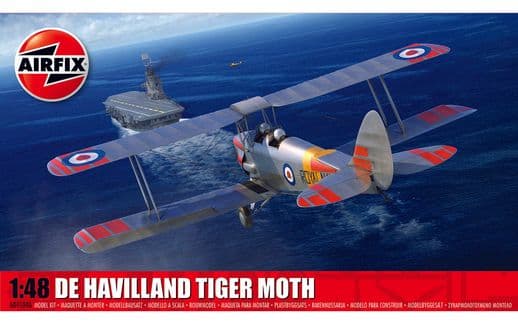
The following year saw the arrival of Hawker Sea Furies and Fairey Fireflies and a significant period of recruitment for what was to become an exciting time for anyone associated with Australian naval flying. Quite a number of Australian aircraft held in storage were also allocated to the new station, but a pressing need to provide training, refresher and communications support for the fledgling force soon saw a trio of former RAAF de Havilland Tiger Moths being allocated to the RAN at Nowra, the third of which was aircraft A17-692.
Full scheme details for this Australian Tiger Moth which possesses an incredibly rich and impressive history.
Once at Nowra, the Tiger Moths were kept incredibly busy for around the next decade or so, and when not providing support for a multitude of flight operations, could also be required to provide engineers and ground handlers with active service aircraft with which to perfect their respective crafts. Once these aircraft were deemed surplus to RAN requirements, the aircraft were sold to the Tamworth Aero Club, where they continued to be used to train new pilots and provide flight experience opportunities to club members.
The scheme option covered here was one of the original 20 Tiger Moths to arrive in Australia, built for South Africa, but released for use by the Royal Australian Air Force, where she was allocated the serial A17-692. During WWII, the aircraft served with No.5 Elementary Flying Training School at Narromine and No.10 EFTS at Temora. The aircraft continued in a basic flying training role until placed in storage during 1953, but early the following year, was one of the three original Tiger Moths allocated to the Royal Australian Navy at HMAS Albatross at Nowra.
Sold to the Tamworth Aero Club, she carried the civilian registration VH-TWA from September 1958 onwards, passing through several private owners until she was acquired by the RAAF Museum. It’s thought that this hard-working Tiger Moth is maintained in airworthy condition, although she currently wears the scheme she wore during her time operating with the RAAF, as opposed to the later RAN Fleet Air Arm scheme she wears in this second kit scheme option.
Full box layout presentation for this latest addition to the 2024 Airfix kit range.
The de Havilland Tiger Moth is unquestionably one of the most important aircraft of the 20th Century, and one which is still a common sight in world skies to this day. Incredibly, these magnificent aircraft are still providing the same flying training support they did during the 1930s as the world war preparing for war and for those people hoping to eventually go on to fly restored Warbirds, will still find themselves spending many a happy hour at the controls of this classic aeroplane.
We are afraid that's all we have for you in this latest edition, but we will be back next Friday with more project development updates and the very latest Airfix kit exclusives. In the meantime, we are always keen to hear your views on all things Airfix and in particular, any thoughts and opinions you may have regarding our Workbench blog. If you would like to drop us a quick line, could we please ask that you use our workbench@airfix.com email for all correspondence.
To re-visit any of the Airfix blogs we have produced over the past seven years or so, please head to our main Workbench hub, where you will find our entire blog back catalogue and all the Airfix design projects we have already covered.
All our dedicated official social media sites can be accessed by clicking the respective link icons at the foot of this page, or by heading to the Airfix homepage. Other useful Airfix links are:
Facebook, YouTube, Twitter and Instagram official sites
Please join us for more Airfix updates next week and thank you for your continued support.